I used to use Dokku but I personally liked the GUI from Coolify so I've been using that. Nice to see that you have a GUI as well, makes configuring apps a lot easier.
(Bridged to Matrix: https://matrix.to/#/#lunni:matrix.org)
Lunni is actually pretty young in terms of community (just me and a few friends now :-), so just a room in Telegram was sufficient so far, but I think it's a good time to start something more official.
https://lunni.dev/docs/deploy/from-git/#github vs https://docs.coollabs.io/coolify/sources
By GitHub app I meant that Coolify makes you install its own custom GitHub app that then allows you to git push to deploy.
Is the actual "production" workflow still pasting a Docker Compose file in? I would much rather have an automated deployment process that doesn't require human input, that way it can be scripted as part of CI/CD, etc.
Personally, I fell in love with `git push production` (naming a git remote `production`) to trigger a deploy. Ironically I didn't like this back when I first tried Heroku, but it's grown on me since. As of now, I have a custom git receive hook on my server (building a NAS from "scratch" using IaC on my home server) that triggers a redeployment using Docker Compose.
Also, you mention Swarm... what does Lunni bring with Swarm as opposed to simple Docker Compose? Does it distribute across multiple systems?
Unlike Kubernetes or Nomad though, it uses mostly the same concepts Docker Compose does, to the point that your development docker-compose.yml file will likely just work there (with some minimal tweaks). I love this website that talks more about it: https://dockerswarm.rocks/
> I would much rather have an automated deployment process that doesn't require human input, that way it can be scripted as part of CI/CD, etc.
This is almost doable with Lunni. This guide will walk through setting up a CI for a typical webapp that packages it in a Docker image and pushes to a registry: https://lunni.dev/docs/deploy/from-git/ (currently for GitLab CI + Registry, and GitHub Actions + GHCR only)
As for the continuous delivery, we're gonna have a webhook that you can call when your CI pipeline is finished. It's not exposed in the UI yet but I'll try to prioritize it (now that I remember I wanted to do it :')
`git push production` feels a bit easier, but I'm a bit concerned about bloat: for this to work, we'll have to bundle some sort of CI and container registry with Lunni. I think sticking with third-party CI is a more elegant approach here.
    docker buildx build --push ...
    curl -X POST https://lunni.example.com/api/webhooks/c8aaa9b8-1bda-4a99-820c-36a75d31f8a7
Have you in all honesty and with first hand experience, deployed and supported in prod on swarm over hundreds of servers?
I know that it is possible to outgrow Swarm – I think that's a nice problem to have actually. We might include some tools for “graduating” from Lunni to something more serious like Kubernetes at some point.
Re: business model: both Coolify and Dokku are open source, so even if their development stops, you can continue to use them no matter what. (You do have to pay for your own servers though :-) So it's not a PaaS in the traditional sense (like Fly.io or Heroku), but more like “build your own PaaS” thing.
For proxying requests, Dokku currently supports:
    - nginx on the host (default)
    - traefik (via docker labels)
    - caddy (via docker labels)
    - haproxy (via docker labels)
I can't say anything else about Coolify since I haven't used it in a while, but I'd be curious as to what other parts are more modern about Coolify than Dokku.
About the modern part: that was my opinion based on the way I recall Dokku and Coolify, and a quick scroll through the docs of both, so I might be really wrong here! I definitely need to check out both Dokku and Coolify again sometime.
One of the main features of Dokku is it's extensibility. You can cut one part out and replace it with another quite easily, and proxying is an example of that. I think that flexibility allows folks to use it in more situations than one otherwise would, though at the cost of being more difficult to maintain (and harder to have cohesion between parts of the system at times).
I don't really have a business model. I do take donations from Open Collective (and Github Sponsors, which funnels to OC) and there is Dokku Pro, but those don't collect anywhere near the funds I'd need to stop my dayjob (at least now. Maybe someday?).
My business model is that code releasing is something I'm pretty passionate about. Dokku isn't even originally my project (Jeff Lindsay started it, I just took it over), but I've been working on it for almost a decade. It's open source and fairly simple, so even if something happened to me, others could theoretically continue the project on as desired (or build on top of it if need be).
I'd be interested in hearing any of your other concerns though :)
I checked the repo and yeah, it checks out, Dokku _is_ pretty manageable with a decently small codebase. Having a low bus factor is really important for me. I'll check it out soon, and hopefully leave a donation to help you keep the project going too :)
I use caddy as the proxy, since I found the traefik configuration absolutely incomprehensible. Now I use only 2 labels to proxy instead of 15.
Portainer is also cool – we're using it internally as an API, actually! I've been using it before starting Lunni and my only objection is the UI. Portainer is kinda like a Swiss army knife for containers, but with this power comes the complexity, too.
For example, to see service logs, you have to pick an environment, then go to Stacks, find your stack, find the service you need, open it and then you'll see the service logs button. In Lunni, you open your stack right from the dashboard and click logs button right beside your service name: https://u.ale.sh/lunni-screenshot-logs-button.png
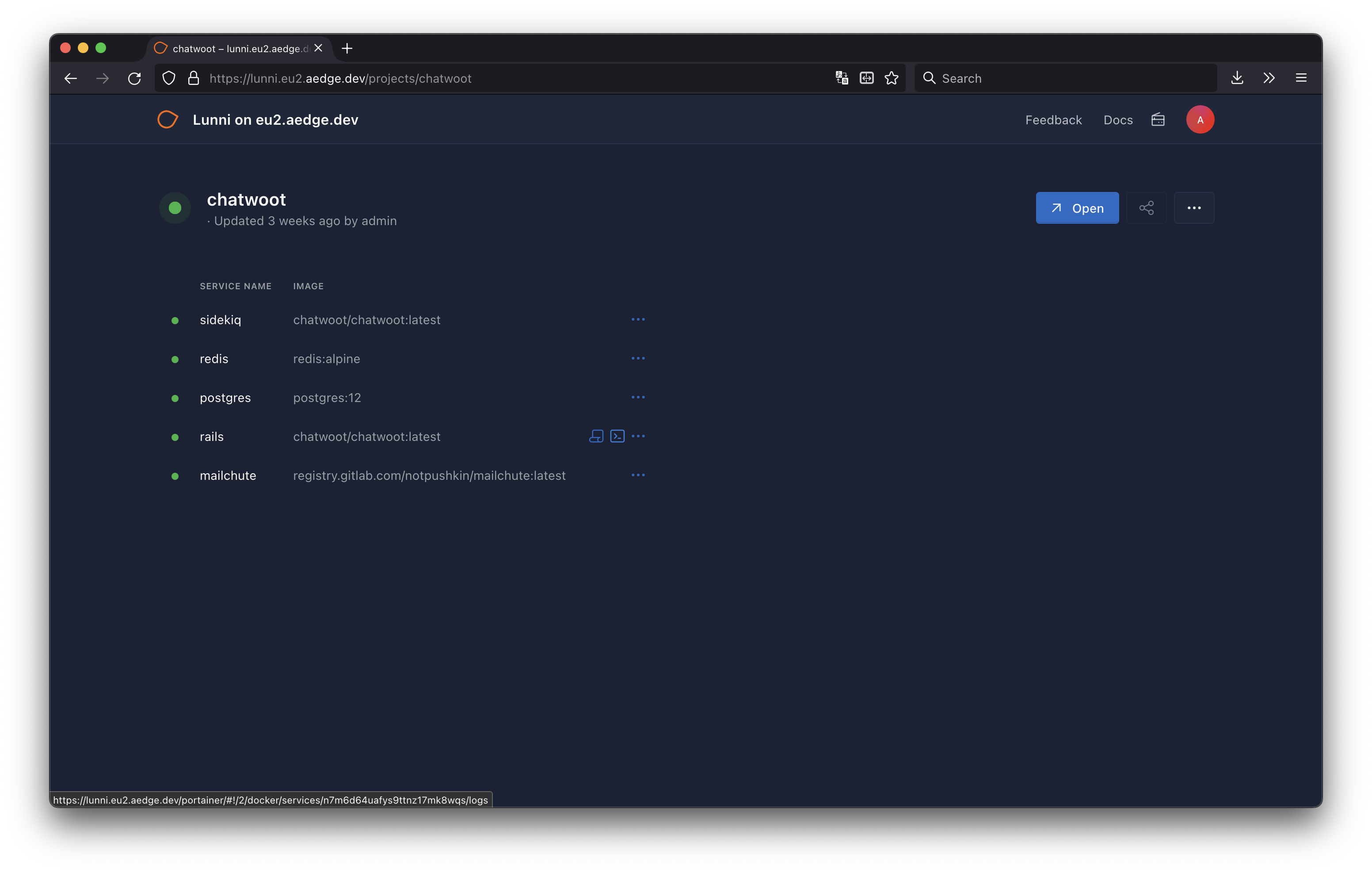
And may I also plug Lunni, a self-hosted Docker Swarm-based PaaS I'm working on right now: https://lunni.dev/
Both work pretty well on $5 servers.