Part of this is from living in a cities and in mixed zoning areas rather than neighborhoods but it just seems to odd that to get ANYWHERE one needs to drive. Even living in a city, but just a bit further away from a major area, you can run into this issue.
Wife and I have looked at the Netherlands as well for similar reasons. Jobs/visas are the main concern. Family is the other big one.
Another hot take - Being in the middle of a city doesn't make one more social. Actually it can be more lonely ironically. You are surrounded by strangers.
In my current suburb I am good friend with all of my neighbors. We share vegetables from our gardens, have block parties, let children play together, it's extremely social.
5? Depends where you live of course, I have 100+ within 20 min walk, easily!
> Being in the middle of a city doesn't make one more social. Actually it can be more lonely ironically. You are surrounded by strangers.
Depends. If you go to the same coffee shop every day, you certainly start meeting people.. or sit on a coffee shop for a while on the street, on a park..
My wife and I stayed in a suburb for 3 months while we were caretaking and working remotely.
I couldn’t step out my door and go out on a run, the nearest coffee shop was a 15 minute drive away, and no restaurants were open past 9 and often closed on weird days.
It felt like the only way to be comfortable in the suburb was to own more things and build your own castle.
We returned back to Chicago and immediately bought to secure our preferred urban lifestyle for the long term.
Even thought in Chicago MOST of the time we go to the same handful of restaurants, its the option to have a near countless amount that we COULD go to that keeps us from feeling like were going to the same few places.
I personally feel like it overvalues commercial activity (restaurants, retail, grocery, entertainment). Obviously, it depends on how often you want to partake in said commercial activities as far as how you would value it.
I would love if the conception of walkability could also take into account:
'How far can I walk without having to worry about cars/crossing streets/waiting for lights?'
'How safe/comfortable is the walk? Will I be walking by people who will harass me/be high on drugs/try to sell me something?'
'How easy is it to string together a run without having to stop?'
'How busy are the sidewalks? Will I have to be dodging people on their phones all the time?'
'Is it easy to take a dog for a walk? Or are there limited green spaces?'
'Are there social/interest groups nearby that meet up?'
I find some of these types of factors much more important than closeness to X number of commercial venues. So a busy downtown street may get a high walkability score (i.e. Walk Score) because of the restuarants/retail/theaters, but it might be atrocious to my conception of walkability.
The strip in Las Vegas is not far behind. While people didn't tend to bump me, there was a never endings series of people trying to get me to buy their prostitutes for the night.
I'd happily take a less nice walk than being forced to drive.
In my case you'd be off by at least an order of magnitude. You like variety, eh? I mean.. I can get any kind of cuisine at all that can be found in a big city... Not sure what suburbia has to offer on top of that. I mean, you do you. Just saying your argument could maybe use an accuracy adjustment.
Whether I walk to the grocery store or not isn't super relevant.
Probably going off on a tangent here, but I grew up surrounded by hundreds of acres of farmland and woods to get lost in the minute I walked out the door, which I still escape to as much as I can, whether it's family owned rural property or state parks/mountains. Working in tech early in my career made that escape harder to get to, but I wouldn't trade rural life for any amount of restaurants, social gatherings, or whatever else within walking distance.
We also have block parties, lol.
These also are the highest cost of living places in the world to live. It's not practical to think everyone could live like that. They also are miserable with homeless people, drug addicts, and crime. It also relies on a huge network of people commuting to those jobs to support that area.
You can't have 30 restaurants within a few square miles with all the people to support that living there in homes. You'd need a combination of super dense housing and people commuting. It's really inefficient.
What aspect of urban development caused these people to be homeless, drug-addicted, or criminal? Did the frequency of bus service get them addicted to drugs? Did the taller building height take their job?
We make this unconscious logical leap that there's some justification for human misery to be concentrated in urban cores. I live in a dense urban core right now, and I see human misery when I go outside. I think "boy, it'd be nice to move to an area where this miserable person isn't". But... it'd be ridiculous to be happy by pretending misery doesn't exist because it's not in eyeshot. If that were the case, we should just ship miserable people to the suburbs where I don't have to see them (that would be cheaper and more convenient for me!). The wealth density of an urban neighborhood is huge, there's easily enough money to relocate miserable people into even rich suburbs.
The better thing to do is to make choices that cause there to be fewer miserable people. I'm optimistic that the current debate around the urban-suburban-rural divide and the role of cars will make us recognize that there's huge mutual interest in the idea that _public spaces should be nice_, and that seeing the misery that results from our policy choices is a feature and not a bug.
that would be a low number for a middling town in the pre-car era.
I have 56 eateries (restaurants, cafés and bistros) in a 500m radius, and also 36 bakeries, butchers and supermarkets all of which offer warm, ready-to-eat meals. Am I a weird outlier?
I don't think I'd be more likely to make friends with my neighbors if I moved to the burbs. This seems to be driven more by personality and need than location, right?
Not only a walkable city will provide you with some 50 restaurants at 10-15 minutes by feet, but what is more important is having groceries and other household shops at 5 minutes.
> In my current suburb I am good friend with all of my neighbors. We share vegetables from our gardens, have block parties, let children play together, it's extremely social.
All of this often happens in walkable cities as well.
Source: Last 20 years I lived in cities with population from 5M to 15M and I always had at least 10 restaurants at walking distance and I used public transport and cars to go to places way beyond the walking distance.
I did this. I have 100 restaurants, too many bars to count, music and theatre (three!) and festivals and arts within trivial distances. No car needed.
If you enjoy biking to establishments, it's worth it to actively think about dirt roads and rail trails in your search -- dirt roads cut car speeds to safe levels, and rail trails let you avoid cars almost entirely. Both make biking miles better.
It's also almost evenly centered between NYC and Boston if you want to do weekend city adventures. You'll probably still need a car but if you live in the center of town you won't use it except for longer trips.
That is how I became aware of western Mass, actually. FWIW education is a major driver for us since we have 3 young kids. My thinking waffles a bit because there's a list of criteria in my head, like being walkable, bikeable, having a downtown area, in addition to the more major concerns we have as a family around education, local economy, and affordability. I appreciate the reply!
Maybe. Two examples I've lived in or around are Chambersburg, Pennsylvania and Hattiesburg, Mississippi, with populations around 50k. Chambersburg is probably little bit more walkable because it's a little more dense, but neither are (in my opinion) comfortable for walking or biking outside of specific areas, and those specific areas don't have everything you need.
Unfortunately, there are relatively few places to live inside the dense part of town. The city is overly-zealous about maintaining historic districts and you'd better believe people get all up in arms about "changing the character of the neighborhood" every time a new development is proposed, even in non-historic and totally dilapidated areas. I've seen literally hundreds of millions of dollars worth of new housing and commercial projects be cancelled or indefinitely postponed due to this attitude just in the last 10 years.
While the city has a lot of potential, it's population has stagnated since the 1970s and the surrounding area has become a massive suburban sprawl. Many of the buildings downtown have been replaced with parking lots. Traffic is generally terrible, and the bus system has low coverage and poor frequencies.
Around 100 years ago, Portland was a thriving metropolis with electric trolleys going to every imaginable destination. All of those trolleys are gone now and their tracks have either been removed or awkwardly paved over.
Portland was once a vibrant inter-city train hub with hourly connections to the rest of Maine. The two primary stations, Union Station, and Grand Trunk Terminal, have been torn down. The current train hub, "Portland Transportation Center" is much further from the city center to make room for a large parking lot. It is about a 40 minute walk from what is considered the downtown area. 20 minutes by bus if your schedule happens to line up.
It's pretty disappointing how much better it once was. I'm doubtful that it will ever be as good as it was back then, but still hopeful. There are plans to move the train station back to where Union Station was. New routes to Lewiston and Rockland have been studied (although would apparently cost hundreds of millions to repair the tracks). The state has recently subsidized certain interstate train and bus routes to make them very affordable. And generally I think a lot of problems could be immediately solved by straightening out bus routes and increasing frequency, as well as obviously removing a lot of building-size restrictions and parking minimums.
What area were you referring to?
This is especially true in north America where cities all went through a huge conglomeration effort in the second half of the 20th century and absorbed their suburbs.
The best walkable suburbs I've visited, Montclair and Red Bank in NJ and Ardmore, PA seem pretty sad, small, and boring in comparison. Fine for a visit, but I wouldn't wan to spend three days in a row there.
There's nothing wrong with small and boring, the major issue is that generally the overwhelming majority of US housing stock and zoning laws are geared towards picket-fence suburbia, to the detriment of people who don't necessarily want that. Plenty of people certainly want that, but it's probably not anywhere near like 90% of people in the US.
I grew up in a dense city outside the US, and even as a not-particularly-social child, I still had plenty of friends I played with and hung out with, and also had tons of interaction with adults. Meanwhile I’ve seen my cousins grow up in suburbs over the past 10 years, and they interact with maybe 3 non-family members outside of school, because everything is like a 15 minute walk away through winding suburb streets. That kind of isolation is not healthy at all.
That's because if you want an individual home, you're giving up the customer density required to make those amenities viable. In a world with the internet, at-home delivery, and yes, cars, it's simply not economically viable to create a grocery store that only caters to 100ish families.
It’s just that these small groceries cannot outcompete supermarkets once people are in the habit of going everywhere by car.
This is true to a limited extent. If small grocers and bakeries were allowed to setup in mixed use areas they would do a whole lot better. However sticking them an average of 3 miles from their customers in a horrible strip mall kills them.
I would happily pay a premium for having a grocer just down the street instead of having to go 4+ miles to a supermarket. Being able to get a gallon of milk and some onions in 10-15 minutes from a place just down the street will always beat driving to, parking at, and walking around a 10 acre supermarket on a 50 acre parking lot. Just the stress of dodging all the parking lot speedsters is more than enough to keep me far from that place.
That's the crux of the problem in the US. Vast swaths of land are dedicated to single-family homes (and ONLY single-family homes). You literally couldn't build a small grocery next to these homes if you wanted. And the hurdles to getting a zoning change as so high that developers just build strip malls on the outskirts of town/subdivision.
We're beginning to see some progress in the DC suburbs, with more mixed-use "village centers" being built in the 'burbs. My main complaint with these is the development is done in one pass by a giant corporate developer, leaving the area feeling very sterile (compared to an old urban downtown in a small city, which might not be as clean, but has a more organic mix of businesses). IMO, of course.
So yes, it's not that you can't have single families, and it's not really about people having cars or not, it's the density, and therefore, it's the lawns and the streets that are too wide, making the number of places that you can go to in a 15 minute walk far smaller
> it's simply not economically viable
You replied:
> t’s just that these small groceries cannot outcompete supermarkets
So you are confirming what he said.
And with Covid restrictions and work-from-home, deliveries and online ordering were cemented as normal behavior.
Uh, somebody has to deliver those orders. And in the US, that's by car (van). You might make single-car households more viable with pervasive online ordering/delivery, but you don't necessarily change the core character of the neighborhood that way.
And there's always services who will pick up bread from such locations and deliver it. With or without the bakery's backing.
This mix is really rare in North America, at least and especially north of Mexico, but it does exist.
Neither of which sounds very nice to me. I don't have a huge yard, but I do have enough yard to raise a few trees and firepit. If I lost that, I might as well be in an apartment.
And that still wouldn't provide enough density to support a variety of restaurants and grocery stores (not to mention things like employment for non-techies).
Take my neighborhood (south Reston, VA). The main road is about 2.5 miles long. There is a strip mall at both ends, leaving homes in the midde just outside easy walking distance (from my house, by footpath, it's nearly 2 miles to one end and a bit over 1.25 to the other). There is a major intersection about halfway down that main road. Instead of allowing a small shopping area, it's more houses. Hard to change now, but if it had been zoned mixed-use/light commercial at build time, there could be a coffee shop and small grocer there. And bring between 1/3 and 1/2 of the available customers in the area within walking distance of at least some of their regular errands.
Additional benefit of this would be reducing the size of the malls at each end, mostly by removing parking spaces, freeing that space for townhouse, apartments, or more shops.
Take my office... it's 1.25 miles away, and I walk. But, the complex is all offices. If there were a grocer there or on the way, I could eliminate my 1x weekly carload, instead grabbing things as-needed on my walk home.
Same office. I have coworkers who live closer than me, but refuse to try walking because the sidewalks and street crossings from their direction are less user-friendly. Crossing on/off ramps without signals. Crossing a 4 lane highway with 50mph traffic. Etc. Some simple crosswalk modifications could make the office complex walkable to some of these coworkers. But, traffic planners don't even appear to think of these things when building roads - it's almost 100% car-focused.
With the number of signaled intersections, I can't drive it any faster than the bike. But definitely faster than walking most of the time (though walking is a guaranteed time - driving that distance has taken 20+ minutes before because of traffic jams).
Basically, if it takes the same or less time than driving, I try to walk or cycle. Sometimes I walk the ~2 miles to CVS or Starbucks, but that's as much recreation as transport - I can drive it in 5 min. Nice to have the option, but if they were closer to 1 mile, I'd always walk.
It's not far from reality. But mostly because so much of the US lacks sidewalks, so driving is the safest way to get A-to-B.
When getting anywhere useful requires navigating places like this [1], using the car for everything quickly becomes the default.
1 - https://assets.bwbx.io/images/users/iqjWHBFdfxIU/ijhV2hgcKaq...
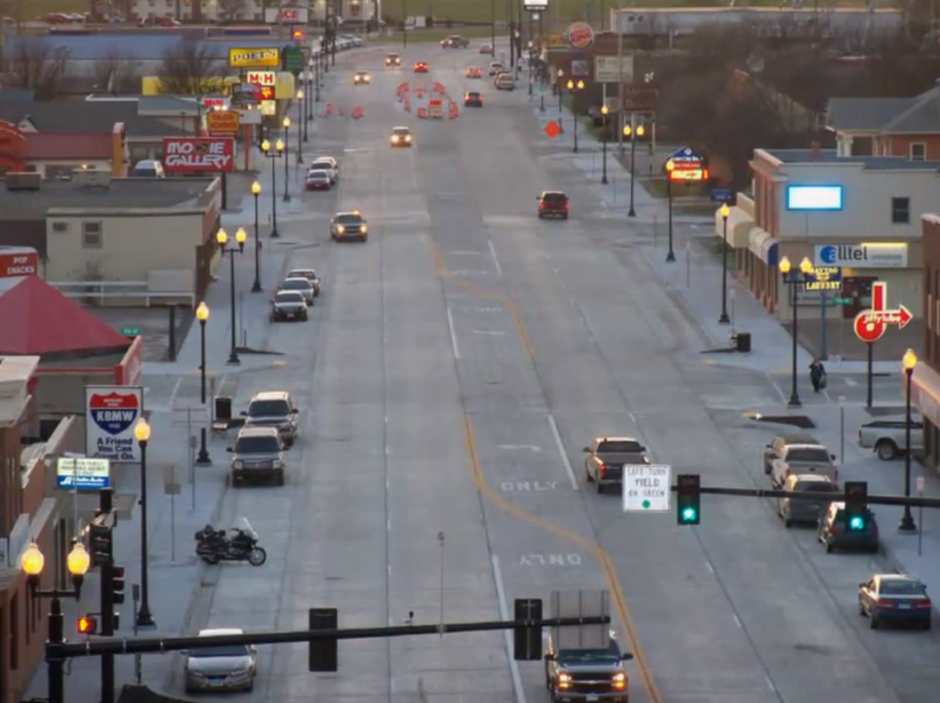
Edit - yes, that photo has sidewalks, but there are so many intersections and road crossing, it's not a pleasant place to walk. Many places don't have sidewalks at all, or have some, but they're disconnected from each other block-to-block. Or you have to walk across a massive parking lot to get to the shops. Much of suburban US really is quite dystopian in this regard.
If this link works [2], it's the intersection to enter th nearest shopping center to my house. Note the lack of sidewalk on at least 2 corners. Crosswalk only on one side (if you live on the close left corner, there's no way to safely walk across the street in either direction). Lack of bike lans on the crossing street (the street has some, but they inexplicably end JUST before the shopping center). And even if you do manage to walk/ride into the shops, you have to dodge cars trying to park before you get to the actual shops. I wish this was unique, but it's extremely common in the suburbs.
2 - https://www.google.com/maps/@38.93839,-77.3287099,3a,75y,293...

But here's the thing: all those big spaced out houses with big yards leave less room for trees and parks that make everyone happy. Suburban spaces also tend to be bereft of trees overall because no one can stand to have their lawn 2m shorter so the street can have a boulevard.
Apartments suck, a lot, in the US.
  * Noise; aren't built to sufficient privacy levels.
  * Smell; laundry, cooking, or whatever...
  * not designed to scrub, filter, and direct exhaust.
  * Patios == smoke or grill; even though those are banned by policy.
  * Somehow cost more than renting elsewhere
  * Rent seeking causes negative patterns
  * Car parking hell
Yes these problems also exist when you rent in single family home (intended, often not fulfilled) suburbia, but they're less due to the lower density.
I think a future with comfortable, large, isolated apartments is possible, and even such "fancy" apartments are going to be cheaper than full houses, if there are enough of them.
    * Noise is an easily solvable problem, with insulation.
    * Proper ducts and exhausts can handle smells/smoke.
    * high rents means there is a demand but not enough supply.
    * car parking can be in basement, easily accessible.
   * easy to secure/gate.
   * grocery, pharmacy,...  are < 5 min walk.
   * a large pool, 2 hectare park inside the society.
   * multiple badminton, tennis, basketball courts inside the society.
* above all allow my 7 year old to go for lot of activities on his own or with friends.Suburban parts of cities often aren't zoned for high density housing because the NIMBYs don't want them near their detached homes. When everyone sees a house as an investment there's no incentive for them to increase housing in their city.
How can you possibly believe such a thing? That is just an outright foolish assertion. The labor cost to build something to code is the same regardless of the quality of materials. Builders skimp on materials to pad their margins. Even if they used cheaper unlicensed labor there's no impetus to use more expensive materials.
They were not noise, in fact in one I only ever heard my neighbors one time in three years of living there, they were typically pretty spacious, rent didnt fluctuate that greatly, I didnt need/have a car most of the time but there was lots of street parking, and I don't have a great sense of smell but oders were never an issue.
Nice apartments exist. You just pay about the same as you would for them as you would on a mortgage.
If they're not finding it, it's probably because they're looking for a low density housing option.
Every passing year is another one in which old buildings are redeveloped and the US population grows, increasing market pressure.
—-
There’s a separate issue with new modern mixed use in the US where retail tends to have low occupancy. Partially this is because there continues to be a massive glut of retail space in the US, and partly because the new spaces tend to be too large to be profitable for anything other than chain stores, and there are only so many chain stores to go around.
NIMBYs in this city bemoaned old Amoeba records loosing its "historic" low rise commercial building. But Amoeba just moved into one of these mixed used developments a few blocks away closer to the metro station, got more square footage out of the deal, and sold the old property for a lot of money. The city changes and it isn't a bad thing, in fact its typically a good thing that it changes as this keeps rents closer to the actual wages seen.
That said, I like having my own house with my own land. That house and land is freedom to live how I want (within reason) without worrying if the neighbors will complain about my watching The Mandalorian at 1am. A car is freedom to go wherever I want whenever I want, and I use said freedoms on a regular basis. It's also carrying capacity, instead of making multiple inefficient trips to a local market multiple times a week I can get all my family's groceries in one trip once a week. Ditto for outdoor supplies, small furniture, Christmas Trees, etc. Never mind that WFH doesn't work for a lot of jobs, and not just low-paying ones. Many good jobs require a car to get to them.
So I think there's a good middle ground here. Make city centers less car friendly and denser to discourage car use, improve walking infrastructure in the suburbs (more sidewalks/bike trails that actually go places).
I'm all for a wide range of options, but cars are not a universal evil. The frog is not being boiled, this is what a lot of us see as a better life. Granted there are plenty of people doing it wrong, but that's always been true.
> Make city centers less car friendly and denser to discourage car use, improve walking infrastructure in the suburbs (more sidewalks/bike trails).
To put it a bit more concretely: Remove street parking in cities. Expand sidewalks. Build more public transit and bike infrastructure. Create light rail with parking lots outside of cities so you can get in without a car. Let people use cars as before in rural middle-of-nowhere america, and mostly the same in the suburbs (lower speed limits and build more sidewalks and connecting paths, so you can walk between neighborhoods).
This is pretty weird to me.
Whenever I've had exposure to a household like that, what actually happens is they buy way too much food to keep track of it, and either you eat too much or it mostly goes bad in the fridge. I find this oddly stressful, too, the feeling of wasting food or needing to use it before it goes bad.
Whereas I like to plan a day at a time and be close enough to markets that I could potentially visit every day and it's part of the daily routine.
Bonus if it has a self-scanner like this one to further speed things up, though unfortunately we don’t have any like that near me: https://youtu.be/kYHTzqHIngk
I'm not necessarily talking about just corner stores either. I have several full on supermarkets in walking distance.
Then of course as most would live in this mode, those who want large lots or lots of land would move further away.
> It's also carrying capacity, instead of making multiple inefficient trips to a local market multiple times a week I can get all my family's groceries in one trip once a week. Ditto for outdoor supplies, small furniture, Christmas Trees, etc
Is it really inefficient if it's a 10 minute walk away, or on your way home from your job? I think you'd really have to sit down on that and look at the whole context.
For oddball trips like a Christmas tree you have options including delivery, but what most people would suggest is that sure you still have a car for those trips (maybe one per family instead of two) but for most activities you don't have to drive. We get stuck on edge case scenarios so much that we over-optimize for them. It's like EVs. Many are like "but what if I go on a road trip", well how often do you go on a road trip? Once/year? Weekly? If it's once/year, well, figure it out.
-edit-
For example, most I'd argue are envisioning something more akin to German Village in Columbus: https://en.wikipedia.org/wiki/German_Village
Here you can see cars of course, but you can also see that many homes do in fact have deep lots which can be customized with grass, pavers, whatever you'd like. Of course not all homes have those (depends on socioeconomic capabilities) but you are also 5 minutes from a gigantic park with lots of green space.
In German Village you have cars, many homes have off-street parking, lots of pedestrian traffic, lots of bike traffic, tons of locally owned businesses and restaurants, and community events. I think people want more of this and wonder why we can't build like this anymore. Personally I think it's because developers, the government, and automakers are all heavily incentivized against it (not necessarily out of malice). Unsurprisingly, locations that are walkable like this have the highest property values despite often having crappy schools. If they had really good k-12 schools the property values would be immense.
First of all, it probably won’t. But more importantly, even if it does, 20% or more of your remaining healthy lifespan will elapse while it’s happening.
Don’t wait. Carpe deambulatio.
And broadly speaking, while that may be good for the individual I don't think it's good for society. We need some people fighting for walkable cities where they are, else we'll never get any more of them. And the highway widenings continue unabated...
Usually it takes something bad happening.
I also don't think a lot of the changes people want will be coming to US cities as quickly as they hope. I've worked in the architecture/urban planning world and despite the people doing that work knowing what's best for a city, it's the engineers, politicians, and people with money that end up making the decisions unless there is some very vocal asks. There's also a ton of red tape that stands in the way, especially in CA, of anything being built in a timely, cost-efficient manner.
One can hope though. Small stabs at progress are being made.
I agree, and not really sure why there are so many posts on this topic on HN - there are plenty of places to move and live if you want to be someplace where you can walk to or bike to.
There are also plenty of places where you can move to, buy a bit of land with a SFH and enjoy that lifestyle if that is what you prefer.
Why do some people have such a strong need to tell other people how they should live? or expect them to change to suit someone else's idea of what is 'better'.
You might say that the people who want to drive cars everywhere are telling the walkability folks how to live. I just want to live in a walkable and bikeable place where I'm safe from aggressive car drivers within a few hours of friends and family. That place sadly does not exist. Would it be so wild to make a few neighborhoods in the US a bit more human-centric and a bit less car-centric? It doesn't have to change everything. Just a small number of cities and towns.
Furthermore, driving is a lot more expensive than people realize, somewhere on the order of nearly 15% of people's expenses! or more! it's not just gas, but maintenance, parking, insurance, registration, smog, and that doesn't even count all the externalized costs.
I don't know about annoying neighbors and smells. That seems to be a design and engineering issue.
If you live in a lower income area, get used to your condo/townhouse occasionally smelling like marijuana and/or tobacco whenever the neighbors decide to hotbox. Also get used to arguments and loud music late at night on weekends.
> That seems to be a design and engineering issue.
I'm sure you could build hermetically and acoustically sealed condos that keep out all unwanted noises and smells, but those sound like "rich people" condos that are not very economical.
If those issues go unresolved, that's a dereliction of city government and apartment administration duty.
Not to mention public transit is dirty and unsafe in any major city in the US because there is way too much tolerance for disorderly and disruptive people.
Having lived in a Berlin Altbau flat, in a dense central neighbourhood, I can say that's not the biggest problem. At least not when at home.
Crappy neighbours are. For both noise and smells.
Techno blasting behind the wall. Arguing families and shrieking children, through the wide open windows. Passionate cigarette and weed smokers (plenty of them in Berlin). Smoke from cooking wafting through the Hof.
This is even a bigger problem if you are unlucky to have to live in a commie block (pretty much anywhere in Central Europe). Even more neighbours, even denser.
Noise pollution: Caused by what? Probably cars. (Sure, some sirens here and there, but rural and suburban living doesn't make you immune to the sounds of train crossings, highways, jake brakes, motorcycles, etc).
Annoying neighbors, smell/hearing through walls:
1. Easily mitigated through smart building design and practices, enforced by building code.
2. You can have completely detached single family homes and still build walkable transit-oriented suburbs just by sticking to some simple development practices:
- Banning subdevelopments that disconnect form the city street grid, requiring residential neighborhoods to fit into a holistic city plan rather than farm parcels being sold where the city greenlights residential development projects without an ounce of thought to how it integrates with the town/city.
- Prohibiting neighborhood designs that increase walking distance, like winding roads and cul-de-sacs.
- Building traffic-separated, safe, pleasant cycling and walking infrastructure that offer a workable alternative to driving
- Building roads with traffic calming measures in mind. For example, unnecessarily wide suburban neighborhood streets encourage speeding.
- Properly funding transit service and removing social stigma against transit usage ("I won't take the bus that's for poor people" - we literally need government ad campaigns to help change minds on the issue just like those used to promote seatbelts.
- Prohibiting parking lots against streets, like in big box store developments. Parking should be required to exist in the back of the lot wherever possible.
- Removing mandatory parking minimums. Believe it or not, real estate developers don't naturally want to build parking lots that can't make a return on investment. They're often required to by the city to make them in order to...you guessed it...help ease traffic!
- Prohibiting excessive dead space/green space/setbacks in developments.
Overall, I don't agree that there are downsides to walkable areas that have to exist.
Density can't be faked by flipping the lot into the middle of the block. It can be made real at a city level by design and engineered accommodation interfaces. Public owned mega parking venues at the edges that interface between the city core and external regions. A utility layer and isolated areas for vehicles to deliver or traverse the city.
And I'm advocating for a holistic solution here: doing things like restricting the location/size of parking in addition to other measures. They all work together. Nobody's going to walk/cycle if all the pieces aren't in place.
Remember this also: You don't have to eliminate cars to reduce trips and lessen dependency. The choice on whether to use a vehicle can be left up to the individual, but if there is no realistic choice then the end result will be that the spaces we see in our lives will be maximized for vehicular use rather than a more balanced paradigm.
Great example is this business park in the Netherlands, where it's really obviously built quite well for cars with ample parking, it's nowhere near the city center, but it doesn't exclude people from getting there other ways. So, there's still a lot of space used for car-based infrastructure, but it's not anywhere near 100% car usage like you'd see in an American suburban business park: https://www.youtube.com/watch?v=SDXB0CY2tSQ
Let's say that Walmart builds 500 parking spaces when there is no realistic hope of walking, but what if there was a frequent bus line stopping right in front of it, housing in close proximity, and separated bicycle and pedestrian infrastructure that felt safe and inviting. Would they build those same 500 parking spaces on their own free will (with more of them sitting empty) or would they build fewer parking spaces for a lower overall cost? Essentially, we should be prodding the "free market" to get closer to our desired outcomes rather than giving them only one choice.
If you have a situation where people driving to the grocery store use a car 100% of the time (for all the heavy bags), but maybe they only use the car 25% of the time to get coffee or get to the park to take a walk, that's still a win over using the car for 100% of activities.
Noise pollution in the city is just a fact of the population density. Speaking from experience, if you've lived there for some time your hearing won't even be sensitive enough to truly appreciate the difference in a rural area.
It's just never going to be <35db in the city like it is in the rural community that I live in where I get to wake up to bird song. It took me 3 weeks when I moved back from living in the bay area to "hear" how quite it was, years of living in the city had desensitized my hearing. Sure, cars and especially fast moving cars contribute to the din of the city, but considering how loud it was even when the streets were empty in the middle of the night, I think that HVAC, elevators, and subways along with people being people create plenty of noise.
In the rural area I live in I can hear a car coming down the road from over a mile away at night, even with terrain in the way, and because of the low density most of the time throughout the night there are no cars. There is just no way you are going to be able to attain that level of quite with urban population densities - the 24/7 public transit would be louder.
[1] https://www.youtube.com/watch?v=CTV-wwszGw8 [2] https://www.easa.europa.eu/sites/default/files/dfu/Backgroun...
My overall point is that cities/suburbs that have fewer cars have less noise, and that reduction of the usage of individual vehicles is a major contributor to city noise. Just compare decibel levels standing in a residential block of the Upper East Side or inside Central Park versus the exit of the Lincoln Tunnel.
The loudest noise ain't coming from the HVAC and elevators, nor the underground subway.
My car has a comfortable seat, good sound system, a lot of my stuff in it, climate control, and no drug addicts accosting me for money inside it.
I'll be glad to see bike infrastructure and more rail lines built out but I would never want to live somewhere without a car.
Yep. Not to mention, biking excludes a lot of people and is pretty ableist to be honest. I for one get sick very easily and having to bike during snow/rain seasons would mean I'm having a permanent low-mid grade cold.
Imagine you were diagnosed with epilepsy today, and it was so severe you lost your license to protect others. You can still walk around, take public transit -- probably even ride a bicycle. Where would you live in the USA today?
This is just a terrible take. I have wrecked knees and there are times when I can't walk any significant distance, and I'm not even 50 years old.
The f-cars people reek of ableism and it gets really tired, and I'm not even speaking from a position as a disabled person (more like occasionally inconvenienced).
No, as mentioned in my sibling comment (and in the post you linked to earlier!) bike infrastructure also helps people who can't walk. Mobility scooters work fine on a bike path and people who can't walk (or have trouble walking) are among those who would use one.
You just need your city design to accommodate it. Bike paths help, as do ramps into buildings or ground-level entrances.
(I really wish we could popularize a term other than "bike lanes" for these in the US to acknowledge that they're useful for far more than just bikes.)
Seats one person and can be adapted for various disabilities (you can wheel a wheelchair into one for example).
EDIT: Wait apparently some can seat two! Though I don’t think the wheelchair-adapted one can for space reasons.
On public transportation, you don't have to be engaged with the road. You can read. You can text with people on your phone. You can watch a TV show. You can get caught up on emails, or slack messages you need to handle. Commuting in general sucks, but not having to have your mind fully engaged on a specific (and frankly boring) task the entire time is an amazingly freeing experience.
Now I live in Tokyo and mostly work from home. The commuting experience here (for most routes) is even better. It's fast, comfortable, highly accessible and extremely quiet. I'm eventually moving back to the experience, but to be honest I'm a bit worried about my reverse culture shock when I have to downgrade my transportation experience.
I absolutely hate driving everywhere when I go back to visit my family. It's dangerous. It's expensive. I have to figure out where to park, worry about damage to the car, stay sober, and not be sleepy. Driving is in most ways a worse experience than using public transportation.
Same with health care, there's an excellent public system here which is free (paid by tax) but in the Netherlands you pay a private company a lot and there's penalties if you use it.
If you live in a big city in the Netherlands and don't need to leave it much you'll be ok work public transport but there's a huge housing crisis there too so city apartments come at a huge premium.
FWIW I love not needing a car and I hope I'll never need to own one again or even drive one. I've always found it so stressful.
Hard disagree. It depends on too many factors to make a universal statement like this.
As for the bit about human connection, that's kind of silly. Life is what you make of it. For every lonely suburbanite trapped in a house with a two-car garage, I can show you a lonely city dweller who doesn't even know the name of the people in the apartment down the hall. I've lived in NYC and that is VERY common.
I don't really like driving myself. I prefer to walk, or when the weather is good, to ride a bicycle. But I can easily understand why others want to buy a car. They're very useful and the car haters who deny this come across as fools or shills.
> The suburbs were built for people driving cars. Not just cars. People getting rides in cars, avoiding weather, sitting comfortably, transporting the handicapped and the infirm and the older folks.
No, they were built for cars. Giant 4-lane 45 MPH stroads with no sidewalks that "connect" neighborhoods for cars, but isolate anyone without a car... those are built for cars. Driveways are built for people to get to cars, and some cul-de-sacs are built for children to play (but not teenagers to do anything interesting outside the yard -- they might get in trouble).
A lot of us just want SOMEPLACE in the USA where we can live without a car. NYC is the only place I can think of that accomplishes that, but with median rent hitting 3-4k/mo, that's out of reach for all but the highest earners. There are some cities and towns where you can occasionally do things outside of a car if you're willing to pay a premium and deal with poor infrastructure, but it all feels very fringe -- as if you're doing something you shouldn't.
Remember that wanting places without cars does not mean we want to ban cars, or stop people from using them in rural areas, or blow up the suburbs, or anything that wild. We just want to de-emphasize cars in dense environments so we can walk around!
There's a slow movement back to urban environments, in part, because people understand the tradeoffs. But it comes off as foolish to pretend that these suburbs and four lane roads were imposed by some distant, evil presence. No. They were created by city planners trained by the best universities. They were created by progressive folks who wanted to build a nice place for people to live. This is what people wanted-- and many still want it in some form or another.
In suburbs, those stroads are essential to get people from place to place. IMO that "essential" ends at the edge of a city -- at high density, cars selfishly dominate public spaces, and actually detract from that environment's utility. It's a scalability problem; single occupancy cars can only move so much meat. Walking + biking + transit can move a lot more meat in a dense space.
I think a lot of people do want those suburban environments even today. I'm not sure many people want today's US city center environment that has been compromised by the car.
I'm in central Texas and cars are somewhat necessary because of weather. Not enough businesses have employee showers, so biking or walking is often not a realistic option.
I also think if real self-driving cars are developed, it's going to fuel sprawl like nothing before. We will look back on cities of today and think they were decently dense.
These days, I'm pretty much in the pro-car camp. In my 20's I didn't like them and chose to live in pretty small places as close to the heart of the city as I could and I got by with a bicycle and small motorcycle. Then I had kids and we moved to the 'burbs for all the usual reasons. Now that my kids are at college I think my wife and I would like to move further out of the city where we can have a smallish house with enough land for things like a big workshop, greenhouse, gym, sauna, etc... When we get old enough that we aren't as engaged with our hobbies, maybe we would head back into the city for the closing chapter of our lives. I don't think that type of arc is all that unusual. People want different things in different parts of their life.
I drive no more than once or twice a month, to get to the coast or the mountains (or all of Europe via ferry/tunnel) or to move heavy stuff around. It didn’t cost me much but it’s reasonably fast and a joy to drive on country roads.
I can’t think of anything worse than having to drive every or even most days, to work or the shops or to see friends.
I walk almost everywhere, cycle most of the rest, take public transport if it’s really raining or really far (or I am late) and take the occasional Uber when none of those is an option and I still don’t want to drive.
So I don’t think there should be no cars, just [almost] no cars in the middle of most cities and towns, and no need for anyone, anywhere to own one to have a reasonable life.
However, I also don't really want to use my car every single day to commute, or do basic chores. I see my car as an exploration/recreation/hobby, and I love it! But do wish that it wasn't necessary for the more boring parts of life, too.
While I would love more walking/biking friendly cities, what about all the rural areas? It would take millions and millions of buses or train connections to get to all the places I drive and would still be more of a hassle than just driving there myself plus I couldn't pick the scenic routes.
People in major cities have different needs than those in rural areas.
It'd be great to have more cities as dense as NYC in this country.
Yes, but remember that density is not without its problems as well. Socially of course, but also practically--density requires more competent urban management for things like sewer and water, which the US is famous for being awful at.
In the not so distant past, even rural places had (limited) access to public transportation. My mother lived way out in the sticks, but there was a road nearby. The bus would stop for anybody standing on the side of the highway to take them into town or back. This was in the 1940s-50s.
The reason that sewage and water is so hard to get right in the United States is in part due to sprawl, as well as the lack of political will to actually maintain infrastructure once it is built.
A bit of a deflection I'll admit but - look at the NY subway. It barely receives the funding to keep basic maintenance afloat. Compared to equivalently sized systems in Europe it fails because there's a massive political diaspora to overcome since culturally taking transit is "for the poors" (you know what that translates to) and we can't be giving them anything.
Similar holds true for sewage and water (for water, look at Flint Michigan). Housing, transportation, zoning, etc. are all the same problem. The reasons we fail at them are all connected and without taking a holistic approach we likely will remain bad at it. Pointing to any one thing and claiming "well even if we do that we'll still suck at 99% of everything else" isn't really a helpful description of reality, it just means there's more work to do.
I guess what I would really push back on in your argument is the point that higher density requires higher competence. At some meaningless level, sure, we have engineers that have to solve harder problems. But the reasons that the US is bad at a lot of urbanist policies isn't because we lack competency (you could just hire people from overseas) - it's because we've allowed ourselves to build a system that incentivizes that incompetency at multiple levels through restrictive zoning, endless veto privileges a la "community feedback" / NIMBYism, car culture and the social disdain for what is perceived as normal in other countries (trains, bikes), etc.
This isn't a problem with the US geographically or its people, and the problems have solutions. I think if you talk to most people in cities they probably agree wholly or in part on a lot of fronts, even if there's still a prevailing "got mine" attitude depending on where you ask.
Actually, rural America has fantastic public transportation - if you're attending public school. Everyone else is SOL.
1. Commercial production of food and timber begins literally at the city line around most European cities. There's not the ring of suburban hellsscape. One one block, there's a city. And the next, farms begin.
2. Rural European villages are also compactly built. If you work for farmers or just want to live among farmers, you still might not need a car for your daily necessities.
3. Even if you are a farmer, you have the option of living in the village and commuting to your fields. Your machine barn is also right near the village, which means you are not the only person watching it day to day. And since you commute to your fields, leasing them to your neighbor for a season is easily done as a matter of course. Want to take a sabbatical? Walk next door, sign some papers. Done.
Europe does farm country better too.
I visited Nashville recently. Developers can pay a small fee to not put in sidewalks. Kids, adults and pets walk on the road in million dollar home neighborhoods. People don’t even have the option to walk because of ingrained car culture.
/s
When my friends do leave the USA, it seems to largely land them at resorts, or guided tours, or other "on rails" tourist experiences that disconnect them from the day-to-day life of people who live in those places. Meanwhile I visit cities to explore on foot. I plan on doing some European bike tours soon to experience some of the small towns and countryside that I've previously missed out on.
Considering how much my friends and family love the walking and public transit experience at Disney World, I wonder how much they would enjoy just walking and taking public transit around other cities around the world. It's really not that different.
I share your distaste for resorts and guided tours, but if a person can only get one week off, these are safe options.
For my first real trip, I had to quit my job to get sufficient time off. They would not allow time off even without pay.
Also, you really don't have to travel to realize that life can be different elsewhere. In fact, if you're going for an out-of-touch idealized belief, not traveling is almost a benefit: see "Paris syndrome".
I think you sort of do, or at least I did.
I like to think I realized quite well that life could be wildly different throughout the world - it's what motivated my initial travels.
Hearing about how the Netherlands does transit vs. actually feeling and experiencing it immersed over a month of living there is just an entirely different level of understanding.
In this example I went from thinking the NL style transit is pretty neato, to now thinking that transportation is one of the most fundamental pieces that forms a society and it's future. It's not just energy and moving mass around. Get transportation wrong and you will fundamentally break society in unexpected ways.
I've visited Europe multiple times and lived in Austria for 7 months. I loved seeing new things that were so different from my midwestern home. Using the train was awesome, the ease of access to get good quality food, walkability etc.
However, returning to Europe in my 30s I don't have that same feeling anymore. Those cities give me anxiety now. There are far too many people in one area. Everyone lives in tiny apartments where they have to be careful about who they disturbed. Almost no one owns houses, much less any land to go with those houses. They're completely reliant on public transportation. There's a massive lack of access to any real nature. Everyone just seems really sheltered and most of them don't appear to have any knowledge outside of urban environments. There's also a very elitist attitude that their way of life is somehow better, even though most of them couldn't survive a day without having easy consumer access to everything.
Further into adulthood now I much prefer to live outside a city with some land and the freedom to do what I want on it. I can take my car into the city and visit whenever I want. However, I get to live outside of it with much better access to nature and imo a mentally healthier environment than a packed city. Large cities just seem packed with consumerism to me. People do nothing but go around and pay for products all day. Pay to eat, pay to have coffee, pay to go to a show. I'll visit and live elsewhere.
If the crusaders on this mission want to carve up SF/Seattle/Portland/DC/NYC to build whatever it is you think is better, please do. Good luck. You can't even build housing in SF, but go ahead. Redesign the cities to be whatever you want.
I'm completely done with cities and I'm not alone, never again to return. Even 78 people per square mile, where I am now, is slightly too many. Once the kids are done with school I'll reassess, and probably move even further out.
do you realize how homogeneous the US is when compared to the diversity you get between different countries? and yes, I've been to all 4 corners and the midwest. There's more in common between LA and the midwest than between LA and southeast asia for example.
The equivalent drive in europe or asia will net you a rapidly shifting palette of languages, customs, holidays and foods. Not to mention the added perspective of seeing another countries politics and how it puts into perspective out own obsession with a two party system.
I have a feeling a lot of this sentiment is driven by digital nomads who booked a hostel next to a wework and do nothing but go to a coworking space for half the day then sightseeing and get the impression that everyone lives like this. I've stayed in more than one world class city and if you can afford it you eventually just start taking a lot more ubers than you'll care to admit.
I don't think all cities outside of the US are utopias. I just think you can walk around more comfortably. I've taken public transport plenty, thank you, and I know it's not always as convenient as taking a car. I don't mind carrying around a backpack with items in it, or putting a pannier on my bike.
> I have a feeling a lot of this sentiment is driven by digital nomads who booked a hostel next to a wework and do nothing but go to a coworking space for half the day then sightseeing and get the impression that everyone lives like this. I've stayed in more than one world class city and if you can afford it you eventually just start taking a lot more ubers than you'll care to admit
Please don't paint everyone who wants car alternatives with the same brush.
Anyone who would stoop to the level of constant ride sharing doesn't like public transportation, biking, or walking. I loathe ride shares as much as I hate cars. They exacerbate almost all car problems in US cities.
But, it has downsides.
Walkability, in a rich country, means insane real estate prices (in a poor country people don't have enough disposable income after food, clothing etc to create an auction effect).
In a poor country on the other hand, it means crime. In rich country even poor people have cars so crime is more equally distributed, but in poor countries, living in a place where jobs and shipping is unreachable on foot, you are also shielded from almost all crime, but in a poor country all walkable places are dangerous.
In other words, walkable places are only good if you are rich and live in a rich country.
A suburbia can cover entire continent easily and stay cheap because land, on the scale needed for private houses, is almost free. It just doesn't work this way with liveable cities that have to be small, and quickly lose attractiveness as you move away from the very core which is normally only a few hundred meters in radius.
European cities look nice for a tourist but people living in "nice" parts of them are living there either because their ancestors bought their apartments pre-WWI, or because of one-off luck, or because they are rich. Vast majority still lives in the outskirts that look a lot more like Soviet Union than "Europe" the way Americans see it.
All that said, I feel a bit trapped here. I've yet to find somewhere else in the United States I'd like to move to if I had to move. Manhattan would be fun, but whoa boy...
Miami, Savanna, Boston, NYC, Austin, Vermont, Minneapolis, Duluth, Salt Lake City, Chicago, Nashville, Colorado, Scottsdale, Vegas, Tahoe, San Diego, Seattle ...
It seems like there are a lot of different climates and feels to choose from ...
And then they go ahead and just paint a white bike lane right next to the car lane. Yea, even when politicians listen to their constituents, they just half ass the effort.
I'm not risking my life to ride in that bike lane, so I still use a car.
Bike lanes become more common, so they grant access to more areas instead of getting you 90% of the way there, so they can be used, and people can take advantage of them, and see (or know someone), that uses them. It all ends up being a positive feedback cycle for bicycles.
They may not be popular in your city, but if they can keep the political motivation up for a few election cycles, it can work :)
Even offroad spaces set aside for bike routes often cross busy highways without proper signage, putting riders and pedestrians in the crosshairs of fast turning vehicles that are surprised to find anyone on the road who's not motorized. With the rise of big big SUVs and even bigger trucks, those who are not likewise encased in a large metal cage are just too easy to miss. Or hit.
There isn't a single US city which meets your criteria?
If you've ever tried to bike on an icy bike lane (when the car surface was cleared days ago), been honked at by aggressive drivers on residential streets for daring to walk or bike, been yelled at by a driver parked in a bike lane, or been stressed out by a street corner that becomes completely blind to traffic due to a huge parked car... that's what I'm talking about.
There are plenty of cities where you can live parts of this life, for example when you're young. But when it's time for a family there's basically nowhere in the US you can avoid the house-and-two-cars typical American lifestyle (except New York City with lots of money).
You could live in New York, Boston, DC, Chicago, or other dense cities with decent transit options without leaving the US entirely. It is certainly not impossible to live in the US without a car.
EDIT: not really sure why this is downvoted. Just taking OP's statement that they would prefer not to uproot their whole life at face value. I have lived without a car in both the US and Europe, so I promise it can be done.
Traditional car rentals like Avis, Hertz, etc., as well as carshare services like Gig or Zipcar enable this if you don't already own a car. Many people I know in SF do this.
That's one of the issues with the US today.
Bikes bring me joy. I guess label that however you'd like!
I bet if this happened you'd be living in a downtown that's physically walkable, but there's no business left to walk to.
https://www.bostonglobe.com/2022/07/10/metro/jamaica-plains-...
There's been a growing movement to permanently close down certain roads around Back Bay to encourage this behavior as well because restaurants and local shops love the increase in customers.
https://www.wcvb.com/article/open-newbury-street-returns-aug...
Burlington, VT. Boulder, CO. Old Town Arvada, CO. All have very successful pedestrian-only streets in the USA with lots of healthy businesses.
If I can do everything I want in my city -- exercise, drink, eat, buy groceries, meet up with friends, etc. -- without a car, why wouldn't I be able to live there?
I expect in this situation you'd be able to store your car in a secure garage on the edge of town if you want to own one. Or you could take public transit or bike to rent a car on the edge of town. Or you could take a train to wherever you want to go and use another method of transport once you get there.
Is there some kind of deep intrinsic human need to sit in a car within 1000 feet of your home that I'm not understanding?
Conversely, Kalamazoo MI closed off a major downtown street year-round around 1975 to encourage foot traffic, but found few takers especially in winter. After a decade or so of declining attendance in general (as interest in the downtown also faded) they finally reopened the street to motor traffic.
The positive impact of car-free streets on businesses during COVID: https://www.bloomberg.com/news/articles/2021-05-11/the-busin...
Good overview about autoluw streets and the effects they have: https://youtu.be/GlXNVnftaNs
…though as the video states, autoluw doesn’t mean completely car-free. I tend to agree that it’s probably the best balance rather than eliminating all cars from the area.
The usual political activist group has switched to this. The laptop class wants to ban cars. We could discuss if that's a good idea or not.
Societal cost of transportation is insane. Imagine where you have a society number of amortized cars sitting in drive ways doing nothing. What a huge waste of society's wealth.
What would be the cost difference if we simply had driverless vehicles that could pick you up, do whatever you need to do, and then move onto the next person. Sure there would be peak times and all this but for the most part you far better utilize transportation.
The cost is immense. Car ownership is stupid. If only we had a legitimate driverless option. Free market would shift because of this alone.
>I really hope this is proof of the younger generations -- Millenials, Zoomers, and younger folks even -- waking up to the idea that the USA in particular has become a toxic environment thanks to cars.
No certainly not. The only proof is the political activists have shifted their intentions. perhaps we find out later?
>I hate cars. I don't want to use them on a daily basis. I'm cheap, and I don't want to own one, or maintain one. I try to do everything I can by biking or walking, or transit if those aren't feasible. It is nearly impossible in 95% of the USA.
Ive been considering this.
https://organictransit.com/product/elf-2fr/
Solar powered pedal assisted ebike that's enclosed so even in the winter you could zip around and get where you need to go. It's an ebike so hills arent a problem. In the summer you could take windows and doors off.
If there's situations where there's too much snow? Ok I'll just not go, staying home. It's enclosed for rain. I dont need AC or heat.
But $10,000 for something that'll get stolen?
Looking at building my own from scratch as a winter project this year. I am estimating I could build something equivalent for probably $2000.
I really hope this is proof of the younger generations -- Millenials, Zoomers, and younger folks even -- waking up to the idea that the USA in particular has become a toxic environment thanks to cars. WFH was a big wakeup call, I think -- once you step away from the commute for a year or two, trying to sit in traffic again seems insane. I guess it's a successful "unboiling of the frog," where we realized that car infratructure has been turned up for the last century to unbearable levels.
I hate cars. I don't want to use them on a daily basis. I'm cheap, and I don't want to own one, or maintain one. I try to do everything I can by biking or walking, or transit if those aren't feasible. It is nearly impossible in 95% of the USA.
Selfishly, I really want the USA to bring city centers back to livable levels by banning most cars and redesigning them for humans. Otherwise I'm absolutely going to end up moving to Europe eventually -- likely the Netherlands -- because driving a car is just so unpleasant for me. I'd rather not learn a whole new language and leave my family and friends so far behind, but especially since covid I've come to realize that driving makes me miserable, and I need other ways to get from my home into the world.