Take my neighborhood (south Reston, VA). The main road is about 2.5 miles long. There is a strip mall at both ends, leaving homes in the midde just outside easy walking distance (from my house, by footpath, it's nearly 2 miles to one end and a bit over 1.25 to the other). There is a major intersection about halfway down that main road. Instead of allowing a small shopping area, it's more houses. Hard to change now, but if it had been zoned mixed-use/light commercial at build time, there could be a coffee shop and small grocer there. And bring between 1/3 and 1/2 of the available customers in the area within walking distance of at least some of their regular errands.
Additional benefit of this would be reducing the size of the malls at each end, mostly by removing parking spaces, freeing that space for townhouse, apartments, or more shops.
Take my office... it's 1.25 miles away, and I walk. But, the complex is all offices. If there were a grocer there or on the way, I could eliminate my 1x weekly carload, instead grabbing things as-needed on my walk home.
Same office. I have coworkers who live closer than me, but refuse to try walking because the sidewalks and street crossings from their direction are less user-friendly. Crossing on/off ramps without signals. Crossing a 4 lane highway with 50mph traffic. Etc. Some simple crosswalk modifications could make the office complex walkable to some of these coworkers. But, traffic planners don't even appear to think of these things when building roads - it's almost 100% car-focused.
With the number of signaled intersections, I can't drive it any faster than the bike. But definitely faster than walking most of the time (though walking is a guaranteed time - driving that distance has taken 20+ minutes before because of traffic jams).
Basically, if it takes the same or less time than driving, I try to walk or cycle. Sometimes I walk the ~2 miles to CVS or Starbucks, but that's as much recreation as transport - I can drive it in 5 min. Nice to have the option, but if they were closer to 1 mile, I'd always walk.
It's not far from reality. But mostly because so much of the US lacks sidewalks, so driving is the safest way to get A-to-B.
When getting anywhere useful requires navigating places like this [1], using the car for everything quickly becomes the default.
1 - https://assets.bwbx.io/images/users/iqjWHBFdfxIU/ijhV2hgcKaq...
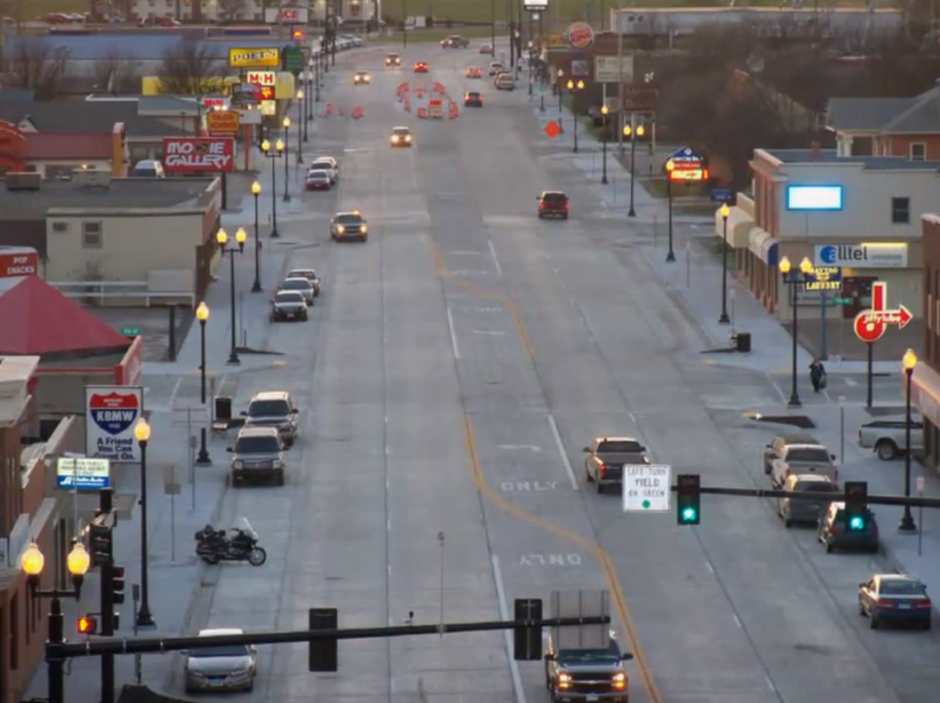
Edit - yes, that photo has sidewalks, but there are so many intersections and road crossing, it's not a pleasant place to walk. Many places don't have sidewalks at all, or have some, but they're disconnected from each other block-to-block. Or you have to walk across a massive parking lot to get to the shops. Much of suburban US really is quite dystopian in this regard.
If this link works [2], it's the intersection to enter th nearest shopping center to my house. Note the lack of sidewalk on at least 2 corners. Crosswalk only on one side (if you live on the close left corner, there's no way to safely walk across the street in either direction). Lack of bike lans on the crossing street (the street has some, but they inexplicably end JUST before the shopping center). And even if you do manage to walk/ride into the shops, you have to dodge cars trying to park before you get to the actual shops. I wish this was unique, but it's extremely common in the suburbs.
2 - https://www.google.com/maps/@38.93839,-77.3287099,3a,75y,293...

But here's the thing: all those big spaced out houses with big yards leave less room for trees and parks that make everyone happy. Suburban spaces also tend to be bereft of trees overall because no one can stand to have their lawn 2m shorter so the street can have a boulevard.
Neither of which sounds very nice to me. I don't have a huge yard, but I do have enough yard to raise a few trees and firepit. If I lost that, I might as well be in an apartment.
And that still wouldn't provide enough density to support a variety of restaurants and grocery stores (not to mention things like employment for non-techies).