It’s just that these small groceries cannot outcompete supermarkets once people are in the habit of going everywhere by car.
This is true to a limited extent. If small grocers and bakeries were allowed to setup in mixed use areas they would do a whole lot better. However sticking them an average of 3 miles from their customers in a horrible strip mall kills them.
I would happily pay a premium for having a grocer just down the street instead of having to go 4+ miles to a supermarket. Being able to get a gallon of milk and some onions in 10-15 minutes from a place just down the street will always beat driving to, parking at, and walking around a 10 acre supermarket on a 50 acre parking lot. Just the stress of dodging all the parking lot speedsters is more than enough to keep me far from that place.
That's the crux of the problem in the US. Vast swaths of land are dedicated to single-family homes (and ONLY single-family homes). You literally couldn't build a small grocery next to these homes if you wanted. And the hurdles to getting a zoning change as so high that developers just build strip malls on the outskirts of town/subdivision.
We're beginning to see some progress in the DC suburbs, with more mixed-use "village centers" being built in the 'burbs. My main complaint with these is the development is done in one pass by a giant corporate developer, leaving the area feeling very sterile (compared to an old urban downtown in a small city, which might not be as clean, but has a more organic mix of businesses). IMO, of course.
So yes, it's not that you can't have single families, and it's not really about people having cars or not, it's the density, and therefore, it's the lawns and the streets that are too wide, making the number of places that you can go to in a 15 minute walk far smaller
> it's simply not economically viable
You replied:
> t’s just that these small groceries cannot outcompete supermarkets
So you are confirming what he said.
And with Covid restrictions and work-from-home, deliveries and online ordering were cemented as normal behavior.
Uh, somebody has to deliver those orders. And in the US, that's by car (van). You might make single-car households more viable with pervasive online ordering/delivery, but you don't necessarily change the core character of the neighborhood that way.
And there's always services who will pick up bread from such locations and deliver it. With or without the bakery's backing.
This mix is really rare in North America, at least and especially north of Mexico, but it does exist.
Neither of which sounds very nice to me. I don't have a huge yard, but I do have enough yard to raise a few trees and firepit. If I lost that, I might as well be in an apartment.
And that still wouldn't provide enough density to support a variety of restaurants and grocery stores (not to mention things like employment for non-techies).
Take my neighborhood (south Reston, VA). The main road is about 2.5 miles long. There is a strip mall at both ends, leaving homes in the midde just outside easy walking distance (from my house, by footpath, it's nearly 2 miles to one end and a bit over 1.25 to the other). There is a major intersection about halfway down that main road. Instead of allowing a small shopping area, it's more houses. Hard to change now, but if it had been zoned mixed-use/light commercial at build time, there could be a coffee shop and small grocer there. And bring between 1/3 and 1/2 of the available customers in the area within walking distance of at least some of their regular errands.
Additional benefit of this would be reducing the size of the malls at each end, mostly by removing parking spaces, freeing that space for townhouse, apartments, or more shops.
Take my office... it's 1.25 miles away, and I walk. But, the complex is all offices. If there were a grocer there or on the way, I could eliminate my 1x weekly carload, instead grabbing things as-needed on my walk home.
Same office. I have coworkers who live closer than me, but refuse to try walking because the sidewalks and street crossings from their direction are less user-friendly. Crossing on/off ramps without signals. Crossing a 4 lane highway with 50mph traffic. Etc. Some simple crosswalk modifications could make the office complex walkable to some of these coworkers. But, traffic planners don't even appear to think of these things when building roads - it's almost 100% car-focused.
With the number of signaled intersections, I can't drive it any faster than the bike. But definitely faster than walking most of the time (though walking is a guaranteed time - driving that distance has taken 20+ minutes before because of traffic jams).
Basically, if it takes the same or less time than driving, I try to walk or cycle. Sometimes I walk the ~2 miles to CVS or Starbucks, but that's as much recreation as transport - I can drive it in 5 min. Nice to have the option, but if they were closer to 1 mile, I'd always walk.
It's not far from reality. But mostly because so much of the US lacks sidewalks, so driving is the safest way to get A-to-B.
When getting anywhere useful requires navigating places like this [1], using the car for everything quickly becomes the default.
1 - https://assets.bwbx.io/images/users/iqjWHBFdfxIU/ijhV2hgcKaq...
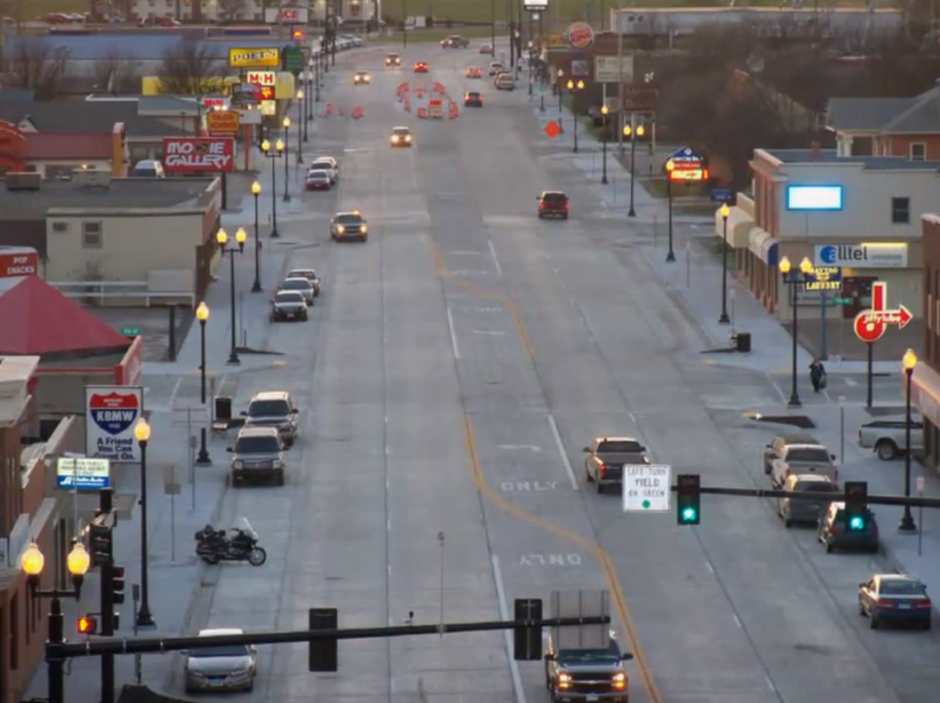
Edit - yes, that photo has sidewalks, but there are so many intersections and road crossing, it's not a pleasant place to walk. Many places don't have sidewalks at all, or have some, but they're disconnected from each other block-to-block. Or you have to walk across a massive parking lot to get to the shops. Much of suburban US really is quite dystopian in this regard.
If this link works [2], it's the intersection to enter th nearest shopping center to my house. Note the lack of sidewalk on at least 2 corners. Crosswalk only on one side (if you live on the close left corner, there's no way to safely walk across the street in either direction). Lack of bike lans on the crossing street (the street has some, but they inexplicably end JUST before the shopping center). And even if you do manage to walk/ride into the shops, you have to dodge cars trying to park before you get to the actual shops. I wish this was unique, but it's extremely common in the suburbs.
2 - https://www.google.com/maps/@38.93839,-77.3287099,3a,75y,293...

But here's the thing: all those big spaced out houses with big yards leave less room for trees and parks that make everyone happy. Suburban spaces also tend to be bereft of trees overall because no one can stand to have their lawn 2m shorter so the street can have a boulevard.
Apartments suck, a lot, in the US.
  * Noise; aren't built to sufficient privacy levels.
  * Smell; laundry, cooking, or whatever...
  * not designed to scrub, filter, and direct exhaust.
  * Patios == smoke or grill; even though those are banned by policy.
  * Somehow cost more than renting elsewhere
  * Rent seeking causes negative patterns
  * Car parking hell
Yes these problems also exist when you rent in single family home (intended, often not fulfilled) suburbia, but they're less due to the lower density.
I think a future with comfortable, large, isolated apartments is possible, and even such "fancy" apartments are going to be cheaper than full houses, if there are enough of them.
    * Noise is an easily solvable problem, with insulation.
    * Proper ducts and exhausts can handle smells/smoke.
    * high rents means there is a demand but not enough supply.
    * car parking can be in basement, easily accessible.
   * easy to secure/gate.
   * grocery, pharmacy,...  are < 5 min walk.
   * a large pool, 2 hectare park inside the society.
   * multiple badminton, tennis, basketball courts inside the society.
* above all allow my 7 year old to go for lot of activities on his own or with friends.Suburban parts of cities often aren't zoned for high density housing because the NIMBYs don't want them near their detached homes. When everyone sees a house as an investment there's no incentive for them to increase housing in their city.
How can you possibly believe such a thing? That is just an outright foolish assertion. The labor cost to build something to code is the same regardless of the quality of materials. Builders skimp on materials to pad their margins. Even if they used cheaper unlicensed labor there's no impetus to use more expensive materials.
They were not noise, in fact in one I only ever heard my neighbors one time in three years of living there, they were typically pretty spacious, rent didnt fluctuate that greatly, I didnt need/have a car most of the time but there was lots of street parking, and I don't have a great sense of smell but oders were never an issue.
Nice apartments exist. You just pay about the same as you would for them as you would on a mortgage.
If they're not finding it, it's probably because they're looking for a low density housing option.
Every passing year is another one in which old buildings are redeveloped and the US population grows, increasing market pressure.
—-
There’s a separate issue with new modern mixed use in the US where retail tends to have low occupancy. Partially this is because there continues to be a massive glut of retail space in the US, and partly because the new spaces tend to be too large to be profitable for anything other than chain stores, and there are only so many chain stores to go around.
NIMBYs in this city bemoaned old Amoeba records loosing its "historic" low rise commercial building. But Amoeba just moved into one of these mixed used developments a few blocks away closer to the metro station, got more square footage out of the deal, and sold the old property for a lot of money. The city changes and it isn't a bad thing, in fact its typically a good thing that it changes as this keeps rents closer to the actual wages seen.
That's because if you want an individual home, you're giving up the customer density required to make those amenities viable. In a world with the internet, at-home delivery, and yes, cars, it's simply not economically viable to create a grocery store that only caters to 100ish families.