Survive what? I don't see RISC-V disrupting much of ARM's bigger-named business (eg, phones, with some inroads into other things like Apple Silicon & laptops). Maybe Amazon pivots into RISC-V for the next Graviton? But that also seems unlikely unless someone with very deep pockets invests in making an actually competitive RISC-V CPU core at the mid/high end.
ARM's low-end market seems likely to be taken over by RISC-V. So like the Cortex M series days seem numbered without a change in the business model. But that seems like about it.
Go back a decade or so: how many people thought that ARM could compete against Intel/AMD?
Chromebooks on ARM have already been out for a year. Windows RT for ARM was coming out later in the year. Smart phones are clearly all going ARM. The 64 bit ARM spec was out and people were excited about it.
I think it was a lot clearer that ARM was going to succeed x86, as compared to looking forwards now as to where RISCV will beat ARM.
I do suspect the microcontroller ecosystem will have lots of RISC-V. But it seems a lot less clear that it will succeed ARM in the mobile/laptop/desktop/server markets. I personally do not think that’ll likely happen any time soon.
ARM has so far, outside of Apple and very limited cloud experiements (and some very badly received laptop experiments), not really put a dent in Intel/AMD's markets. But all of this was fueled by the once-in-a-generation explosion that gave ARM untold increases in adoption "for free". RISC-V has seemingly nothing similar, and RISC-V itself certainly isn't manufacturing any such radical shift.
It's a matter of time other shares will be eaten when x86 is having hard time innovating over its decades old design.
More battery time for consumers laptop and less electricity bill for cloud vendors are something very attractive.
Yes, obviously, which I mentioned repeatedly. For ARM to be successful outside of embedded it took an entirely new category of device to appear. What's RISC-V's entirely new category of device where it happens to be uniquely positioned?
> It's a matter of time other shares will be eaten when x86 is having hard time innovating over its decades old design.
Based off of what? The only ARM CPU that isn't thoroughly outclassed by AMD & Intel's x86 CPUs is Apple's, and Apple sure isn't licensing that to anyone. And so far every time ARM has tried to enter the domain of x86 it's been either absolutely embarrassingly bad (laptops) or mediocre at best and only for the very latest generation at that (servers)
> less electricity bill for cloud vendors
ARM server CPUs have the ~same 250W TDPs of Intel & AMD server CPUs. There's no power savings to be had here.
Hello, that would be me? :)
A decade ago was 2011 / 2012. Not a lot ( if not zero ). Even Anand from Anandtech was still cheering on Intel because of Intel's foundry leadership.
Wrote it on Anandtech and AppleInsider ( probably on HN with my old account as well ) the moment Intel decide not to make chips for iPhone or Fab Chips for iPhone in 2011. That was before Intel announced their Customer Foundry. They later went to do a JV with a Chinese company which later become Spreadtrum now known as Unisoc.
The whole reason why Arm competed against Intel and AMD wasn't because of ARM the ISA. It was the business interest and Foundry model. On a projected annual 1.5B Smartphone shipment by 2020 ( Which turns out to be a little too optimistic ), and 150M PC shipment by 2020 and continue to trend downwards. ( A little too pessimistic ) Even had TSMC not taken over the leading edge crown or stayed one node behind Intel the market today would still have been the same. The smartphone market was far bigger than the PC. This actually ties to why people were dismissing moore's law in the late 00s and early 10s. And it was the economy scales that wins.
What turns out to be wrong though was Tablet didn't take over PC. We are not in a Post-PC world. E-Sport (x86) picks up and PC as a Gaming platform is bigger than anyone could imagine. PS4 would move to x86 ( I dont think rumours of PS4 on AMD x86 even began til early 2012, and only partly confirmed by 2013 ) GPU is no longer a Gaming niche but a fundamental in Data Science. The hype of so called Cloud where everyone laughed at or sceptical of ( that is including me ) turns out to be multiple order of magnitude bigger as well. x86 ( Intel / AMD ) thrives because of that.
There is a huge discussion about peripherals and IP. You can buy peripherals for ARM all day long, they’ll work from one chip to another for the most part. Once everyone can “make their own CPU”, expect fragmentation in the peripheral interfaces.
I think low end cortex A and R are where V will shine first. Something like a CISCO IP phone, not an iPhone.
Doesn't that inevitably set up a classic Innovator's Dilemma?
Kinda like how Intel just never cared about going after embedded, and they're not exactly struggling as a result of that. With the big asterisk of smartphones where scaling up proved a quicker path to shipping than scaling down, at which point inertia took over, but for that to repeat would require a currently unknown new product category.
Of course RISC might push them to make their licensing mechanism to be more flexible if they start considering RISC an a real threat to them (I don’t think this is very likely to happen in the near future, though)
I'm afraid they have seen RISC-V as a threat for a while now. It has already been years since their first FUD campaign.
>if ARM started allowing everyone to use their IP for free you would expect them to survive?
That's not how I see ARM surviving.
One way ARM could survive is by doing what the MIPS owners did: Abandon the ISA, move to RISC-V, use your extensive expertise to make competitive cores, and your clout in the market to sell them to your pre-existing clients.
They could totally pull it off, but it would honestly surprise me if they did so, considering how poorly they've dealt with RISC-V so far.
Even if that’s their best bet, long term, I don’t see why they would have to start doing that right now. Why would they leave their castle with its golden egg-laying goose, only because they know it won’t live for X more years?
Timing such transitions is always difficult (you can’t wait until your goose is dead), but I think they’re better of waiting at least a few more years.
The MIPS owners were in a different situation, weren’t they? Their goose already was dying or even dead.
Alas, that would probably have worked better 2+ years ago, there is a lot of movement now.
It seems like Intel has realized this. They tried to buy Sifive, but have now themselves joined as a major RiscV International sponsor and are investing heavily in the ecosystem.
Of course there is a downside there too, because it accelerates a software and hardware ecosystem transition to a different architecture that can enable other players. We'll see how it plays out
One of the reasons Intel is spending money on RISC-V could be that they want to undercut Arm, as the latter are now beginning to be competitive in Intel's X86 world. RISC-V is going to succeed at all as an ISA, it is going to hurt Arm before Intel.
Me neither, but spreading FUD about RISC-V as they've been doing doesn't help their credibility should they take the MIPS path.
ARM's vast experience brings the quality you've come to expect to the RISC-V world. Want to lower TCO and level up your designs, while leveraging existing experience, but worried about low quality IP polluting your tech? Fear not. etc...
You can probably let an AI spew this stuff by now. Training data is easy to find.
Got a good chuckle from that, I did! :D
MIPS was pretty dead when they abandoned it, ARM is still alive and well.
ARM could survive by making the ISA free and competing by having the best ARM core designers and designs, and/or by having proprietary addons for media handling/decoding.
The trend with RISC-V suggests that ISAs are going to be commoditized and the real value will be in the implementations themselves.
It is not that difficult to re-target a micro-architecture (what you call implementation) to a new ISA, especially if the ISAs relatively close, as most modern ISAs are. RISC-V and Arm ISAs are an example where that should be especially easy.
Why pay for ARM if you can retarget to RISC-V and still retain most of the benefits of your designs.
Right now, the Arm ISA has much better micro-architectures than RISC-V, why bother with RISC-V? I think this will change over the next 5 years. One of the ways to change this could be Arm selling RISC-V implementations.
Of course there are also dangers in RISC-V: one is that we will get too many RISC-V versions, so no stable software ecosystem emerges for any single one of them. Adapting Linux, GCC and so on to your specific version of RISC-V (or any processor really) is rather expensive.
It is the fundamental basic business ideas that they have it all wrong. Which is why every time these discussions came up they are non-productive. It is no different to saying Linux would take over desktop in the 90s because it is free. We are in 20s and coming up 30s. It is still not happening.
But at least ( or hopefully ) we have passed stage where RISC-V is fundamentally better ISA than ARM. And talk about the business aspect of it.
Edit: Ok I was wrong, the ISA debate is near the bottom of the page. I didn't invent the term "Riscy Silver Bullet" for no reason :).
The desktop? Maybe not. But Linux has done well with laptops in recent years (Chromebooks). Definitely not "taken over", but 30 million units a year is nothing to sneeze at either.
Completely agree.
Irrelevant question that no one anywhere has any obligation to care about.
Longterm I’m afraid that a completely open ISA might result in a less competitive market as long the cost of developing competitive cores is high enough. All top players could just start behaving like Apple and just keep their cpus for their own products/cloud services instead of selling them at commodity prices and losing a competitive advantage. So having a ‘neutral’ player like ARM might still be preferable.
But ARM probably cares about ARM's survival so it is relevant to the discussion about what future decisions ARM might make.
I literally quoted a question that asks "you expect", and what I am pointing out, not declaring but observing, it's already a fact regardless if I say it, that neither you or I nor anyone else has any obligation to expect anything.
It doesn't even matter if we do expect something. Even if you were some kind of Arm fan like being a fan of a sneaker brand or a celebrity, your good wishes still don't change anything.
"you expect" is just irrelevant in this question. Arm can adapt to the new environment or not. The environment is changing and it doesn't matter if anyone likes it or not.
And the nature of the change, people giving away something that someone else used to be able to charge rent for, is not unfair or unethical or immoral in anyway, nor is it any kind of net loss for society as a whole, so there is no argument for doing something to artificially protect Arm's business model.
Steve used to sell cakes. Sally gave everyone her recipe for cake and now fewer people buy Steve's cakes. So what?
Do you mean to say that Sally should not be able to give away her own cake recipe? Steve doesn't like it because he had a good gig going for a while there, but so what? The environment Steve was operating in changed, and his business model no longer works. And while you could sorta-kinda say it's Sally's fault, you can't say she did anything wrong either legally or morally or in a holistic sense for everyone as a whole, and so there is nothing anyone else should do about it. Steve had no special right to his cakes being purchased. He has the right to offer them, but no one is obligated to buy them, and no one is obligated to care if he fails to sell enough to live well on.
I don't expect anything related to Arm, and neither can anyone else. It's just a totally irrelevant question.
https://riscv.org/blog/2020/11/13-year-old-nicholas-sharkey-...
We've got kids designing their own cores. That was a bar that previously was out of reach to anybody without a nine-figure engineering payroll. That's amazing.
RISCV does make it a bit easier and gives you a clean ISA but it hasn't really had that much of an influence due to its own design i.e. it's caused people to herd around it so there's lots of tutorials and work to borrow floating around.
SPARC was able to run Linux and Solaris, and used by Sun in their servers that powered much of the commercial internet in late 90s and early 2000s (before x86 Linux took over).
There have been a few others since then. So relatively sophisticated open source cores for study and modification have been around for many years by now.
It looks to me like the difference with RISC-V is that a larger community has formed around it due to smart organisation and the timing being right, rather than availability.
This toolchain enables going from knowing nothing to a core in one class. One doesn't even need to enroll in the class to follow along.
See: https://ocw.mit.edu/courses/electrical-engineering-and-compu...
From article: “The open-source community developed key tools that are crucial to make RISC-V-based processors ubiquitous, such as chip technology process design kits, design verification suites, implementation tools, and more”
Closed source tooling was available and “smart”, but licensing, cost, and inflexibility were significant roadblocks. Disclaimer: I don’t work in the industry.
Things like: is it enough for one to make any core or does one have to make the "best" core? If it just has to exist that was pretty much always possible. Definitely not the lowest friction way to go. But possible.
For example here is basic MIPS core originally written in 2003, from chapter 1 of a common VLSI textbook: http://pages.hmc.edu/harris/cmosvlsi/4e/code.html
It's just over 400 lines of verilog and super easy to follow. The tooling changes that happened in the 90s made that possible.
I experimented making cores that were taped-out in my University, as an undergraduate, in the late 90s. It didn't cost my University even close to 9 figures. It was definitely a lot harder than now but the designs were also a lot more modest. Things, essentially untrained, students can do now would've been unthinkable then.
Dumb cores are a commodity now, which progressed in horsepower from their ca. 60 years old ancestors. I.e. the core is hardly innovative, so what is so amazing about it, technically?
Suppose you just want a soft core for a one-off FPGA project. RISC-V is a no-brainer if you need to run complex stuff like a Linux kernel. There's myriad of projects to pick from on GitHub. Try them all, pick the one you prefer.
The barrier to entry is so much reduced that you can use RISC-V "by accident" without having considered it in advance, as part of a normal engineering process in companies of any size, vs months-long waits for IP, after deciding it was worth obtaining.
- Arm has no IP that can’t be quickly replicated by other firms (for very little money).
- That the quality of designs from other firms will be better than those from Arm (or for the architecture licensees their own).
- The really big Arm licensees would see a commercial advantage to switching.
Intel threw billions at the smartphone market and still lost against Arm. Today there are zero RISC-V smartphone designs. That may change but probably largely because of the Arm China and Nvidia missteps.
I expect (and look forward to) RISC-V establishing a presence in the market but this sort of commentary does the ISA no favours.
Edit: I see elsewhere you think they should abandon the Arm ISA in favour of RISC-V! really not sure about that ..
2) Network effect favoured ARM.
> With ARM, You have to pay ARM for ISA license
This is only true for some definitions of ARM. See for example:
https://en.wikipedia.org/wiki/Amber_(processor) "The Amber core is fully compatible with the ARMv2a instruction set and is thus supported by the GNU toolchain. This older version of the ARM instruction set is supported because it is not covered by patents, and so can be implemented with no license from ARM Holdings"
> Frankly, unless ARM does radically change their business model, I do not expect them to survive.
Looks like someone is having similar thoughts inside ARM. https://hackaday.com/2018/10/02/free-arm-cores-for-xilinx-fp...
There are other efforts too.
I also trust the ARM ISA designers more than the RISC-V ones, but I don't know enough that you should trust me.
RISC-V for hobbyist like me is just WAY WAY easier to deal with. There is a great consistency between RISC-V 32-bit and 64-bit which ARM lacks. There is just one compressed ISA and it maps to the regular one in straight away manner. Register naming is more sensible and consistent.
ARM instructions with their complex addressing modes are not easy to read. ARM vector instructions makes your head explode trying to keep all the details in your head at the same time. RISC-V vector instructions are just way easier to grasp.
In many ways it reminds me of the documentation situation with Python vs Julia. Python has more documentation for sure, but a big problem with that is all the stuff that is outdated irrelevant, combined with the difference between Python 2.x and Python 3.x although that has gotten easier in recent years.
New technologies will always have less documentation but they often benefit from not having lots of legacy which complicates understanding.
At least ARM is easier than x86, but that is a pretty low bar.
You're not wrong in your assessment. However you're looking at it as it is right now, as opposed to where it's headed for in the future and what it could ultimately become. While CG and computer hardware are very different fields, the effects of communal knowledge sharing are very similar and very powerful. When bored high schoolers and broke college kids (and curious adults) can tinker with the tech, they enter the industry with that much more experience and/or have another avenue for career transition. And that is far more valuable than the mild (and sometimes nonexistent) conveniences of ARM over RISC-V.
In the first case anyone with the right skills can do it. In the second you need access to lots of specialist tools / proprietary industry knowledge.
If RISC-V 'wins' in application processors it will be because an Intel or a Qualcomm invests (probably) hundreds of millions in building a team that works on a multi year project. It definitely won't be bored high schoolers.
> In the first case anyone with the right skills can do it. In the second you need access to lots of specialist tools / proprietary industry knowledge.
In the first case, it used to require specialist tools like the Autodesk suite, and people had to have access to that software to develop the right skills and acquire the industry knowledge.
I don't think RISC-V "winning" is the right way of measuring success. Whether or not it becomes the dominant ISA for everything is irrelevant. It serves an important role in our market and it doesn't need the guys at Qualcomm and Intel to use it to make it successful. Either way Intel is investing big money into RISC-V: https://www.zdnet.com/article/intel-invests-in-open-source-r...
Also, careful what you say about high schoolers: https://riscv.org/blog/2020/11/13-year-old-nicholas-sharkey-...
https://info.efabless.com/press-release-efabless-launches-ch...
I was going to use that exact wording in a different comment but decided against it, spooky
I mean there was clearly a lot of analysis put into aarch64 - which probably involved Apple etc - but I've seen comments previously saying they obviously got it wrong because [insert some headline design decision].
They might have got it wrong but they're definitely not amateurs at this and you can't prove anything with a one line comment.
I feel ARM could go the Docker way, who faced a similar foe in the stakeholders seeking to commoditize their core business... ruthlessly stomped on them, creating k8s, runc, registries, microvms, serverless, and what-not. Despite Docker having stellar engs working for them (and in some cases, better tech: Swarm, for instance), there's nothing they could do.
The Tencent and Apple of the world are...Tencent and Apple.
If Amazon say decided to throw billions at developing a Graviton 4 using RISC-V...they really couldn't leverage much of their previous Graviton development work. They also wouldn't have a deep bench of low level RISC-V wunderkind to bring on board to leverage the new platform. It's a chicken and egg problem.
Why would Amazon then want to pay to bootstrap a whole RISC-V market? That's a lot of CapEx without a clear potential for returns. You'll note they did develop Graviton using the ARM ISA so they didn't have to create from whole cloth a "Graviton" market.
Amazon made the same decision as PC makers in the 80s. They consolidated around the IBM clone architecture to take advantage of the rest of the market, especially Microsoft and IBM, supporting the IBM clone market. Commodore, Atari, and Apple all had to fight uphill against IBM clone market.
I haven't seen any technical advantage of RISC-V over ARM that would suggest it's worth pouring billions of development dollars into. It might make sense for Western Digital for drive controllers but not phone, tablet, PC, or server makers.
Now, if someone would create a RISC-V core competitive with the Arm server cores, and an ecosystem of RISC-V compatible peripherals (well, not compatible in the sense that some random peripheral would need to care about the ISA, but that Arm might not want to licenses their peripherals to a RISC-V based project?) shows up, I'm sure Amazon could do roughly the same with a hypothetical RISC-V Graviton. But if you're talking about designing a RISC-V core from scratch, that's a whole different ballgame.
This is my point. Amazon using ARM lets them tap into the huge ARM ecosystem with minimal investment on their part. The cores they're using have known qualities and meet whatever performance targets they want.
At this point RISC-V doesn't have that same ecosystem. It doesn't even have extant high performance cores someone can just order. Building momentum is expensive. If selling that ecosystem isn't your main business it's probably not worth investing millions or billions to develop it.
RISC-V has geopolitical advantage however in that it's not controlled by US/UK.
I can see why Amazon wouldn't pay to bootstrap that, but I can see why Tencent/Huawai/Alibaba would try to.
I kind of agree, but it’s not straightforward. ARM’s growth wasn’t so much a hockey stick as a more continuous curve with a small exponent. Yes, they only started in 1990, but that was itself a reboot/restart after acorn’s 12 years of effort. And they were scrambling hard for every deal for at least another 15 years.
The environment in which RISC-V emerged is different, of course, but many of the dynamics are still the same. Car companies were still using 16 and even 8 bit devices into the 21st century.
Secondly, ARM has a large arsenal of patents that go along with the license, and they continue to add to the load.
I bear ARM no ill will but I also want RISC-V to supplant them. I just don’t think it’s automatic.
Anyway, that's all well good, but - does anyone end up making decent RISC-V processors that could replace a desktop CPU, or a RPi CPU, or something weaker but not in a small niche? Or is this still a vision for the future?
As of November, a large number of extensions got ratified, including the vector extension, cryptography acceleration, hypervisor support and other important features.
RISC-V is finally not missing any important feature ARM or amd64 have, and it does it with an order of magnitude lower number of instructions (equivalent but simpler, i.e. better) and with significantly higher code density.
However, test chips with the first designs implementing all of that will take time, even assuming they were tapped out right then, after confirming no last minute changes.
High performance cores depend on these extensions, so we'll begin to see them soon. We know multiple such efforts exist.
Tenstorrent has one such project, led by Jim Keller.
>Their (ARM) business model was to be sold to NVIDIA, but that didn't work out.
They intend to go public now. I recommend against buying those shares, as I do not expect ARM to turn around.
This is not correct and is a known weakness of RISC-V at the moment. The ARM toolchains are really good and have decades of improvements in them. This is a big issue for those who need to buy ROM in volume.
Better tools are coming online though. For example:
https://blog.segger.com/code-size-closing-the-gap-between-ri...
"One of the issues faced by RISC-V developers is that the code density of the RISC-V instruction set for deeply embedded processors does not match that of Cortex-M with existing tools."
This has historically been a problem with RISC-V and it’s not really something you’ve backed up as being improved.
I am not sure how to parse the «simpler, i.e. better» part; simplicity vs betterness is orthogonal at best and is contradictory at worst.
Very few people write meticulously handcrafted, highly optimised code for any ISA today, and the compiler writers actually prefer a more complex ISA as it becomes easier for them to transalate high level programming abstractions into an efficient concrete hardware implementation and run it through an optimising pass. Simplicity of the ISA does not immediately translate into faster or more optimised code.
Moreover, creating a highly efficient optimiser is no easy feat as it depends on a large variety of factors and the in-depth knowledge of a specific CPU incarnation: the knowledge of each instruction's timing, instruction interdependencies (i.e. the most optimal instruction sequence that does not stall the pipeline or maximises the ALU/whatever utilisation etc etc), L1 I and D cache line sizes, the knowledge of a particular CPU model / generation… – and that is just a beginning. There is a good reason why Intel, AMD, IBM, ARM et al publish hefty optimisation guidelines / documents for each generation of their CPU's with the compiler writers in mind: the same sequence of instructions issued for the CPU model 123 might be less (or more) efficient than in the next CPU model 456 and vice versa; moreover (e.g. specifically for Intel vs AMD), a sequence of instructions optimised for a particular Intel generation might underperform for an equivalent AMD model or vice versa. Same is likely to be true for different RISC-V core designs from different RISC-V vendors. This is the reason why -mcpu=XXX and -mtune=YYY exist in GCC and clang/LLVM: efficient low-level code optimisation is a tricky business and depends on a large number of compounding factors.
It remains to be seen how the optimisation will be tackled in the RISC-V case with its potpourri of optional ISA extensions and also with the instruction fusion. Given that a random concrete RISC-V implementation can be a combination of the base ISA + a random permutation of any RISC-V extensions (in the worst case scenario), emitting the code that will run equally efficient across N different RISC-V core designs appears to be problematic. Instruction fusion can pose another challenge as a fused macro-instruction may or may not run as efficiently on a RISC-V instance that does not fuse them. There is no guarantee that the compiler generated / optimised code will be equally highly performant across different implementations even for the same set of ISA extensions.
Itanium aka the Itanic demonstrated this is not the case.
On the other hand there is a vast market for low-end CPUs that have specializations to be disk controllers and things like that. If the ISA and all the IP required to make specialized devices is free and particularly if there is a culture in which it is easy to learn how to do that then RISC-V will have a special place.
My next spatial computing project is going to be RP 2040 based mostly because I have the parts in stock (other projects are blocked because of supply chain issues) but I am really an AVR8 fanatic and the only path forward I see to higher performance AVR8 systems is a soft core running on an FPGA where very hard tasks (vision? comms?) get offloaded to the FPGA and that can be a very appealing architecture where somebody might prefer RISC-V particularly if the tooling and accelerator integration are there.)
It might also be successful, even in that segment. The RISC-V ISA was specifically designed to scale up (e.g. to OOO and vector processors) while still being very simple, especially at the low-end - a basic RV32E is really comparable in complexity with many real-world 8- and 16-bit chips.
But, the similarly minimal Arm Cortex M0 is, drumroll, 12k gates.
Not saying this means Arm is better than RISC-V, such a small difference can probably be explained by some microarchitectural feature or lack of it. Just that you can scale down Arm as well.
But yes, I can see tiny chips like these putting a squeeze on 8 and 16 bit microcontrollers.
That's not the impression I got, when I studied the specification.
Do you care to elaborate?
I remember reading that ex-ARM employee's take back then, when it was discussed here[0]. It was based in a pre-standard version of the ISA which was already old at that point in time, and also ignored the rationale behind many of the decisions it criticized.
By objective metrics (simplicity of instruction set, features available, code density, absence of µarch assumptions), I find RISC-V to be the best general purpose ISA available at the present time.
If the macro fusions don't work for example that's a pretty dramatic blow against RISC-V compared to aarch64. Similarly code density is a tradeoff because riscv's simplicity means more instructions in the first place i.e. requires actual battle testing first.
He said they were talking about open-sourcing the CPU block. If they did (the CPU isn't their core business), we could see lots of RISC-V competition popping up. The age of CPUs being commodity items seems to be approaching.
Either way I don't think anyone is seriously arguing you can't make a high-performance RISC-V process, but the thing is that scaling from (say) fast at memory and basic integer operations all the way up to all the sometimes wacky shit people want from their desktop machines will probably not be easy. It took Apple decades to do it with an ISA they helped design themselves.
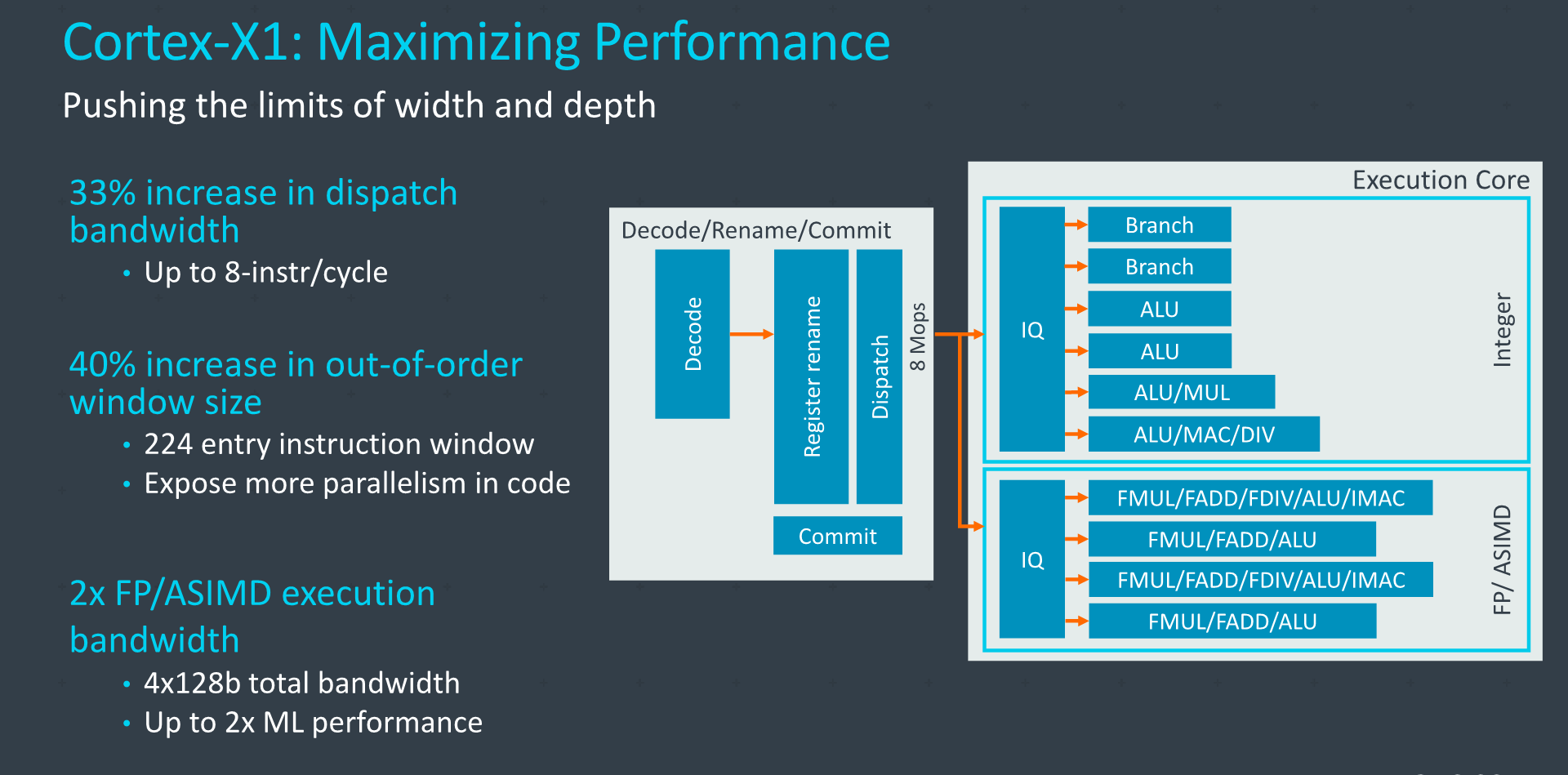
They didn’t mention how many branch units they have, but the ALU count is identical to X1.
They have half the SIMD units, but each unit is twice the width which increases instruction density on high performance workloads.
I also think the high performance here is a relative term to their small core.
The only really janky part is the fusion of more than 3 instructions. Now that is insane. However, it is like energy storage for renewables. Once you have an electric grid that can store days worth of energy that's actually extremely amazing. The old way of doing things will be viewed as something cavemen or barbarians did. If macro op fusion scales beyond 3 instructions then RISC V will easily beat other architectures because 2 is the limit for every other architecture.
A note for those not following: RISC-V as in RV64GC. x86 as in 32bit x86.
64bit x86 aka x86-64 aka amd64 is dramatically worse in code density.
Whether you are designing a server chip or machine learning powerhouse it is all about having lots of cores. To get more cores you need smaller cores and RISC-V has demonstrated they can make small cores of half the size of an ARM core with similar performance.
RISC-V simplicity really starts paying off once you go very small.
What they plan to do with them is unknown, but Apple has the cash flow to try a lot of things.
I would expect them to quickly adopt it for embedded applications, and experiment with making their own high performance design, including porting MacOS and Rosetta Stone. They can afford to do this much, regardless of whether they end up moving their main CPUs to RISC-V or not.
Trust modules, device controllers, smart adapter cables etc.
I might be making this up (I can't remember the company) but I'm pretty sure at least one chip designer has moved from risc-v to arm. It's not clearcut.
Building a desktop system with a PCIe graphics card would be easier.
I believe the team behind LibreSOC is also working on a 3D processor, but I don't know how far along they are.
However, if a vendor instead ships a decent framebuffer and high-performance vector unit, I think LLVMpipe would not be a problem for most RPi-equivalent use cases, either light desktop use or server use (especially the latter!)
If you make your own CPU
- With ARM, You have to pay ARM for ISA license (after a several months long negotiation), and you cannot license your CPU design to anyone, as ARM has the exclusive right to do that with their designs.
- With RISC-V, you get a free ISA license, and you can license your CPU design to others.
If you do not make your own CPU
- With ARM, you can (after a several months long negotiation) license one of the few designs ARM has available. There's no other vendors that can offer you ARM CPU designs.
- With RISC-V, right now, you can license any among hundreds of options available, from tens of vendors. The licensing process is usually very short and straightforward. Alternatively, there are some open hardware designs. You can get commercial support for some of them.
Frankly, unless ARM does radically change their business model, I do not expect them to survive.