It might also be successful, even in that segment. The RISC-V ISA was specifically designed to scale up (e.g. to OOO and vector processors) while still being very simple, especially at the low-end - a basic RV32E is really comparable in complexity with many real-world 8- and 16-bit chips.
But, the similarly minimal Arm Cortex M0 is, drumroll, 12k gates.
Not saying this means Arm is better than RISC-V, such a small difference can probably be explained by some microarchitectural feature or lack of it. Just that you can scale down Arm as well.
But yes, I can see tiny chips like these putting a squeeze on 8 and 16 bit microcontrollers.
That's not the impression I got, when I studied the specification.
Do you care to elaborate?
I remember reading that ex-ARM employee's take back then, when it was discussed here[0]. It was based in a pre-standard version of the ISA which was already old at that point in time, and also ignored the rationale behind many of the decisions it criticized.
By objective metrics (simplicity of instruction set, features available, code density, absence of µarch assumptions), I find RISC-V to be the best general purpose ISA available at the present time.
If the macro fusions don't work for example that's a pretty dramatic blow against RISC-V compared to aarch64. Similarly code density is a tradeoff because riscv's simplicity means more instructions in the first place i.e. requires actual battle testing first.
He said they were talking about open-sourcing the CPU block. If they did (the CPU isn't their core business), we could see lots of RISC-V competition popping up. The age of CPUs being commodity items seems to be approaching.
Either way I don't think anyone is seriously arguing you can't make a high-performance RISC-V process, but the thing is that scaling from (say) fast at memory and basic integer operations all the way up to all the sometimes wacky shit people want from their desktop machines will probably not be easy. It took Apple decades to do it with an ISA they helped design themselves.
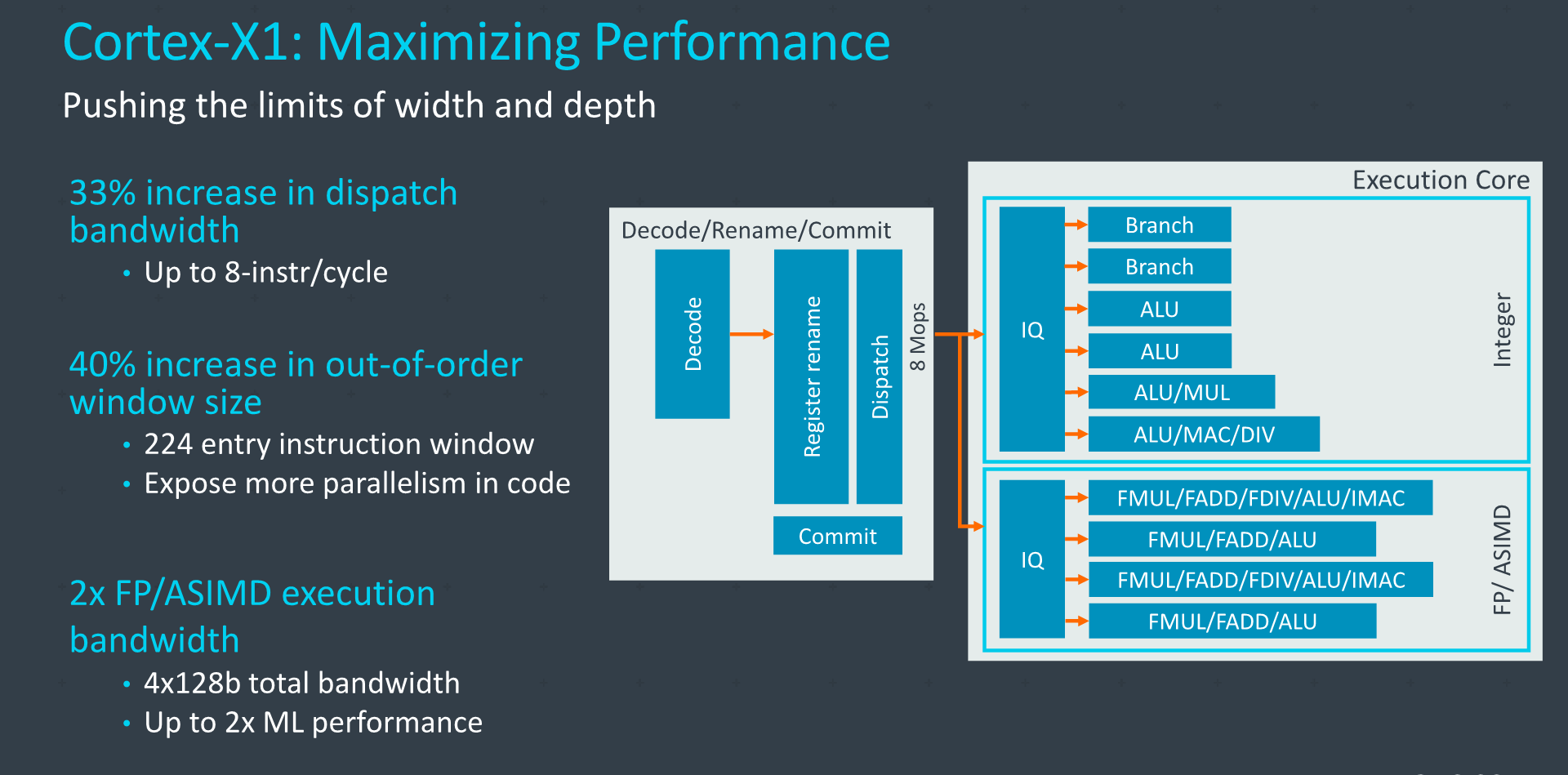
They didn’t mention how many branch units they have, but the ALU count is identical to X1.
They have half the SIMD units, but each unit is twice the width which increases instruction density on high performance workloads.
I also think the high performance here is a relative term to their small core.
The only really janky part is the fusion of more than 3 instructions. Now that is insane. However, it is like energy storage for renewables. Once you have an electric grid that can store days worth of energy that's actually extremely amazing. The old way of doing things will be viewed as something cavemen or barbarians did. If macro op fusion scales beyond 3 instructions then RISC V will easily beat other architectures because 2 is the limit for every other architecture.
A note for those not following: RISC-V as in RV64GC. x86 as in 32bit x86.
64bit x86 aka x86-64 aka amd64 is dramatically worse in code density.
Whether you are designing a server chip or machine learning powerhouse it is all about having lots of cores. To get more cores you need smaller cores and RISC-V has demonstrated they can make small cores of half the size of an ARM core with similar performance.
RISC-V simplicity really starts paying off once you go very small.
On the other hand there is a vast market for low-end CPUs that have specializations to be disk controllers and things like that. If the ISA and all the IP required to make specialized devices is free and particularly if there is a culture in which it is easy to learn how to do that then RISC-V will have a special place.
My next spatial computing project is going to be RP 2040 based mostly because I have the parts in stock (other projects are blocked because of supply chain issues) but I am really an AVR8 fanatic and the only path forward I see to higher performance AVR8 systems is a soft core running on an FPGA where very hard tasks (vision? comms?) get offloaded to the FPGA and that can be a very appealing architecture where somebody might prefer RISC-V particularly if the tooling and accelerator integration are there.)