I remember reading that ex-ARM employee's take back then, when it was discussed here[0]. It was based in a pre-standard version of the ISA which was already old at that point in time, and also ignored the rationale behind many of the decisions it criticized.
By objective metrics (simplicity of instruction set, features available, code density, absence of µarch assumptions), I find RISC-V to be the best general purpose ISA available at the present time.
If the macro fusions don't work for example that's a pretty dramatic blow against RISC-V compared to aarch64. Similarly code density is a tradeoff because riscv's simplicity means more instructions in the first place i.e. requires actual battle testing first.
He said they were talking about open-sourcing the CPU block. If they did (the CPU isn't their core business), we could see lots of RISC-V competition popping up. The age of CPUs being commodity items seems to be approaching.
Either way I don't think anyone is seriously arguing you can't make a high-performance RISC-V process, but the thing is that scaling from (say) fast at memory and basic integer operations all the way up to all the sometimes wacky shit people want from their desktop machines will probably not be easy. It took Apple decades to do it with an ISA they helped design themselves.
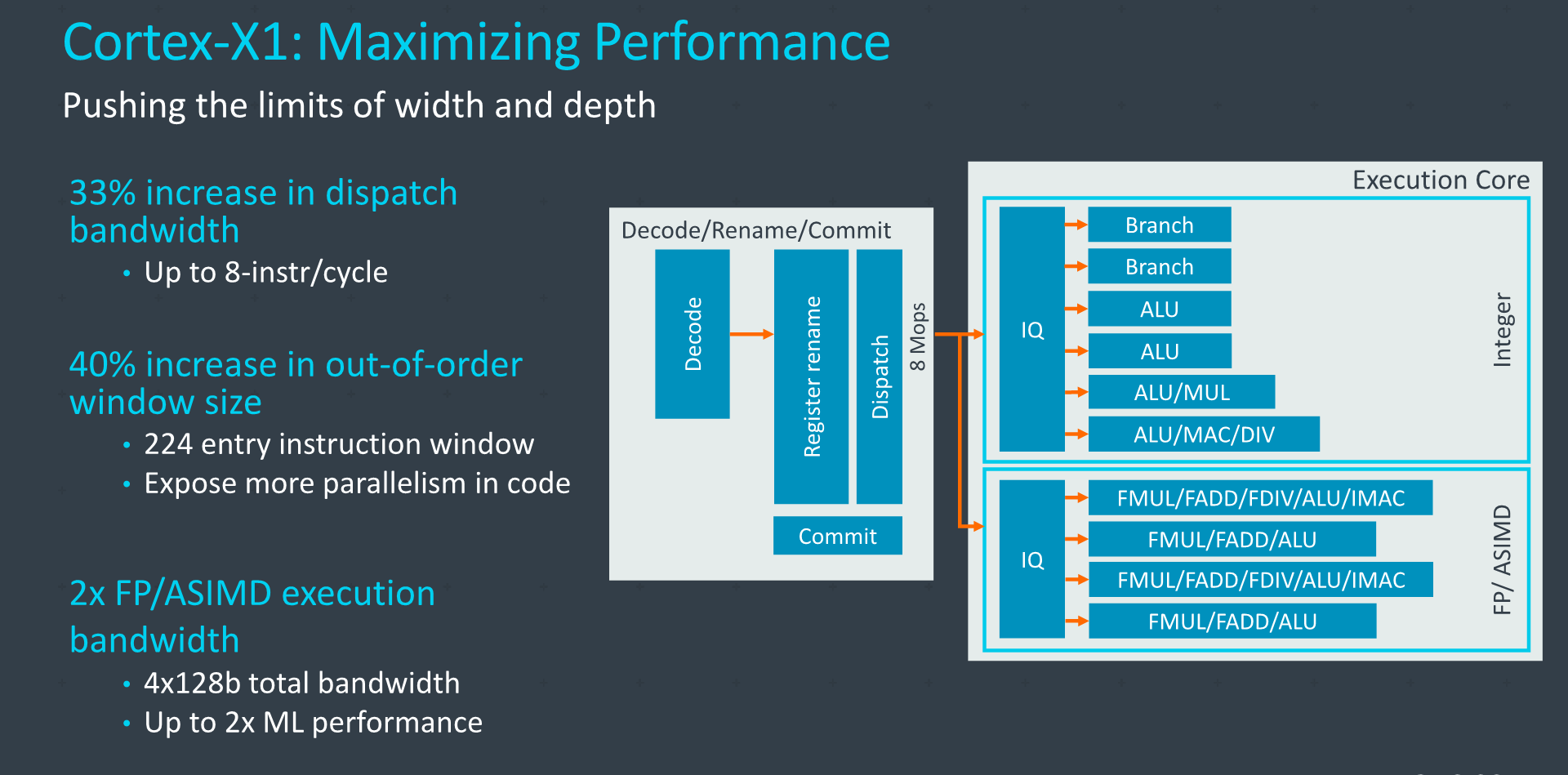
They didn’t mention how many branch units they have, but the ALU count is identical to X1.
They have half the SIMD units, but each unit is twice the width which increases instruction density on high performance workloads.
I also think the high performance here is a relative term to their small core.
That's not the impression I got, when I studied the specification.
Do you care to elaborate?