> people who are at risk of dying can protect themselves even around sick people (wearing a mask, staying at home, washing hands, ...)
This makes it clear "nobody successfully proved" really means "I didn't bother to listen". The messaging on masks has long been "they reduce transmission by infected people", not "they prevent you from getting it".
In EVERY other country you can buy masks, and they were strongly encouraged, that prevented YOU from getting sick.
South Koreas KF94 masks come to mind, very good coverage and fit (3 parts including one under chin). And despite the lies basically posted by you and plenty of others including health authorities (don't wear masks if you are "healthy", masks can't protect you from covid) masks CAN be used to protect you from infection, and that is a MUCH more powerful motivator for folks to wear them, and can also be targeted to those who are at higher risk.
We need to get a grip of basic facts. Masks help reduce transmission and if reasonably designed (look overseas) infection. Why else do doctors in hospitals wear N95 masks? To avoid getting sick.
I am somewhat higher risk. I wear and N95 under a surgical mask. This reduces my risk of getting covid.
The other issue you miss is that there really has not been good evidence of outdoor transmission, and the claims of covid living on outdoor surfaces for 7 days also are suspect.
So when folks say - no one go to the beach, it's a bit of an eye roll. If covid were THAT infectious (huge open ocean airflow hitting the beach, blasting sun) then we'd all have it already just from going to the grocery store.
I think health professionals lost a megaton of credibility in claiming masks don't help, to not wear masks, or that masks can only help reduce transmission not infection. Other countries went all out on masks - with great results.
They are reaping the rewards of these basic lies. Now I'm told going to beach on a sunny breezy day is high risk. I'm listening, show me the outbreak, show me the data that says this is high risk.
Cloth and non-medical disposable masks are not considered protective (although it's likely they block some inbound particles, and there's evidence they may thus result in a gentler illness on average) but do reduce transmission.
You're right that there are multiple kinds of masks; in the US, it's kinda pointless to talk about N95s. No one's wearing them, in part because they're hard to get, and in part because our anti-maskers threw enough of a fit about fairly comfortable ones.
> The other issue you miss is that there really has not been good evidence of outdoor transmission, and the claims of covid living on outdoor surfaces for 7 days also are suspect.
You'll actually find me elsewhere on this thread noting that outdoors tends to be safe, so I'm not sure what statement of mine you're arguing with here.
Yes, our government has been incompetent all around. That's a bad thing.
If the country can't gear up production of masks to fight a pandemic, why am I supposed to believe we could do anything of meaning competently? I know I'm a lot less impressed with our military's readiness if we ever get into a real war than I was a year ago. We've shown we're very good at throwing money at fraudsters and very little about actually producing things we need ourselves.
We also seem to care very little about over a million deaths, if we go with something like a 0.5% fatality rate. Puts the reaction to 9/11 and the whole "how dare you disrespect our troops" racist reaction to athletes protesting into perspective...
I don't understand the people who go from "wow, we've handled this badly" to "we might as well never try anything again," though.
That should be the motivation to start paying more attention, from local politics all the way up, not give up.
I don't agree. This is not incompetence. It is malice. The government absolutely could be responding far better, and doing much of the same things every other western democracy is doing. A popular political position in this country is to prove that we need less gov't by making sure it appears incompetent. Combined with the similar political need to believe the virus is a hoax means we get zero federal response.
I believe that national politics gets an undue spotlight, and that local government (in particular) does not receive the attention warranted.
Or we are a federalist society where by the states need to ask for assistance and not have the response mandated by the federal government.
We are a Union of States, and the states do and should have their own sovereignty from the federal government even in pandemic response.
What works in NY may not be the the same as what works in SD as an example so a Federal response is just not needed
While I disagree with the strategy and execution it is completely dishonest to say they were sent "to do community-level police work", they were sent to protect Federal Property after the City and State Governments failed to provide any protection for said property in the face of riots.
Again if it were me I would have just abandoned the building, and take with it all federal money letting Portland burn setting up a new Federal Courthouse (and giving the money that comes with it) to a new city in the region that would welcome the economic output of such a venue.
>>And they are certainly more than happy to dictate many other aspects of our lives using whatever levers they have available.
2 wrongs do not make a right... As a libertarian I advocate for the reduction in Federal power all the time at every level. It seems however Democrats only complain about federal power when a Republican is in charge, and Republicans only complain about Federal Power when a Democrat is in charge. Democrats and Republicans alike have transferred HUGE amounts of power from the Legislative to the Executive which enabled both Obama and now Trump to use that federal power in ways many people disagree with
They may wish that the local police were more successful at suppressing the violence, but that doesn't make it their responsibility to deal with the rioters. And why did they feel the need to meet the Portland protesters with violence but not the guys who occupied federal property out in Eastern Oregon? Politics, perhaps?
> 2 wrongs do not make a right
Sure. However, promoting the general welfare of people in the US by supporting pandemic response is a good bit less bad than creating arbitrary new regulations and laws that criminalize behavior which is really a local concern.
That is something to ponder. What does this say about us as a people? "Hey, we must retaliate, they attacked us!!" vs "Hell no I will not do one simple thing to protect others when we are all under attack from a virus." Hrm.
Nothing. A large fraction of the population does not feel this way at all.
There's an analogy to US police forces there, too. And to US politicians.
People that say government can or should impose/strongly-suggest/mandate mask wearing to protect overall population. Essentially the pro-mask wearing individuals.
Individuals that believe that we need end-to-end encryption, and that we can't have government watching our emails, tracking our movements, doing facial recognition, profiling, etc to stop violence.
In both cases, one could argue, the solutions being pushed-back against can effectively stop their respective problems. E.g. large scale big-brother surveillance of all individuals could effectively reduce crime to near zero. Just as 100% large scale government lockdowns/SIP and mask-orders can stop the spread of an epidemic.
Obviously I'm generalizing to try draw a comparison and point out the hypocrisy. Both of the problems require a suspension of some set of rights for "the greater good", yet we somehow balk at one (surveillance, facial recognition, centralized DBs, etc) whilst applauding and being offended when people question the other (mask wearing, SIP laws, social distancing, etc).
It's probably time that we decide as a society what we want instead of incessantly debating back and forth with contradictory requirements and expectations we impose on our governments.
By comparison wearing masks to slow down infection rates of viruses/diseases that spread via nose/mouth secretions has centuries of evidence backing it up and the government doesn't really gain anything by enforcing the use of masks in places like supermarkets. Maybe it can artificially increase demand to benefit some mask manufacturers but that's it.
Do you still think it's hypocrisy?
If you sit long enough you can come up with a potential abuse for any government law or idea. Just as is done with mass-surveillance. What we don't do is sit down and come up with extraordinary ways and means for us to use powerful tools/ideas/solutions such as surveillance in a responsible and safeguarded manner that is not exploitable by bad individuals in government, or bad governments themselves.
So they can fine them? There are already hundreds of offenses that can be used for that purpose and that can actually land you in jail.
> the negative social aspect of creating laws that have neighbors secretly reporting each-other for this?
Is that really happening? There is no special incentive for reporting people for not wearing masks.
> Or the potential for child-traffickers to gag + hide the gag with a mask while they're busy engaging in trafficking?
They could already do that, wearing masks was already legal.
> If you sit long enough you can come up with a potential abuse for any government law or idea. Just as is done with mass-surveillance.
False equivalence, the potential abuses from mass-surveillance are much more dangerous.
Freedom of speech is another matter.
Yes. That's pathetic at this late date. Worse, many of the off-brand ones don't do much. Some tests found masks performing around the 20% level, instead of the 95% level. This problem should have been fixed months ago. Part of the problem is that manufacturers didn't want to invest in the equipment, because the epidemic was supposed to be over by now.
Good N95 masks use a clever technology. The inner layer is a stretched film with holes. That layer can stop particles smaller than the holes - it's an electret, with a permanent static charge. Anything solid small enough to get through the holes gets pulled to the edge of a hole electrostatically and sticks. This has the interesting property that it works better on smaller particles; the static charge pulls them in more easily. So these can filter solids far below the hole size. Masks lacking that technology either don't work or obstruct breathing too much.
3M 8210 masks work that way. You can get them expensively on eBay, and cheaply if you're willing to wait 60 days for delivery. The "8210 Plus" model has a better elastic strap, which mostly matters for long-term use or storage. Aging of the elastic band is the weak point in the base 8210 model.
There's a vast supply of cheap "surgical" masks available. At least get a supply of those. Only ones with a bendable nose clip. Anything that leaks around the nose is worthless.
Machines for making N95 masks are available for sale, although some of them look like prototypes and are far too slow.
All verifiable sources I've seen have them reserved for medical personnel, although I haven't looked too hard.
For some reason it is absolutely CRITICAL for me to not go outside to a beach, but it isn't critical for the folks lecturing me to get their act together and make masks that cost basically 10 cents to $1.50 and would allow myself and others to carry on productive and healthy activities?
This is the issue - YOU are not listening. People see through the pantomime. Google and apple have API's to help with exposure notification - no apps developed at national level and few at state level. Other countries went big on apps.
Sure, they may not work great, but there just is a total lack of effort to actually solve the problem.
Same thing with masks. Countries with fractions of our per capita GDP and income levels crank up huge mask production. Total availability - literally the post office handing them out. No, not N95's always, but KF94s and other very effective masks. We are still talking about mask availability?
Same thing with testing. I'm talking walk up no dr referral needed testing. My health care provider WILL NOT test unless you are basically dying. I had a collegue, a once in a lifetime chance to see family (10 years) came up. I told him, find a private pay / doesn't do insurance / doesn't deal with govt testing facility and get tested before traveling so you don't spread it by accident.
What about contact tracing. You have millions of folks unemployed, are paying out 1+ trillion in checks etc to all sorts of people, and you can't get a contact tracing program going. Your telling me none of these people can go down a call list and call folks up?
All I hear from health professionals is how they can't do anything about anything, nothing helps, except staying alone at home. Masks don't help if you don't wear them perfectly, masks can't be found, the apps won't really work so they aren't going to do that. PLEASE get a grip.
Masks will help - so get production going. Contact tracing - hire folks sitting around. Get the apps going, get testing up, get rears in gear. I think if we saw more credible action by the "proper authorities" lecturing us we'd all be more enthusiastic in doing our part (now we can't even get good masks or apps etc).
No. Beaches are quite safe.
> but it isn't critical for the folks lecturing me to get their act together and make masks that cost basically 10 cents to $1.50 and would allow myself and others to carry on productive and healthy activities?
It is! (It's not happening in the US, though.)
> This is the issue - YOU are not listening. People see through the pantomime. Google and apple have API's to help with exposure notification - no apps developed at national level and few at state level. Other countries went big on apps.
You seem to be ranting as if I'm supporting the current state of things. The current state of things is bad; the Feds are largely AWOL. States are muddling through with various levels of competency, mostly poorly.
Everything you're saying I agree with. The reaction to the pandemic has been absolute shit, and it leaves us in this position now - ongoing lockdowns, supply shortages, and the like. One need only look at Europe, Australia, New Zealand, Vietnam, Taiwan, South Korea, etc. to know it didn't have to be this way.
No they are not. This misconception is absurd. I bought 200ct of KN95 in early April from AliExpress and got them in 10 days. They are still plentiful.
NPR article from today on even medical clinics and dentists still struggling to keep up N95 and other PPE supplies: https://www.npr.org/2020/08/19/903612006/yep-masks-and-prote...
How certain are you they are authentic? Remember a couple years back when everyone bought glasses online for watching the solar eclipse and then it turned out they were all fake and wouldn't protect your eyes?
Especially given the economic incentive present today for anyone willing to sell "N95" masks.
N95's are available on eBay as a black market ish item. Sellers come and go. I've bought dozens and given them to friends and family and use them when in an Uber.
KN95s are fragile, have crappy fit (leak air enormously, obvious if you wear glasses since they fog), and aren't very well regulated. But they are better than surgical or those ridiculous cloth masks.
> anti-maskers threw enough of a fit about fairly comfortable ones
How's this for a solution? Make masks with inhalation valves. You can find masks for dusty work with exhalation valves. It wouldn't be too big a change to reverse those valves. The lost protection against inbound particles isn't much, and the gain would be near elimination of the inherent discomfort of re-breathing CO2. I'm not an anti-masker, but I notice I'm a lot more comfortable with my mask off.
Why would it not be impacted? You'd be breathing in unfiltered air, and that's the main method of transmission.
> the gain would be near elimination of the inherent discomfort of re-breathing CO2
Which isn't really the comfort problem with N95s; they're just tight and hot.
Why would it not be impacted? You'd be breathing in unfiltered air, and that's the main method of transmission.
It would be impacted. You'd lose 100% of that benefit. But 100% is still not much.
What would even be the point then? That'd just be reduced to obstinate anti-maskers wearing lace 'masks.'
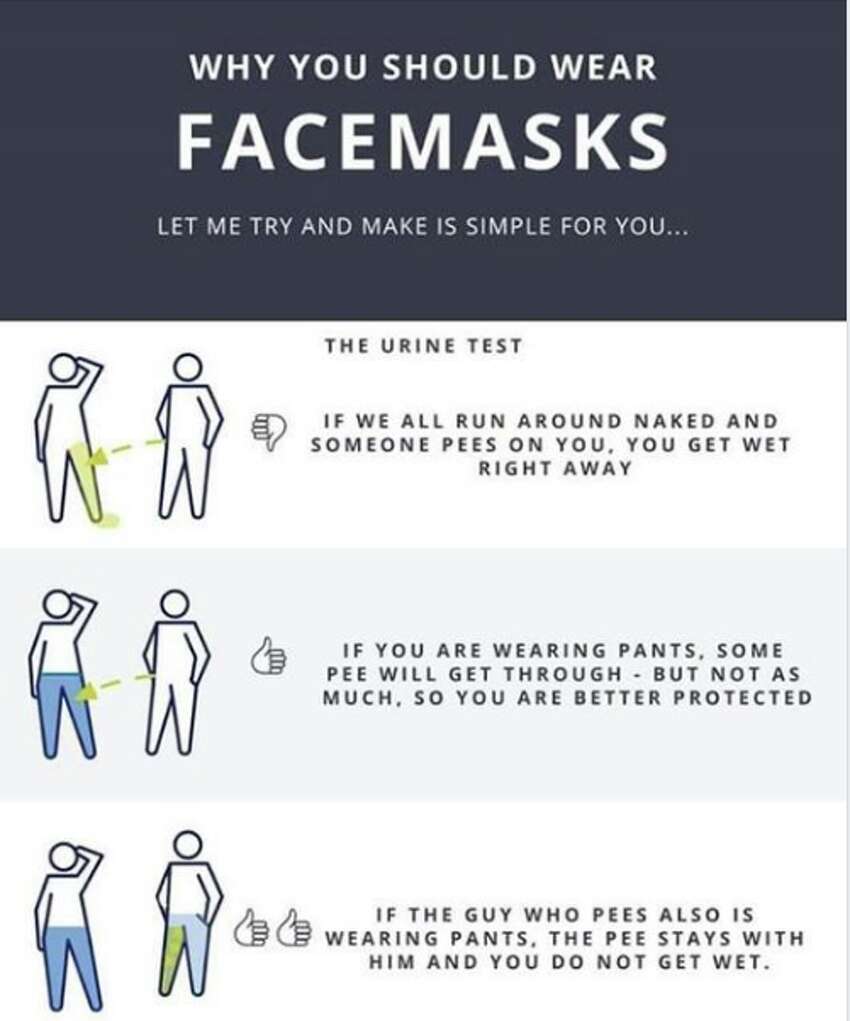
The mask still protects other people from transmission by you.
Anti-maskers wearing lace 'masks' does not protect other people.
They are completely different, and that is the main point of mask wearing for the general public - to protect each other by reducing the chance of ourselves transmitting it if we have it.
You're pretty much back at ubiquitous and widely available surgical style masks at that point.
If you want to do that you can just wear a surgical mask instead.
An inhalation valve preserves the mask's primary purpose by closing off during exhalation. It gives up a small amount of protection for the wearer, but obviously a lot of people aren't interested in that anyway and refuse to wear masks. With an inhalation valve they could at least protect others.
It doesn’t just assume it. It’s the whole point of the masks.
If your aim is just to prevent making people sick, a surgical mask is just fine (exhibit A, normal doctors).
If your aim is to prevent getting sick yourself, a N95 respirator is a better choice (exhibit B, doctors treating COVID patients).
An inhalation valve does less to protect other people, because the expelled air still has to go somewhere, and will just blow out of the sides of the mask. It could theoretically go through the mask material if it was thin enough, but there’s probably too much pressure inside and it’ll burst out the sides.
That in reverse is the whole idea for masks with an exhalation valve. Breathing in creates negative pressure inside the mask, so air gets pulled inside through the mask. When breathing out the valve opens and releases the extra pressure without blowing out the sides (not really a problem per-se, but would compromise your protection).
No, an inhalation valve makes 0.0% difference here. Here's a simple mental exercise to understand better. Imagine two people side by side. They are wearing identical masks, except one has an inhalation valve. They breathe in, pause, breathe out. In your mind, freeze the frame at the pause between breathing in and breathing out. At that moment, what's the difference between the two? Nothing. Now watch them breathe out. What's the difference? Still nothing.
> Where is this coming from that only a small amount of protection is provided to wearer [...] public health authorities
I clicked the HN link to your comments. I couldn't quickly find studies, just a mention of Korea having success with KN94 masks. I think it's safe to repost them now without being repetitive.
I always thought they are meant to protect the patient from doctor coughing directly into an open surgery wound.
The relationship between particle size and the ease of filtering them is U-shaped, not linear, with the dip at around 2.5 micrometers being the bottom of the trough.
I think for the most part health professionals answered specific questions about specific types of situations or types of transmission, and the media runs with overly broad statements when are then pushed/rejected by different parties.
There are many inputs that go into something as simple as a recommendation of "should the general public wear masks", including "are there enough masks for health professionals currently", "what's the current infection rates", "how far has it spread", "what type of masks". Additionally the answer might be different at different times in the past depending on whether talking about a locality with an outbreak or the whole nation. Expecting the answer as to whether wearing a mask to help to not change over time is as silly as expecting it to not change pre-COVID-19 start and after it.
The bottom line is that the inputs that influence the recommendation are fluid and change over time, so we should expect the recommendation to change over time, and the only reason people aren't getting that is because it's in the best interest of different groups to position it otherwise so they can use it to score points (and while the obvious groups in question are political, they aren't limited to one side of the spectrum, this is a common tactic used across the board which is particularly troublesome when it attacks the credibility of the people we trust to tell us how to protect ourselves).
The US Surgeon General https://twitter.com/Surgeon_General/status/12337257852839321...
> Seriously people- STOP BUYING MASKS! They are NOT effective in preventing general public from catching #Coronavirus, but if healthcare providers can’t get them to care for sick patients, it puts them and our communities at risk! http://bit.ly/37Ay6Cm
Highlighting
> They are NOT effective in preventing general public from catching #Coronavirus,
(Edit: This is from March, just to be clear that he's not saying that now.)
>Fauci: Right now in the United States, people should not be walking around with masks.
>LaPook: You’re sure of it? Because people are listening really closely to this.
>Fauci: …There’s no reason to be walking around with a mask.
https://www.factcheck.org/2020/05/outdated-fauci-video-on-fa...
Consider, the situation is that people think if they get a mask, they are protected, and can go about their lives as they were. Also, there's a shortage of masks. Given the option of "stay away from large groups of people and public events" or "wear a mask and feel protected", saying "stop buying masks" might mean something slightly different then than it does now.
At the same time, I acknowledge that's a particularly egregious example. To that I say that the Surgeon General is a political appointee, and our government and the politicians that make it up (all of them) have failed us to various degrees. That interacts with what and how the health professionals have communicated with the public, but in a much less straightforward way (if there's different messaging coming from government health services and the general health community, and the government sources are counterproductive, who did you trust, and who do you blame?).
You can read Fauci's statements on what he said and why here[1], but the main things to thing about are:
- What did we know about transmission at the time those statements were made?
- Where was the outbreak at those times? Localized to specific areas, or nation-wide?
- Was it responsible to report to the whole nation that they should be wearing masks given those facts? What if we know there's not enough masks, and that means masks go to areas that don't need them?
The bottom line is, should we have expected anyone to act differently given those conditions and that knowledge at that time? You can note someone made a wrong decision in the past, but if they made the correct decision given the information they have, you can't rationally hold them accountable for the outcome (and if we're not speaking rationally, then we're not actually discussing anything, just airing grievances).
1: https://www.businessinsider.com/fauci-doesnt-regret-advising...
Yes? This isn't a school classroom. It's okay to cheat on the test. You know who's best at handling this because you know they handled it last time. You ask your boss to ask his boss to get on the line with Chou Jih-Haw and ask for some of his best people. They're an allied nation with close ties who want even closer ties. They will gladly help.
And this isn't news. People were saying this in February, in March, in April. People whose full time job is other things knew this.
The real problem is that American public health institutions have NIH (haha, a pun!) syndrome.
You think that's Fauci's call? That's Trump's call. You're blaming healthcare professional's for doing what was best given the knowledge and resource they had available. I've made it pretty clear that the politicians failed us, and you've just pointed out another way.
> And this isn't news. People were saying this in February, in March, in April. People whose full time job is other things knew this.
All this does presuppose they have any actual help they could provide. It's unlikely they were willing to ship us a few tens (or hundreds!) of millions of N95 masks.
> The real problem is that American public health institutions have NIH (haha, a pun!) syndrome.
The problem is that they are beholden to the politicians, and even more so now, where appointees that speak out using their experience but contradict the party line are replaced.
There's been a lot of talk about how Trump is eroding people's faith in government and institutions, and here we have a prime example of that, where the institutions were clearly dysfunctional for obvious reasons that have to do with the executive branch, and we still have people shooting the messengers.
That includes my county health department (I asked if they would arrest me if I put a mask on or didn't take my mask off on a crowded transit vehicle - they said they would STRONGLY encourage me not to wear a mask on crowded transit vehicles if I was "healthy" despite my higher level of risk and that I shouldn't believe "disinformation". A month later they issued a mask mandate!)
Masks are cheap. For 10 cents to $1 you can save a life - perhaps cheapest intervention out there.
Unfortunately, health recommendations regarding this outbreak have been seen as fair game from both sides for political plays (there's no point in debating why or who started it for this discussion), and as such recommendations from the top had a political bent.
If there is a difference between what healthcare professionals and government agencies employing healthcare professionals recommended, we should note that and target our ire to the correct location.
When there was a toilet paper shortage, businesses were still able to get their supplies since they used a different supply chain compared to the end consumer. I'm surprised that this isn't the same case with PPE.
PPE is often literally the same product sold in consumer vs. healthcare markets. Sure, the distributors may be different, but it's the same goods from the same factories, and often the same packaging.
Masks are currently not required in public transport across the country, but that changes this Saturday. Up until last week I can count on one hand how many people I have seen wearing masks.
Now that people seem to have forgotten what social distancing means, masks are a useful tool. But if everyone just keeps their distance, they're not a must have.
Much less pathogen is needed to get you sick if it is stuck to something covering your breathing pathways on every breath.
Your N95 mask reduces your risk of getting covid by about 99.9%.
Why even wear a surgical mask?
Anyway, I think the issue with going to the beach isn’t the part where you play in the open air on the beach. It’s where a bunch of people go to a beach house and drink a bunch of beer in a small room.
To prevent others from getting covid from _you_ [0]
N95 masks are more expensive, take more effort (and training?) to use correctly and have limited reusability IIRC.
As a society, it's more efficient if everyone wears surgical masks, because that means every infected person is also wearing one, even those that don't know (yet) that they are covid positive. So in my opinion, it's a good thing if countries force everyone to wear them.
Good surgical masks are much nicer to breath in then fabric ones.
[0] https://s.hdnux.com/photos/01/11/66/67/19361245/3/850x0.jpg
> I wear and N95 under a surgical mask.
They’re wearing both a N95 and surgical mask at the same time.
What? I’m East Asian from a country known for mask wearing and this is definitely not how mask wearing is treated. It’s definitely to protect other people from you!
The second category are masks such as N95, P95, N99, P100, etc. Things like disposable painter masks or reusable masks with replaceable filters. These are meant to filter out particulate in the air and they do reduce the likelihood of you getting the disease. To call your mask P95 it must be certified by NIOSH and tested to meet the given rating, ie P95 must filter out 95 percent of particulate and be resistant to oil.
In the beginning the US and CDC were not recommending using masks. I believe the main reason for this was, not that they didn't believe it was effective, but that they were worried about a shortage for health care professionals.
Yeah, but instead of saying that they lied and said masks don't work.
I wonder how much of the current anti-mask sentiments arise from these lies.
I also don't see how you can blame the health authorities for this when half the political leadership in this country continually questioned (and in some cases still questions) the efficacy of masks and successfully politicized the issue.
Scott Alexander covers your point under this blog post https://slatestarcodex.com/2020/03/23/face-masks-much-more-t.... I believe at one point he felt similarly to you.
>“What the World Health Organization [WHO] and the CDC [The Centers for Disease Control and Prevention] have reaffirmed in the last few days is that they do not recommend the general public wear masks.”
A quick googling also produced this, from a site I've never heard of, but it naches my memory of the time: https://techstartups.com/2020/06/17/dr-fauci-admits-health-e...
It's possible they were wrong w.r.t. the harms outweighing the benefits but that's easier to say in hindsight.
"They are NOT effective in preventing general public from catching #Coronavirus" reads to me exactly as "you shouldn't wear a mask because they won't work".
That's not a lie, it's fact.
It's really easy for you to prove it's a lie: post a link to your best quality evidence that shows masks work.
I think he was right. If your glasses are fogging, RainX isn't your answer. Make the damn mask fit better.
"I don't regret anything I said then because in the context of the time in which I said it, it was correct. We were told in our task force meetings that we have a serious problem with the lack of PPEs and masks for the health providers who are putting themselves in harm's way every day to take care of sick people," Fauci told O'Donnell.
"When it became clear that we could get the infection could be spread by asymptomatic carriers who don't know they're infected, that made it very clear that we had to strongly recommend masks," he said.
"And also, it soon became clear that we had enough protective equipment and that cloth masks and homemade masks were as good as masks that you would buy from surgical supply stores," Fauci added. "So in the context of when we were not strongly recommending it, it was the correct thing."
So if you think masks _can_ help (now or in the future, with training, used correctly, when we have enough of them in the future, etc etc) then DO NOT say they do not help and then come back to that because you have "new information".
If the problem was sourcing PPEs for health professionals why didn't the government use emergency powers to seize shipments and ban selling of such critical products to the general population? At least temporarily while building stocks for health professionals (which I'm surprised we didn't already have stocks of, you know, that seems like normal preparation procedure for a national health emergency?)
And that's what Fauci was indicating at the beginning.
But all the good quality evidence we have so far struggles to find a benefit to masks. This is especially true for DIY cloth masks that are being mandated for the public, but it's also true of high quality N95 masks. We only see a benefit when we drop the quality of evidence down, but this means we have less confidence in the result.
https://www.publish.csiro.au/hc/pdf/HC15950
> RCT evidence was limited and showed no effect but accumulated evidence from retrospective case controls and cohorts all showed these strategies decreased transmission. N95 respirator mask OR 0.17 (CI 0.07–0.43), Gloves OR 0.32 (CI 0.23–0.45), Gowns OR 0.33(CI 0.24–0.45), All OR 0.09 (CI 0.02–0.35)
Note that this is for an N95 mask, not worse masks like surgical loop masks or cloth face coverings.
There's some research looking at post-operative wound infection rates. It can't find a benefit to surgeons wearing masks in clean surgery.
https://www.ncbi.nlm.nih.gov/pmc/articles/PMC7138271/
> Main results
> We included three trials, involving a total of 2106 participants. There was no statistically significant difference in infection rates between the masked and unmasked group in any of the trials. We identified no new trials for this latest update.
> Authors' conclusions
> From the limited results it is unclear whether the wearing of surgical face masks by members of the surgical team has any impact on surgical wound infection rates for patients undergoing clean surgery.
https://pubmed.ncbi.nlm.nih.gov/20524498/
> Conclusion: From the limited randomized trials it is still not clear that whether wearing surgical face masks harms or benefit the patients undergoing elective surgery.
Here's the most recent, very high quality, paper about masks and covid-19. This wasn't available when Public Health organisations were making their recommendations.
https://www.thelancet.com/journals/lancet/article/PIIS0140-6...
> Although direct evidence is limited, the optimum use of face masks, in particular N95 or similar respirators in health-care settings and 12–16-layer cotton or surgical masks in the community, could depend on contextual factors; action is needed at all levels to address the paucity of better evidence. Eye protection might provide additional benefits. Globally collaborative and well conducted studies, including randomised trials, of different personal protective strategies are needed regardless of the challenges, but this systematic appraisal of currently best available evidence could be considered to inform interim guidance.
This para is saying we just don't have the evidence yet. It's saying people should wear facemasks because masks may help, but we don't know, and maybe masks cause harm.
> Interpretation
> The findings of this systematic review and meta-analysis support physical distancing of 1 m or more and provide quantitative estimates for models and contact tracing to inform policy. Optimum use of face masks, respirators, and eye protection in public and health-care settings should be informed by these findings and contextual factors. Robust randomised trials are needed to better inform the evidence for these interventions, but this systematic appraisal of currently best available evidence might inform interim guidance.
Look at the difference in the description of distancing (supported) and masks (optimum use may help).
> Face mask use could result in a large reduction in risk of infection (n=2647; aOR 0·15, 95% CI 0·07 to 0·34, RD −14·3%, −15·9 to −10·7; low certainty), with stronger associations with N95 or similar respirators compared with disposable surgical masks or similar (eg, reusable 12–16-layer cotton masks; pinteraction=0·090; posterior probability >95%, low certainty).
Tucked away in this para is "low certainty". This comes from GRADE. Low certainty means that masks may be much more effective, or much less effective, than they estimate.
https://bestpractice.bmj.com/info/toolkit/learn-ebm/what-is-...
> Low The true effect might be markedly different from the estimated effect
This happened anyway. Telling noble lies to the population just increases populism and makes people distrust the government even more. Which is paying off wonderfully right about now.
Are you saying there have been studies showing approximately 0% reduced risk of infection from wearing a paper or cloth mask?
I'd have assumed that these masks are much less effective than an N95, but I haven't seen any data showing they have no effect.
Related: https://slatestarcodex.com/2020/03/31/ssc-journal-club-macin...
The obvious solution is: If you are at risk, or worried about COVID, don't leave your house. To everyone else: wear a mask, stay away from people, follow the precautions...but go do what you like (mostly).
What we're doing now is the worst of both worlds: not enough to actually eliminate the virus (not gonna happen in the US...it's just not. Welcome to America) and just enough to mess up the economy and put a lot of businesses out of business (and also just generally make life annoying).
So it seems to me pretty clear: let people do what they want as long as they wear a mask, and just pass a bloody law that says you can't fire someone cause they don't want to come into work because they are overweight. Seems a lot cheaper to just support those people staying home with a welfare payout/BI than shutting down the country for no reason.
Tell that to my buddy who almost died. Healthy, early 40s, no pre-existing conditions.
Also... there are plenty of people who do not fall in out-group rhetoric of being “Very sick, very old, or very obese” who are extremely vulnerable. Or, is that you just define “very sick” as anyone who is not like you?
(1) Best available evidence indicates pretty clearly that masks will prevent you from getting it sometimes. This is sharply different from early messaging that masks could increase your risk due to them somehow being viral-magnets and thus you risked infecting yourself.
(2) We have done many studies on many viruses and the consensus seems to be that the initial viral dose matters a great deal -- the lower the dose, the lower the severity. It's also fairly clearly established that, at their worst expected performance, masks will lower the dose you receive.
This is a disease in which the severity matters a great deal. We see wildly different ranges of outcomes/levels of severity.
And indeed, many of the worse outcomes are setting where it's reasonable to assume that there was a significant viral dose.
I think it's irresponsible to promote the idea that masks only help protect others from the wearer. While they clearly do that, the balance of probabilities of available data strongly indicates that they sometimes protect the wearer.
We've even had studies as specific as having examined masks with SARS-CoV-1 -- to pretend that none of our medical knowledge indicated that masks are helpful for SARS-CoV-2 is insane.
The "risk compensation" concern which was claimed as one of the reasons to pretend that masks weren't helpful has been thoroughly debunked as a false concern. Additionally, while they were busy talking about "lack of evidence", their "risk compensation" concerns were also completely lacking a foundation in evidence.
The whole situation disgusts me. "Doctor knows best" and "we can't tell people the truth because they might not respond the way we want" attitude has to stop -- it destroys the fabric of society and the credibility of health experts.
Why would people ever trust words of officials when it is obvious to anyone paying attention that their messaging was focused on avoiding blame for contingency planning failures instead of focused on providing true, accurate, not-misleading and helpful information.
Here's an example from the United States Surgeon General:
Seriously people- STOP BUYING MASKS!
They are NOT effective in preventing general public from catching #Coronavirus, but if healthcare providers can’t get them to care for sick patients, it puts them and our communities at risk!
You want people to believe that your plan is to use these ineffective masks to protect healthcare workers? Are the healthcare workers a different species than the general public?
Of course it is clear that if someone has covid and wear a mask, the probability to transmit covid will decrease (I was actually encourage people to wear a mask 6 months ago), but will it stop ? no. people can still transmit it by touching you. So yeah this is decreasing the risk, but is it decreasing the risk high enough that it will prevent the virus to spread ? Nobody has answered the question yet.
In France the mask is mandatory almost everywhere and still the number of cases keep increasing
> "If we were to run into the same disease, knowing exactly what we know about it today, I think we would end up doing something in between what Sweden did and what the rest of the world has done."
https://www.npr.org/sections/coronavirus-live-updates/2020/0...
He's on record saying mask requirements will be needed if cases started going back up:
https://www.thelocal.se/20200804/tegnell-if-we-see-problems-...
and Sweden wound up with de-facto lockdowns anyways, as many people did it on their own without government instruction. The end result: Same economic damage as the other Nordic countries, but substantially higher deaths.
https://www.nytimes.com/2020/07/07/business/sweden-economy-c...
> no. people can still transmit it by touching you.
That's an argument for "don't touch people", not "don't wear masks".
So if cases started going back up, which is not the case for now, so this is not an argument
> The end result: Same economic damage as the other Nordic countries, but substantially higher deaths.
You compare the economic impact of one country which was hit by the virus (Sweden) and one which was not (Germany,Finland, ...). What is going to happen if the virus restart in Germany and Finland and not in Sweden ?
If you're going to make the "Sweden did things right" case, "Sweden got it bad and Germany didn't" is an odd position to support the argument with.
Of course, a lot of the US has lost patience with the difficulty of safety, so I wouldn't be surprised if it's worse now. But that's not because of lockdown not being effective. In fact, it's the opposite.
And let's not forget, in the US H1N1 infected 60M people and only killed 12K of them.
The rest of the (developed, and many underdeveloped) world dealt with it and are moving on. I'm watching Champions league finals on TV and Wuhan pool party clips on twitter, thinking wtf went wrong here.
They did at the outset of the current administration but chose to fire the people trained for 'reasons'. When the pandemic finally pressed on the country, the game plan handed down from the previous admin had been abandoned for years at that point by the current administration.
The logic remains breathtaking, and the irony would be delicious if it weren't so deadly.
I'm not really sure on that, lets take greece, which was praised for their strategy (I was in greece during the lockdown). They didnt have a strategy, they just locked down before there was an outbreak and blocked flights, so no spread. Now they have an outbreak because they stopped all there restrictions. They were just lucky
Look at New Zealand, their strategy is to prevent anyone to enter the country with covid, well that works as long as not a log of people fly to NZ. Now that flights have restarted, they have like 3 cases so they lockdown the entire city, well, doesnt seem very smart in my opinion.
The only countries which are doing well, are the Asian countries, China (can't really trust their figure), Taiwan, south korea same as NZ, but restricting all freedom of citizens.
The smartest country of all, is Sweden, never locked down, explained to citizen the situation. Managed to get the situation under control without any lockdown, and probably will reach herd immunity before anyone else. Time will tell this is too soon to judge, but they seem well positioned for winning
I keep seeing this narrative but I can never find the data to support it. When you look at the data, Sweden has the worst of both worlds.
1. Among their neighbors, only Germany has more deaths than Sweden. Norway, Denmark and Finland have fewer almost an order of magnitude less cases and deaths.
2. Despite not being government sanctioned, people still chose to self isolate meaning that the still suffered the economic fallout of that decision. Turns out, a global pandemic is bad for business whether or not your government decides to shut everything down.
There is no metric by which Sweden is doing any better than anyone else, and is doing a lot worse than their neighbors.
Geographic comparisons are of limited usefulness; MA had 10x the death rate of near neighbors NH,VT& ME. There are too many other factors to consider. Sweden still did better than UK, France, Spain, Italy and many others.
>> 2. Despite not being government sanctioned, people still chose to self isolate meaning that the still suffered the economic fallout of that decision. Turns out, a global pandemic is bad for business whether or not your government decides to shut everything down.
Mobility data would suggest otherwise; no masks, kids still in school etc. Life has continued with some restrictions. We could have done the same with similar outcomes. Economy definitely took a hit, but less so than other eurorzone countries.
>> There is no metric by which Sweden is doing any better than anyone else, and is doing a lot worse than their neighbors. The fact that the pandemic is effectively done in Sweden is one. We still dont have an exit strategy.
Acting like this is a foregone conclusion is the height of arrogance. Diseases spread in waves. They could just be at the low point between two waves.
We won't know until years from now. Just asserting you're right when there are still this many unknown factors smacks of someone looking for data after coming to a conclusion.
fair point, but do you know that the under 65 excess deaths metrics for Sweden is already almost identical to previous years ie. if you were looking at the charts you would not even know they had a pandemic. I suspect "years from now" looking at the US metrics it will be similar.
You can clearly see excess mortality for Sweden, higher than previous years.
Edit: missed the under 65 bit, would be interested in seeing that data for Sweden, but you can see the collated graphs for all the countries that contribute and you definitely can spot spikes in the lower age ranges.
Deaths per 100k:
Norway: 4.9 Finland: 6
...
France: 46.8 Sweden: 57.6 Italy 58.6 U.K.: 61.1 Spain: 61.7
The number of case is under control [1], almost no death now (and not hiding after a lockdown, really no death) so probably less death in the future compared to those countries
[1] https://ourworldindata.org/coronavirus-data-explorer?zoomToS...
If you look at Belgium 859 deaths per millions, Sweden (and the US) could go much higher without any preventive action (I believe Sweden is now acting more in line with other countries?).
(Source: https://ourworldindata.org/grapher/total-covid-deaths-per-mi... )
So the numbers are bigger, on purpose.
Source: I'm from belgium
The US also has spectator-less sports going on, I'm not sure how that's any different.
That in addition to the federal government not supporting people and businesses while the economy is shut down, leads to this obvious outcome we're experiencing right now.
Wearing a mask is mostly about keeping the respiratory droplets of the ill, including the 40-50% which don't have obvious symptoms from spreading around. If only the vulnerable wear masks they wont be safe.
Sure, you can be selfish, but you're also negatively impacting society and saying that you don't care. You do you, but I don't get it.
Sorry if I was a bit harsh - had someone yell "America" at me while running with a mask the other day but I shouldn't project that frustration onto others.
If you're going to attack others for their alleged ignorance maybe you should get basic numbers right? Covid hasn't killed 'millions', it hasn't even killed one million people. You're off by at least an order of magnitude.
Power rack: $300-500
Weights: $200-800
Bench: $100
Bar: $75-100
Plywood and rubber: $40-100 max
I rent a room in downtown of a big city and I simply don't have space for equipment (my room is mostly just bed with small kitchen and bathroom). Don't assume everybody is rich and owns a house with spare room / garage where you can put equipment.
I am 30+ years old and never lived in a place where I would have spare space for gym equipment. You must be very privileged if you have that (top 1% at least).
Thanks for downvote though.
If you're in a city there has to a playground nearby providing all sorts of options.
I think people just get too tied to a gym, when there are countless options to get really good workouts if the gym is unavailable for a period of time.
It is possible to get good workouts with minimal equipment.
The problem is that you are effectively deciding how others live their lives through your careless actions. Everyone should have a say on how they want to live their lives, not just you.
Originally he erred way on the side of caution, because we did not know enough. We learn more every week, and his current outlook is a lot like what you just wrote.
The big remaining problem is this is not going away anytime soon. There's more politics than science going on, and there have been institutional failures world-wide from top to bottom.
This is nothing more than a tantrum. Nobody can "prove" it. Humanity is still learning about COVID-19. No model is going to predict the outcome of closing the economy. It has not been done in modern times at this scale.
>0.5% death rate for population
Google is showing the death rate at ~3% worldwide. 6 times higher than your nonsense 0.5% water-level figure.
You're commenting later down the chain that you wish to frolic at the beach. The fact is, you're sick of inconvenience and will stomp your feet until someone hears how sick of it you are. Go cry elsewhere.
Confirmed Cases: 21,991,954
Deaths: 777,018
World Pop.: ~7,800,000,000
Case Fatality Rate = Deaths/Confirmed Cases = ~3.5%
Death Rate = Deaths/World Pop. = ~0.01%
It is also very strongly correlated with pre-existing conditions and age.
That's similar to claiming that, because only 93% of all humans ever born have died so far, your risk of dying is 93%. It may be mathematically sound, but completely ignores the context of the problem: That for the living/not-yet-infected the result is still outstanding.
If you're ready to listen, the proof is already there.
It's not a matter of proof, it's a matter of weighing the cost of action vs the possible outcome. Just like insurance, there's a low cost of action (low continuous payments) to hedge against a possible large negative outcome. It's also worth noting that some types of insurance are mandated because people are bad at calculating risk in general, and when they fail, we as a society don't necessarily want that to have too extreme an outcome, so we have societal guards in place to help. Mandated insurance shifts the burden from society (taxes) back the the individual. We see this in health insurance, car insurance, home insurance, etc. Sometimes it depends on region (some localities requires fire/earthquake/flood, etc insurance).
> people who are at risk of dying can protect themselves even around sick people (wearing a mask, staying at home, washing hands, ...)
To clarify, wearing a mask, as recommended by most officials currently, is not about protecting oneself, but about protecting those around you in the case you are unknowingly contagious. It greatly reduces the spread of your contagion, it does not greatly reduce your chance of being infected unless you are using a high-grade mask very securely fastened such that all airflow is through the mask and not around it.
> so this is not your fault if they catch it
It very well may be your fault if someone catches it if you're contagious but ignoring recommendations about avoiding gatherings of people, or not wearing a mask, etc. They could literally catch it directly from you with little ability to block it. A sneeze can travel very far, yelling expels particles with more force, and direct contact with people or surfaces they touch shortly after and then may touch themselves or something else they touch after washing their hands is not something easily protected against.
> but you need to stop living your life.
This, right here is the crux of the issue. What is being asked for from people ranges from not working to curtailing social group gatherings and activities. The work portion is horrible, and life altering, and actual affects people living their lives. The group activities being classified as "living your life" is both a) relatively recent for the vast majority of the world, which did not have the free time or money to do such things on a regular basis decades ago, and b) shows a complete mismatch by people of what the need and what they like and want.
A vanishingly small number of people actually need to go to the gym (those in physical therapy that need certain equipment), and the others can get basic exercise at home or outside without anyone around. Nobody needs to go to a bar. That we classify these niceties as "living our life" is really just a shift of priorities of modern people in first world countries away from actually having to worry about survival. But this is a matter of survival, and those thought patterns are doing us real harm as a society during this crisis.
> It is not that people don't want to sacrifice, it is just that scarifying is the worst solution for everyone
No, it's that people are unwilling to separate simple and (relatively) easy sacrifices from hard sacrifices, and acting like they're all the same. Get food from restaurants, but limit or eliminate the in-restaurant eating/time (you don't have to order door-dash, just pick it up). You don't have to stop drinking, or talking to friends, but you shouldn't do those in person when avoidable.
Collectively, people stopping the non-essential gatherings such as gyms and bars will not only reduce the spread and save lives, if everyone did it we might get back to the point where the increase in cases was so low more optional services could reopen again, lessening the economic impact.
It's not about scarifying, it's about making people actually understand how this works, and how their actions actually play into this when carried out by massive amounts of people. And when it comes to bars and gyms and people being unwilling to change their habit, it is also a bit about people not wanting to sacrifice. In the grand scheme of things, those are fairly small changes to ask for, and if people can't even bother to do that, what hope is there that they'll follow through with other things?
The "masks only protect others from you" narrative (which may turn out to be false) certainly increased that.
Maybe because nobody successfully proved to these people (me included) that this sacrifice is useful.
You can't tell to people, you have no risk of dying (0.5% death rate for population, much much lower for healthy and young people), people who are at risk of dying can protect themselves even around sick people (wearing a mask, staying at home, washing hands, ...) so this is not your fault if they catch it but you need to stop living your life. That can't work.
And above all, what is the long term strategy, we stop everything for the rest of our lives ? (a vaccine doesn't always work, example the flu vaccine, which works approximately).
It is not that people don't want to sacrifice, it is just that scarifying is the worst solution for everyone