I don't think that's a fair reaction. It's possible to care about the rest of the world and recognise context. Workers looking for greater bargaining power in the US shouldn't accept "but things are much better in Eastern Europe these days" as a reason for them to not organise - the two are entirely separate issues, and can happen independent of each other.
Now at its disposal, a government can implement tariffs and protectionism to level the playing field, but those can have disastrous long term effects (see the history of India's protectionism).
So, an excellent way for wages to rise is to make employees extremely efficient, and to increase the demand in labor. Make no mistake though, the gains in other countries have effected US and European workers.
It's easier to get away with worker hostile policies for an employer when the employer's option if workers object is not "no workers" but "I guess I have ti shift production to China".
You're right that it's not directly related to the decimation of unions. That has other things going on, and different things in different sectors.
The absolute improvement is great.
The accelerated concentration of Wealth is not.
The term economists have now settled on and are considering is the very mundane “lack of social mobility”
It’s a problem.
Yes, exactly. The reason actually is very simple: wealth inequality results in inequality in political (not to mention legal) representation, as the wealthy always carry more influence in society and use that influence to stack the odds in their own favor.
It’s pretty much the same line parents use on their children - I don’t think it works for them, much less adults.
The conclusion that I draw is that while people broadly in this position might accurately perceive that they are now in a more comfortable short-term position than they were, they are at high risk in the medium-term and long-term.
Secondly, it's not clear whether wealth has improved for poor people (something I should take a look at...).
https://avc.com/2016/08/elephant-chart/
The chart, as I understand it (in limited reading), tracks three phenomenon:
1. Increasing wealth formation by more disadvantaged groups in non-first world countries (the "body" of the elephant).
2. Wealth stagnation for middle classes in first-world countries (the "dip" in the elephant's trunk).
3. Increasing returns to capital held by upper classes in first-world countries (the "trunk" of the elephant).
I found this version [1] showing that, in absolute terms, the gaps are actually increasing.
[1] https://patternsofmeaning.files.wordpress.com/2018/05/elepha...

In any case, you are not necessarily addressing my rebuttal of the elephant graph. What I'm saying is that the elephant graph is an interesting conversation starter, but, by itself, it does not convey enough information to make a conclusion about fairness. To make an extreme example, if I have literally $0 last year and I have $1 now, my growth rate in the elephant graph is infinitely higher than the richer 1%. I'm still going to starve to death, though. Absolutes matter.
My point is that knowing only the fact that "absolute inequality has increased" doesn't tell you anything about whether that's good or bad for the world.
I agree that absolutes matter to the individual - but I personally think percentages are a better way of understanding and interpreting growth over time for most populations, because growth has historically been very consistently exponential.
A growing absolute wealth gap can still lead to reduced quality of life for lower-wealth groups - e.g. because prices rise faster than their incomes and so they effectively lose access to certain goods. It will also increase inequality and makes other economic measures (that rely on the mean) less reliable.
Just because an effect is always present, doesn't mean you can ignore it, especially if doing so would flip the conclusion. Posting the elephant graph as an argument that all is going well would do exactly that.
[0] https://ourworldindata.org/global-economic-inequality
specifically from eyeballing
https://ourworldindata.org/wp-content/uploads/2013/11/Global...
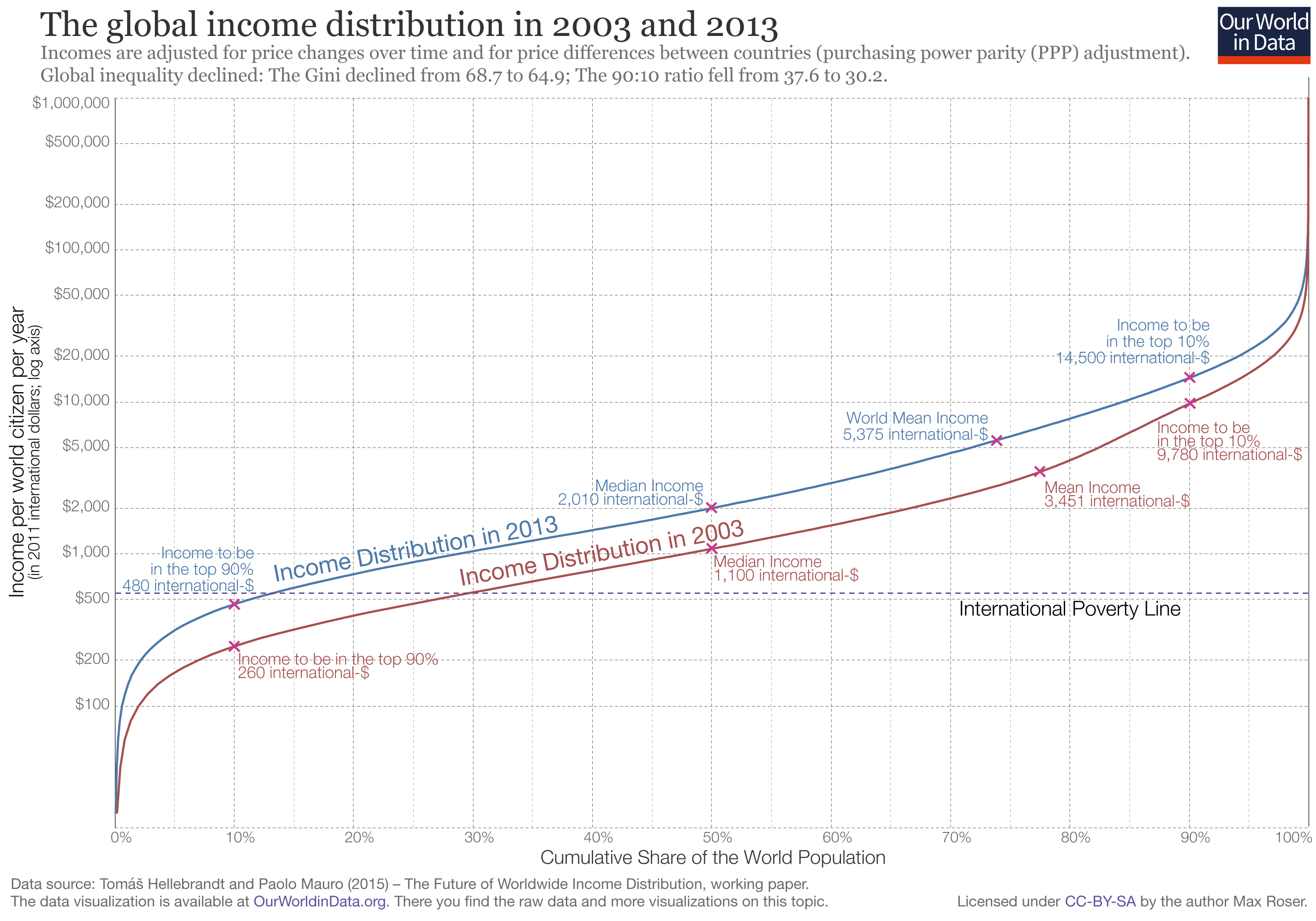
Fixating on silly numbers that ultimately mean nothing doesn't seem like a good way to make the world better. We should look at concrete things - and how often you can eat an orange is the kind of concrete thing that really matters.
1) The percentage of people living in cities as compared to living in rural areas has increased dramatically (https://www.census.gov/library/visualizations/2016/comm/acs-...)
2) Large cities (NYC, San Francisco, etc), have lots of regulations to building more housing
3) Demand for housing in large cities has exceeded supply for decades
4) Student loan debt has destroyed purchasing power for folks in their 20s and 30s, the average student loan is almost 40k (https://studentloanhero.com/student-loan-debt-statistics/)
Leaving NYC, even after taking a pay cut, was one of the best decisions I ever made. I don't have data, but I suspect that for young folks outside of the largest 20 American cities, if they didn't have on average 40k in student loan debt, they would have more purchasing power then previous generations even including real estate.
Those days are over. Germany has a huge real estate problem right now.
There are factories in villages too.
Many things are much more inexpensive jeans, shoes (functional not trendiest), entry-level tools, computers, media, etc.
Whats not more inexpensive and what imho really actually matters are things like education, housing, and the barrier to entry to careers (require licensing, certfications etc.)
Yes. The delta between the richest and poorest indicates a lot of things about a society.
You can go to a place like Mauritius where the delta is enormous, but everyone is pretty happy and the rich and poor mingle freely. Or you can have a place like France where the delta is far smaller, but the rich and poor detest each other and very rarely mingle.
The top 1% in France has about 20% of the total income as of 2014.
For Mauritas no suitable data was found for wealth inequality or dispersion of earnings.
The lack of good data for Mauritas makes a comparison between the two questionable.
Plus even after looking at the numbers for these countries I would want to check out money laundering - if I recall, based on the Panama papers, a nontrivial amount of the 1% (probably more like the 0.1%s) wealth is laundered/hidden/dark. I don’t know if the studies here attempt to account for that or not. I would imagine money laundering is prevalent in France (or any major economy for that matter), possibly in Mauritas
https://www.chartbookofeconomicinequality.com/inequality-by-...
https://www.chartbookofeconomicinequality.com/inequality-by-...
Information on data sources here - https://www.chartbookofeconomicinequality.com/about/
As of 2018 the population of Mauritas is 1.26 million (via google search). The 2018 population of France is 65.23 million (via google search). The 2014 population probably was not radically different.
I wonder if the size of the society in question matters here - is comparing a country to one 65 times larger than it useful?
I did not look for data to validate the hypothesis that everyone is pretty happy in Mauritas as opposed to France.
Doesn't do a single thing to address the point made.
Why are people trotting out chicken as an example of healthy food? It is anything but:
https://www.huffingtonpost.com/2014/09/15/poultry-farms-anti...
Obviously, no one food is healthy, note that I named a couple different "healthy" foods. Having a balanced diet is important. Nothing about your article seems to point to chicken being unhealthy to eat. I don't even know if you read the article.
> Why are people trotting out chicken as an example of healthy food?
Are you kidding me? If you're vegan, just come out and say it, or make an actual point. Part of my response was related to affordability, which is hard to beat when it comes to chicken as a source of protein. What healthy alternatives do you have?
I started watching the second link. Interesting stuff. Maybe chicken isn't the most healthy option, but I don't think it's evil.
How can getting antibiotic resistant E. coli from eating chicken be healthy?
https://www.nytimes.com/2018/05/25/opinion/sunday/meat-antib...
> What healthy alternatives do you have?
Beans are pretty great.
> but I don't think it's evil.
People in Medieval Europe did not think that torturing animals to death for entertainment was evil. It is obviously evil to people in Europe today, just like breeding and enslaving animals in horrific conditions only to slaughter them for food is obviously evil if you take a moment to think about it.
https://www.webmd.com/hypertension-high-blood-pressure/news/...
If you're thinking the unhealthy food in the grocery store is cheap, that's also not true. Chips are $3-$5/bag while 3 pounds of onions is $2. I could go on.
Poor people are likely to be both cash-poor and time-poor: it's not a question of "being bothered". If you have the available time to fully consider, process, and follow this advice, then you may not realistically be poor at all.
And, if you did manage to follow this advice, you would likely still be poor - saving pennies on food is not any way out of poverty.
And lets get off of this no time argument. Why do all these people with no time still have TVs? The average American watches ~5 hours of TV per day. Watch 4 hours instead and cook a healthier and cheaper meal.
That's a complete non-sequitor. You're going to have to provide evidence that those who are poor are the ones watching tv so much, and don't have the time because they're working multiple jobs.
She kept the house stocked with canned soup and lunch meat because a 6 year old (me) and a 12 year old (my brother) could manage to make a meal out of it while she was working.
https://www.cell.com/cell-metabolism/fulltext/S1550-4131(17)...
The research done concluded that differences in Gut Microbiome meant that "The glycemic response to the two types of bread varies greatly across people".
More food for thought (Pun intended :p )
I do think in the general case though, that people usually have 1/2 hour to cook if they wanted to. Are there going to be exceptions like yours? Absolutely.
Which, if you're working 2 jobs, you very well might not have.
"If you're thinking the unhealthy food in the grocery store is cheap, that's also not true."
Time is also a cost. So is the ability to store food.
Not everywhere.
"Maybe you don’t care that much about the world outside the US or Western Europe, but literally billions of people have seen their living standards rise from the subsistence level to a decent level."
That's very uncivil of you. There is lots of poverty in the US, and despite popular opinion, there is lots of hunger here too.
The "locally grown food" in many cases was little more besides white flour and mincemeat. (A situation that still exists in parts of rural Russia.) The only tea that could be drunk was usually a single variety of black tea. I think "poverty" is a reasonable adjective for that state of affairs. The fact that people in urban Russia today do have access to a vastly wider choice of food is a significant advance.
It is amusing that use the term "richer" to dispute my claim above that Russians are less poor.
[1] https://en.m.wikipedia.org/wiki/Soviet_famine_of_1932–33
The millions of deaths (irrespective of the famines ultimate cause) in the USSR and especially in the Ukraine in 1932 / 1933 are well documented (2-4 million deaths estimated):
https://en.m.wikipedia.org/wiki/Soviet_famine_of_1932%E2%80%...
There was also a Russian famine in 1922 where an estimated 5 million people died:
https://en.m.wikipedia.org/wiki/Russian_famine_of_1921%E2%80...
There is a Wikipedia article on “hunger in the United States”, but a google search for “United States Great Depression famine” did not return any Wikipedia articles documenting a famine in the US at that time, only the above Stack Exchange discussion (which appears to reject the hypothesis).
FYI: https://en.m.wikipedia.org/wiki/Hunger_in_the_United_States
Without data to back up the claim of a famine killing millions in the US during the Great Depression the comparison used here is nonsense, although there may be other evidence for the point the author was attempting to support.
In countries like Canada and the EU, where opportunity is more equality distributed, we still have the problem of increasing gains going to the rich. I sold a company at 27 for fucks sakes, the vicious and virtuous circles that the internet enables are stratifying wealth. We need more regulation to stop the vicious circles from forming and we need more redistributive taxes with global coordination to stop region shopping. Also, we need to delink mortgage interest rates from general interest rates to stop bubbles from forming in housing. If housing wasn't 5x as expensive in real terms much fewer people would care about the rich getting richer. The problem is that, in some respects, housing is an arms race so even though society is getting richer the poor and middle class can't ever stop struggling.
No not really, you boil it down to that, but that's simply your framing nothing more. There's also the regulatory environment, so no it's not all about tariffs. There are almost no environmental controls or labor laws in China. So that is a huge factor. There is equal or more possibility that companies wish to avoid the responsibility of ensuring compliance as they do with merely avoiding taxes.
"If you want fat, state protected corporations then fine"
How does restricting the supply of unskilled labor from illegal immigrants and border crossers, visa holders of various stripes have anything to do wit fat protected corporations?
The reality is that, globally, there is a low skill labour glut because most countries are only now developing advanced education systems. If you want to stop competition from low skill labour you ultimately need high tariffs or extreme mechanization / automation, neither of which are good in the long run for poor people here.
Try again, this time taking observed facts into account.
https://www.economist.com/finance-and-economics/2016/09/17/s...
A common interpretation of this is that globalization has resulted in the middle class of wealthy countries now competing with the hungrier, more desperate residents of poor countries. This suppresses the former's wages and raises the latter's.
Capitalism will always have a "race to the bottom" to find the cheapest way to complete a product or service at the lowest possible cost. It can be exploitative, but it is not a zero sum game. With every passing year human society bootstraps itself into more wealth that is used to solve our daily problems.
To me, this is net positive to the world. The global poorest are in the most need of more income, and stand the most to benefit. Efforts at redistribution and charity, while well-meaning, pale in comparison to individuals working hard to better their lot in life. The middle classes are not suffering too greatly on net from globalization (their income did not shrink, it merely stagnated or rose less quickly).
It is easy to weave and popularize a story of middle class deprivation and suffering, because this story provides an interesting tale of the demise of bourgeois values- and who doesn't like that story? But in reality the economy is more nuanced than that. Maybe in some number of decades, the elephant curve will begin to flatten out as enough people rise to relative wealth, or cheap energy will boost the economy with gusto. Until then the middle class can wait.
The way that has been selected, at least in the United States, is that we detached wages from productivity. This means that the benefits from offshoring production (which is good, get more people involved in the economy) is enjoyed by those that receive those jobs, and by those who own capital, while the costs are carried by the middle class of the US.
You say it isn't a zero sum game, but then why in the hell is the middle class in the US getting wiped out, while we produce more and more billionaires?
The pie is growing, so it's possible for the rich to have a larger percentage but everyone still see gains. This is manifested by rising standards of living, more purchasing power, and so on.
The US dollar has also gained a lot relative to foreign currencies since 2008, which makes imports cheaper and further boosts American standards of living and purchasing relative to the rest of the world.
The emphasis should be on boosting living standards than trying to enforce equality.
They are consuming an increasing percentage of a much slower growing pie. This is a problem. Nobody is talking about enforcing equality but about avoid inequality growing even more.
How do you pull that off without enforcing equality in some way?
We could also tax capital gains at the same interest rate as regular income or get rid of the mortgage deduction. These mainly benefit higher incomes and I believe the mortgage deduction drives up home prices.
Do we then drop corporate income taxes? One reason capital gains is lower than income is because the value was also taxed on the corporate profit side. In order to make investment more appealing capital gains is thus set lower to offset the double taxation on the growth.
AFAIK many (if not most) do this for this reason (and a few others, like capital gains not taking into account inflation, etc.).
It's also why the rich have an effective tax rate about 10% higher than their income tax since they're paying the corporate tax. Here's [1] a CBO report on effective tax rates by income distribution showing this.
[1] https://www.cbo.gov/sites/default/files/cbofiles/attachments...
Rich people get richer through dividend payments or capital gains. But if they keep reinvesting the capital in their business then they'll be able to defer tax forever..
You can reduce inequality by limiting the wealth you can generate from a corporation.
In some places. And the new tax bill placed caps on those, so living in high cost of living areas, because that's where the jobs are, means you're probably not going to be able to afford a house.
I don't believe this. People tend to max out what they pay for their mortgage so if they have a tax deduction they just will pay more for houses. Which then benefits the owning class.
If you remove mortgage deduction, I'll buy 10 houses just because others can't use their deductions to offset the mortgage.
There are all cash buyers sitting around the corners.
I advocate for capping the total mortgage deduction.
I agree about capping. Same for capital gains. Put a cap on it that lower income have an incentive to invest.
Capping mortgage deductions would also make real estate "investing" less interesting so the money would go to other purposes than driving up house prices.
Basic utilities/services being improved and increased such as education, healthcare, vocational training.
Investment in public resources such as public transit, roads, and public parks.
Increased low-income housing availability.
Higher (not absolute equality) taxation rates.
These aren't hard fixes and have relatively widespread support. They are just unpopular when it comes to those in power of our political system currently.
And before someone says it, making things closer to equality is not enforcing full equality. We already have basic services that would qualify under that and the only way you can be consistent under that argument is to go full libertarian, which hasn't seem to have worked out practically for populations at large.
The rich are consuming an increasingly large percentage of a very slowly growing pie, so while you are technically correct, you seem to be unfairly dismissing a real issue here.
Purchasing power is cool, but necessary goods (food, housing) prices* are raising much faster than wages. Yes, you can buy a new fablet and yet another pair of jeans for cheaper than ever, but what for exactly?
* Please do your own research as these facts are highly location-dependent.
Housing is an entirely different matter.
Individuals seldom pay the stick price. A $10k/month drug does not mean one pays $10k/month out of his or her own pocket. Same for a $1,000 emergency room visit. Or college tuition, due to generous financial aid and payment deferment programs (some universities have huge discounts for low and middle-class students).
So one must adjust prices for what one actually pays, not the MSRP.
Second, although people are spending a lot on healthcare, they are getting more healthcare and better healthcare, which is the key distinction. This means cutting-edge treatments for diseases that decades ago would have been fatal (a notable example is CML, which used to be fatal within 3-6 years of diagnosis but can now be managed as a chronic condition like diabetes).
Healthcare would be very cheap if drugs were limited to Advil and Aspirin, but also very bad. People would be irate if those were their only options. Not saying the system is perfect or that drugs are not overpriced, but one must take into account quality and quantity than just the price.
Rent, however, is an example of a cost that has exceeded inflation, but where there is no notable improvement in quality, and there are no payment deferment programs. People are paying more and more for the same 2-bedroom apartment. I suspect part of the problem is due to the difficulty of evincing deadbeat renters and due to regulation, so landlords pass the costs to renters both in the form of high rents and huge, upfront, multi-month down-payments. But also, the housing bust in 2008 created a construction shortage, so people who lost their homes in 2005-2010 found themselves with no option but to rent, and this created more demand, but also due to less housing constitution. Housing starts plunged in 2008 and never really recovered: https://www.census.gov/construction/img/c20_curr.gif

It has been proven fact that we (Americans) pay more than every other developed country for healthcare with poorer outcomes. It’s a racket, plain and simple.
https://news.harvard.edu/gazette/story/2018/03/u-s-pays-more...
Women with insurance pay out of pocket an average of $3,400, according to a survey by Childbirth Connection, one of the groups behind the maternity costs report. Two decades ago, women typically paid nothing other than a small fee if they opted for a private hospital room or television.
But one must take into account the risk of complications; if something were to go really wrong, would you rather be in the US hospital or the UK one? I suspect the NHS is more affordable, but does not handle complications and individual patient cases as well as the US system.
How about this? Would you rather be in the US, or Japan, for such an emergency? Japan costs half as much as the US per capita (with even lower out of pocket costs), and beats us by every other measure. I'd rather be in the Japanese system than the American one for anything.
edit: The Japanese system, structurally, is very similar to the American system. It's not socialized, by and large. Private insurance through employers to private providers. Yet it costs half as much and works better. This points to something broken in the US system at a deeper level. Expanding on this, every civilized nation in the world has health care more or less on par with the US (fuck exceptionalism), for more or less half our cost. To the chagrin of liberals, "socialized medicine" isn't the obvious solution, because a lot of systems no more socialist than ours work well. And to the chagrin of conservatives, a lot of highly socialized systems also work better. The American system is uniquely fucked up.
Back to Japan. The key difference I can see between the two systems is that Japan has strict price controls. A government commission sets the prices for all medical products and services covered by insurance, with an eye to controlling costs while maintaining profitability. Insurers and providers have to control their costs internally, rather than jacking prices or doing many-to-many negotiations. Is this the key?
But I digress.
At any rate, the Japanese system clearly works, while the American system is clearly broken. One is selling the same product for half the price of the other. Assuming I'm right about the key differentiator being the Japanese price controls (I could be wrong), then it really makes me wonder why we aren't trying that. Seems like a great way to get costs under control (even shrinking), while preserving much of the complex market and avoiding radical change to almost 20% of the economy.
I think "critical utility services" touches on the importance, but doesn't go far enough. I believe a health care system that denies care purely out of poverty is immoral. A health care system that is the primary cause of bankruptcy for the middle class is immoral. A system that traps employees in jobs they hate, for fear of losing (or even changing) their insurance is both immoral and un-American - what's more American than quitting your job to get a better one, or start your own business? So our system is not just an economic failure, it's a moral failure. It's a stain on our honor and an insult to our values.
In conclusion, I do not give a fuck about "free market" here. I am not putting economic ideology ahead of moral imperatives, and I'm not choosing ideology over observable facts. If I wanted to choose ideology over economic reality, I'd be a communist.
The hospital charges my wife for her stay, my newborn son for his “stay”, her OB charged for the procedure, and the neonatologist charged. Whatever isn’t paid by insurance automatically becomes our responsibility, with no recourse to dispute.
We are actively working to leave this country.
Germany is, by all accounts, amazing. It's where my wife and I holiday and we've contemplated opening a B and B there a few years down the road. If I were coming to the EU fresh I'd be looking closely at Germany, Denmark, or the Netherlands.
http://www.bluecard-eu.de/eu-blue-card-germany/ is very relevant for a skilled migrant interested in Germany.
I can't comment on Colombia though.
https://www.cia.gov/library/publications/the-world-factbook/...
> [You] must take into account ... the racial makeup of America
Oh? Are black people not really counted for the purposes of birth stats? Why? Poorer genetics? Poorer healthcare access? Again, how would poorer healthcare access jibe with your "best in world" medical care?
I would love to see a good study that tries to disentangle the various correlations here...
Again, if you've got great health cover you can probably do better in the US. If you haven't, then you might not.
As someone who has lived in the UK, Australia, and the US, probably not the US?
Also, "Infant Mortality Rates of Countries, deaths per 1,000 live births[1]":
* Australia - 4.7
* United Kingdom - 4.8
* United States - 6.2
Apparently the statistics say we're not as good at "[handling] complications and individual patient cases" as you believe we are.
[1] https://www.infoplease.com/world/health-and-social-statistic...
Provide evidence for this claim, or stop trying to disparage an entire nation's healthcare system.
There have been attempts made to correct for these discrepancies. They end up accounting for a large fraction (but not all) of the difference in infant mortality rates, if I recall correctly.
Most of the rest of the effect is that premature births that everyone considers "births" have a higher prevalence in the US (for various reasons, not all of which are clear). Premature births have higher mortality, obviously.
https://uk.reuters.com/article/us-health-infants-mortality/u... is actually trying to look at an apples-to-apples comparison, and a few things jump out at me:
1) Birth defects. I wonder how much of this has to do with differences in abortion availability and again differences in definition of "birth". Many other countries count a child that dies within some number of days after birth from birth defects as a stillbirth, not an infant mortality event.
2) SUID (aka SIDS) is a huge contributor in the US. In the US this is highly concentrated in ehthnic groups that are largely missing in the comparison countries. Why that is is a good question, but makes this comparison less apples-to-apples.
To know where you'd want to be you want to know the outcomes for your specific demographic in the different countries, which is not something that gets reported very much...
From your own source, literally doesn't help your case at all.
The bit you quoted does not negate my two points about the data in that article.
But just to be very clear, Connecticut is cited as having an infant mortality rate that is slightly above the comparison country rates. Note that those countries were picked for a comparison because they have the 6 lowest mortality rates in Europe. [1]
Anyway, Connecticut is maybe somewhat similar to the comparison countries in terms of ethnic group demographics (mostly negating my point (2)) and has a more expansive definition of "infant mortality" than those countries last I checked, which is part of my point (1).
Mississippi, at the other end of the spectrum, has a vastly different ethnic makeup, has much worse abortion availability (increasing the number of babies with birth defects carried to term). And still has the more expansive definition of "infant mortality".
Now I'm not saying that it's a good thing that Mississippi has higher rates of SUID/SIDS. And I'm not saying limited abortion availability for cases when the child wouldn't survive is good. But I am saying that drawing conclusions about US healthcare here, as opposed to other societal factors, requires apples-to-apples comparison. And drawing conclusions about outcomes for a specific case (specific family) requires understanding whether those societal factors apply to it.
Or to put it another way, families that are willing to do an abortion when told their child, if carried to term, would not live more than a few months will have a lower infant mortality rate than families that are not willing to do said abortion.
One other thing which _is_ mentioned in the study itself but not in the article: "survival rates among preterm infants in the US were found to be very similar to those of the same European countries". Please model that with the "the US just sucks" model.
[1] The numbers in the actual study: Connecticut has an estimated FTIMR of 1.29 with a 95% confidence interval of 1.08 - 1.53; note that they don't have an actual hard number for reasons I haven't figured out yet. The six European countries involved are Austria, Denmark, Finland, Norway, Sweden, and Switzerland. Their numbers range from 0.97 to 1.24 according to the study.
The vast majority of the 'generous' college financial aid is loans with partially subsidized interest rates. Default rates on these loans are high and keep rising.
http://www.chicagotribune.com/business/ct-drug-price-sofosbu...
Costs $1000 in the US and $4 in India.
On top of paying premium prices for things, I also avoid emergency care on occasion that I would rush to if I had affordable insurance.
I wonder where you find ER visits for $1,000 ? I'm pretty sure in our mid size city with 5 or so big hospitals, the cost is much higher than that. I was treated some years ago with antibiotics and pain meds, given a bill over $4,000 - and I had refused the mris and xrays the doc wanted to order.
8 weeks later I got a notice from the hospital that they knew the address of the property I owned and suggested I pay.
"$10k/month" - some meds are $10k for one day. Sometimes one of the drug companies will donate a two day supply in an emergency, however I routinely shudder at the thought of going to the ER and getting hit with a $15k bill for a day and needing meds beyond that.
College tuition has been interesting in our state, they say it's free now, but previously I found that a lottery sold to people as a method to pay for college was only available to those under 25 and whatever other stipulations. I've heard of programs for women, for minorities, etc. There was one college in town supposedly offering scholarships to white people, and they had a great program I was interested in, but it was way across town and the expenses for travel and books was enough to make it a nice thought only.
"they are getting more healthcare and better healthcare" No, I am not getting better healthcare. Certainly there are others who find paying the retail cost of doctor visits and drug prices ridiculous. Certainly I am not the only one that has had a doc or nurse practitioner suggest tests that I cant afford and deny to provide comfort in the name of stopping a possible opiod crisis.
Funny, you say "would be very cheap if drugs were limited to Advil and Aspirin" - Advil and Tylenol are the main line of defense for health issues where I am, it's relatively cheap, certainly not as effective as some prescription drugs, but the cost of the doc visit alone puts them out of reach mos weeks.
Part of the rent / housing costs problems are indeed from the slow down of building some years ago, but there are many other factors putting pressure there, many of those factors have people profiting at the pain of others in a similar way.
I think the housing thing will level out, this is something where capitalism can work. Hospitals having impenetrable territory protected by regulations and drug companies being sneaky with patents however, I don't think that's as fair of a set of guidelines for capitalism to work it magic well.
https://www.kff.org/other/state-indicator/life-expectancy-by...
https://mises.org/wire/how-government-regulations-made-healt...
My country (Uruguay) is the total opposite, it has some nasty warts, but socialized basic medicine + the option of purchasing better healthcare if wanted seems like a much better system.
https://www.firstthings.com/blogs/firstthoughts/2009/07/most...
Also the US develops most of the drugs used by those other countries. IF Drug companies charged UK prices in America, they would not be profitable. Someone has to pay the bill for drug development. In this case, it's the US.
https://qph.fs.quoracdn.net/main-qimg-90fb34d138bbf4ebc946ca...
it's not a libertarian view, just the data.
First of all that source is from a pseudo-intellectual religious journal and carries little to no weight in my opinion, even if it did they admit that those numbers are differentiated by early screening in the US and this has little to do with treatment quality, such a statement on quality would need to control for this difference in screening.
>Also the US develops most of the drugs used by those other countries. IF Drug companies charged UK prices in America, they would not be profitable. Someone has to pay the bill for drug development. In this case, it's the US.
Only 5 of the top 10 largest Pharmaceutical companies are American and 3 of the top 5 are European so this statement is just not true.
Your quaint views on Economics are obviously libertarian, in the failed American political party sense, and frankly the data is not on your side.
Not helping matters is anti-elitism as a crab bucket mentality where they complain about the geographically near comfortable instead of the actual powers. Blaming the miller for their problems instead of their lord.
Even when not hijacked populism often fails to actually fix anything, it may be its refusal to acknowledge reality in its groupthink and search for easy solutions, dislike of nuance and not wanting to hear that the things they had just aren't sustainable or what they would need to do to make it so.
Not only have physical and financial poverty increased in the West - the UK and US have non-trivial numbers of people literally starving to death - but so have poverty of education and poverty of opportunity.
"The poor are lazy and deserve it" arguments are naive, irrational, self-serving - and a populist oversimplification themselves.
The reality is that when education improves, nepotism and corruption are constrained, and wealth becomes more widely distributed and accessible, economies boom and the poor do much better - unless the growth is sabotaged by external influences, as it sometimes is.
Look at the USSR and the way they treated their workers. Taken for granted and undersupplied, given grandiose mandates to live up to from the uninvolved above to deliberately gives lung cancer to union leaders via minutes long xray. The USSR was "for the workers". The Technocrats weren't really scientific or engineering based, just a moronic faschiod cult which called for a power based currency and no interest or accumulation - ignoring the value of other inputs or accumulation of growth. And then there is all of the violence committed in the name of religions calling for peace....
The point is never trust the pretense. Populist movements/groups are untrustworthy by defining themselves by the pretense instead of the policy. This does not apply to some policies called populist.
Moving up the bonus payment dates in the Great Depression, safer working conditions, raising the minimium wage, shorter hours, Roman land reform after the farmland had been illicitly shifted past the legal limits per owner, even more radical goals like Georgist "only the value of the land itself is taxed - scaled appropriately", shifting to direct democracy are all fine - a given policy may or may not work as intended but they are not an easy direct road for some megalomaniac to power.
Populist groups are untrustworthy for the same reason as theocracies. It isn't operating upon the basis of say treating fellow man as a brother that is bad but the actual practices.
Don't confuse the two.
Julius Caesar, after all, was far from poor.
The rich aren't that dumb. The most important things (like medical, fire, etc) will rise accordingly with demand. Restaurants may shift more towards the high end, but that will mean matching tips (for the few that can get a job there). I dislike the unregulated free market a good deal but even I can admit it will adjust before any critical situation affects the rich. Again, those most affected by these dynamics the most will be at the bottom of the pecking order. Should we fix this? Of course. Are we all on the verge of not being able to live in California? No way.
"in real terms the majority of people are poorer than ever"
Disclaimer: I am not rich and dev salaries here are about 30K to 60K (rent is 1.5K per month). Tax is 40%+ (i.e. thrifty SV-people make a lot more)
[1] https://www.ted.com/talks/hans_rosling_shows_the_best_stats_...
It's main message is that:
1) The averages person's knowledge of the world is extremely outdated and in most cases blatantly incorrect. It's not that people don't know the answers to questions like "what percentage of the world's population live in extreme poverty", it's that they think they know and their answer is incorrect.
2) Human's have a lot of instincts that work against them when trying to evaluate data. For example, implicitly assuming that straight line graphs will continue in a straight line, focusing far more on negative things than positive things, categorizing things incorrectly, and misunderstanding large numbers.
3) Positive change tends to happen very slowly and therefore isn't consider newsworthy, so we don't hear about it even though it's happening every day.
The book really made me question my view of the world and I would highly recommend it to everyone. It's short, easy to read, enjoyable, and very insightful.
That said, the author focused more in the differences between what he calls the four levels of poverty, and to be on level 4 (the level almost everyone on this site is on) you only need to make $64 or more a day. He doesn't talk much about the inequality between the people at the bottom of level 4 and those at the top.
I would attempt to apply the authors thoughts to this specific situation, but I only finished the book a few hours ago and haven't really finished processing the information yet so I will leave that task to someone else for now.
Hope this information helps, and I really think the book is a good read for everyone. Bill Gates is giving a free .epub copy away to all college grads in the US this year, and I don't think his website actually verifies that you are graduating, so I think anyone that signs up can download it here. [1]
[1] https://www.gatesnotes.com/About-Bill-Gates/My-gift-to-colle...
As someone who isn't where here is, this kind of comment isn't as hugely insightful as you may think.
Anything even slight center-left on this site will immediately get inundated with broken, inordinary American right+ talking points. We're not hackers here, just American middle class programmers.
This thread is full of justifications completely ignoring the fact that we almost had a full blown financial meltdown just 8-9 years ago, at the expense of the middle class, and the only thing that stopped it was extreme government intervention and then lowering the absolutely hell out of interest rates. How did the middle class survive and maintain its perceived wealth? It's not because they had the purchasing power to do so, quite the opposite. It turns out that lowering interest rates across the board implicitly creates a credit bubble (because low interest money isn't used for assets, it's used for loans). A lot of middle class Americans have maintained their standard of living (or just survived in general) off credit and they're propping up other middle class workers with that debt (notably the service industry).
Here's a quick little stat to satiate anyone who wants to go "citation pls": http://www.businessinsider.com/american-credit-card-debt-nea...
>Why would Americans be struggling when unemployment is so low? Well, having a job and having a well-paying job are two different things. And wages have largely remained stagnant in the 21st century.
We're letting a time bomb tick and tock if wages do not significantly rise over the next decade.
That's my working thesis as well. the increased in real poverty rate in the USA is causing the previously hidden tensions to be exposed and flexed. When the pie was large, it was easy to be easy. When the pie is small, ya gotta watch out for the neighbors taking your slice.
Note, I've lived in the poor(er) white areas of rural America, and I've lived & worked in the rich(er) urban America. It's very hard to have genuine communication. The difference verges on the incommensurable.... from both sides.
but lately im seeing comments downvoted seemingly because users just dont agree with the author or their point of view. thats not helpful. meaningful discussion and debate must embrace alternative points of view. please dont downvote to censor.
I think it's been proven time-and-time again that HN can't handle politics. It just turns in to low-effort garbage.
Source with data? This doesn't match any place I've seen such as BLS data or Census data or FRED data.
Some people just want you to believe that the world is always getting worse.
Ban had many wonderful things to say, but one thing really shook me. he said that as a leader of the UN, he had failed in fostering the world's development, as had his recent predecessors.
he then went on to say that accomplishing the MDGs and specifically slashing severe poverty was largely an illusion if you approach it from the perspective of international collaboration. he said that nearly all of the MDGs which were met were met because china had reinvested in its own country to the extent that its massive population's standard of living had substantially improved.
that's it. not international collaboration. not the west's efforts to pull others out of poverty. just china doing the best that it could for itself over a long period of time, with the amazing conclusion of those efforts coinciding with the deadlines for the MDGs.
so yeah, the world is getting better -- but it isn't necessarily the whole world, and it isn't necessarily because of our efforts to improve things, and we definitely can't relax.
China couldn't possibly bring all those people out of poverty without massive demand for their manufactered goods in foreign market.
You can possibly argue all this has happened at expense of west.
In terms of relative wealth though, comparing the average to people at the top, the 1%'s wealth has grown much faster than everyone else. It's true to say that we are all relatively less well off than we were in 2000. This is bad because wealth begets more wealth, so the inequality grows. That could lead to all sorts of problems (societal breakdown, revolution, civil war at the extremes...).
Remember one of the last times you went for listening to your favourite band or purchasing their latest album. At that moment, something bad had happened - they got relatively wealthier while you became poorer. Given you were not the only one who paid them for their performance that day, those bastards could actually become rich, while a lot more people became poorer. So the inequality gap grew bigger and, according to your reasoning, you had become relatively less well off that day. But did you? And should we do something with that band regarding them becoming closer to the top 1% (maybe we should redistribute their income among visitors of the venue?) Or, how about measuring the value of your emotional/spiritual state of mind before and after that event? Does it account for a relative/absolute well-being?
The point is, while economic stats are good at showing you the monetary part of your wealth, they are insufficient for drawing a wast conclusion on people's wealth and well-being. So is the "relative to TopN" argument.
In modern times this is not even remotely comparable where ever more people have ever more access to ever more things. But the richest of the rich have even more things. For comparison if we break this down into an anecdotes of toddler the French revolution would have been Joe having 0 toys while Jane had 10. In modern times Joe has 500 toys while Jane has 5000. By most of any metric, except in comparison to Jane, Joe has a ton of toys. And so his complaint seems more petulant than justified.
Let's put this another way. Imagine I told you that in 100 years somebody of the lowest social class would have what would be equivalent to 10 million dollars today in terms of spending power. That sounds unbelievably amazing. Would that somehow suddenly change if somebody at the top had a quadrillion dollars of spending power? Taken to extremes wealth at the top can decrease the value of wealth at the bottom (largely due to inflation), but that's not really the case to a significant degree today - people just seem upset that other people have more than them.
That depends, will surgery for a broken leg cost 20 million dollars in 100 years?
You are talking as if poverty doesn't exist any more, which it very clearly does. A startling number of people in the US live paycheck to paycheck and are at risk of extreme poverty if they lose their job or face an unexpected expense like medical care. People in Flint had to drink water that literally poisoned them. Teachers are walking out of schools because their textbooks are falling apart. On the other hand, you have Jeff Bezos who literally said in an interview that he can't think of any worthwhile use for his money other than exploring space.
You can't exactly blame people for being angry about that. "But things used to be so much worse!" isn't really a counter-argument. Why can't things continue to get better?
Did you know that in the early 20th century feed and flour bags used to come with vibrant floral designs. Know why? Since nobody could really afford to buy clothes, people would regularly fashion their own clothes out of whatever they could get - which included these large bags. Companies saw an opportunity and started creating lovely designs on them. This is a time we can hardly even imagine. Now a days even the poor can easily afford many of the things that only the most elite of society could previously. It wasn't even that long ago that a toaster was an extreme luxury. And of course they also have luxuries that those of times past could only dream of as they literally did not exist. In terms of what we have, people have more than ever today. And people want even more. And I think that's a good thing! The never ending drive for more more more is probably an evolutionary imperative which has paid rich dividends for our development as a species.
But let's hit on the Bezos thing. Some of what I said above is conflating technological progress with economic progress. After all one of the reasons many things became cheaper, or available, is not strictly because the poor have more money (though they do!) but because technology enabled things to become much cheaper, and to introduce entirely new things. Bezos is, by far, the richest person in the world. On an individual level his wealth, $135.5 billion, is hard to even imagine. But now let's imagine his level on a social level. What if we, or he, decided to just 'benevolently' share his wealth with everybody in the world. That $135.5 billion is worth a little less than $18 per person. Even at the bottom of the world, that's hardly life changing money.
However, technology does change lives. And while $135.5 billion is nothing in terms of the world, it's an enormous amount in terms of advancing space technology. Can you imagine how much the world will change once we begin to colonize other planets, or when we are able to effectively extract resources from celestial bodies, and so on? Or think of all of the tangential technological developments will inadvertently be discovered in the process of this all. The world has basically been playing on fast forward since the colonization of the new world, and space will open a door like something we can hardly even imagine. I too want things to get better and I think what Bezos is planning to do with his money is vastly more likely to, in the longrun, improve life for all of us far more than, for instance, what Gates is doing with his money.
There was an incredible period of American prosperity starting after World War 2. Good work was plentiful, wages were high, and the middle class prospered- the American dream was alive. That's slipped away from a huge segment of the population. Cost of living shoots up while real wages remain stagnant. We have cheap luxuries that previous generations couldn't dream of but that doesn't mean that many people aren't living paycheck-to-paycheck or fighting to keep their house or running up credit card debt to stay afloat. Outside of our tech bubble, Americans are struggling when they didn't before.
Meanwhile, capital compounds exponentially. People see their quality of life decrease relative to the average person while they work harder than ever, and they see the rich's quality of life increase relative to the average person while their money works for them. It's hard to live every day in that system and not think that there's a problem.
And in fact I think this could be part of the 'problem'. In 1979 a total of 0.1% of the country qualified as rich, and 12.9% as upper middle class. Those numbers have skyrocketed to 1.8% and 29.4% (!!) as of 2014. The percent of people that qualify as below middle class has decreased substantially, but those that remain there are indeed going to see the rest of society doing better than ever - and that's true.
It's what I'd like to call the 'generous king effect.' Imagine a feudal nation with a king and 100 peasants. In spite of the king's absurd wealth, the nation would feel more or less equal. But imagine one day the king feels maybe he's been wrong to hoard everything to himself, so he decides to run a competition and grant the winners vast tracts of land and wealth. Well now society feels a bit less equal with some 10% having great wealth, but things are still mostly fair.
However, our king notices the increasing discontent and so again tries to resolve society. He doesn't have as much left though but wants to still help raise up society. So now he grants the 10 even greater tracts of land with some degree of autonomy, but now also runs another competition granting 30 new individuals wealth and land comparable to what only the 10 had before. We've seen a massive improvement in society. We went from a nation where the 100 had nothing to where 10 have enormous wealth, the 30 have great wealth, and now only 60 are left with nothing. Yet ironically, society is going to be more discontent than ever as suddenly 40% of people have great wealth while the 60% have nothing. What makes those 40% so special after all!?!?
In an effort to improve the lives of the people, those that experience the upward push last become less and less content. And even though their situation is likely even better than it was when all 100 people had nothing, it's probably not going to feel that way. We obviously don't have a king. But we do have an economic system that's making these changes, and it does indeed seem to be succeeding in increasing the economic power of everybody over time, and the social response seems similar - probably driven by a media who seems to love triggering anger and discontent.
(Rhetorical questions incoming) At what point do the Bezos/Gates of the world step in to help this problem? Do they even have any kind of moral/societal/civilization-wide obligation to help tackle a worsening system that they got rich off of? Should they have this obligation? If not, who does?
It will if we don't get government out of healthcare!
If you own a company, or a TV station, or a news source, or a large number of shares in a company, your ability to influence the world is very much greater than someone who doesn't. Your relative influence over society is a zero-sum game. And your relative influence over society reduces when a small number of people get hugely rich.
There are also resources that are drawn from a fixed-size pot. Land ownership for example. If a tiny number of people assume possession of vast amounts of land, the amount left for everyone else is reduced.
It's a very good thing that people are being lifted out of poverty in the sense that they can afford food and shelter, basic sanitation and so on. But this is really the minimum we should aim for.
Access to more toys can be a good thing in many cases, though I'm not convinced it's a good measure of how well society is doing. But being able to afford more electronic items or whatever does not really eliminate the problems caused by extreme wealth inequality.
Taken to the extreme, the logical conclusion here is no one can own a company, therefore one cannot own a part of a company lest they be able to buy up the whole company, and therefore one cannot own property lest they collect it and have more than others (inequality). To your last sentence, what problems are caused by inequality that aren't simply because of envy?
That's usually a poor place to leap to.
Excellent point. Similarly, the pool of doctors is fixed in the short term, because it takes time for new doctors to go through medical school so that supply increases to meet demand.
This means in the short term, rising inequality can drive up the price of medical costs (at least the part of these costs that goes to doctors' wages).
Because they buy houses to rent back to me, they get the opportunities to invest in businesses before me, and they use their money to influence politics to ensure they hold on to their position. They push governments to privatise healthcare making me pay more for it, which they profit from, and that means I'll never have any sort of financial security. I have to live my entire life hoping I never get seriously ill. They buy laws to break the power of unions and collectives. They hoard money in offshore accounts which starves the government of tax revenues so I live in a society with underfunded police, unfixed potholes, and failing education while they* get all those things because capitalism provides those things to those who can pay.
Would that somehow suddenly change if somebody at the top had a quadrillion dollars of spending power?
If they used that wealth to influence the way society works, it would mean I live in the world they want. I don't want to do that.
* Actually I don't, because I live in a country with universal healthcare, but you might have that worry.
Pick a definition of wealth (income, or ownership, or whatever), and pick a dataset for which you can capture all in that bracket for some reasonable timeframe, and for which you can see what percent moves out. For every such dataset I've found over years of looking at this, every one backs the claim that the rich do not stay rich.
Most rich people are newly rich. Most rich families drop year over year in total wealth.
That itself isn't enough to state poor people became poorer, only in comparison to an ever increasing moving goalpost of what poor means is that statement enough to say poor get poorer.
Median personal real income has grown by about 35% or so in the past few decades. The average is quite a bit higher, I'm just talking about the median.
Household income usually isn't as good an indicator because household size has shrunk.
Whether that's true or not, to me, seems to depend on your definition of individual wealth, it either being relative to total wealth or rather quality of life -- but it's certainly not the same thing.
So I think this is not a good measurement of whether or not the majority have become richer or poorer. A much better measurement is do they have more stuff, or better stuff, or a higher quality of life than before. This is the level I think most people care about. Not whether some rich people got richer (mostly from stock growth) faster than I did.
Oh but it does.
Systemic inequality engenders winner-take-all dynamics. We see this very clearly in the data: as capital becomes more concentrated the rich grab more and more of the surplus. Eventually all growth will be captured by a few large enterprises.
Now, even if you don't go all in on Piketty and you give fuck-all about the poor, it should be clear there's an issue here. We don't live in a static world. Someone else becoming richer doesn't make you poorer... until new players join the game. The rich capture all the economic surplus but it's the poor keep having all the babies. So now you've got no choice but to commence with the somewhat unpleasant business of liquidating the poor. Get them hooked on opiods, send them off to wars, drive up the cost of housing and schooling -- do whatever it takes to drive down birth rates and increase mortality. There's no money for these new mouths to feed because it's literally all going to the rich.
And long term this becomes problematic. Again, even if you give fuck all about economic justice, history has proven such systems to be woefully unstable. Humans aren't like rabbits -- they just don't and lie down in a hole and starve to death quietly. Unlike natural systems that tend to course correct smoothly human systems tend to just collapse.
For example, Last Place Aversion is a real psychological effect that motivates people in their voting habits, e.g. minimum wage laws. Status signalling effects in medical outcomes are also an area of active research (e.g. the richest person in a poor neighborhood can end up having significantly better longevity outcomes than a wealthier person who happens to be the poorest person in a rich neighborhood).
Relative wealth has material effects on health, mortality, etc., which look to be driven by psychological effects and persist even when controlling for material benefits.
In other words, if you're in the middle class and your perspective is that you have to work harder to be less relatively well off, this psychological factor can be a cause for genuine material harm.
I think we are only just beginning to understand these types of inequality effects.
You can't just assume that a trend will continue in a linear manner forever.
The data is that the rich don't stay rich , which is why the majority of the rich for any reasonable level of rich are first generation, and have been so for a long, long time.
And the majority of the poor don't stay poor, as FRED data shows.
This is, of course, yet another lie that must be told to justify what is a deeply evil system. Dig a little deeper [1] and you'll find capital concentrations are extremely enduring, particularly those tied to fixed assets like real estate.
The thread is full of all sorts of highly motivated reasoning and half truths to try to avoid what is a very simple and very obvious truth: all the economic surplus is being captured by the rich. Not most, not the majority, absolutely all of it [2]. In such an environment it should be obvious -- even if difficult to admit it -- that the poor can't do anything but fuck off and die. Or did you think the falling life expectancy and falling birth rates were just blind luck?
[1] https://qz.com/694340/the-richest-families-in-florence-in-14...
[2] https://www.nytimes.com/2014/09/27/upshot/the-benefits-of-ec...
Your paper is about Florence, and does not apply to the wider world. Instead of reading a pop account, read a more direct account [3]. They explicitly state their account does not match the same research or outcomes from other places and times. They reach an elasticity for this group of around 0.02, and note this varied "from under 0.2 in the Scandinavian countries to almost 0.5 in Italy, UK, and the US". The only reason their account got widespread coverage and the others didn't is because the others don't reach a conclusion that sells as well.
But that result is not applicable to modern US. They state this directly.
For example, here's [1] a more recent paper on a more relevant dataset - intergenerational mobility in the US, UK, and Germany. It doesn't reach the same conclusion as your Italian paper.
Probably the most comprehensive look at mobility is the Chetty et al paper [2] that looked at all tax records for several generations and found mobility in the US is consistent with what it has been for decades stretching back into the 1900s.
Most interestingly, they compute transition probabilities over time to move from one quntile to another by generation. Put this into a markov chain, and you'll find that it takes very few generations for nearly perfect mixing of incomes. (I've done this years ago - try it). These transition probabilities match ones from the FRED research which are only for recent people.
So, in short, the rich don't stay rich as a group. Post selecting the few that did is simply bad statistics and misleading.
A simple experiment you can do yourself is take the lists of Forbes 400 riches over time, and see how many are first generation, and how many drop off the list over time. You'll find that the top in general do not remain so very long.
It's easy - try it.
>This is, of course, yet another lie that must be told to justify what is a deeply evil system
Yours is, of course, a misleading statement cherry picked from all available data to spread unfounded beliefs.
[1] https://onlinelibrary.wiley.com/doi/pdf/10.1111/roiw.12364
[2] http://www.rajchetty.com/chettyfiles/mobility_trends_publish...
[3] https://voxeu.org/article/what-s-your-surname-intergeneratio...
I'm not sure what you imagine this proves. Social mobility is something that has been well studied in America. It is well-known that social mobility is over in the United States. A simple visit to Wikipedia will set this straight -- see https://en.wikipedia.org/wiki/Socioeconomic_mobility_in_the_....
> Yours is, of course, a misleading statement cherry picked from all available data to spread unfounded beliefs.
Frankly this entire thread is you leaping from one myth to another. Now you seem to be clinging to this myth that there is high firm competition and social mobility in the US. This is not supported by any of recent research. All of the recent research shows that there is far less competitiveness across firms and that net social mobility has collapsed.
You claimed a paper about Florence had wider applicability than it does, by ignoring what the authors specifically wrote to make your claim. I quoted the statement from your own paper contradicting your claims and I presented more recent papers on the US that show you're incorrect.
So I don't think I'm the one making mythical leaps.
>All of the recent research shows that there is far less competitiveness across firms and that net social mobility has collapsed.
I just cited one of the most cited paper in this area, the Raj Chetty one, and it directly contradicts your statement. Did you look at it? They had unprecedented access to all US taxpayer records, making their study vastly more comprehensive than anything before (and since as far as I can tell). They analyzed every single person in the US income for the period in question. You're not going to get a much better dataset than that.
>I'm not sure what you imagine this proves.
It is evidence for the claim this started with: the rich get poorer, where you take some definition of wealth, take all people in that group, and see what happens to them over time. One such metric is the top X people, and demonstrating that they do not remain is one data point showing this statement true. I've yet to see a dataset for which you can answer this statement that does not support. The Forbes 400 is a particularly easy one for anyone to check.
Or simply google what percentage of millionaires or billionaires are first gen, and again you'll see most wealthy are new, not inherited.
So, do you have any dataset showing for everyone of some level of wealth in the US, that over time that same set of people don't regress to mean? I've just given several places showing exactly this.
>net social mobility has collapsed
FRED, Raj, BLS, and Census disagree. Even your Wiki link states "A large academic study released in 2014 found US mobility overall has not changed appreciably in the last 25 years ".
I don't think the word "collapsed" means "has remained fairly constant".
(1) relative deprivation is a substantial source of disutility, and
(2) additional wealth/income has declining marginal utility.
It's quite easy for a situation where the rich/poor gap grows and everyone gets richer in absolute terms to actually have negative net utility.
A good explanation of neo liberalism here: https://americanaffairsjournal.org/2017/11/progressive-neoli...
Where? When?
that is due to concerns over immigration , not wealth inequality
Russia 1918
this had to do with famine and massive unemployment as a consequence of ww1, not merely wealth inequality. America is a long way from being as bad as Russia was in 1918. The Great Depression is far worse than anything now, yet there was no civil unrest in America.
French revolution
Wealth inequality was just a single factor, all. France was in financial crisis due to debt from various wars, causing high taxes and food shortages, again, which are problems America does not have.
In modern America, we don’t have food shortages but we do have housing shortages resulting in high living costs, different health problems than the early 20th century folks, lack of jobs for the lesser / inappropriately educated, high consumer debt, student loans, etc. that contribute to the misery index. The misery, however, gets offset by the sheer glut of passive entertainment leisure options the world has never seen before in history. After all, who cares if we’re living longer if we’re feeling worse throughout it?
Not saying things are worse than the Depression at all, just saying we’re always going to be comparing apples to oranges as we go from different historical periods so looking at primarily economic factors may have limited utility even in looking at sociopolitical problems.
I don't think that's true, at least not in France, the regions voting massively far right are the old industrial regions abandoned by the globalisation, not the ones where the immigration is actually going.
Did Hitler come to power because the innate hatred of jews the Germans had or because of a garbage economy?
EDIT: Seriously the down voting! Here are some resources for you to think about:
[1] https://en.wikipedia.org/wiki/Wealth_inequality_in_the_Unite...
[2] https://en.wikipedia.org/wiki/Capital_in_the_Twenty-First_Ce...
[3] https://en.wikipedia.org/wiki/The_Spirit_Level_(book)
I suggest the rise of populism is caused by increases in wealth going to the very richest while in real terms the majority of people are poorer than ever.