TangoTrotFox
Tax payer funded systems are one of the most controversial things we have. You'll find sharp disagreement on topics like e.g. public vs private funding for everything from education to medical and a wide array of other issues. Yet you'll find most of nobody that wants to privatize e.g. the fire department. This is because most of everybody would agree that the fire department does a good job, does it efficiently, and does it cheaply.
The point of this is that if there were a regulatory framework that was unambiguously and intrinsically superior to any alternative you'd find next to no opposition to it. Everybody wants the same thing in the end -- we just disagree on what's more likely to get you there. In many ways, I think lemonade stands are just a timeless and perfect example. In many states in the US today it is literally illegal, or at least unlawful, for a kid to go sell lemonade in their front yard. They can [and have] faced ticketing, confiscation, and so on. This is clearly idiotic by any standard, yet the very rules and regulations the produced this were all at some point created with good intentions. Perhaps ensuring food safety, or avoiding money laundering, or whatever other rule they happen to be breaking by selling a cup of lemonade for a quarter.
A rule that would generally stand to impose substantial penalties for writing bad code is something that would have unimaginably vast consequences at the lower level. And I think you're looking more at destroying small business in the tech industry than in suddenly having a world where all code is "good". By contrast the companies at the top can afford to greatly expand their staff and create factory lines of code review, extensive internal penetration testing, general audits, and so on. And perhaps most importantly, when they do end up violating the rule they have the resources to manage this just fine. And so it's very possible that the regulation could have an overall net positive effect there. But if it were applied to society as a whole (instead of just large companies), I think you'd be effectively killing off tech industry competition.
Keeping regulations focused on big players serves the dual purpose of focusing regulation where its affect will be most significant, while also ensuring it doesn't negatively affect the market. But yeah, like you're mentioning the big problem is that once companies reach a certain size they begin to develop the political connections necessary for them to simply kill, or at least castrate, any potential regulation that might genuinely require them to behave in a way that is inconvenient - even if it's better for society.
Think about the sort of petty offenses that are more actively pursued. You'll almost always find they tend to be low execution cost with a high probability of receiving payment: traffic violations, prostitution stings, drug related stuff, etc.
There is no vernacular in my post. When I use the word force, I am stating it in a purely colloquial sense. And in this regard everything is completely cogent and clear description of the forces (har har) in play. By contrast look at the top post. It provides a couple of sentences along with a link to Wiki for further elaboration that immediately jumps into orbital mechanics, assuming an understanding of delta v, etc. There's nothing wrong with the comment in and of itself, but it's an absolutely awful comment in regards to the audience it's talking to.
And I think this pedantry a big part of the reason that so many individuals are completely scientifically illiterate. Most of all science is relatively simple, but one of the biggest issues is vernacular. And indeed within a field there is extremely good reason for this vernacular. It is not only vastly more concise than trying to obtusely explain every single concept from the ground up, but it is also more precise. Do I mean force? Do I mean momentum? Speed? Velocity? Every concept is entirely different, but in the world outside outside of the field -- none of this matters. Theories are just ideas, speed and velocity are same thing, and so on.
The point of this is, do you think my post would be clear and accurate in what it is understood to mean from the demographic that the message was directed at? I think the answer is absolutely yes. And the casual use of terms that have more precise meanings within a vernacular is in no way going to mislead them as to the meaning of what is said. Far from it, in my opinion - using more appropriate terminology is likely to lead to a less elucidating post!
So why horizontally? Imagine there was no air resistance on Earth. If you shot a bullet that bullet would keep going until the force of gravity pulled it down and it hit the Earth. But now imagine that you shoot it fast enough that the vertical distance gravity is pulling it down is less than the vertical distance it gains due to the curvature of the Earth. That equilibrium is exactly what orbit is. It also leads to the highly counter intuitive fact that the height of a given circular orbit is determined exclusively by how fast an object is moving relative to the body it's orbiting. Mass doesn't matter.
Okay so back to the plane. If it's not intuitive yet imagine throwing a ball. It works exactly the same as our bullet, but we can visualize one important part easier. The ball's trajectory will be a parabola. And at the highest point of that parabola the net vertical force on the ball is zero. It's where the force you exerted on it to send it up, and the force of gravity pulling it down eventually reach an equilibrium. Something inside of that ball would experience 0g at the moment when it was at its parabolic peak. And that's exactly what these planes do. They simply 'throw' the planes into a parabolic path, and the passengers experience near 0 g while traveling through the parabolic peak.
Ultimately I'm not entirely sure what the point of science along these lines even is. The big risk is you notice a correlation to something and assume causation. You then start working to try to pursue that end in cases where the correlation is good - or avoid that end in cases where the correlation is bad. And you spend immense energy and resources doing this, only to find that in the end there was no actual causation at all and you just spent immense amounts of time, energy, and resources doing nothing.
Even worse is that sometimes you might pursue the correlation and falsely end up at the desired end thus assuming causality when none exists. Maybe the best example of this is human/animal sacrifice of ancient civilizations. Those sacrifices were not baseless from their perspective. What undoubtedly happened is that at one point a civilization has e.g. a bad harvest. They feel they must have wronged the gods, so they end up sacrificing something. And, completely by coincidence, the next harvest is bountiful. Lo and behold, you now have centuries of human and animal sacrifice in a model where you can ignore any negative outcomes by suggesting it simply means that you didn't sacrifice enough. Keep ramping up the sacrifices and indeed eventually you'll get a good harvest, but it has absolutely nothing to do with the sacrifices you've made.
So most drivers rent their taxi, often by the day. And since fares are front-loaded (you earn a lot more picking up 100 people for 5 miles, than 1 person for 500 miles) it creates an incentive for taxi drivers to go crazy. Granted that same pressure is ostensibly there for Uber drivers, but I think it's different when your car is your car rather than a temporary asset you just dropped a fair chunk of change to rent for a single day.
Somehow transportation, world wide, always ends up in these sort of scummy monopolistic rackets.
Nukes have made war between major powers a thing of the past, until they can be contained. 'Modern' nukes make Hiroshima and Nagasaki look like a joke. The 'Tsar Bomba' [1] is a nuclear weapon that was tested by Russia in 1961. Its yield, which was not at full capability, was more than three thousand times as powerful as Little Boy [2], the nuke that practically destroyed Hiroshima. You can't win wars against WMD.
A single missile that is failed to be detected or intercepted and you're looking at fatalities in the tens of millions. And there are thousands of these weapons operational and ready to fire today. Russia has even been developing a nuclear torpedo that's designed to create an artificial tsunami that would produce a devastating radioactive wave greater than 500 meters in height that would annihilate a target. The reason for a nuclear torpedo is to bypass all conventional anti-missile ballistic/laser/etc technology.
In my opinion the issue is relatively simple. If China's growth and development continues at even a fraction of its current pace they're going to become the most dominant nation in the world. This will change the world in unimaginable ways. The current powers on top are pretty happy with the status quo, and aren't ready to say goodnight just yet. Traditional war is not an option so I expect we're going to see a continuing increase in aggression on the two new fronts of war: economic and information.
If you don't want to leave, don't apply. And on that note - yeah people did have to apply, and some were rejected.
I don't really think you can attribute this to the tax breaks, but if you can - then this would be an immense positive. Employee turnover is already very high pretty much everywhere now a days. Getting paid a year of salary, and more, to agree to leave? That's something I think the vast majority of workers would be absolutely thrilled to be offered. It's a potentially life changing offer giving somebody a chance to carry out any entrepreneurial fantasy they have, to get a fat head start on the joy of compound interest, or simply spending a year with bikinis, booze, and beaches if that's your thing.
[1] - https://www.uschesschamps.com/tags/2018-champions-showdown
Our bodies are annoying creatures in that many things that make us feel good or even feel 'right' are in reality absolutely terrible for us. Add a profit motive into making us feel good, let alone paired with some rather less than ethical players, and it becomes a very twisted system.
The whole experience somewhat ironically turned me sharply against drugs in general. In my case the doctor should have forcibly cut me off much earlier. He tried, I protested, he relented -- that was a major mistake on his part. These drugs change your perception of normalcy and make you lose context. And it seems like it's every other week there's yet some new discovery of a negative effect of drugs we thought (and many still think) to be relatively harmless such as paracetamol/acetaminophen/tylenol [1]. That link is just a google scholar search for paracetamol since 2014. Worth perusing if you'd like a reason to avoid that bottle or blister pack next time you have some sort of ache or pain.
[1] - https://scholar.google.com/scholar?q=paracetamol&as_ylo=2014
[1] - https://www.sandiegouniontribune.com/news/environment/sd-me-...
[2] - https://www.latimes.com/science/sciencenow/la-sci-sn-oceans-...
[3] - https://judithcurry.com/2018/11/06/a-major-problem-with-the-...
[1] - https://upload.wikimedia.org/wikipedia/commons/f/f8/Ice_Age_...
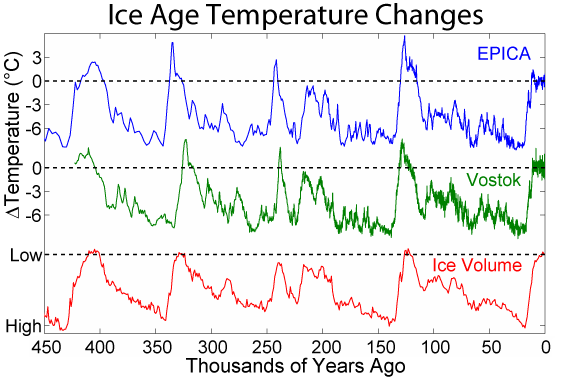
Something that surprises me is that people don't seem to understand that the planet constantly goes in and out of heating and cooling phases for reasons that are still not all that well understood on a clear causal level. This in no way means that we are not contributing, potentially substantially, to the current heating phase. But it does mean that sometime right about now, even if humans did not exist, we'd expect to still see temperatures rapidly rising.
That little comic starts at ~20k years ago is at the exact end of the last ice age and the beginning of the current heating phase so it paints a very misleading picture if you were not aware of the trends before it -- which rather resemble a sin wave of temperatures. For instance humans already lived through the heating phase about 140k years ago where temperatures from bottom to top increased on the order of about 10 degrees celsius. And that was at a time when we had extremely minimal technological capacity to adapt and migrations were something that could take on the order of centuries.
[1] - https://upload.wikimedia.org/wikipedia/commons/f/f8/Ice_Age_...
--------
And out of curiosity can anybody explain why they're downvoting this as fast they can? So far as I can tell I've said literally nothing that is not factually correct (unlike the post I was responding to). In many ways these conversations feel like people want to freak themselves out, and interspersing facts is met with hostility. I'd really like any sort of rational explanation.
You've gotta consider how much things change as you get higher into the atmosphere. The obvious thing is that atmospheric oxygen begins to become insufficient to operate engines as you go higher up, so you need engines that use a different oxidizer than atmospheric oxygen which is extremely complex. And even the efficiency and characteristic of engine exhaust changes radically depending on atmospheric density and the characteristics of its exhaust. In other words an engine that works great at sea level might work awfully when you start to get to a fraction of the same pressure.
There's an immense amount of flexibility in being able to travel hypersonic. The SR-71 Blackbird is an amazing example of the potential. First flown back in 1964 (!!) it was capable of hitting around mach 3, some 2200 miles per hour. That's 6 hours to get from one side of the Earth to the other. It's really quite remarkable how much our overall transportation technology seems to have stagnated since the 60s. I'd like to imagine everything is just classified but everything from the SLS to the F-35 to even things like the Zumwalt just seems to indicate that we've simply technology regressed. Kind of disconcerting to imagine the reasons for that.
[1] - https://en.wikipedia.org/wiki/The_Right_Stuff_%28film%29
The crackdown on online poker was a striking example of this. To give cliff notes the US, heavily influenced by casino lobbyists, decided to ban online poker. Online poker sites were operating in foreign countries obeying all laws domestically applied to them. In spite of the fact that sites were operating within all laws that domestically applied to them, the US decided to act because they refused to overtly ban US players. In an extremely rapid action the US simultaneously confiscated the domains of these sites, and executed arrest warrants on many of the involved individuals including surreptitious raids and extraditions from places including South/Central America, and froze numerous bank accounts around the world including in places such as Ireland.
The US is powerful enough that its own desire is sufficient authority to enact any action. Guantanamo Bay is a great example. This is not a just a US property under US law. It is operated as a US territory but mostly independent of US legal authority. The Geneva Convention is disregarded as convenient. For instance the three prisoners that were reported as having committed suicide (which would result in condemnation in Islamic belief) were allegedly tortured to death at a secret facility in Guantanamo, known as 'Camp No' (as in, no it does not exist), detached from the main camp. [1]
As an example consider the LZR swimsuit [1] by Speedo. In the Beijing Olympics 23 of 25 world records broken were done by swimmers wearing an LZR suit. It had such a huge impact on swimming that the suit is now banned, along with possible derivatives of it. You might expect it's some amazing insta-swimmer, but it's just a regular swimsuit that's nicely engineered resulting in about a quarter less drag than their previous swimsuit. But these changes alone enabled swimmers to shave an average of about 2% off their lap times, which was way more than enough to just destroy just about all previous records.
The ratios of your hips, legs, weight distributions, etc all are vastly different between men and women. And different, though less so, between races. Even consider all the physical differences implied by simply having breasts. Occasionally you'll find a genetic outlier, but in cases where the normal distribution tends to overlap strongly with the ideal performance distribution you're going to get a landslide of results. For instance Kenya makes up a tiny chunk of the world's population, but dominates pretty much all marathon running competitions. Even more interesting is it's not just Kenyans, but a tiny ethnic minority within Kenya that's doing this dominating. Some 0.06% of the world's population ends up dominating marathon racing. Most tellingly, Kenya was basically a nonplayer in these events until cultural changes in the 80s started bringing Kenya (and other East African nations) up to the standards of the west in terms of nutrition and general technology. There was a great article on this all a while back [2].
[1] - https://en.wikipedia.org/wiki/LZR_Racer
[2] - https://www.theatlantic.com/international/archive/2012/04/wh...
For instance a recent conversation I had was discussing the big bang and the cosmic microwave background radiation. Somebody thought that the CMB was evidence of the big bang. Of course when the CMB was first observed/measured it completely falsified our idea of a big bang due to the horizon problem -- regions of space that should not be causally connected are somehow homogeneous, which should be impossible. But instead of this observation != prediction indicating some fundamental problem we instead add in a magical hyper-inflation period to the model of the big bang so that the model can now "predict" what we see. And now you have people that believe that the CMB itself is evidence of the model's accuracy, when in reality the CMB refuted our models and we were forced to massage it back into the model in a rather arbitrary fashion. There is absolutely no physical reason to accept hyper-inflation other than 'if we add this magic event, then we can keep using this model.'
For a less contemporary example consider geocentricism - the idea that everything rotated around the Earth. Prior to Newtonian mechanics and other 'real' systems of interaction, we simply used models for orbital mechanics. And these models ended up being quite rediculous. You had planets doing magical swirlies, stopping and going backwards, and all other sorts of things. But because you can't falsify models detached from reality, everybody just shrugged their shoulders and accepted it for something on the order of centuries. And as time passes these models become even more difficult to replace because it ends up meaning you'd basically have to toss something on the order of decades, if not centuries, of past work. In this particular case astrology, for instance, was in the past a scholarly and academic field analogous in many ways to psychology today. Refuting geocentricism involved completely scrapping this entire field, and centuries of work within it, due to the fact it took things such as Mercury going backwards as key components of its analysis of human psychology.
The point of this all is that as you accept models, it can be that you're searching for answers at the entire wrong level of a problem. For instance astronomers in times of a geocentric universe may have been trying to explain why Mercury went backwards during its orbit, yet it's extremely difficult to answer something when you start with a wrong assumption -- in that case that the planet does indeed go backwards at some point, planets have these orbital swirlies, and so on. People like to rewrite history to blame geocentricism on the church, but inertia is not limited to divine belief.
For an easier to visualize example imagine placing one magnet positive pole up inside of a tube, and then you place another magnet positive pole down in the same tube. It would create a similar effect. There is a repulsive force being perfectly balanced out by an attractive force and the two reach an equilibrium where the magnet on top is 'floating' with the net of all forces in this closed system being 0.
This doesn't seem like a particularly big deal, until you realize what it does. Imagine the US pumps a bunch of funny money (I'm using a sardonic term just to clearly distinguish between organic/'real' growth) into our economy. This would naturally cause inflation. But here's where the fun kicks in. Oil is still by far the most in demand resource in the world. And now when countries go to buy oil they need to accumulate USD. But now due to inflation a country that wants to buy the same amount of oil needs to keep an even larger reserve of USD on hand. And that's exactly what happens. The USD becomes worth less and countries are obligated to hoover up more USD to ensure access to oil. As that USD starts getting removed from circulation, the effects of the inflation start to abate. Like magic, we can 'print' (not how many is made, but that's another topic) a practically unlimited amount of funny money with minimal economic consequences.
This also explains much of otherwise inexplicable actions in the Mideast and related places. We don't want their oil, we want them to sell their oil in USD only. This [1] is an article from Time in 2000: "Europe's dream of promoting the euro as a competitor to the U.S. dollar may get a boost from SADDAM HUSSEIN. Iraq says that from now on, it wants payments for its oil in euros, despite the fact that the battered European currency unit, which used to be worth quite a bit more than $1, has dropped to about 82[cents]. Iraq says it will no longer accept dollars for oil because it does not want to deal "in the currency of the enemy."" By 2003 we had destroyed the Iraq government and killed Saddam in a kangaroo court. Similarly with Libya, Gaddafi was aiming to create a gold backed 'Afro-currency' which is what he wanted to start selling his oil in. Two other nations which have moved against the petrodollar are Iran and Venezuela.
On the other side of things, this also explains Saudi Arabia. One of the most backwards and repressive nations in existence today, we're still BFF since they act like a loyal lapdog when it comes to the petrodollar. In exchange we let them do just about anything. The CIA has recently stated that Khashoggi's murder was likely ordered all the way from the top. I can tell you how this story will end. Do you remember in 2015 when Saudi Prince Majed Abdulaziz Al Saud had a rape and assault filled 'party' at a rented mansion in Beverley Hills? The 'party' was only stopped once a neighbor called the police after seeing a bleeding woman screaming for help as she tried to scale the fence of his mansion to get away. He was arrested and that's where most media reporting ended. The epilogue is that he was rapidly granted bail, got on a plane and simply flew back to Saudi Arabia with no consequences whatsoever.
---------
This is already getting long enough, but something very important now a days is that the petrodollar is dying. It's a mixture of a perfect storm of a large number different of factors, but it's definitely a dead system walking. And this has major implications for the future of the US economy. To date we've had 'economy armor' on. In the not so distant future, that armor is coming off and our economy will stand or fall under its own weight. And this is when being massively in debt suddenly does start to matter because if you just try to print your way out of it, you would not be able to rely on the petrodollar to protect the economy anymore.
[1] - https://content.time.com/time/magazine/article/0,9171,998512...
[2] - https://www.cbsnews.com/news/saudi-prince-majed-abdulaziz-al...
What I was saying is that journalism, in its current state, often runs sensational stories that later end up being false or otherwise unsupported. That report I mentioned was not about the media rewriting a science publication -- the publication itself was published with errors in it. The media just accurately repeated those falsehoods. The problem is that, due to the nature of social media, the sensational stories get let's say a million hits. Later on they either update the story to more accurately reflect the truth or run a retraction. These 'corrections', by contrast get maybe a hundred hits. So you have people who have wildly broken worldviews largely because they take the media at face value.
The following quote from Thomas Jefferson is dated 1807, but it's now more relevant than ever simply because mass media is resulting in mass misinformation: "Nothing can now be believed which is seen in a newspaper. Truth itself becomes suspicious by being put into that polluted vehicle. The real extent of this state of misinformation is known only to those who are in situations to confront facts within their knowledge with the lies of the day. I will add, that the man who never looks into a newspaper is better informed than he who reads them; inasmuch as he who knows nothing is nearer to truth than he whose mind is filled with falsehoods & errors. He who reads nothing will still learn the great facts, and the details are all false."