News for hackers. Stuff that matters.
Re:If wages are to rise, workers need more bargaining power by ejstronge on Wednesday June 06, 2018 @09:51AM (#17247122)
I think there are a couple of intertwined ideas in your comment. I wonder if your observations could be explained by decreases in the cost of food / increased food distribution.

Secondly, it's not clear whether wealth has improved for poor people (something I should take a look at...).

Re:If wages are to rise, workers need more bargaining power by achompas on Wednesday June 06, 2018 @09:58AM (#17247167)
It's well known that folks in the lower 70% of global income have seen significant growth. There's even a name for the plot - "the elephant chart."

https://avc.com/2016/08/elephant-chart/

The chart, as I understand it (in limited reading), tracks three phenomenon:

1. Increasing wealth formation by more disadvantaged groups in non-first world countries (the "body" of the elephant).

2. Wealth stagnation for middle classes in first-world countries (the "dip" in the elephant's trunk).

3. Increasing returns to capital held by upper classes in first-world countries (the "trunk" of the elephant).

Re:If wages are to rise, workers need more bargaining power by mikk14 on Wednesday June 06, 2018 @10:24AM (#17247371)
I think that the elephant chart can be misleading. A 100% growth of very little is still very little.

I found this version [1] showing that, in absolute terms, the gaps are actually increasing.

[1] https://patternsofmeaning.files.wordpress.com/2018/05/elepha...

Re:If wages are to rise, workers need more bargaining power by aoeusnth1 on Wednesday June 06, 2018 @10:48AM (#17247562)
Is a that very useful way of understanding growth? Without any change in the income distribution, everyone getting 1% richer would increase the absolute gap by 1%.
Re:If wages are to rise, workers need more bargaining power by mikk14 on Wednesday June 06, 2018 @01:36PM (#17249214)
I'm not sure I understand this rebuttal, do you want to expand a bit? Everyone getting 1% richer would not affect the Gini nor the absolute gap, or at least not as much as you imply. So I must be missing something.

In any case, you are not necessarily addressing my rebuttal of the elephant graph. What I'm saying is that the elephant graph is an interesting conversation starter, but, by itself, it does not convey enough information to make a conclusion about fairness. To make an extreme example, if I have literally $0 last year and I have $1 now, my growth rate in the elephant graph is infinitely higher than the richer 1%. I'm still going to starve to death, though. Absolutes matter.

Re:If wages are to rise, workers need more bargaining power by aoeusnth1 on Wednesday June 06, 2018 @02:37PM (#17249810)
But it would affect the absolute gap - everyone is proportionally richer, so the absolute gap is proportionally larger.

My point is that knowing only the fact that "absolute inequality has increased" doesn't tell you anything about whether that's good or bad for the world.

I agree that absolutes matter to the individual - but I personally think percentages are a better way of understanding and interpreting growth over time for most populations, because growth has historically been very consistently exponential.

Re:If wages are to rise, workers need more bargaining power by xg15 on Wednesday June 06, 2018 @01:03PM (#17248871)
That seems about right. "Getting 1% richer" would imply something completely different for a billionaire than for a worker, so I don't see why it would be a useful measure.
Re:If wages are to rise, workers need more bargaining power by aoeusnth1 on Wednesday June 06, 2018 @02:40PM (#17249840)
Because economies growing or shrinking generally affects people proportional to their wealth (including human capital). To me, Gini curves seem far more effective for understanding the dynamics of inequality than looking at absolute differences, which largely change due to economic growth.
Re:If wages are to rise, workers need more bargaining power by xg15 on Thursday June 07, 2018 @03:42AM (#17254012)
Yes, that's true when talking about causes of a wealth gap, but this thread was about effects.

A growing absolute wealth gap can still lead to reduced quality of life for lower-wealth groups - e.g. because prices rise faster than their incomes and so they effectively lose access to certain goods. It will also increase inequality and makes other economic measures (that rely on the mean) less reliable.

Just because an effect is always present, doesn't mean you can ignore it, especially if doing so would flip the conclusion. Posting the elephant graph as an argument that all is going well would do exactly that.

Re:If wages are to rise, workers need more bargaining power by yk on Wednesday June 06, 2018 @11:20AM (#17247837)
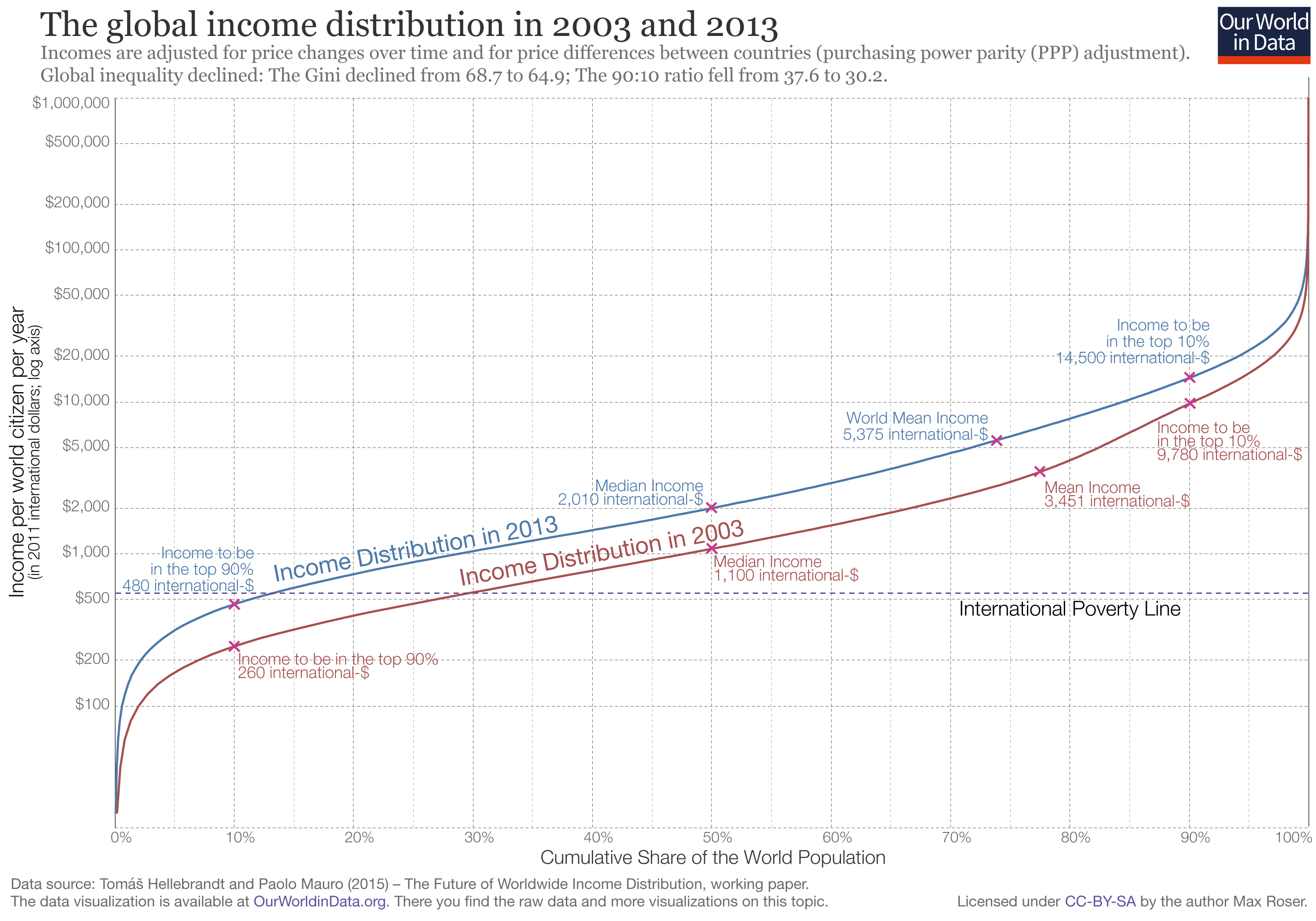
If I understand the graph correctly, the gap in absolute terms reduces, when the derivative of the (original) Elephant graph is negative, that is the gap between the lower half of the income distribution and the P50-60 (6th decile, something like $2k - $4k [0]) increases. And the gap between P80-90 ($8k-$14k, that's the lower third of the US population) and the top increases, while the gap between P50-60 and P80-90 decreases.

[0] https://ourworldindata.org/global-economic-inequality

specifically from eyeballing

https://ourworldindata.org/wp-content/uploads/2013/11/Global...
Re:If wages are to rise, workers need more bargaining power by RyanZAG on Wednesday June 06, 2018 @10:04AM (#17247211)
In terms of poverty, is there a difference between getting more wealth vs everything becoming cheaper? I don't think there is - your life has improved just the same either way.

Fixating on silly numbers that ultimately mean nothing doesn't seem like a good way to make the world better. We should look at concrete things - and how often you can eat an orange is the kind of concrete thing that really matters.

Re:If wages are to rise, workers need more bargaining power by paublyrne on Wednesday June 06, 2018 @10:16AM (#17247304)
Oranges may have become cheaper in relative terms, but property sure hasn't. In many parts of the world property is more inaccessible than ever before for similar social economic groups.
Re:If wages are to rise, workers need more bargaining power by RyanZAG on Wednesday June 06, 2018 @10:43AM (#17247513)
That's just artificial scarcity, right? Rural property out in the woods is just as cheap as its ever been, in my experience. Cities just have a lot of laws preventing a lot of things, but I think most people who choose to live in cities prefer it like that.
Re:If wages are to rise, workers need more bargaining power by paublyrne on Wednesday June 06, 2018 @12:36PM (#17248588)
I'm not sure the relevance of it being artificial or not is here. The reality is that many people in their 20s and 30s can't buy a house, while their parents could, even if their parents were less affluent by many measures, say in orange purchasing power.
Re:If wages are to rise, workers need more bargaining power by ishjoh on Wednesday June 06, 2018 @04:28PM (#17250825)
There seems to be three issues related to real estate that effect prices and one issue related to purchasing power that I'd like to point out.

1) The percentage of people living in cities as compared to living in rural areas has increased dramatically (https://www.census.gov/library/visualizations/2016/comm/acs-...)

2) Large cities (NYC, San Francisco, etc), have lots of regulations to building more housing

3) Demand for housing in large cities has exceeded supply for decades

4) Student loan debt has destroyed purchasing power for folks in their 20s and 30s, the average student loan is almost 40k (https://studentloanhero.com/student-loan-debt-statistics/)

Leaving NYC, even after taking a pay cut, was one of the best decisions I ever made. I don't have data, but I suspect that for young folks outside of the largest 20 American cities, if they didn't have on average 40k in student loan debt, they would have more purchasing power then previous generations even including real estate.

Re:If wages are to rise, workers need more bargaining power by prewett on Wednesday June 06, 2018 @01:29PM (#17249146)
That's also partly because you can't hardly buy a newly constructed house unless it's 3000+ sq feet, whereas houses from decades ago were substantially smaller, leading to more affordability. The lack of these houses does not imply that people currently in their 20s and 30s are less affluent, just that there is less affordable housing.
Re:If wages are to rise, workers need more bargaining power by petra on Wednesday June 06, 2018 @11:05AM (#17247709)
Maybe.But Germany has cities but they created a political system(after ww2) optimized for cheap real-estate , and they do have fine cities, while their real-estate prices has Rose neglibly over the last few decades.
Re:If wages are to rise, workers need more bargaining power by maxxxxx on Wednesday June 06, 2018 @12:52PM (#17248756)
"while their real-estate prices has Rose neglibly over the last few decades."

Those days are over. Germany has a huge real estate problem right now.

Re:If wages are to rise, workers need more bargaining power by stealthmodeclan on Wednesday June 06, 2018 @12:02PM (#17248222)
German manufacturers are not limited to few cities.

There are factories in villages too.

Re:If wages are to rise, workers need more bargaining power by s73v3r_ on Wednesday June 06, 2018 @12:48PM (#17248725)
Cities also have jobs. I don't see many postings for positions out in the middle of the woods. Certainly not enough to sustain all the people who would be needing to go there in order to have property.
Re:If wages are to rise, workers need more bargaining power by awat on Wednesday June 06, 2018 @11:03AM (#17247696)
This is really the question that throw’s people for loops in my experience. Not contextually what you were addressing but in comparison to my parents in the US.

Many things are much more inexpensive jeans, shoes (functional not trendiest), entry-level tools, computers, media, etc.

Whats not more inexpensive and what imho really actually matters are things like education, housing, and the barrier to entry to careers (require licensing, certfications etc.)

Re:If wages are to rise, workers need more bargaining power by BrainInAJar on Wednesday June 06, 2018 @10:11AM (#17247269)
> In terms of poverty, is there a difference between getting more wealth vs everything becoming cheaper?

Yes. The delta between the richest and poorest indicates a lot of things about a society.

Re:If wages are to rise, workers need more bargaining power by RyanZAG on Wednesday June 06, 2018 @10:41AM (#17247497)
What does it indicate?

You can go to a place like Mauritius where the delta is enormous, but everyone is pretty happy and the rich and poor mingle freely. Or you can have a place like France where the delta is far smaller, but the rich and poor detest each other and very rarely mingle.

Re:If wages are to rise, workers need more bargaining power by adamsea on Wednesday June 06, 2018 @12:39PM (#17248631)
In 2014 The Gini coefficient for Mauritas was 30 and for France it was 40.

The top 1% in France has about 20% of the total income as of 2014.

For Mauritas no suitable data was found for wealth inequality or dispersion of earnings.

The lack of good data for Mauritas makes a comparison between the two questionable.

Plus even after looking at the numbers for these countries I would want to check out money laundering - if I recall, based on the Panama papers, a nontrivial amount of the 1% (probably more like the 0.1%s) wealth is laundered/hidden/dark. I don’t know if the studies here attempt to account for that or not. I would imagine money laundering is prevalent in France (or any major economy for that matter), possibly in Mauritas

https://www.chartbookofeconomicinequality.com/inequality-by-...

https://www.chartbookofeconomicinequality.com/inequality-by-...

Information on data sources here - https://www.chartbookofeconomicinequality.com/about/

As of 2018 the population of Mauritas is 1.26 million (via google search). The 2018 population of France is 65.23 million (via google search). The 2014 population probably was not radically different.

I wonder if the size of the society in question matters here - is comparing a country to one 65 times larger than it useful?

I did not look for data to validate the hypothesis that everyone is pretty happy in Mauritas as opposed to France.

Re:If wages are to rise, workers need more bargaining power by pschon on Wednesday June 06, 2018 @02:48PM (#17249901)
Back in the 90's I saw the same thing when living in Brazil. A friend in his 70's who owned real estate in Rio owned a Rolls recently returned from NYC. He said he was shocked at seeing the hatred in the eyes of people in NYC. He countered how he could stop for a coffee or beer or anything else and just talk to anyone who was there regardless of the socio-economic status. I had to agree. I always wondered why there was not more discontent.