News for hackers. Stuff that matters.
Re:If wages are to rise, workers need more bargaining power by mikk14 on Wednesday June 06, 2018 @10:24AM (#17247371)
I think that the elephant chart can be misleading. A 100% growth of very little is still very little.

I found this version [1] showing that, in absolute terms, the gaps are actually increasing.

[1] https://patternsofmeaning.files.wordpress.com/2018/05/elepha...

Re:If wages are to rise, workers need more bargaining power by aoeusnth1 on Wednesday June 06, 2018 @10:48AM (#17247562)
Is a that very useful way of understanding growth? Without any change in the income distribution, everyone getting 1% richer would increase the absolute gap by 1%.
Re:If wages are to rise, workers need more bargaining power by mikk14 on Wednesday June 06, 2018 @01:36PM (#17249214)
I'm not sure I understand this rebuttal, do you want to expand a bit? Everyone getting 1% richer would not affect the Gini nor the absolute gap, or at least not as much as you imply. So I must be missing something.

In any case, you are not necessarily addressing my rebuttal of the elephant graph. What I'm saying is that the elephant graph is an interesting conversation starter, but, by itself, it does not convey enough information to make a conclusion about fairness. To make an extreme example, if I have literally $0 last year and I have $1 now, my growth rate in the elephant graph is infinitely higher than the richer 1%. I'm still going to starve to death, though. Absolutes matter.

Re:If wages are to rise, workers need more bargaining power by aoeusnth1 on Wednesday June 06, 2018 @02:37PM (#17249810)
But it would affect the absolute gap - everyone is proportionally richer, so the absolute gap is proportionally larger.

My point is that knowing only the fact that "absolute inequality has increased" doesn't tell you anything about whether that's good or bad for the world.

I agree that absolutes matter to the individual - but I personally think percentages are a better way of understanding and interpreting growth over time for most populations, because growth has historically been very consistently exponential.

Re:If wages are to rise, workers need more bargaining power by xg15 on Wednesday June 06, 2018 @01:03PM (#17248871)
That seems about right. "Getting 1% richer" would imply something completely different for a billionaire than for a worker, so I don't see why it would be a useful measure.
Re:If wages are to rise, workers need more bargaining power by aoeusnth1 on Wednesday June 06, 2018 @02:40PM (#17249840)
Because economies growing or shrinking generally affects people proportional to their wealth (including human capital). To me, Gini curves seem far more effective for understanding the dynamics of inequality than looking at absolute differences, which largely change due to economic growth.
Re:If wages are to rise, workers need more bargaining power by xg15 on Thursday June 07, 2018 @03:42AM (#17254012)
Yes, that's true when talking about causes of a wealth gap, but this thread was about effects.

A growing absolute wealth gap can still lead to reduced quality of life for lower-wealth groups - e.g. because prices rise faster than their incomes and so they effectively lose access to certain goods. It will also increase inequality and makes other economic measures (that rely on the mean) less reliable.

Just because an effect is always present, doesn't mean you can ignore it, especially if doing so would flip the conclusion. Posting the elephant graph as an argument that all is going well would do exactly that.

Re:If wages are to rise, workers need more bargaining power by yk on Wednesday June 06, 2018 @11:20AM (#17247837)
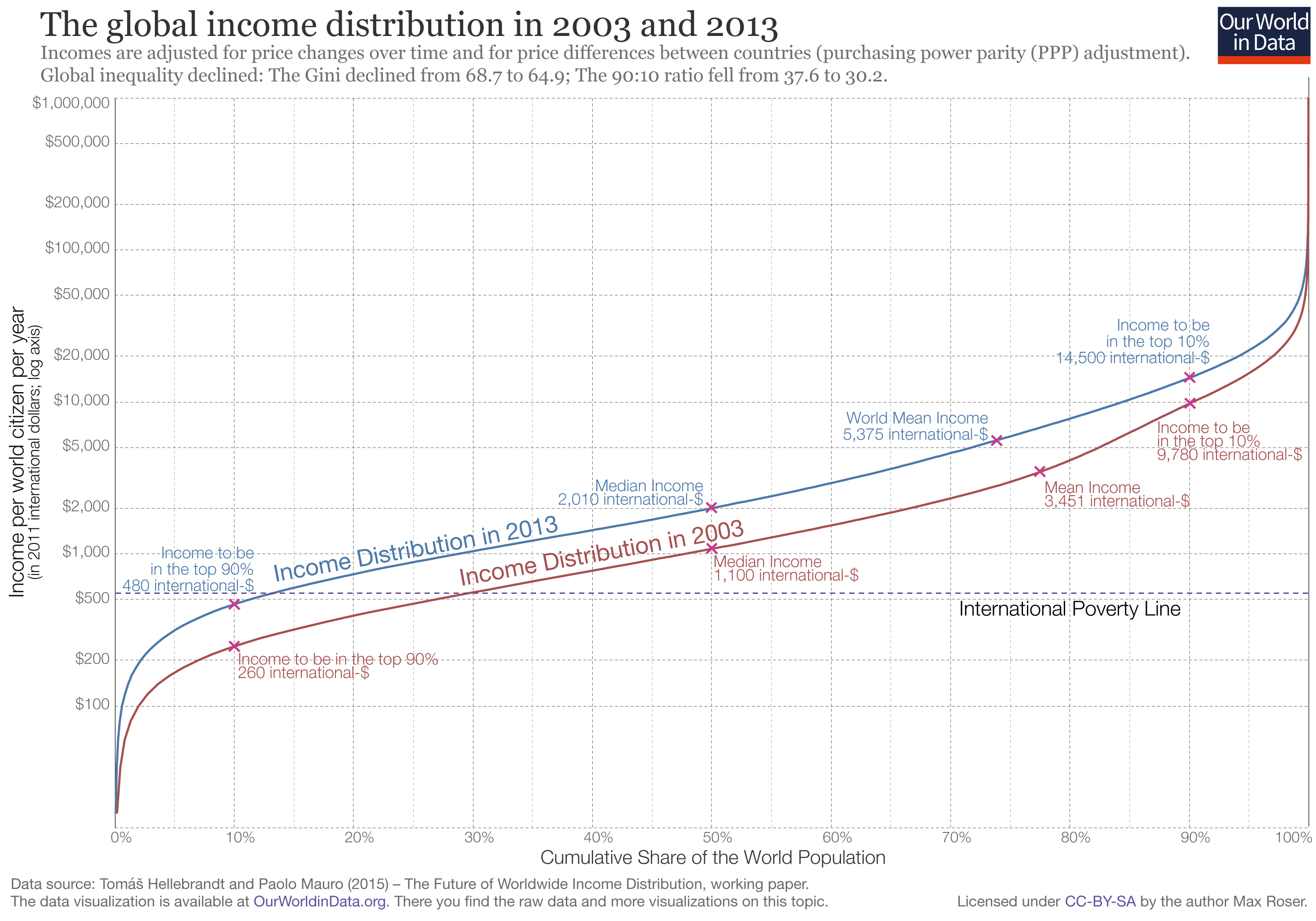
If I understand the graph correctly, the gap in absolute terms reduces, when the derivative of the (original) Elephant graph is negative, that is the gap between the lower half of the income distribution and the P50-60 (6th decile, something like $2k - $4k [0]) increases. And the gap between P80-90 ($8k-$14k, that's the lower third of the US population) and the top increases, while the gap between P50-60 and P80-90 decreases.

[0] https://ourworldindata.org/global-economic-inequality

specifically from eyeballing

https://ourworldindata.org/wp-content/uploads/2013/11/Global...