There were two phases though: the initial rollout, and sometime later the coverup.
If they had asked very reasonable questions about the software during the rollout there would have been no need for a coverup. No software rolls out without any bugs and it's really reasonable to ask why so many post offices had missing funds and if they were sure if it was real or not. The PO leadership basically ignored all evidence that there were bugs from the very beginning, and that makes no sense until you realize that they were starting from the premise that the postmasters are thieves and this software is going to catch them.
It would be reasonable, but that also assumes the ass-covering started post rollout rather than pre rollout.
This, so much this. Not ONLY that but they kept DOUBLING DOWN for YEARS.
I SO SO wish they would be held accountable for the pain, suffering, Chapter 11's, AND the suicides.
If I were in leadership, I'd assume there are edge cases I'm missing and take responsibility accordingly. Id just assume that is my job, as the leader, that is why I am paid, to make important decisions and stop the company from making big mistakes.
This isn’t a critique of your view—just an observation: there's a recurring theme on HN that leadership shouldn't be held responsible when things break down, as if being a CEO is just another job, not a position of accountability.
Where does this come from? Is it a uniquely American or capitalist norm?
I recall ( i dont think incorrectly) 1980s Japanese leadership—tech/auto who took failures so seriously they’d resign or even mention/think of sudoku.
CEO may be the top of middle management, but still middle management all the same. The board and owners sit well above that position, if you want to picture it as some kind of hierarchy, and are the driving leadership.
If you want to hold middle management accountable, why stop at CEO?
And how high up do you go? The common narrative is that the owners/board are the highest up, but in reality they're working for the customer. The customer is the true leader. It is they who make the decisions and who the owners/board have to answer to.
Or are they really the true leader? The customer will have customers of their own. Everyone works for someone. In reality, there isn't a hierarchy at all. It is approximately cyclical.
dude
They also talk about postmaster's motivations for buying a franchise and how sitting behind a retail desk in a small town with a modest but steady income is actually one of the best outcomes available to the type of working-class Briton who was buying the franchise.
The origin of Horizon is that ICL won the tender for a project to computerise the UK's benefits payment system -- replacing giro books (like cheque books) with smart cards (like bank cards):
https://inews.co.uk/news/post-office-warned-fujitsu-horizon-...
https://publications.parliament.uk/pa/cm199899/cmselect/cmtr...
Sure, it was also expected to detect fraud, but overall it was a "modernising" project. The project failed disastrously because ICL were completely incompetent at building an accounting system, the system regularly made huge mistakes, and the incoming government scrapped it.
ICL was nonetheless still very chummy with government, as it was concieved of by 1960s British politicians who basically wanted a UK version of IBM because they didn't want Americans being in control of all the UK's computer systems. ICL used to operate mainframes and supply "computer terminals" to government and such, which is why they needed a lot of equipment from Fujitsu, which is why Fujitsu decided to buy them.
ICL/Fujitsu still kept the contract to computerize Post Office accounting more generally -- Horizon. Post Offices could literally have pen-and-paper accounting until this! Yes, the project was also meant to look for fraud and shrinkage, but at its heart it was there to modernise, centralise and reduce costs. If only it wasn't written by incompetent morons who keep winning contracts because they're sweet with government.
2) The post offices were geographically distributed pretty evenly throughout the UK so there were positions in far-flung locations well outside London. In many of these communities it was a good and stable job compared to what else was available.
3) Many of the postmasters reported liking working retail positions where they get a lot of face time with customers. In many small towns the post office was a central part of the community.
Especially if you’re on the older side, it sounds like an absolutely wonderful way to spend your time. Assuming the post office doesn’t try to ruin your life afterwards.
There are situations where franchisees don't offer other services. These folks tend to be older and for most of the life of the franchise haven't had the need for additional income earlier in the life of the franchise. They don't have the energy and don't want to take on the risk of expanding now. When they retire, they'll probably close up shop as their children have other jobs.
The rural Post Office where I grew up in the 80s and 90s was accessible to a wide area just off the main road. It served a wider area than the current one. The Postmistress' family also farmed. When that closed the natural place to setup was in the closes village because that was projected to grow in population. That development would result in the old Post Office building being knocked down to make way for a dual carriageway. Eventually a few more Post Office franchises appeared with their shops in that part of the county.
People can read more at https://runapostoffice.co.uk/.
And yes, a lot of people are willing to go into debt to effectively pay to have a job.
Edit: A timely news article: https://www.bbc.co.uk/news/articles/cvg8llxmnx7o
That's the same _class_ element that OP was talking about, no?
I guess most of the people on HN don't see issue with people going into debt to get a degree, which is supposed to get them a job.
So how is it different to people going into debt to buy a franchise?
It's even a more straightforward way to actually get a job, while a degree, if it goes out of fashion on the job market, would have absolutely no use, and you'll have to flip the same burgers as the lad with no degree and no student debt.
> a retail position and end up hopefully clearing a middle class salary
Normal retail work is below the poverty line.
Beyond that i think it might be the social/community aspect. I simply can't use the post office in my town as its used as a social club for everyone over 70. Some people are just in to that kinda thing i suppose.
Demand for postal services is, on a long horizon, generally more consistent than demand for any particular junk food.
The better question is: why the hell would the government sell a PO franchise?
I'd wager there was a solid amount of general incompetence involved at the PO "corporate" - management politically couldn't admit that their consultingware could be anything other than perfect, because they signed off on the decision to buy it, and probably on all the work orders that got them to that point.
If anyone from PO management or that of the consulting firm (Fujitsu, I believe?) ever get any work again, it will be a travesty of justice.
She has since been thrown under the bus, though, of course, not prosecuted or imprisoned (despite ordering wrongful prosecutions of over 900 others)
The politician responsible for her was Vince Cable, who since became leader of the Liberal Democrats, and holds 10 positions, most of which are either funded by the government or related to it.
But when the ball started rolling, as the software rolled out and was finding missing funds everywhere, you'd think a normal person would have asked "are we sure there are no bugs here?" That was never done, I believe, because the software was matching the leadership's priors.
That has to be the most egregious confirmation bias I've heard about.
I was at a company acquired by silicon valley company. Our tech support department was folded into another tech support department. Immediately the folks in the valley were upset that we closed more cases / had far higher customer satisfaction scores ... by far. They made no secret that they assumed that us mid-westerners doing the same job had to be inferior at the same job.
Eventually a pool of managers in the valley developed a full blown conspiracy theory that we were cooking the books by making fake cases and so on. It just had to be that right? No other explanation.
They finally got someone in an outside department to look into it. They found folks closing cases prematurely and even duplicating cases. The people doing it all worked for the managers pointing fingers at everyone else ...
Sometimes the folks who talk about fraud think those things because that's how they work.
Constant hoops to jump through to prove they're looking for work or still incapable.
Or in the case of illness to prove they're still sick. https://www.bbc.co.uk/news/uk-59067101
Catch-22.
In order to be given disability you must jump through so many hoops that no one whom is actually sick could complete them. Or how in unemployment you must prove you must spend your time proving you are looking for a job so you cannot spend you time actually looking for a job. My personal fav because its almost universal is sick-day policies that codify 100% abuse of sick days because people are punished for not using them because some people were "abusing" their sick days.
In the case of the book to be discharged from military service they must prove they are insane which no insane person could complete.
It's enough of an issue that even Labour (left wing) is having to deal with it. Though as usual Starmer has chickened out (I think this is like the third thing that was obviously a good move that he's backed down on after dumb backlash).
However you can infer a lot from a) the insane rise in claims, especially mental health related:
https://obr.uk/docs/box-chart-3-f.png
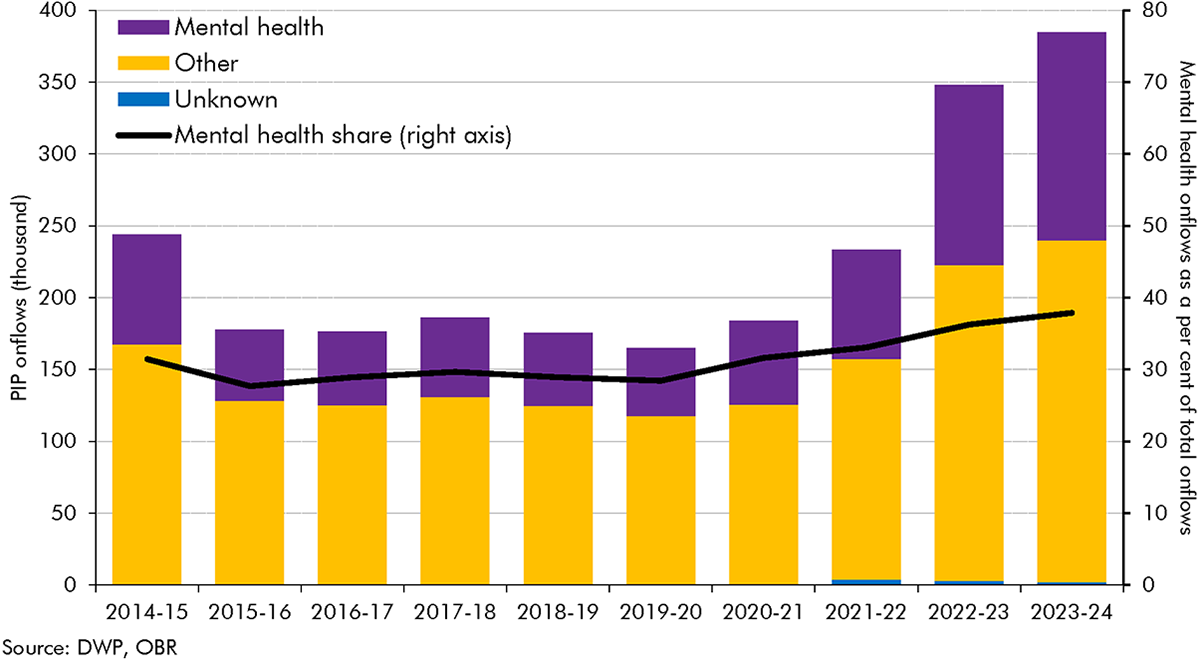
Has the mental health of the nation got twice as bad in 2 years? Obviously not.
And b) whenever the BBC does touchy feely profiles of people there are always some weird red flags:
https://www.bbc.co.uk/news/articles/cx2gpl4528go
£400/month help with her bills because she struggles with time management? I'm sympathetic to her problems but that is a shit ton of money!
Even some of the people receiving it agree:
> "I was shocked by the ease with which it was granted. I was expecting to be interviewed, rightly so, but it was awarded without interview and he received backdated pay for the maximum amount." > > She was also surprised that her husband got mobility allowance for not having a car, even though she had a car and could drive him around.
(This reminds me of WFA where plenty of people receiving that also thought it was ridiculous.)
https://www.bbc.co.uk/news/articles/cn0ry09d50wo
> Paul Harris, from Barnard Castle, gets £72.65 a week in PIP payments to help with extra costs associated with his anxiety and depression - such as for specialist therapy apps and counselling.
https://www.bbc.co.uk/news/articles/cn4llx4kvv8o
> Nick Howard, 51, from Cambridge, is neurodivergent and has been claiming Pip for five years. > > "Without Pip I would not be able to work as it pays for my transport to and from my workplace. > > "I'm currently buying an electric bike on credit, others I have had have been stolen or vandalised," he added.
Great... but I don't think paying PIP for 5 years is a good way to buy someone a bike.
Obviously not all cases are like this, but clearly something has gone wrong. And this isn't a partisan issue. Both parties agree that it has to change. The Tories just ignored the problem and Labour gave up after predictable "N people will die!" press.
And to be clear I'm not anti-poor or anything like that. I also thing WFA is ridiculous and that mostly goes to the rich. Child benefit also goes to lots of people (myself included) who totally don't need it. They all need reform, but look what happens when the government tries...
> £400/month help with her bills because she struggles with time management? I'm sympathetic to her problems but that is a shit ton of money!
£4800/yr is a shit ton of money? Things must be pretty rough over there!
> Child benefit also goes to lots of people (myself included) who totally don't need it.
Is that a bad thing?
For the average person in the UK, it definitely is.
It's a shit ton of money for the government to just pay to people. I wasn't saying it's enough money to live on or anything. Obviously.
> Is that a bad thing?
The government is just a little short on money and they're wasting it by giving WFA and child benefit to people who definitely don't need it.
This should be obvious.
Right, but they're not, because this isn't what's happening. There's a reason they're paying her. Otherwise you would be getting the money too, but you're not.
Assuming that's true, do we know if the new claims are fraudulent, or are they valid claims that people simply didn't claim for before?
The macroeconomic effects of welfare programs create a society that is better for everyone to live in. Reducing the issue to a matter of personal responsibility is a reframing that allows you to completely lose sight of the big picture, and create programs that are destined to fail by not reaching many of the people they need to.
Government running charity interferes with the normal feedback in society. And the need to ask politely, justify one's apparently bad decisions and change failing behavior.
People become "entitled" to regular cash so a lot of the fear that ordinarily motivates the rest of us goes away.
Any system that asks nothing of people is a bad system.
I grew up on welfare. I've also seen how a lot of people on welfare actually live and how they spend their time. They don't spend it cleaning, I can tell you that.
Ok bro, while you're out there building morally pure systems the rest of us will do research and learn what actually works in the real world.
How about UBI coupled with repealing the minimum wage?
I just don’t see any realistic way to make it actually happen.
Er... why wouldn't UBI be more expensive?
I'm not even arguing against UBI here, I'm just trying to make sense of your claim, which seems quite dubious.
We exist in a world where people can be unable to work or even advocate for themselves through no fault of their own. As we raise the bar for how people have to prove that they "need" help, there will be people who die because they don't have the capacity to prove that. In theory we have social workers (as a societal role) but in reality they're underfunded/don't have capacity for the same reasons.
This feels like the same moral argument behind the presumption of innocence in the American legal system: far better to let criminals walk free than to falsely imprison an innocent person. Why do we not apply the same logic to welfare?
I mean, I know why: we're worried the system would get taken advantage of and not serve the people it's "meant" to help.... but then, who does it help? How much effort is it worth making people spend to prove they need help when that effort comes with a blood cost?
I agree with GP that welfare systems make for better societies--see also, public healthcare. I have several friends who are alive because of welfare systems. I grew up with people whose family squandered the welfare they got, but I don't view that as sufficient reason to withhold welfare from anyone else; I just accept that's the cost of a system that helps people.
It makes no economic sense. It’s not more humane/helpful. But it’s what we ‘choose’ over and over.
No, that seems like mostly you. Most people are not motivated by fear.
It's called taxation, it's codified in law. Like... literally. I don't think you could find a better citation for "rights" than that. Jesus Christ.
I think this is the parent’s point: this is the POV of the rich and powerful who lead the organization. They can’t imagine someone in a different position seeing these franchises as a way to secure good (or at least decent), long-term, stable employment.
This does explain why the leadership was so stubborn.
The UK is class-obsessed, which is not as immediately clear to the rest of the world (especially US). Lends a lot of credence to your theory.
In the UK it doesn't really matter if you become a millionaire or billionaire, you still won't be able to perforate the perception of "where you came from". This leads to all kinds of baseless biases such as OP's observation / point.
The Thatcher years created an opportunity for working class (who traditionally lived in rent controlled properties due to low income) to purchase their houses for pennies on the dollar.
Suddenly, millions of families felt they had moved up a class. They were no longer at the mercy of landlords and had moved up in society from a tenant to an owner.
The traditional three tiers of lower, middle and upper class changed to lower, lower-middle, upper-middle and upper.
From my observations the lower-middle class are still adjusting not to having money but rather _access_ to money previously denied. Having equity in a property as a guarantee of a loan opens up a world previously off limits by the banks.
A bit like when someone turns 18 and they have access to credit cards - lots of cash easily available!
I come from a family where (with the exception of a mortgage), if you can't pay for something in cash (and still have plenty in reserve), you can't afford it. My folks were very proud of raising a family with zero debts (minus the mortgage), and I'm forever thankful.
The families I knew (and by extension others living on the typical "cookie cutter" UK housing estate) were swimming in debt. What surprised me the most was how "normal" it was - 3yr (or less) car on the drive; massive flatscreen TVs (in 2007); multiple cruise holidays per year; flying off to a warm destination mid-winter.
Many of them said when they were younger they never experienced such things and told stories of growing up in near poverty. Going into debt for holidays and having a new car on the drive was normalised.
These were nurses, postmen, truck drivers, retail staff, hospitality etc. all traditional working class jobs with low salary expectations.
They were trying desperately to _appear_ like they were middle class at whatever cost.
I'm of the belief it will still take a few generations before the wave of lower-middle class learn that it's not about having a new car on the drive but rather having that cash in the bank as savings - and a significantly cheaper (& older) car on the drive.
And yet the UK school system doesn't teach pupils about sensible financial matters - we all rely on our parents to guide us - so escaping the "buy it now on credit" mentality will be easier said that done!
These days you can get a big mortgage on a cheaply constructed apartment and still get hit for huge maintenance charges by a grasping building management firm.
Americans use stuff like occupation, home area, and education as the manifestation of class, with a sprinkle of racism.
In the US I get the impression that it is much more about money. And therefore less static.
Growing up half in England and US I feel British culture is more attuned to the class aspects to this kind of event. Traditionally America likes to pretend this kind of class contempt doesn't exist (think of, people on welfare angry at welfare queens, unaware they will be affected by legislation they support).
Please don’t bring that nonsense here
It just manifests as racism.
If they didn't do that to other middle class families then they saw you as less than them. Seeing people as less comes both with charity and contempt, not just one of those.
A teacher is lower upper class though. Teaching is used by some as an early step to a political career — I have a couple of friends who have done so. They don’t have an upper class income, but teachers have the merits to be high class.
Of course, but the 2010's it was decided by the powers that he to re-introduce identity politics as the new form of class warfare. Which was 80% sexism/racism and 20% classisn.
All those white folks fleeing the country looking like the fucking Monopoly Man with their bags of money were doing it because of... anti-white racism.
I think Vivek Ramaswamy found out how that worked out for himself in politics and at DOGE as a billionaire.
I suspect your view of very, very few is suspect.
The founding ideas of MAGA certainly cling to it. The 60-70 million voters for it have zero issues with it.
> Most claims of racism in America are in fact classism.
This is bald-faced racism denialism and makes a sweeping generalization. For example, the Trump administration is going after immigrants not for economic or class reasons but as a dogwhistle for their Floridian golf club members who don't like minorities of any sort and to appease a large section of the base of covert and overt racists generally. There is no logic in exiling and disappearing the low cost labor needed to product food, build homes, and do the terrible jobs that make civilization possible.. because it is mission of dumb people sabotaging themselves and others. The selective protection plus oppression and criminalization of undocumented people is grounded in the need to control a desperate, underpaid population to keep prices of agriculture, home construction, and restaurant prices lower than paying ordinary, livable wages to them.
> Very, very few people have actual dislike of others based on race.
You can't know this. And, it's leans towards false because of how propinquity works.
I mean, here's how I see it, if 100 million Polish people, a very white peoples, suddenly claimed asylum in the US, had 300 million anchor babies to exploit that loophole, used the anchor baby army to claim massive funds of welfare in aggregate, all the while claiming zero income while working under the table and undercutting the common man ... ... and also driving drunk and refusing to learn any English and demanding Americans ought to learn Polish
If the Polish people did that I'd have it in to deport them all. And it wouldn't be about race at all, it would be the overwhelming unfair advantages and systematic exploits the Polish performed in this case. The racist narrative is just another manifestation of "playing the race card" to defend indefensible, selfish, toxic behavior
You'd also be legally obligated, but to be lawful is not always the same thing as being ethical nor moral.
It would be challenging, I admit, considering the country will have doubled in size with half of them being infants that naturally don't speak English, or any language for that matter.
We really should close that loophole, though. And it definitely is a loophole and not the explicit intention of a constitutional amendment. An oversight to be sure.
Ignore all the wage thief and other crimes like poniz scheme's, multi level marketing scheme's, political bribery, and fraud. Those crimes just hurt millions upon millions. Don't look at those numbers, they are too big for anyone to under stand. Focus on that person's skin color and accent. They are the true criminals.
This propaganda is just sickening that it works all to well.
As an immigrant to the US from latin america that has spent significant time in britain, this statement is the complete opposite of my experience to the point of ridiculousness.
Britain is the most openly classist western country I have ever been in.
The example of lower class people not recognizing so in the US is meant to be an example of lack of class awareness/recognition; not of less (or more) classism (prejudice based on class)
You've hit the nail on the head "why would anyone want a middle class life" yeah they have never known anything less than that.
The other factor to me is the careerism, all that matters is the project success, who cares if the riff raff end up committing suicide. Honestly listening to some of the tapes of those meetings makes me feel sick. Thing is, I think so many career orientated people I know wouldn't even consider that what went on in the meetings was beyond the pale. It's black mirror level.
I'm from Ireland, but I live on "mainland Britain" the UK class system is mind boggling. I think the establishment here despises the "great unwashed". God help any working class person who ends up in the courts system.
One final thing, Paula Vennells was an ordained church minister. She was preaching while she was overseeing the destruction of so many innocent hardworking people. https://en.m.wikipedia.org/wiki/Paula_Vennells
I don't know why that makes this all worse but some how it does. Somehow it speaks to what the UK is or has become.
I doubt she'll get the prison time she deserves. Actually I doubt she'll serve any time at all.
She was very nearly parachuted in a Bishop of London, off the 'success' of her term in the post office:
It makes it worse because most people are familiar with the tenets of christianity and know that this behavior is counter to that value system.
I think it's one of the most redeeming points of christianity/religion in general -- there is a standard to which people can be judged and agree to be judged. That's why it makes it worse, this person is not only doing terrible things, but doing terrible things while professing to believe a value system that would not condone it.
"Every system creates,
the bullshit it deserves"
This isn't a classic embezzlement of public funds, where the people receiving the money are also the people deciding whether it was well spent or not and hence could easily divert some of the money through behind the scenes deals with contractors without getting caught.
The "embezzlement" here is on the level of getting an invoice and not paying it.
Basically, the Post Office leadership could not understand why someone would buy a PO franchise. It's a substantial amount of money up front, and people aren't allowed to buy multiple franchises, so every PO was an owner/operator position. Essentially people were "buying a job".
The people in leadership couldn't understand why someone would buy the opportunity to work long hours at a retail position and end up hopefully clearing a middle class salary at the end of the year. They assumed that there must be a real reason why people were signing up and the real reason was to put their hands in the till.
So they ended up assuming the postmasters were stealing, and the purpose of the accounting software was to detect the fraud so it could be prosecuted. When the accounting software started finding vast amounts of missing funds, they ignored questions about the software because it was working as intended. I bet if the opposite had happened, and it found very little fraud, they would have become suspicious of the software because their priors were that the postmasters were a bunch of thieves.