Constant hoops to jump through to prove they're looking for work or still incapable.
Or in the case of illness to prove they're still sick. https://www.bbc.co.uk/news/uk-59067101
Catch-22.
In order to be given disability you must jump through so many hoops that no one whom is actually sick could complete them. Or how in unemployment you must prove you must spend your time proving you are looking for a job so you cannot spend you time actually looking for a job. My personal fav because its almost universal is sick-day policies that codify 100% abuse of sick days because people are punished for not using them because some people were "abusing" their sick days.
In the case of the book to be discharged from military service they must prove they are insane which no insane person could complete.
It's enough of an issue that even Labour (left wing) is having to deal with it. Though as usual Starmer has chickened out (I think this is like the third thing that was obviously a good move that he's backed down on after dumb backlash).
However you can infer a lot from a) the insane rise in claims, especially mental health related:
https://obr.uk/docs/box-chart-3-f.png
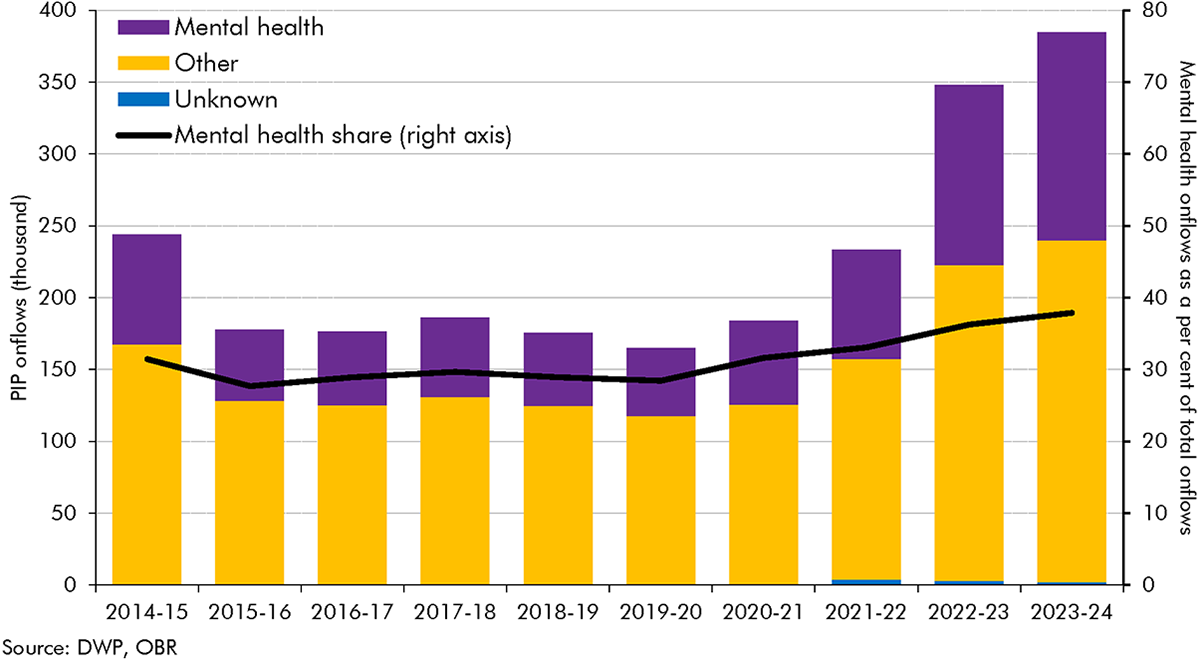
Has the mental health of the nation got twice as bad in 2 years? Obviously not.
And b) whenever the BBC does touchy feely profiles of people there are always some weird red flags:
https://www.bbc.co.uk/news/articles/cx2gpl4528go
£400/month help with her bills because she struggles with time management? I'm sympathetic to her problems but that is a shit ton of money!
Even some of the people receiving it agree:
> "I was shocked by the ease with which it was granted. I was expecting to be interviewed, rightly so, but it was awarded without interview and he received backdated pay for the maximum amount." > > She was also surprised that her husband got mobility allowance for not having a car, even though she had a car and could drive him around.
(This reminds me of WFA where plenty of people receiving that also thought it was ridiculous.)
https://www.bbc.co.uk/news/articles/cn0ry09d50wo
> Paul Harris, from Barnard Castle, gets £72.65 a week in PIP payments to help with extra costs associated with his anxiety and depression - such as for specialist therapy apps and counselling.
https://www.bbc.co.uk/news/articles/cn4llx4kvv8o
> Nick Howard, 51, from Cambridge, is neurodivergent and has been claiming Pip for five years. > > "Without Pip I would not be able to work as it pays for my transport to and from my workplace. > > "I'm currently buying an electric bike on credit, others I have had have been stolen or vandalised," he added.
Great... but I don't think paying PIP for 5 years is a good way to buy someone a bike.
Obviously not all cases are like this, but clearly something has gone wrong. And this isn't a partisan issue. Both parties agree that it has to change. The Tories just ignored the problem and Labour gave up after predictable "N people will die!" press.
And to be clear I'm not anti-poor or anything like that. I also thing WFA is ridiculous and that mostly goes to the rich. Child benefit also goes to lots of people (myself included) who totally don't need it. They all need reform, but look what happens when the government tries...
> £400/month help with her bills because she struggles with time management? I'm sympathetic to her problems but that is a shit ton of money!
£4800/yr is a shit ton of money? Things must be pretty rough over there!
> Child benefit also goes to lots of people (myself included) who totally don't need it.
Is that a bad thing?
For the average person in the UK, it definitely is.
It's a shit ton of money for the government to just pay to people. I wasn't saying it's enough money to live on or anything. Obviously.
> Is that a bad thing?
The government is just a little short on money and they're wasting it by giving WFA and child benefit to people who definitely don't need it.
This should be obvious.
Right, but they're not, because this isn't what's happening. There's a reason they're paying her. Otherwise you would be getting the money too, but you're not.
Assuming that's true, do we know if the new claims are fraudulent, or are they valid claims that people simply didn't claim for before?
The macroeconomic effects of welfare programs create a society that is better for everyone to live in. Reducing the issue to a matter of personal responsibility is a reframing that allows you to completely lose sight of the big picture, and create programs that are destined to fail by not reaching many of the people they need to.
Government running charity interferes with the normal feedback in society. And the need to ask politely, justify one's apparently bad decisions and change failing behavior.
People become "entitled" to regular cash so a lot of the fear that ordinarily motivates the rest of us goes away.
Any system that asks nothing of people is a bad system.
I grew up on welfare. I've also seen how a lot of people on welfare actually live and how they spend their time. They don't spend it cleaning, I can tell you that.
Ok bro, while you're out there building morally pure systems the rest of us will do research and learn what actually works in the real world.
How about UBI coupled with repealing the minimum wage?
I just don’t see any realistic way to make it actually happen.
Er... why wouldn't UBI be more expensive?
I'm not even arguing against UBI here, I'm just trying to make sense of your claim, which seems quite dubious.
We exist in a world where people can be unable to work or even advocate for themselves through no fault of their own. As we raise the bar for how people have to prove that they "need" help, there will be people who die because they don't have the capacity to prove that. In theory we have social workers (as a societal role) but in reality they're underfunded/don't have capacity for the same reasons.
This feels like the same moral argument behind the presumption of innocence in the American legal system: far better to let criminals walk free than to falsely imprison an innocent person. Why do we not apply the same logic to welfare?
I mean, I know why: we're worried the system would get taken advantage of and not serve the people it's "meant" to help.... but then, who does it help? How much effort is it worth making people spend to prove they need help when that effort comes with a blood cost?
I agree with GP that welfare systems make for better societies--see also, public healthcare. I have several friends who are alive because of welfare systems. I grew up with people whose family squandered the welfare they got, but I don't view that as sufficient reason to withhold welfare from anyone else; I just accept that's the cost of a system that helps people.
It makes no economic sense. It’s not more humane/helpful. But it’s what we ‘choose’ over and over.
No, that seems like mostly you. Most people are not motivated by fear.
It's called taxation, it's codified in law. Like... literally. I don't think you could find a better citation for "rights" than that. Jesus Christ.
I think this is the parent’s point: this is the POV of the rich and powerful who lead the organization. They can’t imagine someone in a different position seeing these franchises as a way to secure good (or at least decent), long-term, stable employment.