Now I don't disagree with your point; I'm not 22 anymore and live in the burbs and have a less full social calendar, largely due to the logistical overhead of finding my way into the city or getting friends from the city out here. But I do want to say you can have a lot of fun with a lot of friends in a small space with the right attitude :)
About 2/3 of households in the US own the home they live in. Renting is the minority, not the majority.
There are shifting trends in generational home ownership rates, but these are still just initial trends we're seeing. If you look at the data [0] owner occupied has gone down from the 2000s housing bubble, but in the grand scheme of things is not even particularly low.
People also have this mistaken belief that investors like Black Rock are buying up huge swaths of property, when in reality most "investment" properties are bought by families and individuals, consider anyone who know who owns an AirBNB rental or other rental property, they would be considered "investors".
Most Americans still live in a house, and own that house (or at least, some member of their household owns it).
Like I said, I don't know about the US. It's a big place and you're probably taking too much of a "grand scheme of things" view here. Aside from geographical diversity, total % of home ownership doesn't change that fast – lots of older people already own homes, their children often inherit those homes. Houses aren't like hotdog sales and numbers change slowly.
What matters more is how much does an average 25 or 30 year old pay in housing costs? What hope does someone with a decent (but not exceptionally well-paid) job have of purchasing a house? A single % of home ownership across the entire population doesn't really capture that. Doubly so for such a large country as the US. I'm sure there are affordable homes out in the sticks, but also ... no jobs. That might work for the remote software dev, but not everyone is a software dev.
In Ireland the total housing ownership has fallen, but not dramatically. However, the reality for people not already having a home is quite bleak. Buying a house now is significantly more expensive than it was a decade or two ago, as is renting. I could buy an apartment on my own ten years ago with a salary that really wasn't all that great. I'd have no hope today. My rent today is about three and a half times what it was 15 years ago. There is a generation of working 20 and 30-year old who are still living at home because they can't really afford to move out.
This is a _really_ popular meme, but it's not true. About 50% of new homes are bought by owner-occupiers, about 25% by local authorities and approved housing bodies (https://www.citizensinformation.ie/en/housing/local-authorit...), 10% pension funds and institutions (these are the 'private corporations' you refer to), and the remainder are small landlords, holiday homes etc etc.
I think sometimes people see "50% of new homes are bought by owner occupiers" and read it to mean "and thus the other 50% are bought by evil corporations" (people also tend to forget about the 'new' bit; second-hand homes are much more likely to be bought by owner-occupiers, as REITs and pension funds largely don't want to touch them, and nor do approved housing bodies; local authorities do sometimes buy individual second-hand homes, usually from private landlords), but really the bulk of the remainder is social housing.
The ridiculous rents are driven by the fact that we're just not building enough homes. Not that we're not building a lot; we have one of the highest per capital rates of homebuilding in the OECD, but there was a period of 7 or 8 years where we built almost nothing, and that's a really hard gap to bridge.
If sufficiently masochistic you can also wrestle it out of the CSO's horrible website for 2024, I think.
It's about 1/3rd AFAIR.
I do agree that Ireland has experienced a massive change in house prices from 15 years ago, but 15 years ago was the bottom of a bust after the boom so potentially not the right comparison point.
I do mostly agree with your points, and it's really bad but it's important to contextualise some of those points.
This is caused by an Irish cultural distaste for apartments - as they're generally not setup for modern living, are typified by poor soundproofing and insulation, and marred by fire insulation and other scandals - leading to a decreased stock. Include the Help-To-Buy scheme applicable only to new-build houses on greenfield estates, and the HAP social-welfare payment which set an artificial floor on rents for apartments, and its the case that the average apartment rent is 1.5-2x the cost of servicing the mortgage at a 90% LTV.
This results in an average rent in Dublin of €2,500, with Open-market rents in the capital rising at annual rate of 5.2%. The most recent median (50th percentile) salary is €43,221, which comes from a 2023 CSO report. That's a monthly net salary of €3,000 per person.
The National Asset Management Agency, set up in the recession to take on all the in-default property and babysit it till prices rose again, has a huge part to play. Combine this with a non-fit-for-purpose Planning and Appeals process, and you literally have builders suing the government for blocking developments.
As of November 1st 2024, there were just over 2,400 homes available to rent across the ENTIRE COUNTRY OF IRELAND, down 14 per cent on the same date a year previously and well below the 2015-2019 average of almost 4,400.
All of this laid the foundations for disaster. Now the increased materials and energy costs since Covid-19, combined with a relative collapse in our building sector prior, have meant that building apartments in Dublin has largely become commercially unfeasible, as construction costs are now higher than what buyers are willing to pay.
https://www.independent.ie/business/unviable-construction-st...
> In Ireland, approximately 41% of young adults aged 18 to 34 live with their parents as of 2024.
It's definitely harder to buy a house these days.
after corps, we have foreign buyers also coming in with cash offers. i know of one specific house that is empty for the majority of the year purchased by foreign owners specifically for their kid to live while attending college. the kid chose to not go to that school, so the house sits empty except for when some property manager comes by to "check in" on the place.
so while this thread is discussing still showing decent ownership percentages, those numbers are glossing over some of the "trends" in modern real estate.
https://wtfhappenedin1971.com/
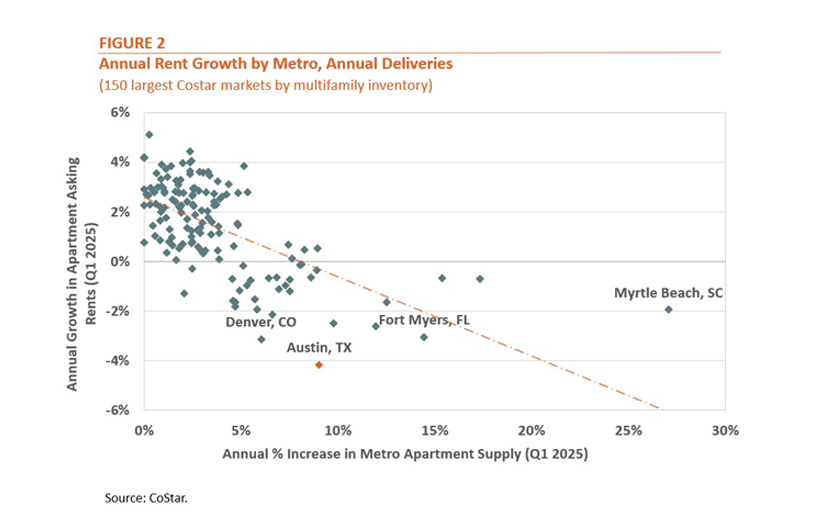
Restrictive zoning laws preventing construction in coastal cities is also a major factor. The cities which see the greatest declines in rents have the greatest increases in supply.
https://www.nmhc.org/contentassets/f9a5ef47d06143e6b8355cfad...
> after corps, we have foreign buyers also coming in with cash offers
As someone mentioned earlier in the thread, these are memes that are not actually backed by data - commonly perpetuated by groups that blame most issues on billionaires/corporations/investment firms.
In my neighborhood specifically, there are homes being bought not by single families but specifically buy management companies so they can then rent the property. To deny this happens is just as much of a stick your head in the sand meme as what you are accusing me of.
I'm sure that happens occasionally. It's not nearly as significant as exclusionary zoning and other bad policies that prevent housing from being built.
In my neighborhood specifically, there are homes being bought not by single families but specifically buy management companies so they can then rent the property
Even in that case, the homes are still on the market.
That's why your anecdote is meaningless and can be dismissed immediately.
the folks in those areas, if you owned a house for the last 20 years, are now richer than ever due to that property appreciating. but the younger generation is absolutely screwed
Only if you sell it, and move somewhere with a much lower cost of housing.
There is also less need to get the maximum possible loan if house prices are lower as a ratio to income.
Here's a size list that is commonly shared https://www.newser.com/story/225645/average-size-of-us-homes...
When you figure in # of people in such houses, the avg person has vastly more space https://www.reddit.com/r/REBubble/comments/14hayqq/average_h...
I bought my house in 2018. It was built in 1997
It is not vastly larger than it was in 1997, but I still paid 2018 prices for it
Most people aren't buying new builds
A few years back, median age of sold house was 27 years. So by that metric you bought even a newer house than the majority of house sales.
Your 1997 house is almost certainly much larger than the median 1950 house.
And, your single data point in no way invalidates aggregate statistics.
They are and the trend is there. The housing market moves slowly and it takes time to chip away enough at the larger stat. Once the boomer's age out, even with wealth and asset transfer, let's revisit this and see how it looks. I'd bet 2/3 ownership looks more like 1/2 or less by then, which is a significant drop and it probably will only continue from there.
And those old folks that took their home equity and used it to buy property for an AirBNB are in fact an example of the rich/old folks screwing the young generation hard. (Other examples: vote to reduce taxes, to increase tuition, stop the free market from building more housing, do nothing on global warming, let the economy be swallowed by health care and financialized scams). As are the people that own and rent 3 houses, while their grandkids have to move far away. (Disclaimer: I live in San Jose, and my adult kids will never be able to live near me).
Owning a home in an HOA area can drastically cut down on what kinds of parties you can host.
Renting honestly can be a better deal, especially if you have the discipline to stick excess money in the market consistently. In fact, your returns are likely better than just using a house as a forced savings account. In my neck of the woods, we have seen rental inversion too.
I mean you can phrase it this way. Or you can phrase it as homeowners are willing to play a premium for stability / forced savings. (And to be less generous, homeowners may be getting cheaper access to capital than otherwise available to a renter; espsecially as the homeowner locks in ~2% interest rate while a margin loan has increase to 10+% [1]).
However, for markets with low construction and strong demand I'm pretty sure home ownership comes out ahead. Like look at housing prices in the bay area historically vs current rents. That said, you need a handicap'd rental market for renting to be worse so the general situation is it's better _iff_ you invest the difference.
[1]: https://www.schwab.com/margin/margin-rates-and-requirements
I will also note, that the notion of having access to a cheap line of credit, like a HELOC, can be a fantastic tool when used correctly. But... I'm also seeing folks abuse this to keep up with the Joneses. And when times get tough, they won't be able to pivot and might end up defaulting and then losing their home in the process.
The overall state of the economy will still need another major shakedown before those elements of society get their wake-up call. It sorta started happening with Liberation Day, but we bounced back rather quickly... so who knows when that would happen.
Property taxes, HOA fees, maintenance, appliances randomly breaking and resulting in bills of thousands of dollars...
the ability to affix things to the walls without worrying about marks when you have to move out
If you care about the sale price you will worry about that, among many other things.
Marks on the walls from hanging pictures is not going to meaningfully change the sale price of a house, please be serious
However it could absolutely lose you your damage deposit when renting
How many of that 2/3 is households that have owned the home for 20+ years—ie, since before the subprime crash?
How many of that 2/3 is households of people 65+? And how many is people under 30? Partying is still largely a young people's game, and even if your "household" owns the home you live in, if that's your parents or grandparents, you're much less likely to be hosting parties there.
Also, it varies quite a lot by state. Over 3/4 of adults own their own home in West Virginia, but in New York it's a bit over 1/2.
In fact I just checked and the ratio of avg salary to real estate prices is about the same as in New York.
Makes for a very angry native population who are being pushed out of the places they were born for new arrivals. We'll never be able to build enough housing to account for the continual flow of well to do immigrants and native population.
I can’t count a single immigrant in my network that was rich by American standards (which makes them filthy rich by most other nations standards) and then chose to move here.
Sure my sample size is probably 30 families (across a dozen countries) but that’s not nothing.
Every single one built their net worth here. Meaning that opportunity is also available to natives.
It made it extremely difficult for us to buy our house because we kept losing out to all cash offers from China, and that was 10 years ago.
My point was meant more that I also knew tons of immigrants that made their money here with the same opportunities available to locals, and not some unfair advantage.
If you’re meeting someone who has a Masters or PhD from a US university and came from another country - often their family is well off. Certainly better off than a typical middle class family in the US that can’t pay for college for their own kids and aren’t even paying international rates.
These people are too rich to talk to you.
https://www.benhams.com/news/london-property-market/foreign-...
"almost 27% of the total London properties sold in Q1 2024 were acquired by foreign buyers, recording a 3% YoY rise."
Note that "foreign buyer" and "immigrant" aren't precisely the same thing; you can buy property in the UK without having to be resident.
It wasn’t long ago when the experts were warning about over population.
The article says a similar decline is seen among the wealthy.
good riddance btw. but we need to adjust because partying is nice. we are still working ad if we have a free employee taking care of half our lives.
welp, it's always a class issue.
I don't think the real estate situation helps but I think there's a deeper social problem driving both of those effects.
This is only true in some HCOL places ands big cities. Plenty of people own homes.
Other places had taxis (that you couldn't order ahead of time to get to work on time) and some had none until they uber/lyft. (Don't know the current situation).
I'm going to guess the other thing Berlin has is safe areas to walk. I can go to a party and walk home, safely on walking paths complete with shortcuts, without even being harassed by the police and risk getting arrested and in jail for the night (for public intoxication). None of these were luxuries I had in the states.
And I'll say that yes, I've been in some small apartments - but only some folks with small apartments can host. You probably have no clue how many would host if they only had enough space, but a small apartment with 2 adults that have hobbies limits things.
It's been years, but I hope Den Gode Nabo is still fun.
Den Gode Nabo is still about, but its been years since I've been there :)
People travel there literally to party.
Partying in someone's apartment is a thing in probably every reasonably sized city in Europe, not just Berlin. Although you should probably alert your neighbours.
My own personal theory? Music sucks now, ha ha.
The median new home size skyrocketed in the '80s.[1]
Many of the post-war suburbs were planned communities built with schools, churches, grocery stores, and other necessities within walking distance.[2] Compare that to developments today (and since the '90s), that are all housing, lack sidewalks, and require a car to get to necessities.
Serendipity doesn't happen when everyone's in cars. You don't pull over to invite an acquaintance over for a beer or offer to watch their kids.
1: https://www.bankrate.com/real-estate/average-home-size/#smal...
2: https://en.wikipedia.org/wiki/Levitt_%26_Sons#Construction_o...
I almost never meet people who like the same bands as I do. I can listen to new music that I love at home. If I go to a bar or a party I'm going to mostly hear music I don't like, and if I do like it, I could have already heard it at home.
Maybe that is part of it
The home ownership rate has been 64%, plus or minus about 1%, for the last 45 years.
https://www.nar.realtor/research-and-statistics/research-rep...
The median age of the population of the United States has increased from 35.3 in 2000 to 38.8 in 2020. (hmmmmm)
https://en.wikipedia.org/wiki/Demographics_of_the_United_Sta...
https://en.wikipedia.org/wiki/Demographic_history_of_the_Uni...
As the population pyramid of the US, which is already a "population Empire State Building", further morphs into a "Population Baseball Diamond", I expect the median age of all buyers to increase and the percentage of owners by age group in the younger cohorts to decrease.
Additionally, as the median age increases, because older people tend to have more money, I expect home prices to continue to increase.
Honestly, I expect home prices to spike by 2035-2040 as the current crop of 50–60-year-olds reach retirement realizing that their only real prospect of not starving to death in retirement is the main (and often only) asset: their home.
That will further stress younger folks, but people don't seem to care and anyone who expresses concern is denigrated as a communist so what is to be done?
Regardless, with the homeownership rate for "under 35" fluctuating between ~41% in 1982 and ~37% in 2024 "nobody owns shit no mo" is still false.
at least in canada, this would mean that 38 y/o are primarily still living in their parents basement, since theyre living with the homeowner, and that counts as home ownership. same thing if you're a roommate with the owner, paying rent.
The simple fact is that people still buy and own real estate, at pretty much the same rate for decades (a century?), and now end up owning much bigger places.
Everyone gets quick and lazy dopamine from phones. Why bother with anything else?
Think about how much time goes into phones. Who has time to plan? Who has time to coordinate?
Phones are probably why the birth rate is declining too.
You don't even need a house to party. You can use a pavilion at a park, go out in the woods like the rednecks I grew up around did, party at the trailer park. Homes are by no means a limiting factor.
It's 100% our phones.
Anecdotally is makes a lot of sense as well. Most of the people I know, including myself, spend an awful lot of time on their phones and the internet in general. All of those hours have to come at the expense of other activities.
When I was in my 20s I spent an unusual amount of time (for the era) alone on my computer, but since most people were still quite social it was easy to hop into various activities. Now that nearly everyone is spending a bunch of time alone on their phone the real life social networks have begun to fray.
Some of the changes are for the better (ie. fewer teen pregnancies) but I think these trends are quite bad overall, without a clear solution. It's probably not a coincidence that political polarization and extremism has also increased during this time. Banning smart phones in schools seems like a step in the right direction, albeit a tiny one. Hopefully we can come up with more.
> All of those hours have to come at the expense of other activities.
It all adds up. Five minutes here, thirty minutes there. It all has to come from something.
The smartphone usage takes away in subtle ways too. Time spent idle is time that the brain can subconsciously solve things and work out interdependencies and relationships. If you put that time on YouTube, Reddit, whatever, then your brain is fully consumed with the dopamine drip.
Smartphones have added a tremendous amount of value to society, but it hasn't been without cost.
Hmm I use a group chat on my phone to coordinate with my friend group where we go out on saturday evening, if we need a reservation etc.
Phones are invaluable for fun too :)
If you look at a graph of home ownership in the US by cohort at various points in time (see, e.g., https://www.census.gov/library/stories/2018/08/homeownership...), while the rates are somewhat lower, between the highest point and the lowest point the difference is at worst 10 percentage points.
This sentiment strikes me a lot more as people in their 20's complaining that they're poor because they don't have the financial resources of someone in their 40's, despite having more resources than the latter did at their age.
I doubt it’s the only cause at all, this anti-social (“Bowling Alone”) trend has been going on for generations, and probably has multiple causes. But the US housing crunch on young people is adding to it.
And this damn attitude of “the younger generations are just entitled weenies” about housing is about the most infuriating attitude in the world. My parents bought their first house on a single earners blue collar salary at the age of 27. That house, with almost no updates, now literally needs a top 1% salary and payments for 30 years to be able to afford. Don’t tell the kids to stop whining when they’re watching older generations gobble up their future in the name of preserving property values.
Short version of the history:
Starting in the late 1990s, you had a super-concentration of both good jobs and interesting culture in a short list of cities: SF Bay, New York, LA/OC, Seattle, and a few others. I remember growing up during this period and the whole cultural zeitgeist was "if you don't live in one of those cities, you can't do anything."
These cities have always had an allure, especially creative centers like LA and NYC, but what I mean is that it got much more extreme. It fits with the general cultural zeitgeist of everything centralizing and going to the extreme right side in an increasingly tight power-law distribution.
This was followed by insane real estate hyperinflation in those cities, of course, because if you try to take all the "interesting" stuff in the world's largest economy and a nation of 300+ million people and cram it into a few metros, that happens.
The rest of the country still has a lot of affordable real estate, less so than it used to -- RE has appreciated everywhere and not just in the US -- but it's far less insane than the top-tier cities.
I post this every chance I get:
https://worksinprogress.co/issue/the-housing-theory-of-every...
How old were you then?
People have a tendency to remember some time period when everything was carefree and you didn't have to worry about how much stuff cost and all this new, great stuff was happening. And then you find out they were 12 and the time where they think all that went downhill was when they were 20.
I've asked older people about this for this very reason, and they've generally agreed with me. There's always been an allure to big cities but it went into overdrive starting in the late 90s - early 2000s.
As for real estate prices, that's objective. You can easily look that up. RE prices went insane starting in the 2000s with the 2008 crash only being a brief pull-back in a long bull run. You can also clearly see the divergence with big top-tier cities appreciating at a much faster rate than smaller cities. You can see it in the numbers.
Look into the origin of early personal computers. They're from all over: Albuquerque (MITS), Dallas (TI, Tandy), Boston (DEC), Miami (IBM PC), Philadelphia (Commodore), Seattle (several), etc. In the early 2000s if we re-did the PC revolution it would all be from the SF Bay, because by then if you were doing anything cutting edge in computing it had to be in the Bay Area.
> "We, alongside the mujahedeen, bled Russia for 10 years until it went bankrupt and was forced to withdraw in defeat," bin Laden said.
> He also said al Qaeda has found it "easy for us to provoke and bait this administration."
> "All that we have to do is to send two mujahedeen to the furthest point east to raise a piece of cloth on which is written al Qaeda, in order to make generals race there to cause America to suffer human, economic and political losses without their achieving anything of note other than some benefits for their private corporations," bin Laden said.
> As part of the "bleed-until-bankruptcy plan," bin Laden cited a British estimate that it cost al Qaeda about $500,000 to carry out the attacks of September 11, 2001, an amount that he said paled in comparison with the costs incurred by the United States.
> "Every dollar of al Qaeda defeated a million dollars, by the permission of Allah, besides the loss of a huge number of jobs," he said. "As for the economic deficit, it has reached record astronomical numbers estimated to total more than a trillion dollars.
> "It is true that this shows that al Qaeda has gained, but on the other hand it shows that the Bush administration has also gained, something that anyone who looks at the size of the contracts acquired by the shady Bush administration-linked mega-corporations, like Halliburton and its kind, will be convinced.
> "And it all shows that the real loser is you," he said. "It is the American people and their economy."
> As for President Bush's Iraq policy, Bin Laden said, "the darkness of black gold blurred his vision and insight, and he gave priority to private interests over the public interests of America.
> "So the war went ahead, the death toll rose, the American economy bled, and Bush became embroiled in the swamps of Iraq that threaten his future," bin Laden said.
Home prices have doubled over the past 20 years, twice the rate of income increases
This isn't just "complaining"
In 2000 a median house would cost 3x the median income, in 2025 it's 6x (and in some cities, 8x or more)
Affordability has changed, it's well documented fact. This isn't napkin math or whinging.
I would hope so, otherwise that would mean the country/locale is so bad that older households are packing their bags and fleeing.
So the most desirable properties, such as large SFHs, townhouses, penthouses, etc… within a short driving distance of an attractive city will likely be owned by the latter, by definition.
Not to mention Private Equity and huge real estate investment firms that vacuum up a significant (if small) number of homes. Even if that 20 something could scrape together a 20% down payment and make an offer for asking price, they're going to get beaten by some corporation buying with cash.
This complaint - we don’t have nice houses so we can’t party - is unintentionally emblematic of the root issue in misaligned expectations and excuses for realigned priorities. Nobody Inknew when young had houses either.
Look, it’s not obviously bad to me that young people party less. Blame gaming, blame some resurgent conservative cultural values, blame the internet or even laziness. Maybe the youth today just have better things to do, and that okay. Binge drinking, drugs, and stupid decisions aren’t necessary good investments in time, and many, many, friends from back in the day didn’t survive it. Like less kids smoking cigarettes, maybe this is a good thing (for them and all of us).
But it’s ridiculous to try and turn this behavioral trend into some manifesto on housing inequality. Give me a break.
Note the age-group with the biggest drop is 15-24, its not like the average 18 year old owned their own home circa 1995.
This is baffling to me. Most of the parties I went to in high school, college, and my 20s were in people's tiny apartments, small rented houses, and small yards.
Maybe expectations changed? Now it seems more like people feel the need to get ready before going out, to bring something, to pre-coordinate to arrive with a group of friends, to have a lot of space, to have everything pre-cleaned and ready to be the background in photos, and maybe even to have a meat and cheese platter that gets posted to social media. It seems there's much less willingness to just go places, be cramped, and just hang out.
Incorrect.
I’m like here’s a giant thing of ice cold booze have fun.
Why clean it thoroughly both before and after a big party? Why not just after?
Gen-Z is not only completely in the right in being sheepish, their predecessors are entirely to blame, and every attempt to claim they were not a part of the increasing surveillance state is a lie.
Even the older members of Gen-Z can be blamed to a small degree.
There is no cure
Anymore this feels impossible due to neighbors, landlords, and police. I have so many anecdotes... I don't think it's "getting ready" as much as it's an intolerant society of chronically entitled people. Also, it's increasingly expensive to go out + I truly believe we're experiencing the destruction of "3rd places"
My 20's had a good amount of that too... but it was increasingly at odds with real consequence and risk. I'm just safer at home with my SO, in my space. It's getting much worse for younger generations :(
That's not what it meant in the 1980's though. That's one of the things that changed. The US in the 1970's and 1980's was much freer in that regard.
I never was much of a partier as a teen but I've been to a few, and they were all in flats ranging from much smaller than an American house to literally one room sometimes with 15 people in it. Had no problem falling asleep drunk on somebody's kitchen floor or on a couch in a room with a bunch of other people.
Even in the US a dorm room (a tiny, rented place) is a stereotyped party location.
Oh and ofc numbers are wrong. The houses in the US are bigger than ever and homeownership rate is smth like 60%.
Sorry but can't agree, as do most folks here backing up with some hard data. That 'glass is half-empty' approach to daily life ain't healthy long term, ever thought about that?
My theory is that people have fewer parties because people have gotten flakier about attending larger social events. It is much easier to cancel plans at the last minute with a text or a social media DM, and people always seem to want to keep their options open. We've moved to getting together only with one other couple/family at a time b/c any time we try to have larger group events half of the invite list will cancel the day of.
Add in the odd issue of younger people not getting their drivers licenses or owning/having access to a car.
It could be anecdotal but I've seen this in a number of locales across the country. Curious if there's hard numbers on it.
Most homes in the US are mortgaged. More likely the banks, which ultimately means the depositors, who are just as likely to be everyday average people (the wealthy normally keep their wealth in things like businesses), own most of it.
People these days don’t own real estate. Wealthy people own it all. Normal people are renting apartments or portions of homes. It’s kind of hard to throw a big party without a big home, a yard, a big kitchen, etc. Small apartments are for small get-togethers that probably don’t register as parties.
Likewise, the larger someone’s home is, the more likely it is to be location in an area with low population density and little to no public transportation. Congrats, you can throw a party, but who are you inviting? All your friends are far away. How can they get there? How long can they stay? Can you accommodate them sleeping there? You aren’t friends with your neighbors who can party easily. You are friends with people on the Internet who are strewn about the world.
And of course, if you live in a major city with lots of friends, small apartment strikes again.
This is part of the reason we have seen the rise of more public events like conventions. There’s a hotel involved. It’s a multi-day event worth traveling to. A lot of people you know will be there. It costs everyone some money, but it’s not out of the realm to go a few times a year. Best part, nobody’s home gets trashed!