Are you sure you didn't just read the link? If you want a book-sized argument, you need to read the book, or at least listen to it.
Even someone making a first principles argument for a revision of US trade policy should agree that this is insane.
What's a 50% drop in value to a billionaire? Most of them would still be a billionaire and the ones that fall from that group still have more money than they could ever spend. No wealthy person will truly feel what's going on. They'll still vacation and eat their caviar. Caricatures aside, it's absurd to compare someone stock sheet numbers going down with people not able to find medical care or feed themselves.
- Threats of annexations - Existing conflicts in North America, Middle East, Europe and Asia. (whats up with South America?) - Mass unemployment and poverty in US freeing up able bodied people for some soldiering - Right wing blowhards everywhere
Just crazy that this is essentially because rich people dont want to pay some debts, and some crazy russian guy's ego
"Go on, my friend, and fear nothing; you carry Caesar and his fortune in your boat."
there's no plan for anything here.
Then why is the economy crashing under these new tariffs when it was recovering nicely just a few months ago?
Explain how is it hurting US economy?
It is unacceptable for any other country to be able to do this to any part of the western-aligned military supply chain.
We needed a targeted policy -- I don't care about American cars except to the extent that those factories can be converted to aircraft and tank factories.
But the conversation has been frustratingly reduced to 'reshore low skill work' vs 'save my infinite trough of cheap plastic slop'.
I don't want to hear about tariffs bad, I want to hear about how subsidies are better or about how it doesn't matter anyway because of the structure of the Chinese economy (I saw it claimed without evidence that they depend on imports from places aligned with the west which is reassuring if substantiated).
There's an underlying issue everyone is dancing around.
National security / foreign interference hadn't occurred to me, and now I'm wondering what would happen to US economy and manufacturing if it was at war with China and or the EU over Taiwan and or Greenland.
How would US deal with Russian style sanctions? Can China simply ban all exports to the US?
In times of war, it probably is super important that a country and manufacture all essentials.
Just give it a few minutes to settle out. Sometimes people tap the downarrow by mistake, since it's 2mm away from the uparrow. It's not always a conspiracy :-)
>But the conversation has been frustratingly reduced to 'reshore low skill work' vs 'save my infinite trough of cheap plastic slop'
The conversation has been reduced to that because this administration's tariffs are and have always been indiscriminate.
You bring up an interesting issue, but people aren't discussing it because it's orthogonal to what is currently happening.
Income taxes on individuals are 2.4 trillion.
How much do you expect to raise taxes to cover that gap? You double my taxes and I’m in the welfare line.
Further, and this is not referenced enough - the US must rollover ~9 trillion in treasuries this year. The lower the interest rate to do that, the better. Otherwise it increase the deficit even more.
The only way this ends is one of two paths - a path similar to what we are on; default.
We may not like this one, but default is world destroying because of the broad use of the Dollar around the globe.
Also, this is a false dichotomy.
https://www.cbo.gov/publication/60870
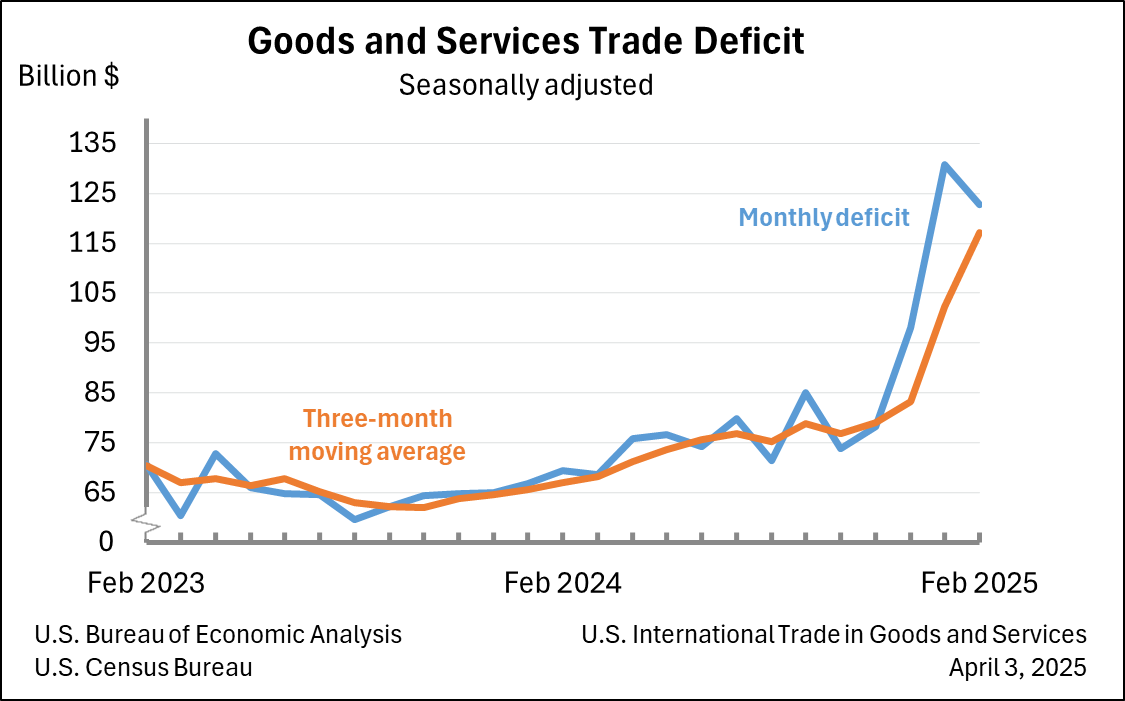
IMO, 5%+ percent of gross domestic product (GDP) in a country with massive trade deficits is not sustainable.
Out of date!
Agreed. However, by imposing tariffs it is not the privileged who are going to be affected the most. The pain is felt most by the low-skill workers you mentioned earlier.
If the solution was instead along the lines of changing tax-brackets to tax the 'privileged' more, that might have better addressed the problem you mention in the beginning.
How much all the imports are realistically going to be made in the US?
Because, if you think about it, it took decades to get us to where we are today and it'll take decades to reverse, even logistically. This is a bunch of stupidity and meaningless saber rattling that will do nothing but hurt everyone except the extremely wealthy who can afford the additional taxation on the consumer side because the Republicans will further reduce the taxation on the income side.
I don't understand why people take this as a given.
Tariffs are a two-way street. What incentive does a company have to move a billion dollar facility to the USA when it will face reciprocal tariffs on any exported goods from the USA?
The calculus is pretty complicated. Economies of scale become a factor - is one large global factory more efficient than separate regional facilities? Also income disparities; Americans can more afford to pay a 25% premium on a good than most of the rest of the world can; so maybe you just make Americans pay more. Or, maybe you do both, have a world-wide facility and a American facility, but still charge Americans the tariff premium, and pocket the 25% as profit instead (steel producers model; also pickup trucks); this works well in conjunction with the USA's low business taxes.
Then there's "hacks" like shipping goods to a country that has lower tariffs with the USA, then using cheap local labor to do the bare minimum to have the goods considered to be produced there. There are some obvious good choices here, supposing the country's leadership is willing to play ball into the ninth inning.
So it's not a given that that long-term effects are increased domestic production. It's just as likely to be a siphon of prosperity and a impediment to wealth generation since it will be hard to start companies in the USA that export products.
Access to the richest single market in the world ?
How long do they stay the richest single market in the world if rest of the global world are producing and trading at greater efficiency while the US are facing large short term supply disruptions, higher costs and reciprocal trading tariffs on their exports?
This is going to catch up to most countries very soon. The US will be in a small group of the ones last standing.
Please brother, don't make me imagine a world war with nukes. The whole world is going to collapse, It would take us atleast three century back and it would be the darkest chapter ever.
I think there are some really smart people in the world. We can use them to create beautiful discoveries. Seriously, it sends me shivers thinking of a world war, but it may happen, and I have no control over it. I have to just watch the world wither away.
Their population pyramid looks good though compared to China:
https://www.populationpyramid.net/united-states-of-america/2...
https://www.populationpyramid.net/united-states-of-america/2...
>how do you justify labelling a birth rate that's been below replacement for 18 years as "OK"?
The US being a nation of immigrants has this unique selling point of attracting people to make up for their woes such as birth rate. Unless we see millions of citizens getting deported, the people "voluntarily" relocating don't move the needle in this metric.
That’s also before you get into the fact that stopping immigration into the US doesn’t make those people disappear * , they’ll immigrate to other countries or stay home may very well cause some countries with a declining population to stop or reverse that trend
* Not en masse anyways, that’s come later as more of a final solution
US: https://www.populationpyramid.net/united-states-of-america/2...
The current admin is saying they are going to stop immigration. I don’t find it comforting or plausible if you’re telling me that we have to wait and see because they might fuck up one step of their plan and that’ll make the other steps less painful
India has an overpopulation issue. In India, we literally have more people than jobs. So you guys could just tap into India.
China is also similar, except it has outgrown its master. So I can understand the mistrust. But america put tariffs on India as well which is just ... funny.
Also if america really falls into a recession (60% chance, like I mentioned in my other comment), how much do you think the US would be doing "OK"
I think what the US is right now, is failed democracy. I mean, I used to hate my government, but it was because of their political views/ I just felt that a tiny change in the Indian system is needed (like Media , incentives for middle class), I have hope in India. India can truly change if need be.
I have no hope for america.
amazon.de click 28cm lightweight bike wheel click Order click.
Well what do you know, you're a big fat liar :)
Huh? It really is. There's free trade and free movement of labour. How is it not a single market?
It's a lot better than having to deal with each county individually but still way more overhead than US.
1. California has 10 million Spanish speakers 2. Every state has its own regulations and legislation (and taxes!)
But I don't think you would try to make that argument... right?
Free movement of labour and goods make a single market. The other stuff is just normal operational costs of doing business.
Also, and you know this: most of the EEA uses the Euro; the countries that don't are exceptions
25% margins are huge. Sounds like that margin is someone else's opportunity....which is exactly what the Administration hopes will happen.
There is an opportunity here: Cozy up to Trump, have him give you a ton of government money and spin up a company that will take those margins.
By whatever mechanism, imports are now more expensive, leading to less demand. Demand for those products actually stays constant, but the demand for imports goes down.
Now we have a niche. If you can produce a good locally for less than the net cost of import, you have an entire continent ready to buy from you.
The reason this has historically gone the other way is labor costs. Factoring the entire global supply chain into your product, it makes much more sense to do the work in a country where work costs less. If the additional cost to import is less than the delta on labor, you've won capitalism or something.
Or, take another angle. If the US can no longer import vital goods, what do you think will happen? Will the goods magically stop being vital? Will we sit on our hands for several decades and wait for the problem to resolve?
Or does the market respond to a need and rearrange itself to provide as profitably as possible?
If you reply with "but surely BASIC INCOME" then I must ask, what are you personally doing to help make that happen?
As for UBI, who is going to provide the money? I've never heard anyone talk about how that is supposed to work. YOUR comment is the first time I have ever heard, well, read, that point brought up. The government can't pay for UBI because there will no longer be a tax base of income earners due to lack of income. Companies can only contribute to the extent that they have customers. I suppose that a super-efficient, low labor economy could be almost entirely export-driven but that assumes the rest of the world isn't in the same situation.
We could also acknowledge that money is a fiction; money is continually created by the banks under the authority of the government, and money can just be destroyed when it’s taxed instead of thinking it has to “balance the federal budget”. “A dollar” is not tied to any physical store of value but we still love to pretend it is. It’s just a fraction of the overall economic worth of the entire US, and entirely too many of those fractions are in the hands of huge bags of money pretending to be people.
Or we could just ditch “money” entirely. Add things like “lodging” and “food” to the Bill of Rights. There’s probably a lot of problems with this! And a lot of them probably rhyme with the problem that some people just really want to become big bags of money pretending to be people!
Bezos makes ~8mil an hour according to some quick Internet searches and that sure is way over the "giant bag of money pretending to be human" threshold IMHO. The idiot-in-chief is worth ~$5mil and he sure is way over that threshold too.
No - consumers will just eat the cost like they did during COVID.
>> Or does the market respond to a need and rearrange itself to provide as profitably as possible?
rearranging itself will mean leaving the status quo, and passing the cost to consumers. Do you think companies are going to jump to spend millions of dollars and 1 year+ to build factories to work around something that might change in 6 months, or even 4 years ?Yes, you've won capitalism, but sometimes, profit is a lower priority. Resiliency and the ability to avoid critical supply chain dependencies are important too. We learned that during COVID, when we only had one facility to make baby formula in the U.S., and we had a dire shortage of masks, gloves, etc. because we imported it all from China.
Another aspect of resilience is avoiding long attenuated supply chains, even if it is cheaper...for now. Why? Because there is a finite amount of fossil fuels (necessary in greater amounts for non-domestic maritime and air transit). Also, lower fossil fuel usage due to in-country sourcing would be better for the climate. I realize that the Trump administration isn't concerned about that! But it is true regardless.
It's not about efficiency. Companies in the US only build and ship their products from the opposite side of the planet because over there they can abuse the local slave labor and pollute the environment in ways that would never be accepted in the US. Even when they could easily afford to by accepting less profit, they aren't going to move production to the US when it means they can't take advantage of those things.
In 3 decades, the US won't be the biggest market for most products - sooner if the harebrained economic decisions somehow persist.
Capital knows no borders, and American companies will "do the needful" to maximize profits wherever they may be found.
Those statements are offered as truism ( and they do sound true enough ),but are they anything more than a hopeful assertion? I won't go into too many details, but I think it is not exactly axiomatic. It may be have been 99% accurate in the post-world war new world order, but, needless to say, that has shifted.
We can argue over whether it is a temporary pit stop or a longer term change that is likely to remain its place, but 'capital knows no borders' has its place along other otherwise useful phrases such as 'bet you bottom dollar that tomorrow there'll be sun'. As in, sure, but it is more of an expression of our wants, not an if/then scenario.
It's much easier for an average non-resident, non-American to register a Delaware LLC than it is to get an American work visa.
> It may be have been 99% accurate in the post-world war new world order, but, needless to say, that has shifted.
Trump has proposed a green-card-inspired "Gold Card" for rich Russians^w investors to skip the immigration queue. Lot's of countries have investor visa with fewer hoops to jump than work visa. I don't see this changing any time soon. If you have the capital, and hint that you're interested in investing $1M+, most countries will roll out the red carpet for you.
It is an interesting argument to make. Given current efforts to reshuffle existing system, those may no longer be available. Let me ask you a hypothetical instead: if those 'ways' are gone, is it automatically a given that new ones will emerge? If yes, why? If no, why?
<< Trump has proposed a green-card-inspired
I don't want to write too much of an obvious comment, but.. how is it different from existing pre-Trump green cards sold to interested parties ( with lower price tag, but I am not asking about the price )? Is the existence of the card proof that capital has no borders or of something else? Is it inherent? I am now genuinely curious about your internal world model.
It's important to remember those were not the only ways, they just happened to have be the most effective, and became notorious because of it. Tax havens still exist, and we are still far from taxing corporate in the same stringent ways we tax individuals. The fact that governments only chipped at the edges with no systemic changes is telling.
> I don't want to write too much of an obvious comment, but.. how is it different from existing pre-Trump green cards sold to interested parties
You need to be specific about how green cards are currently sold before I can attempt to explain the difference. Further, if there is no difference IYO, then why is Trump proposing something new?
I was personally referring to EB5[1]
<< Further, if there is no difference IYO, then why is Trump proposing something new?
Eh, I have a personal theory, but that one will likely need some time to confirm. The shortest, handwavy way I can offer is politics ( and separation/differentiation from existing EB5 ), but I am open to alternative explanation.
[1]https://www.uscis.gov/working-in-the-united-states/permanent... [2]https://legalservicesincorporated.com/immigration/minimum-eb...
<< It's important to remember those were not the only ways, they just happened to have be the most effective,
True, but I am questioning how much some of this stuff will be increasingly challenging to evade. The fact that beneficial owner version in US was effectively scrapped suggests the AML regimes were getting pretty close to the issues you were referring to. And, as always, conversations within the industry players are discussing more monitoring, more data.. not less.
<< The fact that governments only chipped at the edges with no systemic changes is telling.
That is true, but it does not prove that capital has no borders ( original point of contention ).
Which is easier to execute: legally investing on a goat project on Mongolia or Djibouti over 2 years vs legally living there for 2 years?
It's self evident that there are far fewer hurdles for capital to transcend national borders than people. I am not certain if your argument is that the existence of minimal friction proves that there are borders for capital. If so, I'll concede that capital crossing market and judicial boundaries will encounter some minor bumps - typically from the country of origin. This heavily contrasts with labor, which faces significantly more resistance, and the resistance is from the destination country/market/juridiction. Would you agree with "Countries bend over backwards for capital inflows, including from individual investors"? It's a mouthful, but perhaps expresses the same sentiment.
I think so. It sounds closer to what seems to be happening. In any event, thank you for this conversation.
For the US / Euro, yeah you can just digitally wire say $ 150 million no problem. You just can't physically fly out with a suitcase of $100 bills.
This is not true for something like China [1].
The counter-topic is usually Labor. You very much cannot just go to the US and work but you could from China invest in a US company. So Capital knows no borders while Labor does.
[1]: https://www.tradecommissioner.gc.ca/china-chine/control-cont...
That reason will be that he and his pals have already bought up all the stocks that are crashing or the businesses that start failing all at insanely low prices which they can sell off for huge profits once the tariffs are reversed and their value returns to normal.
For all of the whining about the previous tariffs from the first Trump term, or the TCJA, neither were repealed when democrats had the opportunity, although there were small adjustments. That should really tell you all that you need to know.
It turns out that manufacturing jobs are better for supporting a family than service jobs, hollowing out our economy so there are far less good paying manufacturing jobs turned out to be a huge mistake, originally pushed by CFR, Cato, Brookings, etc. so the only people who are doing well are the rich, because the benefits of global trade accrue almost exclusively to them (although many CPI advocates will make the argument that you’re better off now because you can own a nice cell phone even though you can’t own a house)
The public BSing goes the other way too of course. Imagine getting worked up over classified stuff on a private email server and then letting your cabinet use signal and Gmail.
Why? I hear this implied, or outright said in your case, frequently with no backing for it. It seems like a truism.
So, this chart has job numbers and count for the following resource extraction/manufacturing related fields with the following average hourly pay and the number of people employed in that field today:
Manufacturing: $35.16 - 12,746k
Mining and logging: $40.33 - 623k
Construction: $39.24 - 8,313k
Transportation and warehousing: $31.19 - 6,738k
The weighted average of this category is $35.53 per hour.
In general, these jobs can mostly be performed without a college degree.
Contrast that with service jobs that can broadly be performed with a college degree:
Retail trade: $25.18 - 15,595k
Leisure and hospitality: $22.75 - 16,991k
Other services: $32.39 - 6,036k
The average hourly rate for this class of jobs is $25.24.
So, on average, manufacturing and extraction jobs not requiring a college education pay 40% more than service jobs of the same requirements.
I'm not one of those people like the top poster who thinks that everyone can just go get a college degree and become an accountant or a nurse. I think there are a lot of people out there who can follow instructions to work machinery reasonably well, but aren't going to be a great fit for jobs that require a substantial education. These people are the majority - about 62% of US adults are not college educated. We either owe them dignified employment, or in a democracy, we will suffer their wrath.
This feels sarcastic?, but I'll assume it isn't for the sake of the conversation and since that's easy to misinterpret over text
> In general, these jobs can mostly be performed without a college degree.
> Contrast that with service jobs that can broadly be performed with a college degree:
Are these not apple to oranges comparisons? "can mostly be performed without a college degree" and "service jobs that can broadly be performed with a college degree" seem like different buckets.
On top of that "can broadly be performed with a college degree" means nothing. You could describe people in comas as being able to "broadly perform a coma with a college degree". Especially when retail is being pulled up as one of the major buckets.
>So, on average, manufacturing and extraction jobs not requiring a college education pay 40% more than service jobs of the same requirements.
Yea again, this is disingenuous. You're now comparing "manufacturing and extraction jobs not requiring a college education" with "service jobs of the same requirements" but mere sentences ago you were bringing up data on manufacturing jobs that _did not_ need a college degree, and numbers on service jobs that _did_ need a college degree.
I know believe the numbers in this link aren't matching up with this conversation because they are logically inconsistent
Wasn’t my intention but maybe I was laying it on thick.
I misspoke, the service job categories I referenced can be done withOUT a college degree, that probably should have been obvious because it included the categories “retail” and “hospitality”
I didn’t include the service categories that require substantial amounts of post-secondary education such as “healthcare” and “financial.”
Anyways now you’re calling me disingenuous so I’m going to disengage. I hope despite a small mistake on my part, you can still see my point. Have a nice life!
They are talking about getting rid of jobs like journalist, software engineers, accountants, and various other jobs that require college level education as long as its something they associate with some nebulous intelligentsia that they have identified as their enemy
The world followed the lead and it just wanted reciprocity (exclude the enemies of course). What seems fake to you and who is getting scammed by who?
And why do other countries keep doing it if we are the ones getting the better end of the deal?
The PRC has strict controls of their money because that is how they can became the factory of the world. They played the hand that were dealt with and battled adversity and they are reaping the rewards.
The president said today that the US trade partners and allies/friends have been taking advantage. You can easily verify if that is true or false. US capitalists moved production overseas to make more money at the expense of the local workers. That's the scam.
Ths USA was the number one economy when Trump pegged us.
You are too smart to actually not get this. You call it fake as if money isn't just made up 100% fake 'value units' we all agree to pretend (thus making it real) is real.
That's the European Union, with no tariffs within the EU, moderately high tariffs at the EU border, and few policy shocks. The EU plugs along, with somewhat protected industries, moderately high prices, good quality, and some export business.
I've this assertion made here multiple times. The LLM's tell me the average tariff on goods coming into the EU is 2-3%. That's not what I would call "high". The tariffs imposed by the current USA administration start at 10%, and range up to 54% for nation it imports most from (China). Now that's what I would call "high", although if you are going to call 2-3% moderately high then you need a better superlative - perhaps "extreme".
Actual sources of information give you 1.39% [1]
[1]: https://data.worldbank.org/indicator/tm.tax.mrch.wm.ar.zs
1) The resulting industries are only viable under the tariff regime so we have to keep it forever or until the production costs somehow equalize.
2) Who's going to work all these new jobs with the plan of reducing immigration drastically or practically eliminating it? We're only at 4.1% unemployment today. Are we supposed to baby boom our way to enough workers? While costs are jacked through the roof due to the tariffs?
Only for the internal market. America will never again manufacture steel or cars for the rest of the world. The days of America being the factory of the world (which really only lasted a few decades) are forever gone.
For some of the hardest hit locations, very little. The US would have to invade and claim other countries to start producing, for instance, vanilla or coffee (the US essentially doesn't produce vanilla, and for coffee we grow less than a percent of what we consume). But Madagascar got hit with 47% tariffs.
My layman concern though is that these tariffs are not going to be stable enough to convince daddy warbucks to build a $10m factory.
If it funds tax cuts for the extremely wealthy then potentially its going to be a colossal shit show.
Meanwhile countries are raising barriers against US exports and those losses will need to be made up with increased domestic demand. It is a very brave experiment.
Even better would be a tool that, E.G. with your IRS filing number, shows how much 'you' paid in, breaks down where that went, and shows how 'you' compare to other areas.
Such tools and reports would cost money, but making them is practically an audit anyway which is a good use of resources in a bureaucracy (part of the self-calibration system).
What you seek is available and has been available for a very long time. Mathing out how your individual tax dollars map to these buckets is a fairly straightforward (IMO) exercise.
OTOH they might be asking more specifically for a view that controls for how different tax/income sources might be earmarked for specific spending, thus skewing how income tax dollars are distributed compared to the overall budget distribution - though I'm not sure that's going to change one's income tax dollar distribution much. AFAIK even social security is only nominally funded by social security tax, and the deficit means there's debt filling the gaps everywhere anyway.
However as you point out there are different types and methods of tax which go to different bins. The IRS filings are the most likely place to have all that together.
*value for taxation* is also really difficult to discern. The report needs to help break down where someone's tax dollars went...
But it also needs to help collectively show how tax dollars _benefit_ them. That one not just in the taxes they paid but overall based on where they are and what they're doing.
https://www.ato.gov.au/api/public/content/385a815c51944638a3...
But in the meantime, over a billion people elsewhere got out of poverty and built relatively developed economies. The US is no longer an automatic Nr 1 on the world scene by this fact alone. How precisely do you want to keep a massive edge over a billion hardworking East Asians who now have a lot of capital and know-how at their disposal?
Neither Musk nor Lenin can solve this. The US is simply in a relative decline.
Promote the lie down movement in the short term and let the negative birth rate take care of them in the long term. Thats the only way unless the US somehow gets a magical AGI and robots before China.
There is a presumption hidden in that sentence: namely, that procreation will always be left up to the people and their decisions. That is far from certain. If anyone has the nerve to actually develop and deploy artificial wombs, it is China. And the resulting kids will be simply pushed onto young people to raise - an authoritarian country won't have to ask anyone.
Having kids is one of the last almost-non-industrialized attributes of human lives, most people are still being born in the same way as they used to in the Stone Age. I wonder how long will that situation last.
I guess it's a bit Handmaid's Tale.
We will have to take that info as it comes. I was working off the info we have today. Their birth rate (as well as the birth rate of most of the world) is horrendous. This was a problem they should have started tackling 20-30 years ago.
I don't think this is necessarily true. 1 day into tariffs and things are probably the same for the low-skill workers. So far, the stockholders are the ones taking a beating. Sure, that includes some low income retirees, but for the working poor, I would bet that proportionally they consume fewer foreign made goods. They're not drinking imported booze.
Edit: as a follow up, you can basically think of this as the "Monkeys Reject Unequal Pay" experiment as implemented by those who are averse to socialism. If you're already poor, tanking the economy hurts you less than it hurts those who are benefitting.
No, but components used everywhere from agriculture to transportation to producing food products from raw agricultural output are imported from China.
They've taken advantage of recent events to prevent customers from feeling too ripped off though. When covid happened there were legit supply chain issues but even once they let up, and there were warehouse shortages because companies had so much unsold inventory, the companies continued to artificially restrict supply and blame the pandemic for higher prices.
Egg producers were busted colluding to inflate prices far higher than normal using the excuse of "bird flu" even as the largest supplier of eggs in the nation wasn't impacted at all by it (that's less of an excuse this time around though) and "inflation" is the new boogeyman companies are using to set expectations with consumers so that they can deflect blame for overcharging them, but even that only works for so long.
Nobody is going to pay $30 for a happymeal while their wages stagnate and their real earnings decline year after year.
Taxing the rich works just fine. We know it does because we used to actually do it. They'll spend billions trying to convince you that taking taxes from them is impossible and not worth trying tho. Why wouldn't they? That tactic has worked for them for a long time. Don't fall for it.
If these tariffs continue for long, it'll mean many more people needing to put up with having a lot less.
Yes they do hike prices and yes maybe it reduces demand, but you can increase prices and blame the tariffs or the taxes. There is no ill will or conspiracy here. It is justified and lawful. I'd suggest the solution is to prevent price hikes due to tax increases. But is there a way of doing that?
> the companies continued to artificially restrict supply and blame the pandemic for higher prices.
> They'll spend billions trying to convince you that taking taxes from them is impossible and not worth trying tho.
Bunch of citations needed, I'm tired of copying and pasting.
I thought the idea was that the billionaires would buy up all the crashed stocks then suddenly the tariffs would be lifted so that they can sell them off as soon as they recover. If so, the privileged will be affected the most but only in terms of how much money they'll make while everyone else suffers in the meantime.
Even if they somehow ran out of money in all of their accounts (and that's extremely unlikely) and at the same time lost all the money they had that wasn't in stocks they could very easily borrow money.
"Those who don't learn from history are doomed to repeat it"
People should check out all the tariff insanity before and during the period of The Great Depression. That includes the justifications given.
There are folks who earn $1000 per month who also occasionally want to buy a birthday gift for their nephew. I advise everyone to just occasionally go to a budget store and walk around looking at the customers.
cutlery, toothbrush, sponges, cleaning stuff, garbage bags, pen/glue/notebooks/glue (if you want your kids to go to school), basic self-care things (hairbands, razors etc., if you want a job), bandages and a score of health stuff, screen protectors (gotta make your phone last, that's how you get jobs), batteries. and then some toys for your kids to keep them busy because you will be working a lot...
I always assumed people would learn from history, because everyone knows that proverb. And yet now as I'm pushing 40 it seems more a warning, people will refuse to learn from history, and they will repeat it. So be as prepared as you can.
[1] - https://www.youtube.com/watch?v=i8WWvBEiFvE [video][10 mins][cnn interview]
[2] - https://www.youtube.com/watch?v=1ts5wJ6OfzA [video][24 mins]
i.e. You could place a tariff on steel to ensure local manufactures use American steel while placing a tariff that includes cocoa does not necessarily mean American chocolate producers can buy more from American cocoa producers so it only injures the local chocolate producers (and downstream consumers) without protecting or improving another local industry.
You could still argue that the steel tariff is not a net positive but at least the positives and negatives of tariffs are arguable.
To your second question three (inexhaustive) possible reasons are that the industry has large political sway, or it's part of a plan to stop the quick collapse of an industry while the economy develops other industries, or it's a defense against the artificial short term lowering of external prices (i.e. foreign government subsidies either to grow an industry in their country or to destroy the industry in other countries).
tons of cynical one-liners from partisans drown out efforts to really examine the impacts over medium and long term. A horrible problem with this move is that it is not entirely wrong from a fundamentals point of view? It certainly creates winners and losers, no question about it.
Devils advocate point, and one nobody wants to talk about: what if everyone can't be a high-skill employee?
Imagine if the highest earning jobs required immense physical endurance and strength. Nobody would argue that everyone can do that. It would be obvious that only a subset of people are capable of doing those jobs. For some reason, with intellectual labor, we are able to pretend that there is no threshold and everyone can do it. It's an idea that makes people feel good but what if it's just not true? Can everyone be made above average in something with enough education?
If we're creating an economy where decent jobs only exist for people in the top ~20% of the ability curve, how do we handle that? How do we maintain a democracy? Sometimes people float the idea of UBI, but that could turn out extremely dystopian with a huge underclass of UBI-collecting people in a state of hopelessness and boredom. That doesn't work much better for democracy than a huge underclass of under-employed and unemployed people.
To make matters worse: the fact that our past strategy works so well for increasing GDP means it it tends to inflate assets, including things like housing prices. The end result is a country that looks, to more than half its inhabitants, like a vacation town where outside capital inflates the cost of everything way above what local wages can support. It might not be a coincidence that San Francisco, New York, and other capitals of high margin high skill industries have real estate prices that lock ordinary people out of even "starter homes."
I absolutely do not support Trump's execution here -- it's ham-fisted, reckless, and badly thought out. If we are exiting this neoliberal model, Trump's exit from it is a little bit like Biden's exit from Afghanistan. Still it is obvious to me that the current system is not working for more than half of Americans. It's fantastic for the top ~20% or so and leaves everyone else behind.
We can't keep doing that if we want a democracy. If we exclude 50-80% of the population from anything meaningful or any economic stability, we will get one of two things. Either we'll get the kind of totalitarian state that is required to maintain that kind of inequality in perpetuity, or we will get a string of revolutions or a failed state. People will not just sit around in hopelessness forever. Eventually they will be recruited by demagogues. Ironically Trump has been one of the most effective at this. I'm sure more will eventually show up though. There's a big market for them.
You still need education to become a nurse, caregiver, welder or kindergarten teacher. And the right subsidies (free education) allows people to make the switch.
Agree with this.
Also, what if there's just not a need for it?
Even if "everyone" in some abstract sense is capable of "high-skill" jobs, how many are really needed? Look at software jobs alone and the onslaught that is the current labor market.
I think there's nowhere near enough "work" ("real" or otherwise) to go around to maintain the level of employment necessary to support the population that we have at the costs that we have.
I don't think any sort of "UBI" (assuming you mean direct cash payments) is a realistic solution, either. People need to "work" in some organized fashion to avoid the common negative outcomes associated with "welfare" scenarios.
I legitimately, unironically, support the kinds of "fake" jobs that were prevalent in years' past (day in the life TikToks come to mind, Gov jobs where people send three emails a week, etc).
I guess in another sense I do support "UBI", as long as it's paired with the illusion of "work."
I understand this seems nonsensical, but just from practical experience it makes total sense to me.
Here's an example.
Years back I worked a software gig at a large non-"tech" F500 company. Much of the programming work there was extremely dull--occasional maintenance of large barely functional enterprise Java messes, writing a few SQL queries a week for wretched multi-table joins requiring all sorts of nasty casting and hacks as "normalization" was an alien concept to the original author and the like. Realistically, folks worked on this stuff perhaps 10 hours a week?
Anyway, I know a few people hit with a layoff that worked there a long time (decade+) and now they're back in the Thunderdome looking for work as "developers". The people in question are nearing retirement but presumably not there, for one reason or another.
Hows this going to work for them? I'm not denigrating them, but having worked with these folks, they're not going to be tearing into broken pipelines, adding React components, configuring Docker builds or whatever--there's a skill mismatch and the workload I've seen at roles lately is just so far beyond the pace, scope, and "scale" that there's no way they'd make it, if they can even get an interview at all.
In this example, would it be best to give them "UBI" payments, or some other slow near-sinecure where they have dignity?
Maybe I'm just soft.
With DOGE the US seems to moving backwards, cutting down on gov busywork for what self-defeating purpose? They just end up flooding the market, or worse, sabotaging productive teams with their meetings and ceremonies.
Many actual software jobs are, too.
How many people are working/have worked (especially during the covid-boom years) on projects with no path to profitability, minimal practical utility etc.
How many "promo" projects were launched during those years?
My perspective is there's a lot of (unintentional, perhaps) "patronage" that's gone on for some time now, and what we're seeing throughout the industry is a reaction to that.
That's actually the point of a UBI.
The problem with existing welfare programs is that they're a poverty trap. If you have no job or a very low paying job, you get benefits. If you make any more money at all, you lose the benefits, and simultaneously you lose the time and expenses of taking the job. If that means you e.g. have to buy a car to go to work, taking a job causes you to lose money. Sometimes you lose money even before your working expenses because overlapping benefits phase outs can consume more than 100% of marginal income.
With a UBI, the amount you get is only the amount you need to avoid starvation and homelessness, but you get that amount unconditionally. If you can find any work at all, you get the UBI and your wages, instead of getting your wages instead of welfare programs. Which allows you to work, even if you're only qualified to do low paying jobs, without being put in a worse position than you'd have been if you just stayed on welfare.
"pfff it's easy-peasy, just go attend a (literal) bootcamp, you'll be fine, anyone can do it"
----
> Still it is obvious to me that the current system is not working for more than half of Americans. It's fantastic for the top ~20% or so and leaves everyone else behind.
god yes
The elephant in the room here: there is no money for anyone not in the top20%, it all goes into their pockets and they just sit on it, leaving only scraps for everyone else, tax the rich, anyone with more than x% of the median amount of wealth should have everything above that taken away and redistributed to everyone, possibly by means such as UBI/welfare/etc!
But we ain't gonna get any of that without revolution. And honestly it feels like Trump's getting us closer and closer to the brink of that.
The most important thing here is to do something about the cost of living, i.e. the price of necessities.
Housing isn't inherently as expensive as it is in the US, it's made that way on purpose. Healthcare likewise. If you only make $25,000/year and housing is $20,000/year and healthcare is $12,500/year, you're screwed. If you only make $25,000/year and housing is $10,000/year and healthcare is $5000/year, you're not.
But lowering the cost of tuition also have positive effect on economy, because people who are starting their career will have more money roughly at the same age where they will want to spend more money. They are figuring their living situation, they are trying to figure out what independence means, a lot of people will want to start families at the first 10 years of their career.
If you paid your tuition fees for 15 years, then you most likely already figured where you live/had kids and the additional money will go into savings for retirement. It's will not be "buyer" money, that will go to pay for products and services, and so it wouldn't go towards someone's paycheck.
And how do you propose we do that? By giving schools even more money at taxpayer's expense?
> raising taxes at the high end
40.1% of US taxpayers on the low end of income distribution pay no income tax, 16.5% pay neither income nor payroll taxes. Top 1% pays 40.4% of all income tax (while holding about 30.8% of net worth, 13.8% of the total is held by top 0.1%). Top 1% (with the possible exception of a few billionaires) already pays through their nose.
According to 2022 IRS data, average deductions for those who itemized totaled $43,686 in tax year 2022 [0]. The 2022 bottom two quintiles of income were under $44k [1]. That means in 2022 rich people AND poor people didn't pay income taxes on their first $45k of income. Is that unfair to rich people?
Worth noting, the 25 richest Americans paid an average effective tax rate of 13%, as of 2018 when IRS data was leaked [2].
==Top 1% (with the possible exception of a few billionaires) already pays through their nose.==
"While average effective tax rates barely changed in the US from 1945 to 2015, the average tax rates of high-income households fell sharply—from about 50 percent to 25 percent for the highest income 0.01 percent and from about 40 percent to about 25 percent for the top 1 percent." [3]
If the average effective rate hasn't changed, but the effective rate paid by the top 1% has fallen by ~40%, how is the difference made up? The 99% pay more.
[0] https://www.pgpf.org/article/7-key-charts-on-tax-breaks/
[1] https://data.census.gov/table/ACSDT1Y2022.B19081?q=income+qu...
[2] https://www.propublica.org/article/you-may-be-paying-a-highe...
[3] https://taxpolicycenter.org/taxvox/effective-income-tax-rate...
In that case, someone else is going to be holding the bill that you might not have intended.
I hate discussion of percentages, because every percentage seems reasonable by itself. It's the summation of the percentages that politicians have no interest in discussing.
In fact, it should be a requirement of government to sum the percentages of federal,state,medicare,social security, sales, resort, fuel, local levies, internet sales into one effective percentage that a given citizen in a given city has to pay.
Has anyone calculated that number for themselves? I've been collecting all my transactions and taxes to figure out what percentage of my income actually goes to taxes.
This is true only if we impose barriers to geographic mobility, which we do via artificial scarcity of housing in our major cities.
If we produced housing like we did cars, all the "low-skill" people would be able to move to the city and find a job in the many other services that require human labor.
> the government to lower the cost of high-quality education, build out social systems, and invest into onshoring select strategic industries by raising taxes at the high end.
We don't need more high-quality education nor do we need to onshore. We need to deregulate the housing market, we make it easier to migrate to the US (funny enough, yes that would help with inequality). And I do agree we need better social systems.
There is no way to frame this admin's policies that makes it look reasonable. It's a Crony Clown Club show.
Why would they want to do that? Their priorities are myriad, but raising a family, having a degree of autonomy and space to themselves, and remaining a part of their community are all generally on the list.
What’s generally not on the list is living in a tiny rabbit hutch, owning nothing, working a dead-end service job, trying to raise a family in a city (or just not trying at all), and paying a higher price for the privilege.
That this doesn't work is self-evident. Cities are currently filled with low skilled people. The vast majority of whom find no employment or employment in illegal activities.
Also:
We don't need more high-quality education
The idea that the world, and the US in particular, has no need for more and better education is laughable. Considering the fact that a lack of education is, arguably, what got the US into the current situation in the first place.
Let's suppose these policies are to the benefit of some Americans over other the benefit of other Americans. The open question now is: does it matter? does it really have an influence on the gross profit numbers? Will an isolationist foreign policy destroy the international order and how could this effect the US in return?
It's true that free trade is hugely beneficial to large cap U.S. companies and their shareholders.
If you are U.S. worker without a lot of equity in the market all you notice is that your job gets outsourced.
Even for highly paid Silicon Valley engineers what does it matter if much of that money goes right back to landlords?
It would be beneficial to increase taxes on the massive service economy and use the proceeds to subsidize lower wage industries.
In trumps first term after tariffs affected farmers, they had to subisidize them to keep them afloat. It didn't quite work the way it was intended. The trade war relief program in the first term spent $30bn keeping farmers afloat.
Very few people who work as full-time devs are so wealthy that they are totally insulated from general social decline.
You're proposing to tax an international supply chain. To tax something it has to be in your jurisdiction to begin with, and then you have several problems.
The most obvious of these is, what happens when the stuff just isn't there anymore? Suppose the US isn't competitive with China for manufacturing certain goods, e.g. because the US has a higher cost of living as a result of a purposeful housing shortage and then has higher labor costs, or for any other reason. So manufacturing moves to China, not just to sell to the US but also to sell to the domestic market in China and to Europe and India and the rest of the world. No part of those other transactions is in the US, so the US can't tax them and use the money to help the people in the US who used to be doing that manufacturing and selling those products to the rest of the world. Whereas if you sustain domestic manufacturing through some means then it exists and can make products to sell to the rest of the world because the fixed costs of establishing a manufacturing base can be covered by the domestic market and then it only has to compete in the international market on the basis of variable costs.
Next consider the industries where the US still makes stuff. You could tax those things because they're still in the US. But that makes the US less competitive in the global market for investment capital, which is highly mobile. If higher US taxes cause returns to be lower in the US than they are in other countries then investors go invest in the other countries instead, and then the thing stops being in the US. So that doesn't really work. You can see this in the case of e.g. Europe, which has even worse problems with the loss of manufacturing than the US.
Which leaves the activity where it's the other half of the transaction happening in the US, i.e. China is manufacturing something but the customer is in the US. That you could tax without a huge risk of capital flight, because companies can rarely change the location of their customers, but that still leaves you with two problems.
First, either of the countries participating in the transaction could levy the tax. In the case of China, then they can levy a tax (or some tax-equivalent) to only such an extent that it consumes the surplus in the transaction attributable to the competitive advantage of their country. China can do this because they have a lower cost of living etc., which doesn't work for the US. But because they do that, the US can't tax that portion of the surplus, which was the gain from moving manufacturing to China.
And second, a tax on imports is called a tariff. Which the US can impose to tax that portion of the transaction surplus that isn't attributable to the foreign country's cost advantage, i.e. the preexisting transaction surplus where it costs $8 to make something someone is willing to pay $10 for regardless of where it was made. But tariffs are the thing you don't like.
OR tax wealth. If most return on international capital investment is being stored in the US, taxing this effectively taxes profits on international sales???
That's basically what already happens. The US has been running a huge deficit for a while now.
It also requires government spending to be the spending that drives productivity growth, which most of it isn't.
> OR tax wealth. If most return on international capital investment is being stored in the US, taxing this effectively taxes profits on international sales???
Why would they store the wealth in the US if the US had a wealth tax? One of the biggest problems with a wealth tax is that it has such a strong propensity to induce capital flight.
It's also not just a question of how you structure the tax. Wealth taxes are hard to avoid for things like real estate (can't move it), easy to avoid for things like factories or intellectual property (can easily move it), but the same is true for other taxes that apply to those things. It's easy to impose an income tax on rental income, so you don't need a wealth tax for that. The hard thing is how to impose any tax on all the money the Saudis have without causing them to just invest it in something else, possibly in some other jurisdiction.
It wouldn't be a solution even if it was possible. If China was a US territory and still did all the same manufacturing, how does that help the people in the rust belt get better paying jobs, or address the single point of failure where some turmoil in Asia can disrupt global supply chains?
The only thing that works is to diversify manufacturing out of that single region, and that doesn't require conquest.
Like... Scandinavia?
And I don't know what you mean with "captive tax base" but Norway just piles up the wealth they are too afraid to use it since it will increase the inflation.
"Captive tax base" means the industry can't move to another country as a result of high taxes. You can move factory jobs to China by moving the factory. You can't move oil and gas extraction jobs to China by moving the oil field.
The only useful increase in equality is the one that makes ordinary people better off. Making them poorer just to spite the rich by a larger amount is absurd.
Governments making beneficial use of tax dollars can counteract some of that, because the investments would increase productivity there (e.g. more educated workforce), but for that to work the government would have to make net positive investments against the losses resulting from higher tax rates. That's notoriously difficult and governments more often fail than succeed at doing it efficiently, and there is a strong incentive for corruption. If any significant amount of tax money is directed to cronies or politically connected constituencies, the possibility of not causing net harm quickly plummets.
Moreover, government spending has diminishing returns. Collecting enough in taxes to have a basic government that can at least enforce laws against violence and provide transportation infrastructure has very high returns. The first $10M you spend on police might cause the number of unsolved murders to go from 1000 to 500. The next $10M you spend might cause it to go from 500 to 450, because the remaining ones are harder to solve, and because there are fewer remaining to solve. At some point additional spending isn't getting enough of a benefit to be worth the cost. And the same for infrastructure and education and all the rest of it.
The exact breakeven point is obviously a matter of some debate, but there is generally a negative correlation between higher tax rates and GDP per capita, implying that most current governments are either taxing at inefficiently high levels because the marginal government program isn't worth the cost, or that there are productive investments governments could be making with the existing money but instead they're allocating it to something else, e.g. because of government corruption or mismanagement.
There are lots of reasons for high/low GDP per capita, but i would like to see proof of this to believe it.
Why is Denmark so high up for example, generally considered the country in the world with the highest tax pressure, and without any substantial natural resources. Cherry picking of course, but your argument is very sweeping.
https://en.wikipedia.org/wiki/List_of_countries_by_GDP_(nomi...
It isn't the country with the highest tax pressure, e.g. Denmark government revenue is 36% of GDP, approximately equal to the UK, vs. 44% for France or 48% for Greece:
https://en.wikipedia.org/wiki/List_of_countries_by_governmen...
But the major source of variance in the numbers is that it not only matters what the tax rate is, it also matters how effectively you spend the money.
Suppose a government with the level of competence of Denmark would have an optimal tax rate of 20%, i.e. that's the point at which the low-hanging fruit is gone and additional spending starts to become net negative. That doesn't mean it's enormously net negative, when the government is more competent and efficient than average the loss could be small, so that Denmark at 36% might still only be slightly worse than breakeven compared to the lower tax rate.
Meanwhile a different government has the 20% tax rate, but three quarters of the money is lost to corruption or incompetence instead of funding the beneficial programs it should have been, so they could be worse off because high levels of corruption and waste can be as bad as high taxes.
The worst case is, of course, when you do both and have a high tax rate which goes to a government with a high level of corruption, which is what you see in e.g. Greece. But this is also what tends to happen in any place with a less efficient government that tries to solve it by raising taxes. The inefficiency that was the cause of the problem to begin with then gets more money to set on fire and that makes it even worse.
I am pretty sure that you will not see a negative correlation between tax and GDP, just look at that list.
And maybe the politicians and tax officers in Denmark are people that got there because they enjoyed free university education instead of getting it paid by their parents?
Or maybe they were even re-educated factory workers?
The short-term correlation is between tax and GDP growth. Obviously if you set a lower tax rate in Greece it doesn't instantaneously become a rich country.
And the correlation exists at the level of taxes typically seen in first world countries. If you try to look at Zimbabwe or Ethiopia and ask why their low tax rates don't result in higher GDP, it's because they're not even providing a threshold level of basic government services. There is such a thing as too low, it's just not a thing typically observed in practice in Western countries. (To some extent the baseline is also an absolute dollar amount per capita rather than a tax rate; you could easily provide police and basic transportation infrastructure for 5% of US GDP but not 5% of Somali GDP.)
> And maybe the politicians and tax officers in Denmark are people that got there because they enjoyed free university education instead of getting it paid by their parents?
The typical causes of government inefficiency aren't the unavailability of qualified people, they're corruption and nepotism, or some other structural misfeature that exacerbates the principal-agent problem.
For example, the US constitutional structure envisioned a weak federal government with enumerated powers and constrained by a US Senate elected by the state legislatures with a personal incentive to inhibit federal overreach. Then the commerce clause was read so broadly as to de facto grant a general federal regulatory power and the 17th amendment caused Senators to be directly elected, leading to a massive expansion in federal power without otherwise changing the structure of the federal government. People elect their local dogcatcher and State Comptroller but the federal executive branch has only one elected official, the President of the United States.
The result is an excessive amount of regulatory capture and corruption, not because there are no qualified people available, but because there is a structural lack of accountability to the voters because the federal government wasn't originally intended to do most of what it currently does.
Some times it feels like USA should become more like EU and EU should become more like USA in that respect.
Like the department of education, EU does not have that thing to begin with, each country takes care of that. So I am not very upset when they threaten to close that down.
While EU does not have a common defense which could be a good idea.
Common defense is mostly relevant in wartime. The level of military adventurism the US engages in isn't anything Europe should covet.
What our objective function should be is of course a very deep and interesting question. We don't talk about it enough. Most people think about solution first like: socialism, liberalism, sharia law, biblical law etc...
They're not unrelated though.
Suppose that at a 30% tax rate you long-term end up with a GDP per capita of $50,000, whereas at 20% it would be $80,000. Then in the first case you get $15,000 per capita to provide healthcare and things, whereas in the second case it's $16,000.
There is a point where that stops working. If a 15% tax rate would get you a GDP per capita of $100,000, 15% of $100k isn't more than 20% of $80k. Then whether the extra GDP is worth having lower government revenue becomes a more complicated question. But if the tax rate is too high, it isn't even a trade off, the higher rate is just a net loss to everyone.
I will even say that it is very likely that they are already near the optimum for their country. The reason is simply that if every time you increase taxes and notice revenue goes down, you will naturally reverse it. Society moves through incremental changes.
That isn't necessarily how it works.
Suppose you increase taxes and revenue goes up by 5%, but growth goes down. Now in ten years your economy has grown by 2.5%/year instead of 3.5%/year or more, so your tax base is >10% lower than it would have been in the alternative but at no point is is less than it was the year before.
Notice also that the result will be confounded by the factors that affect government policy choices. If the economy starts to do better, politicians who want to spend money will see their chance because normally raising taxes triggers loss aversion in the population but the population is more likely to tolerate it if the economy is improving.
So you have a situation where GDP growth had been at 2%, politicians observe the start of an economic boom and use it as an excuse to raise taxes, and then the measured growth rate is 2.5%. Does that mean higher taxes didn't lower the growth rate, or is it that in the alternative it would have been 3.5%?
Scandinavia is the gold standard for liberals.
Unless you are talking about immigration, and then no one ever heard of them.
People there are happier, healthier, and better educated than they are here.
https://en.m.wikipedia.org/wiki/List_of_countries_by_number_...
Not that that has to be a good thing though...
You are assuming that this administration has the same goals as you, just different ("foolish") methods of arriving there. I'd posit that they have very different goals that these methods are solving for.
Not everyone is smart enough to land in the professional class. The US does its young population an enormous disservice by pushing low academic performers to go to college. There needs to be, somehow, a way for people to make a living with their hands, because for some people, that is genuinely all they are capable of.
> ... build out social systems...
The way you build out the social system is by enabling people in the working class to find genuine work that produces value, not some ditch-digging make-work government program. You don't take those jobs away by offshoring them.
I'm not saying I'm against offshoring in general or that I support Trump's tariffs - I don't. But it's not exactly controversial to point out that, since the end of the Cold War, the US prioritized the recommendations of economists over social cohesion and socially harmonious policy. A lot of people were thrown out of work and were left to fend for themselves. Many of them ended up as victims of the opioid epidemic. I'm not convinced that the prior system was completely peaches as cream.
Like building out clean energy infrastructure?
Modern "ditch digging government programs" aren't necessarily low-skill. Even at the time, the new deal government programs were massively beneficial for society while also providing jobs for folks who needed it, at reasonable wages. Let's not shit on good government programs just because the right has been feeding us propaganda demonizing it for decades.
The reference is to how a government can pay people to literally dig ditches then refill them. This nominally increases GDP (due to additional government expenditure) but it does not produce value and, more importantly, does not give people the dignity they would ordinarily achieve through their labor because they know such work is bullshit.
Edit: looks like this is discussed in a sibling thread: https://news.ycombinator.com/item?id=43573036
I'm always skeptical of the idea that we can just educate ourselves out of problems.
As I see it, that would only raise people's wage expectations which would make us even less competitive on a global market?
The need for blue collar workers doesn't just evaporate, and there's frankly only a finite demand for white collar workers. You give everyone expectations of a white collar job, and they end up working blue collar because there's no job for them, you're just setting society up for mass disappointment and resentment.
You give your average blue collar worker today a degree, are they actually more valuable to their current position? Probably not.
I suppose that's the point, people were tired of hearing the same old crap by leftists who fancy themselves as smarter, as their quality of life continued to drop, so they figured "screw it let's try the opposite".
Guess we'll see where it lands.
People don't realize this but China is moving toward Service-based, naturally, as they raised their standard of living, thus education.
What's missing is not raising tax on Income but taxing Wealth: the super rich has their wealth sitting and growing unproductively (house appreciating is not productive, buying farm lands and rent it to other farmer isn't productive). Holding Limited version of a Ferrari isn't productive. Feel free to find other Assets.
Once the super rich completed their journey in this world, they will inherit billions to their kids, whose productivity output does not match the wealth they inherited, again, not productive.
Tax their Wealth.
More generally, you'd probably get the OECD together and make a deal if you wanted to do this.
Not many billionaires will move to the Congo, regardless of how much they are taxed.
Let them swallow that pill.
The rich can’t bring their assets without divesting and get taxed first.
Can you imagine if someone like Elon Musk got wealth taxed at 75% of his $400Bn?
He’s still a billionaires and USA coffers will increase by $300Bn.
He can’t replicate his success outside USA because USA has the market and the appetite to spend.
You wanna cut income tax? Get Wealth Tax in place. Not Tariffs and cutting Govt. That’s billionaires playbook.
Well, at least it might get interesting if you like crazy. I don't really believe those crying the loudest that they are particularly interested in combating inequality or are too interested in protecting low income people. Yes, maybe they need industries protected by tarrifs instead of cheap t-shirts. Maybe this perspective is rather stupid though. We will find out if that works or not. Economics projecting the next depression aren't really sources to trust either.
There is a simple mechanism to distribute the money from the rich back to middle class / poor.
Its called taxes.
Basically, Trump shouldn't have done tariff and instead just taxed the rich after a certain point.
Oh wait, I think that sounds familiar.
Of course I am not saying tax them 90% and of course, you might say that there are loopholes. How are we going to distribute money from stocks? And you are right. But the thing trump is doing isn't working or maybe its working as intended by trump being a chatgpt wrapper.
If even trump literally just sat and did nothing, it would have been more beneficial.
I mean, Europe also has a high tax rate, its not that bad to have a high tax rate if you genuinely want equality, though I presume nobody really wants that. And Lobbying is legal in america which really shocks me.
I had said it time and time again. Trust is like a glass ball,once broken it can't be recovered. I feel like people are however still in shock of that glass ball being fallen and are in disbelief, But you guys gotta know whom y'all elected is doing harm.
Polymarket and even goldman sachs etc. are predicting 60% chance of US recession
The flow of goods is balanced by a flow of US dollars to other countries, which are ultimately cycled back into the US financial system - enabling budget deficits and an abundance of capital to invest in high growth industries.
The flip side of this is that it also drives inequality - the upside of this system is felt by the entrepreneurs, investors and high-skill employees in tech and finance, while the downside is concentrated with low-skill workers whose jobs are outsourced to lower wage countries.
The obvious solution is not to hurt the economy as a whole, but rather for the government to lower the cost of education, build out social systems, and invest in select strategic industries by raising taxes.
As such, this administration's policies are foolish, but many on this very site would need to give up a little bit of their privilege to reduce the pain felt by many of their fellow citizens.
That is something that in the current American political climate seems a nearly impossible sell.