Why doesn't the same logic apply to people who don't like the high prices of housing in some areas? There's plenty of affordable housing in the country, but it doesn't all exist in the places people want to live.
Not everyone can have a location independent job. Many places that seem “affordable” lack decent paying jobs. And the areas with the highest paying jobs are filled with people who scream that people should go live somewhere else.
These are people who started the race a mile ahead and think they are superior runners. They’ve done very little to earn what they have and are fighting like hell to avoid even mild inconveniences to themselves (e.g. an affordable development for low income seniors or teachers).
Before you say “well this is what voters want” voters at the state level got legislation through that mandated changes and the minority of voters in a handful of well off areas are actively disregarding that law.
> Not everyone can have a location independent job. Many places that seem “affordable” lack decent paying jobs.
We don't have to hand wave about areas that "seem 'affordable'": we actually have the data for both income and home prices. The math isn't complicated: housing is affordable to the average person in much of the US [0].
The conflict here isn't driven by people who couldn't afford to move elsewhere, the conflict is driven by the sheer number of people who choose to live on the west coast. One group of those people already owns homes along the west coast and wants their neighborhood to stay the same. Another group would really like for there to be affordable housing along the west coast.
But at the end of the day, there isn't anything stopping either group of people from getting a job in one of the green or yellow areas in the map below and living there with a very decent ratio of income to expenses.
[0] https://www.reddit.com/media?url=https%3A%2F%2Fi.redd.it%2Fg...

No more fever posting
LA edges out NYC: 7000 to 5300. Presumably in individuals per square mile.
And when people think New York City they think Manhattan, but New York City includes quite a bit more.
On top of that, finding a job can be quite a bit more work if it is a career that can't work from home and you don't want a long commut., Many types of jobs are much easier to come by in urban areas, even in the Midwest.
That said, there's plenty of great places to live here, and significantly lower costs of living too.
The problem with those things is the main decision is made by people who are not affected by the high cost of living; Musk doesn't notice the difference in housing cost between Texas and California, even if his employees would.
2. Governance problems is unfortunately not a monopoly of high population areas.
Your proposal merely shuffles the problem around, it doesn't increase housing supply.
  - my community (friends) are here
- any cheaper place I would move is a political nightmareBecause the cities in question green lit the office buildings that have the job I need. If a city chooses to grow its economy, it has an obligation to allow enough housing for those new people.
I, for one, don't want to be forced to move every time I change jobs. I would much rather have the opportunity to take jobs in near by communities as well (assuming I didn't work from home of course).
1. city keeps adding dense office buildings
2. city and suburbs resist new housing
3. new housing is greenfield development outside the existing suburbs
I'll pause here to point out the resulting trend: average commutes get longer because the people in the new housing are driving more miles each day than existing residents. Traffic is a function of miles driven. So traffic is super linear on growth.
4. housing closest to offices become extremely expensive [rich people will pay to save time] and existing residents have longer commutes because of increased traffic
5. make the roads wider
6. 5 doesn't work because of the super linear relationship https://plazaperspective.com/road-widening/
7. homelessness increases because housing that use to be cheap is now renovated for people that want to live closer to work
Now you're Austin passing the same sit-lie law in 2021 that didn't work in San Francisco in 2010
Austin https://www.texasstandard.org/stories/new-play-gives-a-first...
SF https://www.sfgate.com/bayarea/article/What-happened-to-SF-s...
Commuting into a city is a thing everywhere. But the American "sprawl forever" model has broken down in the places that have grown the most in the last ~30 years. It screws the people with extremely long commutes, the homeless, the people spending the majority of their paycheck on housing, the people want to have kids but can't afford to, etcs
Property rights are a shared fiction we adopted because they're (largely) in the best interest of society. When they instead act as subsidies and hand outs to some fortunate few, we need to rethink how things are done.
Seriously, look up your local zoning rules. It's not "you can't build a chemical plant next to a preschool" like it's so often portrayed. It's minimum size for the lot, max square footage of the house based on lot size, max/min frontage, height allowances, max garage sizes, minimum number of trees, number of windows.... etc.
It really just goes on like that, and then to top it off, you can be totally compliant with code and still not be approved. Either because of local incompetence (building permits stuck "in review" for years) or because of local opposition.
I live near a cove that comes off of the Chesapeake Bay. We have many of those zoning rules here for environmental reasons. Water movement and erosion are huge concerns here. Rules that affect density, frontages, trees within 100’ of the water…they are all necessary for the common good of the entire area.
We actually have a case on the other side of the neighborhood. A guy bought some land near his property for cheap. It’s not zoned for development because much of it is wetlands. He thought he could pressure the local zoning board to rezone it so he could make a handsome profit reselling it to a developer. As part of that effort, he diverted a creek and filled in the wetlands…and now several houses in the adjoining neighborhood flood (and there are legal repercussions for our entire neighborhood).
And you base that on…?
> How does not wanting houses to flood relate to setbacks, minimum square footage, lot size, etc. requirements?
Here, minimum lot sizes are based on public/private water/sewer. We’re on well water so we need room for the well. We’re on public sewer, however, so we don’t need room for a septic tank.
As mentioned in other comments, minimum lot size also relates to infrastructure requirements. Here, it’s not as simple as just widening the current road or building another road through the narrow parts of our peninsula.
Setbacks are also related to stormwater management. Tree protection requirements, again, stormwater management and erosion control.
> Literally no one is saying "get rid of every single development regulation".
But you think that there are only an “_extremely_ small” number of valid regulations. You and the other comment I replied to seemed dismissive of specific rules that are vital to the survival—not just value, but physical survival—of my neighborhood.
Why not admit to yourself that you just like exclusionary land use regulations, and are comfortable with the impacts on the cost of living, increased commutes, etc.?
It’s not your neighborhood under threat, it’s your status quo.
This means nothing without knowing the specifics of the local geography and ecosystem.
> Why not admit to yourself that you just like exclusionary land use regulations, and are comfortable with the impacts on the cost of living, increased commutes, etc.?
I’m not denying that our current zoning is exclusionary. It absolutely is. It’s excluding developers who want to sweep through and enshittify the place for a quick profit without regard to long-term viability.
> It’s not your neighborhood under threat, it’s your status quo.
In our case, the status quo many of our rules are meant to protect is, “the peninsula still exists and remains accessible by land,” so it’s both.
What about an ADU in your backyard? What about tearing down your house and build a triplex?
Or has your peninsula achieved the platonic ideal of density as it is now? If so, you must be very lucky to live in such a place.
In isolation each rule is defensible (to varying degrees), but when we step back and look at the whole, we've created a regulatory environment that is hostile to development at every step. It's death by a thousand cuts. Big government through a massive collection of tiny rules.
Therein lies the real problem and why this keeps getting worse. There's no political will (probably because there's no political reward) in doing that sort of systemic analysis of the rules. What is actually essential? What is nice to have? What would be great but increases costs so much that it's not worth it?
Do you think zoning rules like this - that Washington state is currently trying to change - exist for valid reasons? I really don't see a good reason, other than `NIMBY-ISM`.
This seems contrary to what you're stating - local government exists to represent the interests of local residents. Protecting those residents from external forces is completely in-line with their mandate.
> If they don't like it, they can move.
A person who owns land somewhere should have more sway over local politics than a megacorp developer from another state or country. How about that developer moves their project somewhere else if they don't like it?
The developer's interests come from the local non-land owning residents...
As long as it’s the main store of wealth for your average citizen, there will be very little incentive to change that.
This was a very unfortunate trap that many western governments fell into in the latter part of 20th century. It's not really about wealth per se. but forced saving for retirement (i.e. reducing government responsibility for elder care).
That's a bit of a non-sequitur. The economy pays for elder care no matter what, and mostly our governments remain responsible if people haven't saved.
Plus we get emergent outcomes in our economies for systemic reasons - blaming our governments as though they are effective at controlling everything makes little sense.
Even if true it seems unlikely to be a primary reason, although it could be a partial reason.
That's the point of it being "forced saving".
Look, I'm not saying the government steered everything or even that they thought it through very far. I'm saying that they constructed a bunch of programs (in US, Fannie/Freddy, mortgage tax break, etc. similar other countries) to subsidize and incentivize house ownership in ways that economists hate (creates market distortions). Couple this with policies that support growth of houses as an asset class effectively has people saving pretty aggressively in a way that will typically be available to them in retirement. Less people with no assets upon retiring means less load on government programs. Implicit in this is left to their own devices, most people don't save as effectively.
The trap part is this: once this system has momentum any abrupt policy change will result in a lot more people being directly dependent, or more directly dependent on government programs in their old age. This will have massive budget impacts and governments know it.
The second part of the trap, which we are seeing now, is that if you make housing too effective as an investment vehicle, it will be financialized and further distorted away from effectively functioning as housing.
It's not just financialization of housing - as you note there are emergent outcomes in complex systems. For example, end of life care would probably look a lot different if it wasn't often effectively drawing down some of these savings.
It isn't really savings: it is a giant Ponzi scheme that depends upon the population cohorts aging and working and getting mortgages.
I'm in New Zealand and immigration is a primary driver for our house prices. Overseas owners will also drive house prices when we allow that again (our economy is strong but I suspect we will need to sell the family silver eventually).
If you are below 50 it is difficult to apply your implicit knowledge of the current steady-state to the future.
Italy and Japan have houses for sale at $0.
> saving [that] will typically be available to them in retirement
Currently.
I'm suggesting to try and take care to avoid inductive reasoning when looking locally at older cohorts and applying your knowledge of their experiences to your planning.
Of course as an individual you don't have a lot of choices to avoid the economics of your particular cohort. Understanding and mitigating your personal economic risks is trés difficult.
Using the word "savings" for your house is extremely self-deceptive in the longer term IMHO. Especially because the vast majority of what you spend is on interest not principal. I'm not saying paying for interest is avoidable or worthwhile, just that using the word savings misleads oneself.
Plus I deeply mistrust governments to do long term planning. The biggest drivers of our economic wealth seems to be unplanned emergent results of capitalism. Governments will turn to taxation and other means when an aging population turns out to be a problem. Our Green Party in New Zealand with about 10% of the MMP vote already suggested a policy of a wealth tax if you had saved over $1 million.
I don't think we are really disagreeing here, which is why I described it as a "trap". Governments will go to great lengths to keep this market stable, probably more than they should, because they are in a bind. People will respond to the incentives and keep buying when they can - probably more than they should. So long as there is net growth in economy and population on the whole they can keep the plates in the air, if either or both of those fail to be true, harder. And of course this is only on average, individual areas are not all protected.
Detroit has houses for sale for $0 (or near enough) for the same reason as some places in Japan and Italy (and others). Namely, fewer people want to live there than housing and infrastructure exists for. Same deal with unfinished subdivisions in Florida, essentially worthless.
NIMBYs worry that the mere existence of nearby multifamily will decrease their home value. In rare and unsympathetic cases (places like Winnetka in Illinois) that may be true. But in the bedroom neighborhoods of big cities and their inner ring suburbs, it's not; allowing missing-middle multifamily will revitalize neighborhoods and help shift the cost burden from SFH property taxes to sales tax (retail follows rooftops).
It's not rare. I've known multiple people, myself included, who have decided not to make an offer on a single family home because it neighbors a gross apartment building.
The vast majority of home buyers want single family homes. I don't know where HN obsession with vertical housing comes from, maybe because the majority are young and still live in apartments, but this isn't reflective of most home buyers
The only adults I know who will even consider purchasing a condo are single with no pets and no intention of having a family. Even among most childless couples, once they live in a single family home they would never go back.
* (Probably foremost, in IL at least) the perceived quality of the school districts
* The property tax burden
* The diversity and quality of amenities
Missing-middle multifamily improves all of these things.
SFZ neighborhoods and munis are locked into a death spiral on property taxes and schools: residents are incentivized to plow money into schools (attract new residents -> increase home prices; you "get the money back" you put into schools) which quickly gets you across a threshold where the only rational buyer of property in your muni is a family with children. Multifamily allows for aging-in-place (rather than moving out when your kids graduate, a phenomenon sometimes called "renting the schools") and diversifies the tax base.
Amenities scale with foot traffic and usage. Expensive bedroom communities tend to be commercially moribund. In addition to not being fun to live in, it also shift the levy towards property taxes and away from sales tax and licensing fees, which in turn depresses home prices.
The first answers you get on this policy question always seem to come from people who think it's dispositive that they and people like them don't want to live near apartments. Municipalities make policy decisions for the welfare of the entire mix of people who will reside there. When you do the math on overwhelmingly SFZ munis you sometimes realize that the people loudly complaining about multifamily are a minority interest to begin with.
• how much can one borrow?
Mortgages drive house prices so long as demand outstrips supply: which it always does in desirable places. Demand can always increase in a healthy city - I want to have multiple houses in different parts of the city and I could even AirBnB them out to defray costs or make a profit.
I live in Christchurch, where we had a lot of houses selling at below ½-price for a while because the bank rules forbade giving mortgages on those houses. This was after our 2010 earthquake and banks would not lend on uninsurable houses. The houses were often safe and liveable but uninsurable due to fine print (e.g. require even floors <50mm drop across entire footprint). They were often economically fixable, but to fix them needed money or a mortgage! There are still "as-is" uninsurable houses on the market - the price discrepancy isn't because of demand per se but because of mortgage/insurance restrictions - although the pricing gap has significantly narrowed (flippers and cash-buyers create enough demand for the very few as-is properties that now go on the market). I bought a spare as-is property and there's reasons not to sell it (even though I can't insure against say fire).
Christchurch zoning rules were relaxed for a while plus our government was committed to more housing so Christchurch now has many more houses than a decade ago. House prices are going up even though you can effectively only get variable mortgages in New Zealand at 7%. We have more house supply but demand is outpacing that because we also have high immigration (30% of NZ population was born overseas and we still encourage immigration).
As an individual buying a house the market dynamic is visible - I borrowed as much as I possibly could to buy the best place I could afford for my home. Bank lending rules drove my pricing. The "market" price for the house did not set my price (low competition blind deadline bid - I could not know what others bid and a price could not be accurately calculated for my property). Market price is set by competition between buyers - most buyers are borrowing as much as they can.
The economically worst part is that it is a zero-sum game with everybody competing for how much money they can give to banks for interest payments. We all lose.
The graph of sold house prices in a city looks strange - a severe cut-off just below the median price. Investigate the underlying cause for that and everything will be revealed?
This is a huge part of it, as is anything that drives housing demand (for example, as more people end up divorced, more housing is needed).
And most people go to the bank and ask how much house they can buy (based on what monthly payment they can stomach), and then go looking for the best they can get for that.
But there is another floor even without banks and mortgages; the cost to build new housing. If the minimum viable house is $250,000 to build (assuming minor builder's profit, etc) than you're going to be hard pressed to find new housing less than that.
Mostly irrelevant in an older city so long as there is a large number of older less-desirable houses in the market. And new houses become old houses in 2-3 decades.
Only the people that can afford a new home need to buy a new one.
Building prices do drag up prices, but I don't believe they set a floor unless most everything available is greenfield.
I even suspect SFH owners will see some benefits. Their underlying land will become more valuable as the parent explains but SFH buyers will no longer be competing against people who don’t really want a SFH but have to rent or buy one because that’s all that’s available. A lot of my friends end up doing a group house thing with 4-5 people because they have to live somewhere without apartments.
What people want is far more complicated that "single family homes", but a range of preferences. Most prefer a detached home from any thing non-detached. Most prefer access to good schools (while/if they have school age children) opposed to poor schools. Most prefer being close to work over a long commute. Most prefer easy access to cultural/social aspects of a city over not having access. Etc. etc.
Every buying choice is a set of tradeoffs unless you are almost unfathomably wealthy (20m detached home in a dense city with a helicopter pad ticks a lot of boxes). I think a lot of focus not so much on "vertical housing" but density and "missing middle" housing is just the fact that current (US, anyway) city design is hitting some walls, and "more of the same" isn't going to work.
But there are many other people (even with families!) that like living in dense or even vertical communities with lots of proximate commerce and culture, people who would rather live in the lively urban community they grew up in rather than on a isolating cul de sac, people that appreciate not having to direcrly maintain as much, etc
I beliece that "the only adults you know..." feel the way you describe, but you might want to take that as a sign that there are many other adults for you to go out and meet. They can be so different than the ones in your bubble and might even inspire you to look at your own life less rigidly!
The vast majority of home buyers have a quality of life they want to achieve at a given price point, and SFHs as built in America fulfill the requirements (other than costs) better than the MFH that gets built.
Moved out of a townhome into my current house when we had a kid, I actually looked at quite a few condos and townhomes first but multi-family housing in America is, ironically, not built for families.
The townhome community I had live din actually had a lot of families in it, but my particular unit was not conducive to family life.
The complex had 2 yards, one huge field for hosting parties complete with a fireplace, lots of tables and chairs, and bathrooms right off the court yard. Kids are playing together outside all the time! The other smaller grass patch was for people with dogs to take them out.
After moving into a house, my yard is now smaller than what I had before, go figure. Also there are fewer kids running around on my block than at the complex I moved out of.
Unfortunately those nice lifestyle complexes aren't being built anymore, instead what you get is 8 or 12 narrow townhomes scrunched up together with the government required minimum amount of greenery outside.
IMHO the 4 story town homes that are being built all over the place are foolish on many fronts. They aren't good for babies (stairs) they aren't good for anyone over 50 (stairs) and they waste a ton square footage (on all the stairs).
But if I could buy a 3 (+ den) or 4 bedroom flat in a large complex that had huge green spaces and places for activities? Sure! The QoL of living in a well managed complex is better than doing all the home owner stuff myself, and it turns out when services are being ordered for 100 households (window cleaning, pressure washing, deck cleaning, etc) you can get some good group discounts!
The large complexes that I do see being built around my city (Seattle) are all rental units, which has a ton of down sides - bad for the local economy, money doesn't stay in the community, residents don't build value in their house, prices go up dramatically year over year, etc.
Are you really that important?
This whole thread is kind of silly, in that high-density apartments aren't what's going to get built on SFZ blocks in cities and inner-ring suburbs; 3-flats are.
A NIMBY straight-up told you that their motivations are about lifestyle and not money and your response is "I don't care about your preferences".
The purpose of this comment is to make this conversation interesting instead of rehashing BS about NIMBYs.
Don’t get me wrong, measuring billionaires’ wealth by multiplying stock price and stock count is flawed too, for a different reason. But both your wealth and that wealth are really measuring “taxable wealth in the marginal transaction case.” Not a super interesting measurement IMO.
If you were an immigrant from the Soviet Union like my parents were for example, sure you were dirt poor but you might have an education, which turned out to be much more valuable in every sense, in most cases, than a house, for baby boomers this century.
Like isn’t being educated being “wealthy?” On the flip side, Russia today has 30 percentage points more higher educated people than the US, so tell me Obama, what did that education get them?
There’s no reductive lens for this stuff. One POV is that maybe the average American is myopic, their house value number goes up and they regard that as real wealth, just like billionaires do. But it’s not just a matter of understanding what house values are because “that number going up and therefore you become wealthier” isn’t strictly speaking flawed. IMO what we lack is leadership: politicians who have the patience and motivation to figure these things out and inform the public, as opposed to merely being reactive to the hottest crisis on social media.
It is mostly, since your purchasing power doesn't increase because all house prices rise.
But: people don't live forever, and when your home-owning parents die, you now have two homes instead of one, and you'll get much more than if housing price was half the price. Same when your in-laws die too.
Obviously this is entirely unsustainable and is a huge driver for the political despair that is spreading in Western countries.
While I absolutely believe it's a thing for someone. It's not a thing for anyone I know.
Two factors there.
People live longer. An then parents die (70+), they kids ( avg. 2) are at the age of 55+. At that point they housing situation is figured out. Also if ( big if in Canada) house was paid off you inherit half of it ( unless you are single kid which was rare 50+ years ago in Canada).
However in Canada what I see is that houses were reverse-mortgaged to supply income on pension and/or live in a retirement home, and thus my friends got trivial inheritances in a tune of tens thousands of CAD dollars after estate liquidation.
That's exactly what I mean when I say people end up with two homes. In fact, if the home was given to children not owning their home, we would still be in the wealth illusion situation.
> However in Canada what I see is that houses were reverse-mortgaged to supply income on pension and/or live in a retirement home, and thus my friends got trivial inheritances in a tune of tens thousands of CAD dollars after estate liquidation.
This is not something we see a lot in my country (France) because so far we had decent pensions… But obviously situations vary a lot between countries.
My own experience is that I couldn't care less about my property value: I view my mortgage as mostly a locked-in monthly payment, a guard against rent increases and against being forced to move if the landlord decides to do something different.
However, I would actively campaign against a large multi-family housing development being built within a few blocks of me. I don't want the added traffic it would bring, I don't want the added noise, and I don't want the more frequent turnover. I enjoy being able to recognize all of my neighbors, not just because it's nice but because it makes me feel safer.
If you actually went out and interviewed NIMBYs instead of just reading the stereotypes on the internet, I suspect that the motivations I describe above are much more common than wealth. It's not as exciting or provocative as "the upper-middle class just wants to get richer", but it's the reality that many of us live in.
That being said, I don't hold it against people from paying themselves rent and taking a profit when they sell. But if you have kids, you do have to come to terms with the fact that you're creating a situation where they likely won't be able to afford to live in the neighborhood where they grew up or near you at all.
To put it in your terms, why does it make more sense to tell existing residents "your place has to change and you can move if you don't like it" vs channel the new residents to other places where more housing is available and is available cheaper.
Your perspective amounts to existing residents extracting all the economic value in a location simply because they bought land there first.
That's ridiculously inefficient and toxic at a national scale. Or even at a local scale, over 40-50years.
One important paper on the topic calculated 50% GDP losses in the US because of large metro areas being too expensive to move into [1]
1. https://www.nber.org/system/files/working_papers/w21154/w211...
I think people mainly think of it as "their home and their community" rather than "economic extraction"
// calculated 50% GDP losses in the US because of large metro areas being too expensive to move into
Doesn't that strike you as obvious bullshit?
It doesn't matter what they think. Some people also talk of "protecting property values".
At the end of the day it's all ways to restrict the allowable number of units per square foot of land.
Those people are enriching themselves sitting on a piece of land. It's not the value of the building on the land that is going up.
This modern landed gentry are not improving the economic value of their land. They are extracting the economic value through higher resale prices. Because *other people* are doing productive economic activity nearby.
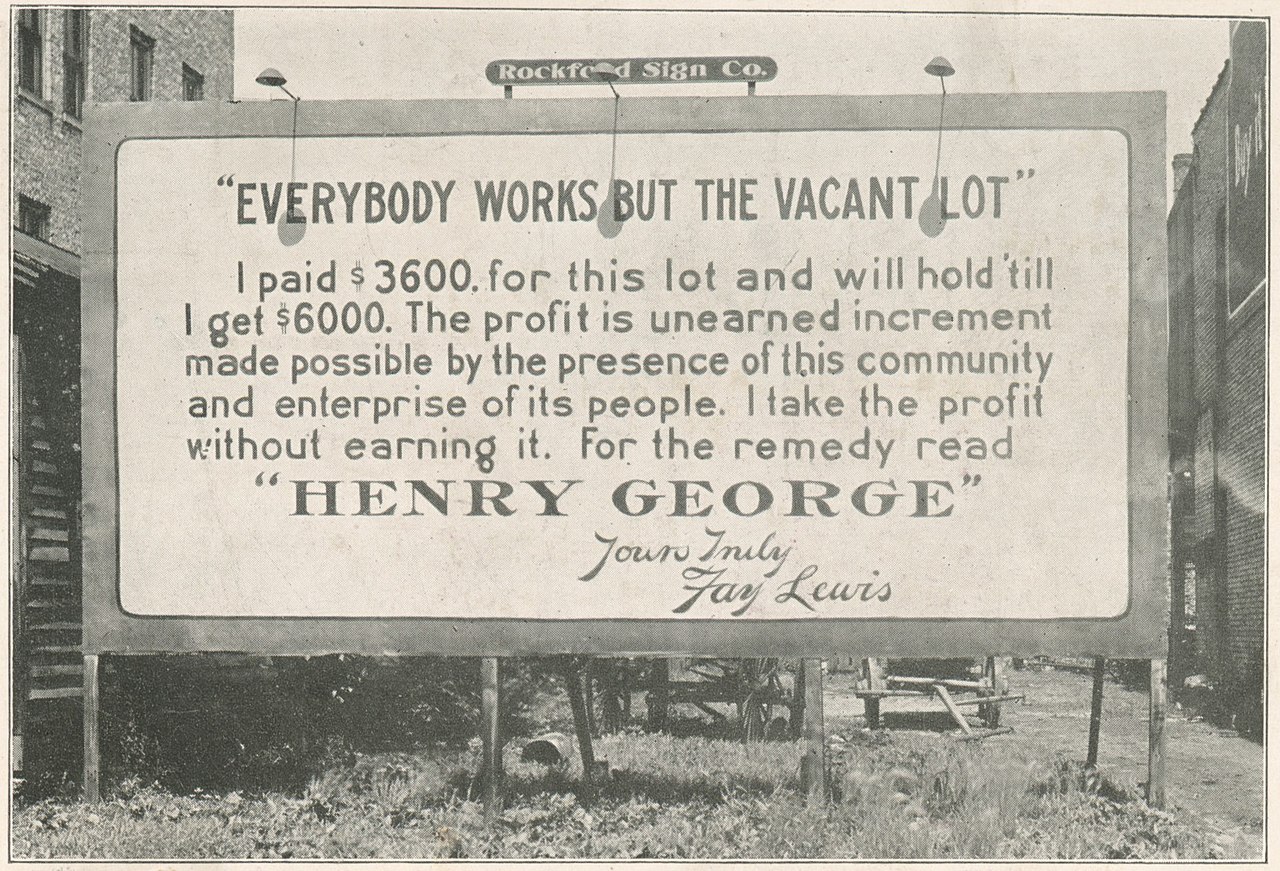
It's the same idea as "everybody works but this vacant lot" [1] on a large scale.
> Doesn't that strike you as obvious bullshit?
No. You can go read the paper, come back and argue methodology.
The economic GDP gain for a person from West Virginia to NYC is large.
1. https://upload.wikimedia.org/wikipedia/commons/thumb/a/aa/Ev...
Even then in a town here, most of the electrorate is renters, but most people who actually vote are homeowners.
And a public library district found it better to "protect themselves" with a card fee for non-residents rather than open access to all state residents (like nearly all other public libraries around them, and like the state financially encourages.)
So yes, it makes sense for the voters to have only so much power and influence. Sometimes it would be nice if someone in that pile concerned themselves with a longer term vision than "my lawn, right now". And that doesn't mean their political hobby either.
At some point you have to give up; if the electorate doesn't even bother caring enough to vote, what can you do?
Currently in California, there is some push at the state level to try and move things along - and override some city rules. Also one surprising city noticed that their past gridlock is not helpful (Berkeley, CA! Surprising because they are said to have invented restrictive zoning).
Then some cities in the Los Angeles area somehow managed to never get in that rut at all, and allow construction. And they are not exactly hellholes because of that.
Replacing First Past The Post voting with an alternative voting system will eliminate any chance of a spoiler effect. People could feel safe in the fact that if the party that best represents them doesn't make it, their vote will continue to be counted throughout the election.
More political parties means more representation, and a bigger portion of the population being involved in the electoral process.
More competition means higher quality representation, even from established parties.
So all the outlying neighrborhoods/cities/areas -- MANY of which were built out in 40s to support the war effort as we were building liberty ships in the bay at an alarming rate - and all those women workers needed housing (rosie the riveter)...
So all these tiny packed neighborhoods needed for the 1940s workforce resulted.
Now we have a 2040 workforce need in the exact same way for building Liberty LLMS! (Expect of poisoning the dirt with war chemicals - we will find another similar metaphor digitally)
(most of saily city, alameda, treasure island, hunters point, candle stick, dog patch, etc - were all heavy industry for these ships and the naval base - and they were massive amounts of toxics buried in the dirt.
This is why hunters point was always ghetto - because they knew it was a Super Site - and so many people have gotten sick from it. Which is also why it was a very slow process to build stuff out new because new laws require environmental impacts which include soil sampling which reveals Super Site chemicals...
The very tip of Alameda Naval base was also a dumping pit now Super Site -- they decided that its cheaper to pound giant metal posts as a barrier to prevent the chemicals leeching into the bay - rather than spend 10 times as much to clean up the site properly.
and this just happened in the last 20ish years.. its been leaking into the bay since WWII
Residents don't and shouldn't expect to have the final say on who can live in their area. This is explicitly acknowledged by, for example, racial housing covenants being illegal these days.
Can't you say the same for people trying to move in? There's plenty of places in the US that you can still get a house for under 200k.
I bought 3 houses all for under $20k each over the past 2 years. I use them all as rental houses. You can get waaay under $200k. The problem when you bring this up to people online is they say, "well I would never want to live there". So they are very happy to tell people that already live somewhere that they can move if they don't want new large housing complexes built, but if you tell them that they can move to somewhere more affordable, they act like you are attacking their human rights.
It's triply confounded by the huge group of people who simply don't understand the math behind renting (and this includes many landlords, sadly).
And unless you have literally infinite incoming new residents or people who want to squat on unrented property, increasing the top-end supply will also increase other ranges. It might still not allow someone on minimum wage to live there, but the total number of units increases - unless you replace cheaper units with more expensive same or less density units.
The problem with new housing development is that only large corporate investors are allowed to develop. I am very NIMBY as it relates to building apartments next-door, because I am prohibited from building apartments on my lot.
I'm all for reducing land use restrictions, but it should be done in a neutral fashion that doesn't advantage those with the capital to hire real-estate lawyers.
If I stop my neighbor from building an extension that's 1v1. Doesn't map easily to "democracy". Now, if I and the neighbor on the other side stop our middle neighbor building an extension... it's sort of democracy? The majority decides. But what if everyone else on our street wants to allow it? Now blocking is undemocratic. Thoughout all of this my neighbor might insist they don't care what anyone thinks and they should be able to do whatever they want with their own land.
The citizens of a particular city neighborhood blocking development is democratic when looked at up close and undemocratic when looked at from afar. There aren't any easy answers and anyone pretending there are is fooling themselves.
In theory, Democracy is simply the idea that the government is formed from the will of the people... but there is no single will of the people. How do you decide, then, what the will of the people is?
Many of us have grown up with the idea that 'majority rules' is democracy, but why? What makes 51% a magic number?
Most modern democracies don't like the idea of a majority suppressing a minority, so we put restrictions on what the majority can do. Is that undemocratic? Is the Bill of Rights undemocratic because it blocks the will of the people?
There are no easy answers to these questions.
You're right about there being no simple solution. Even voting on higher level issues (like providing affordable housing) is perilous. Deciding upon something without specifics just opens up the floodgates for abuse. I've seen housing built on land unsuitable for construction. I've lived in a couple of neighbourhoods that narrowly escaped being razed for highways (to the point where parts were razed and some infrastructure was built).
Even long term urban planning, something specific enough for voting on and distant enough to avoid being personal, has proven to be less than successful.
And general ideas always lose out to specific ones (which is why you can have an entire city that is pro-affordable housing but each example thereof is strongly fought against).
In this case, it is fair for the middle neighbor's outcome to depend on more than his two direct neighbors. And it's also fair for the middle to balance their own wants with the ones of their neighbors. But for sure everyone gridlocking each other is not a solution for progress.
If they don't like it, they can move.
Or do you mean that existing owner should be required to get their neighbors' consent to do what they want with their own property?
Anyone selling their home would, all other things being equal, prefer to sell their home to an neighbor with which they have a relationship then to a random person. The neighbors should make an offer if they really care.
Is Ferrari "not allow specific groups of people" (I am in that group) to buy their cars by not pricing them the same as a Honda?
To use your example, it's as if we were to restrict car production to mostly only Ferraris. And then if someone can't afford a Ferrari, we tell them to buy a Honda - but there aren't many of them to buy.
My town is being more strategic about it. They allowed businesses to come in first and expanded out the robustness of the local coop's electric grid and only then did they allow appartments and they are doing them in stages to make sure the area can handle it. This is important in an area where not everyone is even hooked up to the city's water supply or has access to city sewage.
In areas where the power grid is struggling to keep up with demand, the municipality will need to plan with that in account. If you expand housing in an area where you've made driving the only transportation option, that will straightforwardly lead to more cars on the road. And so on.
But at least in my area, municipalities largely seem to be trying to keep housing density at or below the level it's at now, which is a problem when we're facing a housing shortage.
In most lower middle income countries with relatively limited property rights, urban housing that can actually be bought is actually much more expensive relative to local median incomes, though these do have more options in the form of dorms and slums...
And almost no matter where you live, there's someplace (even nearby!) that's better (and usually more expensive).
Land value tax.
We are more likely to get a 10000-page micro-managing land use policy with a whole new agency that can never hope to be as efficient as a single flat tax and free market.
> This will probably never happen in the U.S
Thank god for that.
Maybe checkout in other countries like Canada, UK, France, Germany or even eastern europe, further in Asia on how they are doing on housing front. For sure they couldn't be having housing policies as bad as US.
I suspect important drivers of home pricing are:
- Young people not getting married and starting a family right out of school, making average household size drop considerably
- Increased standards for construction and rental quality
- Everyone wants more space, houses are pushing twice the size they were 30+ years ago
I think these are more plausible than just zoning and cars. I'd guess those are only serious problems in a handful of very dense cities which are constrained geographically.
The household size issue will probably level out, you can't really go below 1. Lowering standards won't happen. But smaller homes might. Bring back starter homes.
This is leading to people running away from the city[1]
1. https://www.deccanherald.com/india/karnataka/bengaluru/techi...
The same. Canada's population grew by 3% last year but housing supply remains inelastic. Small developers have difficulty getting loans, zoning, NIMBYs sue projects, etc.
> I think these are more plausible than just zoning and cars.
It may be more complex than "just" zoning, but it's certainly more-so zoning than the conceit that people want larger houses. People want houses period.
I always liked the idea of more local taxes rather than federal. Then the larger tax base would improve services or do a direct transfer.
But the other thing is that density is only the solution if you insist people live in certain areas - the US has experienced tremendous growth in many time in history, and not all of them were handled by densification.
b) Does the answer to a) have slums?
On the other hand it seems like it's functioning exactly as intended. The interests of the people who live in <area> and who elect the city council are being represented just as they should be.
The argument could equally be if you don't like it, build somewhere else.
Do you believe communities have any right to self-determination? I would feel a bit peeved if I and all my neighbors built this nice neighborhood and then am told too bad people really like your neighborhood so we're letting Alliance Residential buy up a bunch of property for a huge apartment complex. The neighborhood I grew up in is going through this. They were a bunch of lower-middle class people who bought houses in a "rough" area because it's what they could afford, made it nice and then developers saw dollar signs. They don't have the kind of pull to keep them out so it's about to get steamrolled with gentrification.
Because obviously you can do whatever you want with your property: well not open a business because it's not zoned for that, and not build too close to the property line, but anything else! Oh and you can't make too much noise after 9pm that's just rude, or fix your own electrical work because if you do a shoddy job it'll catch your neighbor's house on fire, and...
I think that most jurisdictions already have the legal tools they need to put the public good in front of special interest groups, in the form of eminent domain laws.
It's just that the policial will is just not there.
Really this is a case where states should pre-empt localities.
I don't understand what point you tried to make.
Fair market value is what you expect to pay anyway, and the point of eminent domain is not to fleece property owners.
Legal disputes are also not a problem, and quite expectable. It's part of the checks and balances of not having corrupt government officials just steal property to hand it over to the highest bidder.
The key factor is political will. Government officials need to fight to get this sort of project through, and be able to invest their time and effort to navigate political chicanery.
"There are no coincidences..."
The solution is terrifyingly simple: don't allow existing residents to block new housing developments. If they don't like it, they can move.
This will probably never happen in the U.S., because the government no longer functions as intended.