I have no inside information, but here's my guess at what happened. John Lilly was a great CEO. When he left, there was a gigantic void. They hired Gary Kovacs, who started the "squirrel!"-ing. He wasn't well-liked, and used Mozilla as a stepping stone. So going forward they only hired from the Mozilla community, which is a small pool – both of people who could do it and people who wanted to do it. I'm not sure if Mitchell wanted it or not, but I don't think there was a lot of competition.
Being the CEO of Mozilla is not a good job, and I imagine it's really hard to fill. There's a ton of pressure, relatively low salary, no equity, no exit.
But doesn't seem like Mozilla is a typical company; not built around selling a product... so maybe that merits a different type of CEO with different skills not normally desired by the companies paying 10s of millions to their CEOs.
I'm no business person, so I could be completely wrong about what's needed at the C-level to keep Mozilla afloat. My view my be warped by assuming the vast majority of companies do not make money the way Mozilla does; but maybe there are more Mozillas than I know about.
Source: https://www.theregister.com/AMP/2024/01/02/mozilla_in_2024_a...
But if you're a CEO good enough to turn Mozilla around given the constraints... you could make a lot more elsewhere. If nothing else, you'd get stock, which would correlate with your performance.
Why? Why does pointing mozilla in the right direction require such rare skills?
Or is this because we're only looking at existing CEOs for hiring?
If the rareness is about having the right industry knowledge and vision in a CEO, I bet you can get better results by hiring a company aimer and separate managerial co-CEO and using the money you save for 20 more devs and 5 more marketers.
Now imagine your market share is down a ton (and decreasing), and there's no clear way to change that trajectory.
Then imagine that despite being CEO, you're owned by a non-profit. So, you have a boss, and your boss has different goals than you do.
Then imagine attracting and retaining top talent, while not being able to give out equity.
Then imagine that your product is free. You can't charge more for it; you give (almost) everything away for free and there's no clear path to monetization.
And then imagine that almost all of your money comes from your biggest competitor, and your only lever is to negotiate (from a position of weakness, because they're much bigger) a deal every 3 years in order to keep paying your employees.
> your only lever is to negotiate (from a position of weakness, because they're much bigger) a deal every 3 years in order to keep paying your employees.
It's entirely possible that Mitchell Baker was responsible for getting hundreds of millions of dollars extra for Firefox when they switched search provider and then back, invoking a clause in their agreement with Yahoo.
Which seems like some pretty skilful playing of a bad hand.
I talked to one of the corporate lawyers that worked that deal, and told him it was a genius move.
But I don't see why it needs particularly rare skills.
And lots of people do really hard jobs for much much much less money.
I wouldn't want that job, and I'm not sure I could do it.
Always being on-call, and having to constantly context switch and synthesize questionably-accurate material from reports, to make important decisions.
(And that's not even broaching the political tasks... which are required, because it's the only way to become and remain CEO)
No one is hired to fail, and no one tries to fail.
They're hired to try and succeed, and sometimes it doesn't go that way.
> I wouldn't want that job. However, with the right team I AM sure I could do it.
Remember as a tech lead, if you are heroically writing a lot of code burning the midnight oil, banging out tickets and completing sprints by yourself, you are failing. As a CEO, the more you are doing the more you are failing. This is probably why it is so hard for people like us to he leaders. It is very difficult to delegate and not meddle with things. It is easy to say let go but very hard to actually do so.
Remember that even Steve Jobs delegated all operations and supply chain stuff to tim cook. And that's Steve Jobs! We are not Steve Jobs.
There is no reason why my manager should make more money than me.
There are many jobs that I wouldn't want and that are not paid 6M a year. There are some things that I can do that not everybody can do, and still I am not paid 6M.
You can try reverting it: a CEO earning 6M a year could not necessarily be a firefighter. Yet firefighters are not paid 6M a year. And they actually risk their life.
IMHO, the stronger argument against CEO compensation is that the delta (in company performance) between a great CEO and a midling CEO isn't equal to their compensation.
If a firefighter sucks at their job... someone dies. But (unfortunately, if we're being honest) that's worth less than +/-1% of large company performance.
(Personally, I think public safety, medical non-doctors, and teachers should all be paid a lot better)
I would consider most min wage jobs harder than what i (computer programmer) do. Compensation is often inversely correlated with how shitty the job is.
I don’t either! But apparently they’re rare. One pays dearly when trying to go cheap, or broaden the pool in seemingly innocuous ways, in executive recruiting.
> lots of people do really hard jobs
Fortitude is necessary, but by itself insufficient.
Do we have good evidence for that, or is it just what the people that hire CEOs tend to think?
When I think of disastrous CEOs that I've managed to hear about, they weren't cheap. They got paid huge amounts to cause their disasters.
(Edit: Missed the word “never” up top)
Watching The Grand Tour[1] season 1 it feels stilted, awkward, like they are reciting their lines for some forced humor while Amazon showers cash and flashy cars all around trying too hard. If it was like this with three unknown people I wouldn't bother - I'm only watching on the hope that the lightning in a bottle sparks up again as they settle in, because the highs of Top Gear were good - friends messing about for a laugh, daring bold ideas, beautiful filming and settings.
e.g. scaling the Guallatiri volcano https://www.youtube.com/watch?v=NOcJOn0nxnU
Crossing salt flats in Botswana: https://www.youtube.com/watch?v=OETj9aTYO2Q
Driving to the North Pole: https://www.youtube.com/watch?v=WNkvASxfEWQ
Driving the Bolivian Death Road: https://www.youtube.com/watch?v=daQcxVqQJsI
Building their own amphibious cars and crossing the English Channel in them: https://www.youtube.com/watch?v=WTVPPTV-bQM
Trying to run out of fuel before arriving at the Chernobyl exclusion zone: https://www.youtube.com/watch?v=5YtVV1VJ4f8
Getting lost trying to leave a traditional Italian city: https://www.youtube.com/watch?v=c_eLViH7_YI
Budget Italian Supercars: https://www.youtube.com/watch?v=GuCff8nCxBU
[1] When they stopped Top Gear, Amazon snapped up Clarkson Hammond and May to make a Top Gear knockoff for Amazon Prime, that's The Grand Tour.
I think so, and it’s largely in the attrition of start-ups due to executive leadership breaking down. Start-up founders are already a rarefied group; that so many break down or flip out or can’t handle all the balls in the air is telling. (There is plenty of academia on the topic. It doesn’t support massive paydays. But certainly single-digit millions, i.e. life-changing money for someone who may already be rich.)
> got paid huge amounts to cause their disasters
Look at the state of the company they took over. Golden parachutes are often required to woo top talent to a trash pile because top talent knows the world is stochastic.
Yes, I'm specifically thinking of companies that were doing fine when they took over.
Remember Mitchell killed FirefoxOS (I know you were likely happy about that @gkoberger), and now Mozilla is complaining about not getting level playing access to other OSes. Guess what, when you have no platform, you'll be forever a second class citizen.
Baker is a good motivational speaker, but should never have been allowed to made any operational decision.
But Mozilla had no chance in the real smartphone market. If Microsoft couldn't manage to attract developers with their billions and dedicated hardware, Firefox supplying only the OS and no hardware just had zero chance to make it mainstream. It would have been relegated to the same position as Sailfish: A cool curiosity but not interesting enough for anyone but some hobbyists to develop for.
I don't think it was a bad idea trying: At that time the duopoly in the smartphone market was not as firmly established and there were other open projects like Ubuntu as well. They might have attracted a huge party like Samsung (after all, they did go for Tizen in the end!) and things might have worked out differently. But the choice to drop it was inevitable at that point.
KaiOS got Whatsapp support thanks to shipping in India with a single carrier (Jio) that has a very large user base. Deployment in the rest of the world has been a struggle and the company is not in great shape.
All that to say that Mozilla could have kept the lights on for a couple more years and get access to large markets. Hard to predict what would have happened but we certainly would have more diversity in the OS space.
Which would have been because they thought they could make more money using it than Android.
Which probably wouldn't have bode well for user-friendly changes to the base image.
Android's value prop to manufacturers was "Was to sell a lot of mobile phones, but not have to pay for most of the development? And get a working Maps solution? Here you go." Which Google could afford to torch money on.
And I'd imagine carriers don't, as they'd no doubt love to go back to the feature-phone days, but they're all (individually) too weak to do anything about it.
Only aggregated can they offer the resources to support an alternative.
My thoughts that FirefoxOS was mismanaged from an executive level are in no way a reflection of the work I saw coming out of your team, and I took no pleasure in it shutting down. I felt the executive team got caught up too much with things like presenting at Mobile World Congress, at the cost of a ton of focus.
Mozilla should have been focusing on the one thing anyone cared about, the browser. Rust and Servo were the correct risks to take. But I know, hindsight is 20/20.
When the thing you are good at is being a CEO (as opposed to, say, being a teacher), then you are very lucky. Because other CEOs before you managed to make it acceptable to earn an indecent salary for just doing a job. Ok, let's say they don't sleep at all, so they can work 2-3x as much as the average people. Are they paid 2-3x more? No! They're paid orders of magnitudes more. That's indecent.
Right now, you’re simply complaining about a perceived problem without offering any logical argument for an alternative.
I do not mean to sound flippant, I’d like to hear what your alternative ideas are.
To the problem of human beings receiving way too much money for the time they spend doing their job?
Easy: crazy taxes. If the company really wants to increase the salary up to some limit, knowing that 95% of that increase will go into taxes, then good for them. Otherwise they can do something else, like increasing other salaries or hiring people.
Also if you ask me, there should be laws for the difference between the lowest and the highest salary in a company. I.e. "the highest salary cannot be more than X times the lowest salary". Which means that if the CEO wants to earn more, they need to raise the lowest salaries.
Consider that you could attempt to solve your perceived problem in multiple ways within the existing structure. 1) Garner public support and lead a campaign to change our laws to be more inline with the thoughts you have around increasing taxes; 2) Exploit the market opportunity you’ve identified (of paying CEO’s less to pay others more) by starting companies that follow this ethos, attract talent, and deliver value to consumers; 3) Attain a leadership position as CEO or in the Board of Directors for a company where you can take responsibility and change these perceived compensation problems; so on and so forth.
The responsibility lies with you to bring the change you seek.
I'd imagine that at a place like Mozilla (effectively a high-tech nonprofit primarily staffed by white-collar workers), this difference in compensation is actually not that big, compared to, say, a business that hires hourly workers.
Who said it would? Though I may argue that it is not clear at all if you really get the best person for the job when you make them rich just by getting the job. Not saying that all the CEOs are here "just for the money", but... well if they are not here for the money, why do they get that kind of salaries?
> I feel like something has taken a left turn in this thread.
I feel like when people are talking about the salary of a CEO and whether they "earned it" or not, I am entitled to say that no human being can ever deserve that kind of salary. Just like a liberal could say "they don't deserve it because they did not please the shareholders that much".
Because if that's the case, I think it is completely stupid. You don't get to make up rules and then say that I am objectively wrong because your made-up rules disagree with me.
FF has 3.3%.
I think FF would have done mych better under his leadership.
The idea that nobody possibly could reconcile these issues and yet should still be paid egregiously is absurd
Because it basically requires to beat a monopoly power that has repeatedly used its unrelated lines of business to crush competition in the past?
Growing Mozilla is probably as hard as growing diapers.com as an independent company.
At the last company I started, a b2b saas, as of 5 years in, there were under 10 logged-in pageviews from Firefox. Ever. It's dead; the coyote is 50 feet past the cliff; and we're just waiting for gravity to appear.
Mozilla has also clearly given up on Firefox, though people get mad on here when you point that out. I just don't know why they're operating under the delusion that anyone will listen to Mozilla about privacy when everyone realizes they no longer build a browser that matters.
Her salary kept going up as the marketshare was going down...
You'd really need to decide if you thought their marketshare would go down faster or not with someone else.
To be honest, market share shouldn't ever have been Baker's goal and losing it isn't necessarily a black mark against her. Firefox should have a vision of what it wants a browser and the internet to look like and be working to make software that supports that. Firefox seems to just be following along as Chrome with some minor tweaks [0] and that is the real problem. Google's vision of the internet is not what Firefox should be working to implement. There are deep strategic issues here that go far beyond market share. I'm personally happy to use niche software, I don't care what other people are using (Linux reached my desktop a long time ago). But it is hard to see what even Mozilla thinks the point of Firefox is.
One of the things that makes Brave interesting to me is that it sees a web where middle men get cut out through the use of cryptocurrency. Is that going to work? Probably not. But it is a different take on what the internet could be. We need competitors like that. Even for privacy; it is hard to tell who Mozilla thinks the internet should look like. I'd hazard little change from now except without 3rd party cookies. That isn't a very impressive vision.
[0] https://www.mozilla.org/en-US/firefox/browsers/compare/chrom...
Mozilla positioned Firefox in part as a reference for how web standards should behave (*), particularly for ones where Chrome/IE/Safari diverged with competing non-standard implementations.
But for that to work in the real world, not just at W3C debates, you need major websites to care if they function correctly on your browser. And for them to care, enough people have to be using your browser that these companies see a business case for spending money to add your browser to project plans and QA test matrixes as a compatibility target.
That decision is heavily informed by market share, whether global or as a percentage of the site’s own access records. In particular, double digits is a rough threshold for that, and that was pretty much Mozilla’s target. 50% would be wonderful but 10%+ let them assert standards in the ecosystem via the implicit threat of users leaving a site if Firefox didn’t work.
As a test professional at the time, one of the most discouraging things I saw after leaving Mozilla was Firefox dropping off all the test plans I knew about when they hit single digits. I’d poke at that decision where I had influence, and would basically get back a response that “Firefox is dead, just look at the numbers.”
(*) I’m pointedly ignoring some of the more aggressive introductions of things like device-interface APIs crucial to making a browser engine act like a phone OS, etc. Ultimately, someone has to build a working implementation before it’ll become a standard, anyway. There’s a race aspect for new ground and Mozilla was part of that.
But generally speaking, where there was an actual recognized standard, Firefox used it and not some homegrown alternative. So websites also had to develop to that standard to function correctly for a significant percentage of users.
I think this whole discussion of market share smacks a little too much of evaluating a president by the country’s GDP. Useful for a pithy remark, but doing any sort of detailed analysis seems doomed. I think the factors you listed are far more relevant
How does that play into your decision to use Firefox or any other browser? I'm a Firefox user and I care nothing about market share. I get annoyed if I stumble upon a page managed by incompetent devteams and thus only runs on Chrome, but that's a quick in-and-out.
Why do you care about share? Why do you feel it's relevant, specially if people are pushed to use Chrome or Edge through unethical means?
A few years ago Firefox was my main browser and I got sick of the constant changes and just use chrome, brave and safari now. I never missed FF for one moment.
I remember when Firefox was the faster leaner version of the mozilla browser and now they have bloated it up and forgotten its foundational principles.
It's one thing to claim to not include Firefox in your list of supported browsers.
It's an entirely different thing to claim you only support Chrome and Safari.
If you are a developer and only target browsers from Apple and Google, this is a personal decision you're making to purposely ignore around 25% of your whole market share. This is not Firefox's or Microsoft's Opera's problem. This is your problem.
I read this kind of comment all the time, and it's something I almost never experience.
The only feature that I want in Firefox that I need to use Chromium for is Web Bluetooth, and that's because I use a Bangle.js smartwatch, which is even more niche than using Firefox is.
It's very hard for me to understand why so many people think they routinely encounter websites that don't work in Firefox.
I agree, fortunately that's somewhat rare. It still stings if you come across a broken site that you need to use frequently. I'm concerned that Google's "extend" phase is just ramping up, with incompetent devteams confusing "Chrome has a large market share" with "it's ok to publish a broken site if it works with Chrome".
Now everything runs like shit on every browser so things appear to be more equal.
There are also plenty of other direct-to-user benefits
Which Mozilla could provide if they'd spend more resources on Firefox and less on random tangents.
But now Google is doing their work for them by making Chrome worse:
https://arstechnica.com/gadgets/2023/11/google-chrome-will-l...
Generally speaking, we have seen that people are okay with handing over the web and all their data to Google, if a button press registers 20ms faster.
In 10 years she'd be making 100M per year and have 100 customers :P
Now if that person caused the downward slide to begin with, that's a different conversation. Again, I don't know the internals of Mozilla well enough to make an educated argument one way or the other.
Instead it doubled and then increased again (wasn’t it more like $7m by the end?)
The product's global importance is now a tiny fraction of what it was 15 years ago, and the person during whose tenure this happened was recently making 10x as much as back then. TEN TIMES.
And whoever approved that obscene compensation thought this was a good idea.
I used to be a big Firefox fan, but the last 10 years made me abandon it, I don’t even check if my sites work on it anymore because the market share it has is so tiny. My time is better spent making sure it works with Safari...
Over the past few years Mozilla has increased revenue while reducing the percent derived from Google with expenses slightly down.
And it's absurd to put the fault for the declining market share purely at the feet of Mozillas leadership. Not to say they were blameless, but when Google threw its weight behind Chrome, including massive ad campaigns on billboards, pushing it on its web properties, and regularly breaking Firefox on their own websites for no technical reasons, you can't reasonably expect Firefox to just magically maintain their market share. That said, at the upper end you could look at Germany, where Firefox is still between 10-20% (depending on the estimate you look at), as what could have been achievable more broadly.
This committee has 3 members. One of which was… Laura Chambers, the new CEO. Source: https://www.mozilla.org/en-US/about/leadership/
So she basically decided how much she would be paid. For me it's a clear conflict of interest.
They explain here how the compensation for the CEO is decided: https://www.mozilla.org/en-US/foundation/annualreport/2021/a...
It's basically based on what other similarly-sized tech start-ups pay. Which is ridiculous to me as Mozilla is basically a Google-funded open source project.
Also, who was on the nominating committee when Laura Chambers was nominated to the Mozilla Corporation in the first place? Baker. With one other member of the compensation committee, and another person.
This seems also to be a conflict of interest to me.
I’m not sure why all the excuses made for her
We have a massive aging population, and text reflow helps immensely, and only Opera does jt well.
The controversy is not over whether or not he performed his duties effectively as CEO, it's over the disguised self-dealing that produced the comp package in the first place.
The milestones were reasonable, the rewards were not.
Why is that not reasonable.
Sure $50bn+ is unreasonably large, but isn't $0 unreasonably small?
If any regular person negotiated an underpaid salary at their job the past 5 years, and then demanded to be paid extra, that would get laughed out of the room.
He agreed to forgo one type of compensation in favor of another type, that was later yanked away from him under the reasoning that his compensation package was deemed retroactively excessive.
I imagine a scenario where I take a slightly lower base pay for a higher number of RSUs, that are only unlocked if I meet my performance goals. I then proceed to meet or exceed these performance goals, as the contractual agreement specified. And then the government, acting on behalf of a shareholder who used to hold 8 shares total, complains that my compensation package was retroactively excessive, even though he hadn't raised this concern earlier.
I'd feel unfairly cheated in that scenario, and I can't help but figure Elon probably feels the same way. I know he isn't going to starve to death or anything, but it seems bizarre and worrying to me that it's just perfectly fine to invalidate what was a perfectly fine and legal contract 5 years after it was signed because a minor stakeholder of one party to the contract didn't like the terms.
Does this undermine the trustworthiness and stability of executive compensation contracts, or really any compensation contract, broadly in the US? Do I ever need to be worried about getting rug-pulled the way Elon was?
I fear this precedent may be abused against "the little guy" / the working class in the future.
All public company executives need to get their pay package approved by a real board that can actually tell them no (or at least sound like it in the minutes), not a handful of fawning sycophants. Or, if their board is actually a handful of fawning sycophants, they need to not lie about that when describing the pay deal to shareholders. Or they can take their chances on what a judge may think in the future. Doesn't seem unreasonable.
Get a real board to negotiate and approve the package. Boards and CEOs are already buddy buddy, but this is so far beyond even that. Heck, one of the members is Musk's brother - not even trying to appear objective. Musk's hubris bites him again.
https://theconversation.com/why-elon-musks-self-driving-of-t...
Everyone talks a lot about market share but I never saw the breakdown of the market in terms of what is actually reporting the user agent. For example, both Chrome and Edge provide embeddable webviews used by applications to put together their GUIs, while Firefox doesn't. Other competitors such as Microsoft also pushes Edge very aggressively in a way that to me seems ethically questionable. Chrome leverages Google's control over some apps and features to be pretty much the only browser that is able to render some pages.
To me, Firefox is undoubtedly the best browser out there, and the only reason I see people use any other browser is inertia and not having control over their OS to change defaults. So what's the argument on market share?
https://en.wikipedia.org/wiki/Mozilla_Corporation https://frankhecker.com/2020/08/13/mozillas-uncertain-future...
In recent years, the proportion coming from Google has also been coming down (even if slowly, from 90+% to just above 80%), and considerable cash reserves have been built up.
Her compensation is ahead of the median for companies in the 0.1-1 billion revenue range, but in line with the median CEO compensation for a company with 1-5 billion in revenues:
https://corpgov.law.harvard.edu/2021/10/07/ceo-and-executive...
https://corpgov.law.harvard.edu/wp-content/uploads/2021/09/F...
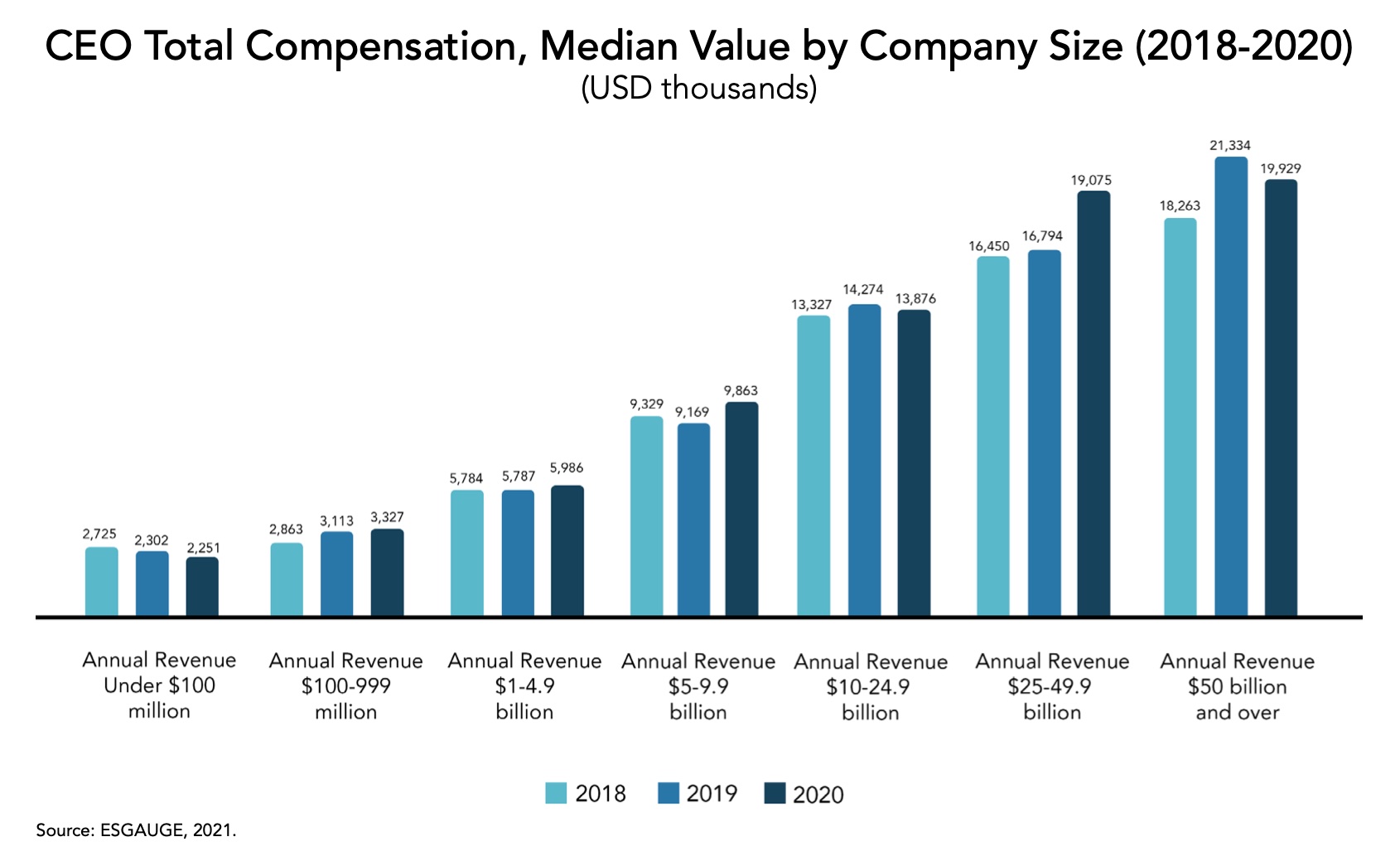
So if you accept that this is an unusually complex CEO role, then it does not seems disproportionate (when judged relative to the absurd disproportionate growth of CEO compensation overall).
> In recent years, the proportion coming from Google has also been coming down (even if slowly, from 90+% to just above 80%), and considerable cash reserves have been built up.
Instead of building cash reserves and laying off engineers, Mozilla could have invested that money in Firefox. Could it have successfully turned around? Maybe not, but we'll never know.
It's basically a question of whether you believe Mozilla's mission is best served by building Firefox or by continuing to exist once Firefox no longer exists, and whether its appropriate then for the foundation chair & CEO to be pulling a 7 figure compensation out of a declining non profit. It's obvious the leadership believes the Mozilla Foundation needs to outlive Firefox, but from my perspective the Mozilla Foundation's influence and significance will be nil without browser marketshare.
The idea that the lack of quality of Firefox is the dominant reason behind the declining marketshare just is not plausible to me, and I have seen no evidence posted for it. It's wishful thinking. Firefox and Internet Explorer both started declining when Chrome started eating the world. The speed of the decline does not in any way seem to relate to the gap in tech between the browsers.
I worked in academia, now government, in HPC/data-sciency positions, so the overlap/competition with finance and big tech is large (and a lot of people move there and back again). Let's just say, we have far more interesting problems ;)
That sounds… plausible, at this point. I wouldn’t say probable. Especially with tech making everything so interconnected. I loved the kind note at the root of this thread, but the idea that the CEO is some market visionary who is carefully keeping the whole company afloat seems rotten.
If that isn't company leadership worth paying for, nothing is.
> "Hey, at least Firefox stayed in the game"
Not according to other people in this thread:
- "As a test professional at the time, one of the most discouraging things I saw after leaving Mozilla was Firefox dropping off all the test plans I knew about when [FireFox market share] hit single digits. I’d poke at that decision where I had influence, and would basically get back a response that “Firefox is dead, just look at the numbers.”" - https://news.ycombinator.com/item?id=39309843
- "At the last company I started, a b2b saas, as of 5 years in, there were under 10 logged-in pageviews from Firefox. Ever. It's dead; the coyote is 50 feet past the cliff; and we're just waiting for gravity to appear." - https://news.ycombinator.com/item?id=39309564
(and I'm typing this from FireFox, although on my work machine I'm moving to Edge because it's good. Click a link in Outlook, the link opens with Edge and the sidebar opens with web Outlook open showing the email I clicked on to reference, for one example. Vertical tabs for another, I stopped running TreeStyle Tabs in FireFox years ago, though I no longer remember why).
- Chuck Robbins of Cisco making $655M/year
- Mark Benioff of Salesforce making $360M/year
Maybe let's look smaller:
- Fidji Simo of Instacart making $29M/year
- Patrick Collison of Stripe making $166M/year
When you look at it like that, Baker's compensation is quite absurd.
(And for more comedic value than anything serious, similar to Tim Apple making $4.4B/year...)
Instead, Chuck Robbins makes $31.8M.
Benioff makes $28M.
Simo, $2M. Collision, $6.3M. Cook, $15M.
Isn't there a fundamental tension between "be good to employees" and "strong sense of direction"? If you are focused as CEO, then you must neglect a fraction of your employees at any point in time. This is a side-effect of focusing on one direction, while maintaining capability to go in other directions in the future. If you don't neglect some of your employees and project, then you come off as being distracted and without a strong sense of direction. Is there some way to square this circle?
Nah. I have a quote that I think about often on this topic, from none other than Bojack Horseman[1]:
Bojack, "Well, do you think I'm a good person... deep down?"
Diane, "That's the thing, I don't think I believe in deep down. I kind of think that all you are is the things that you do"
$CORPO_STOOGE is just a sociopath who follow the suggestions of "Lean In" as a behavioral guide of motions to follow. That doesn't make them a good person, just maybe a more pleasant manipulator.
I think this statement from the parent addresses your point. Perhaps them stepping down as CEO will result in more focus? Time will tell.
I'm not following extremely close, but it seems like Mozilla is chasing what can be turned into a product. Things that involve setting up a monthly subscription, whether it's VPNs, keeping your name out of certain tracking databases, etc.
I wonder how Mozilla used to be funded vs how it's now funded?
The web is a better place with a non-profit-driven group like Mozilla in it... but is Mozilla Corporation becoming more money-driven than it used to be, even if it can't turn a profit? Or can it turn a profit, because it's not the Mozilla Foundation [1]?
I think we see this a lot, with companies pulling in too much money from IPOs or venture capital, pissing it away on unfocused growth, and if they are lucky back where they started. Or unlucky and bankrupt.
Not saying the comp package was justified. But it was a job doomed to fail.
New Edge was released in January 2020 with Chrome around 70% of the browser market. By May 2022 new Edge was the second most popular at like 10%. Safari gained and took second in 2023, Edge reached record high browser share 11% last month, with Safari also growing leading second place. Chrome is down to 65%. Yes Edge hasn't crushed Chrome, but it's going toe-to-toe with Apple, and is far ahead of any other contender (FireFox, Opera, Brave, and the rest).
Microsoft has started aggressive tactics like opening links in Edge even when it's not the default browser [I'm observing, not defending that] and it results in things like this on Reddit[1]: "When did everyone switch to Microsoft Edge, and why? I work in cybersecurity for a software vendor and over the last 3-6 months have noticed Edge has completely dominated my customers' web browsing choices. [...] the last six or so months it's been nearly 100% Edge."
Chrome grew by being better, faster, and signing in with your Google account to sync state between devices, and with ChromeBooks. Today, Apple is knocking it out of the park and Microsoft can underhandedly force many businesses over to Edge and is jumping on the hype with "your AI powered browser enhanced with GPT-4" and "prioritises your privacy with adblock and tracking prevention". What's Google doing which could push Chrome back up or stop it sliding down by tempting people away from Apple/Microsoft?
[1] https://old.reddit.com/r/sysadmin/comments/1ah5yv6/when_did_...
Instead they freaked out about overall browser usage going to mobile, and threw shit against the wall trying to make some kind of mobile strategy stick no matter how late they were to the table. But I personally still use desktop universally at work, and sometimes browse that way at home too. Maybe Moz could have maintained significant market share in just that space and still be more relevant today.
To be fair, that was more Gary Kovacs and immediate successors as CEOs than Mitchell. But Mitchell had a lot of influence on direction even then, and could have decided to pivot back to core competencies once she did take the reins directly. Servo looked pretty promising to me. At least we got Rust’s success out of it. Maybe she could have leveraged that more.
Fabrice seems pretty convinced that embracing feature phones would have made the difference, and KaiOS shows that the FxOS platform certainly is more well-suited for that than for smartphones. She was involved in the decision-making around killing FxOS right as Mozilla started exploring pivoting to feature. Whether that would’ve helped drive Mozilla’s higher-level goals of browser synergy and making sure the web stayed open, I don’t know, but you’d at least still know their name as a thriving organization.
Or if data privacy is the way to go, maybe pivoting to that focus years ago would have been successful. I guess we’ll see how much potential it has, but I bet it would be even more if Mozilla and Firefox still commanded the respect they used to.
I just think Mozilla had way more routes to success than the routes they picked. Almost everything they tried either struck me as too late, too unlikely, or something nobody really wanted. That’s what I meant by questionable execution.
The OS folks tried to spin it into a few different things. Shipped a Firefox TV OS but that only lasted for a year or so. In parallel there was the IoT plans that never really took off.
Don’t take my words as being too critical of the Android version FWIW, at least the Gecko one. I think that’s been one of the few mobile successes. But what I personally perceived as discounting desktop as a viable strategy was a gross mistake IMO.
Yeah, I agree FxOS was largely a dead end for Moz by the time it was killed and there wasn’t much choice there. My take was partners pretty much lost faith when it became obvious we’d never have performance parity with Android even if feature parity were reached.
But I’m not sure what they—or Moz—expected. FxOS was running core apps on multiple layers of browser stack. Even a Dalvik-based app was going to be faster than that for having a JIT optimized to that purpose, much less native core system utilities. WebAssembly could possibly have mitigated some of that, but partners were universally putting FxOS on the lowest of low end smartphones since cheap was the selling point for them.
I also think the split personality it put on development of Gecko was a huge detriment to Mozilla’s momentum. The browser-focused devs plainly didn’t appreciate the pressures FxOS put on the stack. Then there was the bit where a zero-day in the browser would have been unfixable without potentially compromising all the phones that wouldn’t be able to update for weeks or months later across a disjointed ecosystem.
I left largely over my dissatisfaction with how Mozilla handled that whole period of time and particularly the FxOS effort. It really damaged my impression of Moz as an effective org, primarily due to the leadership and execution issues and what struck me as extreme tunnel vision.
I hear you that after being on that path, Moz was pretty much forced to fold when partners walked away, but maybe some unrealistic expectations were set in the first place. And maybe there wasn’t enough consideration for how that half-pivot would divide the org and drag on Gecko.
I do think the opportunity for feature phones could have panned out technically, though the way reorgs played out may still have gutted it. But when I said I don’t know if it would have advanced browser synergy or the open web (i.e. pushed market share back to full-featured Firefox) I’m saying I’m deeply skeptical it would have been anything other than a purely business success.
KaiOS isn’t a mission-based product and just needs to succeed in being adopted. Moz would have needed to make it mean something. Plus I’m just not sure the audience for feature phones and the audience for web-standards-requiring websites are the same. That’s why I think brand recognition and cash influx were the only real potential gains there.
I think IOT played out well after I was gone, but another comment on here suggests it was never a serious effort so much as a tactical positioning.
Re: TV OS, if you mean Panasonic I’m not sure exactly how much of Mozilla’s code actually survived into that product. I’m pretty sure I’d heard that there was a lot of work done on under the hood on Panasonic’s part to make it viable, while keeping the look and feel plus the FxOS brand on the label.
Maybe that was exaggerated or Moz took a more active role in it after I left, but I didn’t get the impression we had many people in the org dedicated to it when the first implementation happened.
I don't think their processes have ever been better, they got initial and later injections of code from outside. Rust/servo was the moment when I thought they might turn it around, but their bus has always gone in the direction of the same cliff.
Because greenfield parallel rewrites of giant production codebases have such a fantastic track record, that we might as well add "in a novel programming language we're inventing while we're at it" just to make it interesting?
I think demise by drastic jump stories work because the examples are few and notable. Most projects accumulate experts in moving around the wrong optimum who then block plans of getting free that aren't too conservative to possibly work.
Security is a huge concern for something like a web browser, which is a thing that keeps on increasing more and more in complexity. So far it seems Java is dead in the desktop space, and .NET has a very minimal impact, so it seems a compiled language is the way to go.
And Rust's excellent support for multithreading is also a big boon since now multicore CPUs are a standard and keep on getting more and more cores.
Overall the idea of building a very safe and performant browser seems like a great one.
With regards to be a good "community leader", it sounds like it might be true for the devs, but it is completely false with regards to its user base. Pocket and other commercial moves were made in a very underhanded way that angered many, for good reasons, and they repeated these types of mistakes many times over.
Since a very long time the worst enemy of Firefox has been Mozilla, let's hope it changes.
Mozilla in recent memory has reminded me more than anything of the dogs in Pixar's Up ("squirrel!"), constantly chasing after the latest shiny tech fad while neglecting the fundamentals. They've been a follower on everything and have failed to lead on anything. Mitchell's justification for stepping down as CEO seems to me to follow this same pattern: she's stepping down in order to focus on AI and internet safety.
It's good to know that she's a decent person and was good to Mozilla employees, but it's hard to square the picture you paint with the complete lack of direction I've seen during her tenure. Maybe Mozilla was in a much worse situation than I thought at the time she took the position?