What's interesting about Rogan is you can often find theses talking head types getting easily flummoxed by normal questions that are outside of the ritualized interactions they're used to. Watch Rogan talk to Shapiro about his criticism of Colin Kaepernick, or him asking Bari Weiss why she calls Tulsi Gabbard an "Assad toady." He seems to like both of them (perhaps even to the poitn where both are friends), but his simple questions end up making both of them look completely foolish. And because he's genuinely curious and doing it in a non-aggressive manner, it doesn't get lost in the furor of a antagonistic debate format.
Again, I agree with your criticisms of him and could add several more myself. I think it's one of those situations where in the valley of the blind, the one eyed man is king. The traditional forms of public debate are so shallow that a curious guy just asking random questions can short circuit most of the folks there.
But while he may be genuinely curious the sum of his questions and his guest choices express a thesis and for avid listeners seems to become a program of study that leads somewhere.
It seems like it's always freshman year of college at the JRE and you're learning all this fascinating stuff that shows you the world is larger and more mysterious than you imagined, but he never quite gets to sophomore year when those mundane details are filled in and you see why all the quirky, obscure things remain quirky and obscure.
I guess on some level it's not his job but since he has had this success I do wish he would take it on, to give the listeners more protein with their sugar.
And it affects us too, not just celebrities.
I'm fine with dilettantes (I am a proud one) and recognize that there are some real polymaths in the world, but it creates a tricky situation for the show. A lot of people who lose a specialized debate try making their case directly to the public and the ones who survive become quite good at it and know what they need to do to get on the right podcasts.
The ones who won, who might have the better ideas, are bisy working in the field and if they communicate to the public at all it is without the polish of someone who makes their living that way.
That is, of course, a well known problem in science communication.
If you think that's impressive, listen to Terry Gross's interview with Hugh Heffner.
https://freshairarchive.org/segments/playboy-hugh-hefner
I think Rogan is just barely smart enough to know to never step into Gross's studio.
This is exactly why he’s so popular. Most people are laymen. Joe doesn’t have a research team coming up with optimal talking points. He’s a regular minded guy asking regular questions. He achieves depth through the sheer length of interviews.
A while ago I read that lots of people were upset with Joe Rogan for having Alex Jones on his show. I really didn't know anything about Jones other than what you see on cable news and Rogan I'm fairly neutral on. So I found an Alex Jones episode and played it. Jones came off as being entirely unhinged. It was not flattering at all. They were basically winding Jones up and then letting him explode.
I think he sees himself a lot in the tradition of Stern and Opie and Anthony, where some outrageous stuff is cool. He doesn’t see himself as a media outlet but a guy who wants to have fun and push weird shit. Obviously it’s caused him trouble with the anti vacc guys he had and he’s sort of normalised his show a bit, but still I think he sees himself in that tradition. He’s not looking to be Dan Rather.
Is it though? I assumed it meant people found his show entertaining.
Everybody is using heuristics to navigate an extremely complex world, most of the heuristics are pretty good (which is why they persist), but they also have corner cases.
Humanity has proven to be so wrong about so many things before, best let the discussion flow instead of trying to kill competing theories...
Research shouldn’t be locked up behind paywalls and in ivory towers. It should be public knowledge and lots of basic questions should be asked about it.
And, in general, revolutionary new scientific ideas are targeted at scientists rather than the lay public. Ideas like new models of the solar system don't tend to take hold because the public thinks they are cool but instead because they become inevitable within the scientific community. Being less able to go on JRE and talk about how awesome ivermectin to a massive listener base is isn't going to limit scientific breakthroughs in the future.
Any of us could write an app that generated "theories" ... a few may even turn out to be correct or close.
would this imply something is not right with our society because there aren't laws against listening to joe rogan.
I don’t believe censoring Rogan is justified/wise/useful/etc. — even if it were it’d still be illegal anyway. But does that mean I think we should just throw credulous folks to the wolves with snarky remarks like “won’t someone think of the credulous people?!”
We should think of the credulous people, and take society’s threats against them and their threat to society seriously.
This statement is not even false. One is inevitably a layperson in most things, even at one's job (like Rogan is at interviewing interesting people), but also usually not layperson in at least some things.
Like, I wholeheartedly agree, he doesn't achieve good interviews by the quality of his questions.
Except... that he kind of does, in a weird way. Experts on the show are happy to use those questions as a launching point to correct whatever incorrect assumptions he had in asking it.
He's very good at getting people to open up and talk. Perhaps dumb questions play a role in that? Perhaps they make people feel comfortable by validating their expert status in the room or something, I don't know. But I do know that it seems to work. I also know he's a comedian. Comedy is fundamentally a weirdly manipulative art form... You carefully craft a set of jokes and then practice over and over again to make it feel like an organic, albeit funny conversation. Every little pause, intonation, turn of phrase, it's all intentional. So, being that he is a practiced comedian, it's possible some of that interview style is pretty intentional too.
I think [1] is a balanced evaluation.
"...In short, Taleb resists categorization. If I had to pigeonhole him, I'd call him an anti-guru guru. That is, he mercilessly bashes other gurus, pundits and prophets and warns you not to fall for them. He depicts himself as a brave, lonely truth-teller in a world of fools and frauds. In so doing, he becomes a guru himself, with a cult-like following...
...even if you question what Taleb is saying—and you certainly should—he forces you to examine your own biases and assumptions. Yes, he can be irritating, but so are many of our most original thinkers..."
[1] https://blogs.scientificamerican.com/cross-check/nassim-tale...
Bullshit along the lines of: Did you know statisticians believe the normal distribution curve is infallible and perfectly describe real world scenarios? This actually false. Therefore, statisticians are stupid, and you're smarter than them for understanding otherwise. And I am smarter than everyone for having pointed it out.
He doesn't force you to examine your own biases and assumptions. He tricks you into believing that you have done so and have come out wiser. He's just yet another fool and fraud in a pit of fools and fraud.
I see what you're getting at but I think you're putting the cart before the horse here. JRE has become a highly politicized target and criticism(or praise) of the show is a proxy narrative for half-dozen other issues. This is just more identity politics spilling over into more facets of our lives.
>Joe also likes to deflect by saying "I'm an idiot don't listen to me" which hey that's fine but if you're going to ramble about how the moon is made of cheese then say "don't listen to me" but then bring on a guest who is going to talk about how the moon is made of cheese; the line that is being pushed is pretty clear even if it is unintentional.
I think the diversity of perspectives is a valuable part of the show. But it's a balancing act with many pitfalls.
Could you elaborate what you mean? Especially the term 'identity politics' feels like it is charged and in danger of being mis-interpreted.
He has deliberately made it that way because it is highly profitable for him.
idk, i feel like the majority of trump supporters already listen to JRE. Those that don't support Trump would hate Joe giving Trump the time of day and therefore risk losing those listeners while gaining none. I don't see an upside to Trump being on JRE.
Post Jan 6, Trump is a pariah for anyone not running in a Republican primary.
What people really want is someone who, as best they can, is a bit humble and a bit curious. A note which Rogan hits a lot better than most. It is irrelevant whether he is right or wrong, that isn't what people are looking for. They can't assess that and frankly most people don't prioritise the truth that highly. If they want to be told what is right and wrong they can go watch cable and get told by the likes of government officials, or the clergy. Neither are popular. People want to know what opinions are floating around.
From that perspective, Joe Rogan does no wrong. He is fulfilling a role that people are desperate for. It is easy to overestimate the confident and noisy moralisers who worry about normal people hearing things that are not true - they aren't actually popular. That class of people are the sort who staff censorship bureaus.
Joe Rogan also has lengthy interviews with major figures like Mark Zuckerberg or Elon Musk, which aren’t done by traditional networks like CNN.
I’m having trouble taking people who don’t see the value in that seriously — because it seems obvious to me why people would want a diversity of information.
In my experience, it’s the opposite with Joe Rogan. His fans seem pretty casual, it’s the people who don’t like the show who are extremely outspoken about it.
I'd also say the same thing about Al Franken - he was pretty deliberate about "de-comedying" or whatever it was he called it when he went into his first term in the Senate. I will admit that that would not have been as much work for him as it would be for Stewart.
It's sort of a nuanced issue, since a lot of people took The Daily Show seriously in that era anyway. The difference is, of course, that Crossfire and its ilk were/are unserious in subtle ways, and seemed meant to be taken seriously. I'll leave it up to you, the reader, to decide which space Joe Rogan's show lives in (I actually couldn't tell you, never having seen it).
Presumably people watch CNN for different reasons and with different expectations than they watch Comedy Central.
Tucker Carlson's rebuttal was that Jon Stewart could book political guests that wouldn't come on Crossfire, so he had a journalistic duty to ask hard questions.
Which... felt kind of weak to me. For profit media is for profit, and both Crossfire and Daily Show were beholden to the bottom line, and had to calibrate their behavior against that. Edward Roscoe Murrow, they were not.
PS: My favorite Stewart line from that interview remains (paraphrasing) "Crossfire isn't theater? Tucker, you're 35 year old man wearing a bowtie. This is theater."
There's a play by play of it on Crossfire's Wikipedia page also: https://en.wikipedia.org/wiki/Crossfire_(American_TV_program...
https://www.npr.org/2005/01/11/4279560/tipper-gore-and-famil...
These people may put some thought into what they say. And some of them may be smart people. So sometimes they have good points. And sometimes they don't. Sometimes they are right. And sometimes they are wrong. But you should just laugh. And if they give you a new perspective on something, find out more reliable source. Why are you taking jokes seriously?
And it's not just the USA, see Ukrainian President Zelenskyy, whose resumé previous to being elected president consisted of being a politically relevant comedian.
I saw someone make an argument that the rise of celebrity politicians is about television. See also JFK, kind of one of the first "celebrity" politicians in the age of TV -- not that he was an actor first, but still.
The senile Joe Biden?
Then look up Jon Stewart on Crossfire.
I can't find a version of that interview that isn't edited, you really should watch the entire thing as it went out over the air.
But here's one that shows the important parts (imo). Note the timestamp is 57 seconds
https://www.youtube.com/watch?v=8RkqzRs95Sc&t=57s
Jon Stewart was publicly saying what everyone wanted to say. The only person he could get ahold of was Jim Cramer, but you can FEEL the anger. That anger wasn't just Jon, it was your average Americans.
---
Jon Stewart was consistently getting named in polls as the most TRUSTWORTHY news source, and a lot of it was for this. As a comedian he was pointing out the ridiculousness of the politics, and he wasn't doing it because it was a republican in office.
Because Jon Stewart was saying what most people WANTED to say.
I can't find the skit, but during the Iraq war the US lost _PALLETS_ of money. Think about that. PALLETS OF MONEY. Jon Stewart did a skit where he made fun of it because how ridiculous is that? You send literal pallets of money and don't put enough security on it to prevent it from disappearing?
---
There's this idea of court jester's as being the only people who could safely say certain things. I'm no historian so I can't speak to that historical accuracy, but that's how I view Jon Stewart.
People are aware that he's a comedian, and they're aware that he's highlighting very specific things. But given the news media then (and today), there's a reason he was considered by many people to be the most trustworthy news source.
When Jon made those statements about only being an entertainer, he was defending himself from attacks by the media, not by your every day American people. That statement in particular, put in context, was him showing how ridiculous it was for these organizations to be attacking him.
> There's this idea of court jester's as being the only people who could safely say certain things. I'm no historian so I can't speak to that historical accuracy, but that's how I view Jon Stewart.
I believe that's exactly how Rogan's audience views him too. I am not a fan of Rogan. But this seems pretty similar. The difference is just that you disagree with Rogan's fans and agree with Stewarts, ok...
The difference is just that you personally think Stewart is generally more trustworthy than Rogan? If so (and I generally agree), why didn't Stewart accept that responsibility instead of trying to abdicate it with "I'm only an entertainer, you can't hold me to the standards of news media". Don't both Stewart and Rogan have the responsibility to in fact be held to the standards of news media, when millions consider them trustworthy as news media? I think both of them are irresponsible and acting in an untrustworthy manner if they say "I'm only an entertainer, I shouldn't be held to the standards of a news source", while being considered a trustworthy news source by many. How do we know if someone is trustworthy as a news source? By evaluating them as a news source, not letting them get out of it with "I'm just an entertainer, you can't hold me to that standard".
If everyone believes you're an adulterer you have a responsibility to cheat on your spouse?
---
In addition, this is why cherry picking is frowned upon. Jon Stewart was responding to the ridiculousness of CNN, Fox, et al, running hit pieces on him, and they started running hit pieces on him because they were showing up in polls as less trustworthy than Jon Stewart.
What you're basically claiming here is that because he's more trustworthy than CNN, Fox, et al, he has a responsibility to trustworthiness. AT THE TIME this was happening, the general sentiment was the opposite. That the trustworthiness of CNN, Fox, et al was SO BAD, that even a comedian, whose job it is to take things out of context and stretch the truth for a laugh, was more trustworthy than CNN, Fox, et al.
This was all going on during the second Iraq war, where Bush and Cheney was giving speeches about mission accomplished atop aircraft carriers with the banner "Mission Accomplished" while we were still sending more troops.
It was clearly a political maneuver and Jon Stewart was making fun of it whilst CNN, et al, were mostly not calling them out. But people aren't _stupid_, they knew it was ingenuine. That Jon Stewart, a fricking comedian, was the only public forum really highlighting how disingenuous it was is WHY he was getting voted as more trustworthy in polls. Jon Stewart was pointing this out.
And you know what? The people were fucking right. When the 911 responders were getting dicked who was it that fought for them? It sure as shit wasn't CNN, Fox, et al.
---
Without that context, what you're doing here is cherry picking, and I suspect it's because the current "social politics" surrounding joe rogan are causing younger people to let it bleed over onto Jon Stewart.
No, becuase someone thinks you've done something bad doesn't mean you have the have the responsibility to do something bad.
I think Joe Rogan encourages people to build a worldview off of things he says, encourages people to treat him as reliable news, and profits from them doing so, both monetarily and by influence over what people think. He has a huge amount of influence over what people think, based on people believing that he's a straight shooter. Then when called on whether he's doing so responsibly, whether he really is straight-shooting, he says "I'm just an entertainer, it's not a relevant question". I think it's irresponsible and manipulative.
I don't see how that has anything to do with thinking someone is obligated to kill if people believe they are a murderer, that's a ridiculous and silly analogy that just doesn't work.
I think Jon Stewart did/does the same thing as Joe Rogan. He has a huge amount of influence over what people think, based on people believing that he's a straight shooter, and he likes, encourages, and profits from this trust and this influence -- it is intentional. Then when called on whether he's doing so responsibly, he says "I'm just an entertainer, you can't expect that of me or hold me accountable for it, it's not what entertainers do". I think it's irresponsible and manipulative.
Can you be specific about how you think the cases differ?
As for your question, I've already explained the context around Jon Stewart and I have no interest in a culture war.
People? Period? If you truly don't think journalists and political leaders, among others, have a responsibility to behave responsibly with the truth and their methods, and that people are right to expect that of them and evaluate them on it...
Then I guess we have enough of a different worldview that communication is indeed difficult.
I'm not sure what makes something a culture war to you. I am a leftist critisizing both Joe Rogan and Jon Stewart. My problem with Jon Stewart is not with his politics, which I largely agree with. To me, a culture war approach is more thinking that you must pick a side and then insist those on the other side are without virtue and those on yours without flaw -- I am also not interested in that.
One almost begins to suspect this is all a front for disliking Jon Stewart ;)
You have a good day.
And of course you've thought about Jon Stewart a lot, that's obvious.
That doesn't abdicate the press of their responsibility, but is instead a sign that we've reverted back to feudal power structures.
I struggled with it for a long time, without even knowing I was struggling with it. I fact-checked one of them and realized the truth of the whole comedy situation, and I've viewed them completely differently ever since.
It's a cop out. Often times he's very serious about the political points he's making, even if he packages the point in a joke. The point or argument itself isn't a joke, at all. So you can't do that but then hide behind "I'm just a comedian!" when there's a flaw in your argument.
Stewart fits right into the political infotainment environment. His show was intentionally laced with jokes, but other than that it was very similar to the highlight of "top news stories" you'd hear on other cable news stations. The depth (shallow) was probably about the same for most news stories as well.
Stewart also, despite his claims of being just a comedian, would go on serious moralistic diatribes. Someone brought up his Cramer interview, and that's a good example. The guy clearly doesn't view himself as just a comedian there. Like Rogan, they're willing to go after and call out others as if they know more than them (whether or not they do is another discussion), but when called out on their failures they pretend they're just goofballs and never pretended to be anything more. It's dishonest.
Personally, I dislike Stewart because he's often prone to hypocritical moral posturing. He took a unflattering picture of Charlie Rangel up and laughed about his "front butt." Then a year later he took Newsweek to task for having a bad picture of Michelle Bachmann, saying that you can argue with her politics but it's never appropriate to attack someone's looks. When the only black writer on the show took issue with one of his impersonations, he yelled at the guy and cut ties with him. Now he's going around lecturing white people about how they have to listen to black people.
I believe that he in fact popularized the phrase "fake news" first, to use it to refer to himself, to do exactly this, defend himself when called out, saying "hey i'm just fake news, why are you trying to hold me to real news standards?"
I think it totally paved the way for a lot of misinformation (that now tends to, but not always, be right-wing oriented), and I think it's a mess.
Here's someone else making the same connection in 2016: https://www.cjr.org/special_report/trump_jon_stewart_stephen...
It's not just Stewart, it's part of the general merging of "entertainment", "news", and "politics". But I think Stewart is a fore-runner in serving roles that are actually both "politics" (advocacy of positions) and "news" (informing as to what's going on) for their audience, while disclaiming accountability for performing those roles responsibly because "it's just entertainment" -- an approach that has been adopted by Rogan, among others.
[In case you think I am making this critique from the "right" I am most definitely not]
Turns out the left wasn't any better than the right, they could just be honest when they weren't in power. Once they were, well it's obviously your fault for holding them to the same standards they held the other team to.
This is right out of the Jon Stewart playbook. He can say he’s a “comedian” when criticized but clearly loves the influence he has a “journalist.” Great schtick if you can pull it off.
EDIT: for those who don't remember policital comedy/commentary shows were not a thing before The Daily Show. Sort of like how people forget conversational format and ajax weren't really a thing before gmail
Trump’s presidency showed that it entirely wasn’t.
I have people in my friend circle who have opinions about joe rogan ( and his audience) even though they've never listened to him.
Even top comment on this thread is a meta comment about unreasonable behavior joe rogan supporters or something.
I think there's some truth to what he says here. For some topics he actually just does let people talk. And that's fine. But there are some topics where Joe isn't just "asking questions" but is actively pushing a particular viewpoint.
The first and most obvious one is vaccines. Covid has broken this man's brain. If you go back to March 2020, his interview with Michael Osterholm [1] was actually really good. It was one of the first I saw that recognized how serious this actually was. But for whatever reasons, Joe has decided vaccines are bad and he's had a parade of grifters and charlatans on to back up that view (eg Robert Malone). There is absolutely no evidence in the world that will change his mind.
The second is all his manosphere [2] content. He really rode the wave of popularity of Jordan Peterson in particular and really gave him a platform with no pushback whatsoever. The recent rise of Andrew Tate is just the latest manifestation of this (fun fact: Tate dated JP's daughter a couple of years ago).
The third is transgender people. Trans people broke a lot of people in a way that's reminiscent of 1990s era homophobia. Bill Maher is another example of this.
So a big part of Joe's popularity isn't just a "dumb guy asking questions", it's that he pushes very normative and popular opinions.
Joe Rogan as recently as last week said the vaccine is mostly safe and saved millions of lives. What he says is that the vaccine is more dangerous to some people than the narratives and pharmaceutical companies says. And he despises how you can’t even talk about the negative effects for some people without being cast as an anti-vaxxer. You entirely proved his point.
The exact same thing applies to transgender people. He believes 100% in their ability to be treated as the gender they believe they are. But his main disagreement is pretending that it’s okay that biological males vs biological females is fair. It’s not, especially in sports like MMA which he is an expert in.
Yet by talking about it, he is cast as a transphobe just like you accused him of.
And to correct you further, the 90s were the period where gay rights went mainstream so you’re even wrong about that. That when people started understanding that it wasn’t a choice and was biological. Shows like Dawson’s Creek really humanized being gay for an entire generation. That’s when Canada made gay marriage legal.
Passed the House on July 12, 1996 (342–67) Passed the Senate on September 10, 1996 (85–14)
What happened later is remarkable, but it wasn't even close in 1996.
- "How Joe Rogan Became a Cheerleader for Ivermectin" [1]
- "Fact-Checking Joe Rogan’s Interview With Robert Malone That Caused an Uproar" [2]
- "What the Joe Rogan podcast controversy says about the online misinformation ecosystem" [3]
> But his main disagreement is pretending that it’s okay that biological males vs biological females is fair.
Sports isn't fair, period. It's why there's no "under 6 foot" NBA league. It's only with trans people that people suddenly (pretend to) care.
> And to correct you further, the 90s were the period where gay rights went mainstream
- "ABC shelves Ellen" (1998) [4]
- "Why Laura Dern Didn't Work For A Year, Despite Jurassic Park's Success" [5]
- "How ‘homophobia’ denied Sharon Bottoms custody of her son in the 1990s" [6]
Examples here are legion. Homophobia permeated popular culture (eg TV and box office movies). There was progress made, sure, but homophobia was so normalized at the time. I have to wonder if you lived through this era (as I did) or just read about it.
I mean, homophobia was still weaponized into the 2000s. Many credit Karl Rove with weaponizing state ballot measures on gay marriage to win the 2004 presidential election [7].
> Dawson’s Creek
technically the coming out storyline was 1999-2000 I believe and was controversial. Roseanne [8] is probably a better example. Picket Fences ended up censoring a kiss scene in 1993 [9] and caused quite a lot of controversy at the time.
[1]: https://www.rollingstone.com/culture/culture-features/joe-ro...
[2]: https://www.nytimes.com/2022/02/08/arts/music/fact-check-joe...
[3]: https://www.npr.org/2022/01/21/1074442185/joe-rogan-doctor-c...
[4]: https://money.cnn.com/1998/04/24/bizbuzz/ellen/
[5]: https://www.cinemablend.com/news/2485962/why-laura-dern-didn...
[6]: https://www.pbs.org/newshour/show/how-homophobia-denied-shar...
[7]: https://abcnews.go.com/WNT/story?id=230634&page=1
[8]: https://en.wikipedia.org/wiki/Don%27t_Ask,_Don%27t_Tell_(Ros...
[9]: https://en.wikipedia.org/wiki/Sugar_%26_Spice_(Picket_Fences...
When I said “mainstream” I didn’t mean they were generally accepted. I meant that the issue of gay rights became a topic. Some places like Canada openly legalized gay marriage without much of a protest. Gay rights infection point was definitely in the 90s and only got stronger. It wasn’t like the 80s where gays were openly mocked like in Three’s Company
Examples of stupid things he's said?
As for misinformation, the word you seem to avoid saying - you clearly don't have any problem identifying when Joe is unsure of what he is saying, so I guess you are concerned about what other people are thinking. I'm not sure your speculation about how other people think is grounds for useful feedback. In fact I'm not sure you know much at all 3 episodes in.
He was "intelligent" maybe a few times in his life. Those are represented by the third eye on show's emblem/logo.
Unless you are an expert in every field of every guest, you have no room to patronize. Joe absolutely asks good questions and and receives and considers contradictory information, as any casual listener knows.
Resulting in "asking dumb questions and thoughtlessly yielding to the last authority that spoke" being portrayed as some height of intelligence.
Notably, the one other exception is Joe calling bullshit on Ben Shapiro's claims.
The show has never invited anyone in favor of affirmative trans healthcare, for instance. But they did invite Debra Soh and Abigail Shier almost purely because they were against it.
But because the JRE pretends it's a free speech zone where no opinion is unheard, it creates a very biased view of public opinion in viewers. A division into "the woke mob" of ideologues and the "intellectual dark web" of people that are supposedly free of ideology. The show is massively contributing to what it says it hates.
He’s had Blaire White on.
The parent post is someone who doesn’t listen to Rogan, and a perfect example of someone that casts Rogan as a transphobe because he dares to not tow 100% of the views that they want him to.
This type of philosophical fascism is what is ruining our world today.
And how is it related to the question at all? I am not interested in discussing if Fallon Fox is a good person, good sport or good representative of trans people. I'm discussing Joe Rogan calling her a man being indicative of transphobia on the JRE. Just like OJ Simpson being convicted would not justify calling him the slur with N.
For a competitor who has grown up with the (extreme in the case of contact sports) benefit of male hormones to compete with someone without that benefit is something new, at least in this era. It makes injuries more likely ... to the competitor with the female hormone profile.
A lot of us feel that it isn't fair. Whatever the explanation, it appears to be a man beating up a woman. Because biologically it is. Sanctioned or not, consensual or not, that's not my preferred entertainment.
I would be in favor of sporting bodies deciding these things on a discipline-by-discipline basis, but at this point christian conservative think tanks (like the ADF) became involved and it has all just turned into such a shitshow that I don't trust anyone in these bodies to be impartial anymore either.
If you're interested in a nuanced discussion, may I recommend Mia Mulder[1]? I promise, it's not a straight up arguing for one side exclusively video essay.
Spoiler: It's complicated, in no way straight forward, and if you descend into the ugly guts of it you'll learn that sports were never fair to begin with, and that we'd need better bracketing systems even if trans people didn't exist to have any semblance of "individual effort" determining outcomes in sports.
I feel that I have direct relevent expertise ... having wrestled many boys and girls my age growing up. There was at least one girl who could and did kick my ass. But there were lots of boys I couldn't beat.
It doesn't take a biologist to make this unsubtle observation. Boys in general are considerably advantaged over girls in any kind of brawl. An environment that doesn't allow a person to learn this growing up is too safe.
It is very hard to maintain "excess" muscle on feminizing HRT (the body has different muscle to fat target ratios depending on hormones), and impossible to (re)build it. Someone would have to work disproportionately hard on maintaining most of their "male advantage" a year in. I'm not an athlete, but every trans person you ask will tell you that the difference in strength is quite significant. Even if I can just tell from being unable to open jars.
That aside, I really recommend you invest time into that essay. It's an interesting tale about why we have segregated sports to begin with (believe it or not, women doing sports is a relatively recent thing) and how trans people really aren't the biggest interference to the unfairness of it all.
She might be trans, but she really is on one ideological line with Shrier und Soh. I'm not sure if White would call for all transition to be banned when opportunistic (as some members of the GOP do now), whereas I have doubts about Shrier and Soh being honest about finding transition acceptable in principle, but that's really the only difference.
Or are we not talking about the same person?
LOL.
https://www.govtrack.us/congress/members/tulsi_gabbard/41253...
She might not be as far left as you would prefer, but there is no doubt she is on the left side of the US political spectrum. (And please don't bother wasting our time with that tired old trope about the Democrats being equivalent to center-right party in European politics. We're not in Europe.)
Without even loosely-defined characterizations of what a political ideology is and where it falls on our (albeit very imperfect) scale, terms like "leftism" are doomed to a future of being weaponized by their opponents, who themselves shift right and decry moderates as "radicals".
All of that aside, I'd still like to hear your rationalization for her recent appearance as the host of a far-right talk show where she, among other things, referred to the sitting attorney general's investigation of a former President's alleged crimes as one having "all hallmarks of a dictatorship". Is hosting Tucker's program an endorsement of every position he's ever espoused? Surely not. But I'd say it's a level of support akin to giving a speech at a political candidate's rally...
[1] https://www.pewresearch.org/wp-content/uploads/2022/03/FT_22...
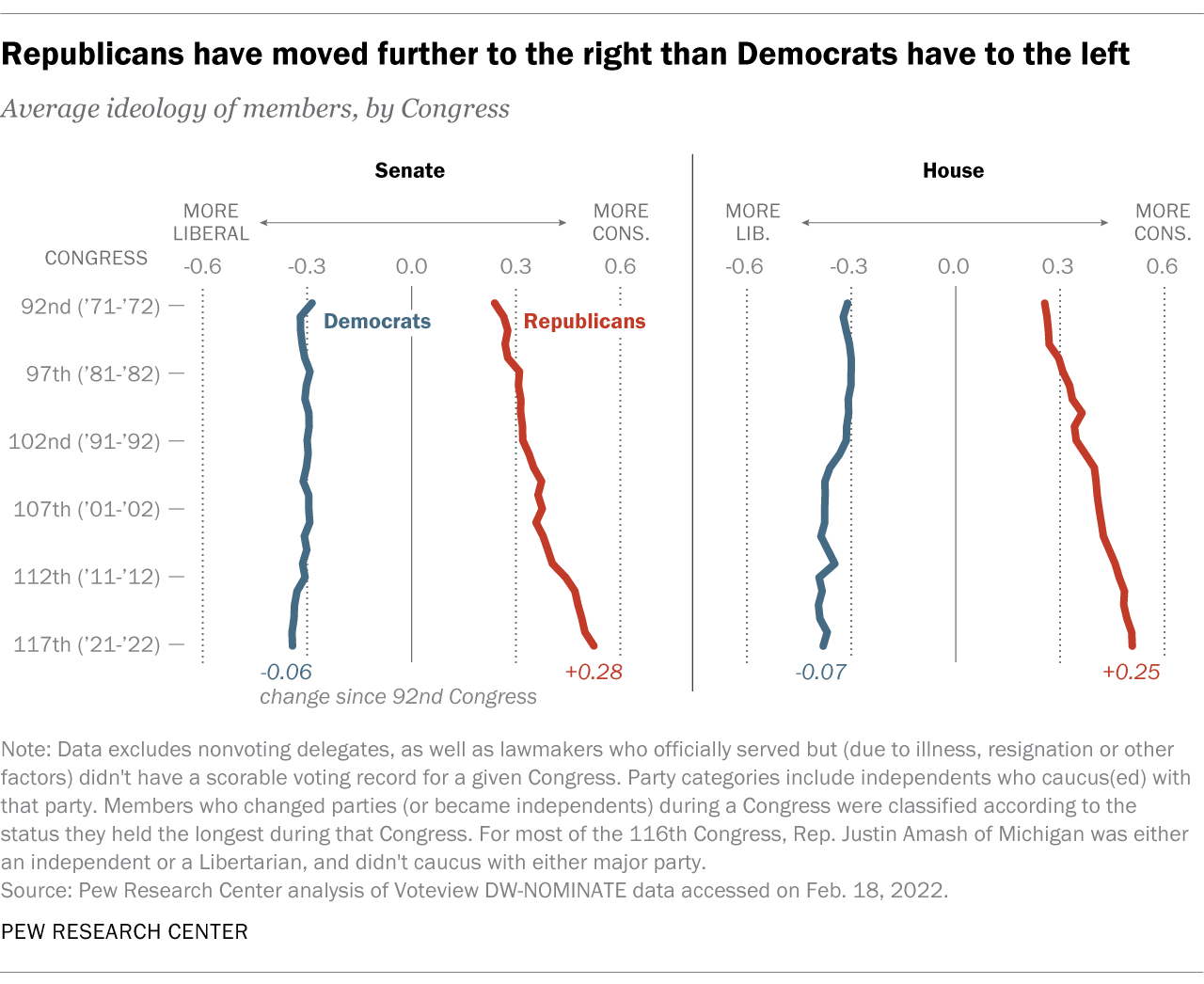
This is dumb misconception, too. It is absolutely false. If anything, Europe (even if you focus solely on Western Europe -- if not, "slightly" would be "extremely") is slightly more conservative than America, especially socially. That may seem false if you look from certain angles, like social welfare, but those are red herrings (e.g., social welfare's a lot easier to expand when taxes are already very high, when your poverty levels are already way lower, etc.).
It's hard to point to a voting record as evidence of one being a leftist or not, when actual leftist policies are not typically put up for a vote in America. Her ideological score puts her in line with Tim Ryan, who is currently running for Senate in right-leaning Ohio, and is competitive because of the very fact he isn't a leftist. Despite what you may hear, not all Democrats are socialists. Far from it.
In present internet discourse, 5-percentile radical leftist opinions are peddled as if they represent any significant group of people in this nation. Anyone who does not agree with their often non-scientific ideological framework is labelled as right-wing-fascist irrespective of ground realities surrounding the person or the topic.
What we're witnessing here is a takeover of the American left by a very particular strain of political activism. Like all activists, they too care more about ascendency in the power struggle and aesthetic markers of cultural victory, instead of practical solutions for improving the lives of the population they represent.
> We're not in Europe
If Europe had anywhere near the racial/cultural/religious diversity of the US, then they'd be on their way to a swift turn to the right. Orban is the canary, and the rise of the right in Germany/France/Italy is exactly representative of that phenomenon. Social safety nets do not make for left-liberal ideology. Most of these socialist-paragons demand incredible conformity (scandinavia) and have restrictive abortion laws [2] among other traditionally right-wing traits.
[1] https://preview.redd.it/iwnju4entbw81.jpg?width=1024&auto=we...

You fucken serious right now?
Europeans love to use ethnic subgroups of white as markers for diversity, but the distinctions are much smaller. Culture and religion(or the manner of its rejection) on the other hand seem to be greatly homogenous in European nations.
Each European nation seems to have a secondary ethnic group of ex-colonial immigrants (France : West Africa, England : North (erstwhile) India, Germany : Turks (not colonial)); but they too seem to be othered within their identity as a nation.
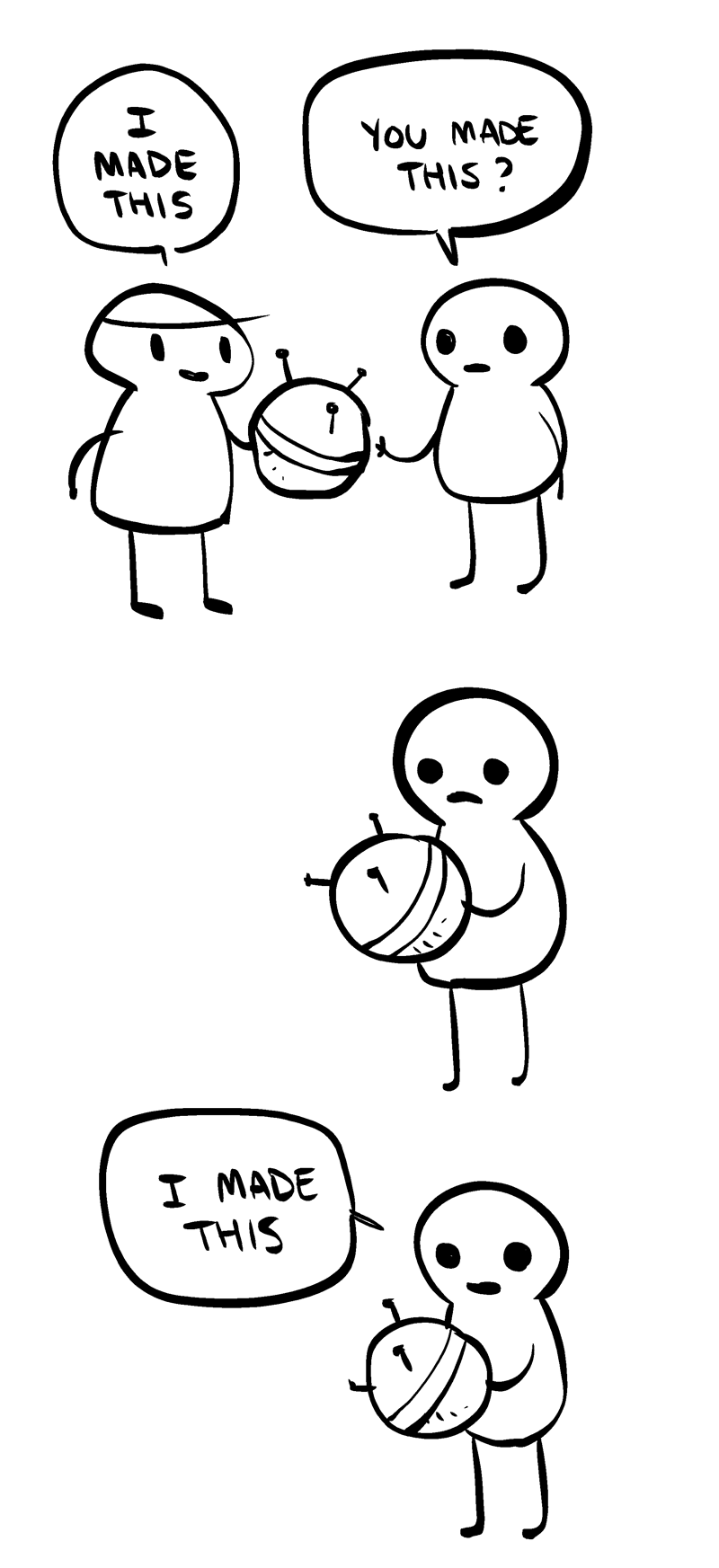
The US actually tries a 2 directional cultural exchange with its immigrant groups. The friction and vitriol that you see, has to do with a genuine attempt at mutual integration. It starts with surface level differences like having access to every cuisine to having celebrities of every ethnicity. But, it also goes deeper. America almost has 'I made this [1]' approach towards appropriating cultural products that start elsewhere. To an extent, the reason Americans get so loud about losing their culture, is because American culture is so weakly defined & fluid. On the other hand, you might not see Germans or French people abusing 'immigrants' because unless you fully integrate, you will always be othered. The very rigidity of the culture, makes it 'feel' like a welcoming place to outsiders.
Americans love to self-flagellate, but the country has done better than any other country at developing at identity that isn't racial, religious or cultural in nature. That's not to say that the conditions are great here. But integration and cultural exchange are hard problems, and not-too-bad is about as good as it gets.
[1] https://i.kym-cdn.com/photos/images/original/001/079/173/ed2...
That aside, it's very funny to accuse the left of shifting the overton window after a republican president that pardoned his co-conspirators, called for insurrection and then took top secret documents home - a crime he himself increased the penalty for. So much for law and order.
Yes, but that implies a certain 'conflict theory' approach to cultural development.
It is an 'all is fair in love and war' framework, which fully enfranchises the obstructionist policies of Mitch McConnell and the executive overreach of DeSantis which involves banning of CRT in schools. If opinions ossify at adulthood, then the only 2 plans of action are brainwash during schooling or disenfranchise your opponents using every slimy trick in the book.
Never convince, never compromise and certainly never rely on a representative democracy to achieve the closest outcome to consensus. I for one, refuse to espouse this theory.
> republican president
I'm not American or white and I dislike Trump, but the 2016 and 2020 elections solidified my opinion of the internet left being a unrepresentative sample of the left-leaning populace in the US. Democrat voters resoundingly rejected Warren/Sanders in 2020 despite the left's best efforts to convince you otherwise. The absolute media onslaught faced by him was unprecedented, and excellent evidence driven organizations were falling over each other to take 'Not-Trump' stances on every policy he ever suggested.
I used to trust NPR, NYT, ACLU & Scientific organizations a lot more until the 2016 election. Now I have to go read the very papers/stats/documents these organizations source from, with conclusions that often contrast the headlines of these very articles.
That's not just a random bar I set, it's been pretty heavily requested - but everyone knows it wouldn't happen because of prior criticism.
Even Tim Pool invites people to the left of the liberal democratic baseline (that I'd call center-right at best, but I'm also used to a more european notion of left and right) occasionally. Why not the JRE?
The Bernie interview was great, but it was a tactical campaign move. He wasn't going to be too contrarian with Joe when the audience is Joe's.
I find that this is a reaction to a reaction.
I have frequently heard women (and some elitist men) make fun of those who listen to Joe Rogan, long before Joe was every heralded as a hero of the masses. It is only after he started receiving what was perceived to be unjust criticism that people started leaning into the 'with him or against him' polarization.
But people have this weird way of taking things they like and not only rejecting criticism but making it their whole identity. Joe can do no wrong and if people dislike him it's because they don't "get it" and they are just being soft.
Joe also likes to deflect by saying "I'm an idiot don't listen to me" which hey that's fine but if you're going to ramble about how the moon is made of cheese then say "don't listen to me" but then bring on a guest who is going to talk about how the moon is made of cheese; the line that is being pushed is pretty clear even if it is unintentional.