The book “Fake law” was terrifying to me - it talks about a whole number of high profile judicial cases that were pretty much distorted by the Mail/Times/Telegraph into whatever propaganda they wanted to push that week, often directed just in ways that it would benefit the oligarchy. And there are multiple books like that. Fake Law, Flat Earth News, Merchants of Doubt.
And without that staff, The Guardian can’t do proper investigations on london real estate’s connection with major money laundering for instance.
Indepedent like someone else pointed out is owned by a Russian oligarch. BBC doesn’t have the mandate to do investigative deep journalism, they can only do reports or documentaries - but that BBC can’t break a major story or investigate anything of political importance because that would jeopardise their “apolitical” position.
This leaves the right wing media, which is the majority in the UK (opposite to the US, in the UK the right wing dominate the media) and they manufacture and manipulate the stories into seemingly-real controversies that are actually just a cover for them to get some law or change passed in Westminster. Read the book “Fake Law” - the way the Mail/Times/Telegraph have distorted even simple judicial cases into something they could use to get popular support for whatever their owners wanted is profoundly disturbing.
There are always people running in online to say that since "both sides" detest the BBC they must be doing something right, but that's ignorance at best, if not plain disingenuous. The BBC have an insanely pro corporate pro war stance, and have wielded it in elections with craft and force. Same w the others.
It's not just me saying all this either. Many have noticed. Many decry the loss of a balanced media landscape. But you won't hear about it on corporate news, or the Beeb or the Grauniad either.
https://pressgazette.co.uk/john-pilger-says-guardian-column-...
An incredible feat, to all those involved, respect for their skill. I’d never seen anything quite like it before I moved to the Uk.
Also, as seems to be the fashion for left wing politicians, he has a soft spot for Russia. I think some people still think there is a Communist utopia over there, it's very strange. Not a good look recently.
I don't believe that there would have been no response from the UK to the Russian invasion if he had ended up PM, but it would have been slower and less impactful.
No it wasn't. Tremendous coordination and force went into pushing that line.
> because of his well known vocal opposition to the Israeli oppression of Palestinians
A view shared by right thinking people everywhere. Oppression is bad yo.
> it was a case of corporate interests and the Tory party pushing the "emergency button" as an real Social Democrat was getting too popular and very close to becoming PM.
Yes. But it wasn't easy, and it wasn't right, and the fact that the BBC and the Guardian and every other major paper and network failed to call the smear campaign out - and even fed it - is indicative of horrifying and deep problems.
> as seems to be the fashion for left wing politicians, he has a soft spot for Russia
Not really, he just isn't into escalating into war with a nuclear power; and recognizes that the Russian people are not the Russian leadership. This "nuance" has been shot and buried in a shallow grave.
> I think some people still think there is a Communist utopia over there, it's very strange.
Literally no one is saying that, except for corporate right wing media putting words in people's mouths. It's really weird that you'd believe them, given - again - that no one is saying that, or anything even remotely like it.
> I don't believe that there would have been no response from the UK to the Russian invasion if he had ended up PM, but it would have been slower and less impactful.
Again, this is a line pushed by right wing corporate media against left leaders all the time. And I thoroughly disagree with it.
Like - how is BoJo faring right now? Do you feel he's respected as a leader? Come off it.
And Britain is on the brink of blackouts without Russian oil, thanks to the dependence on oil fostered by Tories and their mates. A left, pro environment government would not have been so dependent in the first place.
There is no need for coordination when Corbyn did nothing but feed the news cycle with stupid acts and dumb hot takes.
He also directly supported and appeared on stage with people who are anti semites and just did everything possible to be guilty by association.
>And Britain is on the brink of blackouts without Russian oil, thanks to the dependence on oil fostered by Tories and their mates. A left, pro environment government would not have been so dependent in the first place. Being on stage with known anti semites, supporting known anti semites (for other reasons), appearing on Iranian state TV and blurbing one hot take after another.
The UK reliance on Russian fuels was less than 3% of total imports the vast majority of which were through mixed fuel imports from the EU. There were no direct import contracts between the UK and Russia.
Given the two abominations of humanity up for PM now, in 3-4 months he’s going to look positively Churchillian.
There's a lot of remarking going on - Private Eye, for example, have been banging the "NHS privatisation" drum for a couple of decades at least. The Guardian, too, mention it not infrequently.
https://www.bbc.co.uk/news/uk-wales-62442127
The internal NHS IT services were no worse and far better value as you say.
You speak of massive underfunding, but NHS funding has increased in real terms almost every single year since the 1950s: https://fullfact.org/health/spending-english-nhs/
"At the moment, UK public health spending is the equivalent of about 7% of GDP, similar to what it was back in 2010 and higher than in previous years. Back in 1955, it was worth about 3% of GDP."
If the NHS quality of service is as poor as I hear, after decades of increases in funding, why on earth do I also hear it referred to as a "beloved public institution"? Is that just something people feel they are required to say?
https://marginalrevolution.com/marginalrevolution/2019/05/wh...
The point from an affordability perspective is, has NHS funding relative to GDP actually fallen since the end of the last labour government? The answer is no, it’s about the same.
Now it’s reasonable to argue we should be spending more of our GDP on health care, but we’re in the middle of a major global inflation crisis. The recent rise in NI which partly funds health care was slated by the left. How is the country going to afford a significant increase in health spending right now?
Outcomes of serious diseases are probably better in 1955, because science hasn't stood still.
The NHS is also under huge pressure because of all the European health care professionals that left after Brexit (you won't read about that in the Telegraph) and the huge number of sick days caused by COVID.
I also feel they are way too quick to dismiss the idea that health issues are related to COVID. When kids were vaccinated against measles the death rate fell not just for measles, but for all infectious diseases. It's probably because measles damages the immune system. It's not unlikely that COVID had long term health effects that we don't yet fully understand, but which are starting to show up in the statistics.
This is different to NHS funding alone.
Also comparing the UK where healthcare is predominantly a single payer system to countries like Germany isn’t apples to apples. Germany has a multi tiered private-public healthcare system and it’s not single payer.
This looks to be backed up by: "Based on trends observed in early estimates of household final consumption expenditure, household spending on outpatient and hospital services, which include self-funded and insurance-funded treatments, grew by 24.5% and 31.3% respectively in 2021." https://www.ons.gov.uk/peoplepopulationandcommunity/healthan...
But that link also says that NHS spending is 83% of health spending, so like I said I can't get the numbers to add up.
The 83% in your link is the government spending on healthcare as % of total healthcare expenditure not the NHS budget as % of total expenditure.
The government funds other healthcare related expenses that aren’t direct NHS funding.
And so your aunt is currently able to purchase a higher quality of care because she has the money to do so? And this is an option for all moneyed citizens of the UK?
The NHS has been turned into what is effectively a state religion in some quarters. It's untouchable. It can't be criticised. It's immune to meaningful improvement and reform at this point. Yet everyone I know who works for the NHS has a litany of stories about the inefficiency and waste. And it consumes an increasing proportion of the GDP. Eventually, something will have to give.
Its been on an unsustainable path since its inception. It's always been in crisis and needed increasing amounts of cash. Cash that we taxpayers have no choice but to pay up. The NHS isn't optional, it's mandatory.
If we have the option to opt out of paying for the NHS and go private, many will do so. I already have to pay twice over. I pay privately through my employer's plan, and then again for the NHS. I suspect if there is the possibility of opting out and going entirely private, many would do so. At this point it's the only way to ever get a GP appointment for many of us.
The problem with the debate here is that it's always framed in terms of UK vs US funding models, both of which are horribly broken in different ways, and never looks at other European countries or other systems around the world, some of which have systems which work better and provide better health outcomes for less money. If we were to privatise it along French lines, for example, it might be a massive improvement all around. But that debate has never happened.
And yet it is the private system in the UK that is taking away scarce supply from the NHS making it more vulnerable.
There is a supply side limit on doctors and nurses, which means private healthcare works like the Fast Track queue at Alton Towers. All it does is allow people with money to jump the queue at the expense of everybody else.
And remember that since the inception of the NHS Primary Care, ie the GPs, have always been private businesses. Yet that is the bit that is completely on its knees at the moment.
This isn't a private vs public argument. It's far more fundamental than that. It how do we share out increasingly scarce resources in a country that is getting poorer.
It's not a system doing it. Healthcare professionals are choosing to work for private companies instead of the NHS. If you would like to ban that, then say so, but don't pretend there's an amorphous system to blame.
Some of that demand has money, therefore the private system will take capacity away from the NHS to supply the money. Of course it will.
That is jumping the queue.
Therefore as a society we have to ask whether we want to uphold the NHS's founding aim: "Healthcare free at the point of delivery based upon need not ability to pay".
We can't fix the supply shortage by taxing the rich. But we can stop the queue jumping by constraining who private healthcare is permitted to treat and in what order.
For the record I don't like the Fast Track queues at Alton Towers either. That's not the British way. In Britain we stand in line - whether Lord or Leper.
We make people pay for them. Like we do with every other resource on the planet.
Healthcare is something which should be accessible for all, and we can of course subsidise the less well off. But it still ultimately needs paying for.
We also have a hugely archaic system in the Royal Colleges. In no other profession do we expect people to sit regularly very expensive professional exams, and expect the staff to fund them out of their own salary rather than them being funded by their employer. £600 a go is not unheard of.
We do. And you know why. Because the NHS has no more capacity to train any more than that. In fact this last year it has struggled to do that because it was more interested in ensuring its staff had masks on properly than getting the job done. First year medical student placements in hospitals were the first to get the chop.
To train more people in any system, that system has to do less of what it is currently doing and more training. We can't afford that in the NHS, which is already struggling to meet demand.
Ultimately the problem is that we spent the seed cord in the 1990s, and we're struggling to replace it.
In this instance, the resources are humans, and it seems you want to force humans to do something they don't want to do. If you want slave-doctors just say so. It worked for the Romans I guess.
The exact argument is "doctors/nurses are limited, and they aren't behaving how I think they should behave. Let's fix the system so they have no choice". I guess that isn't slavery, that is just funneling people into a single path which they clearly don't like, because they reject that path when they have literally more than one option open to them.
You do have overlapping cover, but the most expensive cover (GP, long term chronic conditions, emergency care) are provided by the NHS. It’s far from clear that you would pay less if you had to cover the whole through a private policy.
You’ve also misrepresented the nature of private healthcare in the UK - this is almost universally not a replacement for NHS services. It will offer you things like faster GP appointments, consultants, and routine operations. It will not replace many of the specialist or emergency services offered by the NHS, leaving you dependent on it anyway.
A bigger “problem with the debate” is that we so frequently find people like yourself who are insistent on having some kind of “debate” without really knowing about what, or why.
edit: and of course you'll rely on NHS for any emergency.
[1] at least not without paying out of pocket for the significantly more expensive premium coverage. Some now offer phone consultations but you still need to go to the GP for referrals and prescriptions.
I mentioned that we don't have the right to opt out of paying for the NHS. It's not possible go entirely private. If you could opt out, you could pay that money to a private provider instead and entirely forego the use of the NHS. That isn't an option today. But it should be.
Employed middle aged workers in the USA pay about the same as we do for the NHS to support Medicare, Medicaid and CHIP through taxes, and then have to pay about the same again to actually get health care for themselves. Plus the system that costs twice as much as ours per citizen still leaves tens of millions of Americans without health insurance. It's utterly godawful. Our current system where everyone supports the NHS, and if you want top up services you pay for it, ensures solid funding for everyone's health care. The fact that my private care actually subsidises the NHS by reducing demand on it is a feature, not a bug. There's also the fact that private health care increases overall investment in health care, so in emergencies the NHS can call on private medical facilities which otherwise wouldn't be available. I know there's a fairness argument, but in practical terms our system benefits everyone.
For what it's worth if you have the money you can get some pretty world class care here. My dad had cancer and due to my mom's really good (publicly provided mind you, she worked for the school system) insurance got my dad great care and he's still out an about to this day
In this scenario, why should an NHS ambulance pick you up when you don't contribute? Surely it should prioritize those on public healthcare? Some poor lad whose leg is broken from a fall?
Because the public healthcare system winds up subsidizing the private one: private insurers dump bad risks onto it when they get too expensive too insure, after years or collecting the payments that don't go to the public system.
It's the definition of privatizing profits and socializing risk.
You want to opt out? You get to opt all the way out. You don't get to come back, it's a one way street. Still keen?
We are forced to spend a significant fraction of our salaries on the NHS whether or not we want to. If we feel that this is not good value for money, or of poor quality, we don't have any real option of choosing to pay an alternative provider. Like all nationalised industries, it's inefficiently run because top-down administration of huge organisations blunts initiative and freedom of action. It's run by Whitehall and politicians, with little input from those actually doing the real work. And the result is that it's in perpetual crisis, with COVID having pushed it right over the edge. Is it really fit for purpose? I don't personally think so, and haven't for many years.
Competition is good for many reasons. It improves the quality and value of goods and services. The NHS has no real competition. There's no direct cost of failure, no direct cost to poor purchasing decisions, no direct cost for poor quality of service, and no real driving reason for improvement in the quality and efficiency of its services. They get the money anyway.
Other healthcare systems in Europe have fully private provision--you have the choice of where to take your money, even if you paid into a public system. If a particular hospital or clinic is providing poor or expensive service, you can take your money elsewhere which is better quality and better value for money. That's a very real incentive to drive improvement and efficiency. That is not the case for the NHS system. There is no choice, and the incentives to improve are minimal.
If there is to ever be any improvement in the NHS, there needs to be competition. The NHS should be somewhere you choose to have treatment because it's the best option, not because it's the only option.
On a small scale, there is some degree of separation. Sometimes the NHS pays for treatment in private facilities, and sometimes private insurance pays for treatment in NHS facilities.
Dentistry is a fucking mess. Eye care is a fucking mess. Care and Nursing homes are a fucking mess. Large private provision of GP care? They can't do it and they hand the contracts back. Specialist commissioning in mental health? It's a fucking mess.
> It's run by Whitehall and politicians, with little input from those actually doing the real work.
If you say things like this it makes me think that you don't know that NHSEngland/Improvement is an arms-length-body, nor what that means in terms of command and control of the English NHS. It makes me think that you didn't know what CCGs were nor how they worked, and that you don't know what an ICS/ICB is nor how they work.
> If there is to ever be any improvement in the NHS, there needs to be competition.
What is "choose and book"? We tried competition, and it dramatically increased costs without doing anything at all to improve care. We're now spending considerable amounts of money rolling back some of that law.
A mess in what way? Do you have to wait 2 years for a private dentistry appointment? Because that's the current wait time for an NHS psychiatrist.
If you can't afford private treatment you go on the NHS. At the moment NHS dentistry is simply not available for very many people. Those people cannot get treatment at all. But for psychiatry, the vast majority of people who need a psychiatrist will get same day or next day access. This is one of the problems - that's a statutory function, they must provide it, and so community care has been cut in order to meet the statutory function.
> Because that's the current wait time for an NHS psychiatrist.
This is untrue in the way that you've presented it. I'm not able to find this statistic any where - what's your source for it please?
There are long waits for some community mental health services, but these are mostly caused by decades of underfunding of MH treatment. Also, your argument says that this problem would be fixed with competition. We've competition and right to choose for first episode of mental health care since 2014[1] and that competition has done nothing to improve things and in many situations has made things worse.
For Early Intervention in Psychosis services (these are services for people with their first episode of psychosis) the current numbers[2] are that 83% of people were seen within 2 weeks after referral.
The number of people in contact with specialist mental health services has increased[3] since 2019 from 1.3m to 1.6m people. This is combined with a decrease in bed numbers and a complex change from CCGs to ICSs. New referrals data is complicated (one person can have multiple new referrals; someone already in contact with services can have a new new referral) but the trend is increasing[3]. The number of young people accessing MH services has increased a lot over the past 12 months, from 575,000 in Mar 2021 to 690,000 in May 2022.
[1] https://www.england.nhs.uk/wp-content/uploads/2018/02/choice...
[2] https://www.england.nhs.uk/south/our-work/mental-health/earl...
[3] MHDS Mental Health Time Series data dashboard
Regarding competition, the NHS hasn't really tried competition seriously now, has it? Not really. Not actually doing a complete decoupling the insurance funding and the service provision. The "choose and book" isn't that, is it? It's a small attempt, which is better than nothing, but it's not really surprising that it didn't drive a huge amount of change, when it's not really going to have a big impact upon the bottom line.
And fuck the NHS. Smash the shit out of it. We'll all die exactly the same number of times without it, but be healthier and happier on the way.
Someone with the default tax code would take home £ 25,539.52 which means they pay 20.2% in tax. It’s quite low by many countries standards but certainly not 15%.
(excuse the gallows humour)
No, they want cost-effective healthcare. Almost everywhere else in the world uses a mixed public-private model for healthcare, which IMHO keeps a lid on the excesses of government spending into the money pit of fully-public healthcare.
https://en.wikipedia.org/wiki/List_of_countries_by_total_hea... https://www.ons.gov.uk/peoplepopulationandcommunity/healthan...
Eg: It's currently almost impossible to get routine or early-stage healthcare. If I want a routine doctor's appointment, I have to phone every day at 8am when the next batch of appointments are released, and hope I get one. Last time, it took hours on hold, and attempts over several days, to get one.
I believe appointments are now run more efficiently due to the backlog and changes in processes due to Covid, with the reason for an appointment usually submitted digitally first, followed by an efficient telephone consultation that is well prepared based on your submitted reason for needing an appointment, and a follow-up consultation as necessary. Perhaps your GP surgery in particular is struggling, or you are perhaps not engaging with the new approach.
I have been surprised at just how well functioning the health service is right now despite the incredible pressures on it, but perhaps my local area is coping better than others.
Importantly, however, this issue was broadly not present 10 years ago when the NHS was better funded to meet its needs, and was still cheaper than other countries. So the issue is not the NHS, but funding, which is also corroborated by our relatively low level of health spending.
While this wasn't previously the case, the spatial and socioeconomic patterns are increasingly similar to that of the Democrat/Republican voters in the US, from what I can tell. The leftward travel of the Democrats is a large part of that. But the left/right inversion in the UK has been slowly coming for decades, but the FPTP system hid that in the outcomes.
There's also the European angle. Those who want to work likely faced competition from EU workers and generally feel hard done by when it comes to globalisation. After all, if you worked in coal, steel, car manufacturing or your family did, quite likely you, or a relative, has lost a good portion of that work to cheaper manufacturing abroad. Which is more appealing: Labour, who prevaricated on Brexit, or BoJo, who simply said he'd do it? It isn't all that different to 'America First' in its appeal.
There probably wasn't any way to avoid the demise of coal, especially given our need to combat climate change, but did Labour provide an alternative? During the 2000s, Labour massively expanded higher education but also increased 'student debt', and only paid lip service to apprenticeships. If you're working class and working/aspirational, likely your budgeting is quite strict. Things like 'debt' and 'loans' generally mean 'trouble' and not a solution.
I agree this is broad strokes, but Labour has a problem in that it no longer actually represents its traditional demographic.
The typical profile of a brexiteer is somebody retired, not somebody in employment, and I think the reasons are largely ideological, rather than practical; polling showed people who supported brexit would still do so if the hypothetical included economic pain.
That said, I stand by what I said. If you look at maps of brexit voting tendency, you'll see they map quite heavily onto rural communities and former industrial heartlands. My explanation for this is that they don't see or feel the benefits of the EU and globalisation. But we didn't have a referendum on who wants globalisation to end, we had one on the EU, and so they took what they could.
> The typical profile of a brexiteer is somebody retired, not somebody in employment
I find this slightly weird stated so definitively having just argued I was being simplistic. I'll lay my cards on the table. I'm British but took advantage of free movement, so I've been party to more conversations on brexit than I really care to think about both back in the UK and here. Trust me, however, this is not an accurate statement: there are plenty of people with jobs who voted for brexit and have strong opinions on it. You don't need to take my anecdata on it though, we can look at a study https://yougov.co.uk/topics/politics/articles-reports/2016/0... - to put this into words:
- of every 100 18-24 year olds who voted, 29 of them voted leave. - of every 100 25-49 year olds you meet, 46 of them will be leave voters. - of every 100 people retirement age or above 36 in 100 you meet will have voted remain.
I find the 25-49 year old bracket overly broad, personally. The vote flips at 50+, but I suspect it would flip slightly younger based on my own experience.
But either way, it can't categorically be stated that all brexiteers are retired people. Actually I can lay further cards on the table: I used to do statistics as a job. So I take issue with the phrase "older people with fewer qualifications most likely to have voted brexit" used on the table I am quoting. Older people yes, but age also correlates with access to education, since my grandparents left school at 15, so there's a significant confounding factor here. I'd be interested in a more detailed breakdown, and I find the "and uneducated" part to be problematic/needing more evidence.
To come back to my point, I was offering a very qualitative interpretation of an extra factor I think encouraged previously core labour voters (in places that have returned labour MPs for about as long as there has been a labour party to choose) to switch allegiances in 2019. I agree with the fact labour does not represent them any longer. Brexit is part of, but not all of, that: I'm adding that Labour had an unclear stance on brexit, whereas these regions tended to vote more strongly for brexit.
This is obviously my opinion only, offered without guarantee or warranty.
https://www.theguardian.com/commentisfree/2022/may/10/starme...
I know this is brushed off or denied by the intelligentsia, and I know the ruling class (no matter what the party) never worked for the interests of the people but themselves, but nevertheless the working class is turning to conservative politics. The really sad thing is very few people on the left seem to be honestly asking why. What is their party doing so wrong that the least advantaged working class is voting for the parties traditionally associated with capital? Instead they seem happy making up feel-good stories about "the horrible uneducated racists voting against their own interest" to tell one another, and that is about the extent of their intellectual curiosity on the matter.
Depending on what happens in the next few years it could well be that they become the party against power. Which would be a rather interesting inversion from the last 40 years.
Which raises a lot of uncomfortable questions for people whose world was informed by Reagan, Thatcher and Bush.
Now that all of those votes go to the SNP it makes it extremely difficult for Labour to get a majority in the Commons along traditional ideological lines. There just aren't enough swing seats elsewhere to really make up for it. 200 seats haven't changed hands since WW2.
Seats gained/lost by winning party in elections since 1966:
1966: Labour Win, 47
1970: Conservative Win: 77
1974: Labour Win: 14
1979: Conservative Win: 62
1983: Conservative Win: 58
1987: Conservative Win: -21
1992: Conservative Win: -40
1997: Labour Win: 145
2001: Labour Win: -6
2005: Labour Win: -48
2010: Conservative Win: 96
2015: Conservative Win: 24
2017: Conservative Win: -13
2019: Conservative Win: 48
Current Seat Breakdown:
Conservative: 357
Labour: 200
SNP: 44
Lib Dem: 14
Plaid Cymru: 3
Alba: 2
Green Party: 1
NI parties: 18 (never been held by Labour or Conservative as far as I'm aware)
Speaker: 1 (politically neutral so irrelevant)
If SNP and Alba (Scottish Parties) are taken out of the equation entirely the way Northern Ireland currently is, Labour has only 18 seats that aren't held by Tories that they could potentially win. 326 seats are needed for a majority. That means Labour, in a best case (and very unrealistic) scenario where they gain all the seats from the minority parties, would need to gain 126 seats, with 108 of them coming from Tory seats in order to form a majority government.
I don't have the data going back past 1966 but looking at what we do have, a seat gain of more than 100 has only happened once: Tony Blair's 1997 win with 145 seats gained. 7 of those gained seats were in Scotland but Labour already held 49. In 1997, Scotland had 72 Westminster MPs but today, due to the redrawing of boundaries, it now only has 59. In total, Labour had 56 seats in Scotland. This means Labour held 78% of Scottish seats, which would equate to 46 seats today.
This is the real reason why Labour has had to become more and more Tory. To make up the deficit they either need to win back seats from the completely dominant Scottish National Party or win Conservative strongholds. They see the latter as more realistic so it's become their focus. When Scotland's seats are essentially out of reach of Labour, the UK becomes a de facto 1 party Conservative state.
It is absolutely bizarre to me that Labour won't make proportional representation and cross party co-operation a key part of their platform. Unless there are some seriously major shifts I can only really see Labour gaining power again through a minority/coalition government. Even if another right wing party such as the Brexit party emerged to splinter votes from the tories, Labour is still looking at a minority government. They simply can't gain enough seats unless they win back Scotland. This is why they are so reluctant to engage with the SNP because if Scotland really does leave the union, Labour probably won't be seeing power again unless there's electoral reform, a revolution or the tories mess up something up so badly that literally millions die. But by that point, they will have probably been in power so long (and absolute power corrupts absolutely) that they'll have the elections rigged autocracy style so even that may not matter.
https://www.electoral-reform.org.uk/latest-news-and-research...
https://www.independent.co.uk/news/uk/politics/jeremy-hunt-p...
The NHS has collapsed since COVID. No, it isn't due to lack of funding, that's a lie. NHS funding has increased massively under the Conservatives who haven't talked about even limited privatisation for the last decade or more. The reason it collapsed is that rigid commands and control systems cannot cope with change and the NHS was already dysfunctional before that. When they emptied the hospitals they created a massive backlog that they already knew they could never catch up on even with more funding.
At any rate it's irrelevant. The excess deaths are much more likely to be vaccine linked despite the collapsed state of the NHS. The timing, causes of death and split between vaxxed and unvaxxed doesn't really work for the theory it's lockdown caused.
That is simply not true. The Conservatives came to power in 2010. Here's what the The King's Fund [1] has to say on funding:
"In the decade following the global financial crisis in 2008, the health service faced the most prolonged spending squeeze in its history: between 2009/10 and 2018/19 health spending increased by an average of just 1.5% per year in real terms, compared to a long-term average increase of 3.6 per cent per year. These pressures were not unique to the UK, whose public spending on health care as a share of GDP is above the EU average, though lower than several comparable nations, including Germany, France, Denmark and the Netherlands." (Source: https://www.kingsfund.org.uk/projects/positions/nhs-funding)
[1] The The King's Fund is an independent charitable organisation working to improve health and care in England.
In the same decade the proportion of people aged 65+ increased from 16% to 22%ish of the population, an increase of a third. Since these are the people who consume the vast majority of NHS resource, the actual age-adjusted funding has been shrinking steadily every year.
Any discussion of the NHS budget has to accept this reality - the British state is already deep in deficit for decades and had built up incredible debts just trying to keep the NHS budget rising, which it always has. To say the NHS would works better with more money is simply to admit it's broken and can't be fixed, because the government can't even afford the current levels. Especially not after the attempts to stop COVID blew debt and inflation through the roof.
NHS apologists always seem to try this switcheroo: someone will point out NHS funding has massively increased - an objectively true claim - and then they'll be accused of lying, by someone who claims it's "underfunded", an entirely subjective and different claim. As you point out, both can be true, but the latter is not disproof of the former nor even a well defined statement.
That definitely sounds like the thread was talking about underfunding/lack of funding to me.
Also, for what it's worth, I think your use of "massively" carries an implication to the reader that funding has increased above and beyond maintenance levels (i.e. that it's gone up in real terms, compared to inflation and demographic changes), as I think most people wouldn't describe increases that are below the level needed to maintain service relative to costs as being "massive increases". You'd probably get less pushback if you described it as "increased in absolute terms", or specifically pointed out that the funding increases have been lower than the underlying cost increases.
I know you did eventually add the "in absolute terms" part, but perhaps consider starting with that next time.
https://news.ycombinator.com/item?id=32540740
"I think your use of massively carries an implication to the reader that funding has increased above and beyond maintenance levels"
The word massive here just means a massive amount of money relative to other levels of government spending changes. From 2010-2020 most govt departments got budgets that went down (austerity), but the NHS was excluded and its funding continued to increase. The amount of money it got is truly massive even on the scale of government.
Trying to talk about "real terms" or "maintenance levels" with something like the NHS is impossible because demand for healthcare constantly increases even with a stable population demographic (some speculate that healthcare demand is actually infinite), as does demand for increased wages. History has shown that there is simply no level of funding increase that the NHS's supporters would ever consider sufficient because they can always claim that the system is strained, could use more people, better paid people, the latest treatments etc. So there's no fixed level that can be identified as maintenance, as one person's maintenance is another's underfunding, which is why all claims about underfunding are impossible to argue with - the statement is literally meaningless.
Related problem: enormous sums of money get allocated to it at a time when every other service gets cuts, explicitly earmarked for upgrades to capacity or buildings and it all gets immediately spent on pay rises in blatant defiance of direct government instructions. So service capacity doesn't change at all but govt can't do anything because too many voters worship the NHS and assume it's perfect except for lack of money.
Still, while waiting for patients to die is an cheap way to shorten backlogs, it does leave not instill confidence…
I agree a 3 year wait is unacceptable, but 2 years of that was covid. Covid has largely passed so they are now getting through the backlog.
I know the most ardent antivaxxers are going to explain every death in the next 30 years by the vaxx ; but the numbers would be so staggering that I suspect plain old counting would help.
https://nakedemperor.substack.com/p/massive-increases-in-exc...
A lot of it is due cardiac reasons. You can also look at when excess death went up in younger age ranges that weren't affected by COVID and see that it starts at the same time the vaccine programme reached them. Hard to explain as lockdowns given they'd been happening for a year by that time.
Edit: Here we go. here's an analysis of deaths by vaccine status for the UK:
https://bartram.substack.com/p/deaths-by-vaccination-status-...
N.b. The way you calculate the population size heavily affects the meaning of this data and the government itself doesn't know what the population is, so there's plenty to debate here, but you can see why the author concludes there should be an investigation. He uses a conservative pop estimate based on official NHS registrations (because the ons estimate is definitely wrong) and plots the graph of the difference by status at the end. So you can set that for everyone under 75 the vaccines appear to be making things worse not better.
In same vein the "every death" (or hospitalization) during the covid pandemic was due to covid and/or lack of vaccination.
I add quotation marks because in both cases I do not believe it's true.
So when you say:
> It never had a great track record to begin with.
Are you talking about government institutions in general or the NHS? I maybe wrong, but I suspect you're speaking of US institutions which are an entirely different dynamic to UK and European ones.
If you are speaking of the NHS, then please outline how it doesn't have a great track record commensurate with its lifespan.
Here's how you do it: you pump unsustainable amounts of money into the service over time. This allows you to offer a great service until in the future you can't pump enough money into it anymore. But that's a problem for the future generations. Those future generations were funding the previous generations all the while, but won't get the same benefits themselves.
An ever increasing percentage of GDP is being poured into the UK's NHS. At some point it's going to be too costly and the young generation at that time will have to pay for it, but won't get the same level of service themselves when they're older. They will be the ones left holding the bag.
I don't think there's a politically viable solution to this though. The problem with this model is that you're effectively borrowing from future generations, but the system takes so long to reach actual unsustainability that people will grow up with the feeling that the system is great.
Don't forget healthcare isn't about you, it is about society and if you don't care about society just think of it instead as having healthy employees and customers, who aren't ruined if they fall ill, and therefore have cash to spend...
https://en.m.wikipedia.org/wiki/List_of_countries_by_total_h...
>you pump unsustainable amounts of money into the service over time. This allows you to offer a great service until in the future you can't pump enough money into it anymore.
This is how every growth based juggernaut business works as well. Quality of service always goes down to continue growth of profits, especially after you've crushed the competition.
IMO, healthcare of the public should not be a profitable business. Or the business will always find ways to squeeze their customers who simply need care for the health.
Healhchare is tricky, because treatments are not one-size-fits-all. Large institutions are rigidly setup to deliver a product, a product that is ever changing, as new treatments are always being refined and added. When it was created it was set up to deliver products that were new 50 years ago, but the structure is inherently slow to evolve. But the private health insurance in UK does not have these problems. More effort could be made at growing the economy in such a way that rising incomes allow people to purchase the private health insurance. It's not an immediate answer for many, but it definitely beats throwing more money at a bureaucracy that cannot adapt.
I know the demographics in the US has vastly changed some cost models over that time, making some earlier social program hit major funding problems through no evil from govt actors.
There's a lot of thinking and work that goes on to cover working out the changing needs of your population that has to be handled by any well managed healthcare service.
In the NHS specifically I am aware that they also have change management procedures that exist to try and understand how to provide continuous improvement as needs and situation change.
That's not to say things are perfect, by any stretch of the imagination. For example the NHS still has a big blindspot when it comes to tech. Most people aren't willing to take the effective pay-cut of being a techie and working in the NHS, a lot of people inside the service don't really respect people with tech skills and there's still a bit of a holdover of not paying much for anyone that isn't a doctor.
That's not to say the situation remains static, some doctors for example are slowly accumulating tech skills as a result, so what will probably happen is that success for a tech person in the NHS is going to require a prerequisite medical degree, at least in the near term.
Which though I don't think it's the best strategy, I can't also argue it's a terrible one to expect people who provide tech services into the NHS have a reasonably high level of domain knowledge.
This is a large institution with a substantial mandate, we should expect to pay a reasonable amount proportional to what it provides us. The fact that it's substantially cheaper than other healthcare services while still providing a very high quality of care leads me to believe that it's doing a pretty good job meeting that mandate.
So I don't think blindly questioning it without taking such things into account is helpful, nor do I think that pointing to costs as being "too high" are helpful without considering what is happening and why they are being paid for in the first place. Chesterton's fence and all that, it's not enough to just cut costs, you have to ask what doing so gains you. There are too many social programs which we cut because "spending less is good" without asking if the spending actually gives us a positive return as a society.
Personally, I think we've become a little too tech obsessed in thinking every problem can be solved with IT. Digitizing records only feeds a surveillance state anyway and can be dangerous (for other, obvious, reasons).
You walked right into it.
What makes you think private business are capable of delivering something cheaper than what the government can do? The most expensive health care in the world is private.
IE they had to provide care to everyone at a reasonable price.
I'm deeply suspicious of healthcare that gets to exclude people for cost reasons.
I too can provide great healthcare if everyone is mandated to pay me for my services and I get to exclude those I treat, that's a great business, the healthy pay and I exclude the sick, what wonderful pure profit business!
The insurance model bothers me for that reason, they really shouldn't be allowed to exclude anyone, if they're taking on the business of healthcare, then that's that, they are providing a utility service, which means they supply to everyone and they make money by spreading the cost between everyone.
There are nuances to that, but practically that's the goal they should aspire to, but unfortunately that model isn't the most profitable.
I mean take a look at the original US health insurance that existed:
> The first plan guaranteed teachers 21 days of hospital care for $6 a year, and was later extended to other employee groups in Dallas, and then nationally [0]
That insurance model worked, it just happened to get outcompeted by entities who were willing to undercut them by aiming to capture only the most healthy people, which is in effect a tragedy of the commons.
Which is a real problem in my book, I'd be fascinated to see what innovations a private company could come up with under that model. We might have missed out on a whole slew of interesting ideas if we kept going down that route, which would still have been a pretty profitable business and would have been a great success for those who do believe that the private space can do healthcare better.
As it stands I don't believe the current private model meets that criteria as it fails at the first hurdle of being a health care service, it doesn't care about health.
So it seems like the choices are bad private care, good public care and bad public care. So yea, I'm leaning to the good public care.
- [0]: https://en.wikipedia.org/wiki/Blue_Cross_Blue_Shield_Associa...
E.g. saying a state-run car company would've done better because all that profit money would've been perfectly allocated is not right. Otherwise the government's perfect decision-makers would be starting car companies left and right and making a fortune, instead of working for the government.
In things that affect your health, I don't want to be the guinea pig that discovers the service I paid for wasn't up to standard. That provider may go bust in the long run, but in the meantime will do a lot of damage.
"Bob Lutz compares Tesla to socialism after GM took $11B from taxpayers under his reign"
https://electrek.co/2016/08/18/bob-lutz-compares-tesla-socia...
I agree that cars are much better than they were 10 years ago. Thanks mostly to government regulations that the incumbent industry fought strongly, while Chinese state owned firms were taking advantage of the opportunity.
Roads aren't cars? I'm not saying that central planning is never a good idea, just that it's mostly not a good idea. "Where to put roads that a private company will build" is a reasonable role of government in a capitalist society.
> and then getting bailed out
I don't think they should've been bailed out. That was politicians buying car worker votes by doing politician things, like inflating the currency to make everyone's wages worth less.
Cars are better not mostly because of regulations, but because of manufacturing improvements, electronic/chip hardware and software improvements, and, most of all, competition.
The more-well-off also think Tory policies will get them a house and security. In practice, the UK housing market is completely fucked and gets more so every year, but... it doesn't stop people believing it.
Basically the health of the NHS is about the tenth thing on some people's minds when voting, until they get cancer or break an arm, at which point they start complaining about it.
Clearly the solution is probably somewhere in between, but political polarization has simply pushed people to their party lines and entrenched their positions such that no real progress can happen while things continue to fall apart.
Basically, libertarians are just wrong on this. Government-run health care works great and we have many decades of evidence showing that.
These are not measures of efficiency. Medicare outlays are about 30-40% of private insurance for the same demographics.
> the care that people get from Medicare is substantially worse than what you get from private insurance
And this is, in fact, not true at all. US citizens on medicare beat their cohorts not only vs. other nations but vs. private insurance in the US too. Don't make the mistake of comparing your corporate insurance for a workforce with a median age of 30 with what retirees in the private market have available.
Retirees on the private market get completely shafted, though: almost everybody in their age group uses medicare, so the insurance will need very high premiums to cover their risks. From what I have heard, people who are on employer plans at that age have better health outcomes than retirees, regardless of where the retiree gets their healthcare.
I don’t think they are comparable. Medicare exists because private insurers refuse to cover old people at a reasonable price. It’s a good scam the private insurers have going: take peoples money when they are generally healthy and productive, drop them like a sack of shit onto the government’s lap when they aren’t.
That is why the life expectancy of the average obese, unhealthy American is about the same as the life expectancy of the average (much healthier) Japanese or European person. Americans are allowed to eat their way to an early grave and then have medical resources thrown at them to desperately keep them alive a few days longer.
EDIT: Also, I should point out that doctors generally demand a lot less end-of-life care than members of the general US population. They seem to understand that it is merely prolonging the inevitable rather than helping.
Rather, it boils down to funding. Nothing else. Just that. The one feature that the NHS has proven time and time again is that it is one of the most cost-efficient healthcare systems in the World, and given that it is working suboptimally that is a clear sign that the NHS needs a significantly greater (and stable and dependable in the long-term) financial investment.
Once that is sorted, all other further changes and optimisations that may be needed can be worked on. But debating how the NHS needs to be reformed today is arguing on the helm of the Titanic on how to improve its unsinkability while it sails merrily towards an iceberg.
There seem to be a lot of British people in denial of this fact. The NHS is dead. The only reason it still exists at all is because it isn't a company so the usual safety systems like bankruptcy can't force a reset.
Note that other countries which spend comparable amounts don't have this problem. I'm lucky enough to have left the UK a long time ago and lines in a party of Europe where the healthcare system is easy more privatised and less controlled by the government. Things here are normal, good even and I can get seen by a gp or specialist more or less immediately.
In general, from a user's perspective, Spanish healthcare tends to work better than the NHS in many regards, albeit with less flexibility at the GP level and more of a hassle when moving between regions. Anecdotally, from the experience of Spanish friends having lived in countries with a more or less public-private model (Belgium, Germany, Ireland) have expressed that the systems there are generally worse, and miss the Spanish healthcare system.
However, different regional governmens have made a greater or lesser move towards covert privatisation via externalisation, and while the two that have done it the most (Catalonia and Madrid) are generally the worst performers, there is little correlation otherwise. The Basque Country, Navarre, Asturias and Aragon are all top performers, yet the first two have privatised significantly while the latter two have kept the system more fully public. On the other hand, Andalusia with very little privatisation is together with Madrid and Catalonia as one of the worse.
And yet, when compared by investment, the pattern becomes much more clear. Madrid, Catalonia and Andalusia have some of the lowest healthcare investment per capita. The Basque Country, Navarre, Asturias are some of the greatest investers—Aragon not so much, but still on the top end of the scale.
(*) As a digression, due to historical differences in how each system evolved, they are not quite the same. Spanish healthcare evolved from Social Security, and thus used to require being either employed, officially on unemployment, or being a dependant of someone in either circumstance (now it's more lenient). Also, all doctors involved are state employees. The NHS on the other hand evolved as a right of all legal residents of the UK, and GPs surgeries are almost always private businesses that are adscribed to the NHS.
Money can solve that, but it isn't the only option.
If the healthcare outcomes don't resemble what other systems can provide with the same level of funding, there needs to be a serious discussion as to whether the NHS model is fit for purpose for today.
[0] https://www.oecd-ilibrary.org/sites/e26f669c-en/index.html?i...
That would be politically risky these days… The UK needs to come back to Earth before this happens.
The shared monetary system with no shared fiscal policy will come apart one day, as it nearly did with the Greek sovereign debt crisis.
This old chestnut. Go read the Rome treaty or the Schuman declaration. The “it’s only economic” is a lie you’ve been sold by your own governments. The aim has always been political Union, from the beginning.
Besides, the EU being “a trading bloc” would not solve any of the issues facing the British government, which mostly result from the government having mutually exclusive demands and being unwilling to keep its word and following the agreements it signed. Including on imports and exports, which is the essence of a trading bloc and would not be improved one bit of the EU were only one of those.
That's not true.
The Schuman declaration refers to the European Coal and Steel Community, which was about making war between countries materially impossible ie. through economic, not political, integration. It doesn't refer to stopping war by creating a common European Parliament with the idea that French and Germans should be subsumed into a European citzenry, with freedom of movement.
Similarly, the Rome treaty established the European Economic Community. The idea of European citzenship being only established with Maastricht as late as 1992.
The history of the European Union has been that of economic integration, with political union coming afterwards. There are many who would have preferred it not come afterwards. To characterise the project soley in terms of those who wanted a pan-European political project is misleading.
Political union has not really worked. The European Parliament is a weak institution, and the sovereign debt crisis showed how unpleasant the democratic deficit is, in this case for everyday Greek citizens, as the European Commission forced through austerity measures, triggering a humanitarian crisis.
> Including on imports and exports, which is the essence of a trading bloc and would not be improved one bit of the EU were only one of those.
The red line for the UK government is freedom of movement. If the EU remained someething akin to ASEAN, ie. prior to Maastricht, the UK would rejoin, and everyone would enjoy sensible trading amongst similarly economically developed countries again.
The EU's dream of German and Greek citizens voting together as "EU citizens" in powerful European Parliament on fiscal issues such as a shared pension age and sharing taxes, will never happen, so we have to wait until that folly is over and peoples using the Euro will continue to find out that they have ceded their democracies to undemocratic institutions.
Right, I’ll quote it here for you:
“The contribution which an organized and living Europe can bring to civilization is indispensable to the maintenance of peaceful relations. In taking upon herself for more than 20 years the role of champion of a united Europe, France has always had as her essential aim the service of peace. A united Europe was not achieved and we had war.
Europe will not be made all at once, or according to a single plan. It will be built through concrete achievements which first create a de facto solidarity. The coming together of the nations of Europe requires the elimination of the age-old opposition of France and Germany. Any action taken must in the first place concern these two countries.
With this aim in view, the French Government proposes that action be taken immediately on one limited but decisive point.”
The CECA was from the begining the first step towards “a United Europe”, however close that unification might be. They just realised that they needed gradual steps. You can disagree with the steps, their size, and their frequency, but the end goal was explicit from the beginning.
> The red line for the UK government is freedom of movement.
And the common agriculture policy. And the fisheries policy. And the customs union. And the human rights. And Ireland. The British government had a lot of incompatible red lines from the beginning. This was obvious to anyone who has been paying attention.
> If the EU remained someething akin to ASEAN, ie. prior to Maastricht, the UK would rejoin, and everyone would enjoy sensible trading amongst similarly economically developed countries again.
That was a position (participation in the EEA but not the EU) the UK did not want to take. Besides, it was not even realistic in the first time. We are not in the 1980s anymore and Europe has changed quite a bit since then.
> The EU's dream of German and Greek citizens voting together as "EU citizens" in powerful European Parliament on fiscal issues such as a shared pension age and sharing taxes
That is not going to happen, at least in the foreseeable future, for several reasons. The first one being that the member states consider that their national sovereignty and they are the one pulling strings in the council. The Parliament cannot do that on its own, it’s just a convenient straw man.
> will never happen, so we have to wait until that folly is over and peoples using the Euro will continue to find out that they have ceded their democracies to undemocratic institutions.
More undemocratic than the Parliament in Westminster? You must be joking. And how accountable is the Bank of England? But yeah, rule Britannia.
Also, you forget that the British government pushed all the way along this drift towards a more neo-liberal, insulated from the whims of its populations, Europe.
> Europe will not be made all at once, or according to a single plan. It will be built through concrete achievements which first create a de facto solidarity. The coming together of the nations of Europe requires the elimination of the age-old opposition of France and Germany. Any action taken must in the first place concern these two countries.
And as your quote shows, it's a long stretch to take the aspiration of a "united Europe" to mean inexorably leading to the problematic; often anti-democratic, institutions we have today. The aspirations were from the beginning economic, and there is no reason at all to think that this can instead take an intergovernmental, rather than supranational form. There was, contrary to what you suggest, no "single plan" that was always in place that governments have subsequently had to, in your words, "lie" about.
> And the common agriculture policy. And the fisheries policy. And the customs union. And the human rights. And Ireland. The British government had a lot of incompatible red lines from the beginning. This was obvious to anyone who has been paying attention.
No, it's freedom of movement, that's the main thing. There wouldn't have been Brexit without the European migrant crisis that shortly preceded it. Brexiters like Farage want a return to economic, not political, union, even if there is grumbling around certain policies.
https://www.youtube.com/watch?v=bQrUFrnW1R4
> That is not going to happen, at least in the foreseeable future
And the weaker member states who have adopted the Euro will continue to pay for it.
> More undemocratic than the Parliament in Westminster? You must be joking. And how accountable is the Bank of England? But yeah, rule Britannia.
Please read hackernews comment guidelines https://news.ycombinator.com/newsguidelines.html
> Be kind. Don't be snarky. Have curious conversation; don't cross-examine. Please don't fulminate. Please don't sneer, including at the rest of the community. Comments should get more thoughtful and substantive, not less, as a topic gets more divisive.
Also please read Yanis Veroufakis's "Adults in the Room" on how the democratic deficit resulted in undemocratic austerity being forced upon Greece, resulting in a humanitarian crisis. There is no comparison between the ECB and Greece and the Bank of England and Parliament.
A return to a European Economic Community, with additional, optional, further integration around freedom of movement, for those who want it, would benefit the citizens of Europe. I don't expect that to happen, however.
No they shouldn't be looking europe. Modern healthcare is subsidization of chronically obese people by healthy working class. UK is the most obese country in western europe. Their situation is different cannot be solved by copying ideas from other healthy countries in europe.
Last September I asked for an appointment with my GP before the end of the year. The first appointment was on January 3. I took the appointment. In October they called to reschedule that appointment. I could take a video appointment another time in early January or an in person visit in June. I took the virtual appointment. Rather than charging a $200 facility fee, they charged a $70 for the telecommunications that were pretty much the same as a zoom call. My insurance would have covered the room charge as required by law. They refused to pay the telecom charge.
Last December my GP ordered a routine screening procedure at my request. I was hoping to have that complete before my January visit so we could discuss any interesting results. In July the clinic that performs that procedure called to schedule the procedure which is scheduled to happen this week.
For this procedure, the clinic is requiring a negative Covid test. They scheduled this test at the one place that they provide these proactive tests. This is a drive through test site that is a 25 minute drive each way from my home. They provided an estimate of the costs for this test. That is $399, which (before taxes) would be earned in 23 hours by someone making the median wage in my city. My insurance company doesn’t think the Covid test is medically necessary so will not cover it. I canceled that Covid test appointment and got a free test at a more convenient location from public health.
Looking back at my past estimates, I see that in 2015 the estimate for the MRI ordered by an ENT that was diagnosing hearing loss was $11,427. In Canada, apparently a private MRI would cost $1,000 or less [1]. I bet the fact that they are available for free for those willing to wait a bit longer helps keep the cost down. If I was given the choice of paying $500 or waiting a few more months for free, I would have definitely taken the free option because I had already delayed care on this for over 10 years.
1. https://www.olympiabenefits.com/blog/how-much-does-a-private...
My wife works with people that are undergoing cancer treatment. One of them is single and lacks FU money in her bank account. She needs to carefully manage the 20 weeks of unpaid leave available to her (and a couple weeks of paid sick leave and vacation) so that she doesn't lose her job. While COBRA could provide continuation of benefits at her current level, that is quite expensive. The Affordable Care Act would give her a path to affordable insurance, but her recent salary would seem to put her out of the running for a full subsidy. Switching insurance in the midst of treatment could mean switching providers. Surely switching providers from one of the best in the area (which is open to Medicare) to someone else while in the midst of cancer treatment is not ideal.
Per the Canada MRI pricing, a private option can be an empowering alternative. A high-quality public option is needed to keep the private options in check and to provide a base level of care for those that are not lucky enough to be able to afford private insurance and private care. Even then, surely there are horror stories.
I have my own story of US healthcare which may be enlightening. It happened to a friend of mine. Let's say this friend is not particularly well to do and lived with his 2 brothers, but they don't always get along that well. At some point, they got into an argument that escalated into an altercation where one brother broke a poolstick over my buddy's head. He had a concussion and laceration needing stiches, so he went to the ER. He was unable to remember his name or which ER treated him, and as a result, was never billed for the care provided and learned the key to universal healthcare in the US - he just gives a fake name at the ER now.
Because governments have constantly demanded the NHS spend less money, but have also been under pressure to preserve numbers of "front line" staff you've ended up with serious shortages of low level admins, medical secretaries, receptionists, finance officers etc. This means that more and more healthcare workers spend their time doing paperwork or customer service work that could be done by anyone. I worked out of one of the largest genomic diagnostic labs in the country with over 150 clinical geneticists, nurses, scientists and consultants and there were 4 admins. That meant nurses were staffing reception, consultants were managing their own diaries, geneticists were doing stock takes and clinical scientists were packaging up and booking samples onto DHL for collection. This was not an efficient way of working, but the lab had a hard ban on hiring any non "front line" staff. And it had been running like that for years.
The trust as a whole had the same problem on a macro scale. There weren't enough finance officers so invoices didn't get paid or debtors chased (the NHS provides a lot of private services as well). Because of a lack of staff working in recruitment it could take months (4 in my case) between being given a job offer and the paperwork being in place to actually start. Payroll was a nightmare because of lack of staff and multiple unintegrated time recording systems, many of them to this day paper based.
A large number of legacy patient records are still paper based and have to be physically moved around and digitised "on the fly" but because the NHS is supposed to be digital there aren't enough porters payed to literally push the trolleys of records around so you end up with nurses doing it.
I could go on for a long time but you get the idea.
It feels like the McKinsey-style design of large orgs has permeated the public sector just as much if not more than the private one. It always comes with a massive amount of procedure – employee surveys, follow-ups and meaningless 10-scale measurements, so that leadership can rest easy knowing that every decision they make is data driven. Somehow a spreadsheet analyst should be able to diagnose and fix every possible issue in an incremental manner, and conversely, all poor decisions are due to insufficient data.
E.g. "Do we think this form being filled out is worth someone not being able to see a doctor?"
Admin bloat seems to be at a higher level if it exists. Because ordinary secretaries are long gone.
The obvious solution seems to be reducing the required paperwork rather than hiring more staff to handle the paperwork, and this seems to agree with your experience when you described "unintegrated time recording systems".
That said, I wouldn't be surprised if too much bureaucracy was also partly to blame, because that's what happened here in Canada.
Most people are worried about the UK moving to a US model, not to be more like Norway, Netherlands and Australia and administrative efficiency is something the NHS does well:
https://www.commonwealthfund.org/publications/fund-reports/2...
> Conclusion: Four features distinguish top performing countries from the United States: 1) they provide for universal coverage and remove cost barriers; 2) they invest in primary care systems to ensure that high-value services are equitably available in all communities to all people; 3) they reduce administrative burdens that divert time, efforts, and spending from health improvement efforts; and 4) they invest in social services, especially for children and working-age adults.
https://duckduckgo.com/?q=yes+minister+hospital+no+patients&...
(Search link because the results are fascinating, looking at Washington hospitals copying British innovation...)

Regardless of private or public, left- or right-wing, bureaucracy begets more bureaucracy. Like a ratcheting effect.
Complaints about bureaucracy is (at least) as old as written history. You may have seen yesterday's frontpage story "The Collapse of Complex Societies (Book Review)" https://news.ycombinator.com/item?id=7207348
Another interesting analysis (for us geeks) is the "complexity catastrophe" described in the book Design Rules: The Power of Modularity. TLDR: Dependencies eventually get so tangled that the cost of change outweighes the expected benefit, and a system which can no longer adapt to the changing world eventually fails outright.
Exploding overhead also happened in education, both K-12 and higher ed. And probably every other mature domain worth examining, if we bothered to look.
Seeing Like a State (James Scott), Bullshit Jobs (David Graeber) and Design Rules (Baldwin, Clark) all address complexity in their own way.
As a geek, I think "path dependent technical debt". For us, there's little to no incentive to cleanup, and certainly no reward, even though everyone moans about it nonstop.
The only notion I have is that, like reducing technical debt, fighting admin overhead (expanding bureaucracy) requires constant effort and investment, that no one is willing to make.
I (greedily) welcome a more optimistic take on this problem, if any one has some ideas. Please.
About 15 years ago the NHS tried to add easy to read labeling to foods with a semaphore: red, yellow, green. And it was blocked during a Labour government with majority.
Giving it more and more funds while not fixing the underlying problems is going to cause a massive budget crisis. We need to fix the causes not the symptoms.
Easy to read, OK, but would it actually be reliable?
It is way too easy to label avocado red because of high fat content while labeling a candy bar orange because sugar isn't officially considered that dangerous ... and unlike avocado farmers, highly processed food producers have a good lobby.
We need both. You don't fix a skull fracture by giving the patient a helmet.
It really depends on the context. Many will defend nhs because the alternative pushed from time to time is a privatised system which would only make things worse. I'm definitely in the "be careful how you criticise the nhs" camp. It's not great, but let's make sure Tories don't hear that as an encouragement to take it apart.
One can be concerned about both.
If we ever had a socially conservative and economically progressive government they would stay in power until they died. I mean in the US they literally had to add an amendment to make sure it didn't happen again: https://en.wikipedia.org/wiki/Twenty-second_Amendment_to_the...
I didn’t say that you couldn’t. But by voting for the current day Tory’s you are choosing to decimate the health system and waste money on sending Refugees to Rwanda. It’s idiotic to prioritise that over the NHS.
It all depends how you view the world. For many people, preserving the historical character and demographic of their country is an important issue. It might not be to you, you might consider it stupid, but it is a concern many people have. So much so, they would see illegal arrivals of non historical descent as a more acute problem. One to be prioritised over what can be argued to be improvements to the existing system.
I myself am one of these people. It is more important to me immigrants be sent to Rwanda than offering additional funding or reforming the NHS.
If my interaction with other people sharing your beliefs ( or more accurate my assumptions about your beliefs ), you believe me to be evil. I do not believe I am and I do not believe you, who think the opposite of me to be evil. I believe you are misguided though and wrong in what your priorities are.
Genuinely, why are refugees something to be prioritized over a cultural touchstone institution if the goal is preserving historical character?
I wish I could answer you unfortunately censorship measures currently in place prevent open discussion.
Looking at the total healthcare expenditure before covid, it consistently hovered around 10 per cent of the total British GDP.
https://www.statista.com/statistics/317708/healthcare-expend...
If this is underfunded for you, how many per cent would be funded enough?
Accidentally, the EU average is about 10 per cent, with 12 member countries scoring less than 7.5 per cent of GDP.
https://ec.europa.eu/eurostat/statistics-explained/index.php...
From what I see, the British values seem absolutely normal to me, and healthcare results (life expectancy, 5-year survival of cancers) are just fine, especially given how fat British people have become.
What percentage of GDP would be needed for that? That question would require a lot of data and analysis to answer, far more than would be reasonable to expect for an HN comment.
Accordingly, the Conservatives gave lucrative contracts to all their friends.
The current Labour party are useless holding them to account.
Paying people directly after every workout might have a greater impact.
Now it's pretty routine to just go to urgent care since it's unlikely you have a family doctor, ever. Rural hospitals and clinics are either reducing hours or just outright closing due to lack of staff.
The difference is there is no private healthcare in Canada (there is, but it's minuscule).
You either wait for the public system or you fly to the US.
I met a guy in Vancouver who was flying to the US to pay $36,000 to get his knee replaced because his doctor told him "the wait was 2 years before Covid, now? it's indefinite". Guy was a highly active 65 year old and realized $36,000 was cheap if it meant he didn't have to give up 5 years of his best remaining years waiting for the Canadian healthcare system.
Same ridiculous waiting times for a 50/50 chance to just get a paracetamol prescription.
Private is expensive as hell, nonexistent or not usable.
Mental healthcare? Pay us, fuck you.
Medication newer than 30 years? Stop huffing that ibuprofen, Bruder.
But it's defended to death by the German Internet Chairforce, so it's got that going for it.
This appears to have started back at the end of 2020, in waves over the last few years. First, the elderly, then filtering down to the younger age brackets.
All in the wake of the terrible things you have mentioned.
Having worked with the NHS for years, I've seen the good and bad of it. The nurses are the rock, a lot of the doctors seem great, others quite alarmingly without common sense. The management seem to have a policy to "promote to incompetence", and the government intervention seems to encourage the wasting of the vast sums of money they are given.
It's a perfect storm, people don't want to recognise what is happening, the NHS is dead already.
They are not responsible for the lack of funding but my experience with NHS's admin has been pretty bad and they can't blame "government's cuts" for everything.
I know people who work in consulting in the Big Four and everyone wants to avoid NHS projects because of their internal organisation and waybof working.
The NHS has a big organisation and quality of people problem as well.
It is a sacred cow, as you mention, and in general people are reluctant to say anything bad about it.
https://ichef.bbci.co.uk/news/624/cpsprodpb/166A5/production...
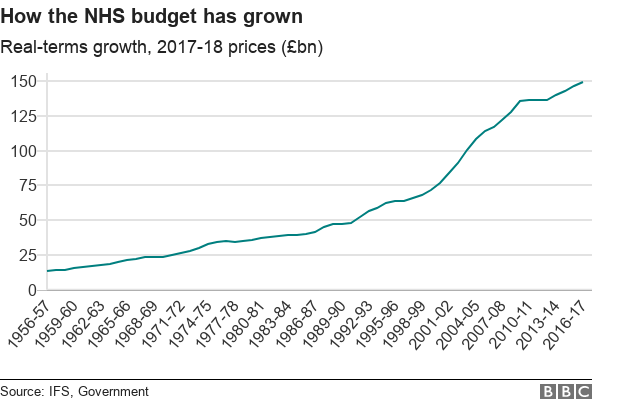
At what point does throwing ever more money into an industrial furnace become a bad idea?
"It takes forever to see a doctor on the NHS, now!"
"Let's get rid of the doctors altogether and see how they like it! They think they're so safe."
This thread really matches well with the thread about teacher shortages. The problem with the NHS is that it should cost far more, and should turn people down when they can't pay. Then patients would understand their place in relation to doctors, like in the US, and stop complaining.
If this were the true issue, the excess deaths would have been starting at peak Covid hospitalization. In fact the opposite is true…
That said, particularly on any bureaucracy- more money doesn’t solve issues. In fact, more money often makes more bureaucracy. Obviously that’s not only the case, but it’s one I’d seriously consider here.
On bureaucracy - a health service requires administration, so any health funding can be described as "more money for a bureaucracy". The evidence shows that I direct public service like the NHS - concentrating on building hospitals, hiring doctors and nurses and making people well - involves somewhat less administrative costs than using an indirect insurance system (like most European countries, Canada etc) and much less than the dysfunctional private system in America https://www.healthaffairs.org/doi/10.1377/hlthaff.2013.1327
I agree more money doesn't solve the issue, especially as so much money was wasted on Covid testing and private beds that were never used.
However in my lifetime the difference in healthcare spending between New Labour and Conservative has been noticeable.
https://data.worldbank.org/indicator/SH.XPD.CHEX.GD.ZS?end=2...
In some sense, the UK became poorer than the other European countries it'd normally be compared to at the end of the previous New Labour government when the financial crisis hit and just never really recovered from that. It's possible there is no obvious way out anymore - everyone being poorer means less means less money for them to spend on consumer products and services and less tax revenue the government to spend on things like healthcare and infrastructure, and all of that means less businesses interested in setting up in the country (for reasons other than low taxes anyway) and less tax revenue, less well paying jobs... it's a vicious circle to be stuck in.
Even before that happened, the New Labour-era spending was obviously unsustainable at the level of tax they were willing to charge. Despite the economy booming and a bunch of NHS infrastructure spending being moved off government books via expensive PFI programs the national debt went up consistently as a proportion of GDP year after year. Afterwards the Tories made a big fancy show of austerity and cutting back on government spending (and to be fair it did eliminate the deficit like they promised, for a while anyway) but even their big scary austerity program only froze the proportion of GDP spent on healthcare for a while.
But that's something most people don't use or even like. A stable job and better safety nets are preferred, and here DE/FR/etc excel.
All nice developed rich northern European countries with reasonable life expectancy and life quality.
https://data.worldbank.org/indicator/SH.XPD.CHEX.GD.ZS?end=2...
Their difference from the UK is negligible.
Swiss medical insurance is actually quite strongly regulated and not like the US system at all. Extras are generally where insurance make money, like having a private room in a hospital instead of a ward.
Where I disagree is that a change of government will improve things, because I don't think 'more money' will magically solve all of the problems. As an example, GPs should be doing face to face appointments again as you say, and they should be on call for out of hours. Not for extra money, they're already highly paid. This is just part of the job - people aren't ill conveniently between 9-5 Mon-Fri. Before anyone says this is unfair, UK software engineer salaries look nothing like US ones most of the time, whereas doctors are 'raking it in'. Yes, being a doctor is a tough profession, undoubtedly, but getting into medical school is highly competitive and sought after. So you either want the status and money in exchange for unsocial hours and dealing with the sick and dying or you choose a different career.
I don't find it a convincing argument that 'this is all the fault of the tories' because I also had a problem with panic attacks when I lived in the UK under a labour government, and was also outright refused treatment because our local area had only adult facilities and I was 17.5 when it started. I've plenty of other stories, but this is mine.
Generally UK politics is polarised like the US and people who believe the conservatives' sole motive in life is to dance on the graves of the poor while watching a food bank burn are likely to be overrepresented online. Remember that austerity came on the heels of Gordon Brown trying to spend his way out of a recession, the same PM who as chancellor sold off the UK gold reserves at the bottom of gold value and tax raided a bunch of pensions. Labour are by no means perfect either, and unfortunately even governments have to budget.
Don't get me wrong, the tories have been the government for quite a while now. They've had time to improve things and they definitely haven't. I'm just saying the idea Labour will magically resolve NHS issues is a fallacy. I'd argue that the real issue is the short term/electoral driven policymaking with regards to the NHS - it is a sacred cow, and even the slightest mention of change could potentially be political suicide.
> Getting a GP to see you in person is now quite difficult (they want to do everything via phone)
Doesn't really strike me as a bad thing in itself.
Once you get past the front line, things get pretty specialist and a general move to Telemedicine is probably a good thing, and is presumably happening all around the world for all sorts of reasons. People even do telesurgery now.
And yeah, in a world where someone is continually lying about something good and useful, you do need to choose your words carefully to not help spread their lies. That's not anyone's fault but the liars though.
Currently people just give up on contacting their surgeries, letting their symptoms develop into something potentially more dangerous. Then they end up at A&E, overloading the hospitals.
Maybe it's not so bad in the 3 biggest cities (possibly due competing private services), but at smaller cities and towns, it's impossible to see your GP. I see people complaining about it in pretty much every media.
I don't particularly see a face-to-face visit to a GP when you think you have an issue as preventitive, but if it was, I still don't see how telemedecine wouldn't be a partial solution to that problem, not make it worse.
But isn't a GP (general practicioner) exactly the front line of which you speak?
- Getting a GP to see you in person is now quite difficult (they want to do everything via phone). - Seeing your GP (depending on your area) can involve a 2-3 week wait and waiting in an hours long phone queue. - When you are referred to hospital for tests you can be waiting 6-12 months for the most simple things if they’re not life threatening (even if they are life limiting in the meantime).
I personally have gotten to the point where I would not want to live in this country without access to private healthcare. I’ve had a number of treatments privately and they’ve saved me months of pain, anxiety, and in one case outright refusal for treatment by the NHS until the issue became dangerous (which was inevitable).
In the UK we treat the NHS like a sacred cow. Even people who have experienced appalling treatment feel the need to exonerate the NHS when complaining about their experience. While the people that work there are not the problem (the failures of the government are) we need to start calling a spade a spade. The current condition of the NHS is atrocious. It’s not “great/the best health system in the world” and we’re no longer “so lucky to live here with the NHS”. It’s shit and it needs massive changes. Unfortunately without a change in government we’re not going to get those and people are seemingly more concerned about refugees arriving by dinghy than health care.