If you follow that logic to the final conclusion, you will find that these "institutional investors" only have incentive to not only buy up all the assets they can at near zero interest, but that doing so is a kind of self-perpetuating profit machine as inflation creates profits for them.
Yes, this is IMMENSELY dangerous.
Oh, and I did not mention that if it's not in collusion, the Fed has the tiger by the tail and is paralyzed with fear to such a degree that it simply cannot let go so as to at least have a chance of getting away in time, rather than the guaranteed demise of holding on to the tail and then eventually only getting ever more tired and the chance of survival crashing exponentially.
It's a trendy thing to say, especially in certain political circles, but could you substantiate it with something from a serious, non-partisan economist? AFAIK, for example, inflation isn't much related to it - rates have been very low for a long time, sans inflation.
> the Fed has the tiger by the tail and is paralyzed with fear
Again, anything substantive to support this? They are 'paralyzed with fear'?
The fact that printed money is fueling the housing market does not require an economist to see; it is obvious from comparing two simple observations:
(1) Americans expect to be able to get 30 year mortgages at rates around 3%.
(2) Americans expect to be able to invest their retirement savings in stocks and bonds with a long term rate of return of 8% or more.
This state of affairs would be impossible in a free market with a money supply that was not being manipulated; in a free market, nobody would be crazy enough to lend money for mortgages at 3% when they could invest the same money in stocks and bonds and make an 8% return over the same time horizon. The only reason #1 above exists at all is that mortgages are made with printed money from the Fed.
> rates have been very low for a long time
That's because interest rates are not determined by a free market; the Fed has its thumb on the scales (see above), and has for decades.
IME, people have lots of theories that look good to amateurs. Look at physics, as a striking example of how wrong amateurs can be for thousands of years.
Anyway, you aren't required to do research for me, but some person on the Internet writing economic theory is not persuasive to me. Oh well.
Less risky, yes. Less risky to the tune of 5 or more percentage points? Not so sure.
> #1 is also less volatile
That depends on the housing market, which can be subject to large fluctuations that have nothing to do with the underlying value of the assets and everything to do with the availability of newly printed money for mortgage loans. The years leading up to and including the 2008 crash showed how volatile a manipulated housing market can be.
But what if no other bank has any reserve to lend? Why then you have a banking crisis as collectively the banking system is short of reserves, at which point the Fed steps in and injects whatever quantity of reserves are necessary to make up the shortfall. So the idea that the Fed would allow a banking crisis in order to limit reserves to some arbitrary quantity is ludicrous. The Fed was created to make sure banks always had enough reserves. That's why we have a Federal Reserve system in the first place.
And in fact there are guarantees -- the bank can take a government bond and automatically borrow reserves with the bond as collateral, directly from the Fed, so the Fed stands ready to convert any bond given by the banks into reserves whenever the banks want. This is the repo market, so you don't need to borrow overnight from another bank if you have a treasury bill or bond, you can borrow your reserve directly from the Fed itself.
https://www.newyorkfed.org/markets/domestic-market-operation...
In short, the Fed controls the price of reserves -- the interest rate paid when borrowing reserves -- and it stands ready to provide banks with whatever reserves they need at the policy rate. Thus the Fed sets the price, and lets the quantity float.
You may also be interested in other nations such as Canada that have eliminated reserves and switched to a corridor system.
That the Fed doesn't care about monetary aggregates is aptly described in this FRBNY note:
"Banks first lend and then cover their reserve ratios: The decision whether or not to lend is generally independent of their reserves with the central bank or their deposits from customers."
[https://en.wikipedia.org/wiki/Money_creation#Credit_theory_o...]
Apartment complexes make sense as rentals because there's a great deal of efficiencies vis-a-vis property maintenance & management. Plus the added benefit of greatly reduced property taxes per unit. The downside is that they don't appreciate as quickly as other real estate can.
SFHs make a lot of sense for small-time landlords because they can be bought up in increments. But even small-time landlords pretty quickly realize the value in multi-tenant rentals and move to acquire more of them.
Blackrock, et al, will hold onto these so long as they continue to appreciate at double-digit rates. But after a few years of inflation-level appreciation, they will begin to dump these as their profits tumble due to the inherent inefficiencies of SFHs.
Cheap as possible paint minimal repairs no inspections. Shady things like intentionally covering up gas leaks. Source: Family nearly died in multiple different ways. Had an HVAC fall on kids bed In the night, just missed. Massive gas leak they lied about. Walls that were so hot they burned the skin.
Many things a home inspection would have uncovered.
The fed is now so fucked it can't even raise rates without immediately causing property value declines as mortgages decrease. There really is no solution and we are in for horrific pain eventually. It's simply a question of how long they can stall it.
There will be pain in the short term, but you're creating opportunity for future generations.
Policy right now is all about pulling prosperity from the future into the present. IE higher valuation multiples today enrich current asset holders, but leave little growth for future asset holders
It used to be that the Fed was not too focused on asset valuations, and actually drove policy on the basis of their mandates. Unfortunately they're too cowardly to do that anymore.
It may be partly due to the short term focused political system in the US. China actually is explicitly acting to reduce property values to make homes more affordable for its people. Of course this triggered all sorts of second order effects like the evergrande situation. We will see if they follow through all the way, but so far they aren't backing down, despite what looks like an imminent systemic implosion of the property sector.
Sometimes people lose when they invest. That's how it's supposed to work. Removing that element creates mass amounts of moral hazard, which will end badly on its own at some point.
Could it be that they're essentially captured by the likes of Blackrock, etc. I mean, it's been this way for a while, but it's getting to where government is openly a tool for the corporations without voter involvement.
But I think it has more to do with the Fed trying to appease both the political party in power (as they control their renomination) and just people generally.
With all the social media etc nowadays, they have more scrutiny over their actions, and are afraid of making tough decisions. E.g. optimizing for the short run to the expense of the longer run.
But to your point, Powell in particular is much more focused on the stock market and how wealthier Americans (stockholders, homeowners etc) are doing. Past fed chairmen, like Yellen and Bernanke didn't seem to care nearly as much about market movements, and focused more on the economy itself, and their mandate.
From the financial crisis to COVID low interest rates (and inflating asset prices) seemed almost a consequence of their inflation+unemployment mandate: even with the interest rate around zero unemployment was slow to come down and inflation was mostly in financial assets and not the consumer price level.
Post-COVID seems to be a different story though. I guess we'll see in the next year or so how they react if the inflation pressure turns out to be persistent - personally I wouldn't be surprised if they do raise rates, even though that would obviously lower most asset prices.
But keep in mind that in the 1970's, home prices were actually included in the CPI. If this were still the case today, we would actually see inflation levels similar to what we saw in the 70s.
The CPI formula has been changed many times over the years, to suppress inflation numbers. There are strong incentives to do this, as Social Security and many other things are tied to the CPI.
There are logical arguments for these changes though. Homes are financed goods, and consumption can be considered the monthly carrying cost and not the value of the asset. However, ignoring "asset inflation" has led to much worse wealth inequality IMO. It would be better to continue to include national average home prices. Nowadays, there's a measure called Owners Equivalent Rents that partially gauge this. But there are tons of methodological flaws in how rent equivalent data is collected for CPI that lead to both underreporting, and a lag of ~12 months. e.g. Rents are up about 20% nationally since the pandemic started, but CPI has shown roughly 3.5% so far. The next few months should start to show the full extent of rental increases.
Now that car prices are causing a large increase in CPI, don't be surprised when they alter the measurement of these factors next year. They'll use some measure like average monthly car payment.
Also keep in mind that unemployment was around 10% post GFC, and took about 10 years to get close to full employment. That was quite a large shock that took a long while to recover from.
The market did fall something like 20% in 2018 as the Fed raised rates to preempt inflation, but they chickened out and reversed course and market immediately rallied back all gains.
And as you said, it's pretty clear right now they are dragging their feet on doing anything post COVID. I'm pretty sure Powell is really optimizing for retaining his job, since his term ends very soon... otherwise they really shouldn't care about market movements to such an extent.
They will almost certainly announce the taper tomorrow, but expect it to be wrapped in all kinds of dovish language to juice assets/speculation further.
Regardless of short term interest rate peg, they should absolutely not be buying bonds to suppress long term rates. They have been continuing an "emergency" bond buying program for a full year beyond what was reasonable to most people. I mean, why are they buying 120B worth of bonds every month, as housing prices have gone up something like 30% nationally? They are terminally afraid that if they can't manipulate long term rates lower through QE, that rates will rise and market or housing will tank. Well, we'll find out soon enough
This is the exact policy adopted by the Fed in 1929: purge the bad out of the system. Let the failing banks go bankrupt. That turned what was a recession into a full-blown deflationary credit crunch.
All the high-and-mighty theory and bloviating may not mean much in the face of 25% unemployment, wages falling 50%, and 15%+ contraction of global GDP.
I agree there needs to be moral hazard to investing and interest rates are to low... but be careful what you wish for.
Stimulus in recessionary periods is smart, and prevents prolonged recessions like was seen in the great depression, and somewhat during the GFC.
But the stimulus has already been done at this point. The crisis is over.
The situation we're in now is corporate earnings at all time highs, the gap between open jobs and job seekers at all time high, consumers with spending power at all time high, home prices accelerating at all time highs, inflation running very hot.
So this is the exact time that the Fed should be smoothing the peak, to avoid a full on bubble type of scenario. By not acting, they setup the risk factors for another 1929 or 2008. E.g. encouraging mass speculation, high levels of debt and so on.
So I agree with you. But the goal should be to avoid creating the conditions for systemic failures by letting bubbles get out of hand. China in particular let their real estate bubble get far out of hand, to the point that it's not really possible to resolve without creating a systemic issue.
You fundamentally just have to accept some down periods and small hits to avoid the massive failures that come along with facilitating much larger bubbles/structural risks.
> This is the end game
I disagree with this statement. Firstly, we will likely fix it sooner rather than later. Secondly, if it truly gets horrible, we still have one person one vote. Its not the property owner that gets the vote, its the renter that gets the vote. If you end up in a locality with 100% rentership, they will vote for rental caps, they will increase their living quality through building codes/regulation, and they will vote to remove zoning and the local politicians will follow through because there is no downside to the people in their constituency.
There will still be corruption in the form of state level or federal laws to reduce local autonomy (e.g. with municipal broadband), but thats a problem we already have, and people need to learn to vote for their best long-term benefit rather than ideologically and/or their short term benefit.
Even today, if you want to stop Big Real-Estate from making rentership horrible and keep making housing prices obscene, vote to remove zoning or at the least, vote for zoning that would let the market increase housing 100x. We are all kinda NIMBY regarding the short term, but need to find a way to vote against our short term best interest for the sake of our long term best interests.
I don't think I've ever heard of a politician even talking about that though.
One of the issues is that when these sorts of policies initially roll out you tend to see a contradictory effect of sudden spiking in prices as a lot of people who were on the fence suddenly decide to add to the housing market demand - but over time these policies tend to settle in a place where thing are more affordable.
The other issue is that the renewal period for first time home owner benefits is quite long, so if you are exiting a long term relationship or trying to pick yourself up after bankruptcy you can be forced to enter the market as if you were a well established asset holder.
I seriously doubt that to be true in a low supply situation. In the Netherlands, the government reduced real estate transfer tax from 8% to 2%, and sometimes even 0%. This should make houses more affordable to newcomers.
Another well intended measure was for older people to share their wealth to their children via early inheritance, tax free.
The market simply adds this discount and extra start capital to the price "room". In a situation of perpetual scarcity, the price will rise to the maximum people can afford/borrow.
And with "people", I mean only the buyers. It doesn't matter if 90% of the population is priced out of the market if the richest 10% is still enough people to buy up all supply.
This last bit is most worrisome, because it means that even the nuclear instrument of increasing interest rates is unlikely to resolve the issue. The interest cannot be jacked up much because that would bankrupt the middle class. A minor tweak will be no issue at all for the richest 10%, so the price will not come down.
Increasing supply in a dense and popular area isn't a structural solution. Not only does it meet a lot of resistance, new demand will forever continue to outpace the constraint of delivering new supply.
Which is why I believe in reorganizing demand. These dense areas are dense because it gives people access to jobs and education. If we reorganize that into a more sane distributed way, we truly address the problem.
Some further flaws in the system: I was shocked to find out that the new home buyers tax credit only applies to homes under $500k - which in vancouver means it only applies to a handful of small condos. It's also not poolable, so two first-time buyers going in on a $501k condo are disqualified.
[0] https://smartasset.com/taxes/what-is-a-homestead-tax-exempti...
Could you point me at some more reading that talks about this? The increase in prices makes perfect sense to me, but I don't really have a good handle on why things would come back down.
Yes, one effects people like you and the other effects people like me.
Entire lifetimes wasted before our eyes. Anyways, maybe we can solve free school lunch finally, seems like that’s what we’re up to.
Edit to add: I looked up the exemption calculation. It excludes up to $432,666 from the assessed value. Multiply that exclusion by the rate of 0.00585 ($5.85 per $1K per year) and the exclusion reduces a homeowner's taxes by $2,531.10/yr.
Scale it per property === take the average of taxes / homes, pass it along to the renter.
About the only way I can the cost not getting passed to the renter is for a "the government" to set the rental prices as if the home was under a rolling 30-year mortgage, taking into account PITI. Adding a property tax on top of that ONLY to the property owner, maybe exponentially per property owned, could curb companies like Blackrock.
That being said, I have very faith that a "the government" could do this efficiently/correctly/at all. Trying to trace down umbrella corps and whatnot would be cat and mouse. The US government can't even figure out who is cheating on their taxes as it stands.
Raising property taxes on SFH rentals, but not apartments will make apartments more attractive. Sure, renting a house has advantages, but those advantages have a price, and how many renters are going to be willing to pay 40% more per square foot for a SFH over an apartment.
At some point, even an expensive mortgage is a better deal.
Apartments are great, we should incentivize apartments. They are high density and can be built in a variety of sizes.
You have to consider that legislative members tend to own property and tend to be baby boomers. They are far removed form the experiences that younger generations have to deal with - from their perspective, their home value can go up 20% in 2 years and that will be rationalized as a normal market. They are not talking about it because they are benefiting financially, and talking about may make them hurt financially. This will change, baby boomers cannot live forever even though they behave as though no future generations exist.
Many of them may have been just in time to snatch a house from the market, and they see their home value go up. None of them are going to advocate for super high taxes on their "unjust" gains nor will they give a discount to future buyers. They will maximize the return just like everybody else would.
It's not boomer behavior, it's human behavior. Boomers were just lucky to get in earlier. The only annoying thing about some boomers is that they don't acknowledge their luck, and insist it was all due to their hard work or brilliance.
The school going generation always wants a revolution, a redesign of society. To fix its flaws, to make it more fair. It's easy to want to change everything if you have no responsibility or anything to lose. But then they grow up and have skin in the game, and they'll be just like everybody else, protecting whatever wealth they have.
Consider that many boomers were hippies when they were young, rejecting even the notion of personal property. Now they own almost all property. The 21st century version of hippies are even better at managing progressive optics whilst taking in top 1% salaries.
Politicians are probably getting paid of by companies investing in housing and buying up hundreds or thousands of houses, because the price increases make it more profitable than many other investments, and (unless there's some legislative action) makes the investment safer than most other high-profit ones (eg. cryptocurrencies).
And the little guy gets fucked in the end.
This leaves out one major factor: they need somewhere to live but that doesn't mean it needs to be the same real-estate market or size. Someone who sells a house large enough to have a family in a major market and retires to a cheaper market can see a very comfortable return. Probably nowhere near enough to make up for the other impacts of the policies people voted for to drive up their home value but it's harder to get people to give equal weight to different factors when one of them will show up directly in their personal bank account.
But considering that people tend to move to a few urban locations, the house prices in eg. florida got very expensive too... yes, they earn a bit more, but I don't believe that single house owners, moving from SF to FL (or wherever) are causing the housing crisis.
I don't disagree that this isn't driving the housing crisis — my point was simply that it's not like many older people aren't strongly in favor of the housing market staying high until they can cash out, because for many people their home equity is the largest component of their retirement plan and they aren't interested in continuing to need to deal with the maintenance required by a single-family house.
Whenever people say anything complex can be fixed easily with legislation, I'm pretty sure they don't have a clue.
These types of issues are never easy to fix, because they're cause by many factors that have taken years to form. There are no easy legislative fixes in practice. They only exist in theory.
Still makes it possible to own several houses/apartments (eg. summer home), but makes it impossible to do at a scale that those companies do.
Real estate ownership is a mess. It can be nearly impossible for people to figure out who actually owns property if the entity buying wishes to remain secret.
If the savings are great enough, it would make sense to pay someone to "own" the house, with a contract saying that they must act at your direction. This isn't some crazy idea either, that's basically the approach that's already taken by these same people that hide their identities through shell companies. The "owner" of the shell company is some random B'zean who is paid to be a rubber stamp.
I guess what you'd want is to tax the hell out of rental properties, then put that money to first-time mortgage assistance.
Well, we're talking about costs. That's why I asked.
Basically you're asking renters to pay for this behavior...
If this does not happen, I suspect Mother Nature will eventually intervene, and that usually doesn't go well for anyone.
[1] I do not presume that any arbitrary Western government is actually capable of this in the real world as it relies on many prerequisites, some of them policy, some of them psychological/ethical.
You would want to make more units, as many as possible.
This is an easy problem to legislate away, our politicians are just too cowardly to decommodify housing.
Of course this would be a giant pain of a workaround to scale, but for the non-mega corporations it'd probably work. I'm sure that the huge corporations owning large swaths of residential properties would figure out scaleable loopholes.
They could also add in a carrot, to reduce capital gains on sale of non-primary residences.
There are too many incentives currently to hoard properties like the damn monopoly man, so you need to start clawing away at them. Taxing the eventual sale just encourages people to not ever sell, so tax them for hoarding directly.
I'll be 90% or more own multiple houses.
Plenty of families out there own rental houses as an investment, which I think is a good thing. It allows people an alternative to investments like the stock market if they aren't into that, and it gives a path to turn labor into wealth through DIY maintenance, repairs, and improvements.
Plus it allows individuals to better manage situations like parents dying and leaving them a house that they may not want to sell immediately.
I mean in general the only possible solution is more housing ... which would mean
1) zoning up neighborhoods
2) make it financially interesting to convert properties and make them denser
> We have selected locations with strong demand drivers, high barriers to entry and high rent-growth potential.
Understand that "high barriers to entry" is referring to legal regimes that limit new housing.
Later, they say:
> We have selected markets that we believe will experience strong population, household formation and employment growth and exhibit constrained levels of new home construction.
These companies aren't driving up prices. They're reacting to high prices. That's what's making these markets attractive.
Source: https://www.sec.gov/Archives/edgar/data/1687229/000119312517...
In places with the most constrained supply, they cannot afford to buy. They stick to once affordable suburbs and reduce supply.
Are you sure you aren't just thinking within the box of the United States?
http://www.datalabto.ca/wp-content/uploads/2019/07/thumb_nai...
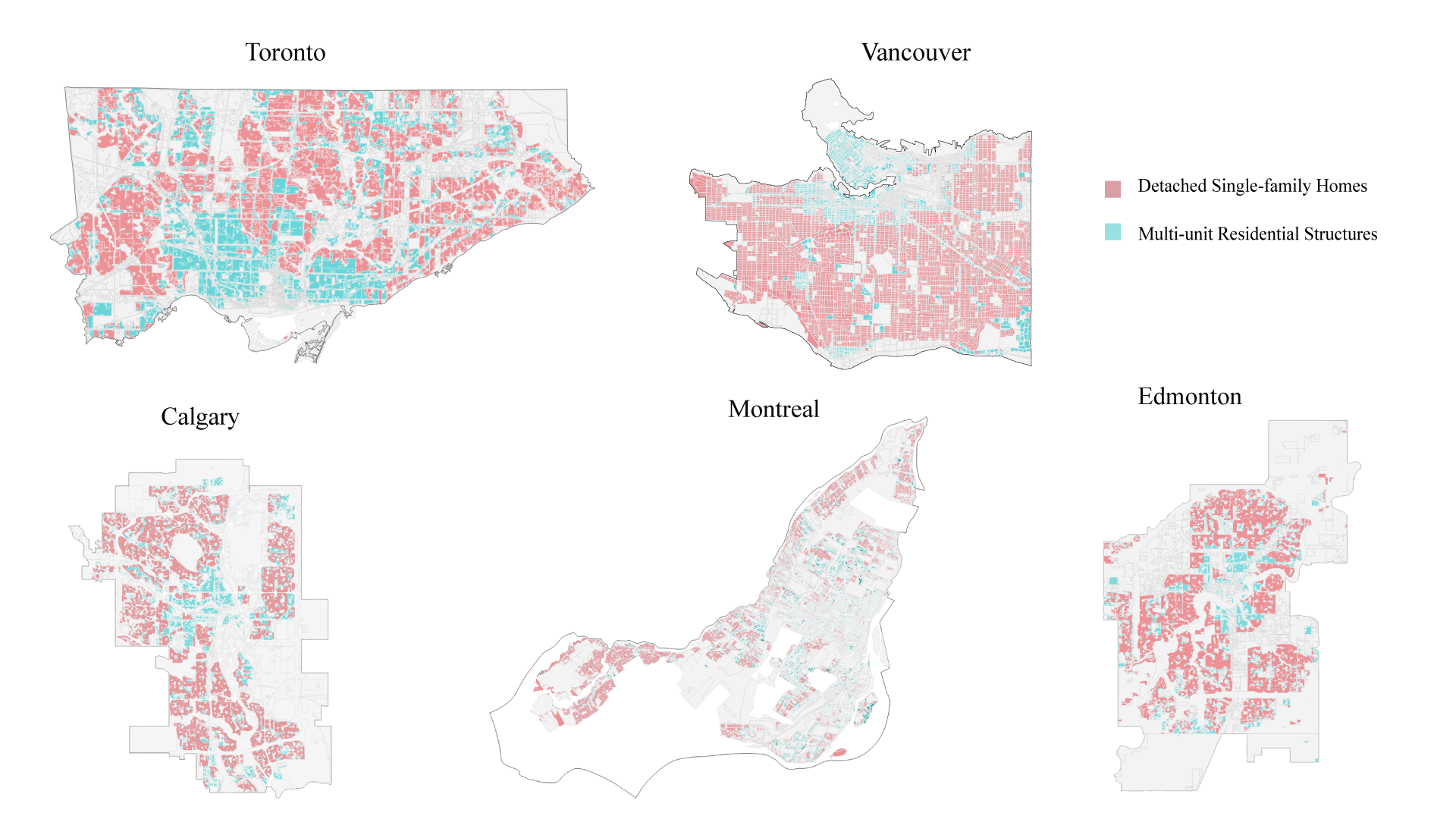
Even Vancouver isn't building anywhere near what the demand would support. If people were allowed to build more housing in Vancouver, then they would. [0]
In general, people's intuition on this stuff isn't great, for a few different reasons:
1. Status quo bias. Any change tends to look like a lot of change. This is the, "I can see three cranes from where I'm standing, so we must be in a construction boom" fallacy.
2. Illusion that concentrated change indicates widespread change. People see a lot of development in one part of town and discount that such development is prohibited in 98% of the city. (This one definitely applies to Vancouver.)
3. Failure to account for proportionality. If somebody hears that a city added 5000 units, they'll probably think that's a lot. But is it? What if we're talking about a metro area with 10 million people? It's nothing. Big numbers can end up being small numbers when the scale is large enough.
3. Failure to account for growth in demand/population. We build fewer houses than we did 100 years ago, but we also have many times as many people! So even a static supply is bad, because you have to at least build enough to keep up with growth. And since some cities have seen a sustained surge in demand for the last 2 or 3 decades without enough construction, even seemingly large amounts of recent development might mean that you're still way behind.
[0] I'm aware that Vancouver has made some progress on this. I think they're going to start allowing more duplexes and more housing near SkyTrain stops. I don't follow Vancouver that closely, so I'll just note that I'm aware it's changing.
Vancouver is a boom bust town for real estate, now it is in a boom, it will bust eventually, just like it has many times before. There is just too much speculation going on to represent stable demand.
But the San Francisco bay is quite unconstrained, with extremely low population density and massive undeveloped tracts all over. Here, only regulation and laws prevent the cities from becoming bigger.
In general, the vast majority of people live in unconstrained areas, not constrained areas. But because constrained areas are where you get the windfall wealth from housing, people in the physically unconstrained areas clamor to make themselves legally a constrained area by making it illegal for the city to grow out.
So yes, there are limits, but these are political limits, not physical or environmental limits, and they are driven by incumbent owners with dollar signs in their eyes, not concern over nature.
There's tons of space in the Vancouver metro to add density. The issue is that it's illegal.
Real Estate scaling supply to meet demand is in direct conflict with old properties increasing in value forever. You can't really have both and we're stuck a valley of bad incentives that favor existing owners.
If we let people build housing to meet demand it would fix it, but existing owners are motivated to leverage enormous amounts of equity (and local political power) to stop any new building in order to keep property scarcity high. Their explanations beyond that are all just motivated reasoning rationalizations. Hopefully stuff like RHNA will force local municipalities to act.
I can empathize somewhat with someone who spent $3M on a crappy house being afraid of being under water from increased supply, but I have no empathy for someone who bought a $300k house 30yrs ago that's now worth millions acting to obstruct new construction.
Housing prices continuously rising to slurp up any marginal income has been studied by economists for a couple of centuries (rent extraction), and taxation solutions such as a Land Value Tax were suggested by Adam Smith himself.
https://blogs.imf.org/2021/10/18/housing-prices-continue-to-...
Even in this situation where almost every development is approved, it doesn't lower prices at all. The reality is that when demand is continuously high, you can never keep up with supply. It just keeps coming.
Which is what happened to my town. A small, quiet, rural town. That was 20 years ago. Now it's packed. Every inch used. Traffic jams just to get to the center. Agricultural and nature areas transformed into concrete.
Quality of life is down whilst prices just keep rising regardless. Do these people have a right to live here? YES. Do I have a right to forever preserve my old town? NO. I'm just saying NIMBYism isn't some roadblock standing in the way of an actual solution.
That doesn't mean 'cheap' if demand is also increasing, but it does cause prices to be lower relative to cities that restrict supply. This is just basic economics, people twist themselves in knots to come up with reasons why the obvious supply/demand is somehow not applicable in this case.
If you allow building in capitalist markets then increased supply will reduces prices as demand is met.
> We have selected markets that we believe will experience strong population, household formation and employment growth and exhibit constrained levels of new home construction.
Source: https://www.sec.gov/Archives/edgar/data/1687229/000119312517...
Meanwhile the NIMBYs that are creating it blame everyone else and play victim.
Fight back: https://yimbyaction.org/2021/ - and have fun and meet cool people while doing so!
If BlackRock doesn't continue to gobble up homes at current prices & rates - then his argument falls apart.
Does anyone have evidence that BlackRock is STILL buying properties en masse?
It is... But what are you going to do about it? Especially in the US, big business owns the politicians who can do something about it. And prop 22 shows that even if the public gets to decide, big business manages to control public opinion to their benefit.
I believe this is only going to get worse for the next couple of decades. Something major would have to happen for this to change.
> This sounds like the typical "the election was fair as long as I won" trope.
How's that? It does not sound like anything but modern American politics. Not to say it's 100% true, but it's largely true on the West Coast USA for the last 40 years...as I can only speak to what I've seen. It's a legitimate surprise when grassroots efforts are not coopted with riders/judicial nullification or drowned by propaganda.
Zillow is also selling individual homes, not just this package. In their main algorithmic buying market of Phoenix they're selling individual homes, 93% of whom they payed more for than the new current listing price (and they usually do renovations before listing)
So Zillow VCs are essentially paying people to take a discount on houses in those markets. pretty sweet
[1] https://www.businessinsider.com/zillow-offers-ibuyer-sell-ph...
Same thing with Uber/Lyft/dash/movie pass. For years the general population received rich VC subsidized services. Pretty sweet
You sound bullish so I wanted to share five risks in the short term that have been on my mind lately:
1) Evictions now allowed in 43 states after a pandemic moratorium on them. My state allowed them October 3rd. Supply.
2) A China conflict at any point. Disruption.
3) Taxes going up on the wealthy. Disruption.
4) Rates going up to counter inflation. I want this one since I have cash and don't care if rates are 2% or 20%. While I do want the free loan (2%), I prefer the market to crash. Disruption.
5) Vaccine mandate job losses. Supply.
Given this, I've been extremely hesitant lately. So I've been trying to hold off until January for my purchase to see how correct I am, or not, on these risks impacting the market. I don't see the point in waiting years as rent drains about $18,000 a year and you have to balance that with home ownership costs. Even with repairs, I don't mind slightly overpaying if it means getting out of rent slavery. I'm also buying a home that I can nearly buy outright. I'm determined to never lose a home due to job loss, tired of working for someone else, so a 30-year mortgage isn't happening under any circumstance. 15-year only.
The one way I've been trying to protect myself is at least seeking a 15% discount off market rate for any home that I do purchase. I see that happening in my city enough that I'm confident. Eats into the 40% buffer from 2019, so I'm still at significant risk but does take some bite off in the event of a market catastrophe.
Any thoughts are welcome. Definitely would appreciate it. Whether the answer is: buy now, or, buy in 15 years. I'll try to integrate them into my view and choices.
As long as mortgage money is cheap, the most profitable course of action is to use the 30 year mortgage, but keep a large chunk of money in reserve and invest the rest in the market for the long term. And never allow yourself to not be well-cushioned.
Debt gets people in trouble when they use it to get things that put them on the edge, where losing a job causes them to miss a payment. For people who stay far away from the edge, and are good with money, it's very profitable.
However, for someone disciplined, taking a 30 year mortgage and paying it off like a 15 year mortgage with significant over payments is a good strategy. It means if you need to tighten your belt you can always drop down to the normal payment for a spell without so much as having to speak to the bank.
The worst option is to take the 30 year mortgage and then buy the larger house that the longer period allows you to afford.
In real terms cash is losing significant money every year while assets are gaining money. Debt makes sense as long as you have a margin of safety and can multiply the impact with leverage.
IF you believe inflation will be significant over 30 years say, and can lock in a low rate, it is better to go with a longer term.
If you think the return of your investments will >= 3% mortgage rates then you're losing money by not taking on debt (albeit with a bit of risk).
This being the utter fucking fallacy of hypothesising with the benefit of perfect information.
It's not a trick, it's simple maths. It certainly doesn't always work, and there are risks involved, so not everyone will agree on the right decision, but there is clearly a path where borrowing money to pay for a large asset makes sense.
Imagine a more extreme example:
Interest rates 0.1%, Inflation 10%, 30 year term, leverage meaning your 50k becomes say 500k invested.
Now it makes sense to take on as much debt as you can get over say 30 years, and to put off paying it as long as possible, because even after a few years the payments will be quite minor compared to your inflating income, and at the end of the 30 years the debt you have left and the interest payments on it will be trivial compared to your income.
This is the worst of both worlds. You pay the interest penalty of a 30 year, with the payment of a 15 year (well, slightly more). The interest difference between a 30 and 15 year mortgage is about 30% (2.x% v 3.x% APR).
I did a 15 year mortgage, then refinanced it every 12m or so ($250 each time), resetting the payments back to 180 months each time. That way, I get the interest savings of a 15 year, which is significant, and each refinance makes your payment quite a bit lower because a 15 year loan actually pays back principal. After six years, my mortgage will be the same as it would have been if I originally got a 30 year, but it will be paid off in 21 years instead of 30.
There's a risk interest rates rise, or I lose my job and can't refinance. But so far, so good. And honestly, my mortgage now is so close to what it would have been with an original 30 year loan that it doesn't even matter if I can never refinance. The hardest part was the first two years.
Depends on how much better the same amount of money would perform if invested in an index fund. It could be more profitable to throw the difference in monthly payments into a vanguard account instead of a higher 15yr monthly payment.
Personally my view is exactly your second point: Buy small enough that you can consistently put $x extra each month against the principle + one full extra payment each year. It's a good middle ground to maintain flexibility
And absolutely-- buying the biggest you can fit into monthly expenses may even seem responsible: "I'm not living beyond my means!" but is a razors edge of risk for unanticipated expenses or more significant life disruptions.
Purchase a house where you can afford the 15-year fixed mortgage, but take out the 30-year fixed mortgage. Pay it off as if it were the 15-year fixed (ensure that your loan has no penalties for prepayment or extra payments, and that 100% of extra payments go toward the principal).
If things go smoothly for you, you’ll pay a marginal amount of additional interest (because your % will be higher as a 30-year than a 15-year). However, if you run into cash flow issues, you have a good amount of reduction in mortgage payments that you can make while keeping the bank completely satisfied.
Obviously if a bond paying 3% would be interesting to you, pay the mortgage off first before buying the bond.
Essentially, I don't expect my overall happiness and satisfaction to be linearly correlated with my finances, and I expect that non-linearity to be such that I'd rather be more risk-averse in such a way that I have to give up some of the potential gain.
If there were a world where I could _guarantee_ the avg. stock market return, then I'd of course take that offer, but sadly such guaranteed returns only exist in the form of scams and ponzi schemes.
You're right about the compound interest, but compound interest can work for you as well.
That said, I don't think they exist in the US.
But consider a thought experiment where you could borrow $1m at a low rate of interest, suppose 3%, from a generous lender who requires no collateral and requires an amortizing repayment. You take the $1m and reserve, say, $100k in "no-touch" cash (your cushion) and invest the remainder in the market, and suppose that the market returns an average of 7% over the long run.
In this scenario, you obviously pay much more interest than not taking the loan. The interest you pay is nearly $500k, which sounds like a lot - almost half the loan! Yet you make a tidy profit over 30 years: after paying back the loan, you have a portfolio worth over $4 million, plus the $100k reserve you still have.
While that's just a thought experiment, the math works fairly similarly for a mortgage. So long as the market returns more (over the long term - it'll be bumpy short term) than the cost of money, you will be paid handsomely for assuming lots of long-term, fixed low-interest debt and investing the proceeds.
And this leads to a second surprising conclusion: you should not pay off your mortgage. Once you've built equity, releverage the house and borrow more, so long as you take the proceeds and invest it in an instrument that will pay more than the cost of money over the long run. If interest rates rise, the math might not work.
This is bad advice for some people, because a pile of savings and investments can be a tempting target to use for luxury vehicles, or boats or whatever, and that can upset the math, although eventually you make enough with it that might be OK. But for people who can live as if those investments were illiquid, it's quite a rewarding path.
And for some people, the psychological value of living in a house with no mortgage exceeds whatever financial gains come from continuing to pay for a mortgage. And while there's nothing wrong with that, it does come at a stiff financial cost.
Regardless though, as a result of working at a successful unicorn and selling a lot of my equity on the secondary market, I ended up benefitting from the Fed's insane money printing anyway (the prices offered for my equity doubled and doubled again in 24 months).
I'm now sitting on a pile of cash. I invested a small amount (about 25%) into stocks (mostly REITs and dividend yielding stocks), but the rest I left in cash with the hopes of buying a home without debt (I can always take out a mortgage later to invest).
But the homes just keep increasing in value. The homes I looked at in 2016 in the Bay Area that were 600K are now 1.5M and up. I took my family out of the Bay Area into the Sacramento area, and even here houses have gone up 30% in the last year. Houses that were 800K are now going for about 1.2M.
But I'm still being patient. Now we're looking to leave the state entirely. I could buy a home here, but I'm looking at the economics for someone who is entry level or working a blue collar job (or being a teacher or caretaker), and I realize I don't want to live here. Apart from housing, I also have to think about what kind of teachers my kids will have, what kind of chefs will be at resteraunts, etc. A California that is unaffordable for everyone but me is a lame place to live.
After checking out Texas, Colorado, and Florida, we've decided we'll get way better value for our money, in terms of lifestyle for the family if we leave. California is bad and only getting worse.
I share your holistic view, I don't want everyone around me suffering and acting tense. Its been that way in most of the country for a couple of decades now. A lot of people must really enjoy that, but I don't really see a true benefit to holding everyone down in such a way. To get a fairer society means less profits for employers so there's a lot of effort to contain those costs. My spouse is a teacher so I know what you mean, though teachers are fairly compensated where I live for sure. She makes more than I do with better benefits by a longshot. Most public school teachers in big cities are bad because the families/students are bad, and they have no authority to discipline them. Most teachers that care don't last and go teach for less money in the suburbs.
I'm in Chicago and while dangerous in 80% of the city, if you lived in the suburbs and don't mind winter, I've never known anyone that doesn't like it here. It's my favorite city in the country, it's the only city that the times I've driven out to move or visit elsewhere that I felt heartbroken. The only other place I've lived where I felt that way was France. I've lived all over and multiple countries on top of it. Crime and undesirable weather for most people keeps costs down here. I like Florida but it's such a diverse state that each area needs examined by itself. Just some thoughts.
My thoughts on buying for you are the same for me: at least wait until January. There's just too many near-term risks. My conclusion has been if things are still the exact same as today in Q1 2022, then go ahead and buy, my crystal ball is broken. That said, I'm deal hunting so if I can get anything for 15% off going rate or more, I'll probably just do it. I'm looking at homes that are in blue collar neighborhoods.
If California would allow anyone to build an apartment complex nearly anywhere (as Minneapolis does in many neighborhoods) then there would automatically be more housing, and more affordable housing for blue collar workers and entry level workers. Instead, we have so many neighborhoods where each house is forced to be on .25 acres, or .15 acre, with forced single family occupancy. Affordability is a construction, zoning, and permission problem in California.
And that high expense for housing then trickles up and makes everything more expensive from child care to healthcare to services ... as everyone has to pay workers ever more just so they can get a roof over their heads. People are making $25/hour with no college degree and feel poor.
I have found a happy (to me) medium - I invest all of it diversified across low to high risk assets (muni bonds, i bonds, tips, mREITs, dividend stocks, stablecoins, growth stocks), and at this point just the interest/dividends (NOT counting unrealized gains!) almost cover even my crazy rent (3500/month, for the house we are renting which is valued at about 1.5m). I just don't have the time or the energy for a house. Also a house doesn't MAKE anything other than provide shelter. Psychologically it doesn't make much sense to me to "invest" in a single house, tied to one area, such a large % of my networth. My friends bought houses recently, and even the "flips" turned out to be fixer/uppers. The supply is so bad right now you can really get burned.
Once the supply improves - and really this means most of the government distortions disappear, I would reconsider. By government distortions i mean specifically 0) stimulus checks 1) extra unemployment (bonus monthly $, extra time, and expanding benefits to people that would not have otherwise been covered) 2) mortgage forbearance programs 3) student loan forbearance 4) super low rates. i agree at one point these distortions were necessary when we were all hunkered down and hospitals were being overrun, but we are far from that these days.
Eventually I just simplified things. Living in a property you own gives so much more for your money compared to what one could afford at the same level renting. And on a long enough timeline crashes have had minimal impact. Many of those disruptions would affect the financial markets too so unless you’re extremely conservative leaving the money in stocks is not very safe either. I’m not renting for another 5 to 15 years with a small place and a nosey landlord jacking up rent regularly. So I bought.
This isn't true everywhere. Prop13 in California for example means that a long-time owner can rent out a property at below market and still make money since they're paying near-zero property tax. Both the renter and landlord come out ahead.
Ultimately I chose the former. Because at the end of the day, a house represents shelter to me. And roughly speaking, shelter is fungible. If the value of my shelter goes up by 50%, the value of the other shelter around me goes up 50%. If it goes down by 50%, so does the shelter around me. So buying into the market gives me a foot in the door to, roughly speaking, be able to move to similarly desirable dwellings regardless of where they are.
This is obviously a bit simplistic, but I think its a fair way to look at it.
A lot of homeowners who needed help during the start of the pandemic were able to get a forbearance on their mortgage. Thus, there was not a huge increase in foreclosures and instead people just had extra payments tacked onto the end of their mortgage.
3) If anything, wealthy homeowners are getting a tax break. Congress is considering a repeal of the SALT deduction limit, which helps homeowners.
5) The number of people who were fired or quit due to mandates has been very small.
If you're buying just to buy, then hold off.
On the inflation risks. I really wish the Democrats would cancel all their ideas about child care and what not, and just shift the tax burden from the working class that punch a clock, to the investment class that live off of IRS-defined unearned income. So much easier, simpler, doesn't engage in designing society, rewards working, helps the economy more than anything else you could do through increased spending, and would be far more popular. But that's an aside.
If you have a great mistrust of the future, then there's never going to be a good time to buy a house. If you think politicians are going to mess things up yet again, buying a house is foolish. Hanging off every word the next three or four presidents make is going to make your heart sink and your blood pressure rise on bad news, and curse the name of whomever convinced you to buy an millstone of a house to hang around your neck.
If, however, you're convinced that buying a house (for you to live in, not as part of a basically-liquid REIT) is your path to financial freedom, then when the refrigerator or other large appliance breaks, that's just part of owning a home, and you'll relish in picking the one you want.
How do you want to live for the next few years? (One thing to keep in mind is that houses can be sold before the full 15-30 years is up, which may be advantageous, depending on your finances.)
You raise really good points. Insightful, like many of the responses here. My main thought in reading is this is why I'm buying as cheap as home as I can that is functional. My strategy is just to buy the cheapest home that I'm happy with. If things go to hell, and I really don't have much to lose with the anchor around your neck that home ownership is. If the fridge breaks that's annoying, but I've been renting a long time, few to no landlords want to spend a dollar anyway. They don't lose so owning is the ticket to financial freedom, even if it's not a money maker and merely a way to get expenses down to taxes + utilities. Which is how I see it.
4 you have to ask yourself about real rates, not nominal rates. Yes you want to get paid interest, but you also have a loss on inflation. Also, you pay tax on nominal but you don't get a credit on inflation.
What you really want to think about is whether rates will get so high that people can't afford to refinance, and are thus forced to sell.
As sad as it sounds, you may want to look into that forced seller thing. When someone hits hard times, it gets even harder due to them having to sell at a loss compared to the market, which for you as a buyer is straight up money in your pocket. See about your local foreclosure markets, I think a lot of them might still be done in an old fashioned show-up-in-real-life and shout way. Depends on where you live.
Finally, it's good to list risks as you do. The big question though, is always whether the market already reflects your thoughts.
This takes a bit more patience though. They can drag on for a while as the bank & "owner" possibly reconcile or the owner fights things tooth & nail. These deals tend to fall through a bit more than traditional sales. Given patience though, you can get a good deal: Banks don't want to be in the business of actually owning houses & their carrying costs, so they generally sell at a market-clearing rate instead of waiting for the best possible offer.
How into the geopolitics of China-US relations are you? I ask because my reason that we're at high risk for a conflict and now low over Taiwan is that China just upgraded their navy, while we have a refresh going on right now. Once that investment is complete China will have essentially the window closed on any hope of winning the conflict. They have to move relatively quickly to have a realistic chance at taking over Taiwan, if US determination is resolute in stopping them at least. It could happen at any time.
1) This will impact rentals much more than home sales, and evicted renters aren't going to increase demand in the home sales market. It's also a positive factor if you're buying: Don't be in a hurry, wait 2-3 months to see how the end of the moratorium impacts supply. If supply increases, sticker price should go down-- you win.
2) This seems too vague of a threat to factor in. Neither side wants an all out trade war (though idiot meaningless wars have been waged before) If you mean military? Well, anything significant enough to trickle into the housing market may not spare you as a renter either. Outcomes in that scenario are beyond the event horizon. If you really think that's a significant enough threat to factor into home buying decisions then you should be buying a home way outside of urban circle-- one with solar power, well water & purification, and two levels of basement for all of your prepper material.
3) Easy enough: factor that possibility in to what you're willing to spend. Let's say a worst case is a 10% increase to your marginal rate. Unless you're over $400k/year that is very unlikely anyway from the (still too few) details I've seen out of congress.
4) Okay, just don't crash the market on purpose. The rest of us have to live here too
5) From areas (NYC) that have implemented these mandates, non-compliance has been very small. And I'm willing to bet that extremely few hold outs are from people who would lose their home & suffer economic ruin over a refusal. Anyway, there's a simple solution here too: wait 2-3 months to see how they shake out.
You're likely making a bad bet by holding on to cash. The inflation and low rates are doing their job for the most part by driving investment and spending, and you're swimming against the current by doing exactly what you're not supposed to be doing: hoarding cash.
> 5) Vaccine mandate job losses. Supply.
We're already back to full employment. These threats of en masse departures haven't really materialized, the few who haven't caved are just helping newer employment market entrants by offering up some nice safe jobs.
This is not universally true.
On the mandate job losses, I think a lot remains to be seen. We have the airline issue going on right now, and I think that's directly related. Not sure there's any in-person "nice safe job" honestly. This is so far from being over in regards to variants, there's just no sense in all this. The only mandate people need is a mandate on employers that any job that can be done at home, shall be done at home. Then mandating hazard pay for those that must do their jobs in-person. Those are the only mandates that make sense to me, and I would hope that by Jove, even our most brainwashed vaccine-loving brethren could get onboard with.
> Those are the only mandates that make sense to me, and I would hope that by Jove, even our most brainwashed vaccine-loving brethren could get onboard with.
I'm afraid that on a planet with 8ish billion meat-based life forms of extremely similar cellular makeup, vaccine mandates are going to be the norm going forward. Covid won't be the last pandemic, and vaccines are the best defense we have against them. It's not brainwashing to accept vaccination as a countermeasure, it's very clear-eyed realism.
I'm uninterested in the flu "vaccine" and the COVID "vaccine". With their narrow band of immunity, that wanes after 6 months requiring yet-more longterm untested vaccine shots. I am interested in the polio vaccine, or any COVID vaccine that's sterilizing.
I don't really want exposure to the real estate market. I put every tax-advantaged dollar that I can into index funds. I hate it, but I don't have a better option as a retirement vehicle. I figure if the stock market is down in 2040 from today's market, we have a lot bigger problems going on in the world than just my retirement. Should have invested in Glocks, Brownings, and ammo. Which I am, but not for that purpose, but rather home defense. When I finally own a home that is.
Covid and flu vaccines save lives in vast numbers, perfect or not, but the capacity to have a sense of responsibility beyond your own life isn't equally distributed in our society so I do see and understand your point of view here.
Still, this is very confusing reasoning. Like refusing to use the seatbelt in your car because the car doesn't have side impact airbags.
They have enough experience, data, and skill to time the market cycle. Companies like Zillow do not.
One seems like an entrenched data-hoarder. The other seems like a "we're smart enough to pivot into this" group.
However, to me it makes sense that theres some softness in what Zillow tried to do because rates are likely to rise in the next year or so and most people know that. Thats going to put pressure on lending which effects housing demand. Their AI might be top notch but they probably just timed the whole market poorly.
To be sure, none of us will be buying one of their distressed properties though.
This isn't really true. They are paying above market rates and have been for the past 18 months or so.
They genuinely believe that these assets will appreciate in the coming years.
  * New construction isn't going up fast enough, so the housing supply will decrease and
  * the number of people that want to buy a home increases as long as the total population of an area increase. Bundle that with
  * fewer people getting married, and you need more houses per person than before, and that further reduces the housing supply; AND, further that with the reality that
  * houses are seen as an investment vehicle, so anything that reduces the value of a house rather than increases it causes people to recoil back because that's literally their retirement in there (see Australia's housing situation, for example)
It's a very, very good bet as long as major things don't change.
It's going to hurt home owners, too - when the valuation of the house goes up, so do the taxes. It won't be long before the tax burden is so high, the only option homeowners will have is to sell (and then pay even more taxes on the gains on the house sale) and rent it back from Blackrock.
Maybe if there wasn't the NA obsession with "home ownership" none of this would matter. Part of what is driving home prices are people with FOMO paying any price. Why?
Lastly, it's hard to overstate to a non-American how much owning a home is seen as a central part of American identity. It's almost like part of "growing up" in a way. I say this in a tone of trying to explain haha, please don't perceive this as being pedantic.
More likely, people flush with cash see inflation eroding it, think the stock market is already too high.
In a world where the likes of blackrock are up to their eyeballs in bad Chinese real estate deals already that seems unlikely.
That said, I'm not arguing for this specific rental model, either.
https://www.visualcapitalist.com/america-land-use/
If it became problematic that people didn't own homes, but wanted to, they could easily just open land for building.
They may own all the land around cities and all the corporations move there. There by making "corporate cities", but at the end of the day, people can create their own thing like they did in the past.
An MLS is nothing but an local organization. There are zero laws requiring a property to be posted on an MLS. I know of zero states with any regulations like what you propose. There's also confusion around the term "Realtor" because "Realtor" isn't actually a thing. It's a brand, a "real estate agent" on the other hand is an actual job.
The real estate industry is *truly* and exceptionally fucked up. The confusion around MLS, "Realtor," and probably loads of other things I'm forgetting are intentional.
There are similar private requirements for the cartel known as NAR. What this means in practice is that pocket listings actually make to to the MLS for one day before apparently being sold "in 1 day".
Zillow as property owner is not part of NAR. Zillow as broker is also not part of NAR, although if they were, they'd do exactly as individuals using pocket listings do. Arrange a sale privately with an institution, place the listing on MLS, then sell it "on the open market" in 1 day.
Today they essentially function as data brokers and unofficial labor organizers, collecting membership dues from agents in exchange for ensuring that the agent's name is on their listing wherever it's shown online and (along with NAR) pushing agents to keep "standard" commissions on their listings (5-6%).
How do you know without getting bids from the open market ?
You can see the transaction history here:
https://www.zillow.com/homedetails/125-Mays-Blf-Fayetteville...
Add in whatever fees go along with the sale, and they're out a fair bit more than that.
Opendoor still holds it, Zillow is already marking down a similar one by 14%.
If you were hoping this was a sign of the real estate market falling and perhaps its your chance to get a bargain, think again.
> The company is seeking roughly $2.8 billion for the houses, which are being pitched to institutional investors, according to people familiar with the matter.
Institutional investors (Blackstone, Blackrock, Colony, et al) will be being in bulk, in cash, and at a steep discount before they even hit the market. Zillow's loss will be the institutional investor's gain. Of course, they will happily rent to you since that is the the plan all along - own all the assets, and every generation after X gets to rent [1].
I wish this would anger people more, but enough home owners will benefit from this dynamic - it will likely keep home prices elevated for longer, and set up an ugly conflict between those who do not have (and aspire to have) homes and those who currently own homes.
[1] https://www.ocregister.com/2021/09/30/in-a-hot-market-compan...