It's amazing because they do finish a lot faster than in western countries, but you can definitely remove 20% of the people in street-level construction and would see little difference. An example: they hire 2 people on every sidewalk just to tell people to continue walking the way they are walking and make sure they don't fall into a pit while looking at their phones[1].
From what I've learned, this specific job is normally filled by people who have already retired but don't have enough to live, so they are paid peanuts (I believe they might also be paid a bit extra by gvmt to go back to work, but I'm not sure I understood this point properly). They have started to be replaced by "robots" though [2].
Edit: in general everything in Japan seems overstaffed compared to the western counterparts, not just road construction. I believe this is how they can maintain very low levels of unemployment here, but I don't yet know how the incentives work to make it possible.
[1] The guys with the blue shirt, notice one on each side https://c8.alamy.com/comp/HBJ2K1/japanese-people-in-construc...
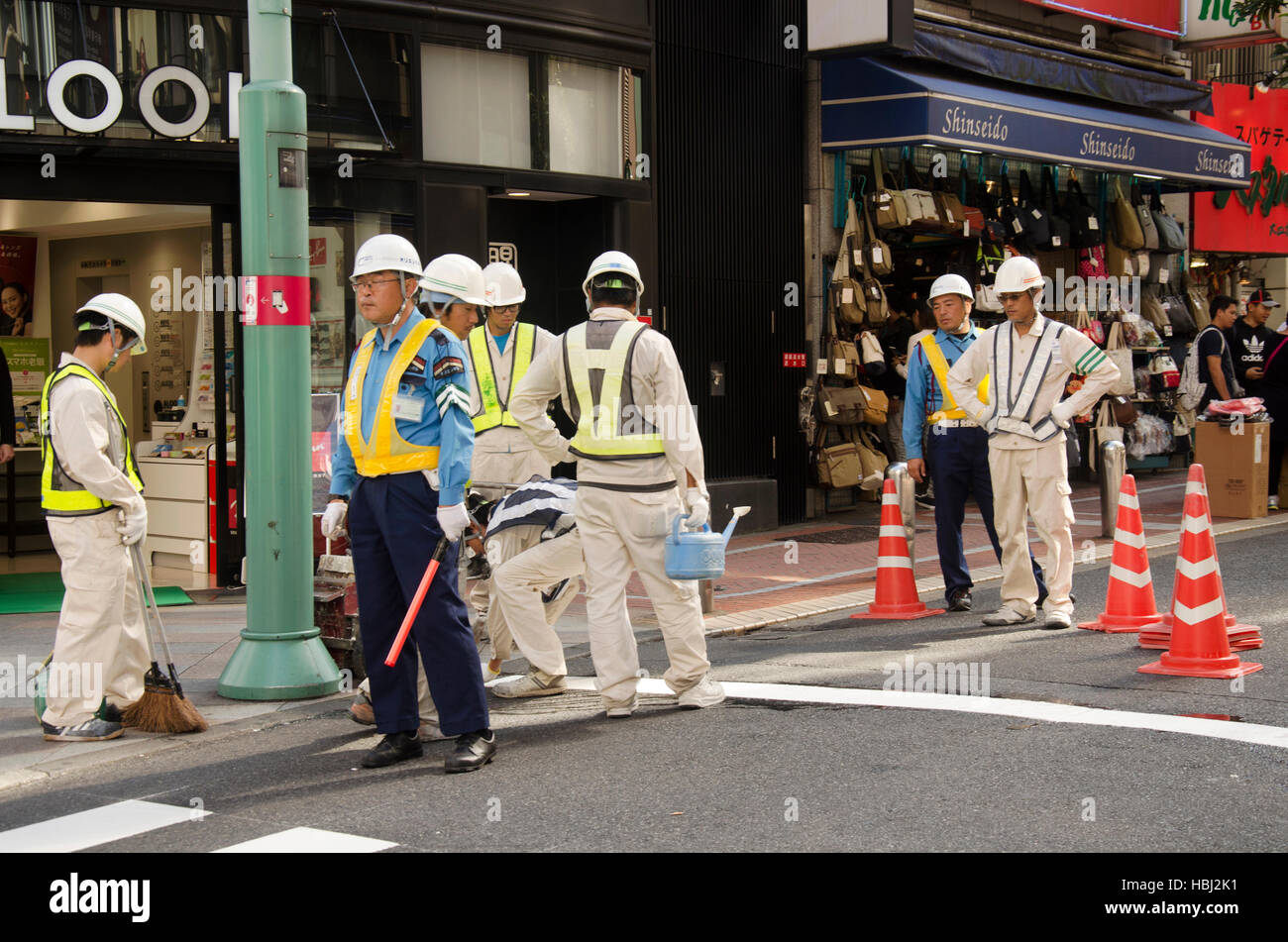
[2] https://japangasm.files.wordpress.com/2010/07/rwintro-swing0...

Of course, with Japan being the land of just-in-time, one could argue that spare capacity is bad -- but that's an oversimplification. Necessary spare capacity is good. What's bad is not being able to address the reasons the spare capacity is needed. Maybe when it comes to humans doing road work there's no way around the need for spare capacity?
There's lots of examples of that, people doing things that you would see brutally optimized out of western city and those cities I feel are worse off for that optimization.
One way to look at it is that with their wealth they've decided to employ more people and do more good, versus pocketing the profit and calling it efficiency.
The famous railway networks in Japan are actually privatized rail companies which was very surprising to me. When the rail companies privatized in my country they immediately became worse, as they were suddenly serving a very different purpose. Staff were let go, the trains are cleaned less often, services were cut. That kind of thing.
It references other patents (prior and subsequent).
How would liability play out for the construction company in a Japanese court? It's already a low margin competitive industry so passing risk management costs onto customers (the cost of the people monitoring the holes) is likely more practical than risking all profits evaporating and years of litigation, especially if insurance has anything to say about it.
In Australia we certainly don't have those people, construction companies just use a few signs, some cones and barricades and that's all that is required to be compliant. If someone falls in the hole they shouldn't have walked past the cones!
Not the case in Victoria. Pretty normal to see a couple of workers standing near the site entrance making sure pedestrians don't get run over by a truck. Or standing in front of a closed footpath, directing pedestrians to cross the road.
There's pretty strict rules around keeping the public out of construction sites and excavations. Putting a couple of cones around a hole is definitely not all that's required.
There's absolutely a limit where adding another person only adds marginal safety. For instance, children who don't know they should not jump to jump a barrier and then go into a pothole should not be allowed alone on the streets. We are not talking about a random hole in the street, these things are already heavily warded in Japan with barriers and signs AND on top of it there's also workers AND on top of it the mentioned security guards. My argument is, many or all of these security guards are not needed.
Here is the thing: there are adults who know all this and they fell into a potholes by accident, or momentary negligence
The privitization is split into different companies, the best having had a 30 year contract to revitilise their line, and they've done wonders with it, while one of the worst was (pre covid) run to the exact orders of the government
You mean vs allowing those people to spend their time on something that might instead be more productive for society?
If that person is going to spend an hour doing something, is that truly the greatest contribution they can make? Maybe it is! Then again, maybe not.
They don't even have to be deceptive about it. Just in time is obviously about not having undue spare capacity, not about not having any spare capacity at all. But Toyota knows this nuance is going to be lost on buzzword-loving PHBs and greedy management consultant firms. You see the same thing happening with corporate Agile.
I have no idea of whether this is true at all, but I really like the story anyway.
----
What I do know is true is that modern day Toyota doesn't mind sharing the solutions they have come up with to various problems, because they think the real value is in the people and processes to (a) identify the problems in the first place, and (b) come up with solutions suited to those specific problems.
Blindly applying Toyota's solutions to Toyota's problems to your organisation, just hoping that you have the same problems as Toyota and that their solutions will work also for you is a recipe for confusion, and not what matters. (Yet virtually every "development methodology" is a specific solution to a specific problem blindly applied to an organisation.)
The competitor probably could have purchased a sewing machine and replicated the engineering drawings themselves. Teardowns of competitor products is common today, and I'm sure it was back then as well.
I think Toyota's "helpful" attitude comes from the Western paranoia in the 70-90s that Japan was going to completely dominate worldwide manufacturing. After all, their rise was fast: in the mid 60s, Japanese manufactures were practically begging to sell rudimentary formed metal components in the USA, but by the early 80s, they were a leader in the high-tech manufacturing. That rise caught many people off guard and I've heard it said that the "lost decade" in Japan was the result of American trade policy specifically designed to curtail Japan's growth in manufacturing.
Viewed in that light, it makes sense that Japanese companies would appear "helpful" to American ones. Why else would Toyota co-build a plant with GM in order to teach GM their Kaizen philosophy for manufacturing?
Edit: found the video: https://www.youtube.com/watch?v=b1JlYZQG3lI&t=804s
At 13 min. 24 seconds:
> Just in time is such a simple principle, but the pursuit of the elimination of waste is now the central mission of any major manufacturer.
> However, most did it wrong. Manufacturers globally saw the headline “elimination of inventory leads to massive efficiency gains” and jumped on that without actually determining what made it work for Toyota.
> They ignored that Japan's small physical size made for short domestic supply chains, less vulnerable to things going wrong.
> They ignored the company's production leveling: finding the average daily demand and producing that regardless of short-term changes and demands.
> They ignored the fact that eliminating excess inventory is different from eliminating all inventory.
> They ignored the principle of growing strong teams of cross-functional workers predicated on respecting people.
> They ignored the culture of stopping and fixing problems to get things right the first time.
> They ignored huge swaths of the Toyota Way and created a system that’s less effective and less resilient but can impress shareholders through short-term savings.
> How Toyota has effectively implemented this system fills books but many are just reading the covers.
> Even Toyota though is not perfect.
> In 2011 japan was rocked by a 9.0 magnitude earthquake the fourth strongest ever recorded anywhere. Not only did this cause immense destruction to life and property but it also led Toyota to recognize a flaw in its own system.
> As japan recovered some supply chains were quick to as well. For example, securing plastic resin for door panel production is not difficult: there are plenty of manufacturers globally creating easily substitutable alternatives.
> That’s not the case with, say, semiconductors: the hugely expensive facilities that create these chips require years to construct and after the 2011 earthquake it took many months to mend them back to operating status.
> This surfaced a truth that had never been fully considered: not all supply chains are made equal. Plastic resin can handle supply chain disruption, semiconductors cannot. Therefore Toyota made changes: all along, their mission was not to eliminate inventory full stop; it was to eliminate excess inventory.
> Supply chain disruption is inevitable. It's inevitable in the same way that Titanic's flawed design would eventually encounter an iceberg, or the structural economic vulnerabilities of 2008 would eventually collide with a market panic. Therefore semiconductor inventory is not excess because inevitably, due to the inevitability of disruption, excess semiconductor inventory will eventually become necessary.
> Recognizing this, Toyota in recent years has started to build up a stockpile of two to six months worth of chips and that's why the company is the only major vehicle manufacturer that is unfazed by the semiconductor shortage.
> Toyota followed its own principles. It did not stray from them, and it did not reinvent them. It’s no surprise that Toyota excels at implementing its own system, but it is a surprise that the entire manufacturing world has so wholeheartedly embraced flawed implementation of the system.
> Just IN tiime, is such a SIMple principlee, but the purSUIT of the ELIMination of waste...
Tab closed, thanks for the transcript.
That's what manufacturers had done ever since Ford tried to scale up his initial (very Toyota-esque) operation, and scaled it incorrectly but managed to inspire hordes of other manufacturers to repeat his mistakes.
The novelty of Toyota et al. was not that they asked the what if question, but that they answered it unconventionally: they worked on making the supply chains more reliable instead of adding buffers.
That's what makes this next move counter-intuitive to so many people: when Toyota encountered a supply chain that couldn't be made more reliable, they chose the previously-conventional response, apparently in defiance of their whole thing. Except it wasn't.
You're right in that it is simple, but in trying to show that you're making it too simple.
Just stockpiling is not really an answer as much as it's trying to just do the least amount of problem solving and thinking.
Naively it looks like it's cheapest to get close to 100% utilisation by removing all slack from the system.
If you do that though you can't deal with shocks to the system and it costs you much more in the medium term. In the long term your company dies.
This is very well illustrated by John Sterman's Beer game[1]. That's aimed at supply chains in general but works well in any system you can make brittle via cost over optimisation.
This happens a lot because initially over optimisation makes accountants and managers look good to share holders. By the time the chickens have come home to roost they've moved on to another job.
1. https://www.isixsigma.com/training/training-materials-aids/t...
Also about making spare capacity undue. The lazy solution to unreliable delivery is inventory. The efficient solution is working with the supplier to make delivery more reliable.
I spent some time in Belgium a few years ago and was amazed to see that the two people on road projects who turn the "slow/stop" signs to control traffic on single-lanes were replaced with robots. So the EU has managed to figure out how to go under skeleton at least.
Meanwhile, when I was in Japan, there were indeed lots of seemingly "useless" people doing "useless" jobs on similar sized projects.
The minute we got off the plane in Tokyo we were met by a greeter pointing people to the escalator. Not that you could miss it, that was the only exit.
In the city you could see people guarding potholes. Bus stations (not particularly busy) would have a couple men at each station that would help arrange the passenger luggage: something usually helped by the driver in the West.
Once we took a night stroll in the city, meeting a roadwork on a deserted street. There were 3 men along the fenced dig basically showing us to walk around it.
Can't see any of that sustainable if you pay people full wages.
Those jobs hardly add any value to society (let alone economy). If you just hand out money instead, some people might find something more useful to do, or at least be better off for themselves. See also David Graeber's essay "On the Phenomenon of Bullshit Jobs".
We provide a jobs program for white-collar folks through our excessively-large and exceptionally expensive healthcare system. We pay for whole categories of jobs that don't need to exist and are only adding costs. A double-digit percentage of our healthcare costs are a white-collar jobs program paying people to do nothing useful whatsoever, and we spend a lot on healthcare so even 10% makes it a fairly big program.
https://d-pt.ppstatic.pl/k/r/1/6c/83/5b7d5e3b2b9de_p.jpg?153...

Anyhow my point is it has little to do with system redundancy.
It's not important that all jobs are high value, it is important that we as a society have a way to create and recognize purpose for individuals to support their mental and personal wellbeing. While welfare / UBI may ensure they have basic needs met to sustain life, it does nothing to support their mental and personal wellbeing, which is why these systems often results in the creation of delinquent behaviors that are mostly absent in a system like that in Japan.
It may be the the same economically, but socially it is much better to have someone doing an "unnecessary" job that is recognize as valued by society vs simply collecting a check.
You say they're standing there in place of a traffic cone, Japanese society instead says that they're there to provide a friendly face ensuring safety of passersby around the dangers of construction work. A traffic cone cannot assist someone who has trouble walking to traverse rough ground because of the work being done. A traffic cone doesn't smile or acknowledge your presence.
That sociocultural element is what has value, and as long as it has value, the job is valuable.
That's why I believe these market forces push to at-capacity, because if someone has spare capacity or a lot of profit another company is going to come in at a lower margin and win the market. Yes this leads to breaking at some situations that happen once every 20 years, but otherwise you die from competition so that's what we are stuck with.
You would. But the guy doing the hiring is just giving the job to his drinking buddy, sure that the favor will come back in some way or the other.
There’s also the social factor to consider. These extra people could be superfluous, but if they’re not there everyone walking past will condemn that construction site as being unsafe.
Why do I phrase it this way? Because the only market mechanism is a sale, you either buy or you don't. Low price is visible before a sale, so a new sale is reward for the low price offered. Quality and timeliness are only apparent after a sale, so can only be punished retroactively by not buying again.
The punishment signal is also far weaker than the reward signal, lots of goods are not bought too often and problems get forgotten by customers, alternatives may have their own problems, etc. And prices can be compared objectively for standardized goods, and at least easily for other goods. Quality and timeliness are often in the eye of the beholder, subject to variation. Comparisons in those areas are also systematically prevented by most vendors.
That's not always true. When a rail network gets privatized, the argument is that the market will make sure it's a good service still. But they are usually paid by the government, not the patrons. The commuters vote becomes negligible, and the rail network has every incentive to optimize for a minimum viable network that meets their government set targets while the service gets worse and worse in all other metrics. Seats are shittier, service is less clean, graffiti stacks up, railstock gets rickety etc.
Mid and long term cost actually turned out a lot higher than if they had chosen the better slightly more expensive bids.
Some Italian construction company underbid, and slightly later went bankrupt after finishing some of the work. They just about missed the contract milestones for payment too, and got nothing out of it. Then, the contract went to someone else who bid, with expected costs adjusted. Think there was an 8-ish month delay.
1. Submit a low bid for EXACTLY what's written in the RFP
2. Submit contract delay notifications with contract amendment offers, explaining that the original bid was incorrect and therefore if the amendment is not accepted the project can't continue.
3. rinse and repeat
No. 2 is basically legal speak to make sure you get paid(or win a lawsuit in the event that you don't) even though you can't continue construction.
It's basically saying, you made a mistake in your original RFP, therefore nobody could have continued the construction anyway and therefore you have to accept my amendment.
Good bidders will actually tell you that your RFP was wrong. As an example in the construction project I was in the main architect requested custom spliced decades outdated Fiber wiring, when I finally got a hold of the wiring company and asked them why didn't just do MTP, they mentioned that a) they mentioned to the architect that the request wiring makes no sense and b) they were not allowed to talk to us(the engineering department) directly. Same happened with the fire protection rules from anything like stair handles to the garage.
That's also why I don't think the Airport delays in Berlin were engineering mistakes but rather gross mismanagement.
Also, while in this whole project there is a lot of physical work that you can't optimize away, a lot of the physical work delays and do-overs were also due to gross mismanagement, which is something the toplevel comment completely ignores in his assessment of the 4 day workweek.
But yes any description of economics is necessarily a simplification. For example market segments where people intentionally pay more for the exclusivity that comes with being charged more.
Construction isn't like that. Companies aren't cranking out a million buildings a day, so they can't remove every ounce of unnecessary materials; they don't control the environment, making delays a fact of life; they don't control all of the companies and people involved; etc. There's just so much unknown when it comes to construction. Like software, it can be difficult to figure out how much padding to put into estimates. It's a good bit easier when it comes to things like roads, but companies still need to contend with unexpected delays a lot.
Maybe the 20% extra people is the reason they always finish a lot faster.
To circumvent strict donation laws, the idea is that these people will be "lended" as administrative staff and door-knockers during elections, in exchange of juicy contracts.
And let's be real, that linked in [2] does not point to a job that requires automation, a blinking panel is enough. Often I have seen the sad spectacle of one mannequin handling a signal on the end and a human on the other end. It is totally a bullshit job.
And it's also probably not for wanting just 1 staff -- it's probably because no one want to work at those place.
If you look around there's plenty of such a "pointless" jobs. The same with people steering the traffic at the parking lot entrances/exits at any bigger entertainment or shopping center. Sometimes with almost no pedestrians around and yet those people are standing there in sun or rain alike. Or people who's only job is to smile and open doors for you, less common, but happens as well.
To be honest, though, as a "consumer" of such jobs (pedestrian in this case) I do feel they took an extra mile to make it as safe and comfortable for me as possible. And I do feel better about it.
It may look pointless at the surface, but I think those jobs are extremely important for society at large.
Maybe, but if you've worked in Japan, or even just living here, you know about the long, pointless meetings, desk warming and busy work. Thus, it's highly possible the government is saying "let's get rid of pointless meetings and busy work". Things are that top-down here that often companies won't do anything unless the government has said something (and it's likely that it was the big companies that control the politicians that told them to say it).
There are plenty of examples of this kind of thing, one is when the government had to do the same to force companies to let/get employees to use their holiday entitlements. Western principles such as truth, innocence and self-reliance aren't foundational here - the moment you accept that you understand so much more about the culture, in much the same way you won't understand Buddhism if you use a mental model constructed out of your understanding of Christianity.
... nor in the West, to be fair. Lies and cheats are commonplace in any Western workplace.
I think you are over-generalizing. Self-reliance is big in Japan too, even while egoism is not - it's drilled into people basically from birth, with things like students cleaning their own schools. Innocence is always politely expected until openly questioned, at which point it turns almost automatically into guilt; but it doesn't mean it's not "foundational" - in fact, it's much more entrenched, it's just that the act of questioning it carries so much more weight on all sides (an unfair accusation, if determined, would be extremely shameful) that nobody wants to go there until absolutely necessary.
They just play the game with a slightly different set of practical rules.
Then what is?
Examples from my own employment experience:
- front desk clerk at a hotel
- fuel pump operator
Both of these are pretty dull work that doesn’t exhaust you at all at the 40 hour work week. Most of the time is spent idle and the time spent working doesn’t require much going on upstairs.
Front desk work could be done away with mostly by electronic systems (most of the time when I "check in" it's just picking up a ready made room card as I checked in online). You could even centralise the "talking to a human" part in a call center operating a number of hotels, who delegate to staff on the premises (house keeping, maintenance, room service, etc). Of course luxury hotels will still have humans.
Fuel pump operator hasn't been a job in most Western countries for decades, as you just pump fuel yourself (and often even pay at the pump). Is "EV charger operator" a job?
Where are you from? I thought fuel stations in most Western countries were fully automated already. In Sweden there are loads with no people at all but even the ones with a store you just pay at the pump. You only go inside if you need to buy something else.
Very strange example to use and kind of invalidates your whole point.
[0] https://www.mentalfloss.com/article/74549/why-cant-you-pump-...
No need to get out of your car and deal with a dirty pump. You can also get out to go in the store while they fill your tank, or some smaller places you can buy stuff right from the attendant. Gas doesn't cost any extra because of it either. We used to have some of the cheapest gas in the country before a recent tax hike. Basically a free service, no tipping either.
One downside is that if it is busy you might have to wait, but the guys are usually pretty quick.
The cost can come from the margin for the gas station, not the consumer
A neural network trained to classify spray-painting kids?
Obviously that's not an absolute statement, especially considering that armed robbery is a thing. But in general humans are better crime deterrents than security cameras or robots.
In a lot of cases, that's the sole reason for employing security guards, since the only thing they're actually allowed to do when they encounter crimes in progress is ring the police.
It seems to me that the question to be answered is: how can we afford to not have full employment?
Full employment means lots of good things: a population that's richer per-capita and spends more, less expenses on welfare, less poverty, less crime, less billionaires, etc.
Nope. See Oregon and NJ, unless you don’t these American states to be part of these “Western countries”.
In general, don’t respond to examples of jobs that actually exist now with a hypothetical world where they don’t exist to state something about the current world.
> Nope. See Oregon and NJ, unless you don’t these American states to be part of these “Western countries”.
Two states out of fifty. Maybe, in general, don’t respond to examples of jobs that hardly exist any more with a tiny and dwindling part of the world where they’re still just barely hanging on and pretend that has any relevance to the world economy.
(As for the US as a “Western country”... Well, sure, at least geographically.)
Its not clear if the change back to "normal" week was entirely rational - there were other suggestions to make the cited target of 80M NOK/year savings.
While someone working a reduced schedule in an office where other people are working a full schedule may be able to set a schedule that misses some of the things they consider nonproductive (and may actually be more productive/hour for doing so), I don’t think that actually is likely to scale to the whole office switching schedules. If the people in authority that think that the meetings you feel are nonproductive are essential are still in the same positions of authority, they’ll still have the same meetings at least the same share of working hours, though there is a substantial risk that some of them will instead take the same number of hours per calendar week, regardless of the reduction in working hours.
1: “The Rise and Fall of American Growth”
If the majority of the economy follows a linear production curve in hours worked, then this opens many jobs. Not a bad deal for a mature economy like JP, but will be interesting to see what un-forseen dynamics emerge.
That's really going to depend on the business. Plenty of businesses-- specifically ones with a lot of customer-facing staff-- would not be able to sustain labor cost increases up to 20%.
To take an easy example where I already know the #'s in the US, labor costs at a fast-food restaurant are around 25% of costs. Net profit margins range from 5% up to around 20%, but that top end is for McDonalds, the rest are on that lower end.
Increasing labor costs by 20% means a 5% increase in absolute operating costs. Sure, McDonalds may still run at 15%, but other places that increase for many others would erase profitability.
Even with a McDonalds, those franchises don't go for less than $1million each, often a lot more, and 20% profit on them seems to be about $150,000/year. So an owner is already looking at 7+ years to recoup their investment, and that's before accounting for any additional capex costs McDonalds may require when they roll out mandatory renovations.
Certainly there are many more businesses than fast food, so the above equation won't hold for every thing. But any low margin business with moderate customer-facing labor costs won't be able to manage this without raising prices, and then we're just shifting the money around to different piles. In fact as a result of those increased prices, the lower paid workers, while they may be able to work less hours and may work for a business that didn't cut their pay, they're still paying the price for that decision in their overall increase in cost of living.
Then there's the fact that raising prices will still lose fast food places customers: For every person not buying it because it doesn't fit their budget, there's someone who just barely fits it into their budget that will stop buying it when prices rise.
This isn't theoretical: Companies analyze the price elasticity of their customers and understand roughly how raising prices X% will lose them Y% customers, and the amount of revenue Y customers represent, and whether that is higher or lower than the revenue generated by X. I don't work in the food industry or retail, but I have run that analysis myself in my own field.
I'm all for a living wage, but simply paying low paid workers more & raising prices to cover it is by no means a complete solution. Raising minimum wages is a bandaid solution. (And I'm not saying we shouldn't do that-- only that it's short term, and we need more comprehensive answers)
The reductive "race to the bottom" can go both directions
If you're getting into the everyone-deserves-a-living-wage side of things, that's a different conversation, one I tend to agree with, but is much more complex than the current discussion about whether current business could manage this if they operate with low margins and moderate customer-facing labor costs.
I'm sure the economics of paying for work on plantations also did not add up.
I think these are useful conversations to have, but this is not a problem that submits to easy one-size-fits-all solutions. I'm all for a living wage, but simply raising minimum wages without doing anything else is a short term solution that will bring things back to roughly where they are now over a period of time as prices for people with newly increased hourly pay rise to the point where it is, once again, no longer a living wage. Sure, go ahead and do that anyway, but only if you have other plans in the works to stop that cycle.
As a side not, emotional appeals to slavery do not help promote a reasonable conversation either. Having to work two jobs to make ends meet is a far cry from slavery. We don't need to look far in the world to find people living in conditions that are actually identical to or not far different from actual slavery. A person in the US working a low paying job 60 hours a week that can barely pay there rent or afford unexpected expenses is nowhere close to those conditions, especially when "barely getting by" in the US still mostly includes the bare bones amenities of living in a modern western country that are significantly better than conditions in many developing nations. Comparisons of this sort simply inflame tensions instead of conversation.
The amount of low-effort populistic comments on HN starts to be worrying.
Surely you appreciate how that’s a problem?
Demand is probably slightly elastic, but not that much (there are plenty of restaurants in France, despite very high cost of employment)
As for demand, it is always elastic. A lot of people eat fast food, and a lot of those people are going to be in a position where they're just barely fitting it into they're budget. Raise prices, and they're gone. That's not even getting to the actual elastic part where people actually have the money to decide either way if they're willing to pay at one price but not another-- that bottom group is simply gone.
Also you shouldn't focus just on the one example I chose. I happened to choose a discretionary spending activity because I knew fast food #'s off the top of my head, but the same thing applies to every single business with low margins and moderate labor costs. Even if you were right and every single one of them could raise prices without losing customers, that would also mean that the exact people we're trying to pay a living wage then have significant increases in their cost of living as everything around them raises prices.
[1] France may also not be the best example to compare to the US. Despite staggeringly astronomical wealth inequality in the US, it still has a lower poverty rate than France. Canada would probably be a better example. https://en.wikipedia.org/wiki/List_of_countries_by_percentag...
And the French definition of poverty is equally useless, it’s just a percentage of the median income
It depends.
In China, the tech companies are testing AI telephone support. My banks uses it, JD.com uses it, China UNICOM use it. If you dial to those companies, an AI will take the call and guide you through the process, no human interaction needed. Not only that, some AI will even call you to schedule appointments etc.
Another example is the supermarkets. Almost all supermarket in our city has deployed self-checkout stations, and some of them even laid off almost all but 1 or 2 of their checkout workers.
I assume this trend will eventually expand to other labor types, so the workload of those workers will be lighten as result. (But of course, we can keep the load the same, but laid off unnecessary people instead, which is more likely if the government don't intervene)
And really, people need to be wary with automation. What people don't realize is that relying on it utterly paralyzes you when it goes down, because its a higher order fault than most staff need to handle.
If the AI telephone support breaks during an update, you've just sidelined your entire operation. If you only have a few checkout employees, and your POS service needs to connect to the internet, and it goes down, you have virtually no one to reply to it.
By reducing headcount you really run the risk of what were tolerant faults becoming critical. My own job has been running on a skeleton crew, and thank god one of us hasn't become sick or left yet. Eventually relying on automation and minimum staffing may bite you hard. A lot of retail stores would be up the creek if the store manager up and quit or was sick for multiple weeks.
For example, a road worker can now focus on fixing the part of the road which is more likely to be damaged, while the rest of the road is serviced by machines automatically. 4 hours later, the worker finished fixing the critical/difficult part of the road, then he/she go home to enjoy their life, the machine takes the rest of the routine to finish it off.
But of course, more likely, we will go down the "Bad route". Workers will be fired, just like those in the supermarkets. And if machine fails, people will be re-routed to a "backup" -- a human or another machine, to be queued up for a even slower handling process. Few hours later, the machine is fixed, and the event is marked as one-time incident -- stability still above 99%, everything stay the same, except more workers will be fired due to redundant stability.
Retail and factory work already has low wages and high turnover, forcing them to try and make up a 20% loss in staffing hours is probably not going to happen over just cutting operating hours and shifting to models designed to work with less staff; retail stores for example may just be open 20% less or be constantly understaffed and understocked.
Or eventually a lot of them just close and the bigger ones absorb the surplus workers to keep full hours.
I've worked a factory job and have seen it there, I work in white collar now and it's the same.
If you say 40 hours you'll only get around 30 because workers have to bounce between working and getting down a little or else they burn out.
Indeed, but going to 4 day weeks will require employers to hire more people then to fulfill the same work.
It's absurd that even with all the gains in productivity we're still stuck since decades at the 5x8=40 week. Time to redistribute the producitvity profits towards the workers.
> The government included the promotion of an optional four-day workweek in its annual economic policy guideline finalized Friday
But even if it wasn’t optional, the idea of mandatory labor laws is hardly groundbreaking anyway. The US has many regulations regarding working hours.
In tech it's very likely someone going from 5 days to 4 days could still achieve the same amount of actual work. As other commenters have said, many tech workers don't do productive work all the time they're present. Retail workers, factory workers, people who fill in the holes in roads, telephone support people, etc aren't contending with pointless meetings and busy work though. They can't do 40 hours of work in 32 hours by removing some of the hours they're not really working. What they do doesn't compress like that.
Consequently looking at this from the context of tech workers is far less interesting. The Japanese government isn't saying "Let's get rid of pointless meetings and busy work!" In tech removing the pointless nonsense isn't actually reducing the amount of real work people do. Instead, Japan is saying "Our country is wealthy enough and advanced enough that our people can actually do less work." That's fascinating.
If you see this as "removing the wasteful time spent on things that aren't useful like meetinga" then you've missed the point. It is that, but it's much, much more than that too.