I assume our political leaders made a decision with the following inputs:
0. As someone with a degree in classics, I don't have an intuitive understanding of how fast exponential growth can get out of control.
1. The death rate dropped from 9500/week in mid-April to 300/week in mid-July. And stayed below 300/week until the end of September.
2. Our scientific/medical advisors say we should keep things locked down - but it's their job to be cautious, they're medical advisors not economic advisors. I have to weigh up their advice against other interests.
3. Compared to at the start of the first lockdown, we now have more testing capacity and PPE. Face masks are now available for everyone not just medical staff, for example.
4. There are loads of industries saying if they can't re-open they'll need a government bail-out and we've already spent an eye-watering amount of money on the furlough scheme.
5. Some of these industries, like gyms and universities, point out that having them open is good for the nation. Keeping schools closed seems to be widening the performance gap between rich and poor children. People avoiding hospitals is leading to more cancers going untreated.
6. Countries like Sweden and America haven't locked down at all.
7. We're going to keep a lot of restrictions in place, with restaurants and theatres running at a fraction of their normal capacity, so it's not like we're going completely back to normal.
8. The prime minister's own chief advisor is breaking lockdown rules because he's bored of them, and punishing him isn't an option, so it'd be a lot less embarrassing if we could make what he did allowed retroactively.
Between these inputs, our leaders convinced themselves that lowering restrictions was the right thing to do in August.
They paid us to eat at restaurants ... basically the highest risk activity.
R shot up only during two events. Schools opening and Universities opening, and you can see this clearly on this graph someone else linked:
https://reproduction.live/world/GB
I can understand schools opening, but the devastating double peak when universities opened (Freshers week and then the 2nd/3rd years the week after) was totally avoidable.
There is minor peak at the end of August, but that is in my opinion actually holiday makers returning from infection ravaged Spain, as otherwise it would have been a month long peak.
Because of the UK's testing policies around only testing symptomatic individuals, it's very difficult to answer questions like this effectively.
See here for example, where it suggests that restaurants are one of the highest risk activities: https://www.nature.com/articles/s41586-020-2923-3
The main problem in the "Western approach" to the pandemy has been the logic: The effect has not been rigorously proven ⇒ The effect does not exist.
All your inputs are uncertain information to varying degrees, yet you still have to decide something. And the correct strategy is not to sit put and decide nothing.
http://bostonreview.net/science-nature/trisha-greenhalgh-wil...
There's a great article on the BBC news homepage fighting this effect now about Vitamin D.
The TL;DR is the government says "Vitamin D cannot be said to help coronavirus infections, but we strongly recommend everyone take vitamin D supplements, and it's so important we'll even give them out for free"
Bullshit.
If you want to play with simulations that clearly do not reflect real life, go ahead, but to me the Real World data is presently showing opening unis killed 10,000s people.
And it makes sense too. Eat out to help out you stayed in your local area. The time periods were short, often outside, and many of the people mixing were already exposed to each other.
Opening universities meant 100,000s of people moved around the country, met in big groups during induction, lots of mixing of new geographic regions. The time periods were long, often inside, and all the people mixing had never been exposed to each other.
We know that this happens every year, so we knew that it would happen this year too.
And not a single newspaper is reporting about it. The media should be shouting from the rooftops day after day that the 2nd wave was caused entirely by universities reopening and yet instead they regurgitate these releases from ONS blindly.
We could have reopened schools and accepted the small increase in actual cases, kept unis online only. But by reopening schools and universities, with the two events so close to each other they compounded and caused the 2nd wave.
As a small ray of hope, I know people who work in both the unis here in Notts and they're taking it very seriously and doing mass testing before they send them home, as well as staggering them being sent back. Hopefully other unis are too.
I've heard that one of the reasons Notts infection rate shot up so high compared to nationwide is because Nottingham University were aggressively contact testing with their own labs and found many more asymptomatic cases than the national government's shambolic track and trace system is presently achieving.
I'm not sure of the exact figures, I think Nottingham Uni has like 45k students and Nottingham Trent has about 25k.
The other thing is that the official "Nottingham City" boundary is actually quite small and has only 320k residents and I'd happily bet at least £50 that the official government figures don't include the students as residents which is why Nottingham has such a high "cases per 100,000" because the true population count is something like 25% higher than the the "official" one, artificially inflating the proportional cases count.
"From 3 December to 9 December, which will be known as the ‘student travel window’, students will be allowed to travel home on staggered departure dates set by universities, who will work with other institutions in the region to manage pressure on transport infrastructure.
The student travel window will mean students can travel having just completed the four-week period of national restrictions, reducing the risk of transmission to family and friends at home.
Universities should move learning online by 9 December so students can continue their education while also having the option to return home to study from there."
https://www.gov.uk/government/news/christmasguidance-set-out...
I know because I'm in it.
And this is the most recent set of data : https://www.ons.gov.uk/peoplepopulationandcommunity/healthan...
isn't this alternatively of a case of holiday makers infecting each others in droves while vacationing in all the same places in Spain?
R was lower in Spain in July and August than in the UK.
> Eligible establishments are those in which food is sold for immediate on-premises consumption.
...
> The discount cannot be applied to the following items:
> ...
> * food or drink that is to be consumed off premises
https://www.gov.uk/government/publications/get-more-informat...
(Not comparing the two diseases, but wondering where grim Covid attitudes will persist)
Counted like COVID19 there are only about 15 000 who die from Seasonal Flu in the US. Compare that to the 250 000 or so dead despite massive efforts to contain COVID19.
For a start, Covid-19 testing is much more widespread than flu testing. The UK has been testing everyone hospitalized for any reason for Covid, which they don't do for flu, and I think other Western countries are broadly similar. The flu tests are also less sensitive. Not only that, but because flu tends to kill more via secondary bacterial pneumonia, apparently patients don't necessarily have enough influenza virus left to test positive by the time they're hospitalized, whereas Covid causes pneumonia directly. Also, there's strong statistical evidence that flu causes heart attacks which aren't recorded as influenza deaths on things like death certificates.
The headline CDC, etc stats take all this into account to estimate the number of people who died as a result of flu, in the sense that they'd have lived if they weren't infected. The "counted like Covid-19" stats generally don't count these as flu deaths, whilst comparing with stats that count almost anyone who died after being infected with Covid-19 as a Covid-19 death regardless of whether it was directly caused by Covid in this sense. They really don't compare like with like.
Yes, the same regime that notoriously made the UK a sick joke around the world after openly announcing its preferred strategy of infecting as much of the population as possible with a deadly plague.
[0] https://www.gov.uk/government/publications/guidance-for-soci...
Trying to protect waiters/esses jobs, maybe?
Though pjc50’s comment looks pretty convincing given gov.uk could have used the same money to make it easier for businesses to restructure to offer delivery...
We just had an outbreak in halifax and bars and restaurants have far and away been the driver.
https://fortune.com/2020/06/26/is-it-safe-restaurant-coronav...
This is a hugely different from just "restaurants", for many reasons:
- restaurants have wait staff, so the guests are much more stationary, whereas in bars every round requires a walking trip to the bar for at least one person per group.
- restaurants have tables, and the guests are usually seated, whereas bars have much more people standing around and close together.
- as a result, the people walking around in restaurants can be controlled and trained, since they are employees. In bars, the people walking around are guests.
- restaurants are a quiet atmosphere, and people at the same tables can usually have an easy conversation. In most bars, there's music blaring at loud volume so people must lean in towards each other for every sentence.
I don't see how you go from "bars and restaurants have far and away been the driver" to "restaurants are one of the highest risk places" with a straight face. Can you point to studies showing how these differences don't make a diffference?
Restaurants are not usually a quiet atmosphere, at least in north america. This loud volume gets people talking more loudly. Animated talking is common in restaurants: people go to socialize, not to quietly.
Bars are worse, but lack of masks in restaurants make them much riskier than masked activities. What places would you estimate are riskier than restaurants?
I’ll grant that bars are #1, but restaurants havw got to be #5 or so. (I’m assuming also that high risk things like choirs are shut down. If not then that changes assumptions a bit)
https://ny.eater.com/2018/6/6/17429648/steve-cuozzo-noisy-re...
[1] https://www.economist.com/graphic-detail/2020/11/28/why-euro... (paywalled, key graphic is this: https://i.imgur.com/JpmZtPk.jpeg )

20%+ of secondary school kids absent (isolating, ill, or being kept away), but they still stubbornly insist on keeping them open.
Starting the new school year, for one thing. For many of us that was critical to letting us keep working (and mass home-schooling and online teaching for young kids was not working).
Is this not why the situation persists? Lockdown hard then go back to pretty-much-normal seems vastly preferable. I say this from NZ. The hit has been hard, but it seems that partial lockdowns and half measures actually lead to worse outcomes. The death toll is certainly on another scale when you don’t lock down.
https://www.google.com/amp/s/amp.rnz.co.nz/article/ba935329-...
There is a general curfew at midnight and health districts of the metropolitan area have been selectively locked down, but everything else has remained open: restaurants, gyms, non-essential businesses, etc.
Cases per 100k are not low but they have been declining for weeks now, with most of the city largely open for business.
It was too late (even though Italy was bad and a good canary, UK politicians did nothing). Even if the country remains in permanent lockdown the virus will still spread now for months/years.
It's a tiny island nation that is in no way economically independent from its trading partners.
And yet, they've figured out how to stop both community spread, and travel-related spread.
Pretty much every tourist flew in, and tourists are in close proximity to each other for 4+ hours. It doesn’t matter how often New Zealanders fly internationally if tourists come in infected. The UK has international flights that last a 15-20 minutes. This could give you covid for sure, but it may avoid infecting the whole plane.
A total of about 3.8 million tourists arrived in NZ in 2019, a number equivalent to about 75% of NZs population. The UK had about 38 million tourists in 2018 (most recent numbers available) and that equates to about 56% of the UKs population. NZ had a lot of tourists relative to its population.
https://en.m.wikipedia.org/wiki/Tourism_in_New_Zealand
https://en.m.wikipedia.org/wiki/Tourism_in_the_United_Kingdo...
Even now we are getting people fly in with covid every day, usually several cases and this is happening without there being international tourism anymore.
The UK doesn’t even require self isolation in all cases and having tried asking people to self isolate in NZ, we know exactly how it doesn’t work. Managed isolation is hard enough to get right.
https://www.gov.uk/uk-border-control
Overall, what happened in NZ was impossible in the UK due to a lack of will, not anything else. NZ was willing to sacrifice it’s largest industry. How would you describe the approach used in the UK? It doesn’t appear to have a particular focus or goal.
I don’t believe the tourism argument holds up in the slightest either. The UK has the fourth largest number of yearly inbound tourists visitors in the world. New Zealand is 69th. Source: https://www.indexmundi.com/facts/indicators/ST.INT.ARVL/rank...
The degree to which the UK is connected to the world is just on a different scale to New Zealand. That’s before you even consider the geography, population density, and wealth distribution sides of the argument. It was always going to be more difficult to control it in the UK. I don’t think lack of will is a valid excuse either. What country doesn’t want to get back to normal as quickly as possible? Why is it that only this tiny island in the Pacific has managed to do it? Is every single other country is simply that incompetent? It just doesn’t make sense. There has to be other factors involved.
> Sure, source https://www.citypopulation.de/en/world/bymap/AirTrafficPasse...
If you order that list by ‘per capita’ NZ is way above the UK, 13th versus 24th. I think you have misread it and got the absolute number of travellers.
> The degree to which the UK is connected to the world is just on a different scale to New Zealand.
In absolute numbers, yes, per capita, no. With covid the thing that matters is people coming into contact. The ratio tourists/population matters. NZ has a lot of travel and relative to it’s population, a lot more than the UK. And NZs population travel a lot more.
> I don’t believe the tourism argument holds up in the slightest either.
How so? Tourists bring in covid.
If you look at things relative to the population, NZ has a lot of people moving a lot of the time.
NZ may be a small, far away islands (it’s bigger than the UK geographically), but the approach NZ used wasn’t invented here and is not novel. It was copied from others that had success. Interestingly, a lot of good policy came from South Korea. South Korea copied it from the NHS. Others have had good results too, NZ is not alone at any stretch and did not pioneer it’s policies.
I’m sure there are other factors and many of them. However the UK leaders have not done well and have contributed hugely to the problems. The ignoring of advice from experts is incredible - why set up systems if you don’t want them? They continue to ignore the most basic advice and get exactly the outcome one would expect, covid.
I actually never at any point said that I thought the UK was doing things well (I'm not from the UK). My point is that I don't think NZ's success was down especially to brilliant leadership so much as a combination of factors that make it a uniquely hard place for a disease like COVID to enter and spread.
Trade in goods is also mostly via very long sea journeys which off course act as a sort of quarantine period. In terms of air travel Auckland is the only hub airport and the number of transit passengers is quite small.
Continental europe would have faced a harder time coordinating it.
NZ has nothing that comes close. Australia is about a 4hr flight away.
People in transit infect each other, and workers are exposed to more chances to get infected, but it's a more manageable situation than land borders.
They could have done this sometime over the summer. Going zero covid has huge economic benefits. And with testing you could let business travellers in with a modified isolation.
If the below is the source, you’re citing an absolute, not per capita stat. NZ ranks significantly above the UK for travel per capita, and the UK population do not travel that much.
https://www.citypopulation.de/en/world/bymap/AirTrafficPasse...
Remember, this is a very good way of spreading Covid-19 to new areas - it's almost certainly how it got into Beijing, which was the best and most aggressively protected city in all of China at the time.
The UK absolutely could have chosen to not have tens of thousands of people die for no purpose, but its political leadership were focused, as ever, on what's in it for them. How much can we exploit this to line our own pockets, how many old mates can be rewarded? Sure, people are dying, but isn't this a perfect chance to loot the corpses?
Just at the state level debt is expected to more than triple by FY23/24 to $155b.
https://www.reuters.com/article/uk-health-coronavirus-britai...
What we really want are goods and services to consume. If people aren't going to work and producing goods and providing services then there will be less to go around making us all poorer.
The death toll is on the scale of normal seasonal flu outbreaks when you subtract the deaths caused by lockdowns (i.e. that occur during lockdowns but that don't mention COVID on the death certificate). New Zealand is screwed by the way: good luck with international travel from now on.
Can you provide a source showing covid is less deadly that the flu?
I can travel internationally from NZ and can get back in if I want to, but I don’t want to leave NZ. Why are we screwed? Everything is normal here now.
Source: look at excess death data for most European countries. Even in the UK which had a significant wave of non-COVID excess deaths during the first wave (a little under half of them didn't mention COVID on the death certificate), excess deaths from it was similar to the winter of 1999/2000. And in countries that have less incompetent management the waves of deaths are similar to flu waves.
There are many, many sources you can get the data from. Try EuroMoMo, the national statistical agencies etc. But here's just one example, long term Swedish mortality data:
https://swprs.org/wp-content/uploads/2020/10/sweden-monthly-...
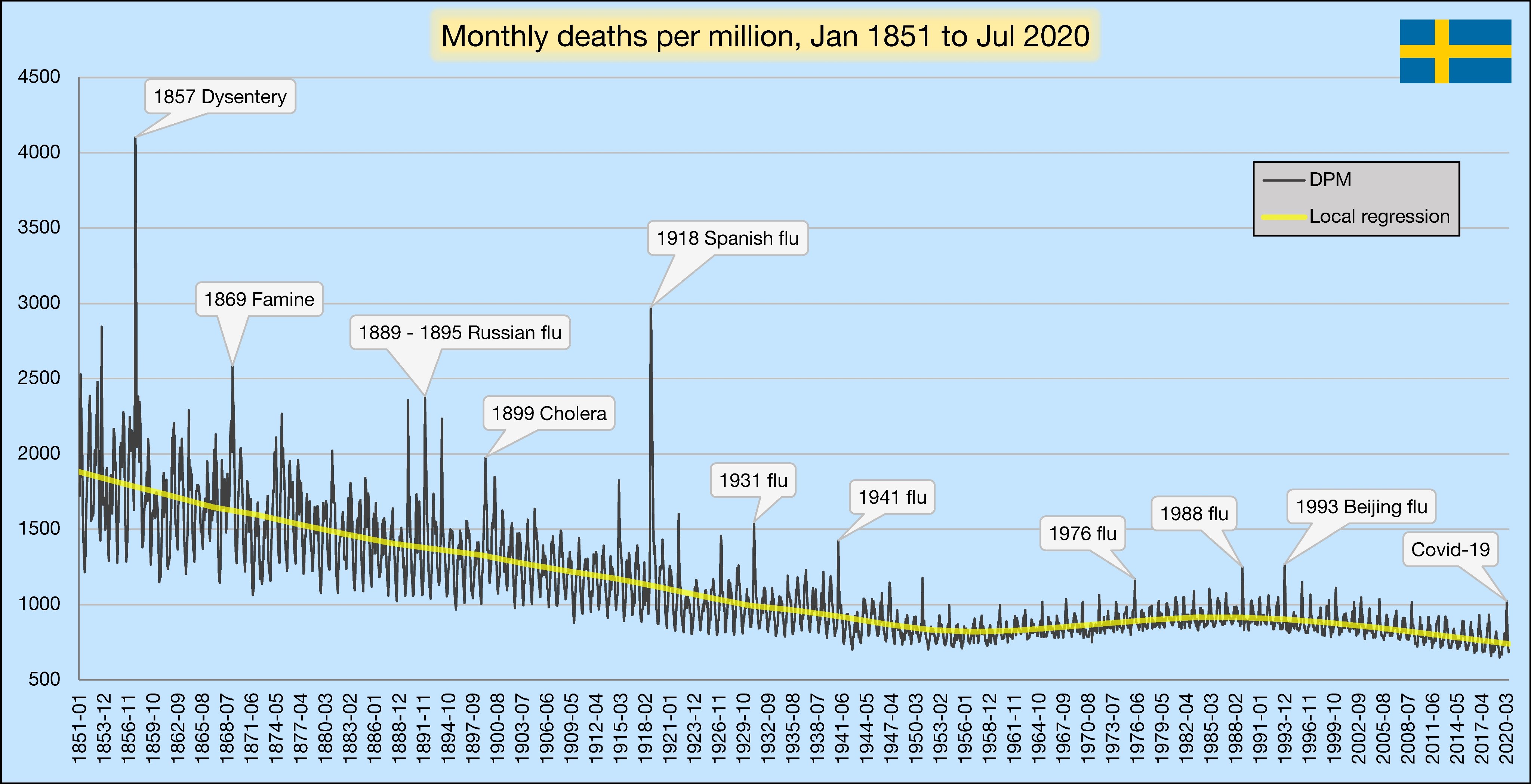
Remember Sweden didn't lock down. Modelling predicted a bloodbath which never happened.
As for NZ, what kind of business or tourist travellers will go to New Zealand now they have to be temporarily imprisoned at their own absurdly high expense? Adding a more than $3000 charge per person to arrival, plus lost time? Your island is currently a pariah state that people will avoid visiting unless absolutely necessary, indefinitely.
I assume at some point these rules will be dropped for those who can show an immunity passport because it's the only way New Zealand doesn't just drop off the face of the planet, but vaccines aren't 100% effective and even the vaccinated can still carry the virus: they just get milder symptoms. So it's not at all clear how New Zealand plans to ever open back up.
The university side didn't seem to work out as well - possibly partly because uni staff are (understandably) less willing to work crunch hours to meet duty of care than primary school staff.
Reopening universities was - students do get it, and they all live together in shared accommodation so as soon as one got it lots of them did.
During the summer, when they talked about opening schools and claimed that young children weren’t major vectors for the virus, I was very skeptical and assumed it was mostly just an excuse -- but it does actually seem to have worked out! If primary school children were spreading the virus en masse, the current spike would be vastly bigger.
(It’s very unfortunate in the US that school opening has been so strongly politicized.)
Opening the universities is another matter entirely. That definitely shouldn’t have been done. I was going to say “in hindsight” but in fact that was pretty obvious right away.
"Young children transmit less
Researchers suspect that one reason schools have not become COVID-19 hot spots is that children — especially those under the age of 12–14 — are less susceptible to infection than adults, according to a meta-analysis4 of prevalence studies. And once they are infected, young children, including those aged 0–5 years, are less likely to pass the virus on to others, says Haas. In an analysis5 of German schools, Haas’s team found that infections were less common in children aged 6–10 years than in older children and adults working at the schools. “The potential to transmit increases” with age, and adolescents are just as likely to transmit the virus as adults, he says. Teenagers and teachers should be the focus of mitigation measures, such as wearing masks or a return to online lessons when community transmission is high, says Haas."
Numbers were low which makes R very hard to calculate. When numbers are low, it doesn't matter much if there is some growth. And, finally, we were under tiered area restrictions depending on local rates (though I felt the chosen restrictions were a bit odd). Finally, in some parts of the country, a full lockdown didn't really make sense even when it was ordered (though arguably, this is lockdown-lite compared to the spring).
People were rebounding from not being able to visit their friends for 6 months.
Non compliance concerns are often a social group function or a side effect of anxiety. it's normal for humans to identify enemies and other groups to make them feel better.
A spectral enemy that one can blame for the bad things.
I wouldn't be surprised if the UKs behavioural modification experts know and use this too.
Ofoten The problem is authorities come with too draconian restrictions too late rather than coming with milder restrictions earlier.
IMO what we really need to be doing is looking at making lasting changes to society to keep things working safely. We’re seeing a little of that, but not nearly enough.
R was good enough in London, back then. That's all they were worried about.
As soon as R>1 you need the next lockdown, so when it's working and R is going down, it kind of makes sense to wait for R<0.8 and not just R<0.999 before you end the lockdown, or else you'll have to restart the next one very soon.
You need to understand that people are still being ventilated on sub-optimal machines outside a proper ITU; a lot of care has been cancelled; and many hospitals are currently on the cusp of declaring major incidents and closing access (including A&E) to any new patients.
I genuinely don't understand what the public thinks of when people in healthcare talk about system collapse. What level of dysfunction and preventable death is needed for the public to accept that the system has collapsed?
One source: https://www.hsj.co.uk/acute-care/difficult-to-maintain-emerg...
I don't get it. We do see problems in healthcare. The excess mortality we're seeing at the moment is a combination of deaths directly caused by covid, but also deaths caused by reduced access to healthcare. When we change long-established norms (eg 1:1 nurse:patient ratios) this is system collapse.
The average person expects a single dramatic event, and that never happens.
This is all entirely possible in 2020 to 1000s of people, and I still wonder why people think lockdowns are a bad idea.
R is basically the second derivation of the case count (+1). So a lower R first means that the increase in new infections decreases, until the new infections decrease.
Not in the uk they didn't, no.
NO!!!
Sorry this is infuriating. What’s the point of getting to R<1 if you then immediately end lockdown and have it shoot right back us? It’s a necessary step, but just abstep in the process. You need to stay in lockdown long enough to get case counts low enough to be able to fully trace.
To be fair, they've made a mess of the whole pandemic, which is very disappointing given that public health was invented there.
My German language and history is not good enough for a rigorous comparison.
https://en.wikipedia.org/w/index.php?title=Otto_von_Bismarck...
https://morningsignout.com/international-health-care-systems...
http://morningsignout.com/international-health-care-systems-...
It is perhaps a mark of public health's incredible success that both replies think I was talking about the NHS.
Also, Bismarck invented the modern industrial state long before anyone else had realized this stuff was important.
Their main beef over the pandemic has been when ministers and the government have been lying fairly explicitly about testing targets (counting posted tests as completed tests).
I find BBC as a whole hasn't been as critical, but they certainly seem to be at least making an effort to explain and contextualise. They aren't parroting government statistics as much as they could be doing.
Straight out of the Trump playbook of course... Every critical question and exposure of wrong doing is actually just biased media.
I've gotten a temperature check every time I've entered a commercial building for the last few months (in NYC), but temperature checks hew dangerously close to safety theater.
To add to the anecdata, in Massachusetts I've only had my temperature checked at a doctor's office but I've also visited very few places.
I got temperature check and covid symptom questionnaire on entry to (private) hospital, but it's not widespread.
https://abc13.com/temperature-checks-covid-coronavirus-sympt...
The problem is that the US media have quite consistently only reported on the fact that they're useless when talking about them being implemented in the US. When China and the WHO claimed they were the basis for China's success in containing the virus, pretty much everyone - including publications like the New York Times - uncritically regurgitated that claim. Same with places like (if I remember rightly) Taiwan using it for airport screening. Anyone who got their beliefs from the mainstream media would be left convinced that America was failing because it hadn't adopted these successful measures from places like China.
R tells you: the graph is likely to keep going up (or will peak and go down). Policy makers should care about this more.
This is exactly why the R value is not very useful. It is calculated over historical data so it has no predictive power whatsoever. However, it does falsely appear to have this power. Quote:
> There is always a slight time lag in the R number of a matter of weeks
ah ok: that's not what I understand from how governments are reporting it.
My understanding is that it's the (best estimate) of how virus cases are spreading today.
Since the graph of cases for today tells you how the virus has spread in the last two weeks, that's not the same information.
If you claim that R is only estimated from the historical number of cases, then R is not giving you information that you couldn't technically identify from this graph, I agree. However, R could be estimated using other information.
The headline assumes its conclusion in a premise? Perhaps you meant the headline raises the question?
https://dictionary.cambridge.org/dictionary/english/beg-the-...
Wasn’t R<1 the magic number for ending the first lockdown?
FWIW I’ve always been suspicious of the way R is used by the government and media. It’s always going to be a best guess averaged over an area, but with asymptomatic transmission and initially poor access to testing, seems like it should be treated with caution. Not dismissed, but not the main driver, I guess.