Edit: just found a source here confirming what you said: https://www.bbc.com/news/health-55040635
The price difference will likely remain substantial, but in case anyone is unaware, the difference is currently greater due to AstraZeneca pledging to the sell the vaccine at cost "during the pandemic", while Pfizer and Moderna have indicated that they fully intend to profit. [1]
Once AstraZeneca deem the pandemic to be over, the price will likely rise.
It was reported a few months ago that internal AstraZeneca documents showed them projecting the "Pandemic Period" to end on 1 July 2021. [2]
[1] https://www.nytimes.com/2020/07/21/health/covid-19-vaccine-c...
[2] https://thehill.com/policy/healthcare/520202-astrazenecas-no...
These two companies have collectively received more than $1.5 billion from the US government [1]. As I understand it, Pfizer have not taken any federal funding. They do have government purchase agreements, but they are dependent on Pfizer delivering a viable vaccine. Their partner BioNTech received German government funding:
Berlin gave the German company $445 million in an agreement in September to help accelerate the vaccine by building out manufacturing and development capacity in its home market. [2]
[1] https://www.nytimes.com/2020/05/21/health/coronavirus-vaccin...
[2] https://www.bloomberg.com/news/articles/2020-11-09/pfizer-va...
I don’t think the data bears this out exactly. US healthcare tends to optimize for access and quality to the detriment to cost. As the saying goes: access, quality, or cost... you only get to choose two.
The US tends to measure better than any comparable country of its size on those two metrics (and quite poorly on cost...but some of that is because the US funds about 50% of worldwide medical R&D)
https://www.sciencedirect.com/science/article/pii/S014067361...
Edit: U.S. percentage of worldwide R&D has been waning and, while still the largest contributor, is now a little over 40%
And in fact this is one of the big differentiators between 1st world and 3rd world countries: if the population has access to quality services, in health care or other important areas like education and sanitation. The US seems to be designing its systems to become a big 3rd world country.
False: The third leading cause of death in the US is believed to be preventable medical errors. You can go to the best institutions in the US to get care, along with seeing the very best doctors, but you cannot evade a statistic like that, even if you are in the 1%. See: https://www.npr.org/sections/health-shots/2016/05/03/4766361...
Also, this article: U.S. life expectancy will soon be on par with Mexico’s and the Czech Republic’s: https://www.washingtonpost.com/news/to-your-health/wp/2017/0...
Also this: 42% of new cancer patients lose all of their life savings in two years because of treatment. The average amount a cancer patient lost was $92,098.: https://www.insider.com/half-cancer-patients-lose-their-enti...
The truth is that you can be in the top 1%, sitting on a mountain of cash, and still lose an unfathomable amount of money, even while insured, if you have cancer or a rare disease. Both of which are actually common.
It is not the doctors who are the problem here with respect to the medical errors: it’s the healthcare system. A good read on what’s wrong with the system is the short book Our Malady by Timothy Snyder.
If you want to stay alive long term, you may want to consult HealthData.org which analyzes each country’s healthcare systems in depth along with outcomes. The group is world renowned. Ironically, it is also the IMHE group that does the coronavirus statistics that everyone consults.
Personally, I am an American culturally, but I became an EU citizen (Croatia) over the US healthcare system. I never plan on working in the US. I do select the country I am working in now due to healthcare.
E.g., if you don't have insurance you can walk into an emergency room and get treated even if it's not an emergent situation. If you don't have insurance, there is a higher risk you won't pay. That cost then gets spread to others who do.
For example, if someone needs to treat cancer, it doesn't make any good to go to an emergency unit: they will discharge the patient as it is not an emergency situation.
That's because the ER is meant to stabilize a patient, not cure chronic disease. Which is to my point: people will forgo preventative medicine until their condition deteriorates and they need to be stabilized in an ER. People get their non-emergent conditions treated all the time in American emergency rooms.
E.g., if I have diabetes, an ER will not put me on a long-term treatment plan. But if I ignore my disease until I start having hypoglycemic symptoms an ER will treat me until I am stabilized enough to be released. Is this the best system? Absolutely not, but it's much different than saying "only the rich have access to healthcare".
FWIW, I used to work in healthcare, including redesigning ER processes
If this was not enough, hospitals are catching up to the "loopholes" in the law and abandoning poor neighborhoods, to make it even harder for people to use emergency rooms.
https://www.governing.com/news/headlines/health-care-facilit...
You may not understand the nuances of the article you referenced. Take Detroit, one of the cities used to support the claim in the article. The baseline decade used is the 1960s. Detroit has only about a third of the population it had in the 1960s so it's not rational to think they would maintain their previous healthcare infrastructure. Further, much of that population left for the suburbs of metro Detroit, meaning the healthcare facilities being built are just following the population demographics. Add onto that the point that healthcare has changed dramatically over the last 60 years with much more emphasis on outpatient care, and there are rational, non malevolent reasons to decrease the number of urban hospitals
E.g. for myself, I have good insurance, but I don't have a "primary care doctor." I don't go to the doctor unless I'm injured or sick. And I don't mean a sniffle or cough, I mean sick as in I have felt awful for several days.
With that said, it seems to be quite a bit and skewing higher for males than females.
The average American sees a doctor 3 times per year. In France it is 6-7 times per year. In Japan, it’s 13 times per year. This statistic is directly linked to the cost of care.
Canada's HAQ index in 2015 was 87.6 vs. 81.3 for the US. However, Canada spent about $27B US on R&D vs. $495B for the US. On a per capita basis, the US outspends most the world on medical R&D. That drives the US total healthcare costs up while helping to drive down the healthcare quality costs elsewhere. To a certain extent, the US subsidizes the healthcare costs through much of the world, effectively allowing them to optimize for a 2 parameter model while the U.S. must still deal with a 3 parameter model.
I'm not trying to be dismissive, I just don't know how it's germane to the discussion unless we view all the other data through the same lens. The data I linked is per country in absolute and per capita basis that tries to put it in unbiased terms.
Are you claiming the US is disproportionately funding non-useful research? If so, how do we measure "useful" research funding?
[1] https://wtfhappenedin1971home.files.wordpress.com/2020/05/ey...
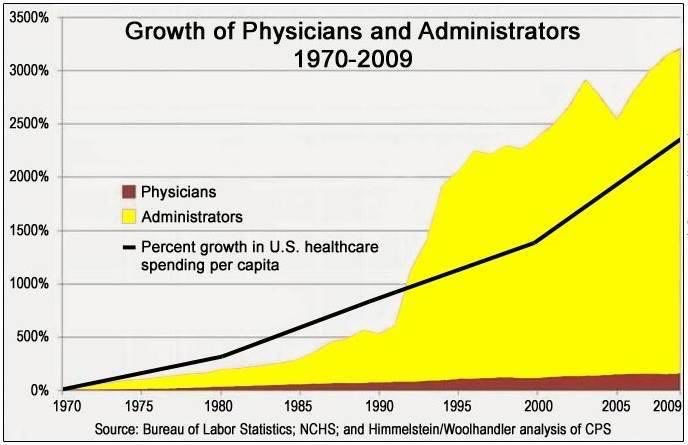
However, the point between comparing countries still holds. If you use older data, you'll see that the U.S. had even more disproportionate R&D funding
I don't think there's a single perfect measure but if you put it in broader context of measures like Nobel prizes R&D spending, patents, etc. it does seem to paint the picture that the US disproportionately contributes to medical innovation.
It's very similar to the measure of health. There is no single great metric. Using a single metric like BMI or blood pressure is flawed. However, you can get a clearer picture if you bring together multiple metrics.
I completely agree that preventative healthcare is lacking, partly due to the system and partly due to culture. If the OP had originally said "preventative healthcare" I wouldn't have much to disagree on, but they used a blanket statement implying only the wealthy have access to healthcare in general.
The US also gives free preventative healthcare to many subsets of the population
I suppose all immigrants have similar problems.
[0]: I mean people living in Turkey
Maybe we're more similar than we like to pretend
No it doesn't. Both dosings use two shots, and the "90%" number from the smaller dosing is from an unreliably small sample set of 33 infections -- it could easily be 70-80% by next month when more data comes in.
Can you count infections as a metric of efficacy for a vaccine that's designed to stop infection?
Consider [1]:
"However, protection was 90% in an analysis of around 3,000 people on the trial who were given a half-sized first dose and a full-sized second dose."
AFAIK it's not known how many of those 3,000 in that trial were exposed to potential infection.
The bars are to be calculated using conditional probabilities.
So where did Pfizer's capital come from to shoulder these costs? It didn't come out of thin air, they've accumulated capital from somewhere. If not from taxpayers, someone is subsidizing Pfizer's expenses through Pfizer's revenue stream. Taxpayer subsidies really make sense here seeing how this issue effects everyone.
Companies taking a portion of what they earn from their existing products and investing this money to create new products is beneficial, and we should have more of it.
Additionally, while this is probably not the case for Pfizer, another possibility is that a company can take outside investment to fund development of a new product.
Without those trillions of dollars/euros most probably the capital markets would have been down by at least 50% (my guesstimate, or at least that's where we were headed mid-March), which means that the money available to companies like Pfizer would have been a lot less.
As such, Pfizer saying that they didn't receive federal money is technically correct, but without federal money most probably their market value would have been a lot less right now.
Pfizer's cash situation or ability to spend/pay a dividend has nothing to do with stock price. Pfizer does not have their cash balance invested in other stocks. Ability/willingness to pay a dividend has to do with excess cash.
To the extent there's any relation, it's a high stock price that discourages paying a dividend. If the dividend yield will be basically nothing, why bother spending down precious cash that could be reinvested (because obviously the market values future cash flows a lot more than current ones).
Deflation might encourage a little bit of holding of corporate cash rather than spending it on R&D, sure. But even then I think you're overstating the case.
I think the OP was reflecting on cash flow being used for R&D but your post seems to be more about market capitalization.
But let's look at this more holistically. Pfizer and pharma benefit a reasonable amount from public research. Pfizer has received their fair share of governmental funding in the form of products, services, and research: https://www.usaspending.gov/search/85a918fa6adf5152dbac723d2...
They've also been subsidized by people with illness over the years that isn't related to COVID (directly or through their insurance provider pools). It's in other cases the previously sick that have padded Pfizer's profit margins enough to enable them to accumulate enough capital they could take on this sort of risky R&D. Theres also the costs of enabling laws and defending their IP rights from external pressures the US pushes.
It may not be direct subsidy but there are plenty of indirect subsidies that enabled Pfizer to do this. Let's stop pretending these businesses pull themselves up by their bootstraps to success and take on all the risk: they don't. They very often take low risk returns and transfer to high risk and use subsidized activity (e.g. federally funded research) to their advantage. Anything high risk like pharma is prone to failure and needs assistance.
Should we continue assistance? Absolutely, I think so, it's good for everyone. As one parent mentioned, it is good to see these businesses reinvest in further R&D that lead to new discoveries in therapy and treatment as opposed to simply hoarding capital.
Apparently the thought of the narratives that Pfizer didn't pull themselves up by their bootstraps financially makes some people cranky. Everyone needs assistance (especially in high risk arenas), let's not pretend that assistance doesn't exist simply because its indirect, time delayed, and being shifted around.
A subsidy is, by definition, a governmental funding mechanism. "People with illness" who used Pfizer products in the past aren't subsidizing the COVID vaccine anymore than I subsidize an automobile manufacturer making pickups when I buy my tiny hatchback. It's built into the business model and not really a "subsidy".
I agree with you in terms that we shouldn't view these companies as operating in a vacuum, I just don't think the idea of the markets being propped up is the most congruent way of framing the discussion. Pfizer benefited along with most other publicly traded companies, irrespective of their COVID vaccine.
https://lifescivc.com/2019/12/venturing-a-perspective-on-the...
There are plenty of 50-100M pharma startups; they wouldn’t exist if your number was right.
Isn't there a selection bias in that the startups that got to 50-100M survived because they were lucky with a candidate treatment. The ones that failed were the ones that never found a candidate in time? The difference being that large pharmaceutical companies have to swallow ALL the failures, whereas startups can "just" die.
Not to say that pharma companies don't have some fat that can be trimmed...
How do you account for the failed attempts?
As yomly alludes to, pharma startups exist because they don't own the risk - their investors bought it when they were funded. Big pharma does own the risk.
A company that is spun out from a PhD project in a research group, that has done a lot of the groundwork on grants will need less funding
Same goes for a start-up that for instance make non-invasive assays for diagnosis, since the documentation requirements are lower for such products
Producing something that has to be injected into humans is an entirely different league, since the amount of documentation required for such products is staggering
The cost for marketing will vary significantly depending on your definition of the word, and I suspect that it might be misconstrued as only being "commercials and paid holidays for doctors"
GP said idea to product costs 1B just for r&d. That and 1B amortized over failures (and including marketing) cannot be true at the same time unless there are no failed attempts and unless marketing cost is zero.
I'm also not sure what you would define as a failure. Drug development often starts with several candidates for a target. Over the cause of development the list is trimmed, as candidates show lack of affinity for the target or have side-effects that make them unviable. Would you consider each of the excluded candidates a failure?
I don't get to define that, companies do, but basically it includes everything that does not involve a lab, technician, doctor, nurse, statistician/programmer, etc. The US and the rest of the world are quite different here - if you've ever watched US broadcast in the evening, you'd see TONS of ads for prescription only medicine ("suffering from foo? Ask your doctor about bar"); that's marketing. Taking three hundred cardiologists on an all-expenses-paid 7-day cruise with one 30-minute "purely informative lecture about our new drug" and 7 days of fun? That's marketing too. Lobbying to congress? That's also marketing.
Outside of the US, the marketing budgets are smaller and less overt - but the cruise-style legal bribe-like events are prevalent everywhere.
> Would you consider each of the excluded candidates a failure?
Possibly. You've described one style, but it's not the only one. Many times, it's a weird result from some other research (how Viagra was discovered, how DCA tests were started).
But many things are essentially complete and utter failures - you have a line of research where no viable compound was found at all. BiondVax just failed a 15-year mission trying to develop a universal flu vaccine. Remdesivir is essentially failed even though it is FDA approved (It failed for Ebola; if you look at the data critically, it failed for SARS-COV-2 -- which the WHO's recent studies show even more clearly).
There is some benefit from this research - new techniques, often new devices - but the drug itself is a failure in the sense that it will not generate any income to the company.
Edit: just saw your earlier comment about marketing. It is those things (which you and I mentioned) and a lot more, but it is basically for the company to define in their books and a rule of the thumb would be “an expense a university department developing this to completion without expectation of profit would not have to spend”
Not this year!
This doesn't apply so much to Covid vaccines, as the time frame is accelerated and demand is already high.
There's so many ways to calculate the cost, that I think it's more important to be aware of the assumptions made for the estimate, than the number itself (which I also failed to do in my original answer)
I think people underestimate the cost of drug development, because the numbers are so big, that it doesn't seem realistic for companies to survive
Pfizer’s trial will run for 2 years, so ~$900M for the trial alone. That’s excluding all the work to scale up the production, regulatory filing, distribution, etc.
Edit: my math sucks. $900M, not $90M
I just think big pharma are fundamentally ok with huge cost for trials and are not motivated to decrease it/make it more efficient, since they're ok with their pie being larger. They will just shift costs to healthcare system and will be happy with larger profit.
Now, $10-15k per patient-year is for a typical therapeutic. And that is an average across global trial sites, not just the US. It’s not much money. You go a 15 min doctors appointment and your insurance is billed $150. Now imagine going 1 per week and having multiple tests run each time. Or having to stay in the hospital for a day when the drug is administered. You can burn through $1,000 per month pretty damn quickly.
It doesn't work this way. Pricing of pharmaceuticals is independent of the cost of development. Nobody will pay $200 per Covid vaccine dose just because the cost to develop it went up 10x. Every extra dollar spent on development, is one less dollar of profit.
That's why some drugs never make it to market - the cost to bring them to market and the low price means they'll never be profitable.
Given the amount of work being done by this and other research labs hired Astrazeneca, and comparing this to quotes I've received for a very modest UX usability studies, it's hard to see see this an sort of money grab.
Most basic research is government funded.
It also feels deeply wrong to pull the "but all the research efforts that did not lead anywhere" argument, when Pfizer did not do the research in the first place. They should get compensation for organizing the huge trial, of course; that expertise was why they were on-boarded in the first place. And nobody expects them to manufacture that stuff at loss or cost. But we should not accept public money buying them goose laying golden eggs either.
Oh, and now there are multiple competitors in the market.
The quantity of vaccines needed will make even a $0.50 markup worth billions of dollars every year
I hate to link to a Youtube video, but this doctor walking through the research in the first part of the video is honestly better than any news article I've seen: https://www.youtube.com/watch?v=gFeJ2BqCFY0
I also noted that 40 of the participants were excluded because they had no PCR test done to confirm covid and no antibodies were found in the assay. This is in my opinion a major flaw, as the subjects could have been infected, but had no antibodies left, when the blood sample was taken
Finally seven of the 18 authors declare competing interests, which might have affected the research
Getting back to your post itself, I agree that you can't measure immunity for a longer period than the virus has been around, but that also means you can't say that there will only be a need for one round of vaccines, which was what I was disagreeing with
It might very well turn out, that you gain permanent immunity for a specific strain off the virus, but unfortunately that immunity also introduces selective pressure. Whether the virus is able to mutate in a way that bypass existing antibodies in a subject is obviously still an unknown, but we have seen that it's able to jump to other species like mink, which caused the emergence of the Cluster-5 variant
Since the virus is able to use other species as a reservoir and selective pressure is being introduced, I think it's reasonable to prepare for a scenario, where a vaccine won't be a permanent fix
The society at large is making huge sacrifices and making painful changes to address this collective problem. Are these companies part of "Human society" or not? If they are party of Humanity, then they can make 'adjustments' as much as we are asked to make adjustments.
Still won't be a fraction of the profit that stands to be made from these vaccines.
They then get to recover their R&D expenses and make a smaller but probably decent profit from its production.
It’s easy to complain about Pharma profits when you ignore all the money spent that goes “poof”.
I'd be glad to be shown some examples, otherwise it's "privatize profits, socialize losses".
And if you fold in the start-ups who have one shot and if it doesn’t work out? Plenty of those. They go bankrupt.
Busting the patents on Covid vaccines would be “socializing the gains and privatizing the losses”.
However I'm certain that the category "bankrupt pharma company" is littered with examples.
a) researching Covid-19 vaccines?
b) will they actually get to produce millions and millions of doses?
Almost every case I know of, it's a huge company or even a state owned one.
Who are we actually arguing for/against? The hypothetical "small pharma"?
Keep in mind that just like for banking, due to the amount of (necessary) regulation, there aren't many small pharma companies out there.
But the reasons and ethics of the system being the way it is are separate from the reality of what it is for the purposes of getting things done in the here and now.
For better or worse, as things stand right now, pharmaceutical companies, like other companies, need to make profits - or at the very least avoid crippling losses - in order to survive and continue doing their work.
That includes covering the formidable costs of the many research studies that go nowhere and yield no revenues.
I'm sure you wouldn't find a single person in a pharmaceutical company who would feel good about withholding treatment from any person with a life threatening illness. But what they also have to care about is remaining in business so they can treat and cure many more people with serious illnesses.
Practically speaking, I suppose a hypothetical scenario could be that the:
- the companies are granted patents
- the vaccine lasts for a limited amount of time
- before each patent expiry they companies make minor modifications (say, storage temperature requirement decreased by half a degree)
- the company make "unfair" profits by extending the oligopoly for a very long amount of time
I'm not stating that this will happen, but on the other hand, I find this plausible.
In addition, the aforementioned patents prevent disruption. Even long after the original patent expires.
That is something we want to encourage!
This ensures equitable access, ...you know, that the whole world is actually saved.
In reality, these costs are microscopical compared to the cost of the Covid recession, and all the "stimulus packages" across the planet.
I assume most governments will pay the cost of vaccines, or even pay people to take the shots. The US says it will.
I prefer a system where it's very worthwhile for people to risk a lot and work hard to save my life.
If it was all about altruism, I doubt a vaccine would be developed for many more years.
Money quote from linked article:
"News of the vaccine's success was first made public on April 12, 1955.[7] Salk was immediately hailed as a "miracle worker", and chose to not patent the vaccine or seek any profit from it in order to maximize its global distribution."
But I also know that my grandmother suffered terribly from rheumatoid arthritis, and it destroyed her life. Long after she died, enbrel was developed for profit which was the first really successful treatment for it.
No profits => no treatment => misery.
The organizations who funded the research looked into the viability of a patent and concluded it wouldn't have succeeded.
"the idea of patenting the vaccine had been directly analyzed and the decision was made not to apply for a patent mainly because it would not result in one."[1]
The distinction should also be made that a patent doesn't necessarily affect global distribution. It just gives the rights to license the technology. They could have patented it and then licensed it for free.
[1]https://www.bio.org/blogs/real-reason-why-salk-refused-paten...
It doesn't really scratch at his integrity though, since it was the institution he worked for that raised the issue.
If he was just a brilliant salesman (apart from a brilliant scientist) we never know.
What is beyond dispute is that his discovery saved (arguably) millions of people from a life in misery.
Enter public trading: the opportunity alone for global ransoming will inevitably become the projection that defines the street price for shares and once valuation is up there ransom-level profits would suddenly appear not excessive but appropriate, given the level of paper investments of the latest, valuation-defining round of buyers.
I wish regulating anti-social behaviour out of industry was more popular.
Sounds like you're simply defining a tyrant as someone who runs a profitable company.
I also want to push back on "everything commercially successful is run by tyrants" kind of narrative. I get the frustration, but these blanket, ideological statements do not help anyone, anywhere. Do you make money? I guess you're a tyrant!
Let's not forget, the countries that we put up on a pedestal as the shining examples of how a country should be run (Norway or whatever) are very much capitalistic countries with free markets, IPOs, and commercial companies. I hardly see businesses there characterized as tyrannical.
I do really get the frustration, but it needs to be directed at the failures of our elected representatives. Not, commercial entities.
Companies are unlikely to stay profitable if they’re overly generous. They need to profit handsomely to survive.
Eh, I think that’s kind of old-school thinking.
> Companies are unlikely to stay profitable if they’re overly generous. They need to profit handsomely to survive.
Yep. That’s fine. (Also ignores low-margin industries that rely on volume, but whatever).
If you want a modern society, people have to be able to take risks with their money in order to make more money. Otherwise we can go back to subsistence farming. Do you work? You’re charging a profit. How evil of you! Being a few steps removed from the transaction doesn’t make you any less guilty of profiteering. You’re just as bad as these tyrannical CEOs, the difference is you’re a sucker for building their product while they make money hand over fist.
(I don’t actually believe the last part, but w/e).
I pray anyone of like mind is never in a position to enact such progress-killing madness and fear terribly that government is already full of them.
And besides, it is mind-numbingly complicated to calculate "at-cost" because as others have pointed out, that includes all of the dead-end R&D, ongoing legal exposure, interest on the loans used to cashflow operations at pharmaceutical giants, appropriate licensing of existing intellectual property that these vaccines are built on, and the million other ways money is spent to develop pharmaceuticals.
We all have things (and people) in our lives who are probably a net negative in terms of financial outcome, but we enjoy them anyways because our value systems are more complex than just "maximize profit"
But: this is not a medicine made of a molecule that can be synthesised by the chemical industry. Such a vaccine requires input from the creator and then specialist equipment to manufacture. Poor countries don't have the infrastructure to manufacture and the creator labs are not going to tell you how to produce the vaccine just because you ask them.
In any case, governments should pressure labs to enforce an low prove.
These programs were federally-funded with the goal to produce as much as possible. For production I'm sure that factories were financially compensated for the work.
I'm also sure that you realize the difference between taking a small profit, and the huge margins big pharma companies have.
In addition, the pharma companies have already been compensated with massive grants.
Also, all 3 have made various noises about not making a profit etc, it's quite hard to sort out the marketing from what will actually happen at this point. Oxford/Astra have committed to supplying at least 100M doses to low-income countries for under $3 though.
This vaccine is cheap, 90% efficient and easy to get people vaccinated. The other ones are expensive, 95% efficient and difficult to get people vaccinated.
The Oxford is best only if you either live in a very remote place, or are a very poor place. If you rely on the oxford vaccine it will be a little longer to get herd immunity, but overall your costs will be cheaper.
But I must reemphasize, the above is only about logistics. Because most people live in cities, all vaccines will be distributed in big cities just to get the numbers they need. What ever vaccine you are offered first is the one to take. You personally are unlikely to be offered a choice other than take it or leave it.
Additionally, lots of countries have already preordered all the major candidates, so in those cases its already spent money.
It isn't a new thing for what it's worth. Going back to earlier this year it has been looked at, but we don't really have a clear picture on what will shake out.
We need the vaccine to remove the virus from circulation, not just keep us safe from it as individuals.
Regretfully, it would be not the first example of major economies using the current reality as an excuse/cover to conveniently push political policies/agendas that would otherwise have been impossible to implement (at least not without violating laws/treaties and maybe even basic human rights). I have no intention to fear monger, but I believe way too many are too naive about some of the things that are currently happening. That is, mostly people within those major economies, for people in less fortunate countries already learned the hard way how double-faced those major economies turned out.
How all this will eventually turn out ... anyone's guess is as good as mine. I guess we will all learn, when the immediate emergency of the current situation is over. I would prefer to be/remain optimistic, but thus far there appear to be more reasons for caution and skepticism (at best).
I've read this 3 times and can't figure out what you're trying to say.
Are you saying that rich countries are going to intentionally choose more expensive vaccines, with the intention of suppressing the lower classes?
That's so rediculous. In rich countries (other than the usa) the gov pays for these things not the citizens. Even then, the expensive vaccine is only $40, that's within the means of most poor people.
Not to mention that would screw over the rich people who want to benefit from (vaccine induced) heard immunity.
> .. the gov pays for these things not the citizens .. You do know that the only money governments have, is the money they got from its citizens, right? That is, aside from what they may have earned (though plundered or extorted might be more fitting) from other nations.
> .. the expensive vaccine is only $40, that's within the means of most poor people .. You may want to reevaluate your knowledge about the rest of the world. That is, outside the USA and some the more affluent parts of Europe. Also, that vaccine probably won't cost "just" $40 equally for everyone.
However, believe whatever you want. Time will no doubt teach us all a lessen. Personally, I hope it will teach me that I was wrong with my skepticism.
> Time will no doubt teach us all a lessen.
I doubt it. You need to actually have a position that can be shown to be true or false with the passage of time before you can learn something from the passage of time. You have a bizare, logically disconnected, rant that does not make any predictions. I don't think any course of events would prove you right (or wrong).
> You may want to reevaluate your knowledge about the rest of the world
In context, we were discussing afluent countries, canada europe, etc.
> Also, that vaccine probably won't cost "just" $40 equally for everyone.
They will cost $0 directly. As you say there will be indirect costs based on taxes. However that will be true regardless of if you get the vaccine and be scaled based on your income, so im not sure how you think that applies to your argument sbout class divide.
India's Serum Institute has already partnered to mass produce this vaccine. https://www.ndtv.com/world-news/oxford-says-covid-19-vaccine...