Instead, in the UK you require 'planning permission' to change the land use of any building. This is discretionary and may refer to some overall plan realting to the feel, density, etc. of an area but is not prescriptive over specific types.
As a result I don't know anyone in this country, urban or rural dwelling, who can't walk to a shop or a pub, though I'm sure some such unlucky places exist.
The average walking distance to a pub has gone up a lot in recent years due to closure, and walking on rural roads at night where there is no footpath is horrendously dangerous even if you carry lights. It's a nice idyll but it's no longer really true.
What you say about Simcity is absolutely true though. It doesn't correspond to traditional UK or most European cities at all. Medieval mixed walkable core, maybe not driveable at all; industrialish area down by the wharves now repurposed as offices and residential; Simcity-ish bit on the outskirts where somebody decided to build a grand scheme, like La Défense.
Zoning is starting to leak into urban planning a bit more, when huge housing estates are built with no shops, pubs, or facilities. As far as I can tell demand for housing outstrips everything else.
Imagine two ice-cream vendors on the beach, selling identical ice-creams for the same price.
Since number of sales are a function of how far people have to walk to your stand (and price etc), you want to make sure you are as close to as many people as possible.
If your competitor is closer to them, they will go there instead, so you either need to be very far away or right next to the competitor. If a person could visit either of your stands, the competitor can 'steal' them by simply moving their stand closer to yours, so that the customer previously in the middle is now closer to them.
A discussion on the general case is here [0].
This principle obviously doesn't extend flawlessly to the real world, but is a significant contributor to, for example, the clustering of car dealerships today.
[0] https://math.stackexchange.com/questions/583157/ice-cream-ve...
There's a big split between European cities which decided to rebuild exactly as it was after they were bombed flat (or the few that largely escaped), versus those which decided to modernise and become car-oriented. Cambridge vs. Coventry.
This is commonly referred to as "Staggering distance" :-)
I found something that kind of supports this notion but isn’t really conclusive
https://assets.publishing.service.gov.uk/government/uploads/...
Wonder if you have a link to share?
I'm not sure about the data for pedestrians being hit on rural roads, though the UK has very low rate of per capita pedestrian fatalities overall, among the lowest in the EU according to [1]. Anecdotally I have never felt unsafe walking on rural raods. I can see how some of the narrower "A" roads (major single carriageway roads with no central reservation, sometimes heavy lorry traffic) might be, though these usually but not always have pavements for pedestrians and if not there's generally an alternative.
Either way, compared to my (admittedly limited) experience of suburban and rural America there is still a big (and welcome) difference. I hope that any downward trend can be arrested/reversed.
[1] https://ec.europa.eu/transport/road_safety/sites/roadsafety/...
No. It's not. You just can't expect drivers to see you so you have to take care and step more or less off the road if there isn't a wide shoulder available for your use at that spot. It's not a big deal because cars aren't that frequent.
It's really no different than any industrial workplace where it is expected that the lighter traffic will make way for the heavier traffic.
Do you have to walk on the road? One might have expected that in rural areas one could walk through fields and forests.
Random example https://thumbs.dreamstime.com/z/narrow-road-high-hedge-18153...
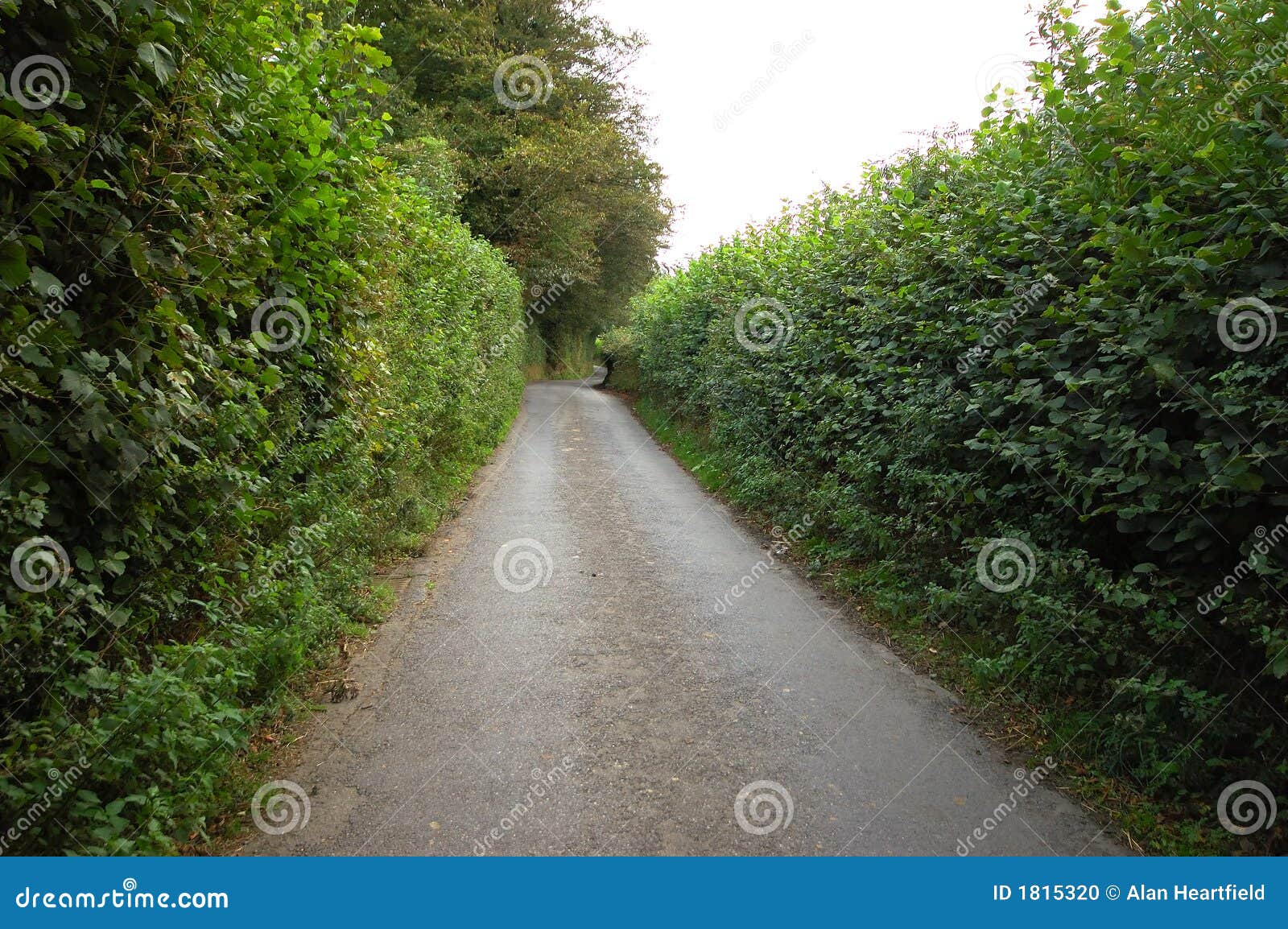
Not all counties will look like that, but quite a lot of them to. Imagine a network of this kind of roads going on for many miles. You really don't want to walk them at night.
We’d made a long loop walking through the hills in the Cotswolds, and the guidebook would have had us crossing a large pasture to get back to the start. At the gate we were confronted by a couple of rowdy young bulls who seemed to have little interest in letting us cross their field, so we took the road instead. Thankfully we could hear cars coming from far away and could position ourselves for maximum visibility in the curves, but it certainly felt like one of the more dangerous miles I’ve ever walked.
On the main topic of this thread, one thing I did note during our two weeks of touring the British countryside was that the network of walking paths and tiny villages made even rural places much more walkable than in the US. One fairly isolated farm we stayed at had a hand drawn guide to getting to multiple nearby-ish pubs via footpaths through the fields. A comparable place in the US would have been 100% car dependent.
It was shocking to me how isolated I was. There was a gas station that I could walk to, but even getting to the fast food place that I could see from my house was dangerous because the neighborhood was surrounded by wide roads and fast cars. Whenever my hosts wanted to get fast food, they'd drive there even though it was literally a stone's throw away.
The wider area was even stranger. A high school that you could only really reach by car. A 'proper' city nearby (Fort Worth) where it seemed like nobody thought to make it accessible to pedestrians. multiple cut-and-paste neighborhoods just like the one I stayed at, completely isolated and only accessible by car. And consistently a Walmart/Kroger's/<random shops> area every 20 mins or so, with one 'bigger' shopping area that had no character or charm but at least it had a movie theater and restaurants.
After that experience I understood why having a car is so crucial in the US, but I also started respecting more how difficult it is to avoid things like obesity or pill addiction. it felt so eery and unnatural.
I used to walk such roads at night.
I was taught, to keep safe:
- Carry a torch (flashlight outside the UK ;-) with good batteries, and don't wear dark clothing. Turn on the torch when you see headlights in the distance, make sure it's pointing somewhere visible.
- Walk on the right-hand side of the road (cars drive on the left in the UK). It's marginal on single-lane country roads but cars still tend towards their normal driving side. Better if you can see surprise vehicles coming towards you rather than from behind you, and they can see you facing them.
- Wear retro-reflective clothing / strips if possible.
As long as cars can see you, they slow down to pass just as they will for a car driving in the opposite direction. Which at night they first recognise by headlights, from quite far away and around corners, so light is what they're looking out for.
Definitely don't be dark, as that makes you invisible to cars at night until very close.
Fortunately/unfortunately that type of road is becoming slightly less prevalent, as efficient modern farming means hedges are maintained less than they were historically and they either get chopped down or neglected and end up growing into larger trees that are much easier to see through.
While I agree that they're bad for sightlines, they're also traditional and may be on private land, so getting rid of them from minor roads would be a hugely unpopular undertaking.
Spend a week in Houston, TX and see if you still hold that opinion after. That is one of the least walkable cities in the US and doesn’t utilize zoning as far as I’m aware.
I think this is exactly Houston’s situation and why it is such a disaster from a walkability standpoint.
be careful what you wish for.
In reality, the financial system is oriented towards big capital. My aunt ran a coffee shop that was established by grandparents in 1939. It was in the lobby of a office building in he central business district of our little city. The building was bought by a Chinese investor. Like other similar stores, her rent went up 5x and she shuttered.
I live in a mixed use urban neighborhood. 50% of he storefronts are vacant or populated by death businesses like karate dojo’s.
What you really want is the small businesses which start off being operated out of the proprietor's residence. A hair salon in a converted living room, a restaurant serving food from the owner's home kitchen. Something that can start off as a side business yet can advertise without getting into legal trouble and grow into more if it's successful.
You get a few of those in an area and someone decides it's a good place to knock down a house and put up a five story building with condos on top and a coffee shop and a bakery on the ground floor.
You have to let it grow organically like that or you just end up with abandoned "commercial" buildings because businesses fear moving in when they know their success would lead to increased rents as a result of the limited amount of designated-commercial real estate in the area.
Shop house is a flexible creature. It can be a business, but is also easily converted into living quarters, if necessarily, or a parking garage, or whatever you want. It’s just a flexible, convertible space.
I did have one friend that ran a shop and lived above -- it seemed great -- but he owned the building and had done a lot of modernizing of the apartment. It doesn't fit the suburban dream, though. No yard -- the green space for my friend was the county court house square across main street from his shop.
Ottawa, Canada has these too on Bank St. Toronto has many of these streets also, for example Queen West. These are generally the most vibrant neighborhoods.
The solution to having lack of backyard space is to have public parks. Montreal has this more right than any other city I’ve seen.
Of course, from my apartment I hear karaoke late at night, roosters early in the morning, and construction, always construction.
So there are drawbacks. It would be disruptive, especially in suburbia. But I would love some middle ground between crazy Saigon and cultural desert suburban Atlanta.
Blaming the disappearance of tiny businesses in residential neighborhoods by saying "It's all those middle class white women" seems both very shallow and specious.
Using a name meant to paint a picture of a suburban white woman is no different than describing someone as a Jamal, Yousef, Goku, Carlucci, Vladimir, Shenequa, Herschel, or Juan. If a news outlet used any of those names to describe a person in a news story they’d be immediately flagged as racist. And yet we see the term used to describe white woman gracing articles on the front page of even the NY Times.
It is. There are plenty of decent people named Karen who do not deserve to have their name appropriated as an insult.
Better to say "entitled jerk" or something similar. That way, the only person you're insulting is whomever you're calling a jerk.
Because it’s tied to behaviour. Stop behaving like an a-hole and you stop being called a Karen.
You can’t stop being black or a woman.
That’s the key difference.
We wouldn't call illegal gardeners a Hernandez, or terrorists from the middle east Mohammeds. Those are behaviors too.
What makes it wrong is picking an ethnic name to associate with that behavior. Karen is a euphemism for suburban, white, female.
The sexist part doesn’t really fit for me either, as we generally reserve insults for genders too. Bitch vs bastard are prime examples.
By the way, the male version of “Karen” in my part of the world is much worse.
This is very much a straw man. If I see a term that is derogatory towards black people, I have every right to object even though I'm not black. And if I see a term that is derogatory towards women, I have every right to object, even though I'm not a woman.
In fact you seem to be claiming, in this case, that you would only ever object to the term "Karen" if you actually have the characteristics that the term refers to. If true, that would simply invalidate the opinion of everyone who objects. But, just like with race and gender, you can object to that term even if its implied meaning genuinely doesn't match your personality type. Especially if you're objecting to the specific term, not to the principle of insulting that personality type.
Edit: to make it a bit more concrete, imagine the term "little black men" had been used instead. Upon objection, you replied "no, no, no, the term term doesn't necessarily refer to actual black men, just people that behave a bit like black men". That is very much what the term "Karen" is like.
Karen isn't derogatory to women, it's only derogatory to Karens. There is no implication that women are all Karens, only that Karens are contemptible.
> In fact you seem to be claiming, in this case, that you would only ever object to the term "Karen" if you actually have the characteristics that the term refers to. But, just like with race and gender, you can object to that term even if its implied meaning genuinely doesn't match your personality type.
Except that race and gender aren't personality types, whereas that's exactly what "Karen" is, and it's just the personality type that would object to the term.
> to make it a bit more concrete, imagine the term "little black men" had been used instead. Upon objection, you replied "no, no, no, the term term doesn't necessarily refer to actual black men, just people that behave a bit like black men". That is very much what the term "Karen" is like.
The analogy to "little black men" would be something like "white female busybodies" which is completely different because it's putting the focus specifically on that race and gender.
I would dispute this point. The term is, at least, derogatory to women who are named Karen -- whether or not they are "Karens".
What you're really doing there is showing why it isn't sexist even though it's implicitly female. The detail is only there for color, not as a core component of the archetype.
You argue that "Karen" doesn't refer to whiteness, the middle-classes or the female gender - it just refers directly to the stereotype and therefore it's OK.
I invite you follow the same logic here.
Consider the stereotype of a gun-toting street gang member. Our prejudices may tell us that person is probably a young black male that lives in a big city. So he gets a name we associate with the young black urban male like "Deshawn" .
The logic is the same, yes?
If you're OK with "there goes Karen calling the cops on the Walmart clerk again", you should be OK with "there goes Deshawn shooting the neighborhood up again".
Are you?
Only a serious level of bigotry would make someone pretend it's not racist or sexist if the word can also mean something else, in this case a simple name. It's what you meant by it and what you associated that with that matters.
It's the same reason calling someone a "fag" is meant as an insult for both that person (even if they are straight), and for homosexuals since you obviously consider this trait of theirs only suitable for an insult. It's an attack both on the people you address it to, and on the ones you based your insult on. Something an uneducated bigot would readily use but never realize why. They usually feel threatened by everything they don't understand or like (different gender, color, sexual or religious orientations) and "weaponize" that as a cover for their own ignorance. ;)
You could argue that Karen was chosen over Steve or Jeff purely by coincidence because obviously 50% of people are female so why shouldn't it be a female name? Actually a technical author I really like, who doesn't like the singular "they", solves the problem by just using the pronoun "she" for every unspecified person ("if the reader doesn't believe this theorem she can check it herself..."), which I think is fantastic... why not use she over he? But the fact this is so surprising is exactly because it is so unusual. It is, sadly, the default, to use male pronouns and names for things, so when a female name comes up it usually has a connotation (although I just gave an exception). Whether you mean it or not, using "Karen" for someone with that type of personality type heavily suggests that women are more likely to be like that.
That is all already true without an additional fact: historically, it is sadly a stereotype that women's opinions are more petty and unimportant than men's. The use of the word "Karen" for someone with unimportant, ill-informed opinions is directly playing into an existing stereotype. And it is totally avoidable.
Suppose I use "Shaq" as a stand in for a generic basketball player. I'm obviously making reference to a specific famous basketball player who happens to be a black man, so is that racist and sexist? Asians can play basketball. Women can play basketball.
It's not chosen at random, it's chosen as an exemplar of the category. The original Karen (from /r/FuckYouKaren) was a real person named Karen.
> historically, it is sadly a stereotype that women's opinions are more petty and unimportant than men's. The use of the word "Karen" for someone with unimportant, ill-informed opinions is directly playing into an existing stereotype. And it is totally avoidable.
I don't think it is avoidable. If using a woman's name is sexist then so would using a man's name. Either way it would cause the reader to be more likely to picture the person with the contemptuous attitude as that gender. But so would not specifying one at all, which we know generally causes people to picture a male. So you have to make a choice one way or the other.
And if it's "fantastic" to select a female in the contexts where the subject is a meritorious student or engineer, sometimes it goes the other way too.
Assuming you mean a negative stereotype, so for example not just a basketball player but one who does it instead of studying academic subjects: then certainly, yes. Imagine someone saying "oh those guys won't have a clue, they're just a bunch of Shaqs". Even if Shaq is the name of a real person, the racist undertone is clear.
> ... so is that ... sexist?
Not so much, maybe borderline, just as Karen is only borderline racist.
> The original Karen (from /r/FuckYouKaren) was a real person named Karen.
I dispute that many people using the term know exactly who that Karen is, and even moreso the people hearing it. To most, it simply sounds like a generic name that white middle-class women are likely to have.
(After a little Google research it seems there actually isn't an original Karen. KnowYourMeme (not exactly a reliable publication but relevant here!) had a few candidates but no clear winner - in fact the main contender was just a bad comedian using it for an unspecific annoying woman. In a post I found on /r/FuckYouKaren itself no one had any ideas. But that's all irrelevant anyway, if people using the term don't know.)
> If using a woman's name is sexist then so would using a man's name. ... And if it's "fantastic" to select a female ... sometimes it goes the other way too.
Actually, by "avoidable" I meant there's no reason to use any name at all. But let's put that aside.
Look, I get it, I honestly do. Equality really means treating people equally, and that means if we're allowed to use a male name as an insult then we ought to be able to use a female one too, right? I actually do think it makes a lot of logical sense.
The problem is that it only makes sense if the current base line is men and women already being treated equally - then adding extra opportunities, compliments and even insults equally would preserve equality. In practice, current societal norms are absolutely flooded with little microagressions that subconsciously make men and even women themselves think of women as somehow less important than men. I remember a very awkward encounter at a team building exercise where a colleague (actually a fantastically nice guy) jokingly let me go first at something with a cheeky "ladies first" comment, only to realise a female colleague was actually nearby (near enough to cause a bit of confusion!). Note that one woman jokingly accusing another of being a man would never be an insult, even jokingly.
Yes I realise there's the odd extreme feminist that genuinely thinks men are less important or worthwhile than women (e.g. those that say that men accused of sexual assault by women should be assumed guilty). But those numbers are absolutely dwarfed by men who think less of women. In that context, your idea (allowing insults that reinforce stereotypes against women in the name of equality) does not make sense.
I think it would be more like calling a random middle eastern terrorist a Mohammed.
If you haven't suffered the Karens, you might be a Karen...
When could society ever be characterized by an ethos of "let's tolerate people"? ISTM that now anyone might receive for criticism for objectionable behavior, not just poor black young men.
Yet now, it seems all sorts are labeling people based upon sex, colour, ethnic background, etc. It is, quite literally, the definition of sexual, racial, age discrimination. It is linking "external characteristic" with "way a person acts".
I don't care what anyone's political stance is, but if you are using terms like 'Karen', you are 100% contributing to sexism, racism, etc.
Just call someone what they are. "Asshole" has worked fine for millennia.
0. https://www.npr.org/2020/07/14/891177904/whats-in-a-karen
The above NPR, states that a Karen is a new label, started in the 2010s (which is just last year, even). It also shows how the Karen label is different from other, prior labels.
It delineates how a Becky is different, a "Miss Ann" is different.
We've historically had labels like this for people, which are racially linked. But this is 2020, this is a NEW label, and other NEW labels keep popping up.
We need to collectively STOP this. No more racist, sexist, ageist, anything-ist labels. It's all wrong.
(Not saying you were defending label use... just clarifying my position)
Slurs are not new. And as I mentioned, what you showed were not Karens, but 'white women who act poorly in certain ways'.
"Kaben" has unique connotations, a specific meaning. While I agree that "white women have had slurs" before 'Karen', I'm going to have to disagree that it's germane here.
"Asshole" is as common as salt in our everyday language, but "Karen" is the spice.
Except that Karens and assholes are different. Karens can be assholes, sure, but a Karen is a specific type of asshole. Football hooligans may be assholes but they're generally not Karens. It means something different, and there isn't another word that means the same thing.
https://en.wikipedia.org/wiki/List_of_ethnic_slurs
A lot of these terms link specific behaviour, to specific ethnic/sex/cultural groups. I guess they're OK too?
I find it utterly disgusting, that some people think some things are 'one way'. That racism is OK, but only "one way". Sexism is OK, but only against men. The list goes on.
Let's see how long you last, if you see a lazy black person (they exist, like lazy people exist everywhere)... and you spout out "Bluegum!" Is that OK?
No?
Then why is it OK with 'Karen'?
You'd don't cure social ills by creating more of them.
"An eye for an eye, leaves the whole world blind." is highly accurate, I think.
Maybe you're seen this. I haven't, and many people seem to have the specific definitions listed above.
Well then it's a good thing that it can.
> Let's see how long you last, if you see a lazy black person (they exist, like lazy people exist everywhere)... and you spout out "Bluegum!" Is that OK?
That is a racial slur. Its meaning is defined by race.
A Karen is defined by behavior.
cries in San Francisco
So apt.
Something like this actually happened to a former colleague of mine. They installed a safety rail on their front porch. Someone complained.
Maybe in the cabinetry case there was a giant van with a company logo parked out front.
Either way, permits shouldn't be required for non-disruptive (and a van being in someone's driveway is not disruptive), non-structural changes to a house.
I’m aware that zoning and permitting laws have been an issue for a while (like a lot of Millenials I haven’t been able to afford to buy a home), but it does feel a bit authoritarian for the local permitting office to look for signs of “black market” modifications to one’s own property.
Most places like not places like Oakland, Berkeley and Santa Cruz County, this sort of thing depends on the neighbors. It's inane what neighbors will go running to the city for. Or not. Friend of mine in the east bay completely gutted and remodeled his house no problem. In San Jose neighbors complained to the city about a disused dishwasher in my garage.
I really don't think people have perspective these days. You think this is the era of officious busybodies?! Seriously?
It's just that these days, things aren't covered up. Or, are seen more due to the Internet.
For example, you think cops are MORE violent now? MORE racist? HELL NO! No, no, no!
They're MUCH better than they were. Much. All of that needs to be stopped, of course, there's zero call for it. However in the past, you wouldn't even hear of it. A black man would be beaten to death, and it wouldn't even make the news!
Go find an older black gentleman from rural Alabama from the 50s, and ask him some questions. Compare that, and police treatment, to now.
So with respect to 'busybodies', I think you need to think back to small town American (and Canada, where I'm from), a mere 50 years ago. Canada is pretty much atheist now, and the US certainly is, compared to back then.
And along with all that religious baggage, came the 'holier than thou' lot. Said lot would always work to dominate committees, town councils, you name it. Religious groups would constantly rail on TV series, movies, even newspaper comics like the 'Far Side' would get hate mail, over crazy silly supposed slights.
The media was controlled, out of fear of retribution.
Oh no, nothing you complain about now even remotely compares to that. And while I say "You literally, clearly, have no idea.".. don't feel bad. Feel lucky you don't.
Real estate is the most "advantaged" businesses out there. They tend to support local political figures heavily and get heard.
Really we should pull that and the mortgage deduction, because at this point both distort the market in favor of people who can afford to own property.
https://www.theatlantic.com/magazine/archive/2019/03/how-kle...
tl;dr: post 9/11 criminal money laundering activity switched from banks to real estate
Charging tax on property (building + land) mostly just disincentivizes more intensive buildings.
Tax is also incentive. You want to tax things you want to discourage more than things that you want to encourage.
They're physical luxury goods that deteriorate as you use them, like cars. They appreciate largely because of nearby corporate and government investment (in office complices, schools, utilities).
That people make money off of them suggests that the government isn't being nearly aggressive enough about capturing the value it's creating here.
I can travel a mile down the road and due to a "bad" neighborhood, many properties are literally negative value. They sit till they burn because demolition is more costly than the value of the land.
Markets don't price risk well. Housing markets definitely don't price capital investments or liabilities more than 5 years out well.
I live nearby one such development, and it's awesome (when there isn't a pandemic). There's a great variety of retail because they can rely on both local residents and homeowners who drive in, and it's thriving (when there isn't a pandemic).
More apartments have been built up around the development as it's grown, and while it's very detached from the urban center there is a bus route that connects it and the other apartments throughout the suburb to the light rail system.
A lot of the new mixed use developments where I live in Seattle are basically malls in how sterile and unvaried the commercial bits are. (New American upscale brunch restaurant? Check. Fad group fitness club? Check. Bank and starbucks? Check.)
Want to know the best way to protect against exceedingly high prices? Increase supply. If the market had enough supply to meet its own demand, then that situation wouldn’t be possible. The number one thing that holds back the supply of real estate is insane zoning and planning regulation.
The idea that permanently preserving nonsense like the “character” of neighbourhood, at the cost of affordable housing and business rent has to be one of the most anti-social mobility, anti-equality, openly classist ideas we have in our society. “But what if somebody builds an apartment tower next to my expensive Victorian house?”, good! Maybe there’ll be less people sleeping on the streets and in their cars because of it.
I'm sure there's that too, but a lot of it is a result of an "unholy alliance" of democracy and economics. For most people their home is the single most valuable asset they have. So they have an interest in maximizing the value of it. One way of maximizing the value is by increasing scarcity. And thus you have the well off people (as in, the ones who already own property in the area) packing the local planning boards, preventing higher density development. Or home owner associations with all kinds of anal rules how your house and yard is supposed to look and what you can do there, etc.
Of course, these types of incentive problems are everywhere. E.g. in my country, like I suppose in many developed countries, there's an under-supply of medical doctors. So how many doctors do we need? Hmm, lets ask the experts, the national medical association. Who of course has no interest in inflating the wages and job opportunities of their members..
The cynic in me thinks it’s just run of the mill political corruption. The cities where these problems are the worst have essentially been run by the same group of politicians for quite a long time, and they’re generally elected on platforms of caring about societies less advantaged groups. But time after time they get elected and incrementally make things a bit worse before being elected again. Which could suggest that you win in politics by simply saying the right things rather than actually doing them. But I don’t find that sort of “people are just dumb” line of reasoning very compelling.
In any case, the problem has gotten so bad in many places that’s it’s not possible to fix over any reasonable period of time. If you too imagine the most extreme approach of simply abolishing all zoning and planning regulations over night, housing prices and rent would certainly sharply decline. But then you would have a new problem of millions of mortgages being underwater.
But on the flip side, deciding that newcomers know better how to manage already occupied land is basically colonialism...
Building housing to support population growth is not even remotely similar to that. Permissive zoning laws (or even better, no zoning laws) don’t even prevent existing residents from using their property their property the way they always have. The restrictive regulations are about making sure that all nearby residents also continue to use their property in a particular way. The idea that buying a house in a particular area somehow entitles you to make sure nobody else who owns a house or property in that area does anything to change it just seems completely insane to me.
A neighbour saying “you can’t build affordable housing on your property, because I like your property the way it is” sounds a lot more similar to colonialism to me.
I think citizens can vote with their dollar where they want to live. I hate suburbia, but I’m also not into super central downtown living. I want something in between. I’m ok with a townhouse and no backyard, as long as there’s a park nearby. I’m up for living with neighbours in a dense area, but only if I can get something for it, like shared neighbourhood amenities and small businesses in walking distance.
Montreal is a good example for North America. Not all of it is perfect, but a lot of it is mixed zoning.
I live in Houston which is by no means very dense, and I love the lack of zoning laws.
It would probably make sense for the city/whatever to incentivise against that.
You this kind of thing in San Francisco, where decades of regulations banning and mandating everything anyone has ever thought of, makes doing nothing with a building sometimes the only remaining strategy.
I'm in NE Atlanta metro; it seems that you can't pass a traffic light without seeing a nail salon, a gas station, a cell phone store, and Subway. And these have been there for years right from the building of the building.
Also if the investor is just looking for a place to save money outside of their unstable country they may be better off losing money on the deal!
The best for walkability was Berlin, which, in the inner part, is mostly 5-6 story buildings. Within two blocks there were numerous stores and about 8 restaurants and a few bars. I also lived in an older suburb of mostly single family houses, but the lots weren't that big, and every house was two stories.
The key to walkability is that you need density. For a business to get much foot traffic, you need a good population in the walkable catchment area, and for that you need density. To get density, you need to build up. Unfortunately, building up is more expensive. Another thing that's helpful is alleys. If you put the garage behind the house, you don't need as much frontage width for driveways and garage doors.
Maybe I’m misunderstanding the US situation you’re comparing to, and people there just build flat, so even a few floors is already building up? That would be strange though...
I specifically don't mean that you have to build up to Manhattan levels to get walkability. Personally, I find the skyscraper jungle of Manhattan to be a nice place to visit, but I wouldn't want to live there, at least at my stage in life.
If anything, perhaps Manhattan levels of density are not great for nice retail businesses. If the average building is 8-10 stories, there is relatively little ground level space available, rents are high, and so there is little room for experimentation. The 5-6 story Berlin (and to some degree Paris) level of density is maybe a sweet spot.
Now, this doesn't necessarily work as well for families with children. However, Berlin manages to be decent for this by having very wide sidewalks, a lot of parks, and hinterhofen. Some parts of Chicago and Brooklyn manage to achieve a similar effect with single family housing by having tightly spaced three story row houses.
Like I said, ultimately a lot of cities that are nice to live in in this way are that way because they were built before the invention of the car, so people valued this much more than they do today when the alternative is to get in their car and go to some big box store with a huge parking lot that doesn't need to be very near by.
If Paris is a model for the world, I don't want this world.
Numbers from https://versus.com/en/berlin-vs-london-vs-new-york-vs-paris/....
Edit: And a considerable amount of land given over to parks, museums, churches, and other non-residential spaces.
So yeah, Paris is dense, but if you compare block by block the differences are smaller.
[1] https://de.wikipedia.org/wiki/Verwaltungsgliederung_Berlins
Yes, that's exactly the situation in most neighborhoods in the U.S. One or two story single-family homes with large setbacks on all sides.
A 5-6 storey standard would likely more thaan double SF's housing capaacity.
At the time the buildings were constructed, 5-6 storeys was a practical limit.
Not just people, but food, water, and waste travelled by stair (or, in the latter case often, air).
What this means in practice is you don't build between 6 and 10 floor buildings because the numbers won't work out. (obviously there are exceptions)
Grocery stores (even small ones) can be very noisy, especially with extended business hours these days. I used to live In an apartment above a grocery story with a small parking lot for a long time. This was also in a mixed zone area (mostly residential, a few shops, barber, etc).
At 6am, trucks start rolling up and delivering food (although they are only supposed to do that at 7am, on some days they’ll start at 6). That means very loud beeping from the trucks backing up and shouting to the grocery employees above engine noise. Throughout the day, there will be random noise (honking in the parking lot, people slamming their cart into the barrier, etc) and sometimes people get drunk in the parking lot and start shouting (usually until 11pm, the grocery store closed at 10). And once in a while, their security system went of and the police show up and make some noise at 4am. With an open window (which you had to have in the summer — air conditioning is an exception in the part of Europe where I lived) you can hear all that noise almost as if you are standing next to it.
I never minded it too much since I’m a very heavy sleeper but I can definitely see that some people would get very poor quality sleep. And no landlord ever wants a store to be built above their apartments because it lowers the value dramatically due to the mentioned reasons.
My nearby grocery store closed recently. Same with the baker and another grocery store before it. It was small was tended to by the owner and his wife and had one parking spot that wasn't just the regular street ones.
Exactly the same takes place in purely residential areas anyway because of garbage trucks. That's no problem if you shut your window however, modern windows isolate noises pretty well.
I'd say at least half of the mornings they do. One day the one which takes generic garbage, another day it's glass (obviously, the most noisy), another day it's plastic, then mixed garbage again etc. That's about 20 minutes of loud beeping + garbage noise. But that's fairly quiet if the windows are well-shut.
Granted, that might not be something everyone can deal with, but I imagine a lot of people can.
P.S.: It was great having a (24 hour!) grocery store that close. I thought of it as my personal walk-in pantry.
But now that the governor says to go once a week she makes the trip out to the big, nice grocery store and we get better food for less money.
The important thing is that we should not legislate these out of existence.
In the "is DC a real city?" angst, people occasionally claim there aren't any such shops in DC. But there are, it's just that the sandwiches are priced at $10-14, so people don't think of them the same way. DC shopkeepers get defensive about it, and put together spreadsheets showing that with rent, labor, etc. you just can't break even selling $6-8 sandwiches in the DC market.
2. There is definitely some level of small-scale tax evasion/paying under the table in NYC. Grey market is a lot bigger, some places will not charge tax if you pay cash.
3. Small square footage. Most deli counter setups I've seen in New York, there's basically enough room for a person to swivel between a counter and a grill, and that's about it. Less square footage means less space to pay rent on. There's almost certainly no seating so you save even more.
4. Most places like this will probably make most of the margin on drinks and snacks that are also prominently displayed, most delis also sell lotto tickets, smokes, etc. I will say that I didn't have the healthiest snacking habits before moving out of New York.
This is all anecdotal growing up in New York in the '00s. Things have certainly changed since then, in some neighborhoods the deli is an endangered species due to increasing rents. And they have never been everywhere; a deli could not afford the rent on 5th Av next to Bergdorf Goodman.
People like bodegas, they are everywhere and like someone else said: tax evasion. Bodegas love cash, and you learn to carry it otherwise you are going to have to meet a $5 - $10 min (which they aren't supposed to be doing, but do)
What is restricting them now? I knew it used to be part of the merchant-network agreement, and based on my quick searching that was due to US federal law. Then Dodd-Frank changed it to allow minimums up to $10 [0][1][2]
[0]: https://www.creditcards.com/credit-card-news/merchant-minimu...
[1]: https://www.creditcards.com/credit-card-news/merchants-who-v...
[2]: https://usa.visa.com/dam/VCOM/download/merchants/minimum-tra...
Sometimes it feels like the people on this site have only lived in SFBA/LA/NYC and nowhere else in the United States. Cars/suburbia work pretty well in most places
I live in a small town but in a very spread out relatively densely populated country. Still with the closing of the old bakery and little grocery store due to the people who ran it retiring I have to go to a nearby city or supermarkets on the outskirts for stuff.
I'm not saying this out of spite or annoyance because of that. It's not that far. Hell i'm even moving soon. But I do see it for what it was. A good thing to have around. It made for local economic activity, it had locals meeting up and having talks there, not driving all the way out if they were missing something minor and very local events were advertised there. There's no reason, 0, nada to do spatial planning to purposefully have people driving more and longer. It's not good for the environment, it's not good for the people, economically, what have you. If you love driving you can do so without a reason. And no by advocating for having spatial planning that allows for local small stores people aren't pushing for everyone to live in a big city either.
At least for the time being.
Suburbia doesn't mean "have to have a car", it is just many like having cars.
This sort of speaks to the prior poster, stating that many here are from big cities. Suburbia isn't low-density. It's only low-density compared to 'downtown'.
Try living in actual, real rural areas. Where I live, houses are a mile apart! Yet bizarrely, we have fire stations, police, high speed gigabit internet, and more.
And it isn't super expensive either.
I acknowledge that it is, indeed, a gradient. But lots of points on that gradient are huge negatives to the people living there.
I've lived in lots of cities where minimum lot size was an acre, which is 200x200ft. Public transit all around, grocery stores all in walking distance (few blocks at most), with loads of corner stores, etc.
I think that as I mentioned in another comment, zoning laws are important. Too much? Too little? It becomes broken.
But for example, large-scale developers typically can't build here, without dedicating some space to park, to retail, without making an actual community out of the place.
And people in most rural areas I've lived, typically aren't bad off for it.
This may be a cultural thing, or a historical thing such as, how cities were build, and therefore, how they are now.
edit:
An added thought here.... when I visited the US, I noticed that a lot of grocery stores were often larger. I've seen some where it's literally a few minutes to walk end to end, when inside.
Maybe this is the difference?
Most of the grocery stores here are smaller. Maybe we just have smaller grocery stores, but more of them?
The article is calling for the exact type of mixed zoning you're familiar with - occassional shops mixed in with the houses. It's not like that, but it should be.
I'm fortunate to live within walking distance of a supermarket. It's nice to get fresh produce and things that we run out of or need on a whim. A little Ace Hardware store serves in a similar way. It seems like the fairly sizable population of retirees in the nearby apartments provide these stores with a lot of business.
I don't expect those stores to have everything, but they really reduce the number of car trips that I make.
But yeah, the insane detail that many cities have in their zoning plans is stifling.
The link[7] monkeypizza included elsewhere in this thread is what I'd like to see as the norm
[7] http://urbankchoze.blogspot.com/2014/04/japanese-zoning.html
My adult life has mostly been in Dallas which is very different. I’ve attempted land development myself so know more than a layman but Dallas and especially surrounding suburbs have what feels like an insane level of zoning. I say “attempted” because there have been a couple dozen times where I see a building or raw land parcel and feel it would be perfect for some use. Do some research and find it wouldn’t be allowed. On some occasions I have a specific aesthetic (tasteful, but I like unique/artistic structures) that I’d like, only to find the town requires all buildings to be made/finished of no less than 80% red brick or paint 1 of 6 predetermined shades of brown. It’s killed my endeavors every time and honestly, makes the DFW area an architecturally soulless Place to be IMO. Just recently, maybe 2018, the state banned these local aesthetic requirements. But I think locally it’s still a fight to get something too far from the city planners vision built.
You've answered some questions I've had about Dallas...
Is it OK for someone to buy the house next door, and build a cafe? What about a night club, which has loud music and closes at 4am?
How about a rendering plant? Or installing a large propane storage facility?
Is there nothing you'd consider unsafe, unwanted, beside the house you just paid $500k for? Which is now worth $200k, and makes it horrid to live there?
These laws, like all laws, are necessary.
Where the problem sits, is when they go too far, or not far enough. There is a sweet spot for everything!
It's one thing if you can opt out of a collective pact by picking another jurisdiction, but local busybodies are so widely spread that land legally allowed to be developed even in a short but dense, traditional American style, is so scarce that it fetches a premium, so now there is nothing between the extremes of "quiet cookie cutter suburb far from everything" and "busy noisy neighborhood of tower blocks."
Most suburbs don't, for no obvious reason. I did complain to the Mayor a few years ago that the grocery store four blocks from my house has only street access and no sidewalk access.
I'm not at all sure why the author seems to think that converted garages are great business incubators. That's a terrible idea. It's what my uncle did for his cabinetry business, but that's largely solo. I can't imagine wanting significant business traffic on residential streets.
The causality in your statement is backwards, because the lack of the latter kind of zoning is exactly what prevents inner suburbs from densifying organically. The current zoning in most of (at least US) suburbia is what artificially caps density.
- Less reliance on cars, which results in less parking, which results in less traffic... it becomes self-perpetuating.
- Better walkability
- Knowing your corner store clerk or at least having a rapport with them
- Healthier citizens, due to them walking everywhere (Go to NYC and see how few overweight people you see... not many unless they're tourists. I gained like 10lbs after I moved out of NYC, you get exercise constantly in that city)
- Happier citizens, due to them walking everywhere, things are nearby, their life is more integrated...
etc etc.
I think basically all spaces should be residential / light business mixed. This idea of sprawling suburbs with light business being 10 - 30 minutes away is horrifying and bad for everyone health-wise, time-wise and economically.
---
Where I live, the city doesn't really hesitate to shut down sections of roads for festivals, farmer's markets, whatever.
Currently we have a bunch of one ways because all of the restaurants took over half the road for outdoor dining... and honestly, it's pretty nice. The traffic is slightly more congested, but meh... don't drive through the center of the city as a transit option, go around.