It’a no coincidence that US has such high opioid addiction and homelessness. Even in third world countries these people would have gotten treatment that didn’t bankrupt them.
This is especially a problem in SF with the homeless population. They obviously have no normal healthcare, but the hospital I went to was inundated with them (my own 5 day stay there was billed at over $80k; no surgery).
How does it work? Do you need to apply somewhere that and get certified for "cannot pay" status? Do you need to do it before the bill? What if you can pay 1000$ but cannot pay 2500$? What if you can pay but after paying it your life standards lower significantly? What if you have some money and you were about to go to college but an appendix happened and now you cannot affor college?
Since the hospital takes a loss in those cases (and has to, since they have to treat everyone), everyone else's cost of care goes up to subsidize the loss.
As someone who's family has been in that situation before, not it is not. We had a $35,000 bill forgiven entirely because we couldn't afford it. The process was certainly stressful, distressing, and we shouldn't have a system where it happened in the first place. That doesn't change the fact that the end result was forgiveness.
That's about it.
"subsidized price" for heath care is the most horrible and obnoxious shit yet.
Consider this: a public service is financed by taxes that are proportional to one's income. The way it works now, both a minimum wage worker and Jeff Bezos are asked to pay $1k to walk into a ER, to "subsidize" what is effectively a public service.
I don't see the double-dipping in the math though. EU has populations of people who aren't contributing in taxes much or at all.
So saying some people pay less and some more is ignoring the fact that you are actually as a whole paying much more.
It’s arrogantly individualistic to assume that “others might pay more therefore I should continue to support this horrid system”
In the EU, people pay a varying amount (overall a greater fraction of their income) in taxes. In the US, people pay a varying amount (overall a greater fraction of their income) in healthcare. I think these are widely accepted facts.
The US healthcare system has endless problems, I was only commenting on the "double-dipping" part of my parent comment, not writing an essay.
Are you saying that taxes in the US don't vary by income?
My uninformed impression is that in the US one does not pay proportionately the same amount of taxes towards healthcare (maybe you have citations to the contrary?).
I would (only from experience and anecdotes) guess that you're right about it costing double, however.
Each and every report of US healthcare costs and funding. I'll just grab from the wikipedia article [0] for now.
> Public spending accounts for between 45% and 56.1% of U.S. health care spending.
And one of the pretty handy graphs [1]
Worth noting that this is with a lot of people unable to afford treatment.
[0] https://en.wikipedia.org/wiki/Health_care_finance_in_the_Uni...
[1] https://upload.wikimedia.org/wikipedia/commons/thumb/f/f7/OE...
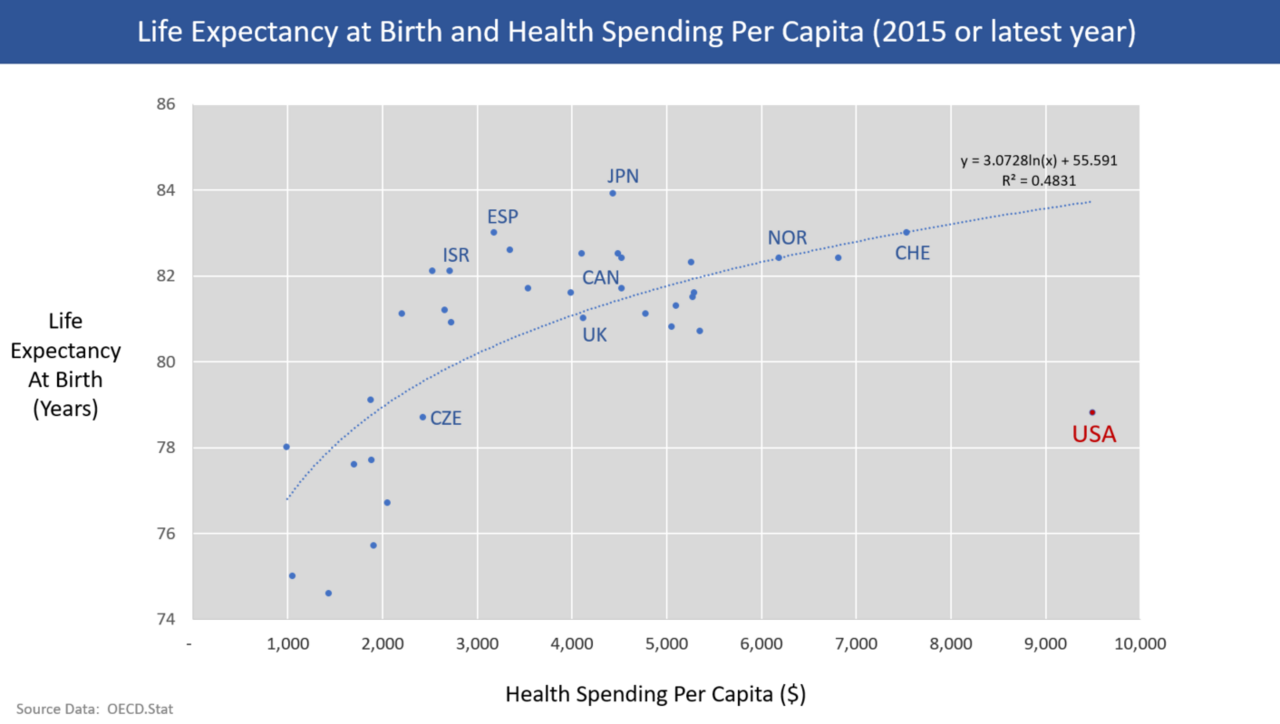
Edit: Has to be coupled with public spending in other nations to be complete. There is another article related to the graph [2] with another easy to understand graph [3]
[2] https://en.wikipedia.org/wiki/List_of_countries_by_total_hea...
[3] https://upload.wikimedia.org/wikipedia/commons/thumb/0/0b/OE...

Proportionately speaking, that means Americans are not taxed the same (higher incomes). Interestingly, based on what I'm seeing re: incomes, the /total/ healthcare expenditure is, as a proportion of income, the same between the US and western Europe.
Overall this seems quite unsurprising: healthcare is expensive, the US pays more and the government spreads it around less. Worth noting that health and lifestyle in the US is also "worse" (more cultural than healthcare related).
Even if there wasn't a monopoly I can only imagine the insurance company advising clients to use specific hand signals to indicate which network they belong to so the ambulance driver knows where to drive if you're incapacitated and can't speak. "Raise and wiggle three fingers for Blue Cross Blue Shield, and two for Anthem". Or maybe have everyone get tattoos on their arms with their insurance network details.
> How did an intern prescribe something to you?
He seemed young enough to be intern. I didn't specifically check his age or credentials.
1) strep throat is not an appropriate use of the ER.
2) codeine is not a course of treatment for strep or any other communicable disease. A course of antibiotics is mandatory.
3) strep infection cannot be diagnosed at first sight. Culturing is required.
2) I was expecting some antibiotics. But because I said I was in pain they gave me a "pain" pill I guess and sent me on my way.
3) For sure. I was expecting them to do some better diagnostics. Certainly after charging $400 (in early 2000's money, I would probably be more now).
1. Mom goes to doctor because of shoulder pain
2. Doctor prescribes "health spa" (wtf?) to see if the pain will go away. Apparently "spa time" is a common default prescription because the healthcare system is overrun with people that come in with sniffles and aches that go away in a few days?
3. Spa Time does nothing (as predicted); doctor orders xrays
4. Process/analysis/??? is taking forever; in the meantime we have moved back to USA
5. US doctor correctly diagnoses problem same day as initial visit and orders specialized PT that actually helps
If you're having an actual issue, you'd have to go to a specialized doctor or a hospital which has the equipment to actually diagnose your issue... such as an xray machine in your case. diagnosis is done right after taking the image, so you'd have had a similar experience if you went to an actual clinic
[1] according to the Finanzamt (german IRS) the average worker takes an additional 12 days of paid leave like that... additional to the normal 20-30 days.
I have a family member who's working in ER in a public hospital in France, she told us that there's a lot of people who come in for nothing, often abusing the free ambulance service. And apparently whenever it's raining there's less people coming in, all things being equal.
In the US, you need to be very careful with medical care. You should never ever go to a hospital unless you're absolutely sure that your life is in danger, and even then, you should research your condition first.
Also, don't have kids. The medical insurance premiums in the US are extremely high, if your employer isn't paying for it.
Nit:
Medical expenses are the top cause, not medical emergencies. Not that this is much better.
Yeah, it might be. But you also pay that in the US, to the same degree.
Why is it so common to think that US citizens don't pay taxes towards healthcare? They do, and just as much as western europeans. The europeans just don't have to pay those extra $3k. US healthcare costs twice as much per person as healthcare in other western nations.
And then it barely seems to cover any normal stuff.. physical therapy for son, still get $1k bill. Dental work for kids, another $1k.
And you are totally right all it does is make you think "is my kid really doing that bad that I should take him in?". Fuck having to get down to that mentality... I hate it, but it's the reality of the situation I'm in.
If someone is lurking outside our house, we don't think to ourselves.. "Hmm, should I call the police? I don't see a gun, he probably isn't too dangerous.. I'll just wait it out". No, you freakin call the police when you need it and don't have to worry about going bankrupt because of it.
Really sick of this backwards ass country we live in with regards to healthcare. I can afford it.. sort of.. but I have no idea how people below my income deal with day to day medical stuff. It's horrifying.
I’d actually just grab my gun and wait it out, assuming I wasn’t already carrying it.
The current training regimes generally do not emphasize de-escalation. Adrenaline-fueled escalations end up killing people that have not committed capital crimes, and likely never would.
There is, of course, also the possibility that the cops don't show up in a timely fashion, or don't do anything to help you when they do arrive, or even turn their investigation onto you, and that is not independent of cultural background or apparent skin color.
There are reasons for owning and carrying guns in the US beyond hoplophilia.
according to posters here, basic insurance is 800 dollars a month. Average net disposable income in Germany is 34K.3 a year http://www.oecdbetterlifeindex.org/countries/germany/
In the US, it's roughly 45K. So, Germans pay less for insurance, but not that much less, considering it as a % of disposable income. And this is for the basic public option. Many Germans pay for private insurance.
In Germany you make your monthly payments and if you ever need anything, it is very cheap or free. In the US you make the same payments and still pay thousands whenever you need care.
So what is being paid for in the US? In the German system you pay your money, you get your healthcare, in the US system you pay your money so you get the pleasure of being less over-charged when you need your healthcare?
That's an exaggeration. You make it sound like a definite whenever you go to the doctor here. That's far from accurate. It can happen, and way too often does, though.
[0] https://www.npr.org/templates/story/story.php?storyId=919714...
https://www.howtogermany.com/pages/healthinsurance.html#gkv
The public opinion which covers you and non working dependants is a reasonable 720 euros or aprox 800 usd or aprox 15% of wages whichever is less.
It's a remarkably bad system, a kind of "pessimum" solution that benefits only insurance companies as far as I can tell. I've also heard that it's run as a kind of jobs program that's designed to employ massive numbers of middle-tier management, clerical, and bureaucratic types.
The US has a lot of these worst possible outcome systems. We seem to like to take all the worst ideas from the left and combine them with all the worst ideas from the right. Another example of the worst ideas of both sides is zoning and urban planning in California.
Considering that, for the services you mentioned, in the US it is often a government itself sending the rhetorical you those bills, I think it is a bit more complicated than merely blaming capitalism.
Edit: does someone mind telling me why I am wrong?
Healthcare in the US is neither free market nor socialized. It's an absurd mess of both worlds combined into a singular nightmare.
It's like saying don't blame Catholicism, blame the Vatican. One is a direct expression of the other.
I think it's more a problem of local governments often acting as quasi-capitalist entities themselves. If charging people $1000 for a ride in a fire department ambulance reduces property taxes, why not?
> It's like saying don't blame Catholicism, blame the Vatican. One is a direct expression of the other.
Eh, I don't think that is accurate because the Vatican is Catholicism, not merely an expression of it.
Also, my point was that you can't blame one idea or entity for the state of health care in the US. There are a number of sociological factors that need to be addressed, including but not limited to extreme capitalist beliefs, belief in "rugged individualism", moralism, and xenophobia.
Perceptions of ideological bias on HN are in the eye of the beholder. Opposite ideologues see opposite bias, I assure you.
Edit: of course there are great people working in health care, but they get ground to pieces by the grifting machine.
[0]: https://en.wikipedia.org/wiki/Median_income#Gross_median_hou...
Hopefully the US is on the way to government healthcare, but for now it would be great to just achieve price transparency so people can shop around.
Without price there is no competition. Without competition there is no capitalism.
There are a million markets with information asymmetry and work just fine, and there are plenty of examples of cash-pay systems that work reasonably well for healthcare.
I disagree with OP that the problem is price transparency, but the healthcare market in the us is intervened in ways that prevent the classic workings of a market.
- Price transparency
- One price for the same service. The practice of charging $500 to the insurance but $10000 to the uninsured needs to stop. Maybe it's fine to vary by a few percent but there is no other market where the same product costs 20x more depending on who pays. If the excuse is that this is to compensate for non payers then let's pay for this from a separate pot.
I agree about emergency situations.
This is the exact point- you do not have the education to shop because you don't even know what you need to be shopping for.
Capitalists are perfectly fine with lack of price transparency or other tricks as long as it makes them money. They don't like competition.
What you are talking about is functioning markets.
In a free market, the assumption is that everyone is a rational actor that will work in their own self-interest. People that want to maximize returns are behaving as you'd expect; someone not wanting to maximize profit in a free market would be considered an irrational actor.
Which, well, there lies the problem. For a lot of markets, maximizing profit comes at a very human cost. For healthcare the profit incentive is to have as many barriers to avoid paying individuals as possible because their profiteering is orthogonal to your well-being in most cases.
This is also why many markets can be considered short-sighted because it's easier to make returns now than it is to gamble on long term growth, which results in smash-and-grab style of corporate takeovers.
Ultimately even if we did have price transparency for healthcare all of the issues would still remain. It just can't work as a free market and going further in that direction is just pouring salt on a rotting wound.
The only way you could possibly maintain free market capitalism is by, ironically, putting in rules preventing people from using the free market in their own rational self interest. Which is why I believe healthcare can't be fixed by making it free-er, simply because the rational self-interest of insurance companies is against that of the insured.
You can also the two, like in the nordic countries (or germany) where employee actually have voting power about the strtegic orientation of the company (actually i think employees are considered "owning" 30% of the issued shares or something like that). From a (weird) point of view, this is 70% capitalism, 30% communism.
Yep, that's how you think about medical problems as an American. Get used to it.
There's no capitalism in US health care system - you alluded to it yourself with lack of price transparency example. The key issue is medical cartel with AMA at the core who lobby hard to restrict supply of physicians as well as narrow scope of practice for everybody else. As a result you have people having to go through a gatekeeping 500k-a-year dermatologist to get a prescription for $250 creams which you can buy over the counter in the UK for 10 pounds.
Nobody really talks about medical cartel in politics because doctors are popular with average Joe - unlike insurance and drug companies.
This is true.
> The key issue is medical cartel with AMA at the core,
The AMA has basically zero power over any of the issues you describe.
> AMA lobbies hard to restrict supply of physicians as well as narrow scope of practice for everybody else.
No, the number of physicians is limited by the number of residency programs, which is determined by how much funding there is. Residency programs are not self-sustaining, so they're funded by Medicare.
> As a result you have people having to go through a gatekeeping 500k-a-year dermatologist
Most physicians take home a lot less than you'd think. The gross salary is misleading, because physicians also have high licensing, insurance, equipment, and continuing education costs. The gross pay does not take these expenses into account, and furthermore, these expenses are typically not tax-deductible for most physicians.
It varies heavily by region and specialty, but the average (not top - average) physician in a city like New York or San Francisco actually has a lower take-home pay than a mid-level FAANG engineer[0] in either city.
[0] e.g. an L4 engineer at Google.
That's a pretty high bar though.
Depends on what your reference point is. I think most people on HN would be surprised to learn that their doctor likely makes less take-home pay than the second-lowest level of engineer - L4, "SWE III" - at Google.
Your take home salary in the U.S. is typically 80% after tax (effective tax rate). In the EU it’s closer to 50% (or less). It’s much more expensive in the EU just not all at one time. That’s perception.
I do think we should have competition though and open pricing. Can’t decide to do something or not unless pricing is clear.
Also if you are upset about medicinal costs be upset at the medical schools. They limit the number of doctors intentionally to inflate salaries.
Having seen a seizure I would definitely call an ambulance if my kid had one for the first time.
Since you picked SF let's talk about that. You may take home 80% but then you pay state income tax, sales tax, real estate taxes etc.
In SF you are more apt to be paying 40% than 20 in total.
Then your premiums for health insurance for a family. The average family pays 5,714 in premiums not including actual health care costs.
Then you have to consider the situation of those who are less fortunate. In Europe it's a slide down a slope. Here it's a drop off a cliff.
Not really, procedures and the drugs themselves are much cheaper as they are usually negotiated on a national level. Personnel salaries are also not that high. If everything is cheaper you cannot argue that the total cost is higher.
UK government with it’s well known free public healthcare and similar culture spends an excessive 38.5% (2018).
PS: Government debt has the net effect of increasing the cost of government spending over time, which somewhat underestimates these figures.
Toddler had a seizure (first and last ever). Called 911. $1300 for a 1.5 mile (per Google Maps) ambulance ride to the hospital plus a $300 bill just towards "medical care" for the ride (none actually given).
Then $800 for the ER, and a seperate $400 bill for the doctor (who sent us home after telling us to come back if more occurred but otherwise give child's tylenol and go see the child's pediatrician on Monday).
Did I mention that both the ambulance company and the hospital have a local monopoly? There's no price competition, no choice to be made, nor could there be in a medical emergency.
The problem with all of these is: If it happened again, I'm genuinely going to think "is this an emergency enough to justify a $2K medical bill?" That shouldn't be how medical treatment is decided.
The whole "capitalism will solve it" thing just isn't working. I cannot shop around for medical care, I cannot see prices, and insurance is $1300/month for essentially no benefit (except to turn prices from bonkers to incredibly high).