They also designed in sound-absorbing walls.
We have a small highway section which was newly done (somewhere in Germany). They seemd to use a different composition and construction method, man, this road is soo silent, even at >200km/h.
Tire thickness is another factor, get the lowest speed rating tires you can if you don't need to go faster than 112 mph/180 km/h, the recommended speed limit of the common rating 'S'.
Of course you should avoid studded tires if you're optimizing for noise, but also All-terrain tires are going to be loud.
2. Smaller rims do not mean smaller tires. On a given car model, the outside diameter of the tire will be essentially fixed. If they have multiple wheel diameters, the tire sidewall height will change to accommodate the wheel diameter. Technically smaller-diameter rims actually mean larger tires.
I will defer to a blurb I just Googled: http://elevatingsound.com/your-guide-to-getting-quiet-tires-...
I'd love an affordable, reasonably well-constructed LiIon scooter, but it's not there. Definitely coming, but not here yet.
Imagine how quiet a city like Paris, Rome or Berlin could be if all vehicles were electric?
I can't wait for this future to arrive and the fact that I will enjoy it a decade earlier -- at least -- I'll owe to Musk/Tesla. More power to them.
Given that Tesla cars and anything with similar range is likely to be another 1000 pounds heavier than cars in it's class, the prospect for quieter cars is poor.
Stand on a sidewalk sometime and listen. At constant speed or slowing down electric cars vs normal cars are pretty similar, but be careful to compare cars of similar vintage. This is part of the way I think legislation that add noise to electric cars for safety is misguided. Compare a 2018 BMW, Lexus, Acura, and MB vs a Tesla. Any of them could easily hit you before you easily hear them.
https://helenair.com/news/crime-and-courts/helena-s-railroad...
I just can't see how the logistics of charging would work for more than a few EVs per city block...
1) People who live in urban residential areas in Europe don't typically drive very far on a daily basis. So charging doesn't have to be as common a thing as it is in the US.
2) Charging stations at work places. I don't know the numbers, but I would assume a decent percentage of Europeans who drive to work have a parking lot at their jobsite.
3) Highway rest stops. The "travel plaza" type of rest stop is common in europe and could accommodate intercity travelers.
4) Battery swapping technology may help down the road.
6) Your car auto drives itself to the charging station and drives back during off hours.
7) All this is moot, electric and self driving technology will so absolutely revolutionize transportation that these problems will not be applicable.
There are a small but growing number of street chargers available, albeit owned by different groups (presumably with rules and different payment routes) and with different changing and connection specifications. [1]
And of course, even if you're lucky enough to live fairly near a charging point, this doesn't make an EV comparable to an ICE car - as you then have the hassle/worry of finding a charging point, leaving your car where while it charges, and then presumably returning and moving it again, so as to free up the bay for someone else.
It's not insurmountable, but would take serious commitment from local government to change things significantly for street parking. I suspect it will come with time, critical mass of EVs, and some degree of homogenisation of the voltage and connector specs.
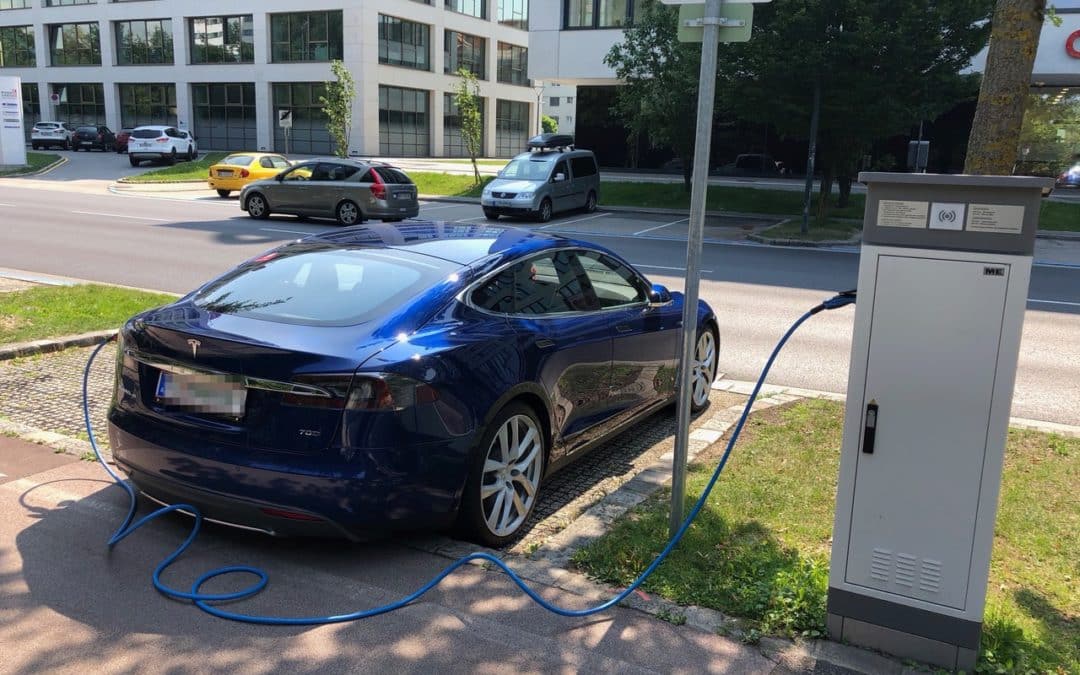
They don't need to support fast charging, 10kW AC would be more than enough when people charge overnight, and low power chargers like that should be pretty cheap to install at scale.
Filling a gas tank takes what, 10 minutes? Charging at a supercharger takes 30 minutes. That's more, but not ridiculously so.
For comparison, getting the same charge at home from the recommended outlet takes 4 hours. Getting the same charge off of a home outlet is something like 36 hours.
So yes, it can take a long time. But it doesn't have to.
It's a difference in magnitude that's the problem. For 5 minutes, of which half is spent actively interacting with the hose and payment, I can comfortably stand around. Anything more than that and I have to find something else to do while my car is occupied.
Which means that you can top off your charge while at the grocery store, or work, or whatever.
Tesla has tried to establish charging stations near shopping areas. There is generally lots to do. For example the last one I visited had multiple fast food places, an outlet mall and a casino. (This was in Primm, Nevada.)
US gas pumps are limited by EPA rules to 10 gallons per minute. A gas pump that is going top speed, filling a 25 MPG car, "charges" at 15000 MPH.
A lot of pumps seem to go at half that or even only a third of that, which in practice can cut that down to 5000 MPH, which is still much much faster than the V3 super charger.
On the other hand, I think I'd be much more likely with an EV to overlap charging with getting a snack from the convenience store (assuming EV charging stations have them like gas stations usually do...), whereas I prefer to stay with my car while gas is pumping, and so can't overlap that with the snack acquisition.
So maybe it evens out somewhat.
The only way filling up my tank would take 10 minutes was if I had to queue for the pump for over 5. Also, you get much less added range from those 30 minutes with an EV, so I really doubt it's a reasonable suggestion (even if superchargers were as ubiquitous as petrol stations).
You have to think of fueling up in a different way with an EV -- you're parked at home for many hours overnight, and at work for many hours too, plug in there if you can instead of making dedicated "fuel stops" like we do in gas cars.
(I drive a plug-in hybrid)
Teslas have a range of around 300 miles.
That really isn't a big frequency difference.
In practice charging a Tesla takes me less than a minute. "Remember to back my car into my driveway and plug it up."
16*24 = 384 miles of range. A Tesla should be able to do what, 300 miles on a charge? You shouldn't have to charge every day.
Can’t find the article atm
Is there a definition for mid-range vs luxury? I wouldn't consider a sedan that starts at $35K (with an average sale price of $60K), or an SUV that starts at $47K (over 50% higher than the median US worker's gross personal income[0]) mid-range. Both the Mercedes A-class and Audi A3 start at $32.5K even.
[0] https://en.wikipedia.org/wiki/Personal_income_in_the_United_...
I don't think that's a realistic assessment of where Tesla is at as a car company. Tesla is still not very good at the actual making of cars. For example, in the last five years Tesla has had more health and safety violations in their factory than the top ten automakers in the US combined:
https://www.forbes.com/sites/alanohnsman/2019/03/01/tesla-sa...
Tesla cars have among the worst reliability of any car brand:
https://www.consumerreports.org/media-room/press-releases/20...
https://www.truedelta.com/car-reliability-by-brand
Consumer Reports no longer recommends the Model 3 due to its lack of reliability:
https://www.consumerreports.org/car-reliability-owner-satisf...
In 2018, Toyota and Volkswagen each sold over 10 million cars:
https://www.autoblog.com/2019/01/11/vw-group-2018-total-sale...
Whereas Tesla has sold about 550,000 cars in 11 years:
https://en.wikipedia.org/wiki/Tesla,_Inc.#Sales
Volkswagen is starting its push into EVs. They'll be releasing multiple electric models across multiple brands every year from now on. Porsche, Audi, VW, Skoda, and SEAT to start. I'm sure there'll be electric Lamborghinis, Bentleys, and Bugattis eventually (if you're in the market for those):
https://www.reuters.com/article/us-volkswagen-electric-insig...
Volkswagen also wants to license its MEB electric car platform to other manufacturers. They already have one licensee:
https://cleantechnica.com/2019/03/05/volkswagen-wants-to-sha...
I think Tesla's main problems are that they are a small car company with an erratic CEO, inefficient and unreliable manufacturing, and they're about to face a lot of electric car competition from one of the biggest car companies in the world.
>For example, in the last five years Tesla has had more health and safety violations in their factory than the top ten automakers in the US combined
Because Tesla manufactures all its car in California, which has far stricter rules than other states. If other manufacturers moved their production there, Tesla would rank better than the competition
>Tesla cars have among the worst reliability of any car brand
And yet, Tesla owners keep recommending their cars more than anyone else, because the car is that good. There are many things that might no be "highly reliable" (even important things, like cars) that are so great to use that you'd buy them again against the current alternatives (like a Tesla vs noisy, polluting, gas-guzzling vehicles).
>In 2018, Toyota and Volkswagen each sold over 10 million cars
So what? How many of them are EVs? One could wonder how Nokia's sales were going when the iPhone started becoming mainstream…
>Volkswagen is starting its push into EVs.
They've been starting since 2009.
>Porsche, Audi, VW, Skoda, and SEAT to start
And yet, we just learned (no later than last month) that they are changing all their EV plan because their future models cannot compete with the current Model 3 (source: https://www.manager-magazin.de/premium/audi-bram-schot-will-...)
Two quotes from this article:
>The Porsche and Audi engineers have to change [the Premium Platform Electric program] because Tesla’s Model 3 has gotten better than they thought.
>The e-tron as the first electric Audi is not only late. It does not reach some target values and has become far too expensive with more than two billion euros in development costs. The approximately 600,000 cars sold for the break-even are now regarded as an illusion.
>Volkswagen also wants to license its MEB electric car platform to other manufacturers. They already have one licensee
Oh, you mean the MEB platform that is being holding up until they can come up with something that is on par with Tesla tech and cost? Ah!
That's just conjecture. Tesla has had a reputation of not being safe because of things like this: http://nymag.com/intelligencer/2018/04/tesla-workers-getting...
> And yet, Tesla owners keep recommending their cars more than anyone else, because the car is that good.
How does that make the original statement false? If anything, it establishes a pattern where Tesla owners are far more likely to overlook these issues because of how much they like their car.
> So what? How many of them are EVs? One could wonder how Nokia's sales were going when the iPhone started becoming mainstream…
The OP was pointing out that some people are looking through a subjective lens when they claim that Tesla is crushing it. In a broader picture when you look into the sale of all cars, it's really not as significant. Ok, so these cars are not EVs. So what? It's not enough to say you're dominant in a niche, albeit a growing one. When you're not on equal footing as some of the bigger name car companies, you're much more susceptible to being crushed competitively if those companies make a play in the same space. I'm not at all saying that will happen, just that looking at this point requires a bigger, broader perspective.
When you're facing technology transitions, looking at it as a niche is exactly the wrong perspective. Tesla is dominant in a field which is the future of automotive transportation. It is a small market not because it is a niche but because it is nascent. The difference is, strategically, very relevant.
ICE automakers are just realizing how far behind Tesla they are. I'd wager at least ten years. The model S was launched in 2012, VW et al won't be able to launch a similar offer before 2022.
Volkswagen will launch multiple models across multiple brands before 2022. The Porsche Taycan is launching before 2022:
https://www.engadget.com/2019/03/09/porche-taycan-ev-20-000-...
https://www.popularmechanics.com/cars/hybrid-electric/a21239...
And the VW ID Neo: https://electrek.co/2019/03/13/vw-id-electric-hatchback-pre-...
And the VW ID Crozz: https://www.youtube.com/watch?v=J8zbuvzEA5A
And the Audi e-tron Q4: https://www.cnet.com/roadshow/news/audi-q4-e-tron-concept-ge...
And the Audi e-tron GT: https://www.youtube.com/watch?v=VsXhl3ilU9I
And the Skoda Vision IV: https://www.youtube.com/watch?v=O72uf9DNakk
And the SEAT el-Born: https://www.youtube.com/watch?v=umwlXFoSAD8
Take the Audi e-tron for instance: the director of the Paris showroom (the only place in Europe where the car was displayed in public) himself told me late last year that they don't intend to sell the car in volume, that it can't compete with the competition, and that EV sales are mostly PR for a company like Audi (at least until ICE don't make most of the company's profits).
NB: this is not a regular dealership, but a fully owned and controlled store by Audi. Good luck with that!
https://www.cnet.com/roadshow/news/porsche-macan-electric-on...
You're not being realistic. Volkswagen will be the biggest producer of electric cars within 3 years.
Not least due to their outsized presence in the world's most important market for EV - China
And there have been many models launched before today. None are even close to model S levels of production volume, performance, range and battery durability.
If your reference is the Porsche Taycan, it is the equivalent to the Tesla Roadster: a low volume proof of concept. It is already more than ten years late (the Roadster launched in '08). If your reference is anything based on VW's MEB (VW, Audi, Seat, Skoda), add two years to publicized launch dates, as the MEB went back to the drawing board, deemed under-specced for what the market expects from EVs. This means production plants have not yet started to get designed, much less built, and are waiting on platform redesign and approval.
The Porsche Taycan will charge faster than any Tesla and won't suffer the Model S's overheating issues:
http://www.thedrive.com/news/5207/this-video-reminds-us-that...
You may also want to walk back the claims about overheating. In one of the press videos, a Porsche engineer explicitly says that the number of hard accelerations over a short time will be limited to 10, or so.
Here's a person sitting in one: https://www.youtube.com/watch?v=uvNw15W_EK8
Here's another person sitting in one: https://www.youtube.com/watch?v=tMEdiq2xTbQ
And yet another person sitting in one: https://www.youtube.com/watch?v=X2i8uS_q6kE
And another: https://www.youtube.com/watch?v=AZFcjJ-PCbs
Is that literal enough?
https://www.wired.com/2009/12/audis-electric-e-tron-is-real-...
That article is from 2009, a full decade ago. It's a prime example why people are very weary when it comes to VAG announcing concept EVs. It's not a contender until I can actually purchase one.
Any car manufacturer can create a concept EV with relative ease. That's the easy part. Taking it to production (especially at scale) is the hardest part.
There's no point trying to concoct a narrative that this is all somehow vaporware. You can pre-order your VW ID Neo in 7 weeks:
https://electrek.co/2019/03/13/vw-id-electric-hatchback-pre-...
Where?
https://insideevs.com/first-ionity-350-kw-chargers-denmark/
When will Tesla introduce 350 kW charging?
I just want to point out that Tesla's California plant is Just the old GM/Toyota NUMMI plant. The article insinuates the safety violations are greater than any US based plant operated by other manufacturers over the past 10 years, a time period which includes the era in which GM/Toyota ran the very same plant.
So I'm dishonest, Forbes is dishonest, Consumer Reports is dishonest, TrueDelta is dishonest, Autoblog is dishonest, Reuters is dishonest, Wikipedia is dishonest, and CleanTechnica is dishonest. We're all dishonest together.
> So what?
So they operate on a larger scale and they're better at making and selling cars than Tesla is. There's no point crying about it. These are simply the basic realities.
>So they operate on a larger scale and they're better at making and selling cars than Tesla is
You don't get it. They're better at making and selling ICE cars. Not EVs. No one is discussing the fact that established manufacturers are established, the issue here is the disruption.
Remember that Tesla is eating up market shares fast and at an increasing pace, and they already produce more than 50% of the entire battery market (including smartphones, stationary storage, EV, etc).
If you're forward looking, you could say Tesla "operates on a larger scale and is better at making and selling EVs". This reality may not be easy to recognize.
What disruption? Tesla is already behind on technology and soon they're going to be behind on volume.
The CCS charging networks are deploying 350 kW chargers, Tesla is not. Volkswagen is introducing the first 800 volt cars, Tesla is not.
And yet, Tesla owners keep recommending their cars more than anyone else, because the car is that good.
You know what that exchange reminds me of? Harley-Davidson motorcycles, back in the AMF days. Those bikes were known for being unreliable pieces of crap that would shake their own bolts loose. Wear comfortable boots if you own one. And yet their owners wouldn't be caught dead riding anything else.
I argue that when you spend nearly $100 on a car (or big bucks on a bike), what else are you going to say? "I'm an idiot and shouldn't be trusted with large sums of money."?
And yet, Tesla owners keep recommending their cars more than anyone else, because the car is that good.
Do you have a source for this?
https://techcrunch.com/2019/02/21/tesla-model-3-loses-consum...
Rav4 Hybrid also uses some Tesla tech. While unclear if they will continue to dominate market segments they enter, Tesla has been more successful than I ha d imagined by this point.
You're off by more than an order of magnitude.
Tesla sold 250k cars in 2018, and Toyota makes < 25k/day.
Not to mention the Tesla number is growing substantially, while the Toyota number is flat.
Is it zero exhaust? Where do you get your energy from? Is it from a caol plant? A nuclear plant? Its more you don't see the exhaust.
In the medium/long term, the trend is towards renewable energy power.
In the short-term, these cars, whether running on renewable or dirt-power, mean that we, and our children, don't have to suck up exhaust fumes.
"Thank you" are the words you're looking for.
No. Valid argument. For the moment we are shifting emissions from one place to another. While that might change in the future, for the moment the environmental impact only happens somewhere else. This should not be forgotten, therefore those uncritical claqueurs are misplaced.
No, we aren't. There are lots of renewable energy sources already on the market, and more coming online every day. You just have to be willing to use them.
In Michigan, as one example, for just one extra cent per kilowatt/hour you can have 100% renewable electricity in your home right now. No new wires, no extra setup.
Not really. The electrons all go through through the same wires regardless of where they come from. I think the extra cent does in some way incentivize renewable power, but you don't literally get 100% renewable energy.
Yes, you actually do. Consumers Energy literally generates that amount of renewable energy instead of the equivalent from Natural Gas.
You are technically correct that my home does not get the specific "renewable electrons" that the wind farm itself generated, since the grid is all interconnected. But that doesn't change the fact that the power company burned less Natural Gas that month, for every user who opted instead for renewable energy.
Burning gasoline in a car is far less efficient than burning coal in a huge power plant. The gasoline refining process is also power-hungry. As an added bonus, it's also possible to capture at least some of the pollution from a power plant in ways that aren't possible when you have to shrink things down to car size.
An average EV charged off a coal plant still pollutes less than an average gasoline powered car.
Check out the maps at https://www.quora.com/How-are-electric-cars-better-for-the-e...
Nope, still entirely invalid. Switching from combustion to electric in vehicles decouples emissions from energy consumption in transportation, which is step 1. From that point on, it's generally up to the larger players e.g. governing bodies, energy suppliers, etc. to make the switch -- but not entirely so. There's already enough funding/incentives on the table to encourage people to not just decouple emissions from transport, but to eliminate emissions entirely eg by powering via their own renewable energy setup. Prices have dropped by more than 60% in five years down to just over 3 dollars a watt, and if that trend maintains itself, we'll be under a buck fifty in the next five. The only way that trend keeps going is if everyone, large players and small, have access and incentive to keep buying and drive costs down.
But none of those trends sustain themselves if the necessary energy decoupling doesn't take place, and that's what electric cars are aiming to do in transportation.
hey, words have meanings. you didn’t invalidate the argument nor did you even argue against it. invalidating an argument would have been pointing out a structural deficiency in the logic. arguing against would be pointing out the falsity of one or more points with counterfactuals. you did neither.
it’s true that emissions are transferred from car to power plant, so that’s a valid argument (edit: because it’s logically sound, not just because it’s true). you accepted and built on that argument by saying it’s a good thing for a bunch of reasons. so your opening sentence was entirely unnecessary.
Different readers will infer different argument structures, but what I find interesting is that the assumed answers to the questions are conditioned on effort expended in becoming greener. So the questions are implicitly polarizing.
People with Tesla's who have taken steps to ensure zero emissions are more likely to respond no to each question. They are also more likely to do this, because they've invested significant resources toward producing an environment that doesn't have externalities. It isn't a random sampling. For someone who assumes no or for whom the assumption of no being possible is obvious, the implied argument is invalid. For others, it's easier to arrive at a yes to every question. Neither answer is correct though, because these questions are not able to be answered in a yes or no fashion. The actual answer is that this is conditioned on investment in green energy infrastructure. You'll notice many arguing in other comments to the effect that this is a boring argument, entirely on the basis of ongoing investment into green energy infrastructure. That doesn't happen randomly. They've thought through the implied argument structure and moved beyond it to the causally important factor on which the not quite an argument hinges.
And they call the argument boring; which it is, especially if you've ever bothered to consume any Tesla marketing since it tackles this question (spoiler alert: the efficiency gain is one of the reasons to buy a Tesla, not an argument against).
yeah, nobody tried to argue that, so i'm not sure who you're arguing with.
It was not a valid argument structure. The definition of valid is that an argument is valid if the argument structure is such that if the premises were true, the conclusion must be true. The stated conclusion of the post many parents is up is that the amount of emissions is higher. If you agree with me that this argument was not actually made, than you ought to agree with me that what was done must not be a valid argument: that conclusion is not reachable via the questions posed in the post, therefore, it is not a valid argument.
I'm a fan of syllogistic logic, so I shared your care for the definition of the word valid. Also, totally understandable to lose the context. This discussion is nested quite deeply. If I hadn't thought about the comment chain for an hour before giving my reply, I would have lost the context too.
The total systemic carbon footprint depends on the fuel and technology used for electricity generation in the particular country or region in question.
Electric cars’ carbon emissions can vary from similar to the average gasoline car (for countries with lots of dirty coal-fired plants) to less than half those of the best hybrids vehicles (in countries with lots of renewable power generation).
Well not exactly, we're replacing a product that will by necessity produce polluting emissions (and not only CO2, btw) from fossil fuels, with one that is able to use whatever source might be available, from coal and nuclear to solar and wind power. In programming terms, decoupling the responsibility of energy production from that of transportation, with all the flexibility that this entails. You become free to optimize energy production as a completely isolated problem from that of the vehicles that drive you around.
Thanks to regenerative braking, a Tesla gets the equivalent of 120 mpg, much better than any ICE car.
In fact the energy used in refining gasoline to drive an ICE car is a given distance approximately the same as the energy to drive an electric car the same. Which means that before you've accounted for turning the ICE car on, the electric car has already arrived at its destination.
https://www.nytimes.com/interactive/2018/12/24/climate/how-e...
In VT's case, they shut down a nuclear plant with no in-state replacement for the power, and now they buy 60% of their power from out of state. A lot of which comes from Hydro-Quebec, so it's often still renewable in their case.
In an ICE, every car comes with its own power plant burning gasoline to produce energy.
With electric cars, power generation is distributed among a much, much smaller amount of power plants. Upgrading those is much more expensive, but by upgrading one, you've instantly upgraded all the electric cars powered by that power plant.
Sure, many countries are still on coal. But there are other considerations as well. Cities are hotspots for emissions, and need not be. Another important point is that nitrogen byproducts form simply from the high temperatures in internal combustion engines, not just from fuel.
Nuclear still has exhaust, it just takes the form of waste heat dumped into some environment to the plant and then spent fuel, which needs to be managed somehow.
(I do think nuclear needs to be a part of the solution, but I'd hardly call it 'zero exhaust', unless you are strictly speaking carbon emissions.)
My main point, though, is that the idea these cars are 'zero emission' is only true in a localized sense. As always, there are tradeoffs that the elevator pitch tends to gloss over.
[0] https://afdc.energy.gov/vehicles/electric_emissions.html
edit: grammer
Renewable energy production is not in line with our peak demand times (noon, evening, morning to a lesser extend).
Somehow we need to be able to save the energy produces/harvested when it's not needed and provide it to handle the demand spikes to ensure grid stability.
If electric cars do take over, that will cause a substantial increase of needed power, something I don't know if it can today. Right now the USA hasn't built a nuclear reactor in decades. I would love to see a more distributed power network (I.e. every home has solar and wind power).
I can only hope we spin up more nuclear.
So even if power plants were as dirty as ICEs, it would be a win.
In less than a decade they've gone from one highly niche electric supercar to a luxury sedan, a luxury SUV, a mid-range sedan, and a mid-range SUV.
And in sales they're crushing competition that have been building cars for literally a hundred years.
So excited for the zero-exhaust future.