Astonishingly, crypto even less defensible.
The beauty line doesnt work, because then platinum shouldnt have any serious value despite its rarity (it just looks like silver basically)
The industrial value is laughable, but read comments below/above to debate that more at length.
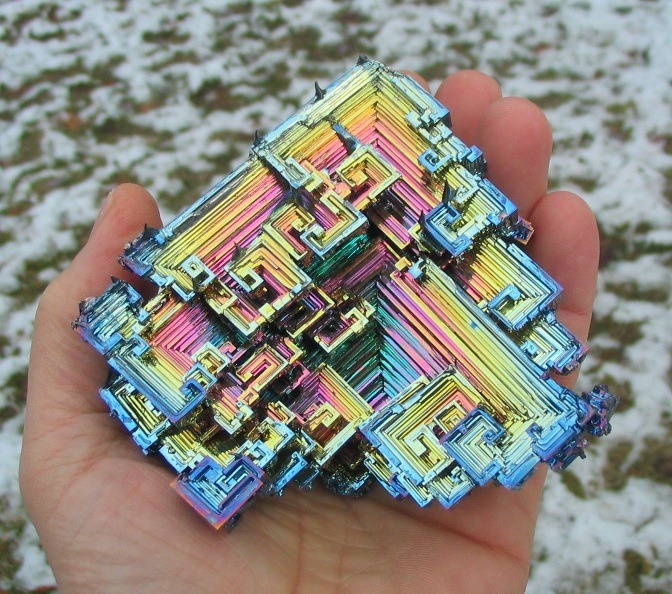
The scarcity line doesn't work, because you have elements like bismuth which are also (Arguably) more beautiful than gold https://66.media.tumblr.com/61ce390242a79a767772d4b2027eb902... but command prices far less despite being .025 vs .0031 on the PPM abundance on earth. Or even look at ruthenium which has a similar look to platinum and is even rarer than gold. Did I mention it also goes for about 400 an ounce? Quite a savings over gold.
The only thing that makes sense is that we as a collective have decided gold has value of X.
Bismuth's attractiveness is subjective, but what is not subjective is that it's found in ore in mineral form, not in pure form like gold. It's also brittle, and not easily worked to jewelry by primitive methods like gold.
Anyway, agree that gold is largely assigned it's value based on social reasons. Also would say that, in spite of its many faults, it's a much, much better investment than cryptocurrencies.
I'm not going to argue that, on the basis that crypto is super volatile and has potential to outperfrom etc etc. Gold is a far safer store of value, a much better hedge against market turmoil, and generally easier to "own" at low risk of having it nabbed.
thats true for anything. that includes currencies, what you get paid, the value of a hockey card, the value of a car, the value of a banana, etc. sure, if society doesn't want to pay you anything for 'it', you can do with it what you want, like eat the banana (before it becomes worthless to anyone).
I am not a gold bug, i personally dont think its a great investment. its not a hedge against a declining market, and its difficult to own in large quantities. however; statements like 'its only valued because people give it value' are not very informative. everything is valued that way. everything.
also, the industrial value of gold is not laughable. its negligible because we have plenty of gold to meet industrial needs. but its not laughable, its in your smart phone, its in your desktop / laptop, etc.
Currencies have value because entities with monopolies on force (countries) give them special legal status to be used conveniently as means of exchange. This is one of the hurdles for Bitcoin, and was a big source of debate in 2016-2018. Every time you spend Bitcoin you have to keep track of the avg. acquisition cost and resulting realized capital gains for every transaction to be able to declare the appropriate gains or losses on your taxes at year-end. A heavy burden for a "currency".
> statements like 'its only valued because people give it value' are not very informative
If you go to first principles, sure, everything is an illusion. But gold, crypto, and other "stores of value" derive their value in fundamentally different ways than everything else. Our existing models and body of knowledge do not apply to them. This is worth investigating. All other things are consumed in some way or another, and the rate at which they are consumed, relative to their supply, determines their price. The consumption of gold relative to its supply is much too low to justify its price using the same models.
Things like cars and bananas are useful outside of being a medium of exchange. You can use a car to get around, and you can eat a banana if you are hungry.
Dollar bills and Gold are useful as long as society agree that you can exchange them for cars and bananas. When society stops agreeing that currency is worth anything (i.e. hyperinflation), money becomes worthless and people throw it away or burn it.
Typically, printing excess currency is what causes it to lose value. Gold avoids that because you cannot just "print" it - you have to physically mine it from the earth by exerting effort.
- divisible (including literally soft to divide)
- fungible
- identifiable
- verifiable
- scarcity tested (people have been looking for, and trying to create, gold for so long without success that supply estimates can be trusted)
And the big one: branding.
Money is only useful when everyone uses it. It has one of the most powerful network effect of any system. The fact that it was successfully used as money for thousands of years, and everyone knows it, making it the default non-fiat money in terms of mind-share - has enormous value. Are you really going to try to convince everyone to exchange bismuth instead when fiat collapses?
It isn't. You just don't seem to understand how it works.
> Animal manures are a valuable source of nutrients for crop growth. But, since every farm operation is different, each manure will have unique characteristics. Make regular laboratory manure analysis an important step in your manure and nutrient management planning. Understand that the total nutrient content in manure is not available the first year and that some nutrients may be lost depending on management practices.
https://extension.umn.edu/manure-land-application/manure-cha...
never mind, I see others have already proceeded to do that.
Bitcoin is beautiful to maybe a few hundred people.
Large corporations don't usually light money on fire for no reason.
I'm talking about industrial usage - like the contacts on your CPU. Gold offers a unique combination of very high electrical conductivity and near-immunity to corrosion.
Industrial use has gone down. They have started using other metals. As an example, the Pentium Pro used significantly more gold than modern CPUs do.
If true, gold's value has not risen, the currency's value it is being measured with has gone down.
I've thought about one from a conceptual standpoint. In finance, many buy-side firms are collecting the same alternative data. This might be anything from consumer reviews to executive flight traffic data. So, could the buyside band together to create "Bloomberg"?
More buyside firms now have data science teams, and with the explosion of alternative data, you could make the argument that the DIY is too taxing for one firm and the vendor is too slow at incorporating new datasets, and merely is the middleman. I don't think a hedge fund would give away its secret sauce, but much of this data eventually becomes table stakes.
I've thought about whether a token could be created to provide an incentive for firms to build and share datasets. Tokens could be rewarded if a large number of other firms use/read from a particular dataset, or another firm could fork a dataset to clean dirty data and potentially tokens would flow to multiple firms in this instance. More firms using the network should lead to more data and a more valuable network/token.
Gold as metal has something more than what makes it scarce and valuable, something we have yet to discover. There's a good reason why all central banks of all economies(US,Chine,Russia) are holding on to gold as much as they can and buy/steal more of it as the opportunity arises.
If most people investing in gold are using it as a store of value, it says nothing of the other uses for the material.
When you're making an investment in something, it's a feature for that thing to have more, not less, potential applications.
Yeah, gold is kinda similar to bitcoin, kinda different. I don't think much of what has been said is particularly new to most people.
Granted, fiat has some major advantages: momentum, required for taxes, no capital gains tax, etc. But neither is a productive asset.
Not that paying taxes is bad. It helps keep inflation down vs the government just borrowing all the fiat it needs from the fed. However, if you try and run your whole life in gold or bitcoin or whatever you just can't do it legally.
Historically there has always been a shortage of capital, and plenty of productive enterprises competing for that capital, so investors have received a discount on expected future earnings. But I think the case can be made that in the current economy, there is no such discount. That appears to be Buffet's stance, judging from his public comments. He says that he doesn't practice market timing, but simply can't find many worthwhile investments.
That is changing with the next breed of cryptocurrencies like Stellar and EOS. Take for example https://intercoin.org (disclaimer: working on it). It is explicitly designed to solve real problems, and the applications are listed in the video.
I consider Bitcoin and Ethereum to be the myspace and friendster of the industry.
Why Intercoin looks like a scam
Why it’s ridiculous to be calling Bitcoin and Ethereum the myspace and friendster of the industry when they are literally the first movers and have been around for 10 years but painted themselves into a corner and are unable to scale - no one uses bitcoin for real world transactions and projects building a token on ethereum who needs it to be actually used regularly says they’ll get off ethereum right in their whitepaper (Kik Messenger for instance).
How can you say Intercoin (or EOS or SAFE network or Stellar) has no advantages over Bitcoin and Ethereum, what planet are you on?
We have half a million lines of public code written over 7 years. We have been trying to fix decentralization for longer than you knew about crypto. And MAidSAFE has been doing this for 12 years!
Why would “projects like this” be “burnt out of the space” in the bear market, when I just said they are the future of the space, which has stagnated?
The promise was utility tokens and ICOs, where the tokens would be presold and the network would be owned by the participants instead of extracting rents. Tht was the dream. That was chilled by regulators, in favor of security tokens.
This reaction is what’s ridiculous. Imagine me saying this about MySQL for instance, or Wordpress. It looks like a scam guys. It has no advantages over current first-gen database systems or CMS, and there can never be anything better
Do you really, honestly think that a system burning more electricity than most countries to do 7 transactions per second, where each full node needs an ever growing amount of memory to even join the network, is the best BFT database and distributed ledger that can ever exist?
Look at other projects like Holochain and Maidsafe. Look at the evolving EOS ecosystem. “People” who dislike cryptocurrency hardly know what’s going on it. “People” also disliked the Internet, the Web, social networking, and thought it was a fad. At the very least, answer my questions point by point and bring some substance. Other people are working for years on free open source software, instead of cushy jobs at some cushy VC funded startup, which is likely to fail, and you are calling THEM scammers because...?
You do realize that these projects produce open source software AND are looking to build a decentralized ecosystem where you no longer have to extract rents and have middlemen like Facebook which can be hacked, influence elections etc. And meanwhile you say once these projects are burned out and we go back to ethereum THEN finally we can get back to the business of decentralization? Ha ha ha.
If you haven't played around with EOS and are interested in blockchain computing you should check it out. Being able to write C++ code and deploy it on chain is pretty dope.
I'm arguing that cryptocurrencies don't have the same economic model as most startups - which is essentially the expected future value generated by their operations discounted to the presented.
There are startups within that definition that have a low probability of achieving such - but it's the same fundamental economic model that applies to Apple that applies to a seed-stage biotechnology startup.
This doesn't extend to cryptocurrencies - given that currencies don't generate operating cash flows.
We may not be disagreeing, I took "this market is a bust" and the picaxe seller analogy to mean that you foresaw cryptocurrencies dying out completely, but you may have just been referring to the crash that's already happened.
...I hear they use Monero
The "store of value" argument doesn't mean anything. Beanie Babies, tulip bulbs, and Hummel Figurines are also "stores of value".
Also, what was the false equivalence?
Can I interest you in a share of Bear Stearns?
Anyway I’m done with this, I don’t even have a horse in this race.
In terms of the "market being a bust", the statement was a criticism of the current valuation of the cryptocurrency market - particularly, that it is based on a cauldron of unholy factors that I mentioned in the first post.
http://www.niemanlab.org/2018/11/i-had-to-borrow-money-to-pa...
Before this huge speculative boom, shady characters could use cryptocurrencies to buy drugs and launder money.
Now, with KYC/AML implemented by exchanges worldwide, plus the outright banning of the coins in some countries, those activities are much more difficult.
If you want simply transfer money internationally, services like TransferWise do it better than any coins.
Of course there is. You are just starting from your ideology (that there must be no value to them) and work backwards to your dismissal and so you have closed your mind to the possibilities.
Here's 1.8 trillion of possible value, just to help put things in perspective
http://www.colorsmagazine.com/stories/magazine/85/story/drug...
Not saying it's right. Just that there is much you have not considered.
The startups that issue the digital commodities are doing ok and can still raise.
The digital assets they created would be valued more by their utility and scarcity, which would have ebbs and flows just like a commodity. It is fine that they dont have utility or scarcity, if the infrastructure and ux around them improves than they will and you can pick them up from the lows. There is a reason that commodity trading never made it into the retail investor portfolio, as there is no reason to have passive investment in them
As long as you, and the retail investor, continues expressing their unfamiliarity with this market through equity investment analogies, the information asymmetry will maintain massive and advantageous to those that do have a valuation model.
As far as I can tell, the primary real-world use case for cryptocurrencies today appears to be money laundering.
It's pegged to the USD using crypto collateral.
I also think those who think crypto is only useful for speculation or crime are very much stuck with the 2013 opinion of it.
I haven’t heard of nearly half of them and can’t think of a legitimate use for the ones I have heard of.
The only reason international payments can be somewhat expensive is because of all the regulation involved into balancing a global currency system and making sure you're not funding the wrong people.
The reason we have lawyers is because the law is not just black and white. As many examples have shown, pure robotic management is not conducive to how people actually do business and the messy nature of human behavior.
The result of this unfalsifiability is the rapid "boom-bust" bubble cycles we see in crypto prices:
- 'informed' speculators buy early on the thesis that 'the old problems have been fixed from the last bubble.'
- typical bubble dynamics play out like 'greater fool' and 'your plumber is buying' rise up to the peak
- "problems" are brought to the forefront in the speculators' minds in response to events (in this last cycle, it was 'the network can't scale' in response to DoS attacks and 'the SEC is bringing the hammer' in response to their memo(s) for example)
- alternative, more foundational valuation measures fail to emerge through the cycle other than the primary hope and speculation in the promise of cryptocurrency, and so the bubble pops once a few whales start harvesting gains
- people lick their wounds, the press stops talking about crypto for a while, and people stop checking the tickers. developers are further enticed to keep working in the space because they can optimistically whiteboard out theoretical solutions to a good chunk of the "problems" (the ones that are due to technology or design limitations.) this is happening right now within the ethereum community, all hope is being pinned on the next set of features.
- in 1-2 years when plausible 'solutions' to the primary problems identified in the last cycle emerge the cycle repeats. note this doesn't mean they actually need to solve the problems, just be plausible enough to induce FOMO in early speculators that 'crypto's time has come.' if you recall this cycle there were memes that took hold around ethereum smart contracts being the missing piece, and that ICOs were going to incentivize innovation properly.
the only way in my mind that this cycle breaks is either a) a more grounded valuation metric comes forward based upon demonstrated value for crypto which rapidly causes some kind of pseudo-market efficiency (but still lots of vol) or b) interest in the ecosystem wanes so much (due to other emerging tech stealing talent or enough people being burned) that the brain drain causes the tech to stagnate and the sentiment that "crypto is dead" takes hold alongside this inertia or c) some fundamental flaw eradicates so much wealth so quickly that it affects most people in the economy. These seem hard to imagine right now, so my guess is we have at least a few more cycles.
Two signals that the ecosystem is perma-dead (if you ask me) is if we see:
- No active development going on due to "emotional capitulation" by most all tech talent (def not the case now)
- We see a crash which directly affected a large % of 401ks (not possible bc bitcoin et al are not fully securitized yet)
Market price action in and of itself doesn't say very much (to me) about if we will see another cycle.
Tech talents' emotional capitulation vs the fact that at this point many are financially independent and free to do whatever they want is also an interesting dynamic.
What would you pay for something worth 10^13 with a probability of 10^-10? Yes, it is more gambling than investing. But still...
* ahem *
The argument made was that time travelers would go through the effort to punish miners, of all people.
There is a lot of other senseless wasting of energy going on theses days.
It's pretty hard to objectively judge what's a waste of energy.
My biggest concern is that a lot of crypto mining was and still is coal powered. I'd probably care less if it was all solar powered.
I don't like if they burn coal for it, but there are also other energy sources, sometimes there is even spare energy that needs to be used somehow.
- Digital currency is a new asset class and an improved form of money. Money as a concept has been around since the dawn of recorded history and it has gone through a number of iterations since. We have only been using nation-backed currencies for between 100-200 years depending on where you set the departure from the gold standard. For most of human history, we have had "hard money", meaning that no one had the power to inflate our money and lower its value(through gold). Nations have that ability today, and it has had far reaching implications. Digital currency has the potential to reduce or eliminate government control of our money. If you think this is a libertarian vision, you would be wrong. Just look at the internet and how it has quickly changed the publishing industry. Digital currencies are also programmable, meaning they have features that normal money simply does not have. Shared custody of funds and time locked funds are just two great examples. - Digital currency paves the way for superior payment networks. The ability to send digital currency is cheaper, faster, and more global than any payment network ever invented. Our traditional financial system is steeped with trust-based relationships, manual checks, competing parties, and fraud. This results in inefficiencies from top to bottom. This all results in bank wires taking between 4-14 days, whereas a digital currency transaction takes an hour to settle on average. In the future, digital currency will also be capable of sending smaller value transactions than ever before.
If you think that aspects of this industry are ridiculous and mere gambling, you would be correct. As a person in the industry, I tend to ignore much of the industry. That being said, there are some incredibly novel ideas that are motivating the best of us to get this system working. If we succeed, we will have a much more open, fast, less expensive, and global financial system to use.
I’m not saying banking is evil by any means, but I do think the whole industry could use some competition. The industry moves super slow, and I think digital currency would make things far more competitive.
I think digital currency’s improvements to money, that I mentioned, are the point.
Your analogy is flawed though, Coinbase wouldn't be selling pickaxes they are simply providing a means of digital asset exchange as well as selling the digital assets directly. Mining hardware would be the pickaxe.
Like it or not, it's a phrase that dates back to Mark Twain that has far more baggage than some strict analogy made up on the spot. For instance Chris Dixon here[1] suggests that Heroku and Akamai sell pickaxes, not dynamite as a service or scalable ore transport systems.
All I'm doing is defending the GP's use of the phrase, which was absolutely valid. Perhaps you'd have used a different analogy, but it doesn't invalidate his. No quantity of curt denials you care to throw my direction will change this.
[1] http://cdixon.org/2011/02/05/selling-pickaxes-during-a-gold-...
Creating mining hardware is actually more speculative than an exchange, because you're picking winners and losers based on what your hardware can accelerate.
Selling pickaxes to miners has been used to describe platforms like CDNs or game engines like Unity. The fact that there is something called a miner in this context is a red herring.
A metaphorical one, I mean.
I don't think they are speculating though, they are simply doing what they do and have always done. Provide a means of exchange from national currency to digital assets. It is up to the people who build around these protocols to create more ways of utilizing these digital assets through services.
It's hard to say what's going on in this market but I don't think it's a bust. A lot of money went in really fast and then huge sell offs from Mt Gox recovered bitcoins. Bitcoin is still somewhat interconnected in price with most altcoins because of pairings, and any major selloffs seem to drag the whole market down. I think it will mature in time and more people will actually utilize cryptocurrency and not just buy it for speculative reasons. Value will be established over the next few years as practical use grows.
This market is a bust, and there's no value-driven economic model to justify cryptos collectively being worth $50B-$100B.
With any startup, there is an expected future value of the company discounted back to the present. It then just becomes a risk-weighted probability question of whether that startup will achieve that expected future value in the expected timeframe.
Conversely, the valuations of the crypto market are driven mostly by momentum and prayers. It's ultimately a case study of what happens when you mix unsophisticated investors, no regulation, frictionless market entry, memes as an investment philosophy ("HODL") and the psychological highs of winning a lot of money. It's gambling, not investing.
In terms of Coinbase - sure, they're selling pickaxes during a gold rush, but gold rushes end and the pickaxe salesmen go out of business too.