For beer, especially, the main distinction between basic German pilsners (I live in Berlin) was the social class that they're marketed to. Price is a pretty poor predictor of quality or taste, but you can choose to spend anywhere from about 50 cents to €1.20 to get almost indistinguishable beers. That doesn't mean to say that some aren't better than others, but that price isn't a good predictor of where they fit on the quality scale. (With craft beers things are pretty different, however.) There are very obviously working class beers, professional beers, etc.
With wine, my impression that almost everything that was sold at a grocery store broadly fit into the category of generic cheap wine. There is a weak correlation between quality and price, but if you sampled a bunch of them, it wasn't hard to find bottles at €3 that were better than the average bottle at €6, and bottles at €6 that were as good as the average bottle at €12. (They don't get much more expensive than €12 in grocery stores here. Note, wine is about twice as expensive for the same quality in the US, in my experience.) Notably, none of those wines would be truly interesting, just better expressions of their archetype.
The most interesting way to taste wine that I've found is at high-end restaurants that do pairings. Having a professional that just picks out interesting wines that they think fit with particularly quirky dishes has yielded more interesting results for me than the handful of wine tastings I've done. They'll bring out stuff that's truly weird and interesting if you're used to grocery store wine. And here at least, once you've, ahm, stomached, what you're paying for the meal, the glasses of wine aren't exorbitant -- about €8/glass, even at a place with a couple Michelin stars.
Relative to the other categories of booze, the place where I have genuine expertise is whisky. I have a large collection that's, well, worth more than my car. The beautiful thing about whisky, however, is that you can keep bottles of different things open for years and compare them to each other. That makes it pretty easy to figure out where you get the best bang for your buck. Over about €35/bottle, there's not a particularly strong correlation between quality and price. There are even some fantastic whiskies below that that punch way above their price-class (e.g. Laphroiag Quarter Cask, or Rittenhouse Rye). While there are some particularly unique and great expensive whiskies, even for a trained tongue and nose, it's absolutely no guarantee that a €100 bottle will be better than a good €40 bottle. Often it will just be rarer, and stroke the whisky-nerd ego to a greater extent. ;-)
I can highly recommend becoming a member of SMWS, if they're in your area. They have some extremely interesting bottlings, and everything is presented in natural style, cask strength.
My experience is as above, though. I've been searching for something a little more affordable as a "go-to" and I've been hard-pressed to find something.
The last is obviously a privileged thing that not many can do, but if you are traveling, absolutely ask the locals what regional wines you should try, and what years. The weirdest & best wines I've had so far were in Delaware, Central California, Spain, Israel, South Africa, and Central France.
For example, I did a tour of some of the dozen wineries in Delaware (who knew?) and tried a varietal I hadn't heard of before: Norton. It's basically the only native American grape which is practically suited for winemaking, and has been in use since the 1700s. It was once so popular that a Missouri wine using it won "Best Red [Wine] of All Nations" in a competition in Vienna in 1873. The one I had was really weird tasting, and I highly recommend it.
Or so I thought. It turns out that even going to weekly tastings you don't stumble into the funky stuff. You'd never stumble into dessert wines or wines made with wild yeast. You'd rarely stumble across their barrel-aged whites. They knew what sold, and they'd highlight that.
I still order a case (12 bottles) or so a year from my favorite winery in southern Germany, where I met the vintner in said department store. I've even stumbled across one of their bottles from the sommelier in my favorite restaurant in Berlin. But it's truly only from high end restaurants (and their drink pairings) that I've discovered how wide the palette for wine goes. Not to put too fine a point on it, but I've been to Noma, mentioned in the lead to the original article, and their wine selection, like with most top end restaurants, is genuinely palette-stretching.
The spouse and I did a blind test on about 20 beers sold in mixed six-packs in the grocery store, and as a result switched our staple cooking-and-drinking beer from Yuengling Lager (amber lager) to Dos Equis Ambar (another amber lager), with the North American (Coors) version of Killian's Irish Red (actually another amber lager) also beating the incumbent. We both hated the pilsners and the IPAs, but disagreed on the darker varieties. We did agree that Guinness Blonde (an "American" lager) was the worst thing ever sold anywhere. We awarded it last place, and someone else ought to take mercy on its soul, because we will damn it forevermore whenever we hear its name (torment be upon it).
It's a bit more difficult to do wines, because it's really hard to find them in 12oz. bottles. So the wines get a series of "challenger versus incumbent" blind comparisons, between only two wines at a time. We have progressed as far as determining that we both prefer sweet to dry, and that some of the cheap stuff is better than some of the mid-priced stuff. The current champion is a sparkling fruity wine from Costco, which isn't always in stock. That said, some cheap wine is truly awful. Plenty of the stuff we try gets immediately demoted to cooking duty.
It's a lot more difficult to test distilled liquor, mainly because critical judgment deteriorates when you're drunk, and it wouldn't really be cost effective for us, unless we went to a bar with a half-dozen different brands on the bottom shelf. Six 375mL bottles of vodka would last us about 2 years. Some of the cheap brands don't sell in smaller bottles. And we would have to retest each after putting some through the pitcher filter.
If everyone did blind taste tests, I think the market for expensive "premium" liquor would collapse. So much of what you pay for at the upper end of the scale is just brand posturing and vapor.
I like really peaty, smoky whiskies. What would you recommend on the cheap end?
Another old standard of mine is the Talisker 10 year old. It's about the same price. It's not very complex, but has a powerful single taste. (When booze tasters say "complex", what they mean is that the taste changes over time from the moment it hits your tongue to the last bit of aftertaste. Something that "only has one note" isn't complex -- it means that it tastes the same in the aftertaste as it did the first moment. But "complex" isn't a euphemism for "good" -- it just means "changing".)
If you want to splurge a bit, two whiskies at about double that price are:
- Ardbeg Corryvreckan: in my not-so-humble opinion, better than Uigedail (that exelius remommends below; I have open bottles of both). It's so packed with flavor that it's a bit overwhelming. Also bottled at cask strength.
- Ben Riach 17: Not from the islands, like most peated whiskies, but has a mix of tastes of Speyside and Islay. Sadly, looking now, this has also recently gotten a lot more expensive. A couple years ago it was about €55, now it's €95.
A young-ish but well dressed lad next to me was eyeing off the selection. Clearly wanted "a whisky" but had no idea what.
"Talisker is an excellent choice", I said, knowing that some of the heavier stuff – I go for a Lagavulin – would probably be a bit too much for his uninitiated palate.
He looked at the bottle. He realised it was "only" ten years old. And he said "no, I need something older".
I let the foolish young chap make his own decision.
(Oh, and curse you Americans for your ludicrous booze prices. A bottle of Lagavulin 16 here is $75.)
But beyond that, Scotch ages particularly slowly, because it, by law, can only be aged in reused barrels. A 10 year old bourbon is as old as the stones, because the barrels are, unsurprisingly, most reactive before being soaked with spirits for several years. Scotch, uniquely, mandates that the barrels cannot be first-use -- they have to be reused barrels from something else, which necessitates the very long aging times.
Edit: I don’t believe there is a requirement in the law to only use previously used barrels. They are just cheaper (boubon IS by law required to use only new casks, which results in a lot of availability), and aren’t quite as active, allowing for more gentle maturation.
For sure the 30 year old bottle is €300 compared to €30 for the 8 year old, and it is hard to rationally say that it is ten times better, but it is _different_ and it tastes great.
I'd never pick a bottle based purely on the age, but there are differences and I personally tend to gravitate to the 18+ ages when I'm picking my single-malts.
I'll readily admit the heavier cost is easier to swallow given our petrol and electricity prices.
edit: petrol instead of gas
If you're willing to scoff at the law, you can get something that tastes similar to a well-aged bourbon from an unlicensed distiller at a very low (relative) price, and any time you might have to wait for it is mostly because their trustworthy high-volume purchasers can jump ahead of you in line at any time. The moonshiners use tricks to flavor their product that are prohibited by law to anyone that wants to sell "bourbon" or "Tennessee whiskey", but since they're already outlaw, it doesn't cost them anything extra to put charred wood splints in a vat instead of using whole wood barrels, and forcibly cycle temperature and pressure to simulate the barrel-aging processes.
This area is just swimming in cheap grains, especially feed corn (aka maize), soft red winter wheat, barley, rice, rye, and sorghum. You can make beer out of any of it, and distill any beer into hard liquor. If you strip it down to pure azeotropic grain alcohol, you can dilute it back to 80 proof and add whatever flavors you want.
Some of the old-school outlaws have "gone legit" and sell their stuff (largely outsourced to one big industrial distillery, with one tiny local distillery kept mostly for show) as "flavored vodka" now. But that's just as expensive as anything else, because now they pay their taxes and comply with the laws and regulations.
It really is ludicrous. It is so cheap to make liquor here.
What do you think about Bruichladdich (sp?) ? Edit: I see /u/YeGoblynQueenne just suggested the Port Charlotte; that's the only one I've tried.
Actually, I now remember, I once saw Laphroaig's "Black Adder". It was so peaty, that they actually had pieces of charcoal in it! Didn't get a chance to try it though.
(If anyone saw an earlier version of this comment, I'd written it about Bunnahabhain, another Islay whisky, and one of my favorites.)
What would you recommend for smoky scotches that don't have much iodine? (Talisker is on my short list right now.)
The cheaper versions of that would be, for example, a Redbreast 12 (Irish) or a Glenmorangie 10. The only Highland Park that I have sitting around is an 18 year old, and I just compared them to that (again, the nice thing about whiskies is that you can put a few drops in a glass for comparison), and while they both have a little less to them than the 18 year old, they're also less than half the price. If you're feeling like branching over to the fruitier side, something like a Glendrodach 15 would be worth trying. It's not soo far off from the others, but tastes a bit sweeter and is a bit more complex.
If you're committed to smokey, non-iodine-y whiskies, Talisker is good, as noted. Maybe a Bowmore 12 (a little sweeter), or, if you find it, Ardmore or a Ben Riach. But again, it sounds more like your tastes go away from the smokey stuff to subtler whiskies.
---
A thing I'll note for the uninitiated here is that another nice feature of whisky is that there are literally only dozens of distilleries. There are something like 80 in Scotland. For a whisky nerd it's entirely possible to have a good 1/2 to 1/3 of them on a reasonably sized shelf. And since bottles take several years to go off, you really can have a huge percentage of the total range represented in a moderate whisky nerd's collection.
However, I love wood smoke, so I'm intrigued enough to keep at it. I'm trying out some non-smokey whiskies too; I had a glass of Macallan 12 that I enjoyed quite a bit.
The last few glasses I drank were really disappointing compared to the initial fanstastic glasses. I can't describe the tastes, but it was simply not good anymore. When too much air gets into the bottle, the Whisky can oxidize, changing its taste (usually for the worse).
I haven't attempted whisky much yet, but I believe that you trained your taste to appreciate the domain and recognize the subtleties within that domain enough to appreciate something you didn't immediately.
I say this as someone who's gotten into music genres I hated 10 years ago, forced myself to try cilantro, olives, more pickled food, and regional cuisines to a point where I appreciate all of it, and can tell well from poorly executed within those areas. I'm not sure we can force ourselves to like everything, but I'm living proof that we (sample size of one) can force ourselves to recognize quality in every domain.
I would be keen on whisky if it wasn't for the fact that I rarely drink to begin with, and the price is non-negligible.
I started trying out whisky when I realized that for the amount I drink, the price even of fairly expensive whiskies didn't add up to all that much each month.
So you're in the same situation as me, yet arrived at the opposite conclusion, and I think you're probably right. :)
I'll reconsider my stance and will pick up a couple of bottles and dip my toe.
But seriously. My Irish mate started me on it and I really didn’t enjoy it at the start. But he kept buying it for me. And I kept drinking it. And now I love it more than words.
I like super smoky whiskies and unfortunately it’s hard to find anything under $50.
This is very controversial, but have a go at Black Label. In my opinion, it is one of the heavily undervalued whiskeys. Otherwise, I found Scotch to be expensive in the US, but I got a bottle of Monkey Shoulder for around 30 bucks which did Okay. Not very peaty, but it does the job on a budget.
If you don’t mind going a little higher, Laphroaig, Caol Ila, Lagavulin, Talisker are the usual suspects. On a budget I would say don’t worry about age too much. 10y Laphroaig is fine! Age is easily overvalued (because it markets easily with people who are afraid to admit they don’t know), as is single malt. Not saying it doesn’t matter; I just find it hard to justify the price hike, sometimes. Although for peat, single malts do tend to be better, unfortunately. :)
You'll do much better in the US with a Rittenhouse Rye, or Buffalo Trace bourbon. Hell, even a basic Jameson is better than Johnie Walker Black.
The Johnie Walker Green is a respectable whisky, but like so many high-brand respectable whiskies, it can't punch its weight with other things in its price range. (I've never tried the Blue, admittedly.) That's the same issue with e.g. the Jack Daniels range. It's not that it's bad for mixed drinks, but you can get some genuinely good stuff for cheaper -- stuff that'd so good you'll feel bad about pouring it into a cocktail.
Obviously this is subjective, but I disagree so completely I can't even imagine how anyone could think this.
Connemara Irish whiskey is also peated. It's also a respectable whiskey, but I think you can do better for cheaper with Scotch island whiskies.
For all-out smokey power, the (Texas-made) Balcones Brimstone is a bit of a mind-fuck. It's dried with mesquite wood fire (i.e. the thing used for good bbq). It's not their best whiskey, and it's not well balanced by any means, but it is unique and very, very smokey.
Edit (after walking through the kitchen): Nikka (Japan) and Kavalan (Taiwan) also produce excellent peated whiskies, genuinely competitive with great Scottish whiskies (unlike Connemara, in my opinion), but they wouldn't be any cheaper than Scottish whiskies in the US.
How "cheap" is the cheap end? If you're fine with about 100 quid, have a look at the Bruichladich distillery. They have three whiskies; the Bruichladich is unpeated (and quite good); the Port Charlotte is sold as "heavily peated" and the Octomore as "super heavily peated". I expect the latter will probably be to your liking - yours for just £125 a bottle.
I didnt find port charlotte very peaty at all, but its been a while.
Agreed, Talisker Storm is interesting for the price(~$50). (is there a dark storm & storm? i've only seen storm in the usa).
More in the $50 range, but delicious. If I still drank whiskey it’s what I’d drink.
also, at that price point, they all contain sulphites.
I've tasted some great Japanese whiskies, but I don't know the range of stuff there well at all. Nikka has a bar under their office in Tokyo, and I went when I was in town last year to try their range:
https://www.dropbox.com/s/6jzabttfzjyk0ea/nikka.jpg?dl=0

I left the country with a bottle of Nikka Yoichi, which is good, but not nearly as good as some of the ones from that tasting, most of which I believe are exclusively bottled for exactly that menu item. So if the question is, "Do I like Japanese whisky?" I can roundly say, "Yes." If the question is if I can recommend any, I'd have to say, "Not really."
Got a bottle of Suntory Yamazaki 12 Year as a gift a while back and really enjoyed it, although it was a bit sweet.
Laguvulin 16, Talisker 10, Glenmorangie 10, Aberlour 10
For bourbon, Buffalo Trace is a great deal (it's not an amazing whisky, but it's great for its price). 1776 Bourbon is quite good, and not very expensive. Bushmills 10 is a nice, relatively cheap, Irish single malt.
Getting out into more exotic stuff doesn't make sense until you've developed your taste for the stuff a bit more since it's expensive. If there's a whisky festival of some sort in your area, at least if they work like the one in Berlin, they're a great place to try a bunch of stuff since 2 cl costs about 1/20th of the bottle price, so you can try a jigger from a €100 bottle usually for €5, or low-end stuff for €2. It's very rare that I'd drop €100 or more on something I hadn't previously tasted, and at said festival, I'll usually try 6-8 exotic whiskies, and then buy a bottle or two.
I can't remember if I've tried the Suntory Yamazaki, but several of the Japanese (and Taiwanese) whiskies I've tried are a bit sweeter; a bit more like a good bourbon.
https://www.nikka.com/eng/products/grain/coffeygrain.html
(Though personally I still gravitate toward Scotch if I have a choice)
This, at least, is IMO not a valid criticism. I make beer, and two easy examples are cloves & banana. Fermenting beer too warm leads the yeast to overproduce esters, which taste like bananas. Too cold leads the yeast to overproduce phenols, which taste like cloves. It's very real & very obvious.
So while I can describe a car finish as "matte black", or "iridescent blue-green" without resorting to simile, I can't describe flavors without saying something like, "it tastes like {another thing you may have also tasted}". So wine tasters end up leaning on seemingly wacky comparisons to communicate the subtleties they perceive (real or imagined).
[0] https://counterculturecoffee.com/learn/resource-center/coffe...
Edit: fixed link
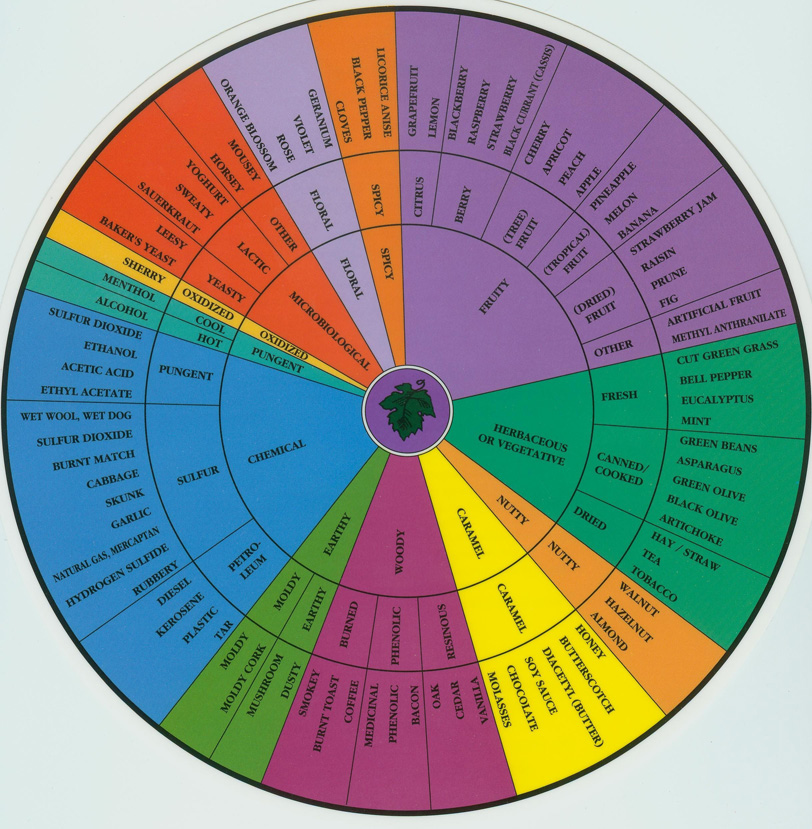
It's really hard to describe what you're tasting if you're not experienced. I'm not experienced at all, I just know whether I like a wine or not, and I can describe it as "heavy", "fruity", "dry" or "light". But the aroma wheel and the vocabulary helps when trying to taste lighter nuances. And sometimes you take a sip, and are instantly reminded of berries, or of oak wood :)
Does it matter? I don't know. In the end, I either like a wine or not. But if you're interested in a topic it helps to share a vocabulary to describe your experiences.
Some color names like "orange" are derived from object names. For tastes can we say that bitter, sour, salty, sweet are the primary colors? Not sure about scents. For audio we named the notes. For textures under touch we seem to have independant names.
In fact, the main difference between German-style and American-style wheat beers is that German-style examples have lots of banana esters and clove phenols, while American-style examples don't. The sole reason for the difference is the strain of yeast used.
And it's not just a wheat beer thing: in general, American yeast strains are bred to produce cleaner fermentations than European strains. The distinct flavors of English and especially Belgian beers are due to the fermentation byproducts produced by the local yeast.
I love beer chemistry.
Diacetyl is another one -- this has a "buttery" flavor. This is considered a flaw in some styles, but is naturally present in others (English ales notably often have a little bit of this in it). Some wines are very "buttery", I understand in particular those that use a process called malolactic fermentation (where diacetyl is a byproduct) are prone to it.
From what I can Google you can get chocolate notes in wine either from the tannins in grapes, or the charring process used on barrels. However, I haven't been able to Google specific chemicals. In beer, "chocolate notes" can come from some of the toasted / roasted malts out there (IMHO more on the pale end of the "chocolate malt" spectrum -- darker "chocolate malts" taste more "coffee" like to me).
A fair bit of places offer a "off flavor" kit for beers that allow you to train your tastebuds on at least the common "faults".
None of them were suitable for consumption.
After searching around I found the distinctive grapefruit flavor compared to other citrus is the result of a sulfur containing terpene, mercaptan. I've been trying to figure out what may have caused it to develop in this batch, but not others brewed with the same yeast.
What source would you reccomend for trying to trace back flavors to the metabolic processes in the yeast?
A homebrew forum.
In wine, the words for flavors are often not meant to be exact. Because there _are_ no direct analogues to the flavors. So you have to try to communicate using words people do know. And if that turns inward and jargony, that's simply how language functions in any community.
It should be no surprise that people experience flavors differently, so of course ratings will vary and descriptions will contradict each other. If apples or hamburgers or spring water were reviewed with the detail and scrutiny that wine is, you'd get the same results. But, that doesn't mean we shouldn't try to communicate with each other about the experience of drinking the wine. Sure, it's almost entirely subjective. No wine expert will disagree with that.
The pragmatic answer to what I think you are asking is basically- in the wine world, a very few people have proven they really can distinguish just about anything. For ordinary people, you can appreciate the notes with training, but probably can't pass a blindfold test on closely related wines.
It's not subtle. At all. Hefeweizen contains large amounts of both banana esters and clove phenols, and drinking one is like drinking spicy banana bread. The first time I had one, it was so different from everything I had before that that it was outright jarring (this was shortly after I turned 21, before I knew much about beer).
My story is I spent about a year trying to get into wine... admitedly for the slightly shallow goal of impressing women, and then I spent a summer in Germany with some family and came back a beer aficionado, and haven't looked back since. The American craft scene has exploded since then and it's easy to find phenomenal beers here. (though good german/belgium imports are still my goto)
I have, however, been learning how to cook (I can not thank blue apron enough), and have been really enjoying using wine in my cooking. The main wines I still drink are port, madeira, pino, and icewine.
Mine too. I got it on sale I think at Costco or some place like that on a whim. It tasted very different than most American wheat beers.
Of course there are some US breweries who brew to the German style, and I'll take your word for it that Public House Brewery does, but my suggestion of avoiding US breweries was aimed at someone who isn't familiar with beer at all and probably wouldn't take nearly as well to "pull out your phone and Google every example you see in the supermarket to make sure it's a proper Hefe and not an AWB" as they would to "look at the label and see if the brewery is German".
[0] http://www.bjcp.org/style/2015/1/1D/american-wheat-beer/
Separate from that are the more subtle, more subjective flavors. I see it in beer descriptions, but they seem to be more ingrained and taken more seriously with wine.
Agreed. In fact, I will go further and support the notion that red wines can give you "brick" and "chalk" tastes, etc., even though I have never actually tasted brick.
My wife likes strawberries. I don't care for them. Professional wine tasters are just people with their own preferences.
> aging a particular bottle actually makes it taste better in a measurable way.
So Bordeaux 2017 is on sale now En Primuer, which means it is still in big casks in the vineyard. Buy it now and your wine merchant will ship it to you in 18 months when it is bottled. The wine experts have all been to Bordeaux and tasted those wines, and I can tell you you need to be an expert....because this young they are very tannic (like sucking a tea bag!). The skill they display in knowing how good a wine will be in a few years when it is ready is pretty impressive. These wines will all taste very tannic in 5 years time, but in 10 years may soften. So no they don't get better with age, it just takes years for them to be ready to drink. I guarantee you could tell the difference between a 2017 claret and a 2009 claret.... because one is ready, one is disgusting. So sorry I think you have missed the point of ageing.
If you were to taste it right before bottling, you would think it less drinkable than pine-sol. After the appropriate amount of time, however, it becomes a delicious, amaretto-like dessert drink. It really is fascinating how much it changes over time.
Yeah but we expect some trends among professionals, don't we? Just like we'd expect all food critics to rate McDonalds below French Laundry. Wine ratings are all over the map for professionals, amateurs and everyone in between.
Taking this further, wine experts usually specialise in a particular region. Learning the wines of a region like Burgundy is a lifetimes study. If you ask a Burgundy expert for a wine around £50 to go with shellfish, don't be surprised when they recommend a Meursault. As an expert in New world wines you might get very different answers.
A relative of mine did some work for a winery. As part of the payment or as a gift for a job well done they got a bottle of wine from 1965. The bottle was covered and dust and grime, looked pretty gross. By that time we drank it it had aged for about 25-30 years. The taste though was amazing. Didn't even taste like wine, had a very smooth velvet-y taste. Almost no acidity, not tannic at all.
I think you're deliberately misunderstanding what is clearly just explaining aromas by saying they're similar to those you'd find in food that you'd be familiar with.
Aromas are just chemicals floating in the air, anyway.
Probably not something everyone would agree was "chocolatey", but the point is that's the aroma or taste the reviewer identifies. If you or I can't detect it, that doesn't mean they were wrong. Maybe we would describe the same flavor or aroma differently. Or maybe our senses would not detect the same chemical they are detecting. Everyone's sense of taste and smell is different.
The one guy in the group who is a real wine expert was having none of it. He knew which wine was "good" and which "wasn't", and why. Anecdotal, but I think it's a good illustration that there's a lot of B.S, but it's not all B.S.
FWIW, I had a master sommelier on my Sales for Nerds podcast (June Rodil, who is not a stuffy wine snob at all, and is so much fun to drink with). (https://www.salesfornerds.io/episode-5-june-rodil-on-wine-cu...)
4 out of 5 Americans would prefer Katy Perry to The Flaming Lips, that doesn't mean she's better (or worse), it just means she's more crowd friendly.
No surprise, wines taste very differently when chilled. Reds in particular lose much of their flavor.
> Maybe it was my just my lame friends
Your friends were fine; it was your test that was lame.
Why would you ever serve red wine chilled? That's not how it's consumed by most wine drinkers, so I'm not sure what you were trying to prove, other than trying to "tear down the culture a peg or two"—and by implication your friends who consider themselves wine enthusiasts.
Chilling a wine slows the volatilization of the aromatic compounds and dramatically changes the flavor. As a result it can taste thin or tasteless. No wonder they couldn't tell the difference.
It's great when you want to mask a cheap product, though. The same is true of beer. Think about the quality of a Coors Light and why their ad campaign is all about drinking it ice cold.
https://www.realclearscience.com/blog/2014/08/the_most_infam...
(And this also extends to food & drink as a whole, to some degree)
Romantic vineyard lore... signaling ones status by drinking the expensive stuff... signaling ones refinement by having tastes that align with the experts... these are also all distorting features that overwhelm discernible differences in wine.
How well a wine taste to most, tends to be fixed on those types of things, rather than the actual wine.
Yeah, that's the point. In any real, coherent domain, you can tell when someone's lying because your model is coherent and based on something real. When your model is 99% expectation, then it can be easily fooled. That doesn't means your model was good; it means your domain is a fraud.
I think some people take a different lesson from the parable of the Emperor's New Clothes.
If you know how deep decision trees work, you know that they overfit very strongly to the training data. Notably, if you intentionally distort the data that you provide as input, by adding dye to turn white wine red, or by saying that the wine is from South Africa but it's actually from Australia, you cause their decision tree process to go down the entirely wrong path and produce a completely incorrect result. The model does not generalize well.
This is not at all how we would train a wine classifier if we were to design one from scratch, but our brains are not really capable of emulating a logistic regression model or an artificial neural network (ironically). They function much better with a discrete process like a decision tree.
I hope that helps you understand. I know it's much more satisfying to be contrarian and rail against the presumptuous wine snobs who claim to see the Emperor's clothes, but then again it's always easier to be cynical about anything you don't appreciate or understand.
We like to believe we can do these things via our tastebuds. We can't. 90% of so-called experts can't either, reliably.
We CAN predict how people (along with those those unreliable experts) will describe and rate wine - based on qualities like color, lore, price, etc - but not taste.
The model for predicting wine quality/affinity is a model based on everything BUT taste. Thats what folks - especially those who've bought wholesale into wine culture - have a hard time with.
Sommeliers are more or less like dowsers, astrologers, or tarot card readers.
>The model for predicting wine quality/affinity is a model based on everything BUT taste.
Frankly, this is reductionist bullshit. But OK, believe what you want to believe.
Then again, if they have to do that much effort to even distinguish between the two, maybe the decision is not that important after all.
In the case of wine, the very act of classification is the same as the ostensible goal.
Would you say that’s a relevant difference? I’m not sure why you’d think the latter is comparable to the former.
There are wines that are bordering to each other and some are all over the place, but I'd say I could most likely nail a chilled red wine just on the tannins, unless there where some really funny ones in the mix.
I've done blind tests of varieties and districts, and even amateurs can sort out a typical pinot noir, shiraz, and cabarnet sauvignon just on the description. But there are always atypical wines that can trick you.
I enjoy great wine and it seldom costs more than $8 a bottle. Some people really want to buy expensive things for the sake of luxury alone, and since wine is so easy to make (and apparently to project your tastes onto) we have amazing choices at nearly all price points.
I'm not just being blue collar, either --- I'll readily admit that very expensive whiskey tastes VERY different from cheap whiskey, and much better too. There's no such thing as a $8 bottle of whiskey that tastes just as good as $90 bottle, but that's exactly how wine works. And, I suspect it's exactly why there's such price variation too. (I mean variation in the sense that a cheap bottle is as high quality as an expensive bottle. For whiskey, a cheap bottle is low quality, and an expensive bottle can be high quality.)
You can definitely get really good wine cheap. But! Sometimes it's worth it to bump up.
I drink a lot of whites these days because my wife can't tolerate red. I find that there is a sweet spot at about $25 (NYC retail prices) for whites that are noticeably better than cheaper ones -- French whites like Sancerre, decent Chablis, the less fancy Bourgognes; what I think of as new-style California Chardonnays (not oaky, more like French Chards).
Then there's another sweet spot for whites at about $40, which includes some of my favorite bottles ever, which can change your idea about what good wine can taste like, if you don't usually "go there" pricewise.. I'll call out specifically the Alma Fria and Division Chardonnays, both from California, and in general a $40 bottle of Bourgogne will be very special.
I also love natural (spontaneously fermented) wines as discussed in the article, but that's a whole different drinking experience, more like kombucha in a lot of ways than conventional wine.
However, I think that if you bargain hunt and don't go for "favorite bottles" you should never have to spend more than $25 for a really good wine. If you divorce yourself from reviews and labels, and pick the wine solely based on region, varietal, grower/producer, and year, there are great wines all over the place, and you end up finding new things you never would have tried before.
And there are $80 bottles of wine that can't be approached by any of the $8 bottles.
The thing is, both businesses are about both very subjective taste, and about marketing. You'll need to find what works for you, and roll with that. In both areas, spending more money makes it more likely you avoid the absolute disasters, but it doesn't guarantee you get something more than mediocre.
I agree very much. With whiskey I can generally say, I like the more expensive ones (to a limit) better, but then I also like the cheap 10yo (~$35) Laphroaig better than their more expensive 15yo (~$118) one.
I just remember being thunderstruck by the fact that something so cheap was (for my taste) better than Van Winkle. (Which I considered in general overpriced, but still pretty damn good.)
Price certainly varies with variety. A Pinot might be $20-40 while a cab would be more like $40-80 for the same quality.
Perrin's CdR is ~$10 I believe—we used to drink that almost every day when we lived in NY. Also Jelu from Argentina is a fantastic Pinot Noir for ~$10 as well I believe.
Be careful with your price ranges there, the most expensive wines in the world are Pinot Noirs!
But pricing doesn't really scale with alcohol content, in particular given the extra work required to create whisk(e)y.
I actually did some research, and my above comment isn't really right. Whisky is priced as a luxury good, the pricing isn't really related to cost price.
Despite Australian taxes, Ardbeg 10 will set you back $85.90 for a 70cl in Australia, AU$76 in Britain, and AU$80 in the USA.
Price only really scales to alcohol content for spirits and beer in Australia though, not wine. You can buy a 5 L box of wine for $9.
I also think the study that showed wine experts that couldn't tell which vintage of the same wine was better sort of spilled over to "all wine tastes alike".
I'm very much an amateur and I can easily tell the difference between sauvignon blanc, riesling, chablis (chardonnay from burgundy) in a blind testing (we often do that). I can sometimes guess country, but that is more hit and miss. My girlfriend that is a more advanced amateur can pick region, country, type of grape, etc on lots of wines.
The thing that I think people who aren't interested in wine don't understand is that taste and smell is something that can be trained. When I started hanging out with people that were more interested in wine I couldn't tell the difference either, most wines tasted, well, wine to me.
And of course cheap wines for $3-9 are usually not that good or unique, even though there are good wines in that price segment too.
Wine tasting also made food a lot better for me, since it trained my sense of taste and smell.
[1] http://winefolly.com/review/where-wine-flavors-come-from/
Maybe the culture on the lower levels, but certainly not at the top.
> And they'll comment on different 'subtle notes of chocolate' in a product that is entirely made of grapes and yeast.
Test could just be if (rand() < .0001)
Obscenely hard randomly, multiple times?
I believe there are multiple levels that get progressively harder so even more unlikely unlikely.
But people are often taken aback when I suggest that there might be a lot of bullshit in wine. Even generally rational/skeptical people that don't have that strong of an attachment to it. They all say, "yeah, but you can definitely tell, like when it's good wine or bad wine." And yet virtually any time a blind test is done the results say differently (precipitating some serious schadenfreude in the movie).
It's the same thing with music. So many people think they need lossless quality when effectively zero people can successfully pick it out in an ABX test with an MP3 @ 320.
BS. You can't tell the difference between expensive wine and cheap wine, but I bet some wine tastes significantly nicer to you than other wine. Wine that tastes good is good. It's just very subjective.
To what extent have people shown the ability to consistently distinguish even that much in a blind test? I've certainly had good glasses of wine and bad glasses of wine, but I wouldn't want to swear that I've always been consistent about which vintages or even which bottles were in which set.
Even from bottle to bottle there can be variation in terms of how good the wine is. I've had occasions where I've opened up a bottle of wine, and it was off, clearly wasn't tasting right. I opened up a second bottle of the same wine, literally a bottle from the same case that had been stored next to the one that had gone off, and it tasted fine.
Why did the one bottle go bad when the one next to it was just fine? Who knows. Maybe the one bottle was contaminated with something, maybe the cork wasn't good, maybe that bottle was stored in a hot spot in the winery before making it into the case. But if all I had tasted was the bad bottle, I would have said that the wine was pretty unpleasant, and if all I had tasted was the good bottle, I would have said "yeah I'll buy a case of this".
In my opinion it didn't paint a picture of substance or rigor. Not saying that the entire wine industry is devoid of that, but this particular view into it validated some of the criticisms in my mind.
Edit: one other thing I recall is that the results of the taste test portion of the actual exam are never released to anybody, which doesn't inspire much confidence.
Meaning no offense, do you know of any evidence for that?
Every time I've ever read about wine-tasting getting examined (i.e. by an academic study), the results invariably turn out to be that people can't distinguish what they think they can. If there's something to wine tasting, shouldn't one expect there to be studies of the "sommeliers were able to consistently distinguish X from Y" variety, for some X and Y?
This is what I'm asking if there's any firm evidence of. Do you know of any?
> That's essentially what they are trained to do, their exam is literally that.
One can equivalently say that healing the body is what acupuncturists do, and what their exams cover. That's all well and good, but if they can actually do it one should expect there to be research to that effect, right?
Yes, it's simply the sommelier examinations that they must pass in order to become a sommelier.
What I'm asking about is evidence of the usual sort - published results that can be duplicated, and whatnot. That doesn't seem like an unreasonable standard for believing something is real.
I go for what I like. Ive had some $40 bottles that tasted like musty vinegar, and $7 wines that I bought a crate of. I dont need someone flashy doing what amounts to tricks to try to sell me 55% markup instead of the 30% markup.
I'm not paying them directly. The establishment is.
Its the same analogy whom HR works for. Cause they sure don't represent my interests.
Do you think your waiter is secretly conspiring to push you to order the most expensive entree?
If you're going to call a sommelier a used car salesman, why stop there with the hyperbole?
The company in which they represent does. And tips are a way to shove the responsibility to directly pay them on me.
> Do you think your waiter is secretly conspiring to push you to order the most expensive entree?
Secretly? It's no secret that you're 'supposed' to tip on percentage of the bill. So the bigger the bill, the more presumed tip. And the IRS makes this assumption as well (even if it is false).
https://www.theguardian.com/lifeandstyle/wordofmouth/2013/ma...
http://www.buzztime.com/business/blog/upselling-tips-z-26-ph...
> If you're going to call a sommelier a used car salesman, why stop there with the hyperbole?
Its not hyperbole. They both know the product. They both know how to discuss and address it. They both are compensated upon price. And both are not returnable after sale (or opening).
Except in places where the waiters are paid by salary. We have sommeliers or wine educated sales persons in most wine shops, they really help you choose wine. I can walk in describe the food and my price range, then almost always get out with something good/perfect.
They are prohibited to upsell alcohol though.
What temperature did you serve them at? I'm not going to argue that your results aren't what they are, but white wines and red wines are served at different temperatures for a reason. Temperature definitely has a noticeable effect on taste, with colder things having more muted flavours than warmer things (this is why soda tastes acceptable when it's over ice, and unbearably sweet when it's warm) so really what you're establishing here isn't "white wines and red wines taste the same", but "when you serve a red wine at a non-recommended temperature, it doesn't taste like what people expect it to taste like" which seems reasonable but also not interesting.
It would be more interesting if, in addition to serving chilled white wine alongside chilled red wine and daring people to tell the different, you also served recommended red-wine-temp red wine with recommended-red-wine-temp white wine, and see if you can tell the difference.
Like you've observed, it's not such a large deal that if somebody poured red wine in a white glass and handed it to me, I'd wave off (let alone burgundy in a pinot noir glass or something). But it turns out that stuff like that makes a difference if you look for it.
> people perceive wine very differently depending on price
Yes, and a surprising part of this is that the price factor in much more unconsciously than we think. People do actually feel the wine, at the neurological level, differently, as it has been shown in MRI. It looks like we prepare ourselves psychologically for a different experience when we know which wine is which.
People don’t buy a drink. They buy an experience. A feeling. A story. Why do you criticize people for being human? We’re not scientists nor robots (most of us at least).
I understand that price does not correlate to taste or even quality, but being told by people that they can't differentiate between Coke and Pepsi, different Milk brands, different cheeses or different wines is as alien to me as tritanopia.
I've had people find it very surprising that I could recognize which of the two glasses containing different wines were which, but unless you have very diminished sense of taste/smell it should be obvious as long as you have already tried both that day. (Of course, I could not have recognized what each were, had the possibilities reduced to a handful of bottles.)
The reason I'm writing this is because even though I cannot relate, I can and must acknowledge that people have different sensory experiences to myself.
https://daily.jstor.org/the-coca-cola-wars-can-anybody-reall...
I literally can't comprehend how blind people must be to tastes that they can't tell the difference.
I also can't comprehend how people can eat anything with vinegar in it or drink IPAs, so maybe I'm just sensitive.
Another anecdote...I know no French, but I had a French wine at a restaurant and commented it reminded me of the smell of the beach in the morning near where I grew up. A more thoroughly educated companion told me that the word Cotes (with some accent I don't know how to type) means "coast" in French, and that was in the name of the wine.
I'm the first one to call BS on elitist snobs but the people who really know wine aren't BSing.
I've found cheap wines to have a higher likelihood of tasting like vinegar Easter egg dye. After about $14 that quality is rare.
That's not to say wine at $60 a bottle is "better." My personal favorite is $18 at Costco. But being able to tell the difference is not BS.
Côtes.
The circumflex, at least in French AIUI, often means there used to be an 's' after that letter, i.e. costes which gets you a little closer to coasts (and the Spanish costas).
claiming that in the 1980s, Pepsi was sweeter than Coke, which had an effect in (pseudo-)scientific taste tests.
Note that (not) recognizing which is which, and label biasing, are different from being able to recognize that they are different.
If you chill them enough it's probably a lot harder to tell, but at the normal temperature of a "cold drink", it's pretty obvious.
The price thing happens for literally everything. People infer the value of things from the listed price, which is why everything in a department store is perpetually on sale and why you should set pricing expectations higher than reasonable when negotiating a sale or an hourly rate. This isn't a critique of wine, it's a critique of the human psyche using easily-manipulable signals as shortcuts for inferring value. I have yet to find a person who actually believes that a forty dollar bottle wine is likely to be better than a fifteen dollar bottle of the same varietal or anyone who would judge someone on the price of the wine they're drinking.
"The Color of Odors" is pretty much just another issue with our brains synthesizing multiple signals to come to a conclusion. If you drink a wine that's colored red, you're going to start with the assumption that it's a red wine and work from there. This works as an exceedingly-reliable heuristic: the average number of times someone is trying to trick you about what type of wine you're drinking per drinking session is effectively zero (and the consequences thereof are roughly zero as well). You've ran your own experiment with N=6, but brown-bag tastings at wine shops aren't exactly rare and amateur enthusiasts are generally in the ballpark with many of their guesses.
Different tasters will rate a given wine differently because taste isn't objective. But it's not subjective either. It's a composite of both. They'll comment on "subtle notes of chocolate" because wines—like beer, coffee, and everything else—have tons of flavor compounds. And they're made of more than just grapes or yeast; barrel aging imparts yet more flavor compounds, and the specifics (oak, steel, level of char, type of oak, if the barrels have been reused, etc.) add yet more variables. I'm not saying that some of it isn't bullshit (https://xkcd.com/915/), but it sounds like you're trying to make the point that all wine could just be replaced with Welch's and vodka and nobody would be able to tell the difference.
Not only will different tasters rate a given wine differently, a given taster will rate a given wine differently, most of the time.
http://letastevin.org/Hodgson%202008%20Examination%20of%20ju...
Well... One doesn't need to be a wine enthusiast to tell a red wine from a white. And there is quite bit of a difference between their serving temperature.
If you give me a wine to taste, I may tell you "this tastes like a zinfandel". And maybe it's not a zin. Maybe it's a pinot that was grown and processed in a way that ended up tasting like zin. Of course I can tell when intense blackberry/blueberry fruit flavors are flooding my mouth, and all the dissolved solids fill the crevices of my mouth and weigh down my palette, just like you can tell the difference between strawberry jam and raspberry jam.
The question is not can you taste a difference. The question is, can you guess what it was supposed to be? Hell no. Grapes with red skin can be used to make white wine. Of course I may be wrong about what grape it was, or what percentages of which varietals, or from what region, or year, etc. But I know when something tastes strongly of blackberries and when it doesn't.
Is there any evidence for this? Whenever I've read looked into studies on wine tasting, they invariably find that people can't reliably distinguish what they think they can.
Lots of people claim that it's not just subjective, and that's what I'm asking about. You said as much in the post I quoted and replied to.
I mean: if someone says Bordeaus pair well with croutons, obviously that's an opinion. But if they say a wine's taste discernibly correlates to its region or vintage, I don't think it's unreasonable to ask if there's any evidence.
The fruit/veg is the output of a plant's function, whose input (simplified) is light, water, temperature, and soil. Two identical seeds will grow two slightly different tasting fruit if they have different access to those inputs. Most gardeners can attest to how many variables are needed just to grow a vegetable at all, much less get it to grow as well as it can.
On top of that, wine grape vines are often selected for the particular fruit they develop, but are often grown in regions they aren't suited to. So they need all kinds of complicated grafting techniques and treatments to survive the local climate, pests, bacteria and fungus.
Once you can actually get the grapes to grow, you have to harvest them when they are just the right ripeness for wine-making. Since a natural environment is variable, you never really know when this is, but good winemakers establish a good feel for when this is. Much like the above gardening processes it's still mostly unscientific, though it is informed by data and experience.
Then you get to process the grapes and ferment them. This unique grape that has gone through so much to be born is now subject to one of several processes to try to convert sugars into alcohols. The fermentation process used (typically yeast fermenting in barrels) depends on several dozen compounds and a hundred factors all being right for the yeast to thrive and convert the grape's sugars into alcohol and carbon dioxide.
Just imagine: the land, air, water, temperature, pests, gardener's care, grape varietal, fermentation... all of these involve complex processes, and a single variable changed can throw everything off. All of this adds up to one unique bottle of wine.
If a person claimed that they could detect all of this from a single sip of wine, no matter how standardized the process of tasting, they're lying. The only thing they can hope to do is guess where this wine was from, what type it was, how it was grown, how it was fermented, etc. They do this by studying the above entire chain of events in every wine growing region in the world, and based on that information, try to deduce the origin of the wine, and judge its quality.
Considering how many wines there are and how many variables go into each wine, it's kind of insane to think you could decipher all of this with a human palette. So wine tasting is a weird guessing game/hobby. A lot of people do make a living off of accurately determining all these things, but there's no way you could call this a science. It's an art.
Nobody's talking about anything remotely that grandiose. If someone simply says they can tell a red from a white more often than not, that's still an objective claim that can be tested. Just because nobody can know everything every time doesn't mean it's all subjective.
More to the point, if someone says "you can taste differences, and often those differences correlate to a certain "kind" of wine", that's also a testable claim - i.e. something I'd believe if there's evidence for it. Hence I asked if you knew of any. (At this point I'll take the answer as read. ;)
Temperature differences greatly affect the taste, so what's the purpose of that test?
If people with trained palates for wine cannot tell a chilled red apart from a white, or a room-temperature white apart from a red, it may not prove that the conventional wisdom around wine tasting is bullshit, but it sure suggests it strongly.
Also, wine tasting is absolutely a narrow classifier trained on limited data (in this case, tasters are not trained to classify red wine that is chilled). It's not surprising that wine tasters have overfit their classifier to the types and conditions of wine that they have been trained and tested on.
I believe this, but it's not what I said. I also assume a room temperature white smells and tastes completely different from a chilled one.
If there is nobody in the world who can, with significant accuracy, sort a set of reds and whites held at the same temperature into a set of reds and a set of whites, then it is reasonable to say that a lot of the conventional wisdom around wine tasting is probably wrong.
If wine tasters are too far up their own butts, use regular people instead, or people with more generally refined palates (e.g. chefs). Train somebody specifically for this task, even. At this point it's a hypothetical exercise.
Claiming e.g. "only trained wine tasters are qualified to make this distinction, and serving wines at 'incorrect' temperatures makes it impossible for trained wine tasters to tell the difference because they've 'overfit their classifiers'" is absolute hogwash.
If these wine enthusiasts trained to drink all wine at the same temperature they would eventually learn to pick up the differences between red and white wines. But they did not train, so their classification error is high.
I didn't serve any spritzig white wines though. Then it would have been very obvious.
That's not that surprising though! I enjoy drinking wine but I am really terrible at blind tasting. However, I have done blind tastings with people who _are_ trained sommeliers and it's very humbling to watch them taste and then methodically eliminate incorrect results until they eventually come up with the correct answer. Now, they are not always perfect, but for the most part they always at least get within the ballpark, whereas I am all over the map.
So, from my experience at least, I do believe that identifying wine in a blind tasting is a trainable skill, and it's not just hocus pocus.
Ever tried? A study famously found that tasters don't notice the difference - when given a white wine with red food coloring, their evaluations were typical of evaluations of red wines.
https://www.sciencedirect.com/science/article/pii/S0093934X0...
I feel like that study is probably an example of the McGurk effect.
I suspect that the truth is, humans simply aren't capable of filtering out our expectations in judgments like this. Seeing color is part of how we "taste" wine, the same way that looking at someone's lips is part of how we "hear" the difference between certain sounds.
I'd bet taht neither your friends are "lame" (tut-tut) neither the wines bad, but I think it's mostly an issue of what wines you happened to compare. In Greece where I'm from, I often drink house wines - I'll go to a taverna and they'll have a couple of barrels in the back, one red, one white. The white always has a distinct sweet twang, which is never there in the red that tends to be on the dry side (which I prefer for this reason). Both types of wine are often drinked chilled anyway (unless you go to some fancy place where they have ideas about the ideal temperature to drink their wine).
And of course, there is no way in hell that anyone could mistake retsina for Merlot... :)
For some weird reason, the US wine is 100% posing, and statement about your social position. Almost no attention is given to the actual quality of the wine and a crapton of of 5$ wines taste significantly better than 10$-20$ or even 50$ bottles. In the same spirit, the "sommeliers" and wine vendors are eager to sell you the most expensive wine in their stock, not in discovering underappreciated wines.
Not surprising that no one develops a proper taste for wine here.
PS: And yes, don't chill reds. Ever. They are to be served at ~18C or ~65F. Otherwise, you won't be able to taste anything in them, even if they are good.
In my country winetasters gather and rate wines individually. Then they reach a consensus. One of the wines gets an award. Of course the process is subjective, but then so are literature or film awards.
But once you're past about 4 or 5 years old, I think you're right - it becomes quite a bit more subjective.
“As long as it’s not ‘73...”
But this doesn't make wine bullshit. I don't give a shit about mechanical keyboards or different fancy fonts but to people who do care and can notice differences they get a lot of value out of them.
This is really important. I think some people think that the reason a $1000 bottle of wine costs that much is that it's so awesomely good that a single sip will give you an orgasm or something like that. That's not it at all. A $1000 bottle of wine costs that much for one reason only: someone with more money than sense is willing to pay that much for it for some unfathomable reason. Even if that person thinks that wine is awesome, there is no reason to think that you will think it's awesome. Everyone has different tastes.
Two reasons I think then. Expensive wines are also made the expensive way. Hand picked grapes off ancient low yield vines. Some even work the ground with horses rather than tractors to reduce soil compacting. Wooden barrels, wooden boxes etc all contribute to make the cost of production much higher...whether you like the taste or not
Wow DRC is expensive in the US! I saw a 30 year old example sell a few weeks ago in the UK for considerably less than that, less than £5,000 ($6,700ish).
Do you have a source for this? I would very much like to read it.
All that being said I get the feeling this is something that someone somewhere saw once 15 years ago, and then the story has just been spreading from there.
How to look like you know about wine when offered a taste. I don't have a great palate, but I have watched the experts...this is how to fit in.
1. Pick the glass up. If it is an older wine hold the glass at 45 degrees and in front of the light. Make a noise like you noticed something. Time for a gentle swirl. If the wine forms into streaks ("legs") it is due to high alcohol or high sugar content. Store that info for later.
2. Put the glass back on the counter-top. Palm-down with the stem trapped between your index and middle fingers swirl it in circles on the counter-top. Make it look like you feel this is important.
3. Sniff. Compost smell is considered bad. If it doesn't smell of compost or vinegar, but something more pleasant make a vague "mm" noise. Don't overdo it. Wine does not have a smell, it has a "nose". If it is fruitier on the nose than the last thing you tried, then it is probably safe to say so.
4. Now take a mouth full and suck air through it as noisily as you can, just like you were told not to when you were a child. If it isn't rancid, give an intrigued look, but don't commit.
5. Spit. A good long spit is the pro-style, dribbling is bad. If there is no spittoon, then swallow. Spitting on someones floor is bad form.
repeat steps 4 and 5. The experts always taste more than once.
6. Now the hard bit, you might get asked your opinion. "interesting" is a great play for time, maybe they will lead. If it is a red and very tannic (dry feeling in your mouth) you could comment that it would be a nice food wine. Now the magic, just like coffee, the longer you can taste it for (the "length") the better the wine. If you get a lovely mixture of spices that is still there in 30 seconds you can safely say it has "good length". If you can still taste it the next morning it either wasn't so good, or you tried a little too much.
Advanced blagging: Wine tastes: Certain regions are supposed to taste certain ways with their own jargon. Here are a few to blag with.
White Burgundy (Chablis, Macconais etc): "minerality" is the word to work in.
New Zealand sauvignon blanc: Grapefruit=good, lemons=bad
Bordeaux: "Full-bodied", "Tannin"
Rhone valley (Chatuex-neuf-de-pape etc): Can you taste green -peppers? say so
Hot dry places (Chille, Australia, California) are supposed to produce fruitier wine than the same grape from France.
White Zinfandel : Don't admit to liking sweet white Zinfandel, unless you are on a hen-night
Germany/ Alsace: You will struggle to blag here, save it for another time.
So maybe that wont help you enjoy wine, but you can show your friends up, and really that is one of the most important things in life.
It was so amusing you almost got away with it untill you conned one of the Koch brothers!
Did they drink from thimbles?
I really can't blame the guests for having trouble identifying it as a particularly superb wine when they don't get enough to coat their tongue.
You need to find a better wine merchant. You need at least enough to fill your mouth twice over...
Just because nobody could tell the difference doesn't mean the cheaper wines were the same as the expensive wines. It just means you served expensive wine at a party where nobody was expecting to have to put effort into analyzing their wine.
Lets not even forget that some of these folks could have a been a few drinks in already...
There was a study done a little while ago (http://www.caltech.edu/news/wine-study-shows-price-influence...) which showed that people perceive wine very differently depending on price. Even if it's the same wine. So somebody who's told they're tasting a $90 bottle will rate it much better than somebody who's told they're tasting a $5 bottle, even though they're both drinking the exact same thing.
After all the uproar over Brochet's "The Color of Odors", I did a tasting with a few friends where I chilled red and white wines down to the same temperature, and had them try the wines blindfolded. Across 6 people who all considered themselves wine enthusiasts, it was pretty dicey even being able to tell a Merlot from a Sauv Blanc. Maybe it was my just my lame friends, or maybe I chose bad wines. Or maybe not.
Different professional wine tasters will rate a given wine extremely differently. And they'll comment on different 'subtle notes of chocolate' in a product that is entirely made of grapes and yeast.
I would be genuinely surprised if a double-blind test revealed that aging a particular bottle actually makes it taste better in a measurable way. Different, maybe. But if 'better' is subjective, then it's by definition not 'better' in an absolute sense.
I enjoy a nice glass of wine, don't get me wrong. But the culture around it is elitist and unscientific, and I'm glad to see winemakers trying to tear it down a peg or two.