So while I can describe a car finish as "matte black", or "iridescent blue-green" without resorting to simile, I can't describe flavors without saying something like, "it tastes like {another thing you may have also tasted}". So wine tasters end up leaning on seemingly wacky comparisons to communicate the subtleties they perceive (real or imagined).
[0] https://counterculturecoffee.com/learn/resource-center/coffe...
Edit: fixed link
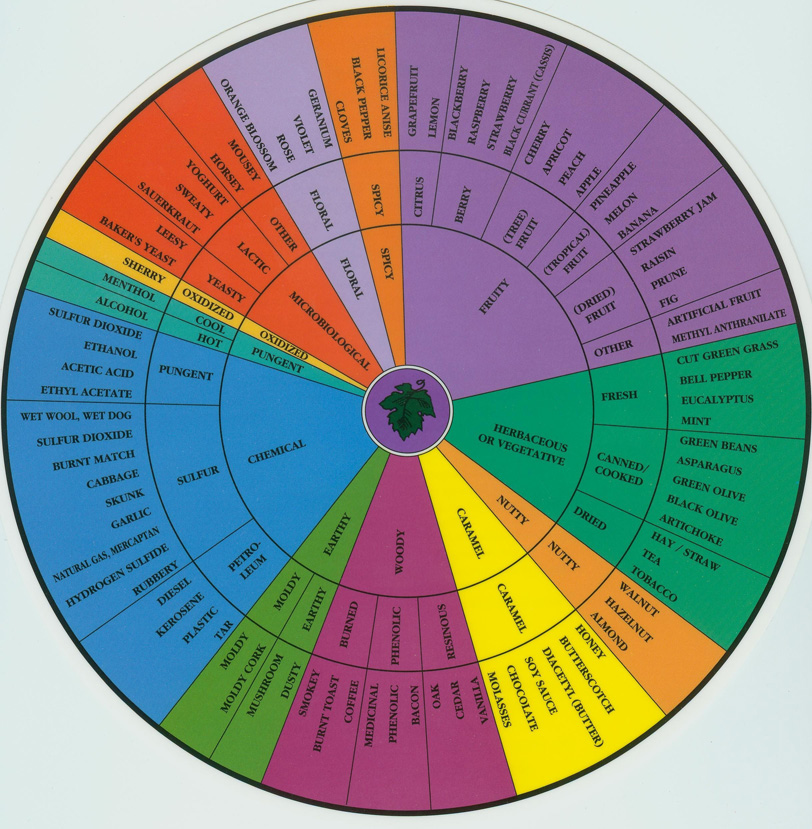
It's really hard to describe what you're tasting if you're not experienced. I'm not experienced at all, I just know whether I like a wine or not, and I can describe it as "heavy", "fruity", "dry" or "light". But the aroma wheel and the vocabulary helps when trying to taste lighter nuances. And sometimes you take a sip, and are instantly reminded of berries, or of oak wood :)
Does it matter? I don't know. In the end, I either like a wine or not. But if you're interested in a topic it helps to share a vocabulary to describe your experiences.
Some color names like "orange" are derived from object names. For tastes can we say that bitter, sour, salty, sweet are the primary colors? Not sure about scents. For audio we named the notes. For textures under touch we seem to have independant names.
In fact, the main difference between German-style and American-style wheat beers is that German-style examples have lots of banana esters and clove phenols, while American-style examples don't. The sole reason for the difference is the strain of yeast used.
And it's not just a wheat beer thing: in general, American yeast strains are bred to produce cleaner fermentations than European strains. The distinct flavors of English and especially Belgian beers are due to the fermentation byproducts produced by the local yeast.
I love beer chemistry.
Diacetyl is another one -- this has a "buttery" flavor. This is considered a flaw in some styles, but is naturally present in others (English ales notably often have a little bit of this in it). Some wines are very "buttery", I understand in particular those that use a process called malolactic fermentation (where diacetyl is a byproduct) are prone to it.
From what I can Google you can get chocolate notes in wine either from the tannins in grapes, or the charring process used on barrels. However, I haven't been able to Google specific chemicals. In beer, "chocolate notes" can come from some of the toasted / roasted malts out there (IMHO more on the pale end of the "chocolate malt" spectrum -- darker "chocolate malts" taste more "coffee" like to me).
A fair bit of places offer a "off flavor" kit for beers that allow you to train your tastebuds on at least the common "faults".
None of them were suitable for consumption.
After searching around I found the distinctive grapefruit flavor compared to other citrus is the result of a sulfur containing terpene, mercaptan. I've been trying to figure out what may have caused it to develop in this batch, but not others brewed with the same yeast.
What source would you reccomend for trying to trace back flavors to the metabolic processes in the yeast?
A homebrew forum.
In wine, the words for flavors are often not meant to be exact. Because there _are_ no direct analogues to the flavors. So you have to try to communicate using words people do know. And if that turns inward and jargony, that's simply how language functions in any community.
It should be no surprise that people experience flavors differently, so of course ratings will vary and descriptions will contradict each other. If apples or hamburgers or spring water were reviewed with the detail and scrutiny that wine is, you'd get the same results. But, that doesn't mean we shouldn't try to communicate with each other about the experience of drinking the wine. Sure, it's almost entirely subjective. No wine expert will disagree with that.
The pragmatic answer to what I think you are asking is basically- in the wine world, a very few people have proven they really can distinguish just about anything. For ordinary people, you can appreciate the notes with training, but probably can't pass a blindfold test on closely related wines.
It's not subtle. At all. Hefeweizen contains large amounts of both banana esters and clove phenols, and drinking one is like drinking spicy banana bread. The first time I had one, it was so different from everything I had before that that it was outright jarring (this was shortly after I turned 21, before I knew much about beer).
My story is I spent about a year trying to get into wine... admitedly for the slightly shallow goal of impressing women, and then I spent a summer in Germany with some family and came back a beer aficionado, and haven't looked back since. The American craft scene has exploded since then and it's easy to find phenomenal beers here. (though good german/belgium imports are still my goto)
I have, however, been learning how to cook (I can not thank blue apron enough), and have been really enjoying using wine in my cooking. The main wines I still drink are port, madeira, pino, and icewine.
Mine too. I got it on sale I think at Costco or some place like that on a whim. It tasted very different than most American wheat beers.
Of course there are some US breweries who brew to the German style, and I'll take your word for it that Public House Brewery does, but my suggestion of avoiding US breweries was aimed at someone who isn't familiar with beer at all and probably wouldn't take nearly as well to "pull out your phone and Google every example you see in the supermarket to make sure it's a proper Hefe and not an AWB" as they would to "look at the label and see if the brewery is German".
[0] http://www.bjcp.org/style/2015/1/1D/american-wheat-beer/
Separate from that are the more subtle, more subjective flavors. I see it in beer descriptions, but they seem to be more ingrained and taken more seriously with wine.
Agreed. In fact, I will go further and support the notion that red wines can give you "brick" and "chalk" tastes, etc., even though I have never actually tasted brick.
This, at least, is IMO not a valid criticism. I make beer, and two easy examples are cloves & banana. Fermenting beer too warm leads the yeast to overproduce esters, which taste like bananas. Too cold leads the yeast to overproduce phenols, which taste like cloves. It's very real & very obvious.