News for hackers. Stuff that matters.
Re:SFO near miss might have triggered aviation disaster by ddeck on Tuesday July 11, 2017 @01:15AM (#14741728)
Attempts to take off from or land on taxiways are alarmingly common, including those by Harrison Ford:

  Harrison Ford won't face disciplinary action for landing on a taxiway at John Wayne Airport [1]

  Serious incident: Finnair A340 attempts takeoff from Hong Kong taxiway [2]

  HK Airlines 737 tries to take off from taxiway [3]

  Passenger plane lands on the TAXIWAY instead of runway in fourth incident of its kind at Seattle airport [4]

[1] http://www.latimes.com/local/lanow/la-me-ln-ford-taxiway-agr...

[2] https://news.aviation-safety.net/2010/12/03/serious-incident...

[3] https://www.flightglobal.com/news/articles/hk-airlines-tries...

[4] http://www.dailymail.co.uk/travel/travel_news/article-337864...

Re:SFO near miss might have triggered aviation disaster by rrmm on Tuesday July 11, 2017 @09:25AM (#14743943)
There was a Delta incident at KATL where a plane landed on a taxiway.

NTSB report: https://www.ntsb.gov/about/employment/_layouts/ntsb.aviation...

Here is a comment from the NTSB report: """ Observations made from the flight deck during the flight test approaches indicated that when the lights were set to the same levels as were encountered by the incident crew, from about DEPOT intersection, the runway 27R centerline lights were not identifiable and the taxiway M centerline lights were more prominent. When established on final, the taxiway signs were more visible than runway 27R edge lights. At about 500 feet above ground level the runway centerline lights were barely visible and it appeared that some lights may have been out. The color of the blue taxiway edge lights became distinguishable at about 500 feet above ground level while on approach. """

Re:SFO near miss might have triggered aviation disaster by anovikov on Tuesday July 11, 2017 @05:19AM (#14742679)
This is facilitated by the fact that in some airports, taxiways and runways are similar and sometimes even used interchangeably (!), i.e. a runway may be remarked as taxiway and vice versa. So it's not 'how can he be so dumb' moment, in some case you have no way to tell the difference unless you just know.
Re:SFO near miss might have triggered aviation disaster by Karunamon on Tuesday July 11, 2017 @02:14PM (#14746551)
Yeowch. I was about ready to make a comment about how the airport/approach plates should make something like this impossible, but then I looked up the diagram for SEA:

https://flightaware.com/resources/airport/SEA/APD/AIRPORT+DI...

Basically, you've got a runway, the taxiway of the same length as the runway!, and then two longer runways from left to right. I totally see how someone could make this mistake in bad lighting or weather!

Re:SFO near miss might have triggered aviation disaster by wolfgang42 on Tuesday July 11, 2017 @02:59PM (#14746963)
And a note on that diagram:

    CAUTION:
    Pilots are cautioned not to
    mistake Twy T for a landing
    surface.
Re:SFO near miss might have triggered aviation disaster by gambiting on Tuesday July 11, 2017 @06:03AM (#14742843)
It feels like it could be solved incredibly easily by a row of lights at the beginning/end of both the taxiway and the runway, bright red for taxiway, bright green for the runway. If you are attempting to land on the strip marked red, then you are doing something wrong. In case that the taxiway is legitimately used for landing, change the colours around.

I guess it hasn't been done for "reasons", I'd be quite interested in hearing why.

Re:SFO near miss might have triggered aviation disaster by phdp on Tuesday July 11, 2017 @06:42AM (#14743006)
This already exists. Runway is lit up in white, has a green strip of lights at the close end as you look at it, and instrument rated fields have a chase strobe that points right to the end of the runway. Taxi ways are blue.
Re:SFO near miss might have triggered aviation disaster by oasisbob on Tuesday July 11, 2017 @08:52AM (#14743695)
Things like this are being tried. SeaTac airport has a taxiway which is large, parallel, and frequently (enough) mistaken for a runway.

> SEA-TAC personnel have been very proactive in trying to reduce the problem, including the installation of an unlit, nonreflective elevated lighted X at the threshold of taxiway Tango; broadcasting a notice on the Automatic Terminal Information Service (ATIS) not to mistake the parallel taxiway for the adjacent runway; posting warnings on aeronautical charts not to mistake the taxiway for runway 16R; and the development of numerous training aids and brochures that explain the problem to transient pilots traveling through SEA-TAC.

(Testing of multiple methods begins on page 5)

http://www.airtech.tc.faa.gov/safety/downloads/TN07-54.pdf

Re:SFO near miss might have triggered aviation disaster by rconti on Tuesday July 11, 2017 @11:43AM (#14745095)
"...including the installation of an unlit, nonreflective elevated lighted X at the threshold of taxiway Tango..."

Unlit lighted X. Right.

Re:SFO near miss might have triggered aviation disaster by shuntress on Tuesday July 11, 2017 @01:35PM (#14746124)
My assumption based on nothing in particular is that one (of unlit/lighted) means 'Lights contained within the X illuminating it from within' and the other means 'Lights external to the X illuminating it from without'
Re:SFO near miss might have triggered aviation disaster by Domenic_S on Tuesday July 11, 2017 @06:22AM (#14742925)
It is done pretty much like that. PDF warning, page 31: https://www.faa.gov/airports/southern/airport_safety/part139...

Taxiways are marked with blue lights.

Here's a video of a night landing on the same runway, the approach lighting is unmistakable: https://www.youtube.com/watch?v=rNMtMYUGjnQ

Re:SFO near miss might have triggered aviation disaster by cmurf on Tuesday July 11, 2017 @01:17PM (#14745968)
Yeah. At 1:18 that's clearly HIRL enabled. There's no ambiguity that's for a runway rather than taxiway. And it's not possible to visually misalign yourself with the taxiway, the whole point of HIRL is a visual aid for precision instrument landings in bad weather for Cat I and II ILS landings. On an instrument landing, it's not legal to go below decision height (200 and 100 feet respectively) unless you meet the visual reference requirement in 91.175 c3, ergo the HIRL lighting is simply unambiguous for a night VFR landing, and makes me wonder if it was even on.
Re:SFO near miss might have triggered aviation disaster by dgoldstein0 on Tuesday July 11, 2017 @06:17AM (#14742895)
this sounds like the start of a good idea, but we should choose something that works for colorblind people and red/green colorblind people too.
Re:SFO near miss might have triggered aviation disaster by gambiting on Tuesday July 11, 2017 @06:24AM (#14742930)
Stupid question - can you be certified as a commercial pilot if you are colourblind?
Re:SFO near miss might have triggered aviation disaster by BjoernKW on Tuesday July 11, 2017 @06:40AM (#14742993)
No, you can't. A friend of mine couldn't become a commercial pilot because he has some kind of colourblindness.

However, I remember him trying for some time and even campaigning for colourblind people to be admissible as commercial pilots because for the actual flying colourblindness doesn't seem to matter.

So, perhaps ridiculous as it may sound taking colourblindness into account when proposing such an improvement isn't such a weird idea after all.

Re:SFO near miss might have triggered aviation disaster by BurningFrog on Tuesday July 11, 2017 @10:50AM (#14744633)
You can become color blind later though.
Re:SFO near miss might have triggered aviation disaster by manarth on Tuesday July 11, 2017 @11:45AM (#14745120)
Commercial pilots are generally required to take a regular medical (it's every 6 months or 12 months in the UK).

If a pilot were to acquire colour blindness, they'd be obliged to ground themselves and report the condition to the aviation authority.

Re:SFO near miss might have triggered aviation disaster by dbarlett on Tuesday July 11, 2017 @12:26PM (#14745471)
Or temporarily from medication, particularly those used to treat erectile dysfunction and benign prostatic hyperplasia [1][2].

[1] https://www.faa.gov/about/office_org/headquarters_offices/av...

[2] https://www.leftseat.com/viagra.htm

Re:SFO near miss might have triggered aviation disaster by URSpider94 on Wednesday July 12, 2017 @02:43AM (#14750603)
... and as a professional pilot, you'd probably have to consult a flight physician if you were taking meds like these.
Re:SFO near miss might have triggered aviation disaster by qubex on Tuesday July 11, 2017 @06:43AM (#14743013)
Actually, airline pilots (and pilots generally) are not the only people you need to take into account here. Many other potential users of the runways and taxiways would need to be taken into account, including ground staff and maintenance staff. Since I doubt that all of these are ruled out on the basis of colourblindness, it makes sense to construct a system that is impervious to ambiguity due to colourblindness.
Re:SFO near miss might have triggered aviation disaster by schwap on Tuesday July 11, 2017 @11:11AM (#14744817)
But ground and maintenance staff don't need to identify them by colour from far away. For them, you could rely on simple signage.
Re:SFO near miss might have triggered aviation disaster by cyberferret on Tuesday July 11, 2017 @04:00PM (#14747514)
Not a stupid question at all. I clearly remember doing the colour blind test during my preliminary medical when I arrived at flying school to get my commercial licence.

The test consists of going through a book with images made up of different coloured dots, and within each image was a coloured number made up of similar dots. We simply had to flip through the book and identify the number within each image.

I was totally smug as I flipped through the book, calling out the numbers and watching the doctor tick off his chart. But towards the end of the booklet, I reached a page, and the image was just a jumble of dots to me. I couldn't see a number. I remember the panic and tightening in my chest as I thought to myself "Oh No, I can't see the number - I MUST be colour blind!! My dream of being a pilot is OVER".

I stared and stared at the page, but in the end had to concede defeat and I quietly told the doc that I couldn't see the number on that page. "Oh", he replied casually. "That's OK, there isn't one on that page!". And he grabbed the booklet and tossed it back on his desk saying "You passed."

Re:SFO near miss might have triggered aviation disaster by cmurf on Tuesday July 11, 2017 @01:26PM (#14746061)
Yes, but the certificate comes with a limitation (color signal landing daytime only proscription; or night and color signal landing proscription).

The requirements vary depending on class of medical certificate but in this context it's a class I medical for airline transport pilots (not commercial pilots) so it's complicated.

Also, full on dichromats or monochromats are rare. Usually people are one of three anomalous trichomats. Hence testing is required to determine if it's a problem. The initial test is designed to have a high failure rate, and the exception tests to get the restrictions lifted take more effort.

https://www.aopa.org/go-fly/medical-resources/health-conditi...

Re:SFO near miss might have triggered aviation disaster by briandear on Tuesday July 11, 2017 @06:33AM (#14742969)
You can’t even be certificated as a Private Pilot if you are colorblind.
Re:SFO near miss might have triggered aviation disaster by phdp on Tuesday July 11, 2017 @06:46AM (#14743026)
Re:SFO near miss might have triggered aviation disaster by deelowe on Tuesday July 11, 2017 @10:05AM (#14744249)
Why do people comment on things they know nothing about? Of course you can.
Re:SFO near miss might have triggered aviation disaster by pdelbarba on Tuesday July 11, 2017 @11:21AM (#14744915)
It's HN.... I get a good laugh out of all these aviation related threads. Understandably your average CS undergrad doesn't have much real aeronautical knowledge but that doesn't stop everyone from blowing up the comments every time the word 'airplane' is uttered.
Re:SFO near miss might have triggered aviation disaster by CPLX on Tuesday July 11, 2017 @09:17AM (#14743882)
You can, but you're not allowed to fly at night.
Re:SFO near miss might have triggered aviation disaster by cmurf on Tuesday July 11, 2017 @01:36PM (#14746142)
No you just get a night flying and color signals proscription on your certificate if you're a monochromat or dichromat (full color blindness); if you merely have a color discrimination problem by being an anomalous trichromat, you might pass the test, or fail it but then get an exemption (reversal of the prior failure) by later passing a more involve series of tests.
Re:SFO near miss might have triggered aviation disaster by Agathos on Tuesday July 11, 2017 @08:20AM (#14743495)
My father is red-green colorblind and he flies small planes.
Re:SFO near miss might have triggered aviation disaster by briandear on Tuesday July 11, 2017 @06:32AM (#14742964)
It’s SFO though. And he’s an airline captain, so he should know.
Re:SFO near miss might have triggered aviation disaster by ncallaway on Tuesday July 11, 2017 @07:18AM (#14743167)
The absolutely stellar safety record of the airline industry exists because they have repeatedly and consistent pushed past human error as an explanation for a crash.

Understanding that if a human made this mistake, another future human will likely make the exact same mistake, they push to understand _why_ an airline captain that should know made this error. Then try to correct for that.

If every crash was written off as "the captain should have known better", aviation would not be nearly as safe as it is.

Re:SFO near miss might have triggered aviation disaster by kbutler on Tuesday July 11, 2017 @08:28AM (#14743538)
Someday, perhaps computer programmers will start applying this principle.
Re:SFO near miss might have triggered aviation disaster by goblin89 on Tuesday July 11, 2017 @08:57AM (#14743741)
Perhaps not all tech companies care to push past human error in each postmortem (or even have a proper formal process at all), but some are known to do just that. Etsy and Google are among the well-documented cases.

> This idea of digging deeper into the circumstance and environment that an engineer found themselves in is called looking for the “Second Story”. In Post-Mortem meetings, we want to find Second Stories to help understand what went wrong.

— Blameless PostMortems and a Just Culture,

https://codeascraft.com/2012/05/22/blameless-postmortems/

> Blameless postmortems are a tenet of SRE culture. … Blameless culture originated in the healthcare and avionics industries where mistakes can be fatal. These industries nurture an environment where every "mistake" is seen as an opportunity to strengthen the system. When postmortems shift from allocating blame to investigating the systematic reasons why an individual or team had incomplete or incorrect information, effective prevention plans can be put in place. You can’t "fix" people, but you can fix systems and processes to better support people making the right choices when designing and maintaining complex systems.

— Site Reliability Engineering — Postmortem Culture: Learning from Failure

https://landing.google.com/sre/book/chapters/postmortem-cult...

Re:SFO near miss might have triggered aviation disaster by kevan on Tuesday July 11, 2017 @01:38PM (#14746162)
Amazon is pretty strong on this front too, the most recent public example is the S3 outage and postmortem[1].

>Unfortunately, one of the inputs to the command was entered incorrectly and a larger set of servers was removed than intended.... We have modified this tool to remove capacity more slowly and added safeguards to prevent capacity from being removed when it will take any subsystem below its minimum required capacity level. This will prevent an incorrect input from triggering a similar event in the future.

[1] https://aws.amazon.com/message/41926/

Re:SFO near miss might have triggered aviation disaster by lttlrck on Tuesday July 11, 2017 @10:24AM (#14744411)
This was address very well by a video posted on the Piper Alpha story yesterday.

https://news.ycombinator.com/item?id=14732404

https://www.youtube.com/watch?v=S9h8MKG88_U

Re:SFO near miss might have triggered aviation disaster by dredmorbius on Tuesday July 11, 2017 @01:03PM (#14745845)
While I agree generally with that sentiment, there's a key difference.

Airplane pilots are licensed, certified, trained, and regulated. There's a clear floor to who is allowed in the cockpit (barring extreme emergencies, e.g., incapacitation of a pilot).

By contrast, software is made available to pretty much the entire world. And it turns out that two thirds of all adults have "poor", "below poor", or no computer skills at all. Which is to say, the qualifications floor is nonexistent.

If you're designing a one-size-fits-all system, you've got to design for this. The results, I'd argue, are ... not particularly satisfactory.

I'm not saying "don't design for the user in mind", or "don't dismiss user error". But rather, than when your floor is zero, you're going to have a remarkably difficult challenge.

https://www.reddit.com/r/dredmorbius/comments/69wk8y/the_tyr...

Re:SFO near miss might have triggered aviation disaster by Analemma_ on Tuesday July 11, 2017 @08:55AM (#14743721)
They do, or at least the big-scale places who know what they’re doing do. When Gmail or aws-east-1 or something goes down for hours, nobody is fired: they figure out why it was allowed to happen and change procedures so it can’t happen again.
Re:SFO near miss might have triggered aviation disaster by athenot on Tuesday July 11, 2017 @09:10AM (#14743836)
They do. That's what UX is all about. Not just UI, not just making thing possible or visual, but actually making the experience as smooth and frictionless as possible.
Re:SFO near miss might have triggered aviation disaster by Tloewald on Tuesday July 11, 2017 @10:07AM (#14744267)
UX is the bane of usability (at least as practiced). E.g. We've had professional "UX" designers seriously contend that "cancel" buttons should be made to not look like buttons. The joke at a certain large company was that if the UX designers had their way every default button would be big and green and every other button would be invisible.

True usability is about helping people make the correct decision, not just being smooth and frictionless. (See Don Norman's classic example of fire escapes that send people into basements to be trapped.)

Re:SFO near miss might have triggered aviation disaster by scrooched_moose on Tuesday July 11, 2017 @01:05PM (#14745865)
I'm a daily user of some of the most complicated engineering software on the market. Every single release promises "Easier to use!" but all they do is make the most basic beginner-level actions more prominent and hide all medium to advanced level important functionality behind 3 extra clicks.

The end result is a beginner can do a tutorial exercise in 20 minutes instead of 30, while any true day to day work in the software takes 4 hours instead of 2.

Re:SFO near miss might have triggered aviation disaster by mysterydip on Tuesday July 11, 2017 @02:44PM (#14746841)
From the company's perspective, getting more beginner users on the software (and converting them to regularly paying users) is probably the priority.

That doesn't mean they couldn't put an "advanced mode" setting/option that makes the UI streamlined towards users like yourself, though.

Re:SFO near miss might have triggered aviation disaster by claytonjy on Tuesday July 11, 2017 @05:08PM (#14748088)
Do you think this tradeoff between easy-to-start-using and power-use-friendly is intrinsic, a scale that designers need to choose where they want their software in it, or is it possible to hit both ends? Does anyone have examples of things they think address both beginners and power users adequately?
Re:SFO near miss might have triggered aviation disaster by athenot on Tuesday July 11, 2017 @11:22AM (#14744926)
True. But as with any other discipline, it's about thinking about the intent and final goal, not just following a rule book containing arbitrary roles.
Re:SFO near miss might have triggered aviation disaster by nkrisc on Tuesday July 11, 2017 @09:10AM (#14743835)
If someone walks into a glass door once, you can say they weren't paying attention. If more and more people start walking into the same door, there's something wrong with the door.
Re:SFO near miss might have triggered aviation disaster by sohkamyung on Tuesday July 11, 2017 @03:00AM (#14742120)
There was also SIA Flight 006 which crashed while taking off from the wrong (closed) runway at Taiwan[1], which was big local news in Singapore at the time.

[1] https://en.wikipedia.org/wiki/Singapore_Airlines_Flight_006

Re:SFO near miss might have triggered aviation disaster by jpatokal on Tuesday July 11, 2017 @03:16AM (#14742175)
Mistaking runway 05R for 05L when both are parallel is more understandable though. It was also at night, in poor weather, and the airport had not blocked off the unusable runway (!) and did not have the gear to track aircraft locations on the ground.
Re:SFO near miss might have triggered aviation disaster by peteretep on Tuesday July 11, 2017 @08:17AM (#14743482)
I'm surprised there isn't more explicit tooling in the cockpit to stop that happening
Re:SFO near miss might have triggered aviation disaster by FussyZeus on Tuesday July 11, 2017 @09:26AM (#14743953)
As I understand it, planes are largely automated but the automated components will always defer to the pilots whenever action is taken. I would hope with the amount of training required to do that job that the pilot would be the half of that equation to defer to.
Re:SFO near miss might have triggered aviation disaster by AnimalMuppet on Tuesday July 11, 2017 @02:59PM (#14746968)
As I understand it (but I am not a pilot), that's true of Boeing planes, but not true of Airbus. Airbus makes the pilots defer to the automation.
Re:SFO near miss might have triggered aviation disaster by wfunction on Tuesday July 11, 2017 @01:19AM (#14741745)
Why in the world is this even a problem? Shouldn't what's a taxiway and what's not be indicated on maps or diagrams or something that pilots can see?
Re:SFO near miss might have triggered aviation disaster by cyberferret on Tuesday July 11, 2017 @01:30AM (#14741780)
Because the pilot is almost never looking at a map on final approach. He is looking out the window, and in the dawn/dusk light, or with a setting sun in the background or inclement weather etc., a taxiway can look exactly like a runway.

Don't forget that almost all taxiways run parallel to the runway, for about the same length.

(NB: I used to be a commercial pilot.)

In most airports I flew into, the surface material for the taxiways was different from the runway, so sometimes the taxiway could end up looking brighter and more prevalent than the runway under certain lighting conditions. Yep, I have had moments of confusion when on long finals into an unfamiliar airport. Never to the point of actually ending up landing on the taxiway, but the confusion is a thing that pilots have to contend with.

Re:SFO near miss might have triggered aviation disaster by wfunction on Tuesday July 11, 2017 @01:34AM (#14741797)
Thank you! That raises the question, (a) why is there no kind of warning system for when you're about to land on the wrong runway (there's a GPS system in the aircraft that knows where you're going, right?) and (b) why is the pilot (or at least co-pilot) never looking at a map on final approach? Is it really that dangerous for anyone to take a quick glance?
Re:SFO near miss might have triggered aviation disaster by cyberferret on Tuesday July 11, 2017 @01:45AM (#14741838)
Yes, autolanding, or if the pilot was using ILS (Instrument Landing System), then this problem would almost never happen, as they would be aware there was a problem.

However, most pilots eschew automation especially on short finals, and prefer the 'hand fly' the aircraft in so that they can maintain complete control over the aircraft. Not a bad thing, and pilots want to actually fly the plane at crucial times.

When hand flying on final approach, your eyes and senses are 75% outside the aircraft. All you are worried about is your airspeed, your rate of descent and whether the runway is remaining visible at all times. Your eyes are darting from your primary instruments in front of you to the runway outside, and your arms and legs are busy working the throttles, control stick and rudder pedals.

Maps and charts are well stowed away at this point. In fact, once you enter the main airport traffic pattern, they are put away as all the details should be memorised by then. At best, the pilot will have the approach plate on his/her control column. But this just gives the instrument approach paths and radio frequencies etc. and not really a detailed topography of the runways/taxiways.

Ironically, AFTER the plane is on the ground, the non commanding pilot will usually pull out the airport plate which details all the taxiways and routes to gates etc., especially if they are unfamiliar with the airport and have to find their way around.

Re:SFO near miss might have triggered aviation disaster by bronco21016 on Tuesday July 11, 2017 @08:33AM (#14743565)
I have to disagree about the maps and charts being stowed away at this point.

I personally can only think of one 121 certificated carrier in the US that isn't using an EFB setup. These are typically mounted to the side of the pilot and there's no reason at all they can't still be on and open to either the airport diagram or the approach in use. In fact I frequently do this and do reference it on approach to parallel runways and to reference the turn offs for taxi.

As this discussion progressed, the lack of progress in the FAA adopting technology was addressed. It seems to me that the FAA is completely missing the boat on tons of safety to be gained with these EFBs due to the bureaucracy. My carrier was recently certified for EFBs and the vendor has the capability to have GPS geo-referenced charts but because of the complicated certification process the airline chose to get certified without to save money and time. As part of that we also received devices without GPS so now there's no way it's coming until the next cycle of devices. Personally I can't understand why there would need to be additional certification for something GA pilots have been using for years now.

Re:SFO near miss might have triggered aviation disaster by cyberferret on Tuesday July 11, 2017 @04:02PM (#14747537)
I am going to say you are probably more right than me. I haven't flown in over two decades, so things are bound to be different/better nowadays and procedures and safety improves.

Take my replies here with a grain of salt and as being 'old school'. :)

Re:SFO near miss might have triggered aviation disaster by wfunction on Tuesday July 11, 2017 @01:50AM (#14741860)
Fantastic explanation, and the question on my mind the entire time is "but why??"! Surely the copilot can look at a map (when I say map I don't mean a piece of paper -- I mean a digital one with GPS and everything) and see their trajectory while the pilot is landing, right? Like I'm imagining there should be something on the plane that shows them their trajectory and the runway information. If there is, why isn't it telling them when they're going the wrong way? If there isn't, why not? Is the technology simply behind, or is there a safety reason or something?
Re:SFO near miss might have triggered aviation disaster by cyberferret on Tuesday July 11, 2017 @02:03AM (#14741909)
Ah, I think you are picturing something like a HUD (heads up display) that they have on fighter jets? That would certainly go a long way towards solving the issue, but commercial aircraft don't have a HUD display system (though I believe the 787 has a partial HUD display now).

Commercial aircraft have a HSI (horizontal situation indicator) located front and center on the panel in front of the pilots. This instrument presents about 12 distinct pieces of information to the pilot, but once again, on short finals, the pilots is mainly concerned with (1) airspeed (2) altitude (3) rate of descent on this instrument. All of which are displayed on the left and right edge of the HSI in the form of moving bars. The information in the centre with relation to position and orientation is discarded as unnecessary 'noise' under this extremely high workload.

You are right in that the co-pilot has to work in conjunction with the pilot to ensure safe flight. Indeed, in many cases, it was the co-pilot (or non flying pilot) that alerted the flying pilot as to an imminent danger. But that doesn't always happen either. Take the case mentioned elsewhere here of the worlds worst aviation disaster. In that scenario, the junior co-pilot of the KLM jet notified the Captain (who was one of the the most senior pilot in KLM at the time) TWICE that he thought the PanAm jet was still on the runway, only to be ignored.

Re:SFO near miss might have triggered aviation disaster by wfunction on Tuesday July 11, 2017 @02:19AM (#14741973)
Yes, I don't know the types, but any kind of display that can show the relevant information would seem viable in 2017 :-) so it seems the main answer to "why?" is just "because adopting such technology is abysmally slow" rather than because it's inherently a bad idea? (Thank you for all the responses again! They're excellent.) (Edit: just saw your other comment, please feel free to ignore this if it's redundant.)
Re:SFO near miss might have triggered aviation disaster by cyberferret on Tuesday July 11, 2017 @03:00AM (#14742119)
Yes, because getting ANY type of new technology on airplanes certified by the FAA (as well as the relevant air safety authorities in every other country in the world) is a laboriously long, slow and expensive exercise. It is sad, but the bright side is that is seems to be getting better nowadays as compared to when I was flying decades ago.
Re:SFO near miss might have triggered aviation disaster by njloof on Tuesday July 11, 2017 @07:35AM (#14743257)
Also, iPads have become a vector for bringing new tech into the cockpit, since it's not physically installed in the plane and therefore doesn't require certification. You can pull up charts, set courses and upload to the autopilot.
Re:SFO near miss might have triggered aviation disaster by wfunction on Tuesday July 11, 2017 @07:40AM (#14743282)
You can "upload" something from your iPad to the autopilot system without any kind of certification?
Re:SFO near miss might have triggered aviation disaster by jon-wood on Tuesday July 11, 2017 @08:37AM (#14743587)
I have a feeling by "upload" they mean the iPad can display all the numbers that need to be manually punched into your autopilot.
Re:SFO near miss might have triggered aviation disaster by michaelmrose on Tuesday July 11, 2017 @01:46PM (#14746231)
This is actually kind of terrible. A compromised ipad could either compromise the planes actual vital systems for one, any time 2 systems are in communication a compromise is possible, and for two it could introduce a subtle numerical error.

I can't imagine a scenario where this ought to be allowed.

Re:SFO near miss might have triggered aviation disaster by Eugr on Tuesday July 11, 2017 @03:36PM (#14747287)
Sort of, at least in general aviation. Some of the newer avionics have bluetooth interface. For instance, popular GTN-series nav/comm can accept flight plans from Garmin Pilot software running on iPad.

Now, the iPad part is not certified, but the nav/comm (including software) is.

Re:SFO near miss might have triggered aviation disaster by Eugr on Tuesday July 11, 2017 @03:32PM (#14747261)
What you are describing is called PFD (Primary Flight Display). HSI is just a bottom part of it, basically combined heading indicator + CDI/VDI + (sometimes) moving map. But anyway, unless you are on instrument approach (or at least have it tuned in on your avionics), the HSI won't show you whether you are lined up with the runway or not.
Re:SFO near miss might have triggered aviation disaster by URSpider94 on Tuesday July 11, 2017 @03:28AM (#14742221)
I don't think a map or chart would necessarily solve the problem. The taxiway runs parallel to the runway, in the same direction, is the same length, and is similar in width.

Similar to how a map or GPS won't stop you from turning down the wrong way on a divided highway. Or how there have been many cases of people following GPS and turning onto railroad tracks that parallel roads. https://www.google.com/search?q=driver+turns+onto+train+trac...

It's not like it happens every day, so I expect there is some significant thought going into how to mistake-proof this particular problem.

Re:SFO near miss might have triggered aviation disaster by amelius on Tuesday July 11, 2017 @05:30AM (#14742712)
When the GPS in my car shows two lanes, it clearly marks whether I should take the left or right one.
Re:SFO near miss might have triggered aviation disaster by Piskvorrr on Tuesday July 11, 2017 @07:56AM (#14743373)
...but it sometimes detects your position as being in the other lane than where you actually are (or even a block away).
Re:SFO near miss might have triggered aviation disaster by amelius on Tuesday July 11, 2017 @08:24AM (#14743516)
I suppose that a GPS in an airplane should always take the precision of the instrument into account. If it can't determine which lane it approaches, perhaps it should show a warning sign, and/or highlight the lane that should be taken.
Re:SFO near miss might have triggered aviation disaster by michaelmrose on Tuesday July 11, 2017 @01:48PM (#14746254)
We can use gps to guide munitions moving at a very high rate of speed to very small targets. I'm guessing missiles and planes have better gps than your phone.
Re:SFO near miss might have triggered aviation disaster by mirimir on Tuesday July 11, 2017 @09:52AM (#14744141)
That can get especially crazy during construction, and after new roads open.
Re:SFO near miss might have triggered aviation disaster by luca_ing on Tuesday July 11, 2017 @05:44AM (#14742766)
> Surely the copilot can look at a map (when I say map I don't mean a piece of paper -- I mean a digital one with GPS and everything) and see their trajectory while the pilot is landing, right?

It's not like the pilot doesn't know there is a parallel taxiway. Of course there is. They would be (subconsciously anyway) looking for it to complete their mental map. It just went wrong in this case.

You wouldn't even have needed a fancy automated system to realise you were looking at a taxiway in that particular situation. There were four big aircraft on there, with position lights and taxi lights and everything. And apparently visibility was good. It was just a spectacular brain fart.

While the system you're suggesting might give better situational awareness, it might also be a dangerous distraction in other cases -- or be wrong for some reason. So more tools aren't automatically better.

In this case the existing system actually worked flawlessly: another controlling instance (the tower controller) discovered the error, took appropriate action, and all that happened was a 15 minute landing delay and a good story. Probably happens more often than we'd care to imagine.

> Like I'm imagining there should be something on the plane that shows them their trajectory and the runway information. If there is, why isn't it telling them when they're going the wrong way?

Well, there's the ILS (instrument landing system), but pilots like to land manually. IIRC it's recommended these days, just to remain in training. I suppose it's also fun.

Also, ILS might be wrong somehow (interference, technical defects, the pilot accidentally entering the data for the left runway when he was told to land on the right, etc).

So the truth is this was just human error, and that kind of thing just happens. You know the saying: if you make a system idiot-proof, nature invents better idiots.

Re:SFO near miss might have triggered aviation disaster by wbl on Tuesday July 11, 2017 @08:02AM (#14743407)
He did notice and asked the controller if he really was clear, who then gave the goaround. At least that's my read of the story.
Re:SFO near miss might have triggered aviation disaster by luca_ing on Tuesday July 11, 2017 @09:35AM (#14744017)
You're right, I misremembered.
Re:SFO near miss might have triggered aviation disaster by dsfyu404ed on Tuesday July 11, 2017 @07:55AM (#14743368)
x2. This is redundancy in action.
Re:SFO near miss might have triggered aviation disaster by raverbashing on Tuesday July 11, 2017 @03:10AM (#14742151)
The copilot is also busy with checks and other tasks, it's not like (s)he's just with crossed arms watching the show

However yes, it's the copilot's job to double check what the pilot says and to warn if anything's not what it should be (like trying to land on a runway)

Re:SFO near miss might have triggered aviation disaster by wfunction on Tuesday July 11, 2017 @03:16AM (#14742166)
> it's not like (s)he's just with crossed arms watching the show

I mean I wasn't assuming that was the case either...

Re:SFO near miss might have triggered aviation disaster by 0xbear on Tuesday July 11, 2017 @03:52AM (#14742323)
Why not put a big ass array of red lights to indicate where not to land though?
Re:SFO near miss might have triggered aviation disaster by HappyTypist on Tuesday July 11, 2017 @04:21AM (#14742447)
All you need is an universal (ICAO) visual indication for "this is a taxiway, do not fucking landing here". For example, a stripe of alternating red and blue lights.
Re:SFO near miss might have triggered aviation disaster by 0898 on Tuesday July 11, 2017 @04:35AM (#14742505)
The runway is where you do want to land.
Re:SFO near miss might have triggered aviation disaster by HappyTypist on Tuesday July 11, 2017 @04:46AM (#14742553)
Thanks, corrected.
Re:SFO near miss might have triggered aviation disaster by djsumdog on Tuesday July 11, 2017 @02:22AM (#14741980)
I was going to ask about the ILS, which I assumed pilots always used for lining up their approach. I watched a friend of mine who was a pilot, punching in ILS codes on a training simulator and I remembered it myself years ago from Microsoft Flight Simulator 4. (now that I think about it, I think he even mentioned that he didn't often use ILS).

It seems like a pretty critical system for lining up an approach on the right runway. FS4 even had a training mode where it would display the ILS bars on the screen without needing to look at the instruments. You'd think some commercial airliners would at least put this in a heads up display, where it would be totally obvious you're lined up with the taxi way since the bar would be glued to one side or the other. Don't Navy pilots have a similar HUD for just their vertical approach angle?

Re:SFO near miss might have triggered aviation disaster by cyberferret on Tuesday July 11, 2017 @02:33AM (#14742022)
Yes. I flew actual planes, and loved playing with MS Flight Sim too, and the number of times I WISHED we could have the same sort of heads up information on the real thing was quite funny.

(Also, would have loved SLEW MODE on the real thing, but that is a conversation for another time and dimension) :D

Re:SFO near miss might have triggered aviation disaster by dorfsmay on Tuesday July 11, 2017 @06:14AM (#14742886)
> most pilots eschew automation especially on short finals

Don't pilots have a legal requirement to manually fly a minimum number of landings per month?

Re:SFO near miss might have triggered aviation disaster by bronco21016 on Tuesday July 11, 2017 @08:18AM (#14743487)
Sort of.

A pilot is required to have at least 3 takeoff and landings in the type of aircraft he is to be operating in the preceding 90 days.

And I say sort of because an autopilot coupled ILS approach down to 100 ft above the runway still counts. This mean that as long as the pilot set up the automation correctly the airplane will have him lined up and on proper vertical path at 100 ft. He can disconnect autopilot and gently set it down.

So one, mostly automated, landing per month is all that is required.

Re:SFO near miss might have triggered aviation disaster by MarkMc on Tuesday July 11, 2017 @06:22AM (#14742924)
What about an audio warning: "Alert! You are about to land on a taxiway!". Wouldn't that be useful?
Re:SFO near miss might have triggered aviation disaster by cyberferret on Tuesday July 11, 2017 @08:08AM (#14743436)
Could be, but there have been many cases of pilots missing an audible warning while under heavy workload too.

Most notably the Adam Air(?) crash in Indonesia, where the crew were so intent on debugging a faulty minor flight computer that they simply didn't hear the the warning klaxon indicating that the autopilot had become disengaged and the plane ended up rolling over, entering a spin and crashed into the sea.

Re:SFO near miss might have triggered aviation disaster by ryandrake on Tuesday July 11, 2017 @01:48AM (#14741850)
When flying visually (VFR), taxiway lighting and runway lighting are visually very different. Taxiway lighting is almost always blue, whereas runway lighting is white (with any displaced threshold marked with red lights). In daylight, the markings on the runway are unmistakably different.

I'm not instrument rated but my understanding is that with ILS, instrument approaches can handle multiple parallel runways precisely and therefore the pilot has the tools necessary to distinguish between a runway and taxiway when in instrument conditions. Someone please correct me if I'm wrong.

Let the investigation happen, but from the reported facts, this seems to be a pretty clear case of pilot error.

And I think you meant to say "raises the question" rather than "begs the question."

Re:SFO near miss might have triggered aviation disaster by FeepingCreature on Tuesday July 11, 2017 @09:48AM (#14744109)
With all due respect, blue and white seem like terrible colors to pick if they are supposed to be clearly distinguishable.
Re:SFO near miss might have triggered aviation disaster by antiphase on Tuesday July 11, 2017 @02:35AM (#14742031)
Re:SFO near miss might have triggered aviation disaster by mercutio2 on Tuesday July 11, 2017 @11:30AM (#14744991)
I’m intrigued by the question of what you were hoping to add to the conversation with a Wikipedia link with zero explanatory text.

Did you mean “look, some people think popular usage has won out and beg the question is now a reasonable substitute for raise the question”? Or something else?

Re:SFO near miss might have triggered aviation disaster by wfunction on Tuesday July 11, 2017 @01:51AM (#14741866)
Haha, thanks! Will fix that last bit.
Re:SFO near miss might have triggered aviation disaster by vacri on Tuesday July 11, 2017 @03:50AM (#14742315)
So many people use 'begs the question' as 'raises the question' now that it's a valid meaning for the phrase.

EDIT: To the downvoters: I don't think you understand how human language works.

Re:SFO near miss might have triggered aviation disaster by briandear on Tuesday July 11, 2017 @07:02AM (#14743103)
Does not something wrong enough times doesn’t make it correct.

For example using “because” without a preposition doesn’t become correct just because Buzzfeed makes it popular.

People make grammar/useage mistakes not because they consciously want to change the language but because they don’t know any differently. It’s quite different than how slang enters a language. Begs vs. raises the question isn’t some kind of colloquial thing, it’s just a misuse. I get things wrong when the language frequently enough, but when it’s pointed out, I don’t continue doing it; in fact, I am happy for the opportunity to increase my precision with the language.

Re:SFO near miss might have triggered aviation disaster by obstacle1 on Tuesday July 11, 2017 @09:40AM (#14744057)
>Does not something wrong enough times doesn’t make it correct.

This isn't true in natural language. Do something enough times -- 'wrong' or 'right' -- and it becomes a part of the language. Like it or not.

Crack an Oxford English Dictionary sometime. Look up your favorite word. Notice that there will be tens of different definitions, including a historical trace of 'first uses' through semantic changes, for the single word.

>People make grammar/useage mistakes not because they consciously want to change the language but because they don’t know any differently

Consciously or not, they are changing the language. Language isn't a fixed thing with unbreakable rules. It is mutable. A language is however people use it; it isn't a thing to know in its entirety before using.

Re:SFO near miss might have triggered aviation disaster by vacri on Tuesday July 11, 2017 @07:57AM (#14743381)
People don't have to consciously want to change the language for it to change. It's not like the differences between modern English and Victorian-era English are all because someone willed it. Usage dictates meaning, and I'd say the general public uses 'begs the question' as 'raises the question', whereas only people interested in philosophy use it as 'presume the answer' - essentially the latter version has become a sort of jargon regarding fallacies.

It's like the word 'irregardless'. As much as 'it isn't a word', it clearly is, because you know what is meant when it's said, and plenty of people say it.

Re:SFO near miss might have triggered aviation disaster by sethrin on Friday July 14, 2017 @08:36AM (#14769265)
'begs the question' is a bad translation of petitio principii, which is itself a bad translation from a greek text. The general usage of the term is the only correct interpretation. The phrase seems to be a trap for a certain category of pedants.
Re:SFO near miss might have triggered aviation disaster by pc86 on Tuesday July 11, 2017 @07:38AM (#14743272)
> Is it really that dangerous for anyone to take a quick glance?

Speaking as a private pilot, it absolutely is. Even in a Cessna you're going to be travelling at least 75 mph. Possible faster if the conditions are gusty. For the last 1/4-1/2 mile at least, your vision needs to be 100% outside of the airplane. Now if you need to do that in a Cessna at 75 mph with no more than 4 people on board, why wouldn't you also need to do in a 787 that lands at ~180 mph with nearly 300 people, or an A380 that lands at ~140 mph with over 500?

Re:SFO near miss might have triggered aviation disaster by wfunction on Tuesday July 11, 2017 @07:42AM (#14743294)
> Now if you need to do that in a Cessna at 75 mph with no more than 4 people on board, why wouldn't you also need to do in a 787 that lands at ~180 mph with nearly 300 people, or an A380 that lands at ~140 mph with over 500?

Because you have 1-3 other copilots who also have eyes and could be doing this instead of you...?

Re:SFO near miss might have triggered aviation disaster by phdp on Tuesday July 11, 2017 @06:53AM (#14743054)
It would be like looking at a map of California and expect to be able to get around San Francisco - the aeronautical charts are generally for long haul navigation purposes. There are approach plates for instrument landings, but for landing there you'd be looking at your instruments, which you've dialed into the correct runway, not the plate, in order to land the plane. In this situation, however, I can only imagine the pilot was on visual approach because otherwise the plane wouldn't have been lined up to land on the taxi way.
Re:SFO near miss might have triggered aviation disaster by dheera on Tuesday July 11, 2017 @02:54AM (#14742103)
Why can't they make taxiways more obvious (e.g. paint them bright red)? Seems like it would be a small cost for a lot of insurance against an accident.
Re:SFO near miss might have triggered aviation disaster by rrmm on Tuesday July 11, 2017 @09:29AM (#14743974)
See the Tests and Research section of the following NTSB report on a Delta incident where a plane landed on a taxiway at KATL. Note Also that the lights had been recently updated with LEDs from incandescents. Basically, the taxiway centerline was brighter than the runway centerlines and the colors of the lights were only apparent at 500ft.

https://www.ntsb.gov/about/employment/_layouts/ntsb.aviation...

Re:SFO near miss might have triggered aviation disaster by vacri on Tuesday July 11, 2017 @03:44AM (#14742285)
With the setting sun just right, you wouldn't see the red, just reflected sunlight. There's no guaranteed solution for all cases, and aerospace visuals are some of the most heavily studied of any industry.
Re:SFO near miss might have triggered aviation disaster by idlewords on Tuesday July 11, 2017 @03:03AM (#14742133)
Runways are already very visually distinctive. An active runway at night is a river of light that you'd think would be unmistakable, and yet these incidents happen.

https://scaredflightless.files.wordpress.com/2012/09/approac...

Re:SFO near miss might have triggered aviation disaster by willidiots on Tuesday July 11, 2017 @01:34AM (#14741793)
Seems like a design flaw. Do any taxiways have markings etc. to make them more distinguishable?
Re:SFO near miss might have triggered aviation disaster by cyberferret on Tuesday July 11, 2017 @01:39AM (#14741818)
They do. They have different lighting systems/colours etc. to differentiate them.

Taxiways generally have green lights along the centerline to guide aircraft rolling on the ground, but runways usually have white (bright) lights along the edges. There are times when even THAT causes confusion, because sometimes the taxiway centreline lights can look like the edge lights of the runway - especially if the light is refracting off a wet windscreen.

So, in the end the problem is generally avoidable, but if you are on finals at a really busy airport after a gruelling 20 hours trans oceanic flight, at night, in the rain, and the tower is trying to hurry you up to expedite traffic, you can make mistakes.

Re:SFO near miss might have triggered aviation disaster by BinaryIdiot on Tuesday July 11, 2017 @02:35AM (#14742030)
Perhaps this is a dumb question but is there any reason why the taxiway doesn't have HUGE red Xs going down it and the runway with HUGE green arrow going down? Sorta like what they do on bridges where the lanes can shift to allow more cares to travel in one direction but more obvious? They could even angle them so the planes on the ground see them differently or not at all.
Re:SFO near miss might have triggered aviation disaster by cyberferret on Tuesday July 11, 2017 @02:54AM (#14742102)
Red 'X's on a runway usually denote an inactive or out of service runway.

They ARE actually quite different in terms of lighting, width etc. and 99.9% of the time there is no issue telling them apart. Runways also have extra approach lights etc. at night to really make it clear where you should be pointing the nose.

(NB: Check out the video posted elsewhere in this thread of the cockpit view of a 747 landing at SFO at night. It is pretty clear which is the runway and which is the taxiway).

However, it is those 0.01% of the times where the weather is bad, or you are landing into the sun or the traffic is really congested and you are trying to talk on the radio at the same time etc. where mistakes can be made.

In this particular scenario in the OP, I am assuming that having 4 heavy aircraft lined up on the runway pointing at the landing plane, then 4 sets of bright landing and navigation lights on the taxiway could have looked like runway lighting, and disoriented the Canada Air pilot? Just outside speculation here, but stranger things have happened.

It's like the case of the Air New Zealand CD-10 crash into Mt. Erebus in clear weather. Non pilots were incredulous that a plane could fly into the side of a mountain in clear daylight weather, but the visual trickery played by bright snow on a slope actually fooled ALL pilots on board that they were flying down a valley instead of into an upward slope. [0] (A badly programmed navigation computer didn't help at all.)

[0] - https://en.wikipedia.org/wiki/Air_New_Zealand_Flight_901

Re:SFO near miss might have triggered aviation disaster by hindsightbias on Tuesday July 11, 2017 @03:30AM (#14742225)
The a/c on the taxiway will not have their landing lights on while pointed downwind.

They turn them on when theyre cleared to enter the runway.

Re:SFO near miss might have triggered aviation disaster by kakwa_ on Tuesday July 11, 2017 @02:54AM (#14742106)
Just a very naive question, would not it be possible for the taxiway lights to only be visible from the ground?
Re:SFO near miss might have triggered aviation disaster by cyberferret on Tuesday July 11, 2017 @03:24AM (#14742205)
A good concept in theory, but bear in mind that the cockpit of a 747 or A380 is something like 2 or 3 stories above the ground, in terms of height.

To be able to see a taxiway light 50m in front of the plane, the light will have to be angled up to an extent that a plane 500 feet in the air a mile away will also be able to see it.

Not putting down your idea at all - anything workable that will improve flight operations should be considered.

Trivia: Speaking of lighting assistance, Did you know one of the best inventions out of Australia is the T-VASIS landing system [0] that is in use at nearly every major airport in the world?? Oh, and we invented the DME too [1], in the aviation world... :)

[0] - https://www.dst.defence.gov.au/innovation/tee-visual-approac...

[1] - https://en.wikipedia.org/wiki/Distance_measuring_equipment

Re:SFO near miss might have triggered aviation disaster by ubernostrum on Tuesday July 11, 2017 @04:10AM (#14742394)
A good concept in theory, but bear in mind that the cockpit of a 747 or A380 is something like 2 or 3 stories above the ground, in terms of height.

Fun fact! The A380's flight deck isn't that high off the ground. It's exactly the same height as the A330 and A340, part of an effort to reduce differences and cut down on the amount of new things pilots would have to deal with to train on the type.

This is also why the A380 has such a pronounced "forehead" -- the much lower flight-deck height (compared to a 747) means there's a lot of plane above that.

(and bonus fun fact: the 747's flight deck is way up top not for visibility, but because Boeing anticipated supersonic planes would take over the passenger market; the 747's high flight deck was meant to accommodate converting the plane to cargo use, so that the whole nose could swing open for loading and unloading)

Re:SFO near miss might have triggered aviation disaster by tialaramex on Tuesday July 11, 2017 @05:16AM (#14742661)
Australia is also responsible for "black box" flight recorders, which are one of those things where it's really hard to appreciate in hindsight why we didn't mandate them much sooner.
Re:SFO near miss might have triggered aviation disaster by kobeya on Tuesday July 11, 2017 @01:44AM (#14741837)
Seems like a very good argument for autopilot landings.
Re:SFO near miss might have triggered aviation disaster by tjohns on Tuesday July 11, 2017 @01:59AM (#14741897)
And yet, when the Asiana accident happened the complaint was that the pilots were relying on automation too much and didn't know how to properly hand-fly the airplane anymore.

Not all runways are equipped for ILS landings. Sometimes the ILS equipment gets taken out of service for maintenance. And even autoland has its limitations.

Re:SFO near miss might have triggered aviation disaster by ubernostrum on Tuesday July 11, 2017 @04:14AM (#14742411)
You might enjoy this classic video:

https://www.youtube.com/watch?v=pN41LvuSz10

Just be sure to make a note of the video title so you can find it again -- copies of it tend to get taken down, since American Airlines got in some trouble after other parts of this training course were blamed for the crash of AA flight 587:

https://en.wikipedia.org/wiki/American_Airlines_Flight_587

Re:SFO near miss might have triggered aviation disaster by jrockway on Tuesday July 11, 2017 @06:40AM (#14742996)
> American Airlines got in some trouble after other parts of this training course were blamed for the crash of AA flight 587

More specifically, the pilots manipulated the rudder on that airplane so aggressively that it sheared off in flight. They were trained to react aggressively in the "Advanced Aircraft Maneuvering Program", which this video is a part of. (There are also related videos that I'm going through now that are more relevant to this particular incident; https://www.youtube.com/watch?v=WfNBmZy1Yuc, etc.)

BTW, if AA is indeed DMCA-ing these videos, that's pretty interesting. Copyright was designed to incentivize the progress of science and the arts -- not to make large corporations look less bad after they unintentionally kill a few hundred people. Oops.

Re:SFO near miss might have triggered aviation disaster by jrockway on Tuesday July 11, 2017 @09:02AM (#14743783)
Ah, here's the wake turbulence one: https://www.youtube.com/watch?v=FxXwqAm1a-Y
Re:SFO near miss might have triggered aviation disaster by justin66 on Tuesday July 11, 2017 @12:18PM (#14745389)
From the sound of things, this particular disaster hasn't happened before, even though it's conceptually easy to imagine how it could. Is that because it's easy for the controllers on the ground to wave somebody off if they're going the wrong way, or is it really because we're just lucky?
Re:SFO near miss might have triggered aviation disaster by nazri1 on Tuesday July 11, 2017 @05:15AM (#14742657)
Side question: do you think one day commercial pilots aren't necessary anymore, i.e. totally unmanned commercial airlines? If so, how far away in the future are they?
Re:SFO near miss might have triggered aviation disaster by briandear on Tuesday July 11, 2017 @07:11AM (#14743138)
There has been some talk of remote piloting (like drones,) but personally, I want whoever is flying the plane to have some skin in the game. Unmanned - fully autopilot aircraft are certainly possible and I sure Boeing probably has a Skunkworks looking into it, but I’ve seen enough source code over the years that I would have a hard time trusting an autonomous airplane unless they had escape pods. Autonomous airplanes seen to be solving a problem that doesn’t seem critical to solve – given the statistically exceptional safety record of commercial air travel. Pilot error is a very rare cause of airliner crashes.

I think electric airplanes powered by Mr. Fusion mini nuclear reactors would be the future I’d like to see!

Re:SFO near miss might have triggered aviation disaster by gruez on Tuesday July 11, 2017 @09:20AM (#14743910)
>Pilot error is a very rare cause of airliner crashes.

Is that overall, or as a percentage of all airliner crashes? Because another commenter stated that human error is responsible for most of the crashes.

https://news.ycombinator.com/item?id=14741726

Re:SFO near miss might have triggered aviation disaster by thekevan on Tuesday July 11, 2017 @02:14PM (#14746550)
It seems like an easy problem to solve. Line the taxiway with red/blue/green or whatever color is appropriate lights.
Re:SFO near miss might have triggered aviation disaster by Tuxer on Tuesday July 11, 2017 @01:28AM (#14741771)
(pilot here) Yes, they are very well shown on maps, but it can be hard to map your diagram to what you're seeing, especially if it's raining or if it's at night, and even more if you're tired.

I never made the mistake, but can see how somebody in bad conditions would.

Re:SFO near miss might have triggered aviation disaster by wfunction on Tuesday July 11, 2017 @01:31AM (#14741786)
Thanks! But why do you even have to map your diagram to what you're seeing? Isn't there a GPS system that shows you exactly where you are on the map and where you are going to go in the next few minutes? It doesn't seem like there should be any mental or visual processing to figure out that you're heading toward the wrong runway, right?
Re:SFO near miss might have triggered aviation disaster by ubernostrum on Tuesday July 11, 2017 @04:36AM (#14742510)
Even setting aside the GPS/tablet/etc. question, I think you'd probably be astonished to learn how simple and how old the technology of automatic/instrument landing is.

Instrument landing systems date to the 1920s, a time when flying at night, or above cloud tops, was incredibly dangerous.

Imagine setting up a couple of directional radio antennas at the end of the runway. One broadcasts short beeps with long pauses (beep-----beep-----beep), the other broadcasts long beeps with short pauses (--beeeep--beeeep--). Set up the antennas so that if you're lined up horizontally with the center of the runway, the signals merge into a continuous tone (beeeeeeeeeeeeeeeeeep).

That's more or less how instrument landing systems still work today. Modern ones have more antennas and coordinate you both vertically (on the correct slope to touch down at the start of the runway) and horizontally, but the whole thing is still based on directional radio signals that you pick up from your plane, and a published set of information for each airport (the "approach plate") telling you what frequencies to listen for depending on the runway you want.

Airliners can be programmed to "autoland" based on this information, but it requires some setup and also requires the pilots to be ready to take over at a moment's notice (if, for example, controllers at the airport decide to have the plane land on a different runway).

Re:SFO near miss might have triggered aviation disaster by cyberferret on Tuesday July 11, 2017 @01:46AM (#14741843)
It's a matter of scale. Even on a modern HSI, the difference in distance between the runway and the parallel taxiway is probably the width of the indicator icon. Very hard to see on instruments. Much easier to see by looking out the windscreen.
Re:SFO near miss might have triggered aviation disaster by wfunction on Tuesday July 11, 2017 @01:57AM (#14741889)
I can't tell if my expectations are just too high, but the impression I'm getting from all your answers is that pilots just don't have a dynamically updating (i.e. digital) map. It seems like everything is a bunch of numbers the poor pilots have to crunch or ticks that they have to count correctly or sheets of paper they have to pass to each other with diagrams. Why in the world is the system so ancient in 2017? Google Maps on my phone can show me where I am within 10 meters and where I'm going for the next 10 minutes, and it automatically zooms in and out at turning points... why can't an airplane have a display that shows them where they are and where they're going within the next minute?
Re:SFO near miss might have triggered aviation disaster by cyberferret on Tuesday July 11, 2017 @02:09AM (#14741934)
Ironically, it is mainly because of reliability. Every system on an aircraft HAS to have double or triple redundancy by law, and a lot of these systems ARE antiquated by usual consumer standards.

A lot of pilots these days have iPads in the cockpit to assist with this, but in nearly all airlines and aircraft types, these are unauthorised devices that are not part of the certification. Generally they are used for non critical things like manuals or checklists, but I know of pilots that use them for situational awareness as well. In an accident though, this may work against them, badly.

Yes, it is the old legal and liability issue. Aircraft systems should be upgraded, but the cost of upgrading an entire fleet is prohibitive for most airlines that are already operating on the smell of an oily rag. New generation aircraft are getting better at it though. Like I mentioned before, I believe the 787 now has a HUD of sorts, which is long overdue.

Re:SFO near miss might have triggered aviation disaster by ajdlinux on Tuesday July 11, 2017 @04:24AM (#14742455)
Hmm, Electronic Flight Bags are now a regulator-approved thing for manuals/other paper products.
Re:SFO near miss might have triggered aviation disaster by wfunction on Tuesday July 11, 2017 @02:22AM (#14741979)
Aw man, sad to read this but thank you.
Re:SFO near miss might have triggered aviation disaster by hueving on Tuesday July 11, 2017 @04:10AM (#14742392)
You know what else Google maps does? It quits working at random times and behaves unpredictably in low precision GPS scenarios.

GPS units certified for aviation are tested to edge cases for usability with predictable and clearly indicated failure modes. This slows down new tech, but it's critical.

Even auto zooming on gmaps seems like a no-brainer, except for the times where the auto zoom into a trivial maneuver (continue onto road) occludes the difficult immediately following procedure (take correct exit out of 4 within 50 meters).

Re:SFO near miss might have triggered aviation disaster by wfunction on Tuesday July 11, 2017 @04:16AM (#14742417)
> You know what else Google maps does? It quits working at random times and behaves unpredictably in low precision GPS scenarios.

OK, so you're saying airplanes don't already have GPS systems that work better?

Or are you claiming I said "Airbus and Boeing should literally install Google Maps in the cockpit"?

Re:SFO near miss might have triggered aviation disaster by Piskvorrr on Tuesday July 11, 2017 @05:15AM (#14742655)
Okay, correction. Airplanes don't have GPS systems that work better at the level of reliability required. "It works most of the time, except it sometimes doesn't" might be sufficient when you can stop at the roadside, but doesn't quite cut it in the air.
Re:SFO near miss might have triggered aviation disaster by wfunction on Tuesday July 11, 2017 @06:04AM (#14742849)
Okay so let me get this straight: you're telling me that passenger airplanes currently fly by dead reckoning or stellar navigation or ground-based triangulation or something else? When a pilot doesn't know where he is, he doesn't have any kind of certified GPS-based system handy to tell him?

And moreover, even beyond GPS: how the hell can a plane's navigation system be capable of (and certified for!) landing the monster under autopilot, and yet not be able to tell the pilot its own location within the accuracy of a few feet reliably? I literally do not understand how what you're saying makes any sense.

Re:SFO near miss might have triggered aviation disaster by throwanem on Tuesday July 11, 2017 @06:46AM (#14743024)
Automatic landing systems rely on ground support by way of microwave signals from transmitters installed near autoland-capable runways. There's no general position information, and the airborne part of the system can't operate independently of the part on the ground.

Civilian GPS signals are limited in terms of position accuracy, too. I believe the CEP is ten meters. That's not bad, but it's not good enough to land an aircraft. Altitude information from GPS is (IIRC) either nonexistent or severely limited, too. About any aircraft with a glass cockpit is going to support a moving map display, and those do see use - but, as a couple of professional pilots in this thread have noted, during final approach the main concern with regard to aircraft position is relative to the glide slope and the runway, and a moving map has nothing to do with any of that.

On a more general note, it is remarkable to me that so many otherwise apparently sensible software engineers seem to regard aviation as a problem trivially susceptible of perfect solution - every time we here on HN discuss any sort of mishap even peripherally involving any aircraft, the same suggestions invariably arise around automation, various schemes of runway lighting, cockpit lighting, instrument augmentation or replacement, pilot augmentation or replacement...

One would tend to imagine that the history of our attempts to perfect our own craft - including those attempts which we who build and maintain software make anew every day - would give us cause for humility on the subject of fields other than our own, about which in the main we know next to nothing.

Imagine five hundred airline pilots confecting an ad-hoc, long-distance postmortem of the recent us-east-1 incident! You'll have to imagine it, because it did not happen - and it is rare at best in my experience for pilots, because they are skilled in one highly complex and technical field, to imagine they can speak authoritatively in the context of another. Perhaps we might profit by their example.

Re:SFO near miss might have triggered aviation disaster by wfunction on Tuesday July 11, 2017 @07:23AM (#14743192)
Thanks for the detailed response.

> Automatic landing systems rely on ground support by way of microwave signals from transmitters installed near autoland-capable runways. There's no general position information, and the airborne part of the system can't operate independently of the part on the ground.

Yes, I understand the landing portion has other kinds of support. However, I don't understand how it can not have the positioning information we need, because {see next response below}.

> Civilian GPS signals are limited in terms of position accuracy, too. I believe the CEP is ten meters. That's not bad, but it's not good enough to land an aircraft. Altitude information from GPS is (IIRC) either nonexistent or severely limited, too. About any aircraft with a glass cockpit is going to support a moving map display, and those do see use - but, as a couple of professional pilots in this thread have noted, during final approach the main concern with regard to aircraft position is relative to the glide slope and the runway, and a moving map has nothing to do with any of that.

This seems to contradict with what I read [1]. See this quote, for example:

Generally, the pilot will handle takeoff and then initiate the autopilot to take over for most of the flight. In some newer aircraft models, autopilot systems will even land the plane.

OK, so I don't have much of an expectation for older plane models, but my interpretation of the above is that in newer models, autopilot need not disengage before landing and require manual intervention in order to align the plane with the correct track (barring bad weather or other unusual situations like bird collisions, etc.). This is supported by the fact that they later explicitly mention that autopilot occasionally disengages. So it seems clear in normal situations autopilot has plenty of positioning available to it, enough to find the runway and locate the plane on a display of some sort. That goes pretty clearly against what you said. Am I missing something?

> On a more general note, it is remarkable to me that so many otherwise apparently sensible software engineers seem to regard aviation as a problem trivially susceptible of perfect solution

I hope this isn't referring to me, because I've been trying pretty hard not to give that impression (which I don't have). I never suggested anything about aviation perfection in general. I'm specifically talking about this particular kind of problem, because it seems to me that with current technology, pilot errors of this kind should be completely avoidable using current technology and, basically, non-problems in the first place. (Again: note that I said these types of pilot errors should be avoidable. I didn't say all faulty landings on the wrong tracks should be unavoidable.)

In other words, nowhere did I suggest that I think airplanes can fly or land themselves perfectly in unfavorable conditions. But this was quite a favorable condition for an automated system. And, as a computer scientist, what seems ridiculous to me is the idea that "Oh, but this system you just described won't work if there is a hurricane and there are turkeys getting rammed through our engines while the pilots are asleep and ATC happens to be on strike in the middle of a nuclear holocaust, so let's "be conservative" and never approve it because it's clearly going to make things worse on average".

[1] http://www.cnbc.com/2015/03/26/autopilot-what-the-system-can...

Re:SFO near miss might have triggered aviation disaster by phdp on Tuesday July 11, 2017 @10:38AM (#14744518)
> OK, so I don't have much of an expectation for older plane models, but my interpretation of the above is that in newer models, autopilot need not disengage before landing and require manual intervention in order to align the plane with the correct track (barring bad weather or other unusual situations like bird collisions, etc.).

What is your definition of manual intervention? Pilots get updated instructions from the tower - the GPS path of the flight within 10 m is not programmed from the beginning due to weather issues, turbulence, traffic at the terminal ends, etc. The pilots hands may not be on the yoke, but they certainly are sending changes to the flight computer throughout the flight.

> So it seems clear in normal situations autopilot has plenty of positioning available to it, enough to find the runway and locate the plane on a display of some sort. That goes pretty clearly against what you said. Am I missing something?

Autopilot landings require a Cat III approach. There are currently no GPS (also known as GBAS for Ground Based Augmentation System) Cat III approaches approved in the US. The autopilot when landing is not using GPS for final approach. The pilot has pre-programmed in the waypoints labeled in the approach plate for the specific runway approach they've been told to take, and then they will switch over to the ILS approach.

The tone of many comments here (yours too) call out people who actually know how the system works and question them. The person you're trading comments with has said twice that GPS is not responsible for the autolanding portion of the flight. They even gave a summary of how instrument landing works - microwaves transmitted on specific frequencies in a specific pattern. You twice try to refute it. And then in your last paragraph you do exactly what he says the software engineers here do and you take offense to!

> sensible software engineers seem to regard aviation as a problem trivially susceptible of perfect solution

> And, as a computer scientist, what seems ridiculous to me is the idea that "Oh, but this system you just described won't work if there is a hurricane and there are turkeys getting rammed through our engines while the pilots are asleep and ATC happens to be on strike in the middle of a nuclear holocaust, so let's "be conservative" and never approve it because it's clearly going to make things worse on average".

Landing a big aircraft is not the easiest thing in the world, if only because the fate of hundreds of people rest in your hands. If you have a system that is designed to cut out the human component, it has to be all or nothing. As we learned from Asiana 214, when pilots have no actual practice doing something even in the absolute best of conditions and still cause loss of aircraft and life, how are they expected to perform when everything is going against them at the exact moment autolanding fails? Everything about flight training is preparing for the worst case, and practicing your skills over and over and over. Complacency can kill people when the margin of error between life and death is razor thin.

Re:SFO near miss might have triggered aviation disaster by wfunction on Tuesday July 11, 2017 @02:39PM (#14746801)
> What is your definition of manual intervention?

I was thinking of autopilot disengaging, but that's not really important here. I'll go along with what you just said.

> Pilots get updated instructions from the tower - the GPS path of the flight within 10 m is not programmed from the beginning

not in the beginning... so it is later?

> due to weather issues, turbulence, traffic at the terminal ends, etc.

Uhm, "traffic at terminal ends" suggests the real problem is that the correct path is not known in the beginning, or that autopilot might not be able to avoid collision on its own... which is quite a bit different from the plane being unable to locate itself accurately and follow the correct path even if it were known a priori. Are we even discussing the original issue at this point?

> Autopilot landings require a Cat III approach.

I have no idea what that means. I'm not sure what gave you the impression that I know what that means either.

> The autopilot when landing is not using GPS for final approach.

> The person you're trading comments with has said twice that GPS is not responsible for the autolanding portion of the flight.

> You twice try to refute it. And then in your last paragraph you do exactly what he says the software engineers here do and you take offense to!

I think you didn't read my last comment carefully because, as I already said, I understood this. My problem is whether GPS is accurate/reliable enough to lead the plane to the place where the next system can take over, which to me implies GPS is already certified to be accurate and reliable enough to get the plane near the correct runway. Read it again. There shouldn't be a single sentence there where I "refute" the microwave transmissions or claim GPS is actually used on the final approach.

> If you have a system that is designed to cut out the human component, it has to be all or nothing.

Wha..? Autopilot isn't perfect either, and can disengage in various situations that it can't handle, but they approve it and pilots manage to use it just fine. When it's GPS's turn, suddenly it has to be 100% perfect?

And when did I ever suggest you have to cut out the human component? For goodness's sake all I'm asking for is a little display with a map that shows where the plane thinks it's going. That's "cutting out the human component" to you?

Re:SFO near miss might have triggered aviation disaster by throwanem on Tuesday July 11, 2017 @04:07PM (#14747560)
> For goodness's sake all I'm asking for is a little display with a map that shows where the plane thinks it's going.

Any commercial aircraft with a glass cockpit, which at this point is ~all of them, already has one of these.
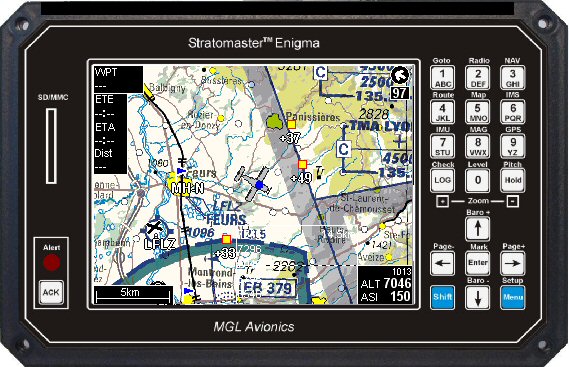
Re:SFO near miss might have triggered aviation disaster by wfunction on Tuesday July 11, 2017 @04:12PM (#14747618)
I mean including information/labels like "taxiway XYZ" that could make a stupid mistake like this obvious. Or are you saying they already do this?
Re:SFO near miss might have triggered aviation disaster by throwanem on Tuesday July 11, 2017 @07:13PM (#14748855)
No, they don't already do this. As 'phdp already explained, there are no instrument landing systems installed in the US which include GPS augmentation. So, while the moving map will show the same position information as at any other time when the aircraft's GPS receiver has sufficient signal, it's going to look something like this: http://www.stratomaster.eu/lignes/mgl/photos/enscr4.jpg

Meanwhile, the ICAO approach plate for SFO's runway 28R looks like this: http://redwoodva.net/lib/skins/en/images/events/charts/ksfo_... - trivially simple to comprehend at a glance, I am sure you will agree!

As far as "stupid mistake" goes, you sure do seem quick to judge professionals in a highly technical field totally unrelated to your own, and of which you've made clear you are happy to preserve your ignorance. Were I you, I'd hope my own errors meet with a greater extent of charity than that precious little you see fit to mete out. But that's your problem, not mine. Good luck with it.

Re:SFO near miss might have triggered aviation disaster by wfunction on Tuesday July 11, 2017 @07:17PM (#14748883)
> As far as "stupid mistake" goes, you sure do seem quick to judge professionals in a highly technical field totally unrelated to your own

The heck? Everyone makes stupid mistakes. Hell, I make more of them than a lot of people I know. That's why there are procedures and checklists and redundancies and automated systems -- to prevent stupid mistakes, evne by the best people. Where was I ever judging the pilot for heaven's sake?! Maybe you could be a little more charitable with how you judge people?

Re:SFO near miss might have triggered aviation disaster by throwanem on Tuesday July 11, 2017 @07:31PM (#14748964)
I mean you've already said you don't know what you're talking about ("I have no idea what [Cat III] means.") but you're totally cool with taking a confidently authoritative tone on it anyway, I'm not sure what other conclusion anyone should be expected to draw.
Re:SFO near miss might have triggered aviation disaster by wfunction on Tuesday July 11, 2017 @07:41PM (#14749020)
> I mean you've already said you don't know what you're talking about ("I have no idea what [Cat III] means.") but you're totally cool with taking a confidently authoritative tone on it anyway, I'm not sure what other conclusion anyone should be expected to draw.

...Did you come here just to fuel flames and burn people, or are you here to have a legitimate discussion about the subject?

You're totally cool being literally in ad-hominem territory at this point and you're lecturing me about not judging people I never even judged?

Re:SFO near miss might have triggered aviation disaster by throwanem on Tuesday July 11, 2017 @11:11PM (#14749891)
Is it really ad hominem to draw uncomplimentary conclusions from your evident disinterest in addressing substantive criticisms of the argument you're advancing? I don't think it is. Perhaps I'm wrong about that - but what else are you giving me to work with?
Re:SFO near miss might have triggered aviation disaster by phdp on Wednesday July 12, 2017 @11:19AM (#14753283)
> Uhm, "traffic at terminal ends" suggests the real problem is that the correct path is not known in the beginning, or that autopilot might not be able to avoid collision on its own... which is quite a bit different from the plane being unable to locate itself accurately and follow the correct path even if it were known a priori. Are we even discussing the original issue at this point?

Your thesis of your statements is that it is ridiculous that there is no moving map for pilots to see on the airplane. You've been told directly by some commenters that there is (tuxer), and others, including me, have said that GPS is not the way to land a plane.

>I have no idea what that means. I'm not sure what gave you the impression that I know what that means either.

I mean this in a positive way, but you should look it up on wikipedia. There are many great articles about the systems in place for instrument approaches and landings, and you may learn something interesting for a quick 15 minute investment.

> My problem is whether GPS is accurate/reliable enough to lead the plane to the place where the next system can take over, which to me implies GPS is already certified to be accurate and reliable enough to get the plane near the correct runway. Read it again.

You call us out for dismissing your idea (And, as a computer scientist, what seems ridiculous to me is the idea that "Oh, but this system you just described won't work..."), which to mean seems to be some sort of GPS en-route to to landing automated system. This idea has been informed by your inaccurate reading of a CNBC article (So it seems clear in normal situations autopilot has plenty of positioning available to it, enough to find the runway and locate the plane on a display of some sort. That goes pretty clearly against what you said. Am I missing something?). The en-route exists but can often change from the time the plane leaves the ground to when it gets within 50-100 miles of the airport, at which time it might be disengaged and switched to VOR based navigation. The landing by GPS does not exist because it is a lot less accurate than the existing systems.

This branch of the thread is about auto landing, and you were talking about how it's absurd GPS is approved for automated flying. Given that GPS is used for en-route navigation and not landing, the assumption was that you were proposing GPS landing systems. That is what my comment is about. And yes, having autopilot disengage at 50 feet above the ground when the pilot is not expecting it can be fatal. I would say that for the landing stage it has to be all or nothing. And you've been suggesting cutting out the human component by proposing an system that goes from take off to landing without manual intervention! Even if there is still a pilot in the cockpit, it still takes a few seconds for the brain to spin up to take over a task from the computer.

It's awesome that as someone outside the aviation industry, you're curious about how it works. Your incredulous tone and sense of superiority (As a computer scientist, as if we should automatically and uncritically defer to your opinion, and I say that as a programmer) is a bit off-putting. If you had just done the basic amount of research you could have come back with a list of questions such as:

- Is GPS used to navigate planes from take off to landing? What else is used?

- Why was the pilot in this incident not using automation to land the plane? How often does this happen?

- What is the procedure for switching between different navigation technologies at different points of the flight? I know that take offs and landings can be manual, but when does autopilot kick in?

- Why is GPS not used to land planes?

- What equipment to pilots use in the cockpit? If they are not the latest and greatest, why?

We could then have had a proper discussion surrounding the need for backwards compatibility, the rolling out of ADS technology, how its absurd we still use voice over radio as a primary way of relaying commands, etc. Pilots and others in the aviation industry generally do believe that a lot of the technology guiding our largest planes is antiquated, but you trivialize it without understanding the full context.

Re:SFO near miss might have triggered aviation disaster by cmurf on Tuesday July 11, 2017 @02:01PM (#14746407)
>The tone of many comments here (yours too) call out people who actually know how the system works and question them.

Lack of enough common frame of reference that the ability to communicate is almost totally inhibited from the word go. It reminds me of the Feynman magnets youtube video. The interviewer asks Feynman to explain the attraction repulsion sensation and Feynman admits any correct answer the interviewer will not understand because he doesn't understand any of the basic prerequisites of having a conversation; and any answer he gives the interviewer would understand is cheating him out of the correct answer.

Re:SFO near miss might have triggered aviation disaster by Piskvorrr on Tuesday July 11, 2017 @07:52AM (#14743348)
Seriously? From here, it looks as if you're doing your best in refusing to understand. Here's a hint: context. If you're en route, even an approximate position within hundreds of feet is great for navigation; please stow your straw men back where you found them.

In this case, the issue is with landing, where you need a precise position; "probably tens of feet, when it works" is exactly the sort of accuracy that's not good enough. As for "know where it is and land" - that's already there, is called Precision ILS, and uses no elements of GPS whatsoever.

Re:SFO near miss might have triggered aviation disaster by wfunction on Tuesday July 11, 2017 @08:00AM (#14743393)
The issue is you're treating this as though (1) cruising can be done on autopilot via GPS because it doesn't need much accuracy, (2) landing can also be done on autopilot because we have more accurate systems, but (3) the transition between the two requires manual intervention because the plane can't reliably locate itself accurately enough to get in the right position for landing systems to take over.

But that simply doesn't seem to be the case (in normal weather, which we had here). See my reply to a sibling comment here for a link. It seems that in normal conditions planes are capable of doing it all in one go, which means they are capable of accurately and reliably locating themselves. Nobody is expecting these to work in extreme conditions like bad weather or bird collisions, but in those conditions autopilot can and does already get disengaged (whether automatically or manually), and this could be done the same way. It's not like we forbid autopilot entirely because it isn't 100% perfect, so why not apply the same standards here?

Re:SFO near miss might have triggered aviation disaster by Piskvorrr on Tuesday July 11, 2017 @08:26AM (#14743524)
Nope. (3) The transition between the two requires manual intervention, as those are very different flight modes, using different systems and there's no automagic way to switch between them; the quote from the linked article is an oversimplification akin to "computers can do almost anything - therefore what do we need programmers anyway?"
Re:SFO near miss might have triggered aviation disaster by cyberferret on Tuesday July 11, 2017 @02:12AM (#14741944)
Oh, and aircraft DO have moving maps etc. now, but these are usually dialled out to show a range of hundreds of miles in cruise, and are not usually adjusted to show distances in mere metres when on final approach.

Once again, because these displays are usually on the centre floor console or located below the HSI, they are outside the 'scan zone' of a pilot on short finals.

Re:SFO near miss might have triggered aviation disaster by PhasmaFelis on Tuesday July 11, 2017 @04:02AM (#14742354)
In their defense, I would guess that making such a system 100% reliable and unintrusive may be a lot harder than we realize. It's not uncommon for Google Maps to be off by a few blocks for 10 seconds or more, and that could very easily be fatal if you're using it to land an airplane.
Re:SFO near miss might have triggered aviation disaster by wfunction on Tuesday July 11, 2017 @04:07AM (#14742381)
Are you suggesting their current GPS systems have that kind of issue though? I'm just asking for an interface to be added, not a entire concept of GPS functionality to be added. I'm assuming the latter is already used. It's not like I was suggesting they use Google Maps.
Re:SFO near miss might have triggered aviation disaster by Piskvorrr on Tuesday July 11, 2017 @05:18AM (#14742672)
Indeed. GPS (and friends) are a best-effort affair - works great, most of the time.
Re:SFO near miss might have triggered aviation disaster by Tuxer on Tuesday July 11, 2017 @12:27PM (#14745481)
There is, if you use it. In this case they were doing a visual approach , where you use eyesight in order to line up and land, because you have seen the runway. People do visual approaches in SFO as they are necessary to land 2 aircraft at the same time on the parallel runways ( they're like 30ft too close for parallel approaches on instrument ). It is still recommended to even in a visual approach, turn on the instrument approach systems ( for that exact reason ) but it looks like it is not mandatory for that airline.
Re:SFO near miss might have triggered aviation disaster by laydn on Tuesday July 11, 2017 @04:06AM (#14742376)
If you watch any 28R approach video for SFO on YouTube, you'll be even more surprised. Because there is no way you can mistake the taxiway for the runway. There is a huge array of lights pointing the pilot towards the runway.

I would imagine this would be more of a problem during the day because the lights are not as bright compared to the ambient light.

I would think the best way to get this detected early would be to integrate some logic into the ATC radar. As the plane gets closer to the runway (or taxiway!), it should be easy to tell where the pilot is going by looking at the track and issue an automated warning.