[0] https://www.microsoftstore.com/store/msusa/en_US/pdp/product...
Are there hardware issues, or do they hope a percentage of the population will pay for the upgrade in 2018?
Either they get $50 from users and let them go buy/install off-market, or make the money in the long run from paid app developers who are pressured now to put their applications on the store.
Holy backfiring shit, what a desperate bunch of clueless clowns! This is a nice machine, and there's a opening now that Apple has somewhat fallen out of favor, and they think they are in any position to play stupid games?
Store apps will not make the laptop slow, they won't have viruses, they will ask the user for permissions, can be uninstalled safely, they will scale well on hi-res screens, etc.
This type of safety is, imo, the most compelling feature of chromebook, and one that Windows Pro doesn't offer.
Are you sure they don't? In the past, many Windows edition upgrades (e.g., Home to Pro) were just a matter of enabling features that were already installed.
What's their basis for that? I'd have thought at the very best it'd be about the same speed as a 13" (assuming you're not doing anything that uses much RAM; the 4GB would really cripple it there). I'll be interested to see what CPU it has, exactly, but I'd be surprised if it has the HD540/640 graphics.
EDIT: Specs here: https://i.imgur.com/Kc1fQ52.png

The expensive ones use an Iris 640, so are the Kaby Lake incarnation of the chips used in the non-TB 13" Macbook Pros (the touchbar ones use the higher wattage chips with Iris 545). The cheaper ones use HD 620. So, the more expensive models might be comparable to the non-touchbar Macbook Pro; it's unlikely that the cheaper ones will be.
https://www.microsoft.com/en-us/surface/devices/surface-lapt...
Also the MBP Touch Bar has a TDP that is much higher than the Surface Laptop, only the low end MBP has the same TDP of all the SL.
So, no, the Microsoft product is MUCH SLOWER.
Yeah they're comparing it to the nTB MBP, it uses 15W Kaby-U, the nTB uses 15W Skylake-U, I assume generational improvements are where they get "faster".
That's the big problem Microsoft has with their hardware that Apple doesn't.
The obvious reason is because they are overpriced. And now they have made it even worse. This does not make much sense. Hopefully manufacturers like Asus can step up with even better quality Zenbooks and do not join this 'premium' binge.
It seems the 'premium manufacturers' see this as a non-elastic market and want to take the prices to around $2000. But is there enough differentiation in laptops beyond the screen and build quality to justify that premium. Everything else is off the shelf components and these dual core chips just don't seem to be worth this kind of money.
Even 'premium' phones are becoming dramatically more expensive with every refresh that are way out of sync with component prices.
But once you notice Windows 10 S, then the price is unusual. I bet the hardware team is disappointed by that decision for this machine. It doesn't make sense.
And free updates until 2018 doesn't help tbh.
Surface i5, 8/256 $1299, MBP $1499 or $1799 depending on the i5 processor.
Surface i7, 8/256 $1599, MBP $2099
Surface i7, 16/512 $2199, MBP $2499.
So not sure how you're saying this is on the expensive end.
The Surface uses 15W U-series, so they can only be compared with the 13" nTB, the other two use 28W and 45W with dGPU, they're in entirely different classes specs-wise.
> Surface i5, 8/256 $1299, MBP $1499 or $1799 depending on the i5 processor.
1799 is an i7, so no. And the MBP has a graphical edge (50~80% better graphical performances) as it gets an Iris 540 to the Surface's HD 620.
> Surface i7, 8/256 $1599, MBP $2099
1799 (nTB MBP with i7), Surface gets an Iris 640, the direct (and almost identical) successor to the 540.
> Surface i7, 16/512 $2199, MBP $2499.
2199 (nTB MBP with i7, 16GB RAM and 512GB SSD).
So the Surface is slightly lower-priced, at least at the low end, but with the caveat of flexibility: you can get a 16GB RAM or 512GB SSD nTB MBP for 1699, for the Surface it's 2199 or bust, and you can cut the i7 from any nTB configuration at almost no loss[0] to save $300.
[0] https://ark.intel.com/compare/91156,91169 the only difference is 400MHz base frequency, 300MHz maximum turbo
So it's a bit more expensive than the MBP if you care about normal things, or a bit less expensive if the i7 branding is for some reason deeply important to you and you don't care about the GPU. Either way, not great, really, because the 13" MBP is noted for its expensiveness, and generally expected to drop $200 or so soon.
Stop buying overpriced crap and start supporting companies that charge fair prices and maybe MS and Apple will release products that aren't 2-3x as pricey as the competition.
I said the price works for me because a 6 year old laptop still chugs along comfortably so the price gets amortized. I was not holding a measuring contest.
That sounds horrible...
By the time you add all that up, it's approximately the same pride as any other similar spec non-Apple/non-Microsoft/non-Dell Win home laptop.
And Microsoft is willing -- eager! -- to drain their moat and move to a world where they're just one in a sea of fully interchangeable app stores. It's baffling.
MSFT commoditized your business and sucked all the profits out of your eco-system until your net margins were 2%, forcing you to cut R&D, Design, etc, and compete in a brutal price war without much hope of unique differentiating features or value.
Now MSFT is directly competing with you by so lavishly spending on design that they are years away from making money on their Surface line.
The thing that really doomed the PC market was not that the easy margins went away, it's that OEM's responded by making their products worse. They cut hardware quality, they bundled crapware. The PC experience got worse year after year. Truthfully, windows 8 did not help, but I still think that if the OEM's had just bundled touch screens across the board it would not have been such an outright disaster. The reduced quality forced people off the platform, to macs at the high end, and to chromebooks at the low end. Granted, mobile would have always caused PC sales to decline, but not as much as they did. It is only recently that the OEM's have started investing again in quality hardware with a pure windows experience, and unsurprisingly last quarter PC sales went up YoY for the first time in five years.
When Apple started kicking butt in laptops by using sealed batteries with substantially more capacity, PC makers were locked out from doing same for years because it required battery conditioning software drivers, which MSFT didn't provide.
Commoditization took time, early PC market didn't have the direct model. And the race to the bottom in PCs isn't the fault of the manufacturers. It's an effect of the business model, and customer decisions. If a large segment paid up for better PCs and local support that model would still work, instead they predominantly choose to save a few bucks on the purchase price by buying the cheapest ones with crapware.
It's insane.
Source?
AFAIK they made over $10 billion in revenue on Surface.
I do agree its risky, but they're stuck between a rock and a hard place. They're watching mobile change everything and the WIMP/x86/W32 ecosystem that has sustained them for decades needs to catch up.
That said, its inexcusable all these consumer-oriented features like Candy Crush, Cortana, cloud sourced start menu items, ads, etc are either tough or impossible to disable on the Pro version of Windows 10. MS should have geared LTSB as the 'business friendly' version of Win10 and gone bonkers on the consumer side.
https://docs.microsoft.com/en-gb/windows/uwp/porting/desktop...
Regarding mobile changing everything, I am not so sure that it is. I still see people using Office over Google Docs (due to Sheets becoming sluggish with large quantities of data and years of XLS files floating around). I recall the release of ChromeOS being hailed as a threat to Microsoft in the media but in truth it hasn't dented businesses at all and I cannot ever see any business IT department even considering a switch to ChromeOS (even small businesses). The Chromebook devices look like etch-a-sketch toys compared to even cheap Windows laptops.
The ability to grab data and modify it on the go has been around since the Windows CE / Windows Mobile days. The requirements haven't changed in that time - grab a document, see it, and then attempt to edit it on a mobile device (give up, wait until you're at a normal computer - my experience anyway).
Much as I dislike the idea (I make a living from selling Win32 apps) I can see why they want to do it.
Or drop the proprietary charger and stick another USB-C port on that side and use it for charging.
Edit: ninja
Hmm, I thought the fabric was a nice touch. I've had my surface pro for a few years now and have never even come close to staining the keyboard. I wonder how common this issue really is.
Were yours?
Thankfully I am past all that now, apart form the chronic hairdo, the spotty face, poor personal hygiene, awful social skills....... etc. etc....
It will depend on how much you type, of course, and it will be different for different people but I wish they'd have chosen another material even though this one looks gorgeous.
Promising for sure.
If you stay with windows you get more of this kind of thing, if you jump ship then you never have to worry again.
Unusual that the Windows RT-alike supports it, though, but perhaps that's because Windows 8 and Windows RT were mutually exclusive in their hardware support (x86 vs ARM), and this isn't.
It seems like the intent is to end up in a similar place to iOS, with the entire system "curated" end to end. Which is not a bad place to be for many (most?) users. The problem with iOS model is that there's no way to escape it for power users, but it looks like it's not the case here - you can run 10 S if you want iOS-like experience, or you can run 10 Pro otherwise.
Well, I didn't.
I really wish a linux laptop with this type of design was put out for an affordable price, I really think its a major opportunity for a large business market there.
I think there is a lot of room for improvement on the "librem' laptops...
Is Linux architecture at fault for the Dell? Just curious. I wonder if there is significantly different battery life for the same machine running different OS (eg. Windows vs Linux).
They have improved upon this some as the current XPS13 has 60WHr. But they still are lacking in this area.
I'm spoiled because I'm used to the MacBook trackpad.
I ended up going back to an old ThinkPad.
Personally I prefer this over a vm, dual boot or running Linux exclusively
Also, did you see the performance demo? 10s was significantly faster than 10 Pro.
Not sure about the $999 for the cheapest model however. Does it include an Office 365 subscription?
Except that giving kids unfettered access to their computers allows them to flourish. See: BBC Micro, Raspberry Pi, Apple ][, the list goes on.
Games are now a rich part of our culture. They can tell great stories, and are not "better" or "worse" then a book per se. If you enjoy them in moderation, and go outside enough, games are a great thing. And LAN parties were a great pastime.
Malware, hacking tools, warez were one gateway for me into serious programming. I downloaded Visual Basic or Visual Studio and proceeded to write a trojan, to make friends' CD tray open and close on LAN parties.
And porn? Grown ups and parents don't like to hear it, but as a teen I of course enjoyed that there was porn on the internet. It didn't hurt me, and I've had healthy, normal relationships in my life.
...and a minute fraction will play on the football field or perform in the school theater.
They'll just use the browser for porn, no need to install third-party software.
Unless you actively try to stimulate the smarter kids and give them something to sink their teeth into, it's extremely difficult to tell the difference between kids who are bored and miserable because the material is below their level and kids who just don't give a shit about learning. In both cases, they'll be goofing off, not paying attention, and possibly disrupting class, but one group can flourish under the right conditions, and the other group is a lost cause.
Without games, there wouldn't have been any point to dig deeper than word processing.
Learning to avoid malware is an important skill for kids to learn. Shielding those kids will just create a bunch of adults that get infected.
I agree that great things can happen when kids can truly explore their computer and take away the 'magic', but just handing all kids a laptop and having them go wild is not the way to do it. I don't what is, to be fair.
If they brick it, they have to work out how to fix it.
As one of the kids who was lucky enough to get a BBC Micro, I had zero support. No-one else in my family even knew how to turn it on. No teacher at my school could support me because none of them knew how it worked either. If I broke it, I had to fix it. And no Stack Overflow, so no code to copy-paste. I had to go back to first principles every time and work out what went wrong and how I could make it go right.
Best education you can give anyone.
We had laptops at my high school 10 years ago, some of us learned how they worked inside and out, most did not.
When the curriculum depends on having a functional laptop, teachers wont want to wait around for kids to figure out how to fix their laptops. 90+% will go go the tech. Little Johnny who's already struggling with math class will not be helped by having a non-functional laptop. Not everyone needs to know how computers work.
EDIT: Probably you are like me and many people on here who found the HS curriculum easy and boring and stimulated yourself by hacking around with computers instead. This is not everyone's experience of HS, some kids legitimately struggle.
What is this weird obsession that we have with making children do everything the hard way? I understand that we want them to apply critical thinking and for them to grow into self-sufficiency, but why do we suggest these archaic hazing rituals?
We've made strides in many areas of technology. We have the power to troubleshoot a non-working laptop, unsuccessfully diagnose, and then re-image it to a saved state in less than a school day. I'm not saying that there shouldn't be consequences, but I think we can put Timmy's time to better use.
> we teach them basic math
Keyword here is teach. We do not give them a math book and tell them to figure out what 8 * 7 means. We break down the concept of multiplication into its constituent parts. In that same vein, we should enable the child to learn how to troubleshoot the system.
Like I said: I think we can put Timmy's time to better use.
Well, life is an archaic hazing ritual.
If I - as a teacher - can do an immediate 'restore to neutral state' with core educational files and programs retained then by all means open them up.
Otherwise, I have to be curmudgeon and say that the existence of the computer in the classroom is to more effectively complete educational tasks. If having an open system gets in the way of that then the system should not be open.
But they still won't know or care how their computer works, or how to program.
Still, that BBC Basic manual and copies of Micro User were mighty helpful - the manual was excellent! I am sure you agree.
I am genuinely curious - ideas?
The target market is students, not schools. They want kids to get a windows computer instead of a mac before they head off to college
Note that in U-series now covers both 15W and 28W chips, so that leaves a fair amount of room.
Considering the iGP (620 and 640) they're using 15W parts, so it's comparable to an nTB 13".
It's a full fledged laptop.
Slack in the Windows Store is packaged by that. It packages the Win32 executable, so it only runs on Desktop environments.
If your codebase is adaptable enough, you can often run directly on the Windows 10 Native HTML+JS stack and cross-compile to that, either directly or maybe through Cordova if you want mobile platform reach.
(I'm wishing there were more convergence between the Electron and Cordova stacks, but writing portable code that mostly runs on both isn't terribly difficult. Every now and then it would be great to have a Cordova plugin in Electron or vice versa.)
There's also a 'native' HTML+JS stack for UWP/Win10.
But why not?
The singular issue with electron is how fucking huge the simplest of apps have to be. I see desktop HTML/JS as a RUNTIME being a very near-future standard.
I'm sure electron has thought about it. It couldn't possibly be any bigger of a hassle than the java runtime.
I don't think it is "sexy" to most developers right now because there are still a lot of developers that still cling to ancient "native" control toolkits, ancient ideas that web platform is already the main UI platform for the majority of user these days, and for whatever reasons dislike HTML and JS for application development. You see a lot of the complaints here on HN every time Electron or Cordova are brought up.
I'm sure Microsoft knows they don't get a lot of enthusiasm from a lot of developers for the native Windows 10 web stack, so I'm not surprised they underplay it at conferences. Those of us that do care know we can follow the Edge team blogs and know that UWP API enhancements benefit all three main stacks.
While the Home to Pro upgrade costs double that? Strange.
Edit: Looking at this picture https://cdn.arstechnica.net/wp-content/uploads/2017/05/surfa... and there's even substantial space around the type A receptacle. I honestly don't understand how it can be thinner than the MBP. I look forwards to seeing one in person.
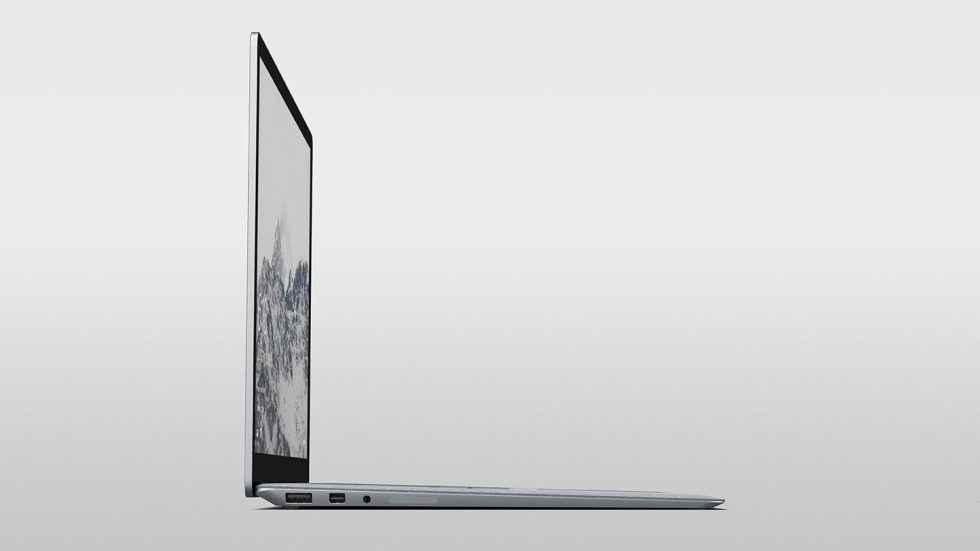
The smaller MBP is 0.59" thick. The Surface Laptop is 0.57" at the thickest point (0.39" at the thinnest). Either one can easily accommodate any USB port.
If you look at a Macbook Pro sitting on a table, you'll see there's a considerable gap between the table and the side of the computer. That's because the MBP is thicker in the middle than at the sides, which makes it appear thinner than it is.


It becomes a lot easier to see it when you look at this.
I think this (the Mac) is Photoshopped 'deceptively'. Look at how the top of the shell and the base don't have concrete edges but are faded into white, too.
https://www.apple.com/macbook-pro/ - look at most of the photography, not shot side on, so it looks like just the vertical edge of the MBP is the entirety of it's "depth", which is not accurate.
The downside? "Windows 10 S", which only runs apps from the Windows Store. The upside over Windows RT from the Windows 8 era? You can port Win32 apps to the Store today, don't think you could back then.
Edit: You can upgrade Windows 10 S to ordinary Windows 10 Pro for $50. Laptops that run Windows S from other manufacturers will start at $189.