I'm not suggesting it's better. But people seem to automatically assume that being older when having kids as better. I know some much older parents who were not good parents. I know I would not make a good parent to a younger child now that I'm in my 40s.
I don’t deny that your way can work out as well. But OPs advice was “get children before you are 30, don’t wait until after”. Whereas my honest advice, based on my experience, is “wait until you are 35, you’ll be much more stable life in several regards”.
Which approach is best for you depends on a lot of things. For me, I can honestly say, there is no way I would be where I am if I had had kids in my 20s or even early 30s, and I also wouldn’t have been as good a father as I am right now based on how I’ve grown since then. Both things that my child directly benefits from.
I feel like I do have the unique perspective having actually done both. I don't need to assume what kind of parent I was in my 20s because I was that parent. And I'm a different parent now. But being a younger parent was a great experience despite any other consequences.
And the life I have would just not have been possible if I had a child back then. Not even if I completely sacrificed family time and attention back then, which I never would have wanted.
But I guess we have to agree to disagree. For you, being a younger parent worked out better. For me, I’m certain I got my child at the right time. In any case, I find OPs general recommendation that if you want children, you should have them by 30, to be ill-advised to the point of being harmful. Many people would benefit from waiting until later.
I'm 32, and I think I currently have much less patience and understanding than I did at say 22. Life has basically broken me to the point that I simply don't have the capacity for these things that I used to.
Kids at 27 would have been a bad bad idea. Kids at 32 as well (wrong partner). I’m even older now but I am with the right partner and naturally want kids now. Before her, the topic wouldn’t even cross my mind.
I think it’s really hard to give general advice if one doesn’t mention how their advice interacts with other variables
I also have plenty of energy, the only real change I’ve noticed getting older is I’m in bed a bit earlier than I was in my 20s.
I don’t understand why people think midlife is some kind of drained, lifeless decrepitude
I think people have a variety of health conditions and lifestyle choices, some of which do indeed result in less energy in mid-life.
Kids change you, for the better if you let it. There's nothing like a completely helpless infant who is totally dependent on you to wear down your selfish tendencies.
I got my son at almost 40, and I’m positive I’m a much better parent because of that. Sure, kids cost energy, but at 40 and 50 you’re not geriatric. I often get the opportunity to compare our parenting style to younger parents, and it’s clear that they often have some emotional growing up to do themselves. They complain about normal parenting things that we just shrug about, they are torn between their career and raising a kid, and most importantly they often lack patience, where to us it just comes natural.
biologically, and for pregnancy, yes you are.
Be it as it may, I conclude that there is an elevated risk for problems the older you get (although for some issues, cause and effect may be reversed, which is hard to resolve), but that that risk may not be so significant as to outweigh other advantages.
> A simulation study concluded that reported paternal age effects on psychiatric disorders in the epidemiological literature are too large to be explained only by mutations. They conclude that a model in which parents with a genetic liability to psychiatric illness tend to reproduce later better explains the literature.[9]
> Later age at parenthood is also associated with a more stable family environment, with older parents being less likely to divorce or change partners.[43] Older parents also tend to occupy a higher socio-economic position and report feeling more devoted to their children and satisfied with their family.[43] On the other hand, the risk of the father dying before the child becomes an adult increases with paternal age.[43]
> According to a 2006 review, any adverse effects of advanced paternal age "should be weighed up against potential social advantages for children born to older fathers who are more likely to have progressed in their career and to have achieved financial security."[63]
Having kids fast-tracked me to a critical increase in patience. I've grown so much in less than three years because of my kids. I'm not sure this growth would have ever happened so quickly through other means.
And I'll always have a special, particular respect especially towards my firstborn for causing that in me, and for enduring my shortcomings in the meantime.
I was more patient as a teen than I am now in my 40s. Now I am tired. All the time. I fear I would literally die of exhaustion if I had to maintain more irregular hours than I already do due to insomnia that I have developed over the last half decade.
Someone with no one to care about until their 40s is supposed to be in a much better shape than someone who raised three kids for the last +25 years.
Congrats on making it though, I completely understand why you would feel tired all the time!
It was really nice that I had time to establish my career and figure things out before having kids.
San Francisco has the highest rate of geriatric pregnancies in USA. We are in a statistical bubble where having kids late is normal (because careers and hcol).
https://www.sfchronicle.com/bayarea/article/mother-birth-age...
I was talking to a nice girl up until she mentioned still wanting kids in her late 40s. Maybe I’m old school, but telling someone you froze your eggs the same day you meet them is weird.
Society itself is broken. You SHOULD be able to graduate high school and make enough to support yourself and a family with a bit of struggle.
This rapidly transformed into no, get your masters, get 8 years of experience. Earn at least 300k as a couple. Then and only then should you consider a family. Childcare is 3k plus a month in many places.
For myself , I wish I made this happen in my mid 20s. I had to move back home to take care of a family member (fck cancer) and I suffered various personal setbacks due to it.
In my 30s I’ve let go of expecting anything. This world has already given me so much.
In my 20s, it felt indeed weird to bring that up early for me, because I wasn’t ready yet and didn’t even really know what I wanted yet. Later in life, when dating we always talked about potential family planning and general outlook on life early. (Unless it was never meant to be a serious relationship to begin with.)
Felt really awkward for small talk.
My point was the economy should support having a family in your 20s if that’s what you want to do. You shouldn’t need a well paid career, a quality lifestyle that supports a family should be available for everyone.
I imagine universal health care, paid family leave ( for months not weeks) and affirmative (free?) childcare could bring that gap.
At a point it isn’t even an age issue. A lot of people will never earn enough to really support a family, and that’s a failure of the social contract.
You should be able to get a job as a Walmart clerk, have your partner work part time and still afford to have a family.
I think I’ve muddled my own point here, but it should be easier. Maybe that Walmart clerk could own a house ?!
These conversations should not need to happen but they do because of the current inequality that exists. A couple can't change the world so they talk about these things since it's their best option
The ultimate purpose of dating is to meet your future spouse. We're turned it into some kind of senseless sexual escapade, and this has poisoned the relations between men and women. It makes them exploitative and dehumanizing in spirit: sprinkling them with the waters of "consent" doesn't change that, as the subjective cannot abolish the objective. We've reduced sex to something that is merely pleasurable and contradicted its intrinsic and essential function which is procreative by employing an array of technologies that impede and interfere with healthy procreative processes. This creates a mindset not unlike that of a drug user who is obsessed with getting another hit with no thought given to the damage, or the bulimic who wants the sensual satisfaction of eating, but not the calories.
The psychophysical reality of sexual intercourse is much more than some passing physical pleasure. It mobilizes processes in us that are completely oriented toward bonding and the strengthening of the relationship in preparation for children. Whence the stereotype that men will often exit quickly in the morning after a one night stand with a strange woman? Because both can feel, if only subconsciously, that the processes of bonding are taking place, and who wants to bond — and in such a profound and intimate way — with someone they've just met? In this regard, the character of Julianna in Vanilla Sky makes an astoundingly profound and accurate remark for a movie coming out of Hollywood: "Don't you know when you sleep with someone, your body makes a promise whether you do or not?" Our capacity for sexual intimacy is likewise dulled.
(Masturbation is even worse. Those processes bond us with a fictional harem of the imaginary and close us within ourselves. For social animals like us, this is a recipe for misery.)
We thwart and ignore our biological nature to our own detriment. The procreative prime spans the mid-twenties into the early 30s. Statistically, most people should be having families by their mid-20s. Our culture confuses people and creates a pointless obstacle course that leads them to postpone such things either because they're too immature (and encouraged to remain so, also by this unserious dating culture) or because they believe they must achieve some arbitrary milestones first. Furthermore, family and community support has been dashed by a culture of hyperindividualism.
The causes of demographic decline are not a mystery. People simply either don't think deeply enough, or they don't want to make the cultural changes necessary to restore normalcy.
Edit:
To be clear I appreciate this comment and agree with it in the large. It’s hard to talk about these things without being quickly dismissed in the current zeitgeist.
Dating culture is evolved to help you find a mate based on YOUR choices and capability not your parents or class level. This allows you to “trial” compatibility over shorter time and find better fits.
Please don’t let your hangups around sex (correct or not) become a world view. It’s not a healthy obsession.
I hear ya. My spouse developed mental illness after sons 4,5 were born. A spouse can sabotage a lot of things when they set their mind to it - and their mind never stops. Not even at 3am. The first year was hard. The second was harder. After 5ys we run out of adjectives. After 15y we're using Dr.Seuss letters to spell out how things are.
Psychosis, bipolar, BPD, NPD, pretty much all the *PDs. She switched it up.
> was it directly related to the kids
As in stemmed from? No.
As far as challenge related to the kids, it was 1) keeping the them as safe as possible when she was not and 2) proving some semblance of parenting. Both were difficult-to-impossible, given that kids are trapped at home, thanks to eradication of free range areas.
This has literally only been true for about 30 years out of the sum total of human history, would you like to guess when those 30 years happened to be?
Obviously the answer is "1950s america".
For the rest of human history, you needed something beyond the education you received until the age of 18 in order to support a family.
Industrialization has pushed inequality to extremes while raising hours worked - even as productivity keeps shooting up. There's no good reason for people to tolerate this; it's just exploitation.
Like, this is a broad consensus thing. There's not really much debate; ethnographic studies have backed it up. Where are you getting your info from?
1. That there was war and war sucked; disease; and also infant mortality was high - therefore life sucked back then. None of that really factors in to the debate of how much free time people had; and those thing are all still very much with us (especially in America).
2. That food prep and gathering firewood takes time. Well, gathering firewood is also known as 'going for a walk in nature', and it's actually good for you. You can chat with your friends while you do it. It's not like your average job. It might not be technically 'idle', but it's a lot closer to 'idle' than flipping burgers in a sweatbox.
Same with food prep - picking through some dried beans, or stirring a pot every 30 mins and making sure it doesn't boil over, while you tell stories around the table just isn't comparable to working in an Amazon warehouse pissing into plastic bottles.
It's critique, and you can buy it if you want; but there's nothing there I would call substantial.
2. How'd you get those dried beans out of their pods? Where'd you get that pot? Where'd you get the water?
3. You didn't actually read the critique did you, you the wikipedia paragraph characterizing the critiques.
2. Sitting around the table, singing songs, telling stories, or quietly reflecting; all working at my own pace, in the comfort of a home that's been owned outright for generations, surrounded by organic soil free from pesticides and plastic.
3. I read your link, not every cited article. I've personally lived that way, and I know what I'm talking about. There's a big difference between shucking corn with your family or stacking logs, and shuffling numbers at a bullshit job which exists to make two or three incredibly rich people thousands of miles away a tiny bit wealthier. That said, if there's something more you'd like to bring to the discussion, bring it.
And anyways, if you’re a hunter-gatherer, you’re following your prey, not sitting around growing corn to be shucked while you sing songs or whatever.
By the way, my buddies and I tell each other stories at work all the time? You can do this at work too, you know. What you seem to be doing is imagining a world where you’ve outsourced all your labor to “it’ll get done” land, then combined hunter-gatherer lifestyles with agrarian lifestyles
Yeah, and we now expect women to work 40+ hour work weeks and house work on top of that. That is the thing causing societal reproduction rates to plummet.
Let's just do the math: a day has 24 hours. The recommendation for healthy sleep is 8 hours. Then, you work for 8 hours, with 1 hour added for the unpaid lunch break. That's the two largest blocks, leaving 7 hours to distribute... dedicate 3 hours for the "staying alive" stuff (preparing for going to work in the morning, aka breakfast, shave, getting dressed, preparing dinner, eating dinner, have a shower and at least some unwind time to fall asleep).
And that in turn leaves only 4 hours for everything else: running errands (aka shopping, dealing with bureaucracy, disposing of trash, cleaning), just doing nothing to wind down your mind from a hard day at work, hobbies, social activities (talking with your friends and family or occasionally going out) and, guess what, actually having sex.
Easy to see how that's already a fully packed day. Society just took the productivity gains from women no longer having to deal with a lot of menial work (washing dishes and clothing, as that got replaced by machines, and repairing clothes) and redistributed these hours to capitalism.
And now, imagine a child on top of that. Add at least half an hour in the morning to help get the kid ready for school, an hour to drive the kid to errands (because public transit is more like "transhit"), and another two hours to help the kid with homework because that workload is ridiculous and you don't want the kid to fall behind kids of parents rich enough to afford private tutors. But... whoops, isn't that just about the entire "everything else" time block? And younger children need even more work, constantly changing nappies, going to the doctor's all the time because it's one new bug every new week and sometimes the bug also catches you cold...
The time constraints that come with a dual income certainly make the logistics of having children more difficult though.
I'm not talking about men, I'm talking about society itself. Try renting a family home on a single income in any moderate popular area. Owning a home is outright out of reach for even more people.
And B, even if you wanted to live that way you can't any more; because the commons has been relentlessly exploited past its breaking point for centuries.
I shouldn't really have to explain any of this, but people generally seem to have some weird ideas and blind spots surrounding our history as a species.
Yes, the obstacle of living illegally on land that has been systematically over-exploited for centuries (or too harsh to bother), without any community or experience. Not sure I'm seeing your point.
In reality in most families all family members were contributing something to the household income.
In the past, huge amounts of household work were done without any such exchange.
Today, child raising, cleaning, cooking, provisioning, and more remain unpaid household labor. The people who do that work were not idle 800 years ago, and they are not idle today.
If we are talking about "centuries" quite a lot of people including men did not worked as in being employed for salary. But their work was economical - necessarily so.
Being stay at home mom today is mostly battling boredom and demotivation. Or then, making up things to do. It is not the same as milking cows or making cheese.
I was a stay at home parent for my daughter. It was extremely far from battling boredom (except perhaps for first year and a half, if that, and even then anyone who is actually interested in child development will not find it boring) and it was the opposite of demotivating.
Rather than speak in such broad generalizations, I think it would be better to restrict your claims to specific, real stories.
And the 50s to 80s anywhere else in the civilized world.
There are lot of alternatives. Men can be primary parents (I was, once the kids got to about the age of eight or so, and was an equal parent before that) and they could stay at home (I continued working, but I was already self-employed and working from home, and my ex never worked after having children).
I think the ideal set up (it would have been so for me) would have been for both parents to work part time.
Of course it still comes back to, you should be able to raise a family on the equivalent of one full time income.
Of course, if the leisured society predicted a few decades ago had come to pass it would be one part time salary.
Beautifully said, very progressive also!
I am a big fan of the 4-day work week (for the same amount of money as 5 days), it's been transformative for my life. The extra energy and focus you get from that 1 day translates to higher productivity in the 4 days where you do work. Sadly, the current "squeeze em', bleed em' dry, and drop em'" brand of capitalism is incompatible with the majority of the people to experience how good life can be like that.
I certainly ain't looking forward to them raising the retirement age to 1337 by the time I get to retire.
It's like a race where they repeatedly move the finishing line because the organizers took the medals and sold them, while waiting for you to drop dead so they don't have to give you what you are due.
If you, as an employer, want a motivated, energetic workforce who are not slacking off, it's also in your interest to give that opportunity to your employees, as multiple experiments have shown that 4-day work results in increased productivity and employee retention.
today men have the ability to watch kids thanks to formula (though it is better for the kids to eat from mom - this is rarely talked about because it is easy to go too far and starve a baby to death in the exceptions).
Aside from the peer comment pointing out the bleedingly obvious, there's also a bit of history here:
  In 1907 Justice Henry Bourne Higgins, President of the Commonwealth Conciliation and Arbitration Court, set the first federally arbitrated wages standard in Australia.

  Using the Sunshine Harvester Factory as a test case, Justice Higgins took the pioneering approach of hearing evidence from not only male workers but also their wives to determine what was a fair and reasonable wage for a working man to support a family of five.

  Higgins’s ruling became the basis for setting Australia’s minimum wage standard for the next 70 years.
* https://www.nma.gov.au/defining-moments/resources/harvester-...
* https://www.fwc.gov.au/about-us/history/waltzing-matilda-and...
This is the list of awards: https://www.fairwork.gov.au/employment-conditions/awards/lis... it's pretty extensive
Each award is also complex, and covers a range of issues in the employment. For example, this is the Professional Employee award: https://awards.fairwork.gov.au/MA000065.html just working out what the minimum wage would be for a graduate engineer with 2 years experience is a complex, detailed matter.
But yes, probably, for most professions you could reasonably expect to support a family of 5 on the award, depending on location and definition of "support". Affording a house would largely depend on an additional inheritance, though.
Tell me a place in any Western society (outside of run-down rural areas/flyover states) where an average employee (i.e. no ultra-rich tech hipster bros) is able to afford a home before the age of 30 purely by his own savings and income. That is frankly no longer a reality for most people.
It is perfectly doable, even common, to buy a home in low and medium COL areas without any assistance from family, living or dead. The fact that you can't do this in NYC or SF is not an indictment of anything other than NYC and SF.
But there aren't any jobs there, so you're going to need an inheritance to support your family of 5.
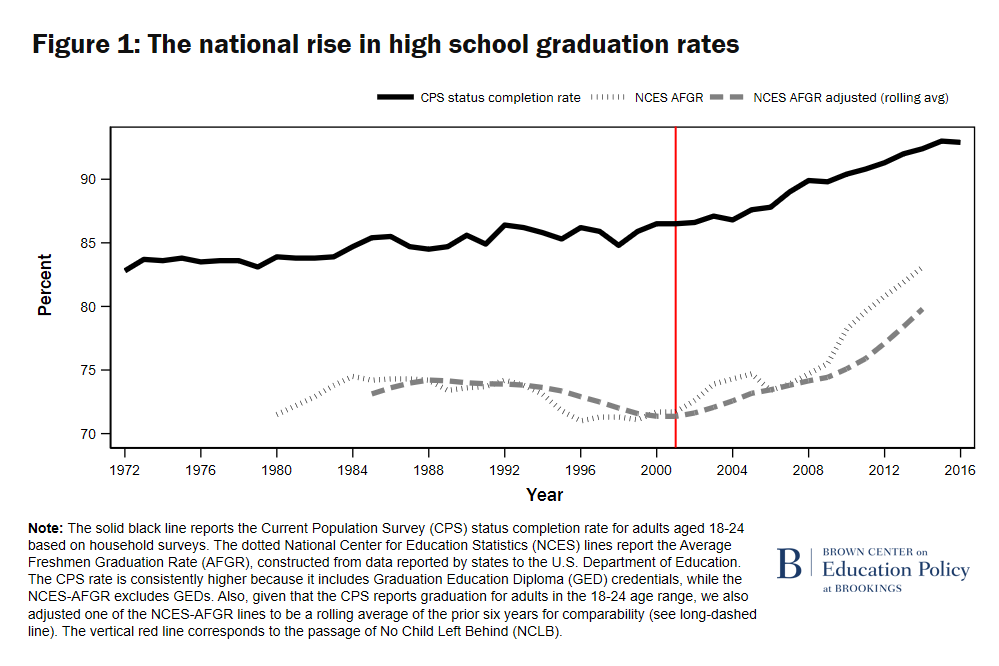
High school was advanced education in 2000. Basic education ended around grade 6-8.
https://www.brookings.edu/wp-content/uploads/2020/02/Grad-ra...
…which is not necessarily problematic either. I was 43 and my wife 41 when our daughter was born. Our child has had a great life and so have we. While I’m 60 now and don’t have quite the same energy I had at 20-30’something, everything has worked out well for us.
Everyone’s path, goals and priorities is different and as long as would-be parents consider the trade offs all around, it’s hard to be prescriptive about this.
> Society itself is broken. You SHOULD be able to graduate high school and make enough to support yourself and a family with a bit of struggle.
No argument there. The complex socioeconomic forces that has created this dilemma are going to tough to unwind.
https://www.amazon.com/Why-Love-Hurts-Sociological-Explanati...
Not least the idea that if you keep dating you can find somebody better than you've found so far -- a problem that's worse in large cosmopolitan cities where the dating pool is large and perceived to be large.
Half the population has an IQ less than 100. Do not expect the low-IQ group to ever get a masters or earn 300K as a couple, etc.
Caveat- this may have to be amended due to the watering-down of educational standards in the USA.
So, if the due date is beyond your 35th birthday but you give birth early it's still a advanced maternal age pregnancy.
My ex-wife was 37, and I was an year older, when our younger one was born and energy was not the problem so I agree with you that 35+ should not be a problem.
However, a lot of people are having kids significantly older than that.
I not know whether I could cope with a baby 20 years later. Contrary to stereotypes I used to get up faster and more fully if a baby cried in the night. On the other hand, having a baby might energise and motivate me! Not planning to try it out though!
I had my kids 25-35; all 5 are adults. We live together as is befitting a 4 income economy.
> and if the kids goes to college
Do you mean go away to college? Yeah. No.
> may have some dependency on you when your peers are retiring.
Me and peers are all working grey. End of career happens with first major illness intersects with the lack of health insurance and we die.
> Plus if your kids have kids
If one of my a sons pairs off with someone and they both work, they'll still be 2 typical incomes short of self sustenance.
BUT, if they got married and then married another couple, the 4 of them only have to find one more adult - the one who will parent during the work day. After the last child enters school, the core 4 can kick parent 5 to the curb.
> Do not let fear of how much it will cost
No fear. Just math.
> or desire for more resources first
But if they had more resources they might only need 3 or even 2 adults working full time to afford basic bills.
> Do not let ... it ... stop you from having kids when you are still young enough to do well.
Parents can (and do) parent while living in their car...
What is below RA/LE? My comment addressed common financial realities. It applied to every adult age, up to and including death.
> MY younger one turns 18 when I will be 58
okay.
> and I am a single parent.
You may be interested to know that parenting can be get much harder than that. ex: I would have loved my difficulty level to be dialed down to Single Parent.
> Baring accidents or the severely unexpected
I agree that some folks do experience year after year after year of luck.
> (which can happen at any age - plenty of people die in the 30s or 40s)
I agree that not having life-changing advantage & luck is pretty dang common.
> its not a problem.
What's not a problem? Taken together, your comment seems to be lacking a subject.
I did the best I could. If you could share which of my points you were responding to, that might help.
Depending on the circumstances in a persons country, maybe getting children at a young age isn't that dumb. I'd argue that the best time to get kids is as a university student. You get free daycare, the government doubles your stipend (and it's extended), your housing subsidy increases, you generally have more free time as a student, grandparents are younger and able to help more and you have more energy and can more easily deal with lose of sleep.
As a bonus, when your kids move out, you're not even 40 year olds.
The only real issue is: Have you meet the right partner yet?
Where... where do you live? I'm all for having kids as soon as possible, but I was barely able to provide for just myself during university.
I'm in Spain, absolutely different landscape here. I guess your government is trying to boost both higher education and birth rates.
Various governments have also attempted to boost birth rates, but unsuccessfully.
There's a bunch of stuff like that, some can be "stacked", some are mutually exclusive, some are "per child" some is per adult. Some are only available to single parents, some are only available if both parents are enrolled in an education, some are only available if you make less than a certain amount.
having energy is subjective and does not really depend on being young or old. some old folks are full of energy and live really active lives. It depends on your state of mind and lifestyle more than age.
A few years in and I feel "back on my feet", but it was harder for being older.
Kids take a lot of energy but they also give you a lot, no matter the age. We are biologically hardwired to rise to the challenge of having kids no matter the age.
An older friend conveyed to me pretty much the exact same thing you are, that he cannot imagine having kids at 40 because you will not be able to keep up with them energy wise. You get old and your body really starts to give in.
Alright Geoff, thanks, but you are 54 and do zero exercise, have a diet of eating out at fast food and fast casual restaurants, a body type that would be described as "meatball", and a list of medical conditions which all scream lifestyle change.
Meanwhile at trail running meets, I bump into 60 year olds still giving some 35 year olds a run for their money.
> Meanwhile at trail running meets, I bump into 60 year olds still giving some 35 year olds a run for their money.
Yup, this is very much key.
I am perfectly capable of keeping up with my kids.
My 72 year old father who is also in good condition keeps up with my 3 year old son.
The difference I see between a reasonably fit 40 year old and not is the massive gap.
So if you hear anyone telling you they can't imagine late fatherhood ignore them, they obviously aren't good at imagining things.
The chance you will need to take care of both your kids and your parents in your 50s is pretty high (not even going into you and your partner), while facing declining health yourself.
Could be easily manageable, or not. Ask me in a decade.
But one thing is darn true - if a good long term stable match is not there, no point pushing for kids. World really doesnt need more damaged folks struggling their whole lives to overcome shitty childhood. And thats fine, parenthood is not for everybody and there can be an amazing life to be had instead (and I mean it in best way possible, but that life shouod not be spent behind the desk and on the couch)
I know two men 18 years apart in age who became fathers at the same time - two months apart to be exact. Even though the older is an avid gym-goer, it's only the younger who can pull off popping back into full strength after less than 6h of sleep.
Interrupt that 60 year old's sleep twice a night with a newborn crying, add a bunch of new responsibilities, and I'll be impressed if he even makes it to the meet.
You're comparing people who have made exercise their #1 priority in life to people who have made their kids and supporting their families financially their top 2 priorities. It's a bullshit comparison.
My father is 63, raised three children and has had a successful long marriage and retired from a good career. He also goes works out daily and did for most of my childhood. He didn't make exercise his number one priority.
There are definitely pros and cons, but overall I'd recommend kids in mid- to late-20s.
>However don't wait until you think it is the perfect time.
Yes! There is no perfect time to have kids, but there will definitely be a time when having kids isn't biologically likely anymore
However at 22 I wasn't the experienced person I am today. Nor was I stable, nor could I jump on opportunities like my peers could.
If having a child in your early 20s would mean not losing opportunities in progressing in a career, at least with enough free childcare and food to feed the children, people could be more inclined to have children while they get their life together. Our culture of moving away from home is also a big problem -- having 2 sets of grandparents helping raise a child REALLY helped me at my youth not miss out on youth and still raise my child.
kids between 25-32 is something our society should aim to be as practical and pleasant as possible.
Securing stable health insurance dictated most of my career decisions. I was captive to turrible gigs, had to pass on a lot of opportunities.
Want to revitalize our society?
#1 is Medicare for All. More startups, more risk taking & innovation, higher birth rate, etc.
#2 is childcare. Cheap, plentiful, good quality.
#3 is housing. Again: Cheap, plentiful, good quality. Plus, rentals better suited for young families (eg more 2 & 3 bedroom units).
This costs infinite money.
It's impossible to scale, because nobody wants an environment where their child is not getting attention from compassionate, engaged adults throughout the day. To get the same level of care as a stay at home parent, you need as many care workers as there are families with young children. And if you pay those workers comparably to the average wage, you need to tax the entire wages of one parent in each family to cover the care costs.
It's probably much cheaper to write checks to families encouraging them to have one parent care for their own children full time.
$50 if they’re watching 5 kids, $100 for 10, etc.
That’s assuming 0 overhead.
Ideally, yes.
But I'm not going to tell someone they can't work.
My wife was stay-at-home, until she couldn't take it any more, and then returned to work. Even though it cost us more overall (childcare, second car, etc).
Also, adopt. Before I was a parent I thought of a child as "mine" because of biology. Really you see that you shape people and form a connection with them because they are part of your family.
Which is another important point: if you want multiple children you probably want to have your first earlier than you might otherwise.
I need to push back on this because no one is actually an adult at the age of 25 despite those people wishing it were so. You do not have your shit figured out and assuming a partner of similar age, neither do they. It's only starting in your 30s where you start to understand what it is to be a responsible adult to yourself and to the world.
So please, do not seriously consider having kids in your 20s, for all our sakes.
It seems to me like when you move the definition of “adulthood” back to age X, fewer people function like adults prior to age X.
Too strong.
You're an adult who doesn't have their shit figured out. Some people never get it figured out, others take into their 30s, 40s or even 50s.
And then in your 60s, you've got new shit to figure out.
You write your comment about the maximum safe age for having children as if most people (at least in the advanced countries and moderately reasonable income brackets) were living the lives of 19th century industrial workers.
This is both good and bad. Having a child is very difficult, but it gets harder as you get older. You lack a lot of monitory resources as a teen or the early 20s, but you have a lot more energy, as you get older your body starts decaying you will lack energy. A kid had at 40 will still be depending on your when you are 55 (kids is only 15), and if the kids goes to college may have some dependency on you when your peers are retiring. Plus if your kids have kids young as well as you, you be around and have some energy for grandkids.
Don't read the above as advocating having kids too young, it is not. However don't wait until you think it is the perfect time. If you are 25 you should be seriously thinking in the next 2 years, and by 30 have them (if of course kids are right for you - that is a complex consideration I'm not going to get into). Do not let fear of how much it will cost or desire for more resources first stop you from having kids when you are still young enough to do well.