N.B. the current U.S. population is 1.6x the population of 1969.
There are reams of economic literature trying to estimate whether government intervention in the market was a good idea. Most of the time it doesn't turn out great. So the parent's suggestion "probably won't be a win for economic output" is a pretty safe bet.
Often governments will use "security" as an argument to keep steel, shipbuilding, etc, in the country. That argument is not really possible to evaluate on economic grounds.
Likely, yes, but even if they are, it’s impossible to say whether that’s a net win for society. Possibly, if the government hadn’t subsidized them, but instead had had lower taxation, other industry segments would have blossomed, and gotten better benefits for society.
As an example, US government support for the Internet may have led to larger automation, making labor relatively more expensive, and because of that decreasing the size of the middle class. Opinions will differ on whether that’s a net positive.
In other words, I think we’d need to presume the absence of those concerns to intelligibly consider the absence of taxation-funded interventions. And that’s more of a minarchst fever dream than a thing that could actually happen.
At the same time, this isn't a "yes/no" question. This is thousands of sliders that we adjust for each industry.
You always have to consider the opportunity cost. Sure, perhaps we've ended greater security and have also ended up with vibrant industry A at the end of it; but we maybe had to pay by hurting industries B, C, and D. It might be worth it; but it doesn't mean it makes sense to do it for industry Z where there is a smaller security benefit.
This is the central thesis of Mazzucato:
* https://en.wikipedia.org/wiki/The_Entrepreneurial_State
Has an entire chapter on the iPhone and its technologies (GPS, touch screens, Siri, etc), which would be applicable to most smartphones.
It should also be pointed out that economic goodness is not and should not be the be-all end-all reason for government spending. Governments building parks, for example, is a social good with little economic value (or at very least hard to quantify benefits).
In the case of things like medicine, government spending there has a social good of limiting communicable disease which is more important than how much money a drug company can make off a drug.
For something like TSMC putting plants in the US, even if it's somewhat economically disadvantageous we are still talking about bringing onshore more jobs and training for US citizens which will generally increase our capabilities here and the satisfaction of those employees.
Trying to get onshore development of electronics, the government basically has 2 levers to pull, either subsidizing building new manufacturing or applying tariffs to incoming tech goods. One of those levers has the negative consequence of raising prices on tech goods for everyone while we wait for manufacturing to build out.
That’s simplistic and assumes a baseline where the relationship with the government starts at zero.
The company pays taxes. There can be negotiations over the tax rate, which is not a subsidy so much as a ‘tax you less’ type arrangement. This can happen at multiple levels for a company like Apple, even beyond the state/federal thing. The repatriation of billions of dollars of earnings is also in play.
We could try and incentivize a company like Apple to fabricate in the US, but the simple fact is that (until recently with the new TSMC fabs) we did not have the fabrication capabilities in the US needed to make apple silicon. Apple does not have the capabilities to make these fabs either.
You can cut taxes to 0 for US fabrication plants, but there are simple overhead costs that are hard to get away from. That's why an actual subsidy is needed.
I mean, you could exempt fabrication plants from employment and environmental laws to allow them to operate cheaper... but that's sort of monstrous.
And completely ignores customers.
That outweighs anything like jobs or economic efficiency (given no such war) by a couple of orders of magnitude.
And this really applies whether or not the US would join the war on Taiwan's side. TSMC production would be likely to be shut down for 5-10 years, regardless.
All those subsidies had to come out of some tax payers pocket, and they could have spent it on something more worthwhile (to them!).
Or more directly: it’s hard to even imagine a contemporary national or international industry without the economic interventions that produced those things.
Yes, there might be some government programs that look like a good deal in retrospect. Just like some lottery tickets are winners.
The heavy press program even turned a profit, if I remember right. Though private enterprise is usually pretty good at funding these kinds of projects, even with long lead times. (See eg how Amazon or Tesla or even Microsoft took ages to return capital to investors, but still had enthusiastic shareholders.)
I don't know specifically about packet switching, but you hear similar arguments about the invention of the computer.
In our reality, programmable electronic computers owe a lot to government and specifically military funding. But as a thought exercise, perhaps you can imagine an alternative history without WW2: IBM already made computing devices for business long before the war, and it's relatively easy to see how they would have eventually come up with a programmable electronic computer.
Compare also Konrad Zuse's work in Germany:
> After graduation, Zuse worked for the Ford Motor Company, using his artistic skills in the design of advertisements.[14] He started work as a design engineer at the Henschel aircraft factory in Schönefeld near Berlin. This required the performance of many routine calculations by hand, leading him to theorize and plan a way of doing them by machine.[21]
> Beginning in 1935, he experimented in the construction of computers in his parents' flat on Wrangelstraße 38, moving with them into their new flat on Methfesselstraße 10, the street leading up the Kreuzberg, Berlin.[22]: 418 Working in his parents' apartment in 1936, he produced his first attempt, the Z1, a floating-point binary mechanical calculator with limited programmability, reading instructions from a perforated 35 mm film.[14] Zuse Z1 replica in the German Museum of Technology in Berlin
> In 1937, Zuse submitted two patents that anticipated a von Neumann architecture. In 1938, he finished the Z1 which contained some 30,000 metal parts and never worked well due to insufficient mechanical precision. On 30 January 1944, the Z1 and its original blueprints were destroyed with his parents' flat and many neighbouring buildings by a British air raid in World War II.[22]: 426
> Zuse completed his work entirely independently of other leading computer scientists and mathematicians of his day. Between 1936 and 1945, he was in near-total intellectual isolation.[23]
In our real history, the US and UK armed forces came first, but a world with more resources in the hands of the private sector (and also with less war) would have surely accelerated some of these private computing experiments (IBM or Konrad Zuse or someone else), and we would have seen computers at roughly the same time as in ours, or perhaps even sooner.
Similarly, the real history of packet switching is heavily intertwined with some US government projects. But even just browsing Wikipedia https://en.wikipedia.org/wiki/Packet_switching tells you about other attempts and projects going on around the same time. So the government's investment probably did not speed up things by that much, even before you consider that in our counter-factual the private sector would have more resources.
Imagining is easy; "hard to imagine" is an English idiom for "that seems implausible" :-)
You're providing examples that counter the impact of government innovation, but it's unclear to me whether these are true counterexamples. The history for IBM, for example, is almost entirely intertwined with IBM's role as a defense contractor. Zuse's second computer (the Z2) was funded directly by the German government, presumably because it aligned with Nazi military interests.
(As a whole, these things are impossible to extricate: it's clear that the government doesn't create every possible idea, and there are an infinite number of innovations that can't be assigned back to government sponsorship. But I think there's general academic consensus that computing, aerospace, and biotech all progressed at rates beyond their equivalent private sector capacity due to government investment, and that the resulting progress was "worth it" in terms of returned economic and social value.)
> But I think there's general academic consensus that computing, aerospace, and biotech all progressed at rates beyond their equivalent private sector capacity due to government investment, and that the resulting progress was "worth it" in terms of returned economic and social value.
It depends on your counterfactual. If government had taxed the same funds, but spent it on something else, yes, we would have had less progress in these specific sectors.
If they had taxed and intervened less, perhaps we would have had more?
And, of course, we picked these sectors out after the fact. There's plenty more examples of failed government investments.
On the other hand, it's also hindered by government regulations making all new development much more expensive than what it could be.
I'd think all the industry segments would exist as the do provide clear benefits to everyone but the development paths taken could be different from what they're now.
These sentences are just propaganda. There’s no factual basis for them.
There are no markets without government intervention. Statements like this are more like religious incantations than appeals to “research” of some kind.
What does this mean?
I would argue it 100% is. You can make MUCH more money if you steal or perhaps keep slaves. We're just so used to these preventative measures that we don't really consider them, but this is, in essence, a huge "tax" on the private sector.
Playing by the rules is very expensive as compared to not.
> beyond the mere regulation of contracts and provision of public goods
Building roads or enforcing rules: not intervention, according to that.
> In economics, a public good (also referred to as a social good or collective good) is a good that is both non-excludable and non-rivalrous.
If you ever sat in a traffic jam, you will have experienced that road use is rivalrous. And toll roads show that it's rather easy to exclude people from using roads.
Building roads with general taxpayer money and making them available without payment by the users might or might not be good policy. I don't know. But roads ain't a public good.
And they're usually a natural monopoly, too. Not to mention that the acquisition of land to make a road is often problematic.
Basically, there's a lot of reasons to expect market failure in a market for roads. That's not to say the only solution is for the government to provide them, but that laissez-faire, completely hands off solutions are probably not going to turn out great.
> Most [roads] spend most of their time with excess capacity and are not rivalrous.
Most cars sit around idle most of the time. I'm not sure what your argument shows?
> And they're usually a natural monopoly, too. Not to mention that the acquisition of land to make a road is often problematic.
That's a different discussion. Though I'm more optimistic.
They are a subsidy to the car industry.
They require ongoing maintenance.
They are a massive transfer to public land to whoever occupies the road, and the person occupying the road might not even be in their steel box for days on end.
But the same physical road, but financed out of user-fees (or by voluntary contributions from nearby shops to attract shoppers etc) by a profit-driven private company, are not subsidies to the car industry.
Or take the hypothetical from the last paragraph, and add massive taxes on top, and all of a sudden it's the opposite of a subsidy. But the physical road stays the same.
Past that, actually engaging with business (as a customer or employee) should be a rapid reminder of how much we have regulation to thank for. From not being poisoned (immediately or over the course of a lifetime) by our food, burned alive by non-fire retardant furniture (and the absence of a fire service), to having weekends off, our wages reliably paid, to being free from physical and the more obvious forms of psychological abuse. It's right there - you engage with the rights and privileges afforded by legislation daily.
Just astonishing to me that this kind of market fundamentalism is still actively engaged in. People can disagree on the extent and fundamental structure of government, but to deny it's role in the basic functioning of business in a society as complex as ours seems outright absurd.
That includes taking weekends off.
It's perfectly legal where I live to work on the weekend. There's also no minimum wage here. Yet, most people get weekends off and get paid more than zero.
It's also entirely legal here to offer jobs without reliable pay (as long as the contract doesn't promise reliable pay).
There's plenty of long term poisonous food available in all countries: you can mainline eg pure sugar to your heart's content. Most people in most countries opt for tastier and healthier fare, because they can afford it. There's also plenty of immediately poisonous substances available, like strong alcohol.
People also regularly opt for more than the legal minimum in terms of furniture safety. Eg Ikea sells you kits to bolt your cabinet to the wall, so it doesn't fall on your child trying to climb up on it. So the legal minimum's don't seem particularly binding: people voluntarily exceed them.
> Just astonishing to me that this kind of market fundamentalism is still actively engaged in. People can disagree on the extent and fundamental structure of government, but to deny it's role in the basic functioning of business in a society as complex as ours seems outright absurd.
Governments do stick their hands into many pies, but that doesn't mean that them doing that is required by some physical or natural law.
> If you're skeptical about whether governance is required for markets to function, launch your next startup on the darkweb or in a failed state.
Yes, governments control some of the best real estate on earth. That doesn't mean they necessarily contributed much to that happy state of affairs; often just the opposite.
Btw, many companies are trying to escape even basic functions provided by government, and are going for private arbitration instead, because it's more efficient.
But that’s beside the point. Even if most markets rely on government intervention, it tells you nothing about how much intervention is optimal.
It’s like saying “no human survives without food”, which is true but tells you nothing as to how much food is good.
David Friedmann (and others) would like to object, I am sure. See eg http://daviddfriedman.com/Legal%20Systems/LegalSystemsConten... for how many legal systems work without (or despite!) government intervention.
Ancap fantasies aside, of course.
And then, there's lots of situations where externalities exist. If I poop in the river and you're downstream, it costs me nothing; I have no reason to stop.
Even if we grant that argument, that's at most an argument in favour of a minimalist nightwatchmen state. Not the full blown Leviathan.
> And then, there's lots of situations where externalities exist. If I poop in the river and you're downstream, it costs me nothing; I have no reason to stop.
Of course there are. Black markets pop up everywhere to route around government intervention
The literature makes it clear that government intervention in markets is broadly necessary; the disagreement is around the how and what and why.
The Silicon Valley story is well known; the SAGE project really created the classic IBM.
If you are interested in this time, I 100% recommend the book The Dream Machine which is centered on J.C.R. Licklider but covers most of the people and projects that lead to personal computers. Stripe Press has a beautiful hardcover version of the book, but the font is tiny. I had to switch to an ereader version in order to read it.
1. TSMC (supported by the ROC government[https://dominotheory.com/tsmc-and-taiwans-government-two-boa...])
2. Korean chaebols (Samsung, Hyundai, LG etc, supported by ROK government[https://www.investopedia.com/terms/c/chaebol-structure.asp])
3. Japanese heavy industries (Japanese government support)
The government support are a combination of low interest loans, import controls and financial subsidies.
There is a very well-understood formula on how to go for from an agrarian society to an industrial one, which has been used going back to the late 1800s:
* https://www.goodreads.com/book/show/16144575-how-asia-works
Of course you have to actually follow it, and not get sidetracked with cronyism and such, like the Philippines did:
Mostly, a big part of the book is just a warming up of the tired 'Infant Industry argument'. See https://en.wikipedia.org/wiki/Infant_industry_argument
For now, have a look at https://mises.org/journal-libertarian-studies/prejudice-free... to get an alternative look at Malaysia, one of the recurring example in 'How Asia Works'. (That paper is also just a really good read by itself.)
I don't particularly like Noah Smith (he's also in favour of protectionism and 'industrial policy'), but his https://www.noahpinion.blog/p/the-polandmalaysia-model has some good points also about Malaysia.
https://www.amazon.com/Just-Get-Out-Way-Government/dp/193086... is an alternative view at development economics. The title is a bit provocative, (even the author wasn't really happy with it, when I had a chat with him about it). The main thesis of the book is that honest and competent civil servants are the most rare and precious resource a country has, especially a poor one, so policies should economies on their labour.
So eg you should privatise a state-owned company by auctioning it off in one piece to the highest cash-bidder open to all comers from anywhere, no questions asked. Instead of having your civil servants set up a complex system or worse trying to evaluate proposed business plans. Complexity breeds corruption in the worst case, and in the best case still takes up civil servants' limited time.
Directly about 'How Asia Works' https://www.astralcodexten.com/p/book-review-how-asia-works mentions some critiques in the 'Conclusion' section. See also https://open.substack.com/pub/astralcodexten/p/book-review-h...
Yeah:
> On a trip to Turkey in 2018, I read How Asia Works, by Joe Studwell. Despite the fact that it didn’t get everything right, it’s probably the best nonfiction book I’ve ever read.
* https://www.noahpinion.blog/p/the-developing-country-industr...
> As any longtime reader of mine will know, my favorite book about economic development is Joe Studwell’s How Asia Works. If you haven’t read this book, you should definitely remedy that. In the meantime, you can start with Scott Alexander’s excellent summary.
* https://www.noahpinion.blog/p/what-studwell-got-wrong
The book goes over what actually happened: it's not theory, it's history. What worked in each country (often the same/similar things), the variations, and where things were tried but went badly (often with analysis on why).
Alas, in the absence of randomised controlled experiments, it's very hard to infer causality purely from observations. You need a theory to guide you. But observations are still extremely useful, of course.
Just because countries did X and Y happened later, doesn't necessarily tell you X causes Y. In addition to the usual causation vs correlation dilemma, in economics you can even have what looks like reverse causation that goes back in time, because intelligent actors anticipate the future.
(Silly example, if there's a clear sky, and you see many people carrying raincoats and umbrellas, it's likely to rain later. But that doesn't mean that umbrellas cause rain.)
Many of the successful countries in 'How Asia Works' share some ethnic similarities. (Eg many have at least sizeable Chinese minorities or have outright Chinese majorities.) Many of the success stories also have some land reform in their past. The author decided that the latter 'worked' (ie was a causal factor), and ignores the former as perhaps a mere coincidence. Similarly, the author decided that the bouts of industrial policy and protectionism are praiseworthy causal factors.
He almost arbitrarily excludes Singapore as purely a financial centre, even though we have a pretty diversified economy these days, and in the past during the fast catch up growth, we weren't a global financial hub yet. That early development owes much more to the typical 'sweatshop' model that we see in many successful industrialisers, ie (light) manufacturing for export.
And yet it describes the historical record of several countries (in the case of Japan, how they did it twice: post-Meiji Restoration and post-WW2).
It goes over countries deemed 'successful' (Japan, Korea, etc), and others (Philippines).
What (particular?) "economic orthodoxy" would you suggest countries follow? What are countries (if any) have followed them, and what are the results? Are there book(s) that you would recommend on how to implement this/these orthodoxies, with case studies or historical examples of implementations?
There are some correlations between various factors and 'success'. Alas, it's hard to tease out which of the correlations, if any, are causal factors, and which are just coincidences, or worse. [0]
The book guesses at some of these causal factors, and makes policy recommendations.
I am mostly not really convinced by the full list of causal factors the book presents. On the one hand, the book observes protectionism and argues that it's a causal factor in promoting prosperity. That's just the old and tired 'Infant Industry Argument', so we should require quite some evidence to take it serious. On the other hand, the book ignores the possible impact of having lots of ethnically Chinese people in your country. (I don't know for sure whether that's a causal factor, but it sure looks noteworthy and deserves at least as much consideration and discussion any of the other factors.)
I also think the book is too quick to dismiss Hong Kong and especially Singapore. Singapore did not start out as a financial centre, and especially early on manufacturing was much more important here.
> What (particular?) "economic orthodoxy" would you suggest countries follow?
Much of what the successful countries examined in the book have been doing is worth following.
In any case, if you want an orthodox policy recommendation: the Washington Consensus was pretty decent. Lots of examples there.
Well, to be precise: Washington Consensus with the crucial addition that your central bank (if you have one) should be doing something like nominal GDP level targeting.
What that means is that the total nominal spending in your economy needs to be on a stable path. Don't let it grow too much, or you get inflation and overheat the economy. Don't let it collapse, or you get a recession.
See Scott Sumner's or George Selgin's writing for why that's really important and how that can work. (And why it's more sensible than targeting inflation.)
As a cautionary tale, look at Argentina. They were doing fairly well during their neoliberal / Washington consensus phase, but their currency arrangements led to a collapse of aggregate nominal spending in the economy. Alas, the subsequent recession was blamed on neoliberalism.
For examples with stable total spending, have a look at Israel or Australia. (At least until a few years ago, I haven't checked recently.) Both countries' nominal stability let them avoid recessions. Australia is especially noteworthy, because as a resource exporter you'd expect their economic fortunes to be as volatile as commodity prices. See https://marketmonetarist.com/2012/11/19/the-export-price-nor... for an investigation.
https://www.amazon.com/Just-Get-Out-Way-Government/dp/193086... is an alternative view at development economics. The title is a bit provocative, (even the author wasn't really happy with it, when I had a chat with him about it). The main thesis of the book is that honest and competent civil servants are the most rare and precious resource a country has, especially a poor one, so policies should economies on their labour.
So eg you should privatise a state-owned company by auctioning it off in one piece to the highest cash-bidder open to all comers from anywhere, no questions asked. Instead of having your civil servants set up a complex system or worse trying to evaluate proposed business plans. Complexity breeds corruption in the worst case, and in the best case still takes up civil servants' limited time.
See also https://www.econlib.org/library/Enc/GermanEconomicMiracle.ht... for some recommendations.
[0] When I say 'worse', I have in mind an example like: empirically we can observe a strong correlation between personal wealth and owning a fancy car. Alas, that doesn't mean getting yourself a fancy car will make you rich. Just the opposite, in fact.
As an analogy: weapons manufacturers do well when there's a war on, too, but that doesn't mean war is good for prosperity.
You are answering specifics with generalities.
If Taiwan didn't support and nurture TSMC so that today it's a national champion that prints money, what development path do you think they could have taken that would've brought at least the same economic success? Please be specific.
I can't predict specifically what other things would have happened. If people could do these kinds of predictions well, maybe central planning would actually work?
Does Soviet-style central planning work? It didn't seem to work well in the few societies that really tried it.
Dos all planning fail? Seems unlikely, given the amount of fairly centralized planning that went on (and still goes on today) in East Asian countries, countries that are the rare "success stories" of developmental economics.
In fact the original East Asian success story was Meiji-era Japan, basically the only society outside of the West that managed to industrialize itself during the 19th century. And if one sits down to read a history book one quickly realizes that what the Meiji government did was highly top-down and planned with the explicit goal to catch up to the European colonial powers. It did not resemble classical laissez-faire economics.
I said that planning and forecasting is _hard_, and that _I_ can't tell you on the spot what counterfactually would have replaced TSMC. Many different options are possible. Or perhaps TSMC would have still happened, but in a different way.
> In fact the original East Asian success story was Meiji-era Japan, basically the only society outside of the West that managed to industrialize itself during the 19th century. And if one sits down to read a history book one quickly realizes that what the Meiji government did was highly top-down and planned with the explicit goal to catch up to the European colonial powers. It did not resemble classical laissez-faire economics.
If I have an ailment and go to a chiropractor to fix that ailment, and later my ailment goes away, that doesn't necessarily mean that the chiropractor helped. In fact, those guys are dangerous and more likely to make things worse.
For another Japanese example, see how eg Sony had to fight and dodge the much vaunted MITI more often than not, especially in the beginning. (Sorry, I'm not up to date on all the Meiji-era stuff. It's a fascinating period of history, though!)
---
Just to be clear, central planning can 'work' up to a point; it doesn't necessarily lead to famine. Eg seen on its own East Germany was the most successful socialist economy ever. Out of the ashes of war torn quarter-country they rebuilt a reasonably high standard of living---the highest among all socialist countries, and pretty decent by global standards---all while paying enormous war reparations to the Soviet Union. (I was born in East Germany.)
Their system had many aspect of Soviet-style central planning. But over most of its life the regime wasn't nearly as totalitarian as Stalin's Soviet Union.
It's just that East Germany pales compared to more market oriented West Germany. (And West Germany pales compared to even more market oriented Switzerland.)
Is this really accurate? Most places regulate, surely there is a reason for that? It works pretty well compared to the infamous ‘self regulation’.
I don't know why people say this. The reason China beat us out in manufacturing of many goods is BECAUSE of government interference. They have a much more top-down leadership style that allows these gains in efficiency. They've streamlined.
But even looking at the US' history this hasn't been the case. The only reason we got out of the Great Depression was because of the most radical government-backed economic policy ever: The New Deal. Even today HUGE sectors of our economy, like defense, are paid for on government money. Those are jobs, companies, entire industries.
We can speculate and play armchair economist all day. But the hard reality is that the New Deal revitalized the economy and created countless jobs to pull the US out of the Depression. Maybe a "do nothing" approach would've worked too, eventually. When I unlock the secrets to interdimensional travel, I'll let you know.
Armchair economists set up an argumentative scenario where they cannot be wrong. You see, if they're wrong about a situation then secretly they're right, because if you did what they suggested instead it would've worked too (and better!). But if they happen to be right then of course they're right, and countering suggestions are obviously wrong and would've caught the economy on fire.
It goes on and on. The majority of what has been outsourced to China (and Taiwan and Singapore and India and Vietnam) is the "face" of high tech electronics, and the majority of electronic piece parts components, but not final assembly and not much of the tricky stuff. I don't think we'll see a quick ramp of high-vol/low-mix mfg coming back anytime soon because too much of the supply chain is in Asia, but it could if there were sufficient demand.
None of the things you mentioned come even close in terms of complexity, on a per cubic volume basis at least.
By dollar value, perhaps, but that mostly means the US makes lot of high-value microchips, a field that has made (well-documented) exponential progress over the past decades. It is still consistent with US manufacturing capabilities regressing in other key aspects, such as machine tools, injection molding, shipbuilding, consumer goods, and so on.
Excerpt:
> "The computer industry, in turn, is an outlier and statistical anomaly. Its extraordinary output and productivity growth reflect the way statistical agencies account for improvements in selected products produced in this industry, particularly computers and semiconductors. Rapid productivity growth in this industry—and by extension the above-average productivity growth in the manufacturing sector—has little to do with automation of the production process. Nor is extraordinary real output and productivity growth an indicator of the competitiveness of domestic manufacturing in the computer industry; rather, the locus of production of the industry’s core products has shifted to Asia"
The whole document is well worth a read.
Here's another article: https://qz.com/1269172/the-epic-mistake-about-manufacturing-...
Also, hedonic adjustments are typically applied to CPI figures, not figures like GDP or value added, so I suspect you have some facts crossed.
When comparing to a past year's GDP, you need to make an adjustment for the differing value of money, and you can't calculate the differing value of money without considering the changes in the qualities of what you can buy with it.
But this is exactly what Econ 101 tells you to expect to happen (and I teach Econ 101 ;) . Countries specialize to maximize comparative advantage. If you are the US and can manufacture high value items at a lower opportunity cost (or high value services at a lower opportunity cost), you will, but this means giving up on doing other things you could use the resources for.
The net result is that US manufacturing output in real dollars has increased 4x, in the past 70 years. At the same time, its share of the economy has shrunk (because other sectors have outgrown it), and many lower value manufacturing subsectors have been largely abandoned.
Here's a video [1] which explains why, in 1955, manufacturing household goods was cheaper to make in the US than in China (and why, at the time, they thought this manufacturing dominance was the thing that backed the US position as a global superpower). It's not because Americans worked more cheaply than Chinese workers, it's because American factories had a well-developed tool-and-die expertise, which meant that when anyone in the world wanted to make something, they were well-advised to travel the US to get it made.
Econ 101's comparative advantage is true at an instantaneous point in time, which is a good start, but if perhaps it's just "knowing enough to be dangerous". Economic policymakers (and company leaders) would do well to think about comparative advantage as planning an optimal trajectory over time, which can mean sacrificing a short-term optimum in exchange for a long-term optimum, and if there even is a textbook solution for that, it's going to look less like a 101-level intersection of straight lines, and more like an iterative optimization over nonlinear differential equations.
And, sure, there are absolutely network effects with related goods and industries that have steepened that movement. If it was a win to change the allocation of resources when e.g. steelmaking was strong in the US, it's even more of a win after steelmaking withered.
> and if there even is a textbook solution for that,
It's not quite what you're saying, but the closest work I have read is 'Dynamic Optimization: The calculus of variations and optimal control in economics and management' by Kamien et al. It is all about estimating gradients and plotting trajectories in dynamical economic systems.
Manufacturing is the core example of path-dependent advantages, because (unlike what any econ 101 textbook teaches), marginal costs decline with increasing production quantity in the manufacturing sector. This means the more you make, the better you are at making more things!
The United States was able to build a tremendous economy by building up those systems while continuing to benefit from its older manufacturing base for decades.
The United States economy is far from perfect, but it hasn’t traded away a long-term asset for only short-term ones as you’re suggesting.
I think there's little doubt that our change in allocation of resources has been advantageous versus staying an economy focused on primary metals and relatively simple manufacturing. Do you really feel otherwise?
Of course, economic assessments and the behavior of markets generally assumes free choice by participants. So there's always:
1. Geopolitical risks: state leverage can turn a local absolute advantage in e.g. producing war materiel into other advantages.
2. Sure, we could back ourselves into a corner, ultimately, by not being able to provide a key part of the value chain by following that gradient. (Geopolitics can be related, too, in that states can gather together lots of small advantages and use them in coordinated ways against other states).
So our state, of course, needs to focus on countering those actions of other parties. And maintaining some diversity beyond what is economically optimal can add resilience.
(One point I make in class: our textbook pretty much says that price controls are always dumb... but that there are plenty of reasons that a country might desire to have a surplus of food or to not be dependent upon another country).
The track record of those who would seek to centrally plan and optimize for some future outcome instead of following that profit gradient has been very poor. Not to say that it's never worked: but generally following the profit gradient has yielded better outcomes.
> because of (unlike what any econ 101 textbook teaches), marginal costs decline with production quantity in the manufacturing sector.
Unlike what any econ 101 teaches? Talking about LRATC, returns to scale, etc, is a big part of my unit 3. If you're not referring to that and instead e.g. Wright's law, that too is mentioned.
The behavior of markets assumes free choices by participants that rewards the participants who make those choices. I do not dispute that the CEOs who were responsible for shipping supply chains to China were following their incentives, and it worked out well for them. I would argue that there are alterations to regulations on corporate governance which would increase long-term profitability of those corporations overall, but that the key people in the corporations aren't properly incentivized to pass them, nor are shareholders sufficiently informed or coordinated.
> Talking about LRATC, returns to scale, etc, is a big part of my unit 3
In your unit 3, do you draw LRATC curve as a parabola? Because that's the wrong shape for manufactured goods. Not only do average costs decrease, so do marginal costs, and this is monotonic over all but the shortest timescales. Wright's law is about half of the reason, yes.
A whole lot of the decline that we're talking about has been in those sectors. Microchips and aerospace grew; simple consumer goods and steel manufacturing fell threw the floor.
> The behavior of markets assumes free choices by participants t...
Incentives can be, and often are misaligned. However, the context of our discussion is talking about large overall economic growth that has outpaced manufacturing growth, even though it is still positive. This isn't evidence of misaligned incentives.
> In your unit 3, do you draw LRATC curve as a parabola? Because that's the wrong shape for manufactured goods.
It's absolutely a bathtub.
It's steep-downward sloping, mostly flat for a loooooonnnggg time, and then upward sloping. Indeed, this understanding of the shape of LRATC comes from study of manufactured goods. At some point coordination gets hard and further increases in quantity require using resources that are not well suited for the task.
Of course, the quantity at which costs slope upwards may be at an impractically large quantity for any industry-- in which case that industry is likely to be a natural monopoly.
I endeavour to convince you that you are teaching your students a falsehood. Natural resource industries have bathtub-shaped average costs. Average costs fall strictly monotonically for manufacturing, and marginal costs either fall or remain constant. Constant marginal costs are what you get if you don't even bother to solve coordination problems, and just copy-and-paste your whole assembly line instead (except even then you can't help but gain economies of scale, if only from your tooling suppliers). The misconception that it's a bathtub does not come from the study of manufactured goods, it comes from thought experiments about manufactured goods done by people who never managed quote requests at a real factory. Empirical studies done on actual firms almost never show rising marginal costs at any quantity.
That this error has permeated introductory economics is a very, very big problem.
You still have coordination problems on the supply and distribution side.
> Average costs fall strictly monotonically for manufacturing
This is an extraordinary claim that is easy to refute with simple thought experiments. e.g. You think that if I want 103% of the units that a set of equipment from ASML can deliver, that average costs will be lower than producing 100%? Or do you mean "strictly monotonically" in some other sense?
Being able to vary your capital in the long run doesn't mean that you can have 10.3 sets of photolithography apparatus.
> and just copy-and-paste your whole assembly line instead
If you copy and paste and have everything truly independent, without the need for any coordination of resources, what you effectively have is multiple firms. In practice, firms still need to allocate scarce resources among lines.
> The misconception that it's a bathtub does not come from the study of manufactured goods , it comes from thought experiments about manufactured goods
This is a falsehood. Bain conducted reams of real-world research on manufacturing, plant size, firm size, and returns to scale, and this informs today's idea of LRAC. Of course, this research is 70 years old, and recent data is more ambiguous. As I've said, some believe that information technology has changed everything.
Apparently this was known as the “American School” of economics — and it dominated from the mid-late 1800s for over a century.
Not true. If your factory can make N widgets per year, and you want to make N+1 widgets, the marginal cost of the N+1th widget is vastly greater than the Nth widget.
For most goods, the factory doesn't run anywhere near N, and the fixed costs are 6 or more orders of magnitude higher than the marginal widget costs, so your business is well served just by finding any method to use that plant more effectivly. As an example, I was quoted $60,000 for a mold which would have produced parts at $0.005. (Very small plastic widgets.) At that ratio, any amount of scale will increase my profit, since the marginal costs, even if they increase by a factor of 10 or 100, are negligible to the cost of the tooling. (And the global market for this widget is measured in hundreds of units.) Any amount of reusing the mold is going to save me money. Sure we have problems if we need N+1 widgets in less than 1/N more time, but if we expected to need 2N widgets, we could reuse the tooling design at a second factory, and marginal costs actually do keep dropping.
There is never any guarantee that profits are long term or short term, or that your manufacturing specialization is going to remain useful, instead of being a dead end. Retaining specialization on, say, cathod tubes wasn't exactly profitable. See all the camera manufacturers that zigged when they should have zagged, and used their manufacturing strength to unprofitability. All of this is hidden by talking about 'manufacturing' in very large terms, but the real world doesn't work like that. Specifically, semiconductors were a very nice place to keep expertise in, and paid off. Internal combustion engines, and filaments for incandescent lighbulbs probably not.
Even in cases where we are looking at the same kind of manufacturing in multiple places, competitive advantages are lost. There are parts of Europe taht still have metallurgy and never attempted to divest, but lost comparative advantages because better technology came in at the wrong time in the capital depreciation curve: They invested heavily at the slightly wrong time, still had expensive labor, so they became far less competitive, at least for a while. Did they not pray enough to the manufacturing god? Did the Netherlands get lucky, or was sufficient dedication to manufacturing that led them to have ASML in their borders? Is the fact that Novo Nordisk found the most important pharmaceutical in the world a matter of Danish superior industrial policy, or did they just get lucky compared to the many other places with large investments in pharma that didn't get anywhere near that lucky?
The path dependence is not so predictable, and the path that makes you better today can lead you down a cliff. It's all gambles, and whoever claims they can predict what is the right one in the long run is being overconfident
A lot of the GLP-1 success is based on progress made in the diabetes space (incidentally so), the refinement of molecules and better understanding of how obesity could be treated.
Van den Brink gave a great interview some time ago, I'll see if I can translate it and post it here.
Looking at how Apple said it would be impossible to get US chips, so much this. It needed a lot of investment to onshore chip production again. And we should onshore more high value manufacturing to keep the supply chain working in one place.
The EU has been better at keeping manufacturing competence, but I see a lot of these short term comparative advantage econ 101 ideas taking over in the EU as well.
Like I said in my previous comment, though, this doesn't mean the capability to build has left the US (or Europe). Just that the decision to continue investing in manufacturing things that aren't competitively profitable has been made and the capacity has been allocated to higher margin manufacturing (regulated industries, complex products, and products where customers are less price sensitive).
It's not just geopolitics. China required partnering with local companies and sharing IP. Even if they were geopolitically friendly, Western countries set up to build their own Chinese competition from scratch in exchange for lower labour costs, believing that either they could out-innovate China at design (even when Americans no longer understand how their own products get made), or that they'd be retired by the time it did matter.
Also because you couldn't offshore production to China or most other places even if you could provide all that due to various geopolitical, economic, social, institutional and other reasons.
The company I previously worked for not only outsourced product manufacturing to South Korea with assembly in the USA, after I left. They also outsourced customer service (CSR) to south Asia. Texas VCs bought the company and are trying to maximize all returns on their investment.
Companies like American, that produce branded products, have a whole department that helps their sales reps with moving customer support, be it email, physical letter, and or phone, to south Asia to reduce office management costs in the USA. They also could just be outsourcing invoicing while CSR is a local provider.
Manufacturing is a simple concept that is heavily politically pushed. The other departments that are needed to support products seem to be ignored. ML has a great likelihood of perpetuating this with real-time vocal transitioning. The CSR in India can sound like some person from New Jersey and break the accent barrier. This would put the customer at ease when sharing the same vocal tones. Consumers would be none the wiser.
I'm not saying that in a judgmental or harshly negative way -- I've personally worked in cost centers for most of my career, and although I think highly of myself and my peers, we're still just assessed bluntly as part of COGS.
If C-level could be outsourced while keeping shareholder returns, it would be
At least with J, if they outsourced the full part of one of the project, we would have it done faster and better XD
All of that manufacturing growth is semiconductors, and most of that measured semiconductors growth is simply Moore's law. I don't think anybody would say that the US is worse at making transistors today than it was in 1970, but that's table stakes; everybody is better at making transistors than they were in 1970. Automotive manufacturing has also done well (in part thanks to trade barriers). When it comes to everything else -- vacuum cleaners, fans, washing machines -- that manufacturing output is not doing so well.
Aka giving up the security and being more vulnerable to volatility. The pendulum can swing too far, as resilience cannot be measured in dollars.
Just because they're "lower value" subsectors doesn't mean they have significant real-world impacts.
This sort of announcement will inevitably be used shortsightedly for political reasons. Someone will interpret "We have 3nm at home" as "We can do something foolhardy with Taiwan" or "We can throw up a big, non-surgical tariff". This will soon be followed by "did anyone mention that the 3nm chip is useless without a galaxy of half-cent supporting parts that we outsourced decades ago?" or "people consume products other than highly binned silicon dies, and now we have supply crunches and price spikes from televisions to toasters to turmeric?"
Given that we have the largest navy in the world, it would behooves us to grow our shipbuilding capabilities to be at least competitive.
??? Scandinavia is full of it. But I suppose in the 1600's it was the Netherlands that cut down all the forests, they were the shipbuilding superpower at the time.
>The Swedish Navy planted oak trees on the island beginning in 1831 to provide strategically important timber for future ship construction. Once the timber was ready to harvest it was no longer required for ship construction.
As ship production ramped up, there were growing concerns about resource depletion. To the point that by the late 16th century, Spain was forced to start importing timber from its colonies to keep up with demand.
Where did you get this information? The Spanish-American war wasn't considered much of a war by Americans at the time since the American fleet had been built with steel vs the Spanish that still used wooden ships. Those ships were run on coal. The US lost its shipbuilding industry because of cheaper competition from Japan and S. Korea in the civilian sector and Congress favors aircraft carriers over smaller ships like frigates and destroyers from what I read.
Times are changing.
Basically measuring this is difficult, but this is contrary to my only knowledge of this which was a Wendover video (that was an enjoyable watch), but I wouldn't hold in the highest standard.
China has the most ships.
Most of those ships are tiny.
By tonnage, the US comes _way_ out on top.
I guess we can give the US some bonus points here for each SM-6 they have, but pretty sure those'll run out in a week too.
On the "plus" side, China is food-insecure, so the US can cause millions of civilian deaths via famine. So it can/would still win, just via genocide. It would take a decade though, and require a strong campaign by the media to maintain domestic support.
Actually, no, I'm overstating things. The strategy would not be so much to kill so many people, as to "make the economy scream" (as in South and Central America), so as to hopefully bring about regime change. The net result might actually be an increase in immigration from China to the US (to the extent that people are able to make that migration). In the long run that'd be a net win for the US, actually.
Indeed, you could say that the first shots of that campaign have already happened. Look at Chinese youth unemployment.
https://totalmilitaryinsight.com/aircraft-carrier-defense-sy...
China and the US have been at war for decades now. Both an economic war and cyber war. Chinese nation-state hackers have hacked into tons of Fortune 500, Aerospace and defense companies, and tech companies to steal R&D from them. They take this R&D and use it for themselves but additionally, they also give it to private industry to use for themselves as well. China plays the long con game. Whatever it takes to make China the number one super power country eventually.
Or you can thank it for there being any shipbuilding left at all.
I would like to hear the case for how repealing the Jones Act would strengthen the US shipbuilding industry. I imagine it would be quite amusing.
> [The Jones Act] requires that all goods transported by water between U.S. ports be carried on ships that have been constructed in the United States and that fly the U.S. flag, are owned by U.S. citizens, and are crewed by U.S. citizens and U.S. permanent residents.
Repeal all provisions save for the requirement of to be constructed in the US.
It's not what I would suggest (an outright repeal would be better), but it's easy to see how this partial repeal would strengthen the US shipbuilding industry: you are making their products more useful and cheaper to operate and more useful for potential owners.
music
movies
microcode
high-speed pizza delivery”
-― Neal Stephenson, Snow Crash, 1992
I have immigrated from my homeland (first to Canada and then Malta) and I usually say "I had the bad luck to be born in Hungary but I fixed that when I could". In other words, I am not particularly fond of the country / people living in there. But it being my mother tongue, growing up there has an interesting effect: some Hungarian songs have a much stronger emotional effect than any in say English. These are not even songs I knew as a child. I am actually quite curious whether there has been scientific research in this.
"If you talk to a man in a language he understands, that goes to his head. If you talk to him in his language, that goes to his heart."
The idea here is pretty straightforward: speaking to someone in a language they merely understand reaches them intellectually, but speaking in their mother tongue resonates on a deeper, emotional level. You can imagine now why songs in Hungarian resonate more to you than the ones in English.
There was a guy called Jackie Orszaczky who was a Hungarian jazz/funk musician - bass player, bandleader, and singer - here (in Sydney, Australia) who made some of my most loved jazz/funk music.
This is one of his bands: https://www.youtube.com/watch?v=Hydb0dyB9GQ
Sadly, he died about 15 years back, way too early. Fuck Cancer.
Apparently he was "a big deal" in Hungary, at least amongst music circles. https://en.wikipedia.org/wiki/Jackie_Orszaczky
Why?
The problem here is working people ARE the economy. If they no longer have the power of consumption everything crumples. Of course it's a sliding scale, but even just a bit less consumerism can be catastrophic for some industries.
You can make gains by new technology(printing press vs handwritten), cutting quality(cheaper inputs/materials) or improving efficiency(work cell design).
Looking at it from a view of consumerism paints a bleak picture, if you look at if from a view of social stability without a functioning economy everyone will starve since the fertilizer, DEF fluid, John Deere tractor code and everything that ties all those together are so far spread out that is has become like a spider web facing a hurricane.
De industrialisation in the UK led to the annihilation of the middle class.
The reason most people want more manufacturing in the US is because they want manufacturing jobs. It is only within the last few years since the pandemic that we started to care about domestic manufacturing as a matter of national security
> they want manufacturing jobs
Shame most of those jobs in high tech factories are not low barrier to entry...
National security and global freedom of navigation are essential preconditions for our current level of economic output and quality of life. In the long run, it’s not an either/or.
And, of course, if you overshoot and the other guys outgrow you as a result, that limits your ability to be secure as well.
As someone who also feels like the future is trending downward, I hope we can at least get some crumbs from the top.
What are you talking about? We are living in an age of unprecedented global peace and prosperity. Most people never had as good as today, and things are set to improve further.
Poor leaning trends include:
1. The collapse of governments that were pushed to the end by the US and its partners: Pakistan(deposed leader), Iran(sanctions, deposed leader), Venezuela(sanction, attempted to depose leader in 22), and I guess you can now throw Ukraine and possibly Russia there as well(collapsed economy, massive population casualties + collapse level birth rates)
2. The US has essentially acted as a bully towards many countries in the global south and while many of them have had to just take it, they now have another bully (China) that they can play off of each other.
In the short term it will be painful as the US tries to keep people on their side through backhanded efforts (Pakistan, Bolivia) but in the end the countries know that the China is a unreliable ally that only wants to dump their manufacturing overflow and take resources back while the US is an unreliable ally that bullies everyone into positions that favor itself(4 years loudly and then the next 4 years quietly) so with no other hope, the best move to play is trying to extract as much as they can from both sides (Djibouti for example). Not sure if you can make the argument that "unprecedented global peace and prosperity" is coming to these countries, they are just trying to get by with what they can.
3. Lets not forget climate change: Overwhelming % of historical emissions caused mainly by the west and with the consequences to be dealt mainly to the third world. Where is the justice in that?
> Where is the justice in that?
I did not want to make any statement about 'justice'. That's multiple separate topics.
The post is about the US, the thread is about the US and the message I originally replied to was about the US....
If you are talking more generally, I am baffled as to why you would ask that. The US's actions are reducing/removing free agency for a significant percentage of people on the planet. I am pro-humanity. Those people are no less deserving of all the possibilities that life has to offer but just as importantly, they deserve every chance to improve their lot. Since we have concrete proof that the US has acted to cause problems in other countries, they will be criticized.
But wait, of that 5% we can clearly see many negative indicators among at least half (if not more) of the population.
If you are not in tech or part of the asset owning class then your wages have been flat or in decline. With the ever increasing amount of inflation in most goods, your lifestyle has been in decline.
So really only a subset of that 5% has been the beneficiary of the hegemon. Does that look like a thing to be proud of? A small in-group of people have got it going while everyone else is trending negative either now or going in that direction in the future.
It begs asking the same question I mentioned in my original post: Who are we really fighting for? The answer to this question really depends on if you have empathy for others or if you just care about yourself or your "tribe".
>practically all of us would be impacted.
To be fair, I did also point out that I hope that people in this bucket at least receive some crumbs from the top. Thats all we could hope for. But if you continue on that thought process, if the hegemon dies at least there would be some justice if it took out the top with everyone else.
2. My focus was deliberately very generalized to focus on the way the US benefits itself by pushing others down on a global level. We could drill down on a country by country basis and find ways in which the US can benefit the country and ways in which it benefits at the expense of said country. If you take the entire world population as a whole you can make the argument that it is a net negative and that maybe a stable multi-polar world might have different results. I don't follow Indian geopolitics as closely as others but sure the US Navy's efforts to patrol the oceans to benefit their main trading partners in Europe and Asia also helps to benefit countries such as India and Pakistan by helping secure trade but also secure a stable source of fuel and food (which is starting to slowly break down now) while at the same time, their clear efforts in deposing democratically elected Imran Kahn because he started to shift away from the US is a net negative to Pakistan's future.
This would have multiple repercussions: The idea of an evangelical christian fueled "end times" would be over, the propping up of Israel would be much more painful than it is now which would result in severe scrutinization.
The chances of other economies given a chance to emerge might be higher if the cost of the west meddling in its affairs gets more expensive.
Life would be harder for people like me, but there would be more peace when going to bed at night.
Let me propose an alternative and just try to consider it: How about we let those countries develop and if they can have a sustainable system then great, more competition is good for humanity or if it does not shake out then they will collapse or be forced to pivot and then we will know for sure.
What isn't cool is deliberately trying to cut their legs out because we want to remain unchallenged (Venezuela, Iran, Russia, China) or quietly control their government preventing any chance of democracy (This year Pakistan, a few years back Venezuela etc.)
People in mainland China have gotten massively richer over the last few decades, but America did not have to pay more for imports. If anything, the increase in productivity made Chinese imports relatively cheaper.
I also wonder what's the share of non-disposable products in US and other Western countries manufacturing.
> > as the actual manufacturing has moved towards higher value items and greater degrees of automation.
US manufacturing has moved away from things like primary metals, which the steel belt had focused on, and towards things further up the value chain.
https://www.nist.gov/sites/default/files/styles/2800_x_2800_...

Manufacturing fell from 25% of GDP in 1947 to 12% in 2015... but real GDP increased by 10x. So, the value of manufacturing output went up by ~4x over that span.
https://www.stlouisfed.org/on-the-economy/2017/april/-/media...
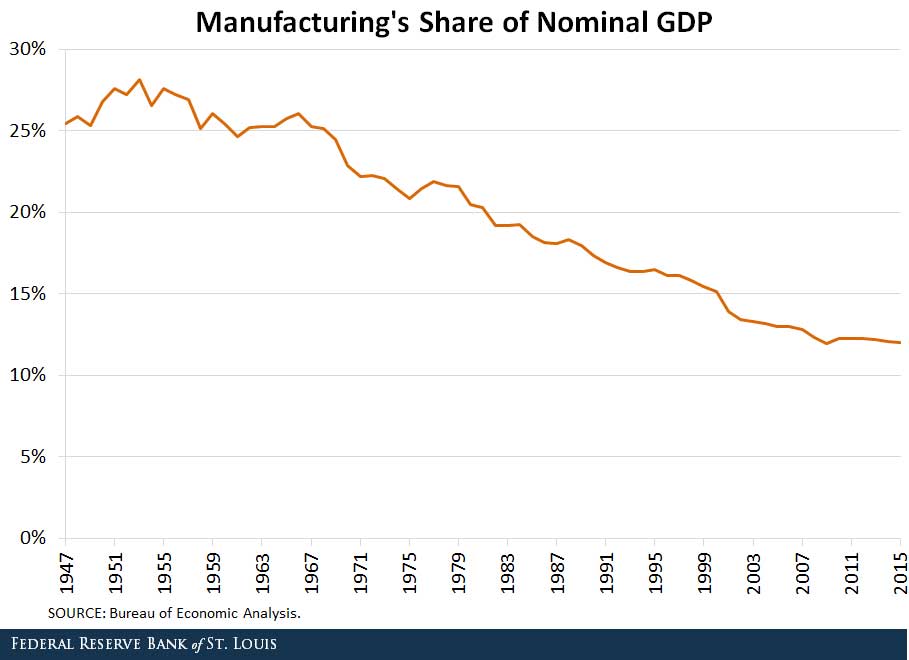
What really went away were the jobs.
Or do you believe in out-of-sight-is-out-of-mind?
In ideal world businesses would have to pay a fair livable wage, no matter where they build factories, or receive migrants from.
> It's not migration itself that is the problem, but the fact many migrants are in a position where they can be exploited more easily than native workers.
Well, if you let people migrate easily and legally, they wouldn't be easier to exploit than native workers.
Obviously the migrants wages would be relatively higher, and the locals' wages would be suppressed. Typically locals' needs are the (reasonably) top priority for elected officials.
Why would the locals' wages be suppressed?
In any case, we could try to figure out how much locals' wages would be suppressed, then tax the migrant workers that amount, and pay the locals. Seems pretty straightforward.
That doesn't seem to be what's happening though.
Let me echo back what I understand to be your argument: “If there were accelerating returns to capital moving the equilibrium of labor/capital-intensiveness mix, then there would be no demand to further reduce the cost of labor”
My argument is: regardless of where that equilibrium is at any given point in time, it will almost never be 0% labor-intensive, and anyone engaged in labor-intensive production would always have a preference for even lower-cost labor.
So the answer to the question of, “why do businesses want immigration despite a more capital-intensive mix of production” is “because cheaper labor is better regardless of how much labor you need.”
You're replying to basically a strawman I wrote. I didn't say that is what's happening, I said that's what would be happening if investment was all going into capital and not labor intensive industry as OP said.
EDIT: Oh, OP is you! No wonder you're getting touchy. Your original comment is wrong.
I think this was the angle epistasis was coming from: not just that chips are physically being formed within the boundaries of the US, but that citizens are involved, being trained and garnering the practical experience that comes with being intimately involved.
So, so much of this sort of experience has been lost over the past few decades, and the fallout is palpable: how many discussions have played out right here surrounding the challenges of manufacturing anything, even trivial bits of plastic, at scale without spending years traveling across the world, dealing with language and cultural mismatches, ensuing mistakes and quality issues?
We're in a weird place now, wrt manufacturing skill - there are still plenty of individual crafters, folks who can make one-off or small runs of high-quality goods... For a pretty high cost per/ea. But scaling is troublesome; to hit that economy of scale requires a lot more people with maybe journeyman-level skill, folks who cut their teeth in a large operation and are looking to specialize - and those large operations aren't here.
>just its share of GDP has fallen as other sectors have grown faster
I think this is inn-accurate. You're looking at a century of data but China only took 1 decade to overtake the US. We're now three decades in and the overall decline of American manufacturing is pretty evident.
https://en.wikipedia.org/wiki/Majiayao_culture
pottery wheels; ultra-thin polished black "egg-shell" pottery; silk; indoor plumbing; dagger-axes; elaborately carved jade
https://en.wikipedia.org/wiki/Longshan_culture
lacquerware and tin bronze knives and pots
The little "just" does a lot of work here. It means people in the manufacturing industry are being left behind.
So there isn't a problem about manufacturing, never has been. Problem is strictly about manufacturing employment, which is of course, inexorably falling and will continue doing so and every politician promising to reverse it is a blatant liar. It's falling much like farm employment has been falling 40-70 years ago, sure it's traumatic, ruins livelihoods of millions of families many of which will never recover, destroys not just their personal finances but their source of pride and sense of self in many ways. But just like it didn't result in decrease in food output back then (quite the opposite happened), it doesn't result in dearth of manufacturing products now.
We've got China cheating with their massively deflated currency, so how the market allocates capital is already screwed.
I see two issues with this:
One, this is the same kind of subsidies and meddling with the markets that we accuse China of doing. If we are adopting state-led approach, it can be done in a serious manner without being hypocrites. But that would also require admission of some mistakes.
Two - why is it seen as okay to give tax breaks to an engineering company, why not give tax breaks to engineers themselves instead? Companies are imaginary, people are real, why not give incentives to individuals?
At least that money won’t be squirrelled away in tax heavens.
But that's hard to do politically.
Accidental double-negative, right?
Middle class manufacturing jobs have fallen off a cliff and completely destroyed huge swaths of our country. Take a tour around Bridgeport, CT sometime as a great example. The northeast is littered with towns like this. These executives and their buddies in Congress mortgaged our middle class for profits by sending all our industry to Asia.
Cuz letting it manage itself works so well
Even the premise that it was always cheaper to manufacture abroad is flawed in many respects as Congress subsidized offshoring over many years as part of an effort to encourage globalization.
Companies often receive massive tax breaks with write-offs to close US plants, tax credits, zero percent import duties, and lower overall tax rates by shifting their profits and losses through offshore banks.
In many respects profitability has most often been determined by the policies we subsidize. and for decades those policies were essentially all in for the benefit of offshoring.
Comparing the actual cost of production by location is far more complicated than just the cost of materials and labor when there are so many subsidies and policies involved.
https://www.forbes.com/sites/stevedenning/2012/01/31/is-the-...
https://www.forbes.com/sites/stevedenning/2011/08/17/why-ama...
If you're talking about efficiency or productivity, you don't need markets for either of these, you just need any kind of economy to work with. Industrialization only intersects with markets (or capitalism for that matter), they aren't the same thing.
The last part is missing something important though. If we're measuring "output" in dollars and the US is doing the parts (like aircraft manufacturing) that globally don't have a lot of competitors, the high "output" is from high prices rather than high production, and then what we're doing is surviving in the markets where there isn't a lot of competition and getting killed in the markets where there is.
There are three problems with this. The first is that it implies the US isn't competitive in competitive markets, which is a sign that something is very messed up. The second is that the markets where other countries aren't competitive tend to get eroded over time. The US essentially had a lock on the auto market in the mid-20th century; not anymore. What happens when China starts making globally competitive aircraft?
And the third is that supply chains matter. If you give up on the low margin stuff instead of figuring out how to make it competitively domestically (e.g. via automation) then foreign competitors have a leg up when it comes to making the high margin stuff for which the commodities are inputs.
> I don't think the government applying such levers to change how the market allocates capital probably won't be a win for economic output or quality of life.
Relying on "free markets" actually requires free markets. If other countries are willing to subsidize their industries until they drive manufacturing out of the US, that's not a free market. It's the equivalent of a monopolist using dumping and tying to leverage their existing monopoly into new markets, but with a country acting as the monopolist and therefore being exempt from antitrust enforcement.
Doing the same thing in return is not likely to be an efficient strategy, but neither is the status quo. The main alternative would be to realize that the thing we've been calling "free trade" is not actually that and a country that subsidizes its industries until its US competitors exit the market has to be dealt with as an abusive monopolist, e.g. via tariffs and similar policy levers, since antitrust laws don't apply to foreign governments.
Take cars - https://www.bts.gov/content/annual-us-motor-vehicle-producti... US production is up greatly in 2019 (that is before Covid - the chart doesn't have after Covid numbers to work with). US production is up by a lot since 1960. However in 1960 the US population was lower, and your typical family only had one car (women often didn't even have a drivers license). Thus you see market share is down while production is up.
Though we are making more total cars, were making a smaller percentage of all cars sold.
As another commenter pointed out, the cars we make today are amalgamation of parts and design work done overseas. That isn't necessarily a bad thing if you view globalization favorably, but it is another factor when considering the value created in the US with regards to vehicle production.
> but with a country acting as the monopolist and therefore being exempt from antitrust enforcement.
This is the US. what antitrust enforcement?
They neutralize the subsidy's effect on pricing and prevent the subsidizer from taking over your market, at least.
> It has been my understanding that tariffs typically end up being tit-for-tat and relatively zero-sum.
The subsidy is already a tit, the tariff is tat. Zero-sum is at least better than just taking the blow and having a negative-sum outcome for yourself.
Why is someone else subsidizing the price of a thing you buy bad?
The subsidy is doing you a favor by reducing your input costs, or freeing up your work and capital to produce something else.
From a national security standpoint this can be deadly in a hot conflict.
From an industrial strategy standpoint, it’s the same as any other monopolist practice - they will erode your base, take over your market, then raise prices to fleece your population’s wealth while increasing their own.
Industrial bases are economic strongholds that shouldn’t be lost, particularly not to great power competitors.
What about a cold conflict? How much do the tariffs and protectionist policies cost in the middle to long run?
For example, the Jones Act costs billions per year and has been going on for a lot of years. How many additional aircraft carriers and submarines and so on could the US have bought with that money?
Successful Asian powers studied history, not Milton Friedman. https://en.wikipedia.org/wiki/Historical_school_of_economics
The net effect is merely a net transfer from the foreign government to the domestic one.
Tariffs that go BEYOND the subsidies in the foreign country has a net protectionist effect. This CAN cause stagnation in the industry in question. But less so if there is still healthy domestic competition.
Subsidies are potentially the most destructive measure. This is especially true for protectionist subsidies, and less so for export subsidies. But in general, subsides sets up a cash transfer facility between a government and local industry, often removing incentives to innovate. In turn, this means that the subsidies need to increase year by year to have the desired effect.
This can lead to the subsidized industry dying a sudden death once public patience for the growing subisides (and so the subisides themselves) come to an end.
The book calls it “export discipline”, that is, you keep the subsidised firms on their toes by demanding them to be exporters and win the global market, thus making them remain competitive.
I'm a consumerist at heart. As long as consumers get to consume, it does not matter to me whose industry is doing the producing.
I get that your foreign suppliers can turn on you and raise prices. I think the money you make during peacetime by not putting tariffs will let you buy more weapons and bribe more allies so that the foreign suppliers don't try anything too awful with the supply chains. Stockpiles can buy a lot of time to restart industry in an emergency or at least find a different foreign supplier.
Take a look at Russia, they are sanctioned by half the planet and they still keep going on a reduced industry because they had huge stockpiles of tanks, artillery and so on. Imagine something like that but with a military that doesn't suck. Nobody would even dare try a sanction.
Losing your industrial base and giving it away to a geopolitical competitor is almost certainly an error in the long run.
Large industrial bases also are correlated with healthier middle class societies, according to Vaclav Smil, and in my experience, he’s exactly right.
So losing the industrial base is fine for you, a service sector worker, but it’s bad for the country and it’s bad for society, if you want it to have a healthy middle class.
The ones who are most hurt by tariffs, most affected by higher prices, are the working class. Sure, the workers of the specific industries that are lucky enough to be protected, the ones with the most persuasive lobbies, will certainly benefit. But every other worker will be a little worse off.
If you are concerned about the people who got hurt by globalization, maybe the government should collect money from people like us and spend it on people like them. They can set up the tax in such a way that rich people pay the most.
But if you use tariffs to help the people who got hurt by globalization, you cannot set it up in such a careful way. It's a blunt instrument that hurts productivity across the board and increases the prices to the end consumer. It becomes an implicit tax that poor people pay the most. An actual explicit tax would hurt much less.
Perhaps in the short to medium term, the people who had their livelihoods decimated and partially compensated for the decline in their standard of living by buying cheap imported products, will be most affected.
But tariffs should be a component of a longer term plan of tradeoffs to revitalize the protected industries.
> If you are concerned about the people who got hurt by globalization, maybe the government should collect money from people like us and spend it on people like them.
That idea is past its sell-by date. It's the neoliberal Democrat's response to the economic damage done by globalization: put the losers on welfare indefinitely. IMHO, that money should be
Should be...?
> Should be...?
Sorry. Should be used to offset any short-term difficulties caused by tariffs, that occur as part of a longer term plan.
You don't see the point of building up, say, your domestic chip building capacity? Really?
>Take a look at Russia, they are sanctioned by half the planet and they still keep going on a reduced industry because they had huge stockpiles of tanks
Russia can "keep going" because they have vast reserves of fossil fuels that Europe, currently, can't live without.
I wouldn't say it's unfair, if other countries actually value domestic manufacturing then they'll provide the subsidies and incentives to cultivate it.
Incentivize it by…taxing imported manufactured goods, for example, to make the domestic manufacturers more competitive?
That’s the plan.
Even if the US lost capacity to build, EVs arent such advanced technology that manufacturing couldn't return if the conditions were right.
Manufacturing isn't something you can just turn on like a computer program. It takes time develop the infrastructure, talented labor and product designs. For something like cars we're talking about many years. It took China decades of concerted effort and heavy subsidies to get where they are now. Without subsidies, starting this process takes even longer and may even be impossible.
Accordingly, if you already have this industrial capacity it would be mind blisteringly moronic to let it slip away from you. What can be destroyed in a few years will take many more years to build back, and won't be built back at all unless you reverse the moronic policies that let it get away from you in the first place.
> The subsidy is already a tit, the tariff is tat. Zero-sum is at least better than just taking the blow and having a negative-sum outcome for yourself.
To be more clear, I meant that it was typical for foreign governments to impose retaliative tariffs. e.g. https://www.trade.gov/feature-article/foreign-retaliations-t...
To say nothing of who actually pays the cost of tarrifs.[0][1]
[0] https://taxfoundation.org/blog/who-really-pays-tariffs/
[1] https://www.cato.org/publications/separating-tariff-facts-ta...
And in the context of massive trade deficits, so what? IIRC, when the Trump tariffs went into effect, there was a lot written that the Chinese didn't have many levers to pull to respond, because of the US trade deficit. I think they implemented a tariff against soybeans (and some other non-tariff actions), and that was about it.
> To say nothing of who actually pays the cost of tarrifs.[0][1]
Who cares who technically pays, especially when they're correcting for some other market distortion? Focusing on that is a hallmark of libertarian anti-tariff propaganda that's pretty monomaniacally focused on free trade dogma and prices to the exclusion of all other considerations.
I was thinking more in the context of consumer inflation. Countries tend to go back and forth in a tariff war, effectively raising taxes and lowering incomes for their citizens.
> I was thinking more in the context of consumer inflation. Countries tend to go back and forth in a tariff war, effectively raising taxes and lowering incomes for their citizens.
That's monomaniacal focus on short-term "prices to the exclusion of all other considerations." An artificially low subsidized price isn't a good deal, especially when its competing with your local industry.
Then one generation later it all bloes up in your face, destroying your democracy .. but you get to pretend your actions where innocent . its just like the weather , cant do anything about that ..
That pretty much sums up all economic policy honestly. It will always be tit for tat since one aide can only respond to the other and doesn't directly control their economy.
Because the US is a huge market, and if you can't sell your goods here competitively (because tariffs price you out), it hurts your business. It's a negotiating tool.
I'd like my critical supply chains to be in North America. Ideally, I'd have a free trade zone with Mexico and Canada. Tariffs, two-sided, reduce trade, and bring me closer to that reality. I'm okay paying slightly more for that security.
I'd like the same thing in the EU too, and in other major world blocks.
There's a slight efficiency gain from specialization, where each country brings a skillset, but it's totally not worth it to me versus the brittleness which comes with it.
Remember how the Covid supply chain disruptions cascaded? That's a tiny fraction of a really bad natural disaster.
> ...supply chains matter.
A corollary (?) is that competency matters too.
The outsourcing mania forfeited vertical integration to please Wall St. Collateral damage included knowledge, culture, and ability to innovate.
> ...not likely to be an efficient strategy
Per principle of no free lunch, greater efficiency at the expense of resiliency.
> ...tariffs and similar policy levers...
Yup. The Rudyard Kipling School of Economics doesn't acknowledge realpolitik, will to power, balance of trade, finance, labor relations, foreign interests, etc.
The Econ 101 glasses give a very myopic view of the world. It's just an introductory model for a very complicated system.
I think if you start to deep dive into the industries that left, you'll find the reasons were often more complicated than simple labor costs. American companies did get out-competed by foreign firms in a lot of key areas.
America is large, but they can't expect to be the best in the world at every industry. If an entire country focuses on a specific niche for long enough, it's possible they will become the best. Samsung and TSMC are incredible companies that didn't happen by accident. And yeah, the USA might not compete at that level on the global stage, but the American economy is also not so completely dominated by one megacorp either.
Also, a lot of manufacturing, especially the high tech stuff, is highly automated. So these massive factories don't generate the same number of jobs they once did. And the jobs they do generate are often technical. More maintenance and calibration of machinery, and less putting bottle caps on.
https://en.wikipedia.org/wiki/Samsung
Samsung is also very closely tied to the Korean government.
>I think if you start to deep dive into the industries that left, you'll find the reasons were often more complicated than simple labor costs
Care to share any of the reasons?
Here are reasons that I know about; EPA regulations, OSHA regulations, their supply base relocating.
https://www.forbes.com/sites/stevedenning/2011/08/17/why-ama...
Don't get me wrong though, we shouldn't roll back our regulations but we should however ensure that what we buy is manufactured in that same conditions that we would demand at home.
Governments being laser focused on building a specific domestic industry and winning. I.e., as you point out, Samsung. It's hard to win a battle where an entire country has decided to push to become the best in the world in one field.
Are companies just going to fight for a constantly shrinking middle class? Or just turn into gacha companies looking to hook a whale? Sell a single doll for $46,000?
> ...I don't think the government applying such levers to change how the market allocates capital probably won't be a win for economic output or quality of life.
I think the problem you're having is you're thinking of manufacturing in terms of dollars, like an aloof economist.
Really? Every time I see this claim its based on some citing some statistical mismash that the person citing does not understand and cannot explain.
How much tonnage of merchant shipping does the USA build in 2020s versus the 1960s?
How many TVs and computer monitors does the United States make in 2020s versus 1990s?
How many tons of steel does the USA make in the 2020s versus the 1970s? Of tool steel?
How many nuclear reactors are produced in the USA in 2020s versus the 1970s?
How many railway rails graded for high-speed trains are produced in the USA in 2020s versus 1980s?
How many CNC mills are produced in the USA in the 2020s versus the 1980s?
How many artillery shells are produced in the USA in 2020s versus the 1980s?
How many jet engines are produced in the USA in the 2020s versus the 1980s?
How many car engines blocks are produced in the USA in the 2020s versus the 1980s?
How many computer hard drives are produced in the USA in the 2020s versus the 1990s?
How many motherboards are produced in the USA in the 2020s versus the 1990s?
(Also, adjust all the comparisons above for population growth, we should be comparing manufacturing production per capita)
If you think that these comparisons are misleading because there are 'quality changes' please tell me exactly how you quantify these changes in quality.
If you read the surrounding argument and want to discuss some further point not covered, I'm here.
There are two separate questions:
1) Has USA manufacturing increased or declined in its output (measured in things, not $)?
2) If output has declined in terms of things, is this ok because of comparative advantage? Is this ok because the US mains a competitive edge in the highest value most technically advanced products?
As for 1), you say "The net result is that US manufacturing output in real dollars has increased 4x, in the past 70 years." Are you familiar with the term "researcher degrees of freedom"? "manufacturing output in real dollars" is an impossibly complicated statistical construct with infinite researcher degrees of freedom. There are infinite opportunities for "Getting Eulered" https://slatestarcodex.com/2014/08/10/getting-eulered/ That is why I insist on starting with the most straight-forward numbers -- how many cars? How much steel? And then layering on adjustments on top of that. If steel is down but it is compensated by some other high value product being up, OK, but show me the calculation, show me the work. Otherwise your argument boils down to "Trust the US government's impenetrable statistical calculations, we are getting richer comrade"
As for 2), when I first heard that argument from the most prestigious and credentialed economists twenty-five years ago, my toys and clothes said "Made in China" while advanced technical products like my computer motherboard was made in the USA. Now it's OK that the motherboards are all made abroad and because the most technically sophisticated motherboards are made in the USA. Well, it seems to me like the areas where the USA has comparative advantage in making the most technically advanced products is becoming a smaller and smaller every year. Just this year we are made aware of how much Boeing has lost ground to Airbus. Seems to USA is increasingly reliant on low-tech exports like soybeans, or worse, exporting dollar bills. It seems to me like our trade deficit is gaping wide, which means our real export is living off our status as the global reserve currency. Which feels nice until ones military might is no longer able to support that status (see 16th century Spain). Seems to me that the US is losing ground on military relevant manufacturing -- particularly drones but also steel, ships, etc. And without that, it will not be able to maintain its status as reserve currency in the long run.
As a thought experiment, you can do the same analysis with any number of technologies from the 20th century—typewriters, vacuum tubes, plate-based printing presses, analog telephones—and the point is obvious.
If you think that the manufacturing output in some of the things I listed declined or stagnated -- but it is countered by the fact that US manufacturing of other newly invented goods has increased -- then please specify what those goods are. Seems to me like the US manufacturing also lags in newly invented goods -- like drones.
I think that's largely the point. Obviously, it's a balancing act, but when market forces create a situation that is incompatible with national security it really is the governments job to address the situation even if, as in the case with Chinese EVs, it means a bit of pain for consumers.
Tektronix lifted the Portland Oregon region right up. Was called silicon forest.
At that time, Tek was funding startups its employees thought up after working for Tek, getting great education provided directly by the company as well as through college partnerships.
Tek also literally trained a workforce here by educating any of its employees and by doing programs with suppliers to do the same.
I am a product of that time.
A drive through this region in the 80's and early 90's was awesome! Shops of all kinds, Tek itself had COMTEK which could make damn near anything, and opportunities abounded!
Howard Vollem died and the MBA took over.
COMTEK was torn down, work was sent overseas, education stopped, startup funding stopped, and soon a drive through this region looked very different: hair nails and laundry.
While large scale manufacturing has grown, the rest has suffered huge!
Our military can't find the capacity it needs! And they, along with aerospace, are the best customers there are, with auto in some parts too.
The rest has been gutted.
That is what we need to fix. It matters.
If companies won't do what Tek did, and that is invest in the region and it's people, and they won't because getting max dollars at any cost matters more than sustainable business does, then we must have robust small to mid sized manufacturing.
Where else will our future skilled labor come from? And I left for higher end professional work and software. I can make anything I can draw, it was damn good at it too. Saw way too many places close and there's no way I can raise a family on that and I quit ... tons of us did.
The skills I have are rare and in high demand. Young people today can't get them like I did, and that adds right the hell up.
You think your arguments make sense. And you are not wrong. They do, but that is not the problem.
The problem is for your argument to make sense, a ton of people and manufacturing potential is lost and nobody seems to recognize the massive opportunity costs in all that.
And frankly if large companies aren't going to do it and get a return on that investment, then our government damn well should. We do really put our national security at risk doing otherwise.
This has a lot more to do with the stance of the past 30 years to manufacture defense materiel at relatively constant, small rates. There was no capital investment, because why pay to have a huge line that isn't being used. We spent our military dollars on wonder-weapons that would probably win a direct war quickly, but that we can't give to allies in a proxy conflict. Going so far was a strategic mistake.
> And they, along with aerospace, are the best customers there are,
Military are terrible customers, especially if you're a subcomponent manufacturer. Gravy might pour, it might not; it's very unpredictable. You spend a lot of effort and business just evaporates.
> Howard Vollem died and the MBA took over.
On the flip-side, can you imagine being the high-cost Tek of old in today's test equipment marketplace? Tek already struggles to compete against cheaper, adequate solutions. So much of that market has commoditized out.
> nobody seems to recognize the massive opportunity costs in all that.
Actually, that's exactly what I'm talking about, in both directions. Having a ton of manufacturing means we would have opportunity costs in the other direction. We've traded the manufacturing we had 50 years ago for other things. It's not possible to specialize in "everything."
I'd like to suggest that what Tek did worked back then, and the same insightful leadership wouldn't simply copy the solutions from 20 years ago.
Thus the problem is "there was no capital investment, because there was no visionary leadership," and the problem is also that the short-sighted leadership simply saw "a huge line that isn't being used," instead of a workforce ready to take your company into the next century.
> Military are terrible customers ... You spend a lot of effort and business just evaporates.
This only applies to companies that lack vision, that seem to only be able to keep stamping out the same widget as 20 years ago.
> Tek already struggles to compete against cheaper, adequate solutions.
Seems like a lack of leadership, instead of an existential proof that Tek can't compete.
> We've traded the manufacturing we had 50 years ago for other things. It's not possible to specialize in "everything."
This actually sounds like the kind of visionary leadership that Tek or the larger Portland metro needs.
If I sound combative, please only read this in a curious voice. What kind of visionary leadership could rise from the ashes of the Silicon Forest?
I was specifically talking about war materiel. The US is not doing great at making things like low-tech artillery shells, because we've not had a large line running for them for quite some time. In retrospect, it would have been better to have a bigger stockpile and to be paying for more line capacity.
Things are steadily ramping, but it's taken a good year and a half to get to the quantities we now want.
> > Military are terrible customers ... You spend a lot of effort and business just evaporates.
> This only applies to companies that lack vision, that seem to only be able to keep stamping out the same widget as 20 years ago.
Nah, vision or not: political winds change and projects get killed. Being involved in an early program is exceptionally high risk: you need to start ramping to do the whole thing and you may get a good return on capital or a pittance.
> Seems like a lack of leadership, instead of an existential proof that Tek can't compete.
The overwhelming majority of the test equipment marketplace has commoditized out. This is a problem if you're still mostly a test equipment vendor. It would be even worse if Tek had higher costs.
> This actually sounds like the kind of visionary leadership that Tek or the larger Portland metro needs.
In those sentences, I'm not talking about Tek: I'm saying the United States has, as elementary economics predicted, specialized in areas where it has a comparative advantage over other countries. It is not possible to have a comparative advantage in "everything."
Often, people wonder about the higher cost associated with government cobtract work. One does need to cost out those risks and include them in project costs.
"Elementary Economics"
Economics is not a science. We cannot execute the scientific method on Economics because we have no way to repeat and or establish controls needed to understand results.
Policy drove "elementary economics", and made it predictive. And the policy was driven by strong advocacy dressed up as real science too. That advocacy was produced by people of significant means wanting more and more control.
Change the policy, and we will see the Economics change too.
Fact is we gutted a lot of small to mid sized manufacturing, and with it went many strong opportunities for people to take advantage of. Those people require help to make it because the opportunities they did find, if they found them at all, do not pay enough to make it, or should they, the labor burden and often painful scheduling makes for tired people lacking often the means and energy required to build skill on their own.
You could say the same thing about mathematics, but it remains the case that it is useful to know some math.
There is policy, and that has a major league effect on what will make good economic sense.
The current policy could change, and that would impact what is worth what and why and the math can tell us what it always has.
Here is one:
For a long time we have ignored anti monopoly laws.
When competition is present, margins are less, people tend to get higher value for the dollar. When it is not present, margins are higher and people get much less value for the dollar.
Right now, big grocery is wanting to do one more merger to basically put Krogers in charge of grocery stores, with its competition being Walmart and maybe Amazon.
So far, each merger has reduced the number of products available to people and higher prices. But someone somewhere is banking more and paying less.
I like competition. I like higher value for the dollar and choice in business. I bring this up because I personally dislike Kroger and it is all about the much lower value per dollar.
How this all goes is political. Policy may be to preserve competition to prevent price gouging and all that comes with a monopoly.
The math may say more dollars are made by having one company, but that same math says it comes at the expense of the people too.
Does not, and I would argue, should not go that way.
What happened was the MBA crew took it right out of the fucking company, gutted the rest and we have a a shell of what we had before today.
Tek was also getting nice returns on several of the more successful startups.
Vollum was no fool.
Snark mode = 1
You mean traded our future for baubles and trinkets today?
Yeah, I agree!
Snark mode = 0
I will ask again:
Where does our next generation of skilled labor come from?
And don't tell me we won't need it because automation. I have automated many things and will do so again, but I never managed to find a robot looking for a good meal, or a home, etc...
At some point we need to look at this in terms of our own, or we will be living in even more of a dystopia than the already growing one threatens to be.
If we do not ask and answer the question, "how do our future leaders and builders, mechanics make it?", they won't. And the cost on that is a lot higher than many will admit it is.
I don't really want to talk to you because you're being deliberately abrasive. But I will leave you with one answer.
Your question presupposes that all the other areas of the economy that have eclipsed still-growing manufacturing do not produce "skilled" labor. I do not think this is a valid assumption.
And that helps nobody, yourself-included. There's nothing on this thread that you should turn your back away from. There's nothing on this thread that should even hurt!
And finally, I'll always talk to the other people. Keeping that door open is the only way we get progress. Just consider that for the future.
What's your calling abrasive is passion. I actually do really give a shit. Consider that too.
edit: I care, too. I mean, I went into education where I'm teaching future high-skilled labor and building human capital ;) And--- where I am, the kids are alright.
There are good reasons why the percentage of people who agree with me are high.
Edit: yes you absolutely do get to pick and choose and I support your ability to do so! However I will observe that you are operating at a disadvantage by doing so
But they're doing stuff like machining aerospace gear that will fly in space, doing structural and thermal analysis, designing and assembling circuit boards, implementing LQG controllers. Or just doing carpentry and fabrication for theater productions to the highest aesthetic standards.
And I go to competitions against other schools and see a ton of what we would have before considered "high skilled" adults, except they're 13-16 year old kids. They're going to go to university and further develop the ability to work with their head and their hands. But they're not going to go supervise a press stamping out the same part over and over, and they're not going to reinvent the wheel that they can buy for 30 cents per unit.
> There are good reasons why the percentage of people who agree with me are high.
This isn't a very good argument for the validity of an idea.
> Edit: yes you absolutely do get to pick and choose and I support your ability to do so! However I will observe that you are operating at a disadvantage by doing so
Avoiding being trolled is not "operating at a disadvantage." There's plenty of reasonable discussion, and the points you raise have already been answered and debated in cousin threads. I'm choosing to answer you a little more because you've been a little nicer.
Indeed it is not in terms of a convincing argument, however is is more than sufficiently compelling for others to think about, perhaps ask "why?" In this, they often will entertain more conversation that has real advocacy potential and that is just fine, intended.
I will just say what you and others are doing is not enough.
Meta:
I was nice the whole time. There are no words of mine here to fret over. That is deliberate intent too. Some style choices are aimed at passersby and to provoke thought. Nothing more. Others may not be so nice. I get that.
Whether you answer me or not has no impact on my choices.
To be 1,000 percent clear, you were never trolled by me. Frankly I could probably do it and not even get under your radar. That sounds something I choose to do. The single most likely reason you answer is my speech here is compelling enough to warrant an answer.
And by percentage it's no replacement for what we had before. All one needs to do is take a look at massive numbers of young people looking for opportunity not able to find it to understand what this all means.
There was a great argument for trading some capability to continue to build new products on now current processes, with the same rapid feedback loop in place.
That should have happened rather than the very aggressive tear down and brain drain we actually saw.
The key point being ongoing and regular investment in the company and people would have yielded more and better products that would compete just fine, not just be the cheapest.
That organization would be smaller, but still potent and a lot more nimble, able to continue supporting technical engineering across many fields.
And as I have mentioned up thread, couple that with returns from smart spin-off investments and an ongoing innovation culture rather than just a cost cutting one and we would have seen more than we did.
I would also argue the big push to apply software was sexy, and took the air right out of hardware efforts. Lack of investment there was not about the lack of returns, and it still is not about that. They are just a different kind and over a longer time.
Ignoring those has bled the region of a lot of capability. It is much harder to make things and here we are trying to understand how the next generation makes it on hair, laundry and food.
Making things is important. And it is not the cheapest way of course. Having a large percentage of people unable to build lives is and will continue to be very expensive. Crime, need for government services and more abound.
Early on, the promise of new tech and automation was a reduced need to work as much and or at the least maintaining respectable standards of living.
Put simply, it was supposed to cost less to live and for the most part these things did not happen.
Something needs to.
However, I do not see this benefiting regular workers.
The US was once a global leader in textiles and now virtually all of that industry is gone. The same goes for many many other industries.
The art of economics consists in looking not merely at the immediate but at the longer effects of any act or policy; it consists in tracing the consequences of that policy not merely for one group but for all groups
One thing that I think that frequently eludes people in this discussion is that US manufacturing has pretty much been constantly growing for the past century; just its share of GDP has fallen as other sectors have grown faster. And the share of the workforce has fallen even faster, as the actual manufacturing has moved towards higher value items and greater degrees of automation.
I think the actual outcome of this policy is mixed. I think it was a big case of corporate welfare that will result in somewhat increased chip production in the US. I think this is a win for national security. I don't think the government applying such levers to change how the market allocates capital probably won't be a win for economic output or quality of life.