That is not really a thing, from a technical point of view. Changing the chemistry of the battery (assuming that a suitably explosive one exists; these tend not to be developed very far) would just be swapping an explosive and not a modification. Doing something like adding some vessel to build up pressure within the battery sounds impractical (you’d need something very resistant to heat as a battery fire goes above 2000 K), at which point it’s not worth the trouble.
The most likely is either some explosive besides the battery, or something that looks like a battery from the outside, but is actually half explosive on the inside to at least pass superficial inspection.
This kind of damage really does not look like a battery gone wrong. It would have left all sorts of chemical residues and burned very differently.
That is the most plausible explanation. It can’t be an obvious thing or someone would notice it. If it looks like a plain battery pack, nobody would think of cutting it open.
Inside the battery is perhaps the best hidden, but you'd need to own a bunch of battery manufacturing facilities (expensive). Cheaper would be to simply remove some other component (eg. one of two speakers) and replace it.
With cylindrical batteries it's a bit harder, but ultimately they are just a cylinder with pressed-on end caps. You can disassemble them (lots of videos on youtube), change the contents and reassemble them.
It is pretty high effort compared to just sticking the explosives next to the pager's electronics, but I don't think the barrier to entry is actually that high
But this, arguably, would be detectable, through low battery life?
More like a year or two off of a single AAA battery.
And if they can make the combined package big enough that the battery life is still acceptable, it's even less likely that someone will pull the pager, notice that they should be getting "great" battery life instead of "just ok", and investigate deeply.
Do you?
What stops you from just taking a smaller battery and packing it with some plastic explosive into the typical "battery foil"? I'm sure the IDF is capable of doing that at scale.
Most battery packs have integrated power management chips, so you could focus on modifying the battery firmware.
You could have another component send a message to the power management controller to trigger it.
You could also use the power controller's internal current sensor and clock to watch for a device event (power draw from the screen at a certain time or the power profile for a specific set of CPU instructions), giving you means to trigger it without modifying any other part of the device.
That won't work. You can use C4 and other modern plastic explosives as cooking fuel; they burn nicely. Getting them to explode requires a detonator.
On a serious note, Israelies are our allies. You don't have to love them, but they are standing on the forefront of fighting against the enemies of the West. If not them, you would be on their place.
Also considering that a plan like that must have taken many months/years start-to-end, this just makes me wonder what else is booby-trapped(?), fridges? laptops? microwave ovens? the next door flat? flower pots?
Stuff like that take the paranoia levels all the way to 11.
Israel makes them quietly shit their pants instead.
They'll cause a big backlash. And the best they have are again suicide bombers in Israeli cities
no, there won't be suicide bombers in Israel again. they've gotten much better at finding the rats - see original article.
Frankly I believe that the people complaining pagers wouldn't if Hezbollah had managed to do the same to Israel. They'd celebrate it. So really they're just unhappy that the team they're emotionally invested in is getting shellacked.
I disagree with the other post you mention, FWIW.
...oh no. They must have handed out those USB rechargeable batteries as an upgrade. The bad guys want to be able to charge it, so they would be incentivized to align the charge port with case back and explosives facing the user. Then the battery could be triggered by time since synchronization && backlight current draw && button press beep.
And, is the device anyway going to pass through airport security? I guess the owners are not really travelling on commercial airliners.
I don't know how those detectors at the airports work exactly but they are probably playing cat and mouse game with the people who are into smuggling things and as a result they are probably aware of the more advanced methods like injecting things into the plastic.
This is a known threat, and this is the reason why some airports do extra checks on some travellers (for example asking them to turn their laptops on, asking them when and where they got the laptop and etc.)
In a country where lots of people would happily crack open the lid of a device to replace the battery or otherwise tinker, the explosives must have been well hidden, not just tucked into the case.
All you have to do is build replacement batteries without the pressure relief vents. You can easily get a Chinese manufacture to do this for a fee and properly some complaining about how stupid it is to do.
Then wrap it in some nichrome wire and have a micro run some power through it. The nichrome wire will overheat the cell really quickly causing the cell to rapidly over pressurize and boom.
Small pouch or prismatic cells that would be used at the size of a pager generally won't burn. And I speak from experience of doing stupid shit to them in the name of testing, nothing like using the nail puller side of a hammer to puncture them, or rigging up a fixture with 3 concrete nail guns to shoot it or well, fun stuff
From https://www.mdpi.com/2313-0105/8/11/201
A puncture causes runaway/explosion in seconds. Overcharging takes 13 minutes. There's not good data on a dead short (because it's unlikely during normal operation), but it's going to be between those on the faster end. From personal experience a shorts cause things to get noticeably hot after about 10 seconds, the graphs show that once you hit 60C things rapidly get worse.
A relay may have been required to hold the short as the battery stops supplying voltage.
Presumably some software that triggers this?
My guess would be that not only the battery but also the main board was modified to initiate the action.
edit: why do you think I'm not sure if they are serious? Calculator jokes are not a niche humor :)
Clearly someone's not being serious.
Another reason I do not believe it was an explosive is that a clandestine explosive installation would have resulted in far greater damage and included shrapnel. Because why would you not install very high explosives and shrapnel in a shape charge that directed the explosion into the likely body of the wearer if you are taking the risk of intercepting and making a physical modification.
This is also less Stuxnet and more infiltrating insecure systems of vehicles to drive by wire accelerate cars into objects. There have been examples of this
No and not much. The amount of explosion you get is proportional to the amount of explosives used. Small amount of explosives == small explosion.
Shrapnel is specifically engineered into explosive military weapons - it is not an innate property of explosive reactions. If you want a lot of shrapnel you have to design the case to fragment (e.g. grenades) or pack the area around the explosive with the stuff you want to become shrapnel (as with many bombers packing nails and screws and bolts etc., around their bombs). A small explosion in a mostly plastic device will result in a small amount of small pieces of plastic being scattered, which might harm bystanders but is by no means guaranteed or even intended to do so.
Is the information wrong?
Similar to how firecrackers work. If you take a firecracker apart and light the powder, you’ll get a flash and a lot of smoke, but no bang. The explosion comes from the pressure building up in an enclosure.
Disclaimer: not a chemist. Just a former unwisely curious kid
True. But if you open enough firecrackers and put the powder in a small plastic container you will not get a bang but a buff and a fireball the size of a car.
Disclaimer: I am a chemist and a former very unwisely curious kid
https://www.reuters.com/world/middle-east/dozens-hezbollah-m...
This isn't how lithium batteries fail.
Blowing a hole in the side of the bag and sending debris for several meters is obviously not plausible with that quantity of lithium.
Tom Scott explains it better than I do https://m.youtube.com/watch?v=OOWcTV2nEkU
Objectively this is therefore targeted, not indiscriminate...
They didn’t. They put explosions in all the pagers which were distributed to all members of Hezbollah, military or not, and indiscriminately exploded them all at the same time, regardless of who was near the pager at the time.
4000 wounded of which 400 in critical conditions
Al Jazeera from a Lebanese security source:
The pagers were brought to Lebanon 5 months ago. They were boobytrapped in advance. Each device contained an explosive weighing no more than 20 grams.
hezbollah got totally owned and look like fools...relying on tech they just took at face value out of the box
That's not to say that they couldn't have put a lithium AA or AAA battery into the pagers or inserted a modified AA/AAA battery that was a combination of lithium (with greater power density) and explosive.
It's also possible that they have fancier 1-way pagers than I'm aware of.
Really shows that the HN community and the victims have very little overlap.
https://www.google.com/search?q=About+https://www.gapollo.co...
Apps (some more or less than others) represent a target for a nation state to pursue for information, graph analysis, bugging, etc.
If you can’t control your supply chain then that isn’t guaranteed.
After all, most pagers don’t contain explosive charges either.
A typical pager is about 60 x 40 x 20mm. Much of this volume requirement is driven by the 16mm diameter 34mm long CR123 battery, a lot of it could be empty.
That battery is a relatively safe lithium primary chemistry, not a rechargeable Lithium polymer pounch or lithium ion cylinder that would risk fire and explode if the overpressure vents were omitted and the BMS corrupted, but the primary lasts for years.
I bet you could use a CR1216 battery (1.6mm thin, 30mAh, instead if 34mm long and 1500mAh) instead and have quite a good deal of spare volume in the battery for an explosive. If you filled the entire pager, that would be even more room, but much more easily detected.
I'd be fascinated if that was the physical vector...
However, tainting a component pre-integration seems a lot more likely than simply packing explosive in the case.
Israel inserts the compromised components upstream in the supply chain, they're duly assembled into pagers, which then make their way to Hezbollah, where they're inspected, look normal, and work normally, and are then distributed.
That would still require a firmware hack to presumably trigger though (incoming message stack to component trigger).
    Active mode, 260mA to 790 mA (!)
    Modem sleep, 20mA
    Light sleep: 0.8 mA
    Deep sleep: 10 uA
    Hibernate: 2.5 uA
Compare that to something like an STM32U5 microcontroller [2]:
    3.1 mA Run mode at 160 MHz
    19.5 μA/MHz Run mode at 3.3 V
    6.6 µA stop 2 mode with full SRAM
    1.7 μA stop 3 mode with 16 Kbyte SRAM
    0.5 uA standby mode with RTC
    0.3 uA standby mode (24 wakeup pins)
    0.1 uA shutdown mode (24 wakeup pins)
That results in a power consumption ratio on the order of 100,000,000. ESP32s are not efficient.
[1]: https://lastminuteengineers.com/esp32-sleep-modes-power-cons...
[2]: https://www.st.com/en/microcontrollers-microprocessors/stm32...
Swatch actually used to sell a wristwatch that includes a pager! Battery life was pretty bad though; it came with a keychain accessoire to store a spare CR2032 and a battery swapping tool.
Pagers—especially commodity models—aren’t profitable enough to warrant cutting edge tech with the latest advances in microelectronics. Lots of room to improve things if you are making a set of them at a loss.
The internals could be replaced with modern smaller and lower-power equivalents, requiring a smaller battery, and saving enough space.
(Or maybe somebody just donated a batch of innocent-looking devices to 'the cause', or offered a bargain on some 'extra secure' pagers?)
If they were using a AA battery, replace the battery with something that provides you space to work (e.g. put in a AAAA or button cell that would provide appropriate power but lower capacity) because you don't really care if the battery life drops from months to weeks.
Supplier: “Hey, we’ve got a refreshed model of the pager you wanted to buy in bulk. Interested?”
Buyer: “I don’t know, how do they work?”
Supplier: “Same as the other ones, minus a bit less plastic protection. With the weight savings they’ve added a new hardened receiver that’s supposedly more secure and will keep communications private. Also, they are 50% cheaper per unit…”
Buyer: “Say no more. We’ll take them.”
Disclosure: my first job was in the Australian Defence Science Technology Organisation, Materials Research Lab, Explosives Instrumentation Group.
So, an "excited" AA (which, I believe is what pagers usually use) could do a surprising amount of damage.
Photo: https://files.mastodon.social/media_attachments/files/111/40...
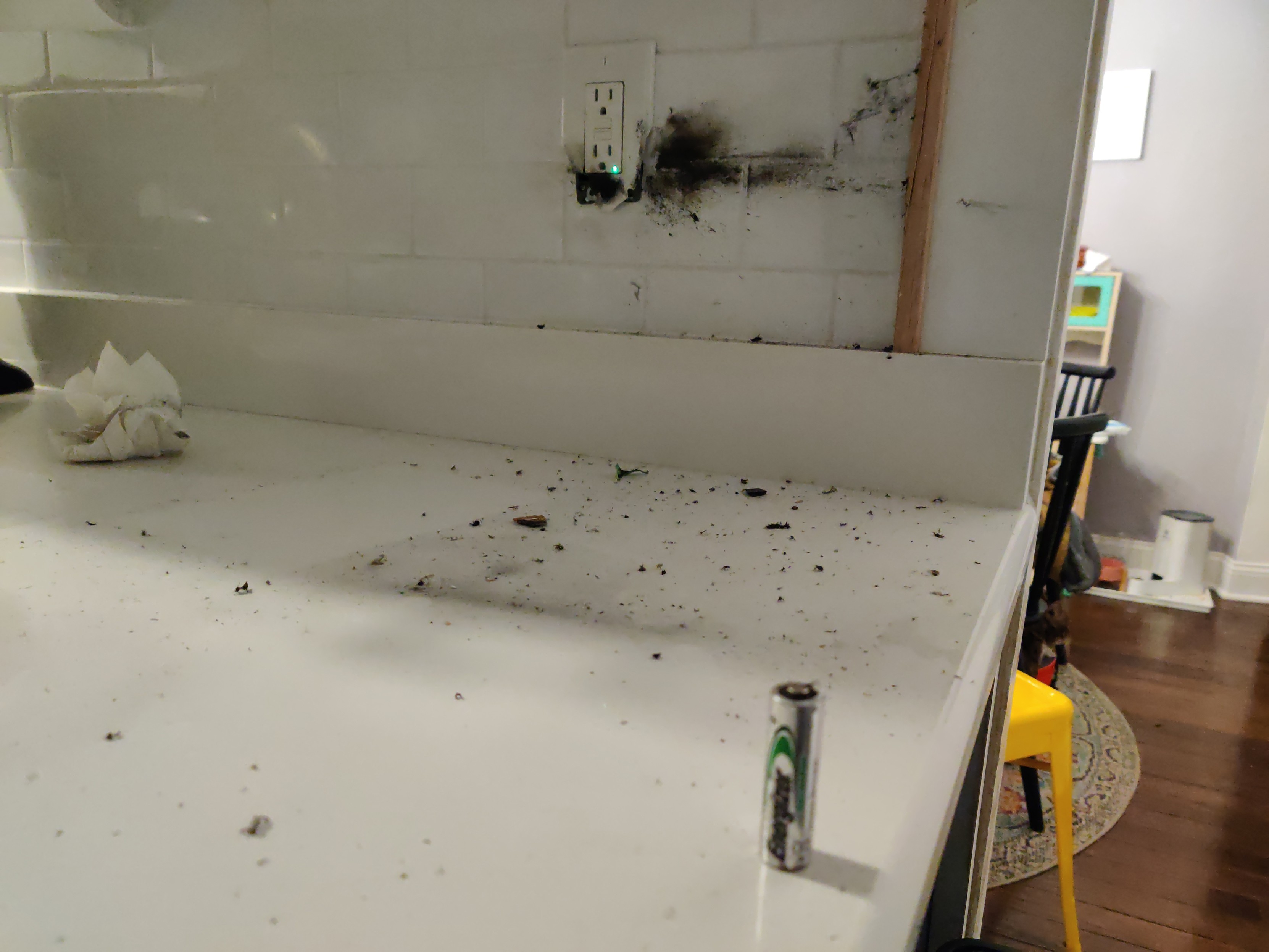
Any idea what prompted the explosion?
Is an interesting problem. Maybe the experts in the area could help here. I assume that a worn battery near the end of its life is more prone to explode, but I wonder...
Would the dead cells in the battery take part in that; or are just dead and not reactive.
In other words: if a battery has only a 30% remaining alive; or a laptop has a very worn battery, would an hypothetical explosion by overheating be much less severe? or is still so dangerous as new?.
I agree, there are photos and videos of extensive damage to furniture and injuries that go way beyond what a small lithium battery would NORMALLY do.
Also, all the CCTV footage I've seen indicates explosions and not fire.
It can be explosives planted, However it can be batteries modified to explode instead of burn&outgas. I recall a video of someone losing their lives when their vape battery exploded. IIRC the vape's metal structure acted as a container that enabled pressure build up and eventual sudden release.
There are many stories about vapes exploding, some causing serious damage similar to these:
https://www.gazettelive.co.uk/news/teesside-news/vape-explod...
https://www.dailydot.com/debug/e-cig-vape-pen-explosion/
Kind of makes sense to modify the battery because since they still need a functioning battery anyway and the space is limited.