mostly tritium and triated water that has been activated in the coolant circuits (practically impossible to separate)
but some other isotopes (carbon-14, caesium-137)
here's the environmental permit for the UK's most modern power station: https://consult.environment-agency.gov.uk/nuclear/consultati...
solid radwaste is kept under lock and key though
and the total volume of radioactive waste produced is WAY WAY WAY less than that produced burning fossil fuels
(turns out coal is reasonably radioactive)
This is only about emissions though. The radioactive waste produced by nuclear power plants has many many orders of magnitude more activity than the emissions.
[1] https://www.science.org/doi/abs/10.1126/science.202.4372.104...
yes I should have probably said "emission" not waste
> No, coal is barely radioactive at all.
but you need to burn orders of magnitude more of it, producing literal mountains of coal ash and exhaust emissions
whereas for nuclear the waste is an extremely small volume, of which almost 100% of is captured
scrubbing technologies have also improved since 1978, and scrubbing not-very-much thoroughly is a much easier than scrubbing vast amounts not-very-well
https://www.ap.org/press-releases/2012/part-ii-ap-impact-tri...
45 out of 65 sites had significant tritium leaks, some were migrating off site, some were starting to contaminate public drinking water.
The nuclear industry is so loosely regulated that a half million gallon leak of radioactive water recently apparently didn't require them to notify anyone https://apnews.com/article/xcel-energy-nuclear-leak-tritium-...
Also: "it's better than coal!"...no kidding. It's not better than wind and solar. Not in terms of price, time to install, time for carbon payback, waste issues, or safety.
That's why grid operators are shutting down both coal and nuclear in the US, and replacing it with solar and wind (the US has in recent years installed 6x more renewables-based capacity than nuclear capacity that has been shut down)
1.5 million litres of radioactive water (triated water) sounds scary, but they don't report the concentration, so it's meaningless
if it was 1.5 billion litres with the same radiological content it would be less dangerous
a load of coal ash getting into a river is likely worse radiologically and chemically than some triated water escaping
- "Look for the Tricastin plant I don't know enough to answer precisely but it has leaked recently and a few years ago. Of course it doesn't leak uranium"
So, your original statement was an untruth. Or "alternative facts"
> of micro-breaches caused by maintenance decades ago. That's actually a sign of proper management, but a counter-argument to reliability.
So you mean microbreaches were made decades ago, the plant has operated for decades with no issues, and you call that unreliable?
It seems like this is a daily occurrence online and in person.
Modern reactor designs are so much better. They are also basically nonexistent because everyone stopped building reactors :(
The French fleet has been running around 65-70 % CF for years, pretty bad, but clearly not root caused by the tech branch.
https://www.reuters.com/business/energy/why-nuclear-powered-...
You mean, they are the most reliable base load and load-following power sources we know.
> References are easy to find if you want confirmation
It's just as easy to find confirmation that all the problems you listed are the result of neglect and politics of the past 20-30 years.
> it has to be done properly and safely, which is certainly not the case around here.
As in: France has 56 operable reactors that provide 75% of France's electricity... And you call that neither safe, nor reliable, nor...
None of the power sources have resilience to politics.
That stat is effectively impossible to nail down after the fact. Air pollution is one metric of am extremely complex system, and coal or any other energy source is one of countless inputs impacting the environment simultaneously. At best we can design and run models to help get clues on what impact any one input has, but those models will always be rough hints at correlation with results that are heavily influenced by the assumptions used when designing the model.
You are correct that any studies claiming to put a number on how many deaths should be attributed to Chernobyl is propaganda. That holds true for the rest as well though, including any claims of exactly how many have died due to coal or cow farts for example.
Sure, but given how long we've been burning coal and how dirty it is I'm positive that tens of millions is a gross undercount. It's not about getting an exact number. We're looking for orders of magnitudes here.
I get what you're going for and anecdotally that number doesn't even seem crazy if you're going back through our entire history of coal. At the end of the day that number simply didn't exist though, and any time someone uses a start like that to bank up an argument it's just propaganda. Having a bunch that number should be accurate is very different from being able to use it as part of a larger discussion of what the biggest problems are and how to improve it.
See for solar: https://news.ycombinator.com/item?id=35661918
Same for everything else. Green Party in Britain is campaigning against literally everything including offshore wind: https://twitter.com/stuarthammond14/status/16486453145621217...
"Jacumba residents sue to stop 600-acre solar project"
https://www.sandiegouniontribune.com/business/story/2021-09-...
"Proposed battery storage site in Eden Valley prompts local worries"
https://thecoastnews.com/proposed-battery-storage-site-in-ed...
"The Energy Transition Runs Into a Ditch in Rural Ohio"
https://insideclimatenews.org/news/29072022/williamsport-ohi...
"An activist group is stopping rural US solar farms with lies"
https://electrek.co/2023/02/20/an-activist-group-is-stopping...
"Marin battery storage project sparks early opposition"
https://www.marinij.com/2023/03/13/marin-battery-storage-pro...
Politics can fuck up everything.
Someone from France is telling you that actually, it's really not that great...and now France's nuclear program is terrible and the result of 20-30 years of neglect and politics? Also, which part of "nuclear plants are sensitive to environmental changes" didn't you get? If there's no cooling water, or the water is too hot, the plant can't run.
How many times do people need to be told that with all the renewables coming onto the grid, we don't need more base load? We need storage. Also, wind keeps working just fine when the sun goes down.
Do any of you geniuses realize that it's a lot more difficult for the grid to accommodate the injection of tens of gigawatts of power, than it is to handle tens of gigawatts of highly distributed generation and storage across a large region?Guess where utility companies are spending their money? Hint: not on nuclear.
Nuclear is the most expensive form of electrical generation while wind and solar are the cheapest.
Nuclear capacity takes a minimum of ten years, more like 20, to come online and then takes decades longer to go carbon-neutral.
Solar and wind take months to deploy and are carbon neutral within a few years.
Nuclear plants require a continuous, expensive, complicated supply chain and hundreds of people supervising and maintaining it.
Solar farms require maintenance that just about any asshole with an electrician's license can handle, the panels last for decades, and can be recycled. Wind turbines require more maintenance but it's standard industrial electrical/mechanical stuff, just on a tall stick.
Note that the cooling argument would be the same for coal or gas power plant. They work the same way. So, until enough storage is in place, we might need some base production, and it would require access to cold source (river or ocean). France had to reduce the activity of some nuclear power plants last summer because they have rules when it comes to river temperature. The next 8 reactors that France is planning to build would likely be build on the ocean's shore for that reason.
The cost of nuclear electricity is mostly impacted by the cost of money. That is why the cost of electricity from a UK nuclear power plant is more expensive than from France nuclear power plant. The UK used private capital (higher interest) when France use gov funds (lower interest). It is correct that it takes time to build a plant, and it requires expertise. But it is also true that a power plant can run for decades (US and France pushing to 80 years) as anything in a plant can be upgraded over time (except the pool).
Until there is an efficient storage technology that can be deployed at large scale, we might need to run some nuclear power plants. No idea for how long ?
Iron-Air Batteries Are Here. They May Alter the Future of Energy.
https://www.popularmechanics.com/science/energy/a42532492/ir...
In any case coal is not going away and there is no single “answer” to the planet’s energy needs. A resilient grid requires a portfolio of energy sources including nuclear but it’s by no means the single answer as the title of the post suggests.
Uranium is “carbon free” but “radioactive waste full” and creates multigenerational environmental debt in the form of waste - nuke proponents usually hand wave and talk in generalities when it comes to this topic. Note the comment that “90% of materials in a nuclear reactor can be recycled” deftly sidestepping the 10% that will live on in deadly form for thousands of years with no solution in sight.
[1] https://www.ncbi.nlm.nih.gov/pmc/articles/PMC3568623/
Google “Biswas Washington University Enhanced Electrostatic Precipitation” for more
[2] https://papers.ssrn.com/sol3/papers.cfm?abstract_id=3817794
Google “Axelbaum Washington University staged pressurized oxy combustion” for more
"More than 90% of its potential energy still remains in the fuel, even after five years of operation in a reactor.
The United States does not currently recycle spent nuclear fuel but foreign countries, such as France, do."
But even if like US does (i.e. does not re-use the waste), less than half of olympic pool is pretty small given the amount of energy produced. Ideally US would re-use the waste, and vitrified the final waste, and then producing even less volume of waste.
Then store it. Properly packed it is not "in deadly form for thousands of years with no solution in sight". Most countries store it deep for 50 years, and then it is safe to dispose on near-surface disposal at ground level, or in caverns below ground level.
Radioactivity is everywhere e.g. with radon (https://www.epa.gov/sites/default/files/2018-12/documents/ra...) at 4 pCi/L 7 our 1000 people will develop lung cancer. Flight attendants get their fair share too. Our body is prepared to fix itself when attacked by radiation. https://what-if.xkcd.com/29/
There are also battery tech like liquid metal that is being more widely tested and suits grid storage. That scales like crazy if it works.
Point me any other energy company which could have survived basically 20 years without proper investments and forced to sell back electricity to their competitors.
I would even say that the tech is what made the grid still standing against all odds.
Yet is amazing that even with the poor management of the French government, it is still a beacon of hope the rest of the world looks to for our energy future.
That person is really just spreading FUD: https://news.ycombinator.com/item?id=35659262
> How many times do people need to be told that with all the renewables coming onto the grid, we don't need more base load?
Of course we do
> We need storage.
Yes. And it's non-existent. There are literally no grid-scale strage solutions in existence.
> Do any of you geniuses realize that it's a lot more difficult for the grid to accommodate the injection of tens of gigawatts of power, than it is to handle tens of gigawatts of highly distributed generation and storage across a large region?
Neither are particularly true statements. Also, what do you think grid-scale storage would do if not inject gigawatts of power into a grid when needed?
> Nuclear capacity takes a minimum of ten years, more like 20,
Fuqing Nuclear Power Plant in China: 6.1 GW nameplate capacity. Built over 14 years at 1 reactor per 6 years. Operational.
Meanwhile the very distributed Xlinks Morocco-UK Power Project was founded in 2018, and is promised to start powering Britain in 2030.
--- start quote ---
Of the megaprojects surveyed, 64% were delayed and 57% were over budget.
https://www.offshorewind.biz/2016/12/02/offshore-wind-projec... --- end quote ---
So we know how that will go.
> Nuclear plants require a continuous, expensive, complicated supply chain and hundreds of people supervising and maintaining it.
> The panels last for decades, and can be recycled. Wind turbines require more maintenance but it's standard industrial electrical/mechanical stuff, just on a tall stick.
Of course it's not just a tal stick. It's a rather complicated machine that you can't even safely get to since it's so tall. And that's before we start talking about offshore wind farms like Hornsea 2. Yo need a lot of specialist equipment to maintain those.
There are 500 to 800 people working on a nuclear power plant.
--- start quote ---
Each windfarm tends to have between 7 and 11 employees per 100 MW
https://graham.umich.edu/media/pubs/Wind-Turbine-Economic-Im...
--- end quote ---
So while fewer than per a nuclear plant, you still have to keep in mind that you need to massively overbuild renewables because their generation fluctuates.
Iron-Air Batteries Are Here. They May Alter the Future of Energy.
https://www.popularmechanics.com/science/energy/a42532492/ir...
Projects like xlinks are not directly comparable to other mega projects as they are far less monolithic. They can scale out rather than having to scale up.
In terms of staffing a nuclear station needs many different professions who are relatively expensive, specialised, and need to be heavily monitored for safety. Renewables requires talent obviously but probably less so.
Relative to...what? Is there any major country that has a great power grid, objectively better than France? Certainly we have plenty of problems here in the US.
I'm a big nuclear power advocate but of course NP has problems, like any human project. It has dangers, like any scalable power supply. I support NP because it is better than all the rest.
Except if you add the cost of 12 hours of batteries to solar it's massively more expensive. You can't just compare an intermittent source and a non-intermittent source, without factoring in the cost of storage.
Nobody knows what nuclear costs, because nobody knows what it will cost to handle the waste 10 years from now, let alone 100 or 1000 years from now. The solution to this for most nuclear operators has been to pay a symbolic fee and let the taxpayers cover the rest "in blanco".
When accidents happen, costs also arrive very suddenly. Nuclear power in Japan is quite expensive already, for example.
Also, since most countries don't reprocess nuclear waste, it's actually good to hold onto it since it's a future source of fissile material.
1. https://en.wikipedia.org/wiki/Deep_geological_repository
2. https://world-nuclear.org/information-library/economic-aspec...
Sure but we don't know how much it will cost. Yucca mountain has been debated for decades already, all those experts, contractors, scientists, politicians have already cost millions. The nuclear industry doesn't pay for that, of course.
> Furthermore, the figures for the costs of nuclear power already include waste disposal
They really don't. They only include a token sum that is nowhere near the actual costs of dealing with the waste. In France they didn't even pay enough to handle actual operations, so the government had to bail them out.
Your source explicitly explains that the cost of a plant is only calculated from the lifetime of the plant, which means it ignores the long tail of costs appearing after the plant has closed.
It also makes the argument that fossil fuel plants should bear part of the cost of global warming (despite transportation actually being a bigger culprit than fossil power plants), yet it doesn't even mention the several hundreds of billions of dollars and counting that the world has paid and is paying only for Fukushima and Chernobyl.
Why does the site not suggest that nuclear operators should pay secondary costs for nuclear, such as Fukushima and Chernobyl, when they do argue that fossil fuel operators should pay the costs for global warming? That seems dishonest.
The source is explicitly the "international organization that represents the global nuclear industry" which does of course explain it. The nuclear industry never mentions costs that are contractually assigned to governments, since such costs never appear in their own books.
But that doesn't mean such costs don't exist.
We have a fairly good idea, Finland built a nuclear waste storage facility deep in bedrock for €818M:
https://en.m.wikipedia.org/wiki/Onkalo_spent_nuclear_fuel_re...
> The estimated cost of this project is about €818 million, which includes construction, encapsulation, and operating costs.
> Last month, the energy research firm Wood Mackenzie estimated the cost to decarbonize the U.S. grid alone would be $4.5 trillion, about half of which would go to installing 900 billion watts, or 900 gigawatts (GW), of batteries and other energy storage technologies. (Today, the world's battery storage capacity is just 5.5 GW.) But as other cities follow the example of Los Angeles, that figure is sure to fall.
The US was able to build nuclear at plants at ~$1B per GW of capacity when nuclear was built at scale during the 60s and 70s [1]. $4.5 Trillion is considerably more expensive even if we assume that serial production would still be 5x more expensive than historical trends.
1. https://www.sciencedirect.com/science/article/pii/S030142151...
$6 billion can buy a 6GW "pumped storage" battery in Australia. It's not fantasy it's happening right now.
Furthermore, 1960s reactors were not safe.
Nuclear power can reduce costs by reducing safety and may well do so to compete. At the moment this cost is hidden, as plant owners' liability is capped at a very low level.
If there is one immutable truth about the French psyche, it’s that things are always “really not that great”.
Source: I am French, and left France because of that state of mind.
That is completely false. Most Gen4 reactors are passively cooled. And even older ones, not all require 'once through' water cooling. there are other options: https://world-nuclear.org/our-association/publications/techn...
Europe needs stable, centralized and long-term source of energy. Neither solar nor wind power fulfills these requirements. The main goal should be to abandon coal and gas power plants as quickly as possible, and Germany showed that it is very hard / impossible without nuclear power.
[0] https://www.osw.waw.pl/en/node/31458 (in polish, sorry, there is no english version of the article)
This is always my objection to Nuclear. Nuclear's biggest drawback is that it requires proper maintenance and a stable regulatory environment to be safe.
Our world is too political and tumultuous. You have to manage too many externalities. This is only going to get worse as our climate continues to change.
I just don't see decades long nuclear projects helping us in the short term, and the disruptions on the horizon make long term governance of them problematic.
Why we don't talk like that about renewables though? While the nuclear production was down to 65% capacity, renewables were down in the same time to ... 8%.
To be fair, the renewable production was lacking even more than the nuclear one at that time, despite being the worst maintainance event during the past 40 years.
....we could also choose to just use less energy and become more efficient. but my guess is nobody would accept it :D
Reducing the energy consumption could be done, but few government would like it, as there is a direct relationship between energy consumption and GDP.
If you want to produce anything (even services) you need energy. Cheap and abundant energy will make your economy thrive. If we want to power the next GPT and our current life style, we would need lots of cheap energy. I can see how nuclear could be tempting to use to boost the GDP with a minimal environmental impact.
There will be no need to do city or urban planning around radioactive fallout or leaks because fusion simply doesn't have those problems.
There are a great number of asterisks on this. We are not close to making a p+B11 reactor.
I think it is exciting times, but there are inevitable booms and busts in hype and funding. Results are what matter, and those are coming.
Activated water with tritium in it has been released accidentally a number of times, and small amounts of tritium and other gasses are released by any reactor, but no unapproved leaking besides that has ever been made public.
There are of course ecological problems with the heat, but all the reactors use one of the Great Lakes as a heat sink and water supply itself isn't a problem.
The CANDU design can be fuelled online and most of the reactors have been online over 80% of the time, including refuelling, maintenance and refurbishment projects. The later designs hover around 90%.
They were expensive to build, and the last plant was really expensive. This was due to various reasons, including post-Chernobyl reviews, and pausing construction for over a year due to a labour dispute, and high interest rates.
Still, amortized over more than half a century they've ended up being the second-cheapest source of power in the province, after hydroelectric. Government is casting around for replacement options as the reactors are retired over the coming decades, but nothing concrete in the short term.
Just like the town, Ontario exports power to other areas and imports non nuclear power. If everyone used 50-60% nuclear there wouldn’t be anyone to export that power to on low demand weekends etc which would drive up prices. The area also has a great deal of hydroelectric power which reduces the need for peaking power plants.
Nuclear has already played a significant role in reducing climate change, but it just can’t economically scale to supply nearly as much power as wind and solar. And much worse when you have a high percentage of Wind and Solar adding Nuclear to the mix just doesn’t work very well because base load power becomes less valuable.
As with France, a substantial influence on historic policy was to build surplus generation for economic security reasons. Could have just imported coal and oil. But Ontario does not have much coal or oil. Same with Quebec and hydroelectric.
Renewables provide the same sort of decentralized benefit, of course.
If the difference was a few billion globally then that’s trivial compared to the issues from climate change, but you can’t hand wave things once the difference starts crossing into the trillions.
France was able to heavily subsidize Nuclear and while their economy took a real hit it wasn’t such a big deal. Bangladesh and other developing countries simply aren’t capable of making those kinds of trade offs and nobody is going to subsidize nuclear power in the 3rd world on the scale they would need.
Cf, "Supply" tab:
Unfortunately the nuclear power plant operator losses money even faster than they are right now.
Renewables are even more susceptible to this because the weather affects all renewable plants of the same type similarly across wide geographic areas, so there will be times when they all generate more than is needed and nothing can be done about it. What's worse, the output is unpredictable, so there's little opportunity for some business to base its operation on renewable electricity generation patterns.
At least the weekend demand drop is predictable, so businesses can use this predictable opportunity to reduce their costs and thus reduce the impact the weekends have on the profitability of nuclear and similar dispatchable plants.
Renewables very much provide surplus power at scale, but they don’t always provide that massive surplus. So, Solar could provide 3/4 of its power when wholesale prices are below 1c/kWh and the economics still end up working out over the year. Meanwhile every other source of power needs to deal with electricity being increasingly cheap for most of the day.
> At least the weekend demand drop is predictable, so businesses can use this predictable opportunity to reduce their costs and thus reduce the impact the weekends have on the profitability of nuclear and similar dispatchable plants.
There’s almost nothing nuclear can do to reduce its costs when demand is low for a few days. They still need to pay interest, still need security guards, the reinforced concrete is still aging etc. They do major maintenance when seasonal demand drops normally in the spring or fall, but they don’t have any way to make use of downtown over weekends because weekends are so frequent. In a world with cheap electricity for 1/3 the day and cheap electricity 2/7 days a week and cheap electricity for 3-6 months out of the year, they need very high prices the rest of the time to break even.
Except at night.
Wind/Hydro and possibly some Nuclear might survive in that kind of an environment, but most industry insiders think Nuclear is basically doomed without truly massive subsidies.
While it would be nice if all the required nuclear or storage was installed decades ago, (1) we don't need to do this transition overnight, (2) a decade is on the optimistic side for rolling out new nuclear on this scale so it's not much of an improvement in that regard, and (3) most of the existing power infrastructure can be kept running until the batteries are available, and we get to keep looking at storage supply in the supply is still growing appropriately for the targets.
No, it's worst for the more expensive, capital intense sources.
Gas is expensive but not capital intense. An idled plant doesnt lose too much because fuel costs dominate. Solar/wind is capital intense but not expensive - idling is cheap if the whole thing is cheap.
Nuclear power is capital intense and expensive. Idling burns through a lot of cash.
Note that Ontario Power Generation, who owns all the nuclear plants in Ontario, has a positive net income of roughly 20% of gross, and is building Canada's first new nuclear plant in a couple decades. Your generalization is incorrect.
Their finances are very healthy because they essentially got 50 billion in assets from privatization of public assets including a great deal of very low maintenance hydroelectric generation and significant nuclear again without any upfront cost.
Things don’t look nearly as rosy when you consider their generating $1.20 billion in net profits off of 60 billion in assets - 10 billion in debt.
Umm… generation is taken offline?
Usually Gas and Hydro if renewables are available. If renewables drop then Gas and Hydro are brought back up.
Even after 50 years you have accumulated only a small percentage of the total costs related to the plant. They will most likely cost more money after they have been decommissioned than they did during operation.
For example: https://en.wikipedia.org/wiki/Rancho_Seco_Nuclear_Generating...
[1] https://www.theguardian.com/environment/2022/sep/23/uk-nucle...
The US has the same problems with Hanford.
But I don't think this is fair to ascribe these costs to modern civilian nuclear power programs.
Rancho seco is an interesting example, it was closed in 1989 and is still costing millions today. "SMUD estimates that it spends roughly $5 million each year to essentially "babysit" the waste, which requires tight security and a small crew to oversee its proper storage”
https://www.sacbee.com/latest-news/article210858009.html"
Also worth noting is that the DoE has paid SMUD over 100 million dollars to date for contract violations (failing to present a storage site for the waste).
The funny thing is that operators book this money as _income_ related to the nuclear plant, when it is in fact costs to the taxpayers.
Also keep in mind of course that if and when SMUD finally gets rid of the waste, that only stops the costs ticking for SMUD, not for the taxpayers.
There is nothing intrinsic that requires the plant to be ripped apart. It can be run indefinitely like any large concrete structure.
This includes the cost of decommissioning closed nuclear plants, disposing of waste, and cleaning up contaminated sites.
[1] https://www.theguardian.com/environment/2022/sep/23/uk-nucle...
In the US at least, the cost for all decommissioning and fuel handling are built into the cost of electricity sold by law.
That was the plan, but it has failed. The mechanism varies but the end result is the same - the operator doesn't pay the actual costs, so they don't charge the actual costs from the customers. The actual costs are paid by taxpayers from some anonymized bucket of money, like a government entity.
As an example, the DOE has so far paid over 100 million USD to SMUD for the decommissioned Rancho Seco plant and will continue to pay for decades more. The operator doesn't pay - the government does.
This has been proven to be true in best-case scenarios like the US, France, Germany and Sweden, and of course once anything deviates from best-case the costs become astronomical almost immediately (Japan).
Despite what the antis will tell you, the waste aspect of nuclear energy is overwhelmingly positive. And the crazy thing is, spent nuclear fuel isn't even waste. 90% of the energy is still in there. So why on earth would you bury it?
[1]:https://pbs.twimg.com/media/Fs4euEoWYAAx65C?format=jpg&name=... [2]:https://www.youtube.com/watch?v=B6no0FmPk84
You'd have to eat lots of Pu-239 to get sick and we know this for a fact unfortunately because of the insane story of Albert Stevens [1] who got the highest radiation dose of any known human and lived to be 79. He was one of 18 people injected with plutonium. None of the patients died from the injections. Why injection instead of ingestion? Because the body is actually very bad at absorbing Pu when it is eaten.
Let me just emphasize again that we INJECTED A MAN WITH PURE PLUTONIUM and he was fine. Nuclear waste is not the problem you think it is.
The sad fact is that nobody has correctly estimated how big a problem nuclear waste is. We keep having to pay more for it than any previous estimate predicted.
Fact is, the waste that everyone is worried about (used nuclear rods) is not actually waste. 90%+ of the energy is still in there. It's just that the dominant reactor technology isn't designed to extract it. It would be dumb to bury this energy. It would be better to reprocess it like France does or even better, build the kinds of reactors that can directly use it as fuel.
Then you're left with fission products that you can bury it several kilometers underground in a deep borehole using oil/gas technology. It will naturally decay away in 300 to 600 years. Remember, most industrial toxins are toxic forever. There is no amount of time that will render it safe, and we don't even particularly try to isolate it because there's so much. It is only for nuclear waste that we try so hard. And it's only feasible because there's so little of it. All the spent nuclear rods (civilian) the US has EVER produced in 70 years fits in a football field at 30 feet high. Meanwhile a single coal plant produces 1100 tons of just ash a DAY. Not to mention all the air pollution and greenhouse gases. A single plant.
The waste aspect of nuclear energy is amazingly convenient in comparison.
What on earth are you talking about? You realize you are full of alpha emitters?
> As stated above your 600 year timescale is off by close to three orders of magnitude
Nope, see this chart: https://whatisnuclear.com/img/ingestion-radiotoxicity-nuclea...
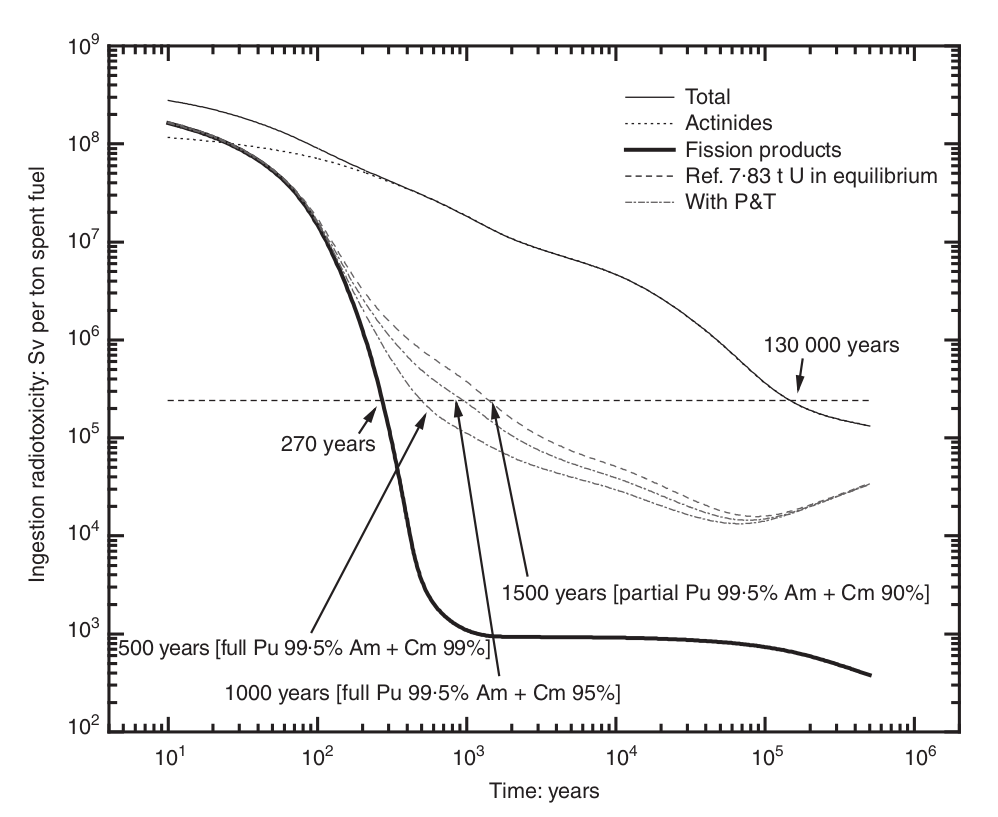
> you appear to be pretending groundwater either doesn't exist or can't move
That's why you bury it in rock where it doesn't move and we know it doesn't. Like the Permian Basin or where the Oklo natural reactors occurred in Gabon.
Oh yes, did you know nature formed fission reactors billions of years before we did ever existed? This always pisses off the hippies when I tell them. And guess what? The fission products from this natural process moved mere centimeters over 2 billion years.
This is a solved problem. It's just that some people desperately want it not to be.
Secondly from known examples where the logic has already proven itself in practice.
One example is France, where the taxpayers have recently had to pay over 50 bn euros in costs that were never planned or paid for by the operator.
Another example is the cleanup costs for the German Asse II storage site. Several billion Euros for the cleanup alone, and the things you extract from that site will have to be stored someplace else at high cost as well, so the costs will keep ticking. Operators don't pay that either, taxpayers do.
Another example is Sweden, where they have a storage facility for second-rate waste, (i.e. low-intensity waste), which is mandated to operate for at least 500 years. It is currently employing over 100 highly qualified people and is going to grow over the next few decades.
This facility is currently underfunded for its planned operations, and please note that this is not even accounting for the costs of handling high-intensity waste. This site will only manage secondary waste, like contaminated pipes, pumps, filters and such - so the actual total costs are severely underestimated. Taxpayers in Sweden will have to pay these costs in the years to come.
Germany had some of the best managed plants in the world -- until they decided to shut them down, leading to more coal being burned and more dependence on other countries like Russia...
Gas and coal imports from Russia stopped completely. But guess what still depends on Russia: The nuclear industry in Europe and the US.
That "shill" is showing data. Just the fact that you don't like this data doesn't make it invalid.
Right now it's night in Germany, and even though the wind is blowing, it's only at 40% generation. And look, there's coal, supplying 22%, and gas supplying another 9%: https://imgur.com/a/3bYudyd
No, it shows that people believe in bullshit and actively hurt their own clean power generation capabilities due to decades of FUD.
And yes, however many renewables you build, you still have no answer for intermittent power generation.
> We also know that nuclear will have no meaningful impact in fighting climate change because it is too expensive and too slow to build.
Strange how some countries build them relatively fast (China can builds 1 reactor in 6 years, building several reactors in parallel, see Fuqing Nuclear Power Plant) while e.g. in Europe after three decades of FUD, scremongering and underinvestment, we not only believe they can't be built fast enough, but can't build them either.
The electricity prices are also becoming zero[2] in Germany during parts of the day, which is a great outcome only on the surface. As this progresses, the consequence will be that renewable electricity producers aren't getting paid during their prime generating hours. This means even more subsidies will be required going forward to bring additional production. It will become more apparent once the reserve of easily dispatchable electricity sources is fully tapped to balance renewables across Europe. We will see very high prices during mornings and evenings and whenever it's cold and dark. The fossil fuel plants that are turned on during these periods will need to earn enough to address the additional wear due to quick power cycling and to keep being maintained for the rest of the time when they are unused.
[1] - https://www.smard.de/page/en/marktdaten/78?marketDataAttribu...
[2] - https://www.nordpoolgroup.com/en/Market-data1/Dayahead/Area-...
It's already a problem in Sweden. It exports electricity to Germany when demand is high... which leaves nothing to Sweden, and the prices skyrocket. https://www.bloomberg.com/news/articles/2022-08-12/swedish-m...
The market will always look to extract the highest possible price from the consumer.
> If there is trade, then because this is cheaper overall (and in general this helps buyer and seller).
Strange how "cheaper overall" fantasy is "consumer energy prices have quintupled in the past few years" in reality
Of course. Because when there's no electricity, there's no electricity.
> even though coal use is at a historic low, it's actually increasing
You pretend this is a contradiction when it's not. Germany has just shut down its last reactors. So yes, the usage of coal will increase because when renewable generation is low you still need to provide electricity. Guess what provides that electricity.
The rise in renewables will continue to decrease coal use. Deadline for coal is 2038, with possibly moving it to 2030.
Tell me, using data, on a quiet night, where does Germany's electricity come from, and where it will come from this wondrous future of 2030?
https://www.umweltbundesamt.de/sites/default/files/medien/38...
The bottom three are:
black coal in magenta
nuclear in gray
brown coal in brown
Nuclear shutdowns started in Germany in 2011. Check the numbers.
BTW with what did France replace its failing reactors last year?
https://apnews.com/article/europe-business-france-climate-an...
Funny how these hard numbers don't answer a simple question: where does Germany get its power on a quiet night like April 15th (answer is simple: buring coal, gas, and biofuels).
> BTW with what did France replace its failing reactors last year?
Last year it's "failing" generators were taken of for planned maintenance. The actual failures accounted for 0.18% loss in power.
I also don't get how an article can claim a global solution if nuclear currently is at 10% and we cannot keep up with supply and plants and and and.. this wont scale to 100%, not even 50 or even 20% of future global needs, would deplete cheap enough enable resources too quick... and what also is always forgotten: our world will likely have more, not less conflicts, unfortunately. Have fun managing this plants with wars all around and rivers going empty.
Yeah yeah all the issues happening and brought up again is just stupid people, mismanagement, etcetc.. But that unfortunately is humanity :/
Just no :/ especially as there are good enough and more sustainable other alternatives.
> Germany had some of the best managed plant
Better than France, likely agrees.. but still awful and that sentence is a joke. If that is your bar, good night. German infrastructure is currently rotting at record pace, happy we got those plants out there.
Please share numbers demonstration health hazards. For ex, bananas are radioactive. Should we outlaw bananas?
> rivers are getting too hot to cool down nuclear plants correctly
That's wrong. In 2022, the power output had to be reduced by 0.18% (not a typo) (https://twitter.com/energybants/status/1645696906327388160). In addition, Nuclear plants can work even in the desert: https://en.wikipedia.org/wiki/Palo_Verde_Nuclear_Generating_...
> nuclear plants are very unreliable
That's also wrong. Please share numbers. Nuclear has a load factor of 95% and its down time can be scheduled (maintenance). Wind has a load factor of 30-40% (and output is unpredictable), solar has a load factor of 20%, hydro requires mountains.
> the government wants to simplify control organism and laws around building new plants
When controls are too tight, nuclear is too slow ; when controls are too loose, nuclear is dangerous. Face je gagne, pile tu perds.
The goal is less CO2, and for that any low carbon energy source is good.
I've noticed by trying that one cannot simply win a political argument by waving the banner of utilitarian ethics. (I'm hoping fusion can circumvent this, if anyone can even commercialise it; we shall see). Likewise, best to compare with other power plants rather than other industrial accidents, and not just because what happened in Bohpal (and its less newsworthy cousins) should not have happened.
And if you ignore possible deaths from Chernobyl, how about the purely financial cost?
But my claim is, if Chernobyl hadn't Chernobyled, the $/MWh price would probably be lower.
I'm not making a specific claim that it would be cheap enough, though; I don't have enough relevant background to guess the magnitude.
$790 billion at 2021 cost
so my point was perhaps it is being held to a higher standard for a very good reason.
(NB. I'm not automatically against nuclear power, but I seriously question their potential cost against their very definite benefits. We had one Chernobyl, I guarantee we'll have another in time. Question is, how hard are we prepared to work to push that possibility, statistically speaking, as far into the future as possible)
Ok, so, total energy produced to by all nuclear reactors in the world in 2021 was apparently 2,653,344 GWh[0]; if there was a Chernobyl-scale disaster every year, that would add just under $0.30/kWh to the cost of electricity[1]. As reactors didn't have such a poor MTBF even then, I think a decade is a less unreasonable guess for rate of exploding, which is 3¢/kWh.
This may seem too concerned with dollars and not enough with lives, but similar things can be said in favour of lives cost per unit of energy produced, and again that's in favour of a yearly Chrenobly over all the fossil fuels, though not the renewables: https://ourworldindata.org/grapher/death-rates-from-energy-p... (I remember an older version that had much worse PV death rate, justified on the grounds installing stuff on rooftops is dangerous).
Like most arguments in favour of nuclear, it's more about the world we used to live in than the one we now live in; if you'd asked me 10-15 years ago, I'd have been all-in on nuclear to save the planet, but now, I think we have better options. But these were my reasons for being pro-nuclear at the time.
[0] https://en.wikipedia.org/wiki/Nuclear_power_by_country
[1] http://www.wolframalpha.com/input/?i=%24790%20billion%2F2%2C...
Painting nuclear as a 100% free of problem energy makes people sound as car salesmans. As of today, nobody want to finance or insure them. As soon as you say "ok, build them reactors if they are so perfect", nuclear advocates want the state to jump in and asume the costs, the consumers to pay an extra price, the safety regulations back to 1960 and the future people to deal with the residues.
The (botched) green energy transformation has given the country I live in top 3 highest electricity prices in the world and it's not even particularly green at all. Literally cannot get worse. And it seems to me that one half doesn't understand how incredibly bad high energy prices are both for people and industry, while the other half cheers at the prices because it causes deindustrialization and pushes towards degrowth - mainstream talking points of the current generation of climate activists here.
Also, would you please not copy-and-paste the same response multiple times as you've done in the thread? It comes across less as thoughtful discussion and more as spam. (I'm not trying to be rude, but that's how it came across to me.)
Since a few days ago, Germany's policy to reduce or keep energy prices and meet demand depends inextricably to France's building more nuclear reactors. (I am talking about the last industrial nuclear reactors going offline, and the future energy budget planning related to that.)
That's not quite correct. France deferred maintenance during COVID and scheduled the downtime in advance. The inspections then found potential problems, so other reactors did additional maintenance and checks.
They could have been deferred further if needed, but politicians were not willing to make the call.
> Painting nuclear as a 100% free of problem energy makes people sound as car salesmans.
Nuclear energy is the one that is actually proven to work and be reliable enough to completely displace fossil generation. Nothing else is coming close to that, including solar and wind.
> As of today, nobody want to finance or insure them.
Russia is busy exporting nuclear power plants. A nuclear reactor can be built within 6 years, two reactors within ~9 years (they're built in parallel).
However it is very suitable for base load generation, there's a reason why oil and coal companies lost their marbles in the 50s and astroturfed anti-nuclear into existence.
I'm not sure if that's their most-effective campaign ever or if it's a tie with BP's popularization of the carbon footprint, which atomizes responsibility for climate change and has successfully delayed systematic action for decades. And even managed to get greens and climate change activists to do their work for them. Just like with nuclear. It's actually, genuinely incredible.
That's not quite the case. You can load-follow with nuclear, but it requires reactors to be designed for that. France does this, for example.
You also can simply keep reactors working at a constant level and just dump excess power into their cooling system. This is not as bad as it sounds, because fuel is just about ~5% of the total cost of the produced nuclear energy.
Most nuclear power plants do not do this because they don't need to do it.
Therein lies the problem. Capital costs dominate nuclear plant costs and they are high.
If you load followed such that you kept the reactor at an average of, say, 50% nameplate capacity that would lead to a levelized cost per MWh of about $220.
For reference, Bhadla solar park sells a MWh for roughly $3.
For the US it's $33 per MWh, so doubling it still gives reasonable cost.
As for wind, it simply can not compete right now for guaranteed capacity. The adequacy rating for most wind power plants is around 10%, so you need 10x overbuild to even compete.
This is exactly a point in favor of nuclear.
One of these solutions is encumbered by problems of safety, the other capacity. It's easier to scale up capacity than it is to scale safety.
If I had to make long term bets, radioactive materials will continue to be radioactive, green capture, storage and transmission will get cheaper and more reliable.
Speaking of transmission, that's another huge problem. You can't go plopping powerplants just anywhere, and power generation needs to be somewhat close to those consuming it.
Distributed collection and storage helps reduce challenges around transmission infrastructure in low density or hard to travel areas.
Consider Puerto Rico, their investments in solar have skyrocketed, especially with the need to rebuild so much infrastructure. They had nuclear, and they were cleaning up contamination for decades after shutting it down. Also part of the issue with power there is transmission. You don't get the efficiency out of tiny boilers to make them cost effective for these folks.
I think you're pushing a bit hard for a tech that has a lot of problems and while it could play a role in our future, it's unlikely to be a dominant force.
At the factories that produce silicon and composites for the windblades.
> One of these solutions is encumbered by problems of safety, the other capacity. It's easier to scale up capacity than it is to scale safety.
So far, no large country has managed to move to 100% carbon-free renewable generation. And I'm not seeing this changing.
> Distributed collection and storage helps reduce challenges around transmission infrastructure in low density or hard to travel areas.
If we're talking about Europe, they are facing the problem of Dunkelflaute - long periods of no wind, no sun, and low temperatures in the middle of the winter. A worst-case once-in-century scenario would require around a _month_ of storage.
So far no technology is even close to that.
And if we compared these factories and their environmental impacts we would see a net increase from the production of solar and wind products? That's the point, and you ducked it hard.
> So far, no large country has managed to move to 100% carbon-free renewable generation. And I'm not seeing this changing.
Who said that we had to hit 100%? There is a place for burning stuff for fuels in our society for long to come, the point is not having it the default way we power larger systems.
> If we're talking about Europe, they are facing the problem of Dunkelflaute - long periods of no wind, no sun, and low temperatures in the middle of the winter. A worst-case once-in-century scenario would require around a _month_ of storage.
> So far no technology is even close to that.
Okay, that's a great argument to not continue investing in storage solutions, but let's be real, a new nuclear steam turbine isn't coming online _tomorrow_ either.
Let's do both, and not pretend like the more risky one is less dangerous than it is, when things go wrong.
Europe has many petawatt hours of potential hydrogen storage capacity in its salt formations.
Extending their lives to 100 will not only raise maintenance costs even further it will raise the risk of catastrophe quite significantly.
This would be a catastrophe for which e.g. American plants are insured only up to the level of 0.05% of 1 Fukushima level event.
In particular, annealing had been developed fairly recently: https://www.neimagazine.com/features/featurerenewal-by-annea...
https://www.reuters.com/markets/commodities/energy-crisis-fu...
Here is the official data for Germany for every year in the past several decades https://www.umweltbundesamt.de/sites/default/files/medien/38...

The bottom three are:
black coal in magenta
nuclear in gray
brown coal in brown
Nuclear shutdowns started in Germany in 2011. It should be easy to see that coal went down significantly since then and is at a historic low. Which brings me back to my original point:
Renewables have been pushed for 20 years and have started to accelerate only 10 years ago, yet they are already displacing fossil fuels in many countries.
I might be lazy, but you are outright dishonest.
https://ourworldindata.org/grapher/carbon-intensity-electric...
Germany went up last two years, but have otherwise been on a steady decline along with the rest of the continent. In 2011 Germany was at 473 g CO2 per kWh of electricity. In 2022 this was down to 386 g CO2/kWh but went down to 333 g CO2 / kWh in 2020.
I will leave it to you to figure out if there was any world event going on in 2020 which would have made it particularly low (i.e. allowed renewables to take up a greater portion of the electricity production), as well as in 2022 which could make it particularly high.
CO2 per kWh is also going down as renewables went up. Also easy to check in the data. You haven't done that either.
From your news source:
> "Only in Germany, with 10 gigawatts (GW), is the reversal at a significant scale. This has increased coal power generation in the European Union, which is expected to remain at these higher levels for some time," the IEA's annual coal market report said.
So your news source only mentions Germany, and only during an energy crisis caused be a war. If you only look at this one country, and only from February 2022 to April 2023 you may find coal consumption going up, but if you look over any other period, or include any other European country, you will see the opposite effect.
That’s very optimistic. Perhaps an ideal nuclear plant with a perfect operating record might approach 95%, but real-world load factors are lower as most plants end up requiring extended outages for repairs as some point in their lifetime.
France’s lifetime load factors for its nuclear plants are around 77%, but that declined sharply in recent years to 72% in 2020-21 and even lower in 2022 due to many plants being taken offline for repairs. In the UK, load factors are even lower: 67% during 1970-2017.
Some wind farms can hit 65%
https://www.greentechmedia.com/articles/read/worlds-first-fl...
The biggest issue is usually our lack of capacity to store/transmit. They shut of some turbines because they over produce for the Network capacity.
Scheduled nuclear downtime isnt any greener than the a slow wind day.
Capacity factors for wind projects surely are highly dependent on location, not just technology. Remains to be seen how many premium locations are suitable?
In quantities not relevant to safety. We can detect extremely small amounts of radiation, down to 1.0001% higher than backrgound levels.
- rivers are getting too hot to cool down nuclear plants correctly
Not quite: the flow of rivers was low enough that they would exceed the 28C temperature limit (ostensibly to protect fish, but no adverse impact from higher temperatures has been observed). It was entirely possible to cool the plants, if this restriction were not in place. Perhaps the solution here is to ask for better evidence on the supposed adverse ecological impact of higher river temperatures, and examine whether it outweighs the global catastrophe of greenhouse gas emissions.
- nuclear plants are very unreliable, we almost got out of power this winter and next winter will be equally tough (only an abnormally hot winter avoid cuts...)
Quite the contrary: Nuclear plants have some of the highest capacity factors [1] of any energy source. France's reactors were taken down for maintenance, much of it actually scheduled in advance. This is, intentionally or not, cherry picking a year with a particularly low capacity factor.
- the government wants to simplify control organism and laws around building new plants
Correct, and since nuclear thus far as proven to be one of the safest power sources [2] it's a reasonable change to accelerate the fight against climate change.
Nuclear is one of the few sources of decarbonized energy that is both non-intermittent, and geographically independent. Solar, wind, and hydro, are all either geographically dependent, intermittent, or both. Plans for a grid based on solar and wind almost invariably assume that a nearly-free form of energy storage will be invented in order to make these generation systems feasible. Unfortunately, such as system has yet to be produced. The heat engine made modern industrialized society possible, and it's easier to switch to a different source of heat than to restructure all of society around intermittent energy sources.
1. https://www.energy.gov/ne/articles/what-generation-capacity
2. https://www.statista.com/statistics/494425/death-rate-worldw...
To say that the reactor is "leaking radioactive material" because of tritium is extremely dishonest.
And later "yep, it leaks routinely but it does not matter because tritium is safe"
And then "of course we knew from the start that is not totally, totally safe for environment, but fuck nature"
Ending with "as long as we can keep the stream of smoke curtains and cheap excuses so can't be linked with us is not a problem". Hey, maybe is not a real french!
This creates a big lack of credibility problem.
I generally look at how people perceive things like this as an IQ test. At the moment the HN visitors upvoting/downvoting things in this thread have failed my baseline IQ test.
How I wish all presumably well-intentioned but badly informed and ill-educated people who very often seem to have.. let's say, bad luck when thinking would just stop trying to spread their gospel via forums in this destructive way.
Also, did you know that french nuclear power plants sometimes are taken down for maintenance. That seems super sketchy, doesn't it?
/s
This f*****g thread.
"as someone living near a plant"
My first 18 years: I lived 45 km from a nuclear power plant.
It helped me getting interested in physics because of some in hindsight exceptionally well performed guest lectures from a physicist working there in grades 7-8.
I'm not sure how France treats radiation levels, but in the US, the guidelines we have set are non-nonsensical.
I think nuclear will have an important part of dealing with climate change but he has a massive financial stake in this. I wouldn’t trust that more than I’d trust the Exxon guys who told us climate change was a liberal myth for half a century.
The problem is, a regulator never gets in trouble for being top strict. The incentives are totally wrong here and lead to bad regulations.
I trust this guy more than the bureaucrat covering their butt.
Guess what, there's risk to everything we do. The science for radiation seems to contradict with the US government has dictated. But keeping the policy strict and in contradiction to what we know about radiation doesn't get people fired.
That said, Thorcon has one of the more practical Th reactor designs and has government backing already: https://www.youtube.com/watch?v=fsi7lzbiq5k
You need to quantify whenever talking about radiation, otherwise it's meaningless. Granite countertops also leak radiation, same as bananas.
Also, coal powered plants leak radiation every time they burn coal...because coal is radioactive too. They also release mercury, which is why we can't eat too much tuna fish.
Fact is, every kind of energy is dirty in some way. Nuclear energy is one of the cleanest kinds of energy we have by far. It's just people have been taught to have an irrational fear of radiation. They don't realize they are constantly surrounded by it already.
btw how does France deal with nuclear waste?
> one of the plant regularly leaks radioactive material
Je suppose qu'il s'agit du Tricastin, ou il y a de temps en temps des petits rejets de Tritium détectés, parce qu'il n'y a pas vraiment d'autres centrales proches de Montpellier qui ont des emmerdes. "Regularly" est un mensonge, et omet aussi les quantités qui fuient. Oui, c'est un problème qu'il y ait une fuite, et le CRIIRAD bosse dessus des que ca arrive, mais on parle de radioactivité non seulement très minimes, mais extrèmement diluées aussi.
>rivers are getting too hot to cool down nuclear plants correctly
Non. On décide de ne pas rejeter de l'eau chaude dans les rivières parce qu'elles sont déjà très chaudes et qu'on a des normes pour éviter d'endommager la vie aquatique qui sont extrèmement basses, et basées sur une moyenne de temperature annuelle. Dans la pratique, on pourrait faire monter largement les temperatures des cours d'eau sans danger encore, mais on ne le fait pas justement pour éviter des surprises. Et c'est oublier que ce problème n'existe que pour les centrales n'ayant de pas de tours aerorefrigerantes, auquel cas _il n'y a aucun probleme de refroidissement_
>nuclear plants are very unreliable, we almost got out of power this winter and next winter will be equally tough (only an abnormally hot winter avoid cuts...)
Jean-José Mauvaise Foi frappe fort la. 60 ans de production sans aucun incident majeur, il aura fallu trois vagues de covid + des conditions météorologiques défavorables + un problème structurel relativement mineur (mais corrigé du coup) qui a causé un alignement des arrêts de centrales.
>the government wants to simplify control organism and laws around building new plants
Fallait pas donner une majorité relative aux tarés.
Bref, comme d'hab, finir sur un "je suis pas contre le nucléaire hein" tout en donnant des arguments dignes du pire article de Reporterre.
Probably just Tritiated water which is essentially harmless. Basically water with extra neutrons and it is very weakly radioactive. So weak that you can't detect it with a Geiger counter. Since it is water it does not accumulate in organisms. Tritium is also naturally created in the atmosphere by cosmic radiation.
You can buy tritium on Amazon - it's harmless.
Please, could you explain why US, EU and Canada governments have set narrow legal upper limits for Tritium presence on drinking water if is soo totally harmless? Are being those governments dishonest or stupid?
And why those dishonest physicians recommend "extended strong medical/therapeutic intervention" [1] in some cases of accidental exposure to Tritium?
If you define the qualities of a chemical by the stuff sold on Amazon prepare yourself for a nasty surprise when meeting the real deal.
Here's a chart with various drinking water limits included: https://pbs.twimg.com/media/FplBOWxWAAAT_Jz?format=jpg&name=...
Backing study: https://academic.oup.com/jrr/article/62/4/557/6256015
> Leaking Tritium in some obscure dose is a problem just because 1. the dose is unknown and 2. we are mostly made of water.
NRC regulates and monitors tritium spills quite actively. Here's an excerpt from their page on Tritium: https://www.nrc.gov/reading-rm/doc-collections/fact-sheets/t...
> As an example, drinking water for a year from a well with 1,600 picocuries per liter of tritium (comparable to levels identified in a drinking water well after a significant tritiated water spill at a nuclear facility) would lead to a radiation dose (using EPA assumptions) of 0.3 millirem (mrem). That dose is:
- at least 2,000 to 5,000 times lower than the dose from a medical procedure involving a full-body CT scan (e.g., 500 to 1,500 mrem from a CT scan)
- 1,000 times lower than the approximate 300 mrem dose from natural background radiation
- 50 times lower than the dose from natural radioactivity (potassium) in your body (e.g., 15 mrem from potassium)
- 12 times lower than the dose from a round-trip cross-country airplane flight (e.g., 4 mrem from Washington, D.C., to Los Angeles and back)
- one of the plant regularly leaks radioactive material
- rivers are getting too hot to cool down nuclear plants correctly
- nuclear plants are very unreliable, we almost got out of power this winter and next winter will be equally tough (only an abnormally hot winter avoid cuts...)
- the government wants to simplify control organism and laws around building new plants
(References are easy to find if you want confirmation)
I am not against nuclear power, but it has to be done properly and safely, which is certainly not the case around here.