Just like the town, Ontario exports power to other areas and imports non nuclear power. If everyone used 50-60% nuclear there wouldn’t be anyone to export that power to on low demand weekends etc which would drive up prices. The area also has a great deal of hydroelectric power which reduces the need for peaking power plants.
Nuclear has already played a significant role in reducing climate change, but it just can’t economically scale to supply nearly as much power as wind and solar. And much worse when you have a high percentage of Wind and Solar adding Nuclear to the mix just doesn’t work very well because base load power becomes less valuable.
As with France, a substantial influence on historic policy was to build surplus generation for economic security reasons. Could have just imported coal and oil. But Ontario does not have much coal or oil. Same with Quebec and hydroelectric.
Renewables provide the same sort of decentralized benefit, of course.
If the difference was a few billion globally then that’s trivial compared to the issues from climate change, but you can’t hand wave things once the difference starts crossing into the trillions.
France was able to heavily subsidize Nuclear and while their economy took a real hit it wasn’t such a big deal. Bangladesh and other developing countries simply aren’t capable of making those kinds of trade offs and nobody is going to subsidize nuclear power in the 3rd world on the scale they would need.
Cf, "Supply" tab:
Unfortunately the nuclear power plant operator losses money even faster than they are right now.
Renewables are even more susceptible to this because the weather affects all renewable plants of the same type similarly across wide geographic areas, so there will be times when they all generate more than is needed and nothing can be done about it. What's worse, the output is unpredictable, so there's little opportunity for some business to base its operation on renewable electricity generation patterns.
At least the weekend demand drop is predictable, so businesses can use this predictable opportunity to reduce their costs and thus reduce the impact the weekends have on the profitability of nuclear and similar dispatchable plants.
Renewables very much provide surplus power at scale, but they don’t always provide that massive surplus. So, Solar could provide 3/4 of its power when wholesale prices are below 1c/kWh and the economics still end up working out over the year. Meanwhile every other source of power needs to deal with electricity being increasingly cheap for most of the day.
> At least the weekend demand drop is predictable, so businesses can use this predictable opportunity to reduce their costs and thus reduce the impact the weekends have on the profitability of nuclear and similar dispatchable plants.
There’s almost nothing nuclear can do to reduce its costs when demand is low for a few days. They still need to pay interest, still need security guards, the reinforced concrete is still aging etc. They do major maintenance when seasonal demand drops normally in the spring or fall, but they don’t have any way to make use of downtown over weekends because weekends are so frequent. In a world with cheap electricity for 1/3 the day and cheap electricity 2/7 days a week and cheap electricity for 3-6 months out of the year, they need very high prices the rest of the time to break even.
Except at night.
Wind/Hydro and possibly some Nuclear might survive in that kind of an environment, but most industry insiders think Nuclear is basically doomed without truly massive subsidies.
While it would be nice if all the required nuclear or storage was installed decades ago, (1) we don't need to do this transition overnight, (2) a decade is on the optimistic side for rolling out new nuclear on this scale so it's not much of an improvement in that regard, and (3) most of the existing power infrastructure can be kept running until the batteries are available, and we get to keep looking at storage supply in the supply is still growing appropriately for the targets.
No, it's worst for the more expensive, capital intense sources.
Gas is expensive but not capital intense. An idled plant doesnt lose too much because fuel costs dominate. Solar/wind is capital intense but not expensive - idling is cheap if the whole thing is cheap.
Nuclear power is capital intense and expensive. Idling burns through a lot of cash.
Note that Ontario Power Generation, who owns all the nuclear plants in Ontario, has a positive net income of roughly 20% of gross, and is building Canada's first new nuclear plant in a couple decades. Your generalization is incorrect.
Their finances are very healthy because they essentially got 50 billion in assets from privatization of public assets including a great deal of very low maintenance hydroelectric generation and significant nuclear again without any upfront cost.
Things don’t look nearly as rosy when you consider their generating $1.20 billion in net profits off of 60 billion in assets - 10 billion in debt.
Umm… generation is taken offline?
Usually Gas and Hydro if renewables are available. If renewables drop then Gas and Hydro are brought back up.
Even after 50 years you have accumulated only a small percentage of the total costs related to the plant. They will most likely cost more money after they have been decommissioned than they did during operation.
For example: https://en.wikipedia.org/wiki/Rancho_Seco_Nuclear_Generating...
[1] https://www.theguardian.com/environment/2022/sep/23/uk-nucle...
The US has the same problems with Hanford.
But I don't think this is fair to ascribe these costs to modern civilian nuclear power programs.
Rancho seco is an interesting example, it was closed in 1989 and is still costing millions today. "SMUD estimates that it spends roughly $5 million each year to essentially "babysit" the waste, which requires tight security and a small crew to oversee its proper storage”
https://www.sacbee.com/latest-news/article210858009.html"
Also worth noting is that the DoE has paid SMUD over 100 million dollars to date for contract violations (failing to present a storage site for the waste).
The funny thing is that operators book this money as _income_ related to the nuclear plant, when it is in fact costs to the taxpayers.
Also keep in mind of course that if and when SMUD finally gets rid of the waste, that only stops the costs ticking for SMUD, not for the taxpayers.
There is nothing intrinsic that requires the plant to be ripped apart. It can be run indefinitely like any large concrete structure.
This includes the cost of decommissioning closed nuclear plants, disposing of waste, and cleaning up contaminated sites.
[1] https://www.theguardian.com/environment/2022/sep/23/uk-nucle...
In the US at least, the cost for all decommissioning and fuel handling are built into the cost of electricity sold by law.
That was the plan, but it has failed. The mechanism varies but the end result is the same - the operator doesn't pay the actual costs, so they don't charge the actual costs from the customers. The actual costs are paid by taxpayers from some anonymized bucket of money, like a government entity.
As an example, the DOE has so far paid over 100 million USD to SMUD for the decommissioned Rancho Seco plant and will continue to pay for decades more. The operator doesn't pay - the government does.
This has been proven to be true in best-case scenarios like the US, France, Germany and Sweden, and of course once anything deviates from best-case the costs become astronomical almost immediately (Japan).
Despite what the antis will tell you, the waste aspect of nuclear energy is overwhelmingly positive. And the crazy thing is, spent nuclear fuel isn't even waste. 90% of the energy is still in there. So why on earth would you bury it?
[1]:https://pbs.twimg.com/media/Fs4euEoWYAAx65C?format=jpg&name=... [2]:https://www.youtube.com/watch?v=B6no0FmPk84
You'd have to eat lots of Pu-239 to get sick and we know this for a fact unfortunately because of the insane story of Albert Stevens [1] who got the highest radiation dose of any known human and lived to be 79. He was one of 18 people injected with plutonium. None of the patients died from the injections. Why injection instead of ingestion? Because the body is actually very bad at absorbing Pu when it is eaten.
Let me just emphasize again that we INJECTED A MAN WITH PURE PLUTONIUM and he was fine. Nuclear waste is not the problem you think it is.
The sad fact is that nobody has correctly estimated how big a problem nuclear waste is. We keep having to pay more for it than any previous estimate predicted.
Fact is, the waste that everyone is worried about (used nuclear rods) is not actually waste. 90%+ of the energy is still in there. It's just that the dominant reactor technology isn't designed to extract it. It would be dumb to bury this energy. It would be better to reprocess it like France does or even better, build the kinds of reactors that can directly use it as fuel.
Then you're left with fission products that you can bury it several kilometers underground in a deep borehole using oil/gas technology. It will naturally decay away in 300 to 600 years. Remember, most industrial toxins are toxic forever. There is no amount of time that will render it safe, and we don't even particularly try to isolate it because there's so much. It is only for nuclear waste that we try so hard. And it's only feasible because there's so little of it. All the spent nuclear rods (civilian) the US has EVER produced in 70 years fits in a football field at 30 feet high. Meanwhile a single coal plant produces 1100 tons of just ash a DAY. Not to mention all the air pollution and greenhouse gases. A single plant.
The waste aspect of nuclear energy is amazingly convenient in comparison.
What on earth are you talking about? You realize you are full of alpha emitters?
> As stated above your 600 year timescale is off by close to three orders of magnitude
Nope, see this chart: https://whatisnuclear.com/img/ingestion-radiotoxicity-nuclea...
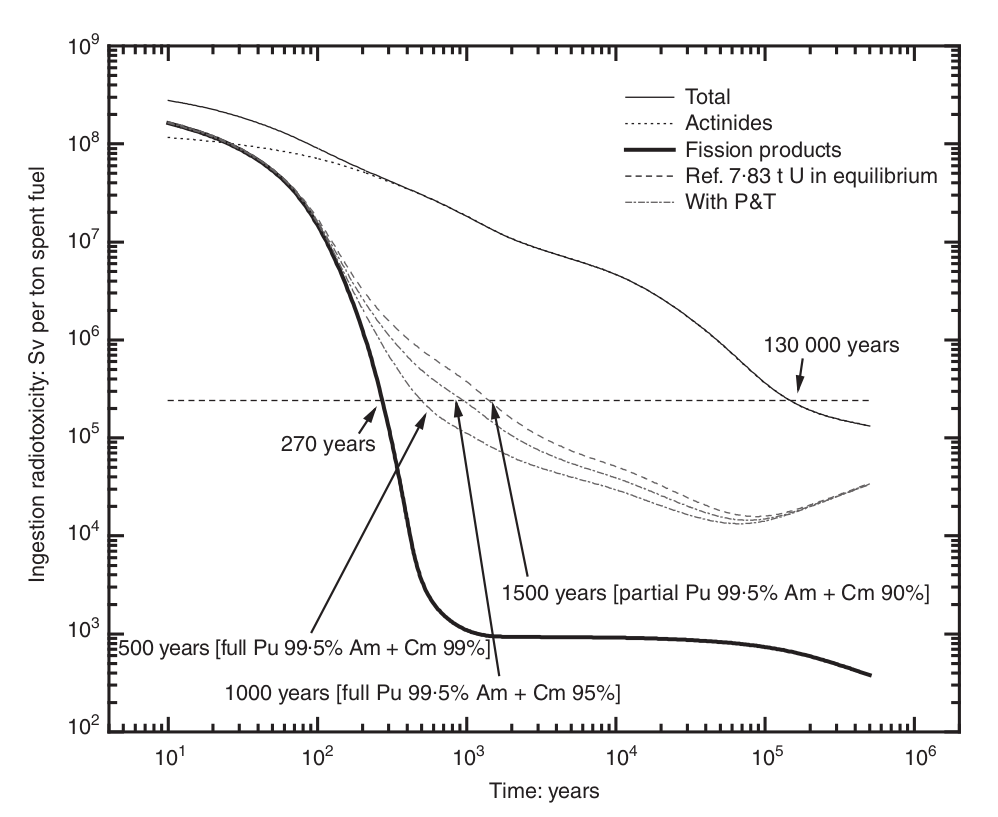
> you appear to be pretending groundwater either doesn't exist or can't move
That's why you bury it in rock where it doesn't move and we know it doesn't. Like the Permian Basin or where the Oklo natural reactors occurred in Gabon.
Oh yes, did you know nature formed fission reactors billions of years before we did ever existed? This always pisses off the hippies when I tell them. And guess what? The fission products from this natural process moved mere centimeters over 2 billion years.
This is a solved problem. It's just that some people desperately want it not to be.
Secondly from known examples where the logic has already proven itself in practice.
One example is France, where the taxpayers have recently had to pay over 50 bn euros in costs that were never planned or paid for by the operator.
Another example is the cleanup costs for the German Asse II storage site. Several billion Euros for the cleanup alone, and the things you extract from that site will have to be stored someplace else at high cost as well, so the costs will keep ticking. Operators don't pay that either, taxpayers do.
Another example is Sweden, where they have a storage facility for second-rate waste, (i.e. low-intensity waste), which is mandated to operate for at least 500 years. It is currently employing over 100 highly qualified people and is going to grow over the next few decades.
This facility is currently underfunded for its planned operations, and please note that this is not even accounting for the costs of handling high-intensity waste. This site will only manage secondary waste, like contaminated pipes, pumps, filters and such - so the actual total costs are severely underestimated. Taxpayers in Sweden will have to pay these costs in the years to come.
Activated water with tritium in it has been released accidentally a number of times, and small amounts of tritium and other gasses are released by any reactor, but no unapproved leaking besides that has ever been made public.
There are of course ecological problems with the heat, but all the reactors use one of the Great Lakes as a heat sink and water supply itself isn't a problem.
The CANDU design can be fuelled online and most of the reactors have been online over 80% of the time, including refuelling, maintenance and refurbishment projects. The later designs hover around 90%.
They were expensive to build, and the last plant was really expensive. This was due to various reasons, including post-Chernobyl reviews, and pausing construction for over a year due to a labour dispute, and high interest rates.
Still, amortized over more than half a century they've ended up being the second-cheapest source of power in the province, after hydroelectric. Government is casting around for replacement options as the reactors are retired over the coming decades, but nothing concrete in the short term.