News for hackers. Stuff that matters.
Re:Maybe Treating Housing as an Investment Was a Colossal Mi... by dfxm12 on Monday March 06, 2023 @12:25PM (#35043927)
What sucks is a lot of young renters with steady jobs can afford to pay off a mortgage month to month, but they just can't afford that down payment (especially the 20% needed so as to not need to get mortgage insurance)! I was in that position for a while. Every time it seemed like I could afford to put that money down, the housing prices went up! It took a handful of years of renting cheap places (with roommates), living with my parents when I could and getting a few raises at work that I could finally save up enough for a down payment.
Re:Maybe Treating Housing as an Investment Was a Colossal Mi... by Muromec on Monday March 06, 2023 @12:39PM (#35044310)
And here at the bottom of the see, there is no down payment (financing up to 100%), but young renters still can't get the a mortage of the same monthly amount as they pay rent, because of regulatory reasons -- mortage ceiling is defined as something like 5x gross yearly salary.

Somehow it's fine to pay half the salary in rent, but not fine if it's financing the mortage.

Re:Maybe Treating Housing as an Investment Was a Colossal Mi... by jedberg on Monday March 06, 2023 @12:42PM (#35044398)
That sort of makes sense. When you own a property, you have to maintain it and pay property taxes. When you add all that up, you either need a lot more than rent, or you need the mortgage to be lower than rent so you can afford those other expenses.
Re:Maybe Treating Housing as an Investment Was a Colossal Mi... by wankle on Monday March 06, 2023 @01:14PM (#35045055)
Our home was $200K. If we own it for 30 years, the property taxes will average to about $180K over that time. If we have $70K expenses (roof, HVAC, etc.) then the total would be 250K.

If we sell our home at the end of 30 years for exactly what we bought it for, no raise in value at all, 200K, then 250K of maintenance works out to around $700 per month for each month of those 30 years.

Any amount we can sell the house for over the original $200K price, reduces the taxes and maintenance down from $700 potentially to zero.

If we sell at the end of 30 years for $450K, even accounting for taxes and maintenance, we lived rent free for 30 years.

Re:Maybe Treating Housing as an Investment Was a Colossal Mi... by dbjacobs on Monday March 06, 2023 @01:41PM (#35045571)
Don't forget the opportunity cost of that $200K of equity. If that money invested earned 5%/yr on average that is another $10K/yr bringing your $700/mo to $1,533/mo. If you sell at $450K after 30 years, that mostly just makes up for that opportunity cost (30yrs at 5% would be 432K).
Re:Maybe Treating Housing as an Investment Was a Colossal Mi... by hd95489 on Monday March 06, 2023 @02:02PM (#35045949)
No tax on the house. 30% tax on investment.
Re:Maybe Treating Housing as an Investment Was a Colossal Mi... by nathants on Monday March 06, 2023 @04:50PM (#35048183)
tax free for profit up to 250k or 500k if married. after that it’s taxed 30% too.
Re:Maybe Treating Housing as an Investment Was a Colossal Mi... by jedberg on Monday March 06, 2023 @01:28PM (#35045342)
You're confusing assets and cashflow.

Yes, after 30 years, you came out ahead. But also, you can't sell your house when the drain breaks and you need $10,000 today to pay for fixing it. Especially if you just bought the house.

Also, you forgot to account for the $180K in mortgage interest.

Re:Maybe Treating Housing as an Investment Was a Colossal Mi... by Spooky23 on Monday March 06, 2023 @01:48PM (#35045699)
Don’t forgot that rent goes up. Renters pay taxes too.

My apartment that was $900/month in 2001 is $2200 today. Outside of some of the really stupid markets, it’s almost always better to own. You’ll be fixing that drain every year.

Re:Maybe Treating Housing as an Investment Was a Colossal Mi... by wankle on Monday March 06, 2023 @03:04PM (#35046815)
I'll throw in the 180K mortgage interest and the mortgage insurance which I also forgot and wager I still come out ahead. Rent would be somewhere between $750K to $1M over that time and none of it is returned.

Since we control our mortgage, we paid it off early, at around 15-16 year mark (due to my wife making me realize the importance of it). We live rent and mortgage free the rest of our lives thank God. I only wish I'd kept either of our 2 former houses instead of taking better job offers requiring moving ultimately to the bay area where we couldn't afford to buy a home. Texas is nice though!

My Dad always said, buy a house as soon as you can.

Re:Maybe Treating Housing as an Investment Was a Colossal Mi... by jedberg on Monday March 06, 2023 @03:30PM (#35047141)
Just use this calculator:

https://www.nytimes.com/interactive/2014/upshot/buy-rent-cal...

In most Bay Area markets, it makes more sense to rent than buy from a purely financial prospective. It's only if you value the ability to modify the home or have a sense of permanence that it starts to flip.

Re:Maybe Treating Housing as an Investment Was a Colossal Mi... by DanTheManPR on Monday March 06, 2023 @01:01PM (#35044827)
But it's not as though property taxes and ongoing maintenance costs don't exist for apartments. The income the owner receives from the rents has to cover all of that.
Re:Maybe Treating Housing as an Investment Was a Colossal Mi... by jedberg on Monday March 06, 2023 @01:27PM (#35045308)
Exactly. That's why if your mortgage == rent then you're behind. Because rent already includes those things.
Re:Maybe Treating Housing as an Investment Was a Colossal Mi... by RHSeeger on Monday March 06, 2023 @02:07PM (#35046016)
Well, yes and no. If you own and the roof needs replacing, you need to have that money on hand (or be able to take out another loan to cover it, which isn't always possible). If you rent, you don't.
Re:Maybe Treating Housing as an Investment Was a Colossal Mi... by 8note on Tuesday March 07, 2023 @02:00AM (#35052427)
Well, if you rent, you rely on the landlord to be able to do that, and if they can't, you're still screwed
Re:Maybe Treating Housing as an Investment Was a Colossal Mi... by RHSeeger on Tuesday March 07, 2023 @03:01PM (#35060387)
I don't see how that's important to the discussion at all. Sure, if you live somewhere, a problem with the roof is "your problem". But if you own, it's also "your responsibility" vs renting where it's "their responsibility". And the person whose responsibility it is is the one that is saddled with the need to acquire that lump sum of money to deal with it.
Re:Maybe Treating Housing as an Investment Was a Colossal Mi... by RhysU on Monday March 06, 2023 @08:04PM (#35050140)
How much does being able to call an expense an expense figure into things? Like, why wouldn't I set up a company owns my house and rents it back to me?
Re:Maybe Treating Housing as an Investment Was a Colossal Mi... by mxkdodi on Monday March 06, 2023 @12:55PM (#35044697)
It makes absolute sense, because maintenance costs are non-negligible. I just paid a fifteen thousand dollar plumbing bill. Since rent would include the ability to call the landlord to make him fix that, I sure would expect rent to be higher for the same place than my mortgage is.

Last year I spent twenty grand on a new roof. What's next? Idk, but that's why my mortgage isn't half of my salary. If it was rent, these things wouldn't be my problem.

That's the trade-off.

Re:Maybe Treating Housing as an Investment Was a Colossal Mi... by ghaff on Monday March 06, 2023 @01:50PM (#35045730)
Depending on what you include I figure property taxes, insurance, ongoing maintenance of my house and property are a good $1K/month (obviously with a fair bit of lumpiness for large projects). Some things you can postpone and some things you can trade money for your time & effort but it's still a non-trivial amount.
Re:Maybe Treating Housing as an Investment Was a Colossal Mi... by sokoloff on Monday March 06, 2023 @02:08PM (#35046044)
I'd love if all that was $1K/mo total. My property taxes alone are $1001/mo (for 2021; they went up a little bit last year, but I could quickly look up 2021 online).
Re:Maybe Treating Housing as an Investment Was a Colossal Mi... by ghaff on Monday March 06, 2023 @02:47PM (#35046617)
Property taxes vary a lot. Mine are about $350/month.

$1K/month is probably low for me though if I added up all the expenses a renter wouldn't generally have although a renter also probably wouldn't be renting a house like mine for an extended period so it's a bit hard to do apples to apples.

In any case, living in a house is very much not free even once you're paid off the mortgage--especially if you make an effort to prevent a lot of maintenance debt from accumulating.

Re:Maybe Treating Housing as an Investment Was a Colossal Mi... by carlosjobim on Tuesday March 07, 2023 @08:29AM (#35055078)
> I just paid a fifteen thousand dollar plumbing bill.

That has to be for commercial real estate, or you've been ripped off. There is no possibility of a single family dwelling ever having plumbing problems of that scale.

But maintenance costs are in general a landlord lie. They wouldn't rent out their properties if costs where anywhere near income. As for my own anecdote, my landlord has spent at most 0,5% of what he's gotten in rent from me on maintenance over the years. A normal tenant won't break anything or induce any maintenance costs.

Re:Maybe Treating Housing as an Investment Was a Colossal Mi... by gangstead on Tuesday March 07, 2023 @10:29PM (#35064864)
That is a very believable number. I had a leak in my concrete slab last year. The plumbing bill was $20k, which didn't include fixing all the holes in the drywall nor the bathroom remodel after they went through the shower to jackhammer a hole in the foundation.
Re:Maybe Treating Housing as an Investment Was a Colossal Mi... by notahacker on Monday March 06, 2023 @01:03PM (#35044857)
Also, it's a little easier to just scrape by for 12 months of a rental contract than for a couple of decades of a mortgage, and a lot more difficult to repossess a house.

And I think we all saw why banks should be expected to be a lot more cautious in rating homebuyers' ability to pay than some individual landlords might be about their tenants in 2008

Re:Maybe Treating Housing as an Investment Was a Colossal Mi... by kortilla on Monday March 06, 2023 @01:29PM (#35045358)
Property taxes are usually collected as part of the mortgage payment for just that reason. The bank doesn’t want another lien risk lurking there.
Re:Maybe Treating Housing as an Investment Was a Colossal Mi... by eloisant on Monday March 06, 2023 @01:29PM (#35045372)
Also if your revenue drop, it's easier to move as a tenant than to sell your house.
Re:Maybe Treating Housing as an Investment Was a Colossal Mi... by BobbyJo on Monday March 06, 2023 @12:50PM (#35044584)
100%. If it's an older house, the mortgage might not even be half your costs for the first few years, while you get everything that breaks back in good condition.
Re:Maybe Treating Housing as an Investment Was a Colossal Mi... by loeg on Monday March 06, 2023 @01:24PM (#35045256)
> mortage ceiling is defined as something like 5x gross yearly salary.

No -- mortgages are limited to 50% debt-to-income. The exact principal that relates to income depends on prevailing interest rates.

You can see this fairly easily by using any mortgage calculator, e.g., Google's (in the "Purchase budget" tab).

Keeping fixed: $100k household income, 0% down, California, Google's tax and fees estimates, 800+ credit score (just to eliminate that as a factor).

At 2% interest, Google thinks you can get a $512k (~5.1x income) mortgage (at 50% DTI).

At 6% interest, that falls to $368k (~3.7x income).

At 10%, $274k. You get the idea.

(For all of these loans, your annual payments would be about $50k/year.)

Re:Maybe Treating Housing as an Investment Was a Colossal Mi... by weard_beard on Monday March 06, 2023 @02:34PM (#35046430)
Bought a house in 2019. Downpayment and Credit Score will make a huge difference. This seems accurate to my experience though. At 5% down, $170k household income. 740 credit score. (Credit Score bumped us from a 2.5% interest rate to 3) The bank said we could afford $680k max.
Re:Maybe Treating Housing as an Investment Was a Colossal Mi... by dragonwriter on Monday March 06, 2023 @01:25PM (#35045272)
> Somehow it's fine to pay half the salary in rent, but not fine if it's financing the mortage.

Because eviction is easier than foreclosure (and, actually, a lot of big property management companies look at similar affordability criteria as lending banks, but you can find mom & pop landlords; mom & pop mortgage lenders, unless they are literally rich family members making an informal loan, probably not.)

Re:Maybe Treating Housing as an Investment Was a Colossal Mi... by oldgradstudent on Monday March 06, 2023 @02:16PM (#35046164)
> Somehow it's fine to pay half the salary in rent, but not fine if it's financing the mortage.

50% of income as mortgage payments are extremely risky mortgages. We've just had the entire financial system collapse not so long ago because of such shenanigans.

Don't people remember the 2008 mortgage crisis?

If you can't pay the rent, you rent something cheaper. It is not nearly that easy when you have a mortgage.

Re:Maybe Treating Housing as an Investment Was a Colossal Mi... by pandaman on Monday March 06, 2023 @08:19PM (#35050256)
>Somehow it's fine to pay half the salary in rent, but not fine if it's financing the mortage.

Where is it fine to rent for half of the salary? Last time I rented a couple years ago, the corporate landlord wanted to see either a paystub exceeding 4x rent for the same period or a bank statement for the funds exceeding 3x total rent. This varies, of course, but the standard used to be the 40x rule (rent not exceeding 30% of income before tax).

Re:Maybe Treating Housing as an Investment Was a Colossal Mi... by SoftTalker on Monday March 06, 2023 @12:31PM (#35044135)
That’s normal. I bought my first house in the early 1990s. Saving the down payment was tough. I lived in a real shithole apartment, anything nice and the rent ate up too much of my cash flow. And I I had to pay PMI, but the monthly payment was still cheaper than rent.
Re:Maybe Treating Housing as an Investment Was a Colossal Mi... by kitsunesoba on Monday March 06, 2023 @12:38PM (#35044297)
I too went for a down payment below 20% (somewhere closer to 5%) because saving up a full 20% would've been daunting to say the least, and as such pay PMI. Still a better deal than renting by a large margin, and the feeling that the cash being put into payments is going towards owning something rather than being set aflame is nice.

That said I agree with the sibling comments that 20% down payments shouldn't be as out of reach to as many people as they are.

Re:Maybe Treating Housing as an Investment Was a Colossal Mi... by findthewords on Monday March 06, 2023 @04:38PM (#35048025)
We can take a look at the St. Louis Fed "Fred" database take a look at historical affordability of 20 % down payment. Let's divide two numbers, a and b to get a ratio of yearly median wage divided by median house price, from 1980 to 2023. [1]

a) Employed full time: Median usual weekly real earnings: Wage and salary workers: 16 years and over

b) Median Sales Price of Houses Sold for the United States

We see that the a/b ratio was 0.25 in 1980, and has declined to 0.05 today.

Therefore, a 20 % down payment in 1980 would equal to a 4 % down payment today. Conversely, a 20 % down payment on a house in 2023 (median wage, median house) is equal to a (25/5)*20 % = 100 % down payment in 1980!

[1] https://fred.stlouisfed.org/series/LES1252881600Q#0

Re:Maybe Treating Housing as an Investment Was a Colossal Mi... by kitsunesoba on Monday March 06, 2023 @05:29PM (#35048672)
Wow, that's brutal. Not much more can be said.
Re:Maybe Treating Housing as an Investment Was a Colossal Mi... by brewdad on Monday March 06, 2023 @09:01PM (#35050572)
Ok, but in 1980, you needed that 20% down payment because mortgage rates were approaching 20%.
Re:Maybe Treating Housing as an Investment Was a Colossal Mi... by actionablefiber on Monday March 06, 2023 @12:38PM (#35044303)
> I bought my first house in the early 1990s. Saving the down payment was tough.

Compare housing prices since 1990 vs. wage growth over the same period. For the overwhelming majority of people entering the workforce today, there is no way to realistically save for a down payment unless you forego saving for anything else - no 401k, no IRA, no emergency fund, no car, no family.

Re:Maybe Treating Housing as an Investment Was a Colossal Mi... by jalk on Monday March 06, 2023 @01:09PM (#35044976)
Don't forget that the interest rate was around 10% in the early 1990ies
Re:Maybe Treating Housing as an Investment Was a Colossal Mi... by triceratops on Monday March 06, 2023 @01:35PM (#35045471)
Yeah that's one reason why houses in the 90s were more affordable.
Re:Maybe Treating Housing as an Investment Was a Colossal Mi... by Scoundreller on Monday March 06, 2023 @03:11PM (#35046907)
Affordable for people planning on paying down the mortgage, but horrible for investors expecting to just refi and refi while maintaining a constant high double-digit LTV. Think about them! /s
Re:Maybe Treating Housing as an Investment Was a Colossal Mi... by ejb999 on Monday March 06, 2023 @01:20PM (#35045170)
My first mortgage was 10.5% in 1989.
Re:Maybe Treating Housing as an Investment Was a Colossal Mi... by cko on Monday March 06, 2023 @01:16PM (#35045102)
I think a more apt comparison would be monthly mortgage + interest payment divided by price per square ft over time. I suspect it just barely tracks inflation.

Houses have gotten bigger and interest rates have fallen since then.

Re:Maybe Treating Housing as an Investment Was a Colossal Mi... by actionablefiber on Monday March 06, 2023 @01:47PM (#35045684)
I understand the bit about interest rates. But the disappearance of starter homes from the market is part of the problem, not a cool accounting trick to hide it.
Re:Maybe Treating Housing as an Investment Was a Colossal Mi... by chipsa on Monday March 06, 2023 @01:19PM (#35045149)
With a Roth IRA, you can withdraw the principle penalty free, while the earnings stay in the account. Also, you can withdraw 10k for buying a house from either IRA type, penalty free. You lose out on the future earnings from that withdrawal, but you can use it.
Re:Maybe Treating Housing as an Investment Was a Colossal Mi... by uoaei on Monday March 06, 2023 @12:33PM (#35044169)
Normative statements don't hold much weight for justifying why things are the way they are.
Re:Maybe Treating Housing as an Investment Was a Colossal Mi... by nostromo on Monday March 06, 2023 @12:41PM (#35044352)
Downpayments need to be substantial because the owner needs to have skin in the game. Otherwise the borrower could walk away from the house and the mortgage with very little downside.
Re:Maybe Treating Housing as an Investment Was a Colossal Mi... by Retric on Monday March 06, 2023 @12:44PM (#35044440)
Someone walking away from a house doesn’t destroy the house.

The lender’s risk is therefore limited to the difference between purchase price and actual value of the property. Which is something they can hedge or simply not make a loan if they think the property is wildly overvalued.

Re:Maybe Treating Housing as an Investment Was a Colossal Mi... by bumby on Monday March 06, 2023 @01:05PM (#35044897)
>Someone walking away from a house doesn’t destroy the house.

The experience of the foreclosure crisis seems to differ. I know people who moved into houses where holes were punched into walls and everything was removed that could be, from door knobs to outdoor deck planks.

Re:Maybe Treating Housing as an Investment Was a Colossal Mi... by uoaei on Monday March 06, 2023 @04:29PM (#35047886)
You describe damage to a property that a bank owns. Therefore the costs fall on the bank. This is part of the definition of the concept of "taking on risk" and if banks are not accounting for these outcomes in their business model, they're simply bad at business.
Re:Maybe Treating Housing as an Investment Was a Colossal Mi... by bumby on Monday March 06, 2023 @05:02PM (#35048328)
Yes (except in the cases of short sales, where I’ve seen the same). My point was not about who assumes that risk, just pushing back on the idea that people wouldn’t damage a house they were going to be forced out of.
Re:Maybe Treating Housing as an Investment Was a Colossal Mi... by quonn on Tuesday March 07, 2023 @02:48AM (#35052702)
Okay, and accounting for the risk is exactly why there is a significant down payment.
Re:Maybe Treating Housing as an Investment Was a Colossal Mi... by Retric on Tuesday March 07, 2023 @09:43AM (#35055858)
Significant down payments are a result of government regulation not choices by banks.
Re:Maybe Treating Housing as an Investment Was a Colossal Mi... by bumby on Tuesday March 07, 2023 @06:35PM (#35062968)
This is only true for a federally backed mortgage. Yes, down payment levels, in the context of whether someone needs mortgage insurance, is set by regulation. But down payments can be much less significant if you’re ok with mortgage insurance. Down payments required by banks were typically higher before regulation.
Re:Maybe Treating Housing as an Investment Was a Colossal Mi... by Retric on Tuesday March 07, 2023 @09:39PM (#35064508)
Before regulation it really depended on the buyer. Some people where putting down 5% without insurance, others had much stricter requirements.

We’ve settled on a really arbitrary system where for example the Federal Housing Administration requires huge upfront FHA insurance payments without regard for down payment size if it’s less than 20%. If you’ve saved up say a 8% down payment you really should be a significantly lower risk than someone putting down 3.5%.

Re:Maybe Treating Housing as an Investment Was a Colossal Mi... by bumby on Wednesday March 08, 2023 @07:28AM (#35068196)
The buyer wasnt the decider. The bank was because they were the one taking the risk. The down payment required by banks before regulation was often 30% or more. That’s partly why home ownership was much lower prior to WW2.

I suspect we’re looking at this through different temporal lenses. When I talk about regulation, I mean the last 100 years in its entirety, not just since the financial crisis of 2008. I agree with some of your point regarding how thresholds are set arbitrarily, though.

Re:Maybe Treating Housing as an Investment Was a Colossal Mi... by Retric on Wednesday March 08, 2023 @01:22PM (#35072719)
> The down payment required by banks before regulation was often 30% or more.

I am talking about lending before regulation. High down payments were not universally applied, so yes sometimes a loan might require 40% but other borrowers might offer nothing. My point is you can’t simply say the required amounts were excessively high some of the time because they weren’t universal and selected based on a perception of risk.

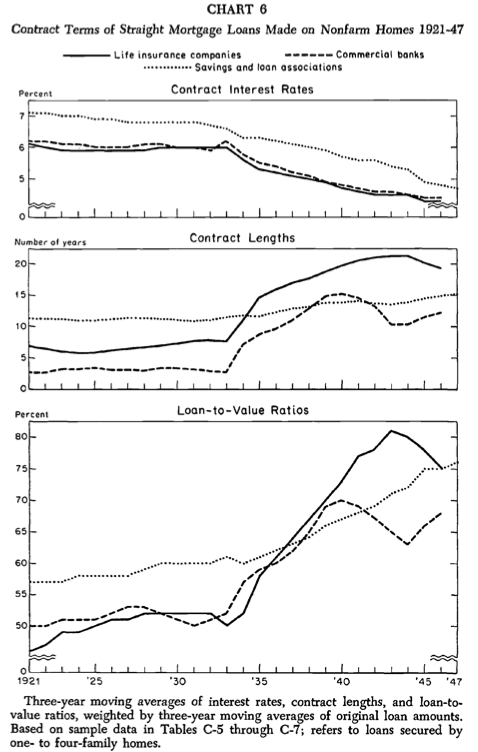
It’s not just regulation at play here, the government has decided to reduce bank’s risks while also subsidizing home loans. Net result is more home owners but also much longer mortgages. https://www.thetruthaboutmortgage.com/wp-content/uploads/201...
Re:Maybe Treating Housing as an Investment Was a Colossal Mi... by sokoloff on Monday March 06, 2023 @12:53PM (#35044642)
A down payment of 20% provides some of that exact cushion (and makes it less likely for a borrower to casually walk away from a house that fell in value or was otherwise a poor purchase).
Re:Maybe Treating Housing as an Investment Was a Colossal Mi... by Retric on Monday March 06, 2023 @01:56PM (#35045850)
In theory sure, but 20% is an arbitrary regulation not some measurement of risk.
Re:Maybe Treating Housing as an Investment Was a Colossal Mi... by sokoloff on Monday March 06, 2023 @02:01PM (#35045927)
Do you think it was chosen without any regard to the risk-mitigation that it offered?
Re:Maybe Treating Housing as an Investment Was a Colossal Mi... by Retric on Monday March 06, 2023 @06:09PM (#35049143)
Any regard is a really low standard, minimal is more accurate. You don’t end up with nice round numbers like 20% which never change from calculating some formula.
Re:Maybe Treating Housing as an Investment Was a Colossal Mi... by quonn on Tuesday March 07, 2023 @02:49AM (#35052711)
If you look between countries you would see that it‘s usually around 15-25%. So it‘s around 20%, almost everywhere.
Re:Maybe Treating Housing as an Investment Was a Colossal Mi... by Retric on Tuesday March 07, 2023 @09:22AM (#35055632)
The global range is wider than that and reflects the reasonable range of this kind of regulation. If it’s say 75% then what’s the point of a loan? On the other hand if it’s 1% what’s the point of the regulation?

Regulators are basically picking a number between 3.5% to 35% and 20% is a nice round number in the middle of that range.

Re:Maybe Treating Housing as an Investment Was a Colossal Mi... by ejb999 on Monday March 06, 2023 @01:22PM (#35045210)
>>Which is something they can hedge

Which is precisely what PMI is for.

Re:Maybe Treating Housing as an Investment Was a Colossal Mi... by Retric on Monday March 06, 2023 @01:54PM (#35045804)
PMI is held buy the purchaser not the lender. It’s one of the few financial transactions set up like this.
Re:Maybe Treating Housing as an Investment Was a Colossal Mi... by rootusrootus on Monday March 06, 2023 @12:46PM (#35044484)
The whole point of interest is supposed to account for that risk.

People buy cars all the time that cost a decent fraction of what a house does, and nobody bats an eye when they finance 100% (or more) of the value. And a car depreciates and moves. The bank knows where to find the collateral for a mortgage, and the value generally appreciates.

Re:Maybe Treating Housing as an Investment Was a Colossal Mi... by makomk on Monday March 06, 2023 @01:02PM (#35044837)
We had a whole, massive global financial crisis that was essentially caused by the fact that this does not work for housing because the risks are so heavily correlated: a large chunk of society finds that they cannot afford the downpayments and defaults all at once, which causes house prices to decrease and the economy to collapse, which in turn means that more people default on their mortgages. It's a systemic risk that affects everyone and that the markets alone do not protect against, which is why regulators have cracked down on mortgage lending so strongly.
Re:Maybe Treating Housing as an Investment Was a Colossal Mi... by adgjlsfhk1 on Monday March 06, 2023 @01:12PM (#35045023)
the problem isn't not requiring 20% down. the problem is not setting interest rates appropriately. the banks did a calculation of interest based on housing prices growth, but if you just do the calculation with stagnation/minor depreciation you get an appropriate interest rate for the lower collateral
Re:Maybe Treating Housing as an Investment Was a Colossal Mi... by olddustytrail on Monday March 06, 2023 @02:03PM (#35045955)
No, we didn't have a global financial crash because a few poor people couldn't pay their mortgage. We had that crash because some people gambled huge amounts of other people's money on whether these mortgages would be paid.

I used to write some lengthy posts about this and then a few months ago The Big Short was on TV, I watched it for the first time, and realised it was saying exactly what I'd been trying to explain for years. So just watch that.

Plus it has Margot Robbie explaining the technical terms in a bubble bath, so if you don't get it the first time, you can rewind and watch again.

Re:Maybe Treating Housing as an Investment Was a Colossal Mi... by uoaei on Monday March 06, 2023 @12:51PM (#35044604)
That's a much better reason, or, at least, something to respond to. Thank you.

Accountability on the part of the prospective owner can be achieved in multiple ways, but using down payments probably minimizes the amount of bureaucracy and following-up in how authorities manage this kind of thing.

Of course, implementing it this way creates "structural inequity", i.e., a process that inherently separates one group into two groups along lines that members of that group have little to no control over. Obviously the property not-having-money is correlated with other factors such as skin color and whether your parents went to college, which creates divisions along lines that are not just economic but socio-economic, and influence the development of not just that person but also everyone who depends on that person, including future generations.

I would be very interested to hear more from systems theorists on other kinds of methods that don't reproduce these kinds of correlated outcomes.

Re:Maybe Treating Housing as an Investment Was a Colossal Mi... by TheOtherHobbes on Monday March 06, 2023 @01:39PM (#35045541)
Are these outcomes unintended?

Hierarchies need hierarchy. Economic apartheid is one of the most common - and least questioned - ways to enforce hierarchy.

It's the usual problem of defining the difference between a progressive and a regressive economy. Regressive economies claim to be about "freedom" but in practice it's a very selective freedom that benefits a few small sectors and acts as a brake on innovation, development, and entrepreneurship for everyone else.

Consider all the businesses that could have been started by talented people currently spending all of their income on rent. It's a brittle, oppressive outcome.

Progressive economies rely on wealth redistribution to create something closer to a genuine meritocracy.

There's a whole PR industry devoted to denying this, but it's not a coincidence that the US was a powerhouse of innovation when redistributive taxes were at their highest. And has stagnated as economic apartheid has become more entrenched.

Re:Maybe Treating Housing as an Investment Was a Colossal Mi... by uoaei on Monday March 06, 2023 @08:24PM (#35050282)
> Are these outcomes unintended?

That's the crux of the political debates going on today. What kinds of values are represented by the status quo, and what kinds of values may replace a (retrospectively) naive approach to meritocracy.

Re:Maybe Treating Housing as an Investment Was a Colossal Mi... by __derek__ on Monday March 06, 2023 @12:58PM (#35044751)
Your GP wrote:

> I had to pay PMI

... meaning that they did not have a substantial downpayment. Assuming they bought in Washington state, they probably also had a non-recourse mortgage.

Re:Maybe Treating Housing as an Investment Was a Colossal Mi... by briantakita on Monday March 06, 2023 @01:04PM (#35044883)
The owner does have skin in the game. It's their home. If the down payment is too high, many people are prevented from owning a home. This causes these people to be stuck in the rental trap, paying >2x what a mortgage payment would cost. Good for landlords & those in the rental industry, bad for everyone else.
Re:Maybe Treating Housing as an Investment Was a Colossal Mi... by ejb999 on Monday March 06, 2023 @01:24PM (#35045253)
They don't have skin in the game if they borrow 100% of the value of a house - house drops 20% in value, they just return the keys and walk away - heads I win, tails you lose. Banks don't want to play that game and I can't blame them.
Re:Maybe Treating Housing as an Investment Was a Colossal Mi... by cool_dude85 on Monday March 06, 2023 @01:41PM (#35045567)
You're describing a "heads I win, tails you win" situation with no down payment. If the house drops in value, the borrower walks away and "wins". If the house appreciates in value, the borrower stays and the bank receives X% interest, on time, in full, for 30 years and "wins."
Re:Maybe Treating Housing as an Investment Was a Colossal Mi... by hd95489 on Monday March 06, 2023 @02:20PM (#35046228)
Only in a non recourse state
Re:Maybe Treating Housing as an Investment Was a Colossal Mi... by briantakita on Wednesday March 15, 2023 @05:50PM (#35175216)
Who would want to walk away from their home? The people living on the streets perhaps?

Credit inflates the housing markets. Houses used to be bought outright without credit. Credit is top heavy, where a small number of parties can obtain enough credit to buy many houses while an increasing amount of people cannot obtain credit to buy a house to live in. The people who already own property benefit from increasing valuations, while people entering into the housing market bear the costs. It's gotten to the point to where people with 6 figure incomes cannot afford a house.

It seems like the instability of the housing prices is largely due to the volatility of credit markets. If housing was not emphasized as an appreciating asset class to be hoarded by speculators who want to grow rich from housing, then more people, who are now stuck in the rental trap, can live in their own home. The situation we have now is that non-speculators who want to own a home have to bear the risk of a credit inflated & volatile asset when all they want to do is own a house & not pay > 2x rental costs. Those who do successfully play the game now live with neighbors who also play the game, instead of a more diverse crowd of people they would rather be neighbors with. The banks created & profit from this mess & are bailed out. The non-speculating aspiring home owner pays the costs.

Re:Maybe Treating Housing as an Investment Was a Colossal Mi... by hd95489 on Monday March 06, 2023 @02:20PM (#35046219)
There is no rental trap. The problem is runaway inflation that destroys savings and taxes investment gains. The only reason housing is such a good deal is that the first 500k is tax free.
Re:Maybe Treating Housing as an Investment Was a Colossal Mi... by AstralStorm on Monday March 06, 2023 @03:36PM (#35047209)
The rental trap is a very real thing for people who are below middle class. (Which is thinning out.)

They are extremely unlikely to be able to save for even a downpayment on a property in two lifetimes combined.

It gets worse when you cannot inherit, which is a situation all too common these days.

Re:Maybe Treating Housing as an Investment Was a Colossal Mi... by briantakita on Wednesday March 15, 2023 @05:51PM (#35175226)
> There is no rental trap

Your decree does not invalidate the lived experiences of the people who want to own a home but can't afford the > $80k down payment, so they are stuck paying rent. The problem is credit inflates housing prices. Some parties, such as speculators, have plenty of credit, so they can buy multiple houses & inflate the markets using credit. Those who cannot obtain credit or are not willing to play the game are stuck trying to save up > $80k for the down payment on top of their regular living expenses that are under rapid inflation.

The middle class used to be able to buy a home or large acreage outright without credit.

Re:Maybe Treating Housing as an Investment Was a Colossal Mi... by turndown on Monday March 06, 2023 @12:39PM (#35044314)
Thank God things were done terribly back then too, or else you'd agree with progress!
Re:Maybe Treating Housing as an Investment Was a Colossal Mi... by kongolongo on Monday March 06, 2023 @12:45PM (#35044460)
I don't think that necessarily is a a bad thing. Just because someone can theoretically afford a mortgage payment now its pretty difficult to predict say 5+ years out whether or not that steady job will hold, especially if they're young and have a short credit history. The down payment adds a cushion for that risk. There's less inherent risk to renting, you're looking at a commitment of 6 months to a max of maybe 2 years for most least terms.

Being too risky with handing out mortgages is partly what lead to the housing bubble in 2008 afterall.

If they're really certain their job will be stable long term PMIs shouldn't really be a deterrent, most PMI can be terminated after meeting 20% in equity.

Re:Maybe Treating Housing as an Investment Was a Colossal Mi... by jackson1442 on Monday March 06, 2023 @12:54PM (#35044655)
My rent for a 1 bed, 1 bath apartment is higher than the mortgage on a family member's 4 bed, 3 bath. _That's_ the issue: homeowners are putting less money into an investment vehicle while renters are burning even more money.

If rent actually reflected the value received versus owning a home I'd be less opposed to it.

Re:Maybe Treating Housing as an Investment Was a Colossal Mi... by lotsofpulp on Monday March 06, 2023 @01:09PM (#35044967)
*In some places.
Re:Maybe Treating Housing as an Investment Was a Colossal Mi... by mgkimsal on Monday March 06, 2023 @12:55PM (#35044681)
> Being too risky with handing out mortgages is partly what lead to the housing bubble in 2008 afterall.

Being aggressively risky with little downside was a bigger root.

I worked in a mortgage comp for a bit before the big crash. "You want a 150% loan-to-value loan, no money down, no intention of proving income or ability to repay... sure, that'll be 7% instead of 5%. Sign on the dotted line..."

I was blown away when I learned about 'no down, no doc' loans, which... yes, it's another variation, but... the interest rate was all of ~2% higher, which seemed in no way to cover the risk. But no one cared, because everything was just sold to someone else, and packaged up in to CDOs, and resold again.

Someone who has 'only' 18% of a purchase price down, good credit, and steady income... to be charged extra PMI - possibly for years, because "we need to re-valuate the property 3 more times".... seems to be just more price gouging, not actually addressing real risk.

Re:Maybe Treating Housing as an Investment Was a Colossal Mi... by freitzkriesler2 on Monday March 06, 2023 @12:51PM (#35044616)
You don't need 20% down. This is a lie that keeps getting perpetuated.

I put 3.5% down on my first house and even with PMI the mortgage payment is less than rent.

To add insult to injury, the massive housing inflation of the past 2 years got the LTV well above 20% which then allowed me to remove PMI lowering my payments even further.

Re:Maybe Treating Housing as an Investment Was a Colossal Mi... by throwway120385 on Monday March 06, 2023 @05:30PM (#35048682)
The real risk with renting to a person is if they refuse to pay and refuse to leave. Most places you still have to let them live there for several months while you go through the eviction process. And in retaliation they can destroy your house.
Re:Maybe Treating Housing as an Investment Was a Colossal Mi... by vondur on Monday March 06, 2023 @12:51PM (#35044603)
Wasn't that a part of the problem with the real estate meltdown back in 2008? We had people getting into loans with either zero down or far less than 20% paying only the interest and not the principal for the first 5 years. They were told that real estate value only ever increases and they'll be able to refinance the loan and put the new equity into a standard loan. That worked fine until it didn't and the whole thing came crashing down. I thought I saw that 10% down mortgages are more common now, except you will have to pay for PMI until you have enough equity to cover a certain amount of the loan.
Re:Maybe Treating Housing as an Investment Was a Colossal Mi... by fghsqwads on Monday March 06, 2023 @01:03PM (#35044847)
It was even worse than that at the bottom of the market. There were people getting 'nodoc' loans where they did not prove their income. People were inclined to mark their income down as the presumed appreciation of the home value, like some sort of financial Ouroboros.
Re:Maybe Treating Housing as an Investment Was a Colossal Mi... by throwswaydollar on Monday March 06, 2023 @01:00PM (#35044798)
Maybe wallstreet is trying their luck again
Re:Maybe Treating Housing as an Investment Was a Colossal Mi... by parineum on Monday March 06, 2023 @01:50PM (#35045728)
You're missing a major factor.

Those loans had variable interest rates and balloon payments.

They were told they could refinance before the balloon payments came due into conventional loans but when housing prices drop, you can't refinance because you owe more than it's worth. Combined with "no document" loans (aka, people lying about their income), people were buying houses that they very literally couldn't afford, not just in the "that's too much of your income" way, actually in the, "that's more than your income" way. Those were the subprime loans you hear about.

2008 would have been very different if everyone was on a conventional 30yr fixed loan.

Re:Maybe Treating Housing as an Investment Was a Colossal Mi... by smallerfish on Monday March 06, 2023 @12:52PM (#35044631)
I did an FHA loan on my first house 15 years ago, and the down payment was peanuts. Unless you have a poor FICO or your debt ratio is high, you probably qualify. https://www.fha.com/fha_loan_requirements
Re:Maybe Treating Housing as an Investment Was a Colossal Mi... by loeg on Monday March 06, 2023 @01:31PM (#35045417)
You may still need 3.5% down, and there are income limits on the FHA program. It doesn't fix the problems with high housing prices, either.
Re:Maybe Treating Housing as an Investment Was a Colossal Mi... by smallerfish on Monday March 06, 2023 @01:39PM (#35045531)
3.5% down is not ridiculous if you are being realistic about what you can afford as a first time purchase (and certainly better than 20%).

And as for income: https://www.nerdwallet.com/article/mortgages/fha-loan-requir...

Re:Maybe Treating Housing as an Investment Was a Colossal Mi... by billiam on Monday March 06, 2023 @01:07PM (#35044930)
I don't think you got the point of this article. Maybe read it again?
Re:Maybe Treating Housing as an Investment Was a Colossal Mi... by smallerfish on Monday March 06, 2023 @01:37PM (#35045496)
I was replying to the parent who said that getting a 20% down payment is a big obstacle. Maybe read the comment in context of the discussion again?
Re:Maybe Treating Housing as an Investment Was a Colossal Mi... by sbarre on Monday March 06, 2023 @01:48PM (#35045695)
How much was your total mortgage? Because housing prices have gone up dramatically in the last 15 years, and the math that worked back then (in terms of total mortgage amount, monthly payments, etc) doesn't work anymore today for a lot of people.
Re:Maybe Treating Housing as an Investment Was a Colossal Mi... by smallerfish on Monday March 06, 2023 @02:05PM (#35045992)
We bought a fixer upper (borderline tear-down) for roughly 2x my income at the time (and then sold it for 2x after 5 years after fixing it up). But just for argument's sake, let's say you buy a house (or apartment) for $400k, which you can absolutely do in DC (for example):

https://www.zillow.com/homes/for_sale/?searchQueryState=%7B%... (hopefully that abysmal URL still works for you).

$400,000 x 3.5% = $14,000. If you can't save a $14k down payment, you probably can't afford the mortgage on that and the associated upkeep anyway.

Don't get me wrong, I'm not defending the housing market. I just wanted to point out the FHA program since it helped me, personally.

Re:Maybe Treating Housing as an Investment Was a Colossal Mi... by nemo44x on Monday March 06, 2023 @12:54PM (#35044657)
Buy a "starter house" and begin to build equity. It's how people have always done it. You buy a really small house that isn't in the most desirable location and start making payments into it. Down the road you have built equity and you can sell your starter home and buy a nicer, larger house. You maybe have some family to support then and need more room.

But you see young people renting for 15 years in expensive places of cities because they want to be close to nightlife/etc. and then trying to figure out how to come up with a 15%-20% down payment on a dream house when they're nearing 40 and wondering how anyone does it and complain the system is broken.

They do it by buying a small house in an expensive location and building equity and then upgrading.

Re:Maybe Treating Housing as an Investment Was a Colossal Mi... by bumby on Monday March 06, 2023 @01:09PM (#35044973)
This is also, IMO, part of the problem. As you “move up” more and more undiversified wealth is tied up in your illiquid “investment” leading to overly protectionist policies.

Imagine if 70% of Americans invested their wealth in, I dunno, IBM. Don’t you think that’s going to incentivize some crony policies?

Re:Maybe Treating Housing as an Investment Was a Colossal Mi... by nemo44x on Tuesday March 07, 2023 @01:35PM (#35059202)
A house/property isn't as illiquid as you think. You can take out loans against it and invest those, often at below or near inflation rates and very often below average market returns. The equity in a home is collateral for more property, investments, etc. I can't sell it on the stock market in an instant, but I can use the equity in my properties for a ton of things.
Re:Maybe Treating Housing as an Investment Was a Colossal Mi... by bumby on Tuesday March 07, 2023 @03:31PM (#35060779)
Right, that’s part of the same problem. Let’s go revisit the IBM stock example and say 70% of Americans wealth is tied up in it.

Now imagine we make a rule that you can’t exit that position. But you can borrow against your unrealized gains. That obliviously incentivizes even more protectionist policy.

Just like with housing, you can rarely fully exit the market because you’ve got to live somewhere. But when people have most of their wealth tied up in a single asset that also acts as a revolving line of credit, it tends to overly inflate the value of that asset. It just makes people protect those unrealized gains that much more or risk being upside down on an asset you can’t sell.

Re:Maybe Treating Housing as an Investment Was a Colossal Mi... by Marsymars on Monday March 06, 2023 @01:21PM (#35045189)
In a reasonable market where house values just track inflation, you don’t build much equity though.

e.g. If you buy a $200k house with 20% down at 2% on a 25-year amort, over five years you accumulate about $26k in equity not counting your down-payment. In my jurisdiction, standard realtor fees on that would be about $10k, going with the 1% rule of thumb for maintenance would run you another $10k, and property taxes would be another $6k. You’re already at zero net profit before you even have to pay insurance or utilities. (All that isn’t to say that you wouldn’t have lost more money renting.)

Re:Maybe Treating Housing as an Investment Was a Colossal Mi... by Miraste on Monday March 06, 2023 @01:03PM (#35044860)
This is completely ignoring the increase in house prices, unless by "not the most desirable location" you mean "move to the middle of Kansas."

The fact is, in many areas, buying any house at all is not feasible for the vast majority of young adults.

Re:Maybe Treating Housing as an Investment Was a Colossal Mi... by nemo44x on Monday March 06, 2023 @01:09PM (#35044963)
> This is completely ignoring the increase in house prices

Guess what, the small and lower cost place you bought 10 years ago went up in price too. So you have equity and you've been in the rising market.

> The fact is, in many areas, buying any house at all is not feasible for the vast majority of young adults.

100% untrue. Buying a house in the place they feel they deserve to live is. You can buy a home that is a 30m commute by train or bus to NYC for <= $400k.

Re:Maybe Treating Housing as an Investment Was a Colossal Mi... by lotsofpulp on Monday March 06, 2023 @01:11PM (#35045007)
While I agree with the sentiment of your comment, I would need proof of this:

> You can buy a home that is a 30m commute by train or bus to NYC for <= $400k.

Even a door to door commute from Secaucus, NJ station, one stop from Midtown is 20min+. I would say 60min is at least the commute you would need for housing at $400k.

Re:Maybe Treating Housing as an Investment Was a Colossal Mi... by nemo44x on Monday March 06, 2023 @01:53PM (#35045782)
Clifton, NJ is 30m by bus. You can get a Cape Cod there for 400k. Harrison,NJ and other places around Newark are cheap and close. Maybe not door to door but you’re at Penn or WTC by then. Most people that live in NYC aren’t 30m door to door to work.
Re:Maybe Treating Housing as an Investment Was a Colossal Mi... by the_gastropod on Monday March 06, 2023 @02:26PM (#35046323)
Currently on Zillow, there are no homes listed for sale in Harrison, NJ for < $400k. The cheapest option is a condo listed for $419k. And it has a $440/month HOA fee.
Re:Maybe Treating Housing as an Investment Was a Colossal Mi... by Miraste on Monday March 06, 2023 @01:22PM (#35045207)
> the small and lower cost place you bought 10 years ago went up in price too.

Exactly, that's the problem. There exist people who did not buy houses 10 years ago, due to personal failings such as being teenagers at the time. Yet the houses continued to appreciate much faster than inflation and are now out of reach.

> Buying a house in the place they feel they deserve to live is. You can buy a home that is a 30m commute by train or bus to NYC for <= $400k.

A: You absolutely cannot.

B: Why don't they deserve it? Why should would-be buyers be forced out of every major city and even the surrounding areas, due to artificial price increases, when that was never the case for previous generations?

Re:Maybe Treating Housing as an Investment Was a Colossal Mi... by lordfrito on Monday March 06, 2023 @03:32PM (#35047155)
> Why don't they deserve it?

It's not about deserving it... it's basic supply and demand. If the house is desirable, people will bid up the price. People with more money than young adults (older adults with more career experience) can afford to pay more and so will bid up the price on the most attractive housing until they get it.

I gave up air conditioning (among other things) for a few years to help save money for a down payment on my first house. What makes a person who didn't sacrifice/safe more deserving of the house than I (who can afford to pay more)?

A famous person once said "there are a million things in this universe you can have and there are a million things you can't have".

We all can't live in high rise penthouses and lakefront mansions. The whole point of markets and pricing/discovery is to decide who gets what. There's not enough for everyone.

Re:Maybe Treating Housing as an Investment Was a Colossal Mi... by Miraste on Monday March 06, 2023 @06:05PM (#35049102)
The rise in home prices isn't due to unrestricted market action, though. It's happening because of a patchwork of local regulations making it difficult to build new housing, and other worse concepts like California's neo-feudal Prop 13, on the one hand, and federal government money flowing into the system on the other. It's not supply and demand, it's very artificial and the market is blocked from reacting to it.
Re:Maybe Treating Housing as an Investment Was a Colossal Mi... by nemo44x on Monday March 06, 2023 @04:13PM (#35047689)
> A: You absolutely cannot.

https://www.zillow.com/harrison-nj/

PATH train, 22m to WTC.

Not a bad area either, just not where the whiners who think they deserve prime Brooklyn dream apartment want to live.

Re:Maybe Treating Housing as an Investment Was a Colossal Mi... by selimthegrim on Monday March 06, 2023 @07:25PM (#35049876)
“bridge and tunnel crowd” is not a compliment last I checked
Re:Maybe Treating Housing as an Investment Was a Colossal Mi... by MaxfordAndSons on Monday March 06, 2023 @02:21PM (#35046235)
30 minutes to <the border of an enormous metropolitan area> is not a very useful metric in practice.
Re:Maybe Treating Housing as an Investment Was a Colossal Mi... by chipsa on Monday March 06, 2023 @01:27PM (#35045312)
This implies that you can buy a starter house. The problem is that they stopped building them, so it’s a decreasing proportion of the houses built. And that’s largely because of increased regulation making it unprofitable to build small instead of large.
Re:Maybe Treating Housing as an Investment Was a Colossal Mi... by rs999gti on Monday March 06, 2023 @01:01PM (#35044819)
I don't know why you are being downvoted. Buying small, building equity, and trading up has always been a thing in home ownership.
Re:Maybe Treating Housing as an Investment Was a Colossal Mi... by Miraste on Monday March 06, 2023 @01:11PM (#35045003)
"Buying small" is often no longer possible due to the insane increase in housing cost relative to wages, making that advice out of touch. Going on to blame this on the youth and their nightlives doesn't exactly reverse this impression.
Re:Maybe Treating Housing as an Investment Was a Colossal Mi... by nemo44x on Monday March 06, 2023 @01:07PM (#35044919)
It's the same people who voluntarily choose to pay top dollar to go to an out of state university when their local university is just as good and then find themselves 100k in debt and with an unemployable degree and complain the system is broken.
Re:Maybe Treating Housing as an Investment Was a Colossal Mi... by borroka on Monday March 06, 2023 @01:45PM (#35045638)
Because this assumes that the value of the property increases more than inflation. And this assumption means that you see and treat the place where you live as an investment.
Re:Maybe Treating Housing as an Investment Was a Colossal Mi... by sokoloff on Monday March 06, 2023 @02:19PM (#35046213)
It doesn't have to increase faster than inflation for it to be a good investment for a leveraged buyer.

Imagine inflation and property appreciation at exactly 5% and an interest-only mortgage (principal paydown is just forced savings, hitting cashflow, but not expenses).

Buyer buys a $500K house, puts $100K down. Next year, the house is worth $525K, meaning that $100K in equity they put down is now $125K, for a 25% increase, even though the value of the property exactly tracked inflation.

Re:Maybe Treating Housing as an Investment Was a Colossal Mi... by borroka on Monday March 06, 2023 @02:44PM (#35046585)
These are costs associated with owning a property (taxes, insurance) that come out of the portfolio + others that do not appear in the excel file, such as the risk associated with owning a property that is not covered by insurance, opportunity costs (less flexibility in terms of relocation if better professional opportunities arise elsewhere), and the occasional real estate crisis that can blow away all the gains on paper in a couple of months.

If real estate values do not rise faster than inflation (I would say substantially faster), it would be a very poor investment or not an investment at all.

Yesterday I was reading in the subreddit of the town where I live about people's complaints regarding the absurd cost of living here. It was funny and puzzling that people were saying, "Yes, it's so hard to live here, housing is so expensive. We were lucky to buy 10 years ago for $500,000, now our house is valued at $1.4 million." Not recognizing that they are the problem.

Re:Maybe Treating Housing as an Investment Was a Colossal Mi... by sokoloff on Monday March 06, 2023 @02:59PM (#35046759)
> Not recognizing that they are the problem.

How are they the problem? They bought one house and occupy it as a family. That's fair play by anyone's measure, I'd think.

If more other people want to move into the town than there are units of housing for them and, as a result, bid up the housing that's available, it's not the fault of the people in the town who bought one house 10 years ago and have lived in it for those 10 years.

We bought our place in 2007 (and lived in it continuously). It's worth roughly 2x what we paid for it. That's a CAGR of just under 5% per year. Was that a good investment? Hard to say, but let's look: The S&P total return was a CAGR of 8.5% over that time, but would have been 8.5% CAGR on X (downpayment amount) or about +2.4X. The house was 4.8% CAGR on 5X or about +5.4X.

Along the way, we've spent around 0.8X on repairs, improvements, and maintenance that I can think of and around 1.1X on taxes and insurance. Mortgage interest (after taxes) was another several X. Our house is vastly more pleasing to live in than our old apartment was and we've had two kids and a dog here comfortably for 15 years. The non-financial aspects dominate the financial aspects, but for a property that's appreciated about inline with inflation, it's been OK financially and great psychologically.

Re:Maybe Treating Housing as an Investment Was a Colossal Mi... by AstralStorm on Monday March 06, 2023 @03:49PM (#35047369)
They are not the problem directly. There's however just no intrinsic reason for the valuation to go up unless:

* investors bought out most of the housing and made it "scarce" or otherwise inflated prices - tacit cartel is common

* the area has been restructured to make it impossible for non-rich people to live there even if they get the housing for free (gentrification)

* people cannot inherit property as they cannot pay the inheritance tax on the inflated valuation

* there is an external scarcity factor like well paid jobs or at least opportunity for them

Note that lack of space to live or overloaded services actually tends to depress prices.

The statement already implies the people live there for a long time and have focused on the valuation for some reason. They will give their inheritors a problem they cannot pay off and have to try to sell. The ones being able to buy such property are likely to be investors. Now multiply that times a lot and you have the shape of the problem.

Re:Maybe Treating Housing as an Investment Was a Colossal Mi... by sokoloff on Monday March 06, 2023 @03:56PM (#35047461)
> people cannot inherit property as they cannot pay the inheritance tax on the inflated valuation

I don't understand the mechanism by which this would represent a driver for the valuation to go up. This effect would seem to be small in any case, but also tend to reduce (not increase) prices in its small effect, all else being equal. Unless I'm misunderstanding your point somehow.

Re:Maybe Treating Housing as an Investment Was a Colossal Mi... by AstralStorm on Monday March 06, 2023 @04:01PM (#35047532)
The valuation is always extrinsic, and as such, a tacit cartel.

Property should depreciate. If you hear that it doesn't, there's a massive structural problem, likely one of the described above.

And these people using the property thinking they're gaining something are not doing anything about it, dooming their heritors.

Re:Maybe Treating Housing as an Investment Was a Colossal Mi... by sokoloff on Monday March 06, 2023 @04:58PM (#35048280)
Buildings should depreciate with wear (in real [after inflation] terms). Land should not, at least not land used for residential purposes.
Re:Maybe Treating Housing as an Investment Was a Colossal Mi... by nemo44x on Monday March 06, 2023 @08:07PM (#35050168)
Land goes up in value. We have more people and more demand.

Structures get repaired and renovated. My house is over 100 years old but I just pumped 700k into it. Does its value not increase?

Homes are expensive to maintain.

Re:Maybe Treating Housing as an Investment Was a Colossal Mi... by borroka on Monday March 06, 2023 @05:37PM (#35048772)
It is quite easy to understand why they are the problem. Of course, they are part of the problem, but this is the comment section of a forum and not an official statement from a public figure.

The reason for the absurd rise in housing prices is that not enough housing is being built to meet demand, and the main reason is that homeowners (obviously not all, bear with me if I generalize) and their cartels oppose any new development. It is a problem with a very simple solution, made complicated by people who make money by throwing smoke. A good place to start is to look at how other countries or regions have solved the problem. It is somewhat parallel to homelessness; there is no will on the part of politicians and institutions to solve a problem that is easily solved (from a system perspective).

The housing stock is fixed because certain interests (i.e., homeowners and real estate investors) want their capital to increase in value and/or their neighborhoods to remain sculpted over time. The calculations in the comment are, outside the specific case, largely irrelevant: dilapidated houses infested with rats and mold in desirable locations have increased in value 10-fold over 20-30 years because the housing stock has not increased over time.

Re:Maybe Treating Housing as an Investment Was a Colossal Mi... by 8note on Tuesday March 07, 2023 @02:01AM (#35052440)
Leveraged buyers are more likely to be people that already own houses rather than not though
Re:Maybe Treating Housing as an Investment Was a Colossal Mi... by sokoloff on Tuesday March 07, 2023 @05:40AM (#35053821)
Everyone who takes a mortgage to buy a property is a leveraged buyer. That’s literally every first-time buyer that I’ve ever known.
Re:Maybe Treating Housing as an Investment Was a Colossal Mi... by bumby on Tuesday March 07, 2023 @07:04AM (#35054398)
Are you implying most first time homebuyers don’t take debt to finance the purchase?
Re:Maybe Treating Housing as an Investment Was a Colossal Mi... by hd95489 on Monday March 06, 2023 @02:24PM (#35046278)
The new play may be buying big and buying the building not the land. Inflation on goods and services is having trouble keeping up with rates
Re:Maybe Treating Housing as an Investment Was a Colossal Mi... by nemo44x on Monday March 06, 2023 @08:06PM (#35050155)
I think a lot of people on this site don’t understand how much materials cost as well as labor today.
Re:Maybe Treating Housing as an Investment Was a Colossal Mi... by HarryHirsch on Monday March 06, 2023 @01:20PM (#35045167)
Have you tried buying a "starter house" around Western MA recently? Builder specials start around 200 kUSD, something that is actually move-in ready is at least 50 kUSD more. (Yes, you can try gentrifying McKnight or Upper Hill in Springfield, MA if you want to pay less, lovely Victorians, free bullet holes from the regular shootings included. You go first!)

The advice is completely out of touch because there is a generic undersupply of housing in the US, especially of entry-level housing in areas where the jobs are. What starter houses exist have reached the end of their serviceable lifespan. My starter house in the Midwest (affordable because construction is happening around town, would have preferred staying in MA) has a roof issue and in the medium term 80 feet of sewage pipe will have to be replaced. I was discussing these issues with a builder, and at some point it stops being economical. But meanwhile you need a roof over the head, especially when you own a large dog.

I'm actually angry at the unserviceable advice from people. Please field-test first before opening mouth.

Re:Maybe Treating Housing as an Investment Was a Colossal Mi... by dsfyu404ed on Monday March 06, 2023 @01:44PM (#35045620)
I did what you're saying can't be done.

It's fucking great. The occasional late night poppity pop, the nip bottles in the street, the un-mowed lawns gaurded by un-trained dogs, they all serve as amazingly effective repellent for the types of people who think they know how I or anybody else ought to live.

Re:Maybe Treating Housing as an Investment Was a Colossal Mi... by HarryHirsch on Monday March 06, 2023 @01:49PM (#35045706)
Good on you! I didn't have the stomach for Upper Hill, not everyone does. (Out of curiosity, where did you buy?)
Re:Maybe Treating Housing as an Investment Was a Colossal Mi... by dsfyu404ed on Monday March 06, 2023 @01:50PM (#35045743)
Not Springfield but basically the same thing. I don't feel like sharing that kind of info here. Go down the list of former industrial cities that make white collar Boston types squeamish and it'll probably be on the list. They're all pretty close to the same in my experience.
Re:Maybe Treating Housing as an Investment Was a Colossal Mi... by hd95489 on Monday March 06, 2023 @02:29PM (#35046359)
A lot of this work you can diy it just seems intimidating. You can absolutely rent a digger and do your own pipe. You can also to your own roof. It’s not really worth it if you make 200k a year but if you make 50 it is.
Re:Maybe Treating Housing as an Investment Was a Colossal Mi... by gwright on Monday March 06, 2023 @12:54PM (#35044672)
> It took a handful of years of renting cheap places (with roommates)

Is this now considered unusual? I didn't purchase my own home for almost 12 years after graduation from college. I lived at home, then with roommates, which was a completely normal thing to do at the time (1987 college graduation).

Re:Maybe Treating Housing as an Investment Was a Colossal Mi... by cool_dude85 on Monday March 06, 2023 @01:27PM (#35045323)
It's more usual than ever, but living at home or with roommates still makes it very difficult to ever afford a home. Let's take a look:

1999 median home cost: $165,000; 1999 median household annual income: $42,000; 1999 home cost / annual income: 3.9

2022 median home cost: $468,000; 2022 median household annual income: $71,000; 2022 home cost / annual income: 6.6

Re:Maybe Treating Housing as an Investment Was a Colossal Mi... by staringback on Monday March 06, 2023 @01:49PM (#35045717)
You can't mention home prices without the interest rate as well.

1999 interest rate: 4.74% 2022 interest rate: 0.08%

Source: https://www.statista.com/statistics/187616/effective-rate-of...

Re:Maybe Treating Housing as an Investment Was a Colossal Mi... by NDizzle on Monday March 06, 2023 @02:41PM (#35046521)
"2022 interest rate: 0.08%" that's not true for 2022 as a whole. Did you mean 2021?!
Re:Maybe Treating Housing as an Investment Was a Colossal Mi... by 93po on Monday March 06, 2023 @03:33PM (#35047173)
Mortgage rates were around 8% in 1999. They're about 6% now. But it's also a moot point because it doesn't make housing any more affordable when the offset is higher house prices.
Re:Maybe Treating Housing as an Investment Was a Colossal Mi... by gwright on Monday March 06, 2023 @04:04PM (#35047563)
I wonder what the square footage of those median homes were in 1999 vs 2022.
Re:Maybe Treating Housing as an Investment Was a Colossal Mi... by TedShiller on Monday March 06, 2023 @02:41PM (#35046526)
> Is this now considered unusual?

Yes. People want free stuff now, paid for by other people. Working is not cool anymore.

Re:Maybe Treating Housing as an Investment Was a Colossal Mi... by rs999gti on Monday March 06, 2023 @12:59PM (#35044755)
> but they just can't afford that down payment (especially the 20% needed so as to not need to get mortgage insurance)

Mortgage insurance is not a bad thing. But the FHA loans in the US solves the 20% issue by only requiring 3.5% down.

Re:Maybe Treating Housing as an Investment Was a Colossal Mi... by bumby on Monday March 06, 2023 @01:01PM (#35044806)
I think their point was that the additional cost of insurance may skew the affordability
Re:Maybe Treating Housing as an Investment Was a Colossal Mi... by wankle on Monday March 06, 2023 @01:07PM (#35044918)
20% is a huge requirement. The following can help anyone who's a veteran and reading this, regarding the downpayment:

https://www.benefits.va.gov/homeloans/

Re:Maybe Treating Housing as an Investment Was a Colossal Mi... by waynesonfire on Monday March 06, 2023 @01:11PM (#35045016)
do you know why they can't afford a down payment? dave ramsey has some ideas, maybe related to the boom in the luxury industry?

https://finance.yahoo.com/news/momma-cant-protect-dave-ramse...

Re:Maybe Treating Housing as an Investment Was a Colossal Mi... by duncan-donuts on Monday March 06, 2023 @01:13PM (#35045046)
When my wife and I bought our first house we made significantly less money but were in this situation. We worked with a local bank that would do downpayment assistance where you'd have 2 mortgages, but your primary mortgage would get a 20% downpayment that would prevent having to carry mortgage insurance for the life of the loan. It worked our pretty well for us. I dunno how common this is or available it is to people.
Re:Maybe Treating Housing as an Investment Was a Colossal Mi... by judge2020 on Monday March 06, 2023 @01:14PM (#35045069)
> especially the 20% needed so as to not need to get mortgage insurance

PMI affects the affordability but not by much - maybe $300-400/mo or so, and if you can get a conventional loan with a 3-4% down payment (which do exist) then it'll drop off once you've paid off 20% of the principal.

For conventional mortgages, the max DTI most lenders will be fine with is 45%, but let's be safe and go 40%. Let's take a household income of 150k, that's $12,500 a month, so you can have up to $5000 in monthly debts (DTI is based on GROSS income). If you have, say $1000 in monthly debts (eg. minimum student loan payments, minimum CC payments, and cars), you'd likely be approved for up to $4000 in housing expenses, which with 3.5% down and a worst case scenario interest rate of 7.3%, means a maximum home price of about $500,000. But when you factor in PMI, you'd only qualify for $450,000 since PMI is about $358 a month.

That's not all that much of an affordability drop - the difference is that you're basically forced to fall in line with urban sprawl by buying a smaller house further out, maybe even to the point where you're driving 40+ miles to work.

Re:Maybe Treating Housing as an Investment Was a Colossal Mi... by smileysteve on Monday March 06, 2023 @01:51PM (#35045745)
> maybe $300-400

If you're paying this in PMI; while your monthly principle payment is also less than $300-$400; you're renting from the bank -- ignoring outlier home price increases.

Re:Maybe Treating Housing as an Investment Was a Colossal Mi... by hd95489 on Monday March 06, 2023 @02:13PM (#35046128)
And you are so over levered the only way you can get out of pmi is if the house market goes up 25-30% (re appraisal Usally comes in low)
Re:Maybe Treating Housing as an Investment Was a Colossal Mi... by lacrosse_tannin on Monday March 06, 2023 @01:17PM (#35045109)
The mortage payment isn't less than rent, at least for me. IF I got a "3.5% FHA loan" it'd be.. more. I don't know how to check how much mortage insurance would add at the moment.

I'm glad everyone was able to make it work 15 years ago though!

Re:Maybe Treating Housing as an Investment Was a Colossal Mi... by lolinder on Monday March 06, 2023 @01:18PM (#35045131)
> especially the 20% needed so as to not need to get mortgage insurance

The mortgage insurance isn't nothing, but it's not a big enough cost to warrant waiting until you have 20% down if that's still a long way off. You can also very easily remove the mortgage insurance once you get to 20% equity, so it's not like it sticks around throughout the entire mortgage if you can't scrape enough together at the beginning.

Re:Maybe Treating Housing as an Investment Was a Colossal Mi... by giobox on Monday March 06, 2023 @01:36PM (#35045484)
This! I strongly advise anyone stuck thinking they can't do a thing till they hit 20% to talk to a professional, there are options, especially if you have a reasonable tech income and good credit scores.

Granted, this advice was a lot easier to consume when interest rates were at record lows...

Re:Maybe Treating Housing as an Investment Was a Colossal Mi... by Spivak on Monday March 06, 2023 @01:45PM (#35045646)
If all you care about is the monthly payment then sure but got damn it adds up now that money isn't free anymore. Even with the the projected rent increases it's significantly cheaper over my lifetime to just rent until I can basically buy a house in cash.
Re:Maybe Treating Housing as an Investment Was a Colossal Mi... by prds_lost on Monday March 06, 2023 @01:27PM (#35045325)
With the exception of FHA (life for < 10% down, otherwise 11 years prior to ability to request MIP removal).
Re:Maybe Treating Housing as an Investment Was a Colossal Mi... by swatcoder on Monday March 06, 2023 @01:44PM (#35045626)
That only applies within the original loan.

You can just refinance out of it (when the numbers are right), and it’s often easy since you now have equity, a proven payment history, and are presumably looking at even lower payments on the new loan.

Re:Maybe Treating Housing as an Investment Was a Colossal Mi... by politician on Monday March 06, 2023 @01:36PM (#35045481)
The problem appears when you try to buy a home from a seller entertaining 10 other offers, most of which are cash offers for 10-20% over listing price with escalation clauses. It can be really hard to buy a home, especially in markets like Seattle, because the seller chooses which offer to accept and, all else being equal, will accept the offer with the fewest conditions (no financing required, inspection waived, etc).
Re:Maybe Treating Housing as an Investment Was a Colossal Mi... by the_gastropod on Monday March 06, 2023 @01:43PM (#35045612)
Yep. This. I'm living in a much lower COL area, but it's still crazy. I've been hunting for a house for the past ~6 months. And have been outbid in every offer by someone else waiving inspection, waiving appraisal, and/or paying all-cash. It's wild how many people are apparently able to / willing to behave that way.
Re:Maybe Treating Housing as an Investment Was a Colossal Mi... by lolinder on Monday March 06, 2023 @01:45PM (#35045654)
Yes, this can be a real problem.

The mortgage company that we chose had a program where they did all of the underwriting before we even started making offers, and part of our offer was a certificate entitling the seller to $5000 at the mortgage company's expense if we couldn't get financing. Kind of like extra earnest money from the mortgage company offered as a guarantee that there wouldn't be any problems in closing.

We ended up getting the first house we made an offer on in spite of an insane market, so I guess it worked!

Re:Maybe Treating Housing as an Investment Was a Colossal Mi... by hd95489 on Monday March 06, 2023 @02:05PM (#35045999)
Luck or you just offered enough more that the seller bit. 5k is nothing on a 1m deal.
Re:Maybe Treating Housing as an Investment Was a Colossal Mi... by lolinder on Monday March 06, 2023 @02:54PM (#35046694)
It's not the money that's the point, it's that the mortgage company is putting skin in the game. The value of a cash offer, aside from going above the appraisal value, is that there is no risk of it falling through due to financing problems. The $5k is nothing except that it shows that our offer may as well have been cash as far as that concern goes.
Re:Maybe Treating Housing as an Investment Was a Colossal Mi... by hd95489 on Monday March 06, 2023 @01:51PM (#35045753)
That was 6 months ago offer asking now and you will get it
Re:Maybe Treating Housing as an Investment Was a Colossal Mi... by undersuit on Monday March 06, 2023 @02:00PM (#35045909)
I scraped together 10% and various fees brought it down to 8%. Still closed on a house(2019) and now dog-friendly rentals in my area have passed my monthly mortgage. Math changes away from my favor if I didn't choose to have dogs.
Re:Maybe Treating Housing as an Investment Was a Colossal Mi... by keerthiko on Monday March 06, 2023 @02:11PM (#35046093)
In NYC, a lot of the affordable housing stock are part of co-ops, where the board has to approve your finances before you can move forward with a purchase. If your monthly income is less than a certain multiple (you would think 3x, but it's usually 5x - 10x depending on the co-op) of your monthly payments ie maintenance + mortgage + insurance, they can reject your application.

And even if you found a condo (usually 2x as expensive as a co-op for same QoL) without a board to reject you or just lived in a city without co-ops holding a lot of housing stock, banks have similar requirements in co-op applications as well. So you really need to have a massive income to go in without a >20% down.

Among the young people who may like to buy a house, this probably applies to a few rare folks working for a bay area tech company salary but are allowed to live in any other city where the home prices are more affordable.

Re:Maybe Treating Housing as an Investment Was a Colossal Mi... by Nemo_bis on Monday March 06, 2023 @03:09PM (#35046884)
"A lot"? I've been researching this earlier in another place and didn't come up with much, do you have a link on how to list them?
Re:Maybe Treating Housing as an Investment Was a Colossal Mi... by theIV on Monday March 06, 2023 @03:19PM (#35047010)
Anecdotal, but: Head over to https://streeteasy.com/ & do some searches with whatever you deem to be "affordable," then compare between the various "building types" in their filtering.

It's been a little while since I've done this–I, at least temporarily, gave up the idea of buying something in the city–but I noticed similar trends to keerthiko. Similar to when I was actually looking at places with a broker.

Re:Maybe Treating Housing as an Investment Was a Colossal Mi... by keerthiko on Monday March 06, 2023 @03:21PM (#35047028)
I used streeteasy[0] almost exclusively during my home search. They label every listing by home type (co-op, condo, townhouse, etc)

I don't think I found a condo under 800k, while there are plenty of co-ops across the boroughs, including Manhattan, in the 300-800k range.

EDIT: just noted you said "in another place". In my experience it's very hard to find this information in America outside NYC without investigating individual buildings.

[0]: https://streeteasy.com/for-sale/nyc/price:300000-800000

Re:Maybe Treating Housing as an Investment Was a Colossal Mi... by Nemo_bis on Monday March 06, 2023 @04:09PM (#35047632)
Thanks! I was looking in https://opencorporates.com (for Georgia) but I didn't know what to look for.

Super interesting: "Today, there are over 1,100 HDFC coops that make up a significant part of the fabric of New York City's affordable housing stock. " https://www.nyc.gov/site/hpd/services-and-information/hdfc.p...

"5,578 NYC Co-ops and Apartments for Sale" https://streeteasy.com/coops/nyc

Though many of these might be from giant projects, it's still interesting. https://en.wikipedia.org/wiki/Mitchell%E2%80%93Lama_Housing_...

This is what you can do if you don't delegate all the management of the housing market to the Fed.

Re:Maybe Treating Housing as an Investment Was a Colossal Mi... by thebigspacefuck on Monday March 06, 2023 @10:36PM (#35051226)
For me it was like $80 a month for a couple years until I refi-ed and it saved me a couple hundred thousand. I wouldn’t do it now, though.
Re:Maybe Treating Housing as an Investment Was a Colossal Mi... by sb8244 on Monday March 06, 2023 @01:21PM (#35045184)
I bought a house in 2021 and not only was the mortgage rate 2.75, they also waived PMI for 10% down. I don't think we would've gotten this same house without that combination. Feels like it will be a while before it's that low again
Re:Maybe Treating Housing as an Investment Was a Colossal Mi... by lacrosse_tannin on Monday March 06, 2023 @01:25PM (#35045282)
The mortage payment isn't less than rent, at least for me. IF I got a "3.5% FHA loan" it'd be.. more. I don't know how to check how much mortage insurance would add at the moment.

OK I found a calculator and it'd be 5k instead of 3k per month.

Re:Maybe Treating Housing as an Investment Was a Colossal Mi... by kortilla on Monday March 06, 2023 @01:26PM (#35045307)
Mortgage insurance isn’t much. It’s really just the difference in extra interest on the larger balance that gets you. You also get worse rates in general for under 20%.
Re:Maybe Treating Housing as an Investment Was a Colossal Mi... by bastardoperator on Monday March 06, 2023 @01:35PM (#35045475)
Even if they can FHA with much less down, they're stuck with PMI which is the biggest bank grift in the history of America. I'm extremely fortunate to have a VA loan. We need more loan programs that are like the VA but don't require people to give up 5 years of their life or being forced to fight in wars.

The bottomline is being less fortunate shouldn't cost you more.

Re:Maybe Treating Housing as an Investment Was a Colossal Mi... by binarymax on Monday March 06, 2023 @01:40PM (#35045550)
Depending on the jurisdiction, the taxes are what get you. The mortgage looks cheap but pile on another 3.5% of the assessed house value per year and it’s not fun.

That being said - I think it’s good to get a property of your own as soon as possible. The rent situation is only getting worse.

Re:Maybe Treating Housing as an Investment Was a Colossal Mi... by mattgreenrocks on Monday March 06, 2023 @04:10PM (#35047643)
Dirty secret: many people get help from their parents to get over the hump of the initial down payment.

IMO, that is the best use of an inheritance: helping kids secure assets earlier rather than later, which sets up the rest of their life.

Re:Maybe Treating Housing as an Investment Was a Colossal Mi... by mikestaub on Thursday March 09, 2023 @03:08PM (#35085980)
There is a huge opportunity for a DAO to buy, fractionalize, insure, and create a rent-to-own program. Real estate investors can be disintermediated.