This only worked because the frame was modular to begin with, a rarity, so they could replace only the damaged part. IOW the car was built to be repairable. This increased its final cost, but means that it's still on the road today, rather than in a scrapyard.
This is a pretty safe general rule, but it is not absolute. I had a brand new truck < 6 months old where I was hit from behind in stop-n-go traffic. The insurance company did not want to total it because the repair could be made for less than the value of the total. I asked how a frame could be repaired, and they just said it can be done. My counter was that the vehicle would now show frame repair and would have no value for trade-in nor would someone other than less than reputable dealers offer a car with repaired frame damage.
So, depending on the insurance company (Progressive was pushing for the repair. I hate Flo), some will argue against frame damage being an automatic total.
How did you manage to do that? Was that in USA? I presume damage was on record with CarFax, etc. Did you tell new owner what happened to the car?
Finally - if you were able to show the car does not track correctly, wouldn't that be enough to re-open the claim and go back to your insurance company to properly fix it (most likely replace it at this point?)
You can find things on salvage titles that are literally two or three cars welded together.
The only thing that keeps me from doing that is not know what to do with that car when I do finally want to get a better car. It will have no value as a trade in, and I wouldn't want to have 2 insurance payments. Are they even worth anything as a donation?
But to answer the question, yes, even a dead vehicle will have some residual donation value (or you can sell it to a junkyard for $200-500 scrap value).
All that to say, they can sometimes straighten a body on frame vehicle. Whether this is a good idea or not obviously depends on the severity of the damage. If a frame rail is bent into a banana shape, probably not. If there's been some light shearing or twisting movement of one rail to the other, they can probably do it safely within limits. Remaining imperfections get taken up in the suspension (it's adjustable). If you wonder how they put race cars back on the track so fast, it's because they'll tolerate a lot of frame geometry out of spec if they can make it up in the suspension without otherwise compromising safety and handling.
All that said, all of your points about the reduced value of the truck are certainly true.
Plus you have to reason on the level of systems, not components.
Single-piece rear casting replaces 70+ parts.
Those parts have to be welded together by robots.
Each weld is a potential failure point.
Casting produces more reliable car with less variances which ends up lowering repair costs on global (system) level.
As far as casting, I would imagine that would result in more brittle components that would snap instead of bend in a crash.
Well, welded structural parts, even produced in high vilumes, are a rather well understood problem so.
A forging press, often just called a press, is used for press forging. There are two main types: mechanical and hydraulic presses.
I don't see how that's possible. Grain structure and alignment make forged parts much stronger than cast for a given weight.
http://www.expansion-parts.com.tw/upload/web/MetalPowderPart...
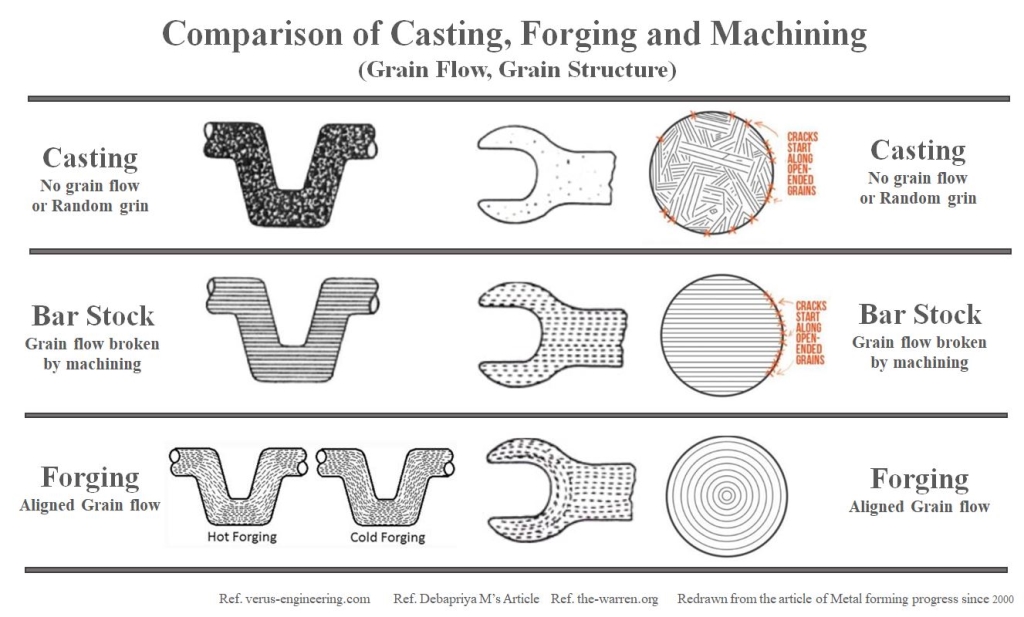
Sure various high stress suspension pieces are forged, but those aren't the ones being replaced by die cast assemblies.

I think that the casting technique mentioned in the article is primarily, or entirely, for non-structural parts that would otherwise be made of something akin to mild steel.
Having said that though, the sheet metal used in unibody construction is far more ductile than usually brittle castings. If they've developed new alloys making the large castings more ductile than previous castings, it might not be a problem.
This is just lunacy.
It's absolutely possible to locally damage a cast item in a manner in which a welded/bolted steel assembly would also be locally damaged. And the cast is going to be harder to repair.
Contrary to internet screeching welding the kind of cast alloys used on cars isn't really a big deal especially the aluminum ones (iron is harder). If the business case materializes I'm it will become common just like aluminum body repair.
There is nothing about it harder to guarantee than anything else in the autobody business. How do you know they're applying panel bonding adhesive properly? You don't.
One example of this is the hood. The previous generation had a beautiful clamshell hood that wrapped down around the sides. Opening the hood made the front end almost look like an open-wheel car. But it was expensive to make in one piece, and the entire piece had to be replaced if any part of it was damaged.
The C5 has a more conventional hood, with seams running along between the fenders and the hood panel. Not as pretty, but substantially cheaper to repair.
So, $900 for a headlight? We need to strengthen (or better align) the incentives for carmakers to reduce component costs.
The games all go away when the manufacturer sells the insurance, estimates how safe the driver is with data, and then handles the repairs.
Tesla understands this and sees it as a way to beat the competition on total operating cost for the customer.
That’s without getting into how much better USAA’s service is compared to Tesla.
And if you have other non-Tesla cars you probably will benefit from having them on the same policy.
Enjoy your cheap car insurance. :)
Expensive insurance will also kill cars, so insurance companies are definitely consulted stakeholders in vehicle manufacturing.
You can DIY it of course, but no BMW 760i owner is ever expected to do that.
Outside of warranty? Don't give a company 10 grand for 74 cents worth of plastic and chrome.
Not repairable by a minimum effort flat rate tech in the US...
There's probably some guy in Latvia that has a Youtube instructional on how to re-seal it or something. $9600 is a hell of a motive to figure out how to repair it.
Some of those attachments were not designed to be removed and performed again, so you're looking at removing and replacing otherwise okay parts and then probably realizing that some other piece is slightly out of alignment and can't safely be reused...
If you bend a a unibody casting, firstly there is a larger chance that it is non-critical since there is so much added mass and structure. It is not a series of dominos like in a composite.
Secondly, all the attachment points are cast into the part. Replacement of one large piece is a significant reduction in effort, and results in more confidence in the ultimate repair.
Just because the OEM didn't bother to figure it out doesn't mean nobody can. There's all sorts of trick specialty repair parts and procedures in the aftermarket autobody industry to fill the gaps the OEM couldn't be bothered to.
Have you taken a car in for repair recently? I agree that the reason is obvious - parts labour costs make it no longer make sense. Just a brake job nowadays costs a thousand dollars or more (depending on car model etc), i.e. 3% of a brand new vehicle purchase price. There's no anti-features causing this, it's just labour charges increasing.
For a 2024 Mercedes I don’t think I’m even allowed to know what’s wrong with it. Hardly anything in modern cars is user-serviceable. Can I replace the airbags? Change their timing or velocity? Alter parameters of the antilock brakes, or emissions control? No way, never. Many of those systems have to be replaced wholesale by people specially trained.
The same argument holds, and for similar reasons, with phones. Anyone with a screwdriver could service an old Bell phone. Today it’s almost impossible to take most of them apart at all without destroying them, and the majority of their function is completely invisible and untouchable anyway (software).
We’ve added a huge amount of technology not just to vehicles, but to the tools we use to maintain them. Of course labor will be more expensive as it gets more specialized. Of course parts will be more expensive as they get more capable and more complex.
The primary basis of your argument falls flat for me though. You don't need to repair new cars as much as you did 40 years ago. You never need to mess with your carburetor, spark plugs last a decade+, other stuff tends not to fail at nearly the rate it used to. My current car has 11 years and 250000 km on it, and I can count on one hand the number of times I've had to do any service aside from oil changes. (aside: why would I ever want to adjust airbag timing? And yes, if I somehow need to replace an airbag, I'll happily pay someone certified to do it. And if I buy a secondhand car, I'd really like to know that the person before me couldn't change airbag timing or velocity)
I do feel a sense of foreboding when it comes to choosing my next vehicle though. I want a BEV, but they all have so much electronic junk in that I fiind to be actively detrimental. I recently drove a friend's (2017) Toyota for a weekend, some ice built up on the sensor (in the badge on the front bumper). The following day, when roads were clear, it wouldn't let me use regular cruise control because the sensor was still iced over. A different toyota wouldn't let me cross the lane lines to avoid a pothole. They'll both slow me well below the speed limit on the highway based on the car ahead of me, with no notification. I would pay more for a car with these "features" removed.
I'd be curious what the long-term impact was, or whether Uber made all that irrelevant.
Is the expected material use and expected cost to the consumer more or less for repairable vs gigapress?
Also: paint. It's never one panel. They usually have to feather in the color on the adjacent panels because getting a perfect match is tough despite computers, etc. You need one panel painted, and you're pretty quickly looking at getting 3 or 4 painted (or at least attended to). Even discounting airbags, it doesn't take much to total out even a five to seven year old car these days.
So we took that and bought the totaled car back and still use it.
It's still an improvement.
It's a bit old fashioned, timing belts result in an engine that runs a little bit more quiet and they make for a lighter package. So it's easy to see why many manufacturers would choose that option. But MB got that bit right (they also got plenty wrong, their software for instance absolutely sucks).
My 2021 Mazda uses a timing chain. My 2004 BMW uses a timing chain. My old 1990 BMW had a chain. My folks' 2019 Lexus and 2016 Toyota both use chains.
Honda was a notorious holdout that still mostly used belts for a long time, but even they are coming around and some new models use chains now.
Mostly yes they are, which is wonderful compared to timing belts. It rubs my engineer brain intensely wrong to have such a critical engine component be designed as a wear item, especially when its failure can cause engine rebuild levels of damage.
However not all manufacturers' quality lives up to the intended design. VW/Audi have a spotty record with various well-known timing chain problems ranging from bad chain tensioners that fail and cause the chain to jump timing to plastic chain guides that break and wreak general havoc.
But for most cars a timing chain will last the life of the engine.
But it wasn't just a matter of the chain. All Saturns burned oil from the git-go, and as a bonus, a low oil level would cause the timing chain to lose lubrication, thus causing it to wear out. People who religiously topped off their oil, every time they re-fueled, kept their Saturns for a long time. I was not one of those people.
My next car was a Toyota, which I still drive. The Toyota engine is designed to make it easy to service the timing belt at the prescribed interval, and the car consumes no oil.
I'm definitely more careful with my newer cars.
My first car didn't burn oil, but dripped. I'd just top off the oil whenever I started hearing the tappets clicking. It was quite a forgiving engine, a 1975 Dodge.
  The main reason why MB lasts so long is due to a single component in the engine,
  they still use a chain rather than a timing belt. This one little change has so
  much impact on the rest of the engine design that they tend to last very long
  compared to cars that have timing belts.
Timing chain vs gear vs belt has little-to-no bearing on the longevity of an engine. You can, for instance, build an engine with a timing chain that's prone prone to catastrophic failure of the timing components. Mercedes has done it twice so far with the M116 and the M272/M273.
  Suddenly a whole pile of stuff is happening inside the engine enclosure
  instead of outside of it reducing the number of seals and in general reducing
  complexity outside of the engine core. It also reduces the need for complex
  service.
Meanwhile people put hundreds of thousands of miles on Volvo's old four cylinder with a… timing belt which takes all of thirty minutes to replace.
Chains vs gears vs belts has no bearing on longevity. The big difference is that chains are smaller and when you need to work on a chain it's generally far, far more complex than a belt drive. Don't forget that engines like the Ecotec, EcoBoost, M272, N20, and 2.0T are basically the bread and butter of those companies. They are high volume mass market engines.
Mercedes tend to last a long time because they're expensive, people pay to repair and maintain them, and nearly any Mercedes part for any Mercedes car can still be purchased new.
As for repair and maintenance: that's a nice bit of circular reasoning, the reason those parts can still be bought new is because there is still demand for them: the cars are still running.
When you start looking for cars that are 15 years and older (which is my bracket in NL) there really are only two brands that stand out: Volvo and MB. The rest are lucky accidents and this is reflected in the state of the rest of the cars as well. But as a rule car engines will fail well before the body does and with MB (and Volvo) it tends to be the other way around.
I can’t quickly find the numbers, but I know that car repair costs are going up and repair rates are going down, and have been for decades. The reason is obvious: the benefits of a modern car come at a cost. E.g., cars are much safer now, partly thanks to airbags; those are expensive to replace. My car has 11 airbags, and if they all popped off at once that alone would probably total it.
Years ago I was in a collision which bent that frame of my car. That’s usually game-ending, but this car has a modular frame, so they just bolted on a new frame component. Now, Mercedes have always (until lately, perhaps) been known as highly-repairable; it’s one reason they last so long.
So it’s good that the right-to-repair movement is getting traction. We’re going to need to point it at cars soon, and for mechanical reasons.