So energy to mine the materials, energy to assemble the battery, energy to recycle the battery after it's useful lifespan (5-10 years)... None of these are ever counted in people's calculations. I tried to find data on energy required to produce the batteries and they still didn't count the mining cost.
I'd wager that hydrogen is more energy efficient over the entire lifespan of a vehicle.
5 billion tons of coal gets mostly burned up.
Meanwhile 50 THOUSAND tons of lithium is produced per year. For which maybe millions tons of waste gets created.
Hmmm, 500,000 litres of water per ton of lithium. Electrolysis required to create lithium metal. Plus the required dirt being moved, water being moved, energy for electrolysis, etc...
Sounds very energy efficient...
/s
But still, that 5 billion tons of coal gets mined, transported and then burned to produce energy once.
A kg of coal contains about 8kWh of energy which it can release once. This is the best kind of coal. Also you only get about 40% of it as electricity.
A kg of lithium will store about 1.1kWh energy in a battery .. thousands of times before it needs to be RECYCLED.
Your efficiency is off by many orders of magnitude.
Coal production is terrible and I'll never support it.
So why are you attributing the coal mining waste to lithium then?
If you actually look at the numbers the benefits of mining for lithium FAR outweigh its downsides.
Coal is an existing form of energy reserve which has stable long-term storage and can be consumed once. Batteries are not native energy, though batteries can be manufactured and then charged to temporarily time-shift energy.
But important distinction nonetheless.
Sometimes the media conflates energy production, storage, and transport. This leads to confusing arguments.
This is a standard component of LCA databases and puts the ESOI in the 50-100 range for the first generation of batteries. Subsequent generations are higher.
Electrolysers also require mining, as do fuel cells, as does any source of heat for reverse gas shift or similar.
Your fud about rare earths is also a lie for any chemistry proposed for grid storage. None of them involve rare earths in any measurable quantity (nanoscale films on semiconductors for controllers and such are insignificant)
Hydrogen (or rather hydrogen derived molecules) are a viable method of seasonal storage, but that doesn't mean most of the hype doesn't exist to greenwash gas or that your talking points aren't propaganda.
Hydrogen cars are worse than BEVs and much worse than transit or active transport.
Yes that's the number I found WITHOUT accounting for mining the materials... Just manufacturing the battery.
> Electrolysers also require mining, as do fuel cells, as does any source of heat for reverse gas shift or similar.
Yes but there's far less of those materials required than the sheer amount of battery cells being produced for automobiles.
> Hydrogen (or rather hydrogen derived molecules) are a viable method of seasonal storage, but that doesn't mean most of the hype doesn't exist to greenwash gas or that your talking points aren't propaganda.
Greenwash gas? The whole point of hydrogen is to create it using renewable sources of energy... The whole problem with renewables is storing the energy since they don't produce reliable baseline energy. Hydrogen accomplishes that.
Are you sure you are reading the study right 'manufacturing' in standard LCA methodology also includes embodied enery/carbon of the ingredients?
You can also fermi analyse it. The absolute cheapest form of energy is lignite burnt at the mine front which is about $5/MWh. Before shortage induced price hikes, the 100 or so grams of lithium in a 1kWh battery was worth $1-2. The battery can store around 5MWh in its lifetime. This puts a fairly hard upper bound of 4-8% of the cycled energy. Phosphorus and iron are less scarce, copper might be significant. Any cost that isn't the cheapest possible energy pushes the lower bound down.
Green hydrogen is fine in niches where it's suited, but most of the hydrogen-for-everything schemes rely heavily on fossil fuel derived hydrogen whenyou look under the hood and ignore the amount of methane, CO2, and H2 that will escape at various stages. H2 is not a greenhouse gas on its own, but it makes methane much worse.
> Yes but there's far less of those materials required than the sheer amount of battery cells being produced for automobiles.
And if you look at the quantities required to replace the role of BEVs rather than as an adjunct, it's worse.
Recycling li-ion is currently a booming business because it requires much less energy than processing raw ores - see Redwood Materials for more info.
Everyone takes these calculations into account because batteries come under intense scrutiny from people with ulterior motives.
https://elements.visualcapitalist.com/wp-content/uploads/202...
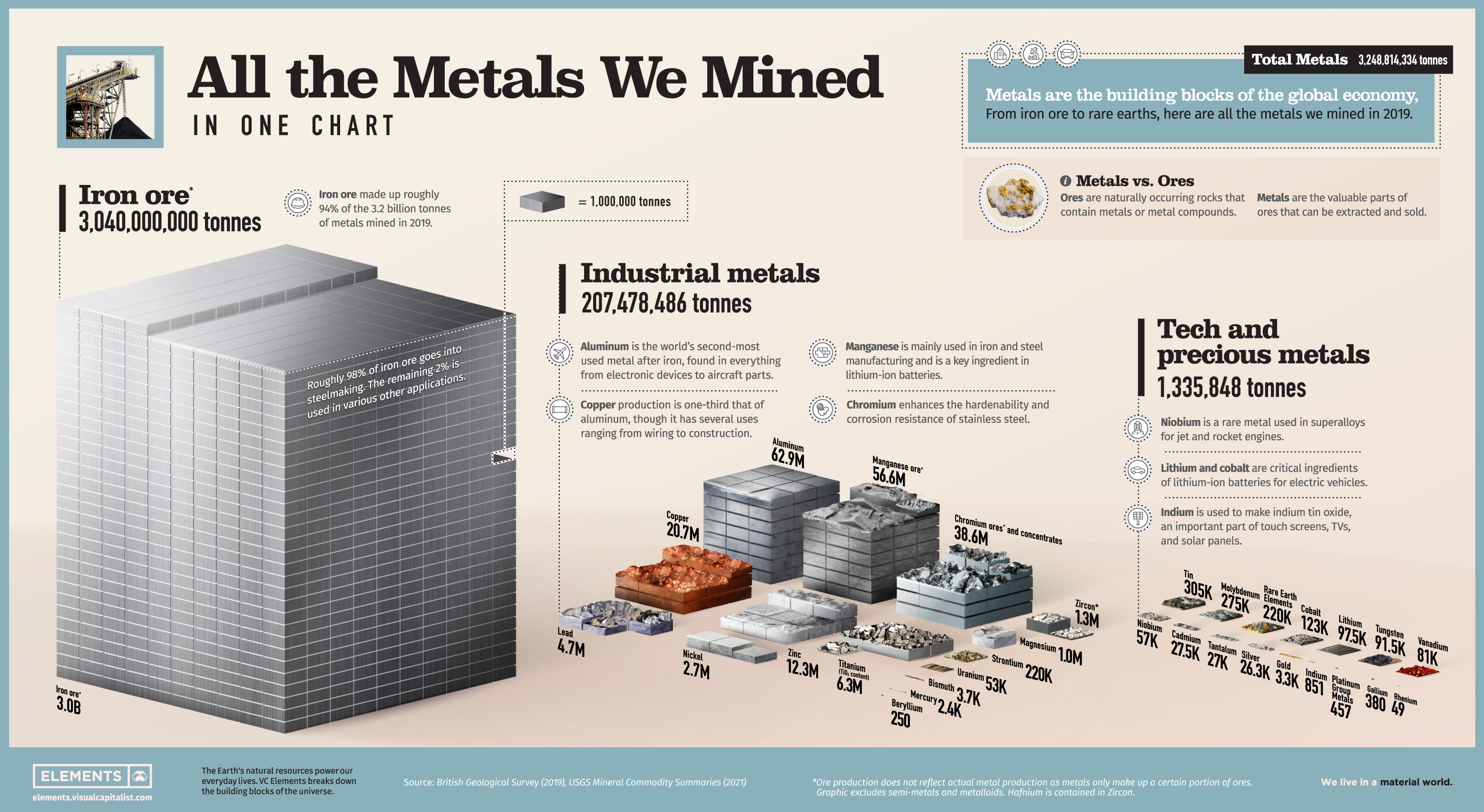
Electric cars use lithium, just now, and a bit of rare-earths. (They are used in wiper and window motors.) Cars are their own thing, which we would be better off with less of.
Obviously before you have built out wind and solar, you don't have much yet. It is a vacuous observation. Instead, look at the rate of deployment, which follows a classic exponential curve.
That question needs to be qualified with a date and time. It's a moving target. Generally: number go up.
Is this different in some way from natural gas? Why can't we use the existing storage and distribution infrastructure for natural gas for handling hydrogen?
Halt! Propose a working alternative first, we'll talk about banning later.
Now: we need to get away from solutions that involve pressurised gas being piped or transported around the world. =)
https://en.wikipedia.org/wiki/Corona_discharge
"[...] Corona discharge from high voltage electric power transmission lines constitutes an economically significant waste of energy for utilities."
https://en.wikipedia.org/wiki/Overhead_power_line
"Transmission higher than 132 kV poses the problem of corona discharge, which causes significant power loss and interference with communication circuits. [...]"
It might be unexpected and surprising, but yes, electricity does leak from cables!
Less energy dense, but not less efficient
They are solutions which will soak up massive amounts of capital for years-decades before they will start paying off. They also know that if they don't market themselves as "the one true solution that solves all" they might not get the capital required to build out their vision. So they HAVE TO oversell it to cover all use cases where they could possibly be applicable and try to get money flowing into alternatives for themselves, otherwise they would not be feasible.
So this is at least one of the reasons for hydrogen problems. They try to create FUD about BEV so they can say hydrogen is better. Meanwhile fossil companies are like really happy about this:
- slows BEV adoption
- while alternatives are not there sell their own stuff
- hydrogen is also massive molecule shipping infra so they will bid for those projects
People who actually look into hydrogen will find lots of issues with the marketing:
- "green" hydrogen is nowhere to be seen in quantities
- real world round-trip efficiency comparable to ICE engines
- which leads to massive need to overbuild green electricity generation (== 2-4x bigger NIMBY/capital problems for nuclear/wind)
So the immediately deploy-able solutions of batteries and PV-solar that have no scale threshold are making their projects riskier.
In essence both nuclear and hydro require governmental funding to get started. So the same sales pitch is now also on political level. Lobbyists etc doing their dark FUD spewing things.
Bottom line of building out hydrogen from governmental monies means that the projects which absolutely have to use hydrogen to be green (steel and some other industrial processes, maybe flying too) will be cheaper because it has been subsidized by nations by having bought into other stuff which will not be used in scale because other market technologies are so much better for those use cases.
For example: I have a BEV and the range is good for me, home charging is 10-100x cheaper than hydrogen, I don't need to go to a hydrogen station etc.
Every single actor is pushing for their own interests and highlighting the flaws of the competitors. You cannot say in good faith that hydrogen, nuclear or fuel are supporting the "renewable energy gang", or that they are not a gang themselves. In fact, my opinions is that nuclear gang was so against renewables that they missed the bus of "renewables + nuclear" friendly mix, letting the gas gang conquest "renewables + gas".
Maybe it's the optimum (I'm not convinced). But to narrow down on one approach that doesn't even quite work seems premature.
If you wanted to just throw money at the problem, I'd just throw it at nuclear - reliable, carbon free, well tested and doesn't need much storage. But hey I guess that's the wrong answer to some.
My background, FWIW, is also not energy, so I'm just happy to see the research net cast wide and well funded throughout.
And most global warming activists aren't climate scientists.
Meanwhile the military industrial complex, who DGAF about the environment but very much want lavish taxpayer subsidies for a well oiled nuclear supply chain, is shouting down solar, wind and storage - largely because it competes for subsidies and its low cost renders it a no brainer alternative.
They are louder, richer, more persuasive (cynically leveraging environmental messaging) and considerably more powerful than people who care more for the environment than military supply chains.
> which solutions are really helpful in reducing CO2.
There, you have already decided that lowering the amount of CO2 should be our concern, but should it?
I say: let's collect facts and count numbers and compare which solutions are really helpful in enhancing the quality of our life.
The physical properties and limitations of hydrogen are well-known. Many people repeat them in other posts in this thread.
Here's a very factual explanation of why hydrogen internal combustion engines won't work: https://www.youtube.com/watch?v=vJjKwSF9gT8
(In summary, you can't compress hydrogen enough to fit in a reasonably-sized tank. The energy that it takes to compress hydrogen will be expensive.)
He told us there were extremely high efficiency hydrogen systems at the time. But they all suffered from similar problems:
- Hydrogen is highly flammable (or explosive) in an oxygen atmosphere.
- Hydrogen has truly awful power storage density—unless you compress it to a couple of hundred atmospheres pressure.
Nobody wants to store potentially explosive fuel at 200+ atmospheres. I'm not aware of current hydrogen technology at all, but that's a fundamental physics challenge that needs to be addressed somehow. And it needs to be addressed in a cost-effective way at each step of the distribution chain.
The problem with high density energy storage is that you're putting a huge amount of energy in a tiny space. Gasoline is flamable, lithium-ion batteries are notorious for ugly fires, and even flywheels can fail catastrophically. A good power storage system needs to manage this risk somehow.
(There was some really interesting work being done with carbon-fiber flywheels and maglev bearings in a vacuum about 20 years ago. Apparently that had decent power density, and it could charge off electric charging infrastructure. But car insurance companies weren't convinced it was safe. Which would also be a problem for hydrogen.)
It seems to me Japan is going all in on their new high-temperature gas-cooled reactor (which supposedly cant melt down)it transports the heat with helium in stead of water which allows for temperatures that allow for hydrogen production.
Just repeating what I read and hear online. This isn't an endorsement and I have no idea if it lives up to the hype. If it does it would be quite the game changer.
For example, the main ingredient in gasoline is C8H18. It has good energy density at atmospheric pressure, and the fire risks are manageable. We already use carbon/hydrogen systems today!
I think one of the candidates for metal hydride fuel cells is MgH2? It apparently also has decent energy density. Of course, magnesium poses some risks of its own. And I personally have no idea what a complete supply chain and refueling system would look like, or what it would cost.
Still, I fully expect that any portable energy storage is going to come with tradeoffs: cost, pollution, rare materials, and always the risk of catastrophic discharge (via fire, explosion, or messy kinetic failures). We should pursue multiple alternatives and invest in basic science, because portable energy is incredibly useful.
That screams regulation waiting to happen. like, have a lever or something on there. there is no more obvious or easily accessible place to flee a vehicle than the door.
also, which "some". is this just another tesla quirk?
The backups unlock the doors "no questions asked", so to speak, which includes possibly damaging the windows (because they don't get lowered out of their seals). For the front doors they are so intuitively placed that pretty much all of my first-time passengers have already used them before I can tell them to press the button instead.
Models other than 3 also have mechanical releases for the rear doors, apparently, but using those involves removing floor mats (according to the owner's manuals, no personal experience).
[1]: https://www.tesla.com/ownersmanual/model3/en_us/GUID-7A32EC0...
The problem with H2, ammonia, biofuels and other synthetic fuels is not that they have some limitations, it's that they are not accepted by the green energy dogma. Some green energy activists would like to see the gas stations go away, for example, and that is not going to happen if you keep needing to go somewhere to re-fuel, with any fuel.
If you're using hydrogen to smelt steel or make ammonia fertilizer, then there's no energy loss. The article aptly refers to these as "no regrets" uses.
Gas stations (ie ground vehicles) are a losing battle. BEVs will eat the sector. They're simply so much less expensive: for the vehicles themselves, for the infrastructure, and then of course for the wasteful energy use in operation.
The current process needs 55kWh of electricity to produce 15kWh of electricity on the other end. Not very efficient at all.
Talking about efficiency is a losing battle, people don't care about that, they care about total cost, safety and convenience.
Without subsidies it is ICE that would go away overnight on two of those three factors and then the third shortly after the market catches up to the overnight shift. EVs already have lower total cost and higher safety (than carrying around a tank of explosives and actively igniting those explosives during travel). ICE looks more convenient with current refueling infrastructure, but if ICE subsidies disappeared and demand plummeted we'd see how fast ICE range anxiety returns when companies quickly en masse decide to not sell such a low margin loss leader. (I do mean "returns", we know from history that ICE vehicles were the original range anxiety and EVs were the reliably ranged household cars until enough gas stations existed. AAA was in part founded because of ICE range anxiety.)
(H2 cannot compete with EVs on any of these three. Total cost is higher. H2 tanks can dangerously explode, even if fuel cells are not themselves at least using a burning process like ICE. H2 refuelling seems convenient if you discount the fact that there's no general, ubiquitous H2 refuelling infrastructure and likely never will be, especially with how badly H2 leaks in all attempts at long distance shipping and long term storage.)
Looking at efficiency alone is not enough.
> They're simply so much less expensive
Not yet they aren't. The upfront cost of an EV still makes it more expensive than an ICE vehicle. Also, they batteries are guaranteed to degrade, so the used market has very bad prices for EVs. At some point, they will probably be less expensive for most automobiles, but hydrogen can still play a part in trucking, trains, planes, boats and specialty operations.
Only about 64% of oil is used for transportation [1] and out of that, only about 50% for automobiles and light trucks [2] (even though for light trucks, motorcycles and other applications, EVs are not going to win probably). So BEVs could replace about 30% of all oil usage. The rest of 70% is up for grabs, so why not pursue hydrogen investment as a possible alternative?
https://www.eia.gov/energyexplained/oil-and-petroleum-produc...
https://www.eia.gov/energyexplained/use-of-energy/transporta...
The (relevant) comparison was H2 versus BEVs — ie comparing decarbonized solutions apples-to-apples. I have edited to make that more clear.
> why not pursue hydrogen investment as a possible alternative?
Because hydrogen, for all its marketing, doesn't actually solve the problems people have with BEVs. Better BEVs do.
I guess it depends on the definition of "people". If you mean private automobile owners, then I agree that batteries will eat hydrogen's lunch. For everything else(70% of oil use), it's an open question. In the future, you might even see a migration of H2 technology from large applications to small automobiles, like we've seen with diesel engines.
I'm just following your lead. You were the one who brought up "gas stations."
>For everything else(70% of oil use), it's an open question
Not really. Road use is ~50% .[1] It's all going BEV, like it or not.
Agriculture is another 10%. Ditto.
The technology improvement curves speak for themselves. ICE and H2 have both plateaued near their theoretical limits.
I intentionally said "ground vehicles," not private cars.
[1] https://www.statista.com/statistics/307194/top-oil-consuming...
If battery densities end up meeting the needs of airplanes they meet the needs of ships easily enough. Plus, there's interesting new research on wind power for ships, which I find is a lovely irony to see ships return to wind power after all these years (though it may look quite different than the classic age of sail with primary propulsion still being electric turboprops).
Still, either a vehicle is more or less drives continuously or batteries will be the better alternative. But that is only for that sector.
Recycling of batteries is very efficient at >95%[1], and will only get better with time.
As for addressing only one sector, welcome to the world of high-complexity problems. Climate change is a "1000 cuts" type, not a "magic bullet" type.
[1] https://techcrunch.com/2021/09/14/jb-straubels-redwood-mater...
Exactly, and I wish I understood why people thought this was a smart point.
EVs are a link in the chain that in and of themselves have no fundamental energy dependence on fossil fuels. They have an incidental reliance on fossil fuels to the extent that electricity is generated from fossil fuels. But they're a piece of the infrastructure puzzle that in and of themselves is fully solved and compatible with decarbonized infrastructure. I would like to think that one goal in advancing public understanding of EVS should be educating people to the point that this particular talking point never gets used ever again.
In general I would say I actually agree with this. It can be perfectly feasible to use an energy source that's terribly inefficient in some intuitive sense, but as long as it's economical to do so, poses no environmental harm, and you're getting significantly more energy out than you're putting in, you can be as inefficient as you want.
Now that said, I don't think that this kind of general truism is terribly responsive in this particular case, because it's nevertheless going to be true that inefficiency, and whatever sense you construe it, can indeed be a deal breaker and I think that's what GP is intending to communicate with respect to h2, biofuels, etc.
Fossil fuel comes out of the ground with the energy already in it, hydrogen doesn't exist in a free form and the energy must be put into it coming from somewhere else.
Most hydrogen now comes from natural gas at maybe 75-80% efficiency through reforming, then it must be compressed, then it must be burned at similar efficiencies to fossil fuel or used in a fuel cell with slightly better efficiency than ICE.
It's way worse in efficiency than fossil fuels, you could just use the natural gas directly in a combustion engine and be way ahead. Solar/wind/nuclear to electrolysis is even worse, just charge a battery.
Hydrogen is a energy storage mechanism like a battery not a source of energy like fossil fuel.
Look at well to wheel efficiency BEV are far ahead of hydrogen.
PS: Please don't post some Bloomberg article about this. They are wrong and did not correctly reference the state of battery technology back in 2010.
Why would long-term storage matter if wind and solar can produce so much energy that we cannot feasibly consume it all? What other long-term energy storage plans are there right now?
I would not write off fuel stations just yet. There may well be a future where some renewable fuel powers vehicles.
No.
You're thinking of "too cheap to meter," which never came to pass, and (as it turns out) was just a marketing line.
>What other long-term energy storage plans are there right now?
https://news.ycombinator.com/item?id=34429623
There was a great article a few days ago about "factories as batteries" (pointing out that aluminum smelting is uneconomic but hydrogen works) but sadly I can't find it.
Energy to plants to biofuels throws away nearly all the energy. More than all of it, by some accountings.
What are the alternatives for those use cases in which batteries are infeasible?
There's also battery systems outside of Lithium Ion formulations which have other use cases. Thermal batteries are an interesting alternative in some use cases, particularly where fast access to heat in addition to electricy is handy (such as in collaboration with building HVAC and water heaters).
But also in general as we keep finding new density scales in the Lithium Ion formulations (and as we have hope to potentially discover even more formulations beside that) the number of use cases where batteries are infeasible keeps shrinking.
The alternatives are mostly
* better batteries
* heat pumps to replace oil burners
* methane or ammonia for the remaining uses (eg trans-oceanic); globally shipping and aviation together account for only 8% of petroleum use
With a universal carbon tax everything would automatically self-organize into the most efficient solution, but of course we can't do that.
Seems like lack of imagination, nothing more.
- First hydrogen fuel cell: 1842
- Earliest li-ion battery: 1965~
You've had a 100 year head start, and yet hydrogen fuel cell cars are terrible. Hydrogen planes? Some prototypes are being worked on.
I can go buy an entire car with a massive li-ion battery in it right now. I can get batteries to power my house during an outage.
Hydrogen? "There are some unresolved issues"
"Why is everyone so hostile to hydrogen" Like, release a product already. Everyone is moving forward on green energy, no one wants to wait another hundred years for you to work out your "unresolved issues".
I'm glad research is funded, because you literally never know where the breakthrough will come. Solar was painfully expensive for most of its history, now it's super-cheap.
As far as I'm concerned, a battery+wind+solar grid is just as much vapourware with serious barriers to success. I'm glad they are worked on though...
EDIT: for example, I'm quite excited about gravitation nal storage in disused mines (coal ones often, in fact). By the same token, should that be sacrificed on the altar of batteries? Or actually pursued, possibly to a happy end?
It is true that these organizations can do great research. For instance, they knew all about global warming in the 70s.
Funding electrolysers is fine.
Credulously accepting 1 electrolyser as a justification for 10 fossil fuel hydrogen reformers is not.
Accepting hydrogen busses and trucks as green before they actually run on green hydrogen is not.
Letting fossil fuel hydrogen steal funding from renewable projects is not.
There is a lot of seabed.
You say hydrogen works better than li-ion grid scale storage.. but there are more batteries being used for that than hydrogen today. Hydrogen demonstration systems are 20-45% efficient, meaning it's hard to compete on price (assuming the issues are worked out). The other type uses massive salt caverns for storage, and those are limited by the number of suitable sites.. just like pumped hydro.. so they'll always be niche applications.
It's not some conspiracy. Utility companies buy energy storage systems based on cost/efficiency. Hydrogen systems aren't in that mix today because they aren't efficient enough or because they have some issue that prevents them being put into products. That's it. There's the whole problem. Hydrogen hasnt passed that minimal bar required to make a real utility scale energy storage product.
Li-ion may or may not be (one of) the solutions for most grid scale storage.. but until hydrogen comes way down on cost and more issues are resolved, it's not going to be the answer at all. All of this "hydrogen is better for X" is currently a fantasy based on lab promises.
Battery capacity scales linearly (n) to material requirements , while a gas tank's capacity scales quadrically to material requirements (n^2, because of only using a surface of materials to store a volume).
I'd also assume the energy required to keep the tank cold relatively lower as the tanks gets larger.
This is still a problem we'll have to face. Road tear and wear grows exponentially with weight, and tire pollution (both noise and particles) is also nothing to be disregarded.
Also batteries require all sorts of raw materials with problematic provenance (e.g. lithium mines destroy the nearby environment, cobalt comes from child labour in terrible conditions, etc.). Cars with batteries are better than cars with internal combustion engines, but still expensive, inefficient, polluting and wasteful as the main means of transportation of every human being on the planet.
Road wear actually grows with the 4th power of weight, not the weight in the exponent, but that is a really bad argument regardless because trucks exist.
I thought something like 90%+ of road wear and tear was due to tractor trailers, dump trucks, and other massive vehicles. Meanwhile cars were a rounding error. Do EVs change that?
It might not be incredibly fast or even useful it does show we don't need to put the engine on the vehicle (entirely)
I just imagined a hilarious contraption using slow moving water in a canal. A screw is inserted in the stream driven by a wheel on the road. As long as the speed at which the road moves is different from the speed of the water you can keep extracting more speed from the flow. (haha)
I mean the whole cathode / electrolyte / anode idea hasn't changed much, we just found better materials for all three.
> - Earliest li-ion battery: 1965~
You just limit to lithium-ion to mislead. Battery vehicles predate all of that:
> The invention of the first model electric vehicle is attributed to various people.[7] In 1828, the Hungarian priest and physicist Ányos Jedlik invented an early type of electric motor, and created a small model car powered by his new motor. Between 1832 and 1839, Scottish inventor Robert Anderson also invented a crude electric carriage.[8] In 1835, Professor Sibrandus Stratingh of Groningen, the Netherlands and his assistant Christopher Becker from Germany also created a small-scale electric car, powered by non-rechargeable primary cells.[9]
-- https://en.wikipedia.org/wiki/History_of_the_electric_vehicl...
> There is a “common understanding worldwide that hydrogen should be limited to applications where it would be difficult to achieve decarbonisation with other methods”, says the report by the Tokyo-based non-profit think-tank Renewable Energy Institute (REI), but Japan has instead laid out a vision of a “hydrogen society where hydrogen is used in every sector”, while promoting and subsidising the use of highly polluting grey H2.
The "save the planet" bunch are unsurprisingly not fans of plans that don't "save the planet".
edit to add: batteries are now at the point where a new pumped hydro scheme from scratch (i.e. no pre-existing dam) would be challenged to be a viable business case versus spending the same amount on renewables and batteries, even if you have a suitable geographic site for the water.
While not 100% a flat faced lie, this is intentionally misleading.
All energy production is heavily subsidised by the state, but of all methods of producing electricity as of Jan 23 2022, renewables are the cheapest.
Issues with storage, human rights, environmental impact, are a mixture of lies and red herring. How many human / environmental tragedies resulted from fossil fuel extraction?
People against battery storage don't actually care about that but they know that you do. "The card says moops"
That's not an honest assessment, because the major renewables are either geographically limited, or their production fluctuates heavily. To compare them against fossil or nuclear, we'd need to factor in the cost of the buffers, which completely changes the equation. If buffers + renewables were still cheaper, everybody would already be doing that and nothing else. People whose beliefs are challenged in this way tend to resort to conspiracy theories surrounding the fossil fuel lobby (disregarding the fact that renewables have a big lobby too).
> How many human / environmental tragedies resulted from fossil fuel extraction?
My point is purely economical.
> People against battery storage don't actually care about that but they know that you do.
I'm not against battery storage, but simple back of the envelope calculations show that production capacity is orders of magnitude away from solving just part of the problem (stabilizing the grid). Moreover, batteries do not last forever. It may well be the case that a combination of natural gas and renewables is the most effective option even from an CO2 perspective, especially if we have a way to turn surplus energy into negative CO2. Hydrogen happens to fit into that scheme, because natural gas plants can easily be converted to hydrogen plants. Then again, maybe there's a breakthrough in battery technology instead. You can't predict these things, it's therefore unwise to dismiss alternatives that don't check all the boxes of solarpunk fiction.
> The report outlines three key areas where the government’s strategy is severely flawed:
1) The selection of low-priority applications;
2) Prioritisation of fossil-fuel-based grey and blue hydrogen; and
3) The lack of focus on domestic green hydrogen production, leaving Japan lagging behind other nations.
If you could say a little more about this, I'd appreciate it. Sanyo (Panasonic) and Murata Manufacturing (Sony) still produce top quality Li-ion cells, among the best there are, and the best NiMH cells in the world are still made only by FDK Corporation.
Conveniently, a hydrogen fuel cell in a car replicates almost of that. The fuel cell is a hot, complex finicky source of power that needs maintenance and sophisticated manufacturing to create. Storing the hydrogen itself is very tricky as it tends to eat metals. It still needs normal brakes.
You can see why the CEO's of Japanese car makers could allow themselves to be deluded about how much better fuel cell technology is than EV tech. EV tech is just a battery, an electric motor and regenerating braking. This is technology from a hundred years ago and needs very little regular maintenance other than tires, a wall socket and wiper fluid.
"No maintainence" EV cars are just platforms for subscriptions.
Hydrogen vs battery isn't about farming dollars and cents, that can be done other ways.
I have not looked too deeply into Hydrogen myself, but even this [0] fairly critical post classes longterm storage as a B (scale A: very good, G: absurd). Even though there is other alternatives that are mentioned.
[0] https://www.linkedin.com/pulse/clean-hydrogen-ladder-v40-mic...
Tropical solar farms synthesizing ammonia for export to high latitudes will be.
For example, renewables right now rely heavily on quick-to-dispatch gas plants - and that's fine as a stepping stone to a carbon-free future. Though the plan fo eliminating it is still vapourware - maybe better batteries, maybe larger grids, maybe something else.
But creating a hydrogen economy that somewhat relies on fossil fuels, with a clear pathway to eliminating the fossil fuel component? Anathema!
I have nothing at all against renewables and batteries, it sounds neat but remains incomplete here and now. But until it's clear it can replace all our uses of energy, I remain baffled by people who would like to shoot down any potential different path to that same goal.
1. That particular approaches don't work is irrelevant. TFA focuses on a particular Japanese policy, which may or may not be misguided. The article is light on discussion, but let's take it at face value. Should we say wind+solar is stupid because Germany is currently in an energy mess? I don't think so.
2. I don't think it's dumb at all to experiment with various synthetic fuels via fossil fuels initially. With both hydrogen and battery storage, the real devil is in the details, in particular in seasonal storage. If we can make battery, or hydrogen, or ammonia economies work, then we know how to produce things, and thanks to cheap intermittent renewables we can do it. Frankly, efficiency hardly matters at this point. If, as predicted by renewables evangelists, energy will be almost free soon, storage efficiency matters not. All that will matter is long term storage cost, an open question for any approach.
3. Regardless, my comment is aimed mostly at other comments. "Duh everyone knows batteries are better", "hydrogen is a dead end".
The part of my comment you tacitly ignored is that burning fossil fuels is somehow ok en route to renewables+batteries without a viable concrete plans on how to decarbonize fully, but not for other synthetic fuels such as hydrogen.
> For the past two years, FH2R has consistently been ranked as one of the world’s largest projects of its kind. According to project participants, FH2R uses a 20-MW solar PV array built on a 180,000-square-meter site along with grid electricity to power a single-stack 10-MW-class electrolyzer. Its developers say it can produce, store, and supply up to 1,200 Nm 3 /hr of hydrogen at rated power operation.
This is a "its not completely there yet but this is where its trying to go."
This has always been a pain point for me. If you feel the world is facing an existential crisis (and I do), then it seems weird to go down the list of possible ways of avoiding utter catastrophe like you're at a sushi bar:
Solar: Ah, yeah.
Wind: Of course.
Nuclear power: Nope.
Geo Engineering: Hell, no.
I don't know how you can believe that we are facing millions, if not billions, of deaths and the possible collapse of civilization and then "tone police" the solutions.
Nukes and geothermal simply cost more than solar and wind: nukes, many, many times more. Spending a billion dollars gets you N GW of solar or wind, and N/M, M>>1, of others. Generally, if you need a steam turbine to keep working, you will trail behind anything with zero opex.
Hydrogen has a plausible place in long-term underground storage, in steel refining and other manufacturing processes, and (as LH2) in the future direction of aviation. It might have other roles, such as an intermediate form when using ammonia. Trying to force it where it is a bad fit adds noise.
It's the time cost. Nuclear takes far too long; geothermal merely takes too long. Same with fancy long-distance HV transmission proposals.
Can it be built and commissioned in a year? Do it.
And yet nuclear is the only tech that has proven to decarbonize a major industrial economy within just a few decades. But of course it takes to long.
When in reality it has not been proven that anybody has ever used solar and wind to de-carbonize a major economy. But somehow everybody knows that it is 'fast'.
Germany could have literally gone to 100% nuclear within the last 20 years and it would likely have cost them 250 billion $ or less. Reliable energy for 100 years. Almost no cost for the grid because you can just build nuclear plants next to coal plants.
> Can it be built and commissioned in a year? Do it.
What is this obsession with short term thinking? When you build major long term infrastructure like trains tunnels, you simply don't do it in a year.
If France could do something in the 70/80s, finishing nuclear reactors multiple reactors every year. Germany could have done the same and they would be done by now.
Ironically because the French were so blessed with so many reactors, they were one of the few nations that didn't use their reactors very well. The Germans were actually better at using their reactors.
The French since the 90s are just as anti-nuclear as everybody else and they have done everything to destroy the amazing fleet they have, and only now realize how incredibly fucking stupid that was. They even forced the utility to collect money from the nuclear fleet and invest in solar. And they forced the utility to sell of nuclear base load at bargain bin prices and then force them to buy that power back at high prices.
And its amazing how anti-nuclear people can look down on France when literally every day they produce green cheap energy for all their people. And they have been saving CO2 for 40+ years, and that is worth more then any CO2 we are saving now.
Almost every other country should envy the French position.
Nuclear is providing cheap long term stable power supply and if they stop forcing their nuclear fleet to support solar and fossil (literally things the French government forced them to do) and do proper maintenance French will have cheap carbon free energy for the next 50+ years.
Funny how nuclear is so expensive and yet somehow people in France and places that nuclear reactors have mostly cheap power while Germany is spending absurd money prevent their population from feeling an even worse hurt from the policy they have inflicted on them.
In total the Germany population over the 50 years has paid way more for energy and getting way worse outcomes. That's a simple fact.
Just the cost for the measure Germany has to take now to buffer from this whole Russia fuckup would have been enough to pay for a whole fleet of nuclear reactors for Germany. Instead they are gone spend another 15+ years using coal and gas and then have to manage an incredibly unstable complex grid while having to replace all those wind plants they put up in the next 20-30 years.
And the French reactors will still be running and still provide stable carbon free power for a low price.
"It can be cheap! All you need is free loans, a liability cap less than the cost of one reactor, money from the military, exemption from any democratic process as to where they go, underfunding decomissioning, cheaping out on materials, never doing maintenance, charging more than the claimed cost, operating at a massive loss, creating a debt you foist on the public, build up billions of unpaid maintenance costs, and then not selling it for cheap! Oh, and you still need to overprovision and build backup."
Also it didn't decarbonize france's economy. It partially decarbonized its electricity, this is well under half of the goal. Numerous countries have achieved more with wind and hydro, and the list of countries with higher VRE percent than france's nuclear is growing longer by the month.
Literally no country uses renwales to produce transport fuel.
France decarbonized electricity and has a very high rate of electricity heating in homes. So they are ahead there to and they did that on the back of the nuclear fleet.
> Numerous countries have achieved more with wind and hydro
And even more country have achieved more with hydro and nuclear, such as Sweden or Switzerland.
So didn't decarbonize its economy then. And sweden prodices about as much wind as nuclear.
They only cost more because of "environmentalists" fighting both new reactors, fuel element transport and waste storage tooth and nail in a way they don't fight coal ash ponds or heavy metal tailing lakes...
(The average lifecycle cost of nuclear power at scale in France - where plants were built before anti-nuclear hysteria - is about 7 cents per kWh, same-ish as the cost of solar or wind fleet, and with fewer intermittency problems. Solar might be cheaper in Hawaii and California, but most places are not blessed with 3,000 hours of sunshine a year.)
Please do not try to resurrect old falsehoods.
We can’t plan our grids or judge the costs according to not just best, but even average scenarios. We have to plan once-in-decades anomalies, the long tail. Non-dispatchable energy sources get exponentially more expensive once you start doing that.
In the future we will need to build out storage. Before there is enough renewable generation to charge storage, building it would be foolish. After, we will need storage, and build it.
If the storage will need to be built out, then your argument about costs is disingenuous in the world without fossils, because those costs are currently masked by fossil generation.
Need for fossil generation backing will decline naturally as storage is built out, but will take a long time to go to zero. Pretending otherwise makes bad policy. Building storage without renewable capacity to charge it from would be stupid because charging storage by fossil fuel burning would be monumentally stupid.
You don't need as much storage if you have nuclear and you can't compare the two without accounting for (potentially weeks or months of) storage. "Building out storage" is not an unavoidable expense that just happens automatically, it's a requirement to have a reliable greed that is mostly based on non-dispatchable renewables, and thus a part of their cost.
Seeing how you outright ignore this point, I suspect you are arguing in bad faith.
Good day, sir.
It's also factually false.
* UK approving Sizewell C for £20bn https://www.ft.com/content/11ca7193-f7d8-496f-bb90-d3270b2cf...
* about 60 reactors are being constructed as we speak https://world-nuclear.org/information-library/current-and-fu...
* the US just allocated $2.5b to support the demonstration of two advanced U.S. reactors by 2028 (X-energy and TerraPower) https://www.powermag.com/updates-on-five-big-nuclear-energy-...
* just a few days ago NuScale's SMR got approved https://www.energy.gov/ne/articles/nrc-certifies-first-us-sm...
Specially now where you have Germany who spend lots on renewables using many 100s of billions to buffer the impacts of their policies. For that price they could have just transformed to nuclear.
Germany could literally have spent the same amount of money over the last 20 and next 5 years and have done what France did in the 70/80s and they would be almost 100% green by now. But nuclear is expensive of course.
And of course those reactors would work for the next 80-100 years, but I guess its much better to rebuild wind turbines 4 times over during that time.
> in steel refining
Far better to use the technology the Boston Metal uses.
> in the future direction of aviation
Questionable. Either use batteries or just go with full synfuels.
Germany would today be in a much worse position if they had spent what they did renewables on upgrading their ramshackle old nuke contraptions. France, notably, imported power through summer.
No there isn't actually. The French pay high taxes because of their social services.
If you actually inform yourself you would know that the cost of the nuclear fleet went on the books of the utility, not the French state and has been paid down by the utility for 40+ years now DESPITE the very low energy prices.
> Germany would today be in a much worse position if they had spent what they did on renewables on upgrading their ramshackle old nuke contraptions instead.
Germany was actually one of the best operates of nuclear power. Their reactor had amazing uptime.
> France, notably, imported power through summer.
And the reason is that the Anti-nuclear idiots who were in power in the French state for the last 30 years took cheap green energy for granted and instead of doing the needed maintenance, they forced the utility to invest in solar and support fossil fuel (yes really).
And in fact in 2015 the French state literally basically forced threw a law to turn off large parts of the nuclear fleet in 2025. This lead to even more maintenance not being done.
This is a case of the French state shooting itself in the foot and taking for granted what their fathers gave to them and them treating the fleet like shit and just believing the magical pixies of renewables would reliably produce 10s of GW of power for them within a few years.
Germany is literally spending up to a 500 billion $ on a plan to mitigate all the issues with their energy policy, for that they could literally have built a nuclear fleet 2x the size they needed to be 100% green on nuclear.
There is not a single reactor on this list with an operation factor (proportion of hours delivering any energy) over 85%.
Storage, backup, and overprovision are part of any system. 24/7/365 nuclear is a myth.
Once you acknowledge that reality it becomes a calculation of total costs vs. total emissions abated. VRE is about 5x as effective by this metric without even using any strategy other than minor overprovision, existing w2e/hydro, and fossil fuel methane backup, because generating even the mythical 100% green energy starting in 20 years is far worse than generating >80% green energy starting in 2 years.
Even if the long term plan is all nuclear (this doesn't work with commercial technology, there's not enough U235) it's still optimal to max out the VRE pipeline first. The VRE will pay back before your nuclear reactor is done just by the money saved on coal and gas.
Hydrogen (also including power-to-gas, e-fuels, Ammonia) is the only technology of its kind that we have; a way of storing energy compactly and long term, and also be able to transport it relatively easy.
It is also the only solution to have carbon-neutral aviation, and many industrial processes can also not be easily electrified.
Hydrogen is coming, just maybe not directly to cars for a while. The airline industry (big planes, not Cessnas) sees hydrogen as one of two options, the other being zero-emission hydrocarbons (fuel from air). Every airline exec dreams of the day they might generate their own fuel from water at plants right beside the planes. Airbus is working on a hydrogen demonstration rig inside an A380. Once airlines start generating their own hydrogen supplies locally at airports, a hydrogen fueling infrastructure for cars might just appear overnight.
Yes, it does. It a very thinly veiled anti human movement. Ultimately, there is a loud sub section of environmentalists whose only acceptable solution will be "less humans" and they dupe a number of their fellow travellers with endless "but what about X" problems so that realistic solutions to climate change and pollution will not be enacted, and thus the only outcome left will be "fewer humans".
They are despicable people. Also, they can safely be ignored. Anyone who's anti human does not have your best interests at heart, and thus shouldn't be listened to.
Well, hydrogen is essentially a scam and giant energy sink.
>The story of how renewables take over the world and displace fossil fuels and nuclear totally relies on storage
Sure, and compressed hydrogen is a terrible battery
>Does hydrogen work for it? Well, maybe, it could, there are unresolved issues but hey we are trying to do science here.
Hydrogen isn't being pushed by "science", because it's a bad idea at the physics level. It's being pushed as a greenwashing/scam by the oil industry.
That might be how things appear from a view from 10,000 ft perspective, but once you zoom in, there's serious logistical problems that are unique to hydrogen, and their problems that can't be brushed away by saying "gee why can't we all get along." I'm far from an expert here, but off the top of my head, hydrogen is uniquely difficult to store, and while it scores relatively well as an energy source per unit weight, it is not nearly so effective per unit volume.
Meanwhile the practical highly scalable applications for the more mainstream renewable sources have already arrived at our doorstep.
If we were in a situation where people loved wind, loved solar, loved geothermal but were randomly against, say, tidal power I could see your point. But this isn't that.
Really? I usually just see the "vroom vroom gang" hyping up hydrogen as the ultimate power source for their overpowered cars, while completely ignoring the huge amount of energy needed to produce that stuff. They're glorifying Toyota for their decision to invest heavily into hydrogen cars.
I'm fine with using it as some form of storage, combined with renewable energy. Maybe even in certain applications for mobility, like trucks (which i think could be replaced by trains anyway, at least here in Europe) or other things that need plenty of power and flexibility. But not in the car of the average Joe, who just uses it to drive to our equivalent of a burger place 500 meter away.
There absolutely should be research and prototypes, there I agree. But companies are already looking for massive amounts of government money for large projects.
1. To make hydrogen you need energy 2. If you just put the energy in a battery you lose less energy than you do if you make hydrogen
So hydrogen only makes sense if #2 should change, and that is fundamentally impossible, or if for whatever other reason no battery exists that is suitable for the application.
Things like "most homes in Japan don't have a convenient place to put a DC charger or external electrical outlets" and "the larger scale Tesla charging places don't fit in existing infrastructure."
This sort of home parking places (https://www.google.com/maps/@35.6772271,139.70988,66626m/dat... ) don't match the American style "room enough for a car and space on the side with power for lights and a garage door opener.
On the flip side, a h2 station in Japan has about the same footprint as a regular gas station ( https://youtu.be/UHft5Lbf2Ho ). That doesn't present a "it takes 40 minutes to get an 80% charge at a dedicated super charger station" but rather something closer to the "fill up the tank" of ICE cars.
If this switches to the US, the H2 infrastructure compared to electrical infrastructure (Note: Japan is kind of weird there too - https://en.wikipedia.org/wiki/Electricity_sector_in_Japan#Tr... - "Electricity transmission in Japan is unusual because the country is divided for historical reasons into two regions each running at a different mains frequency. Eastern Japan has 50 Hz networks while western Japan has 60 Hz networks."), population density, and the ability to charge at home makes the idea of a H2 based vehicle throughly impractical.
In that context, betting on hydrogen is a way of smashing the snooze bar: the technology isn't quite ready, so we'll do some research projects and so on, and maybe we'll have something ready as a mainstream product in a few years, or perhaps a decade.
Same thing with nuclear fusion. I'm all for fusion if it pans out, but we should treat it as something that will make decarbonization a lot easier if it works, but in the mean time we should plan as if we don't expect it to save our bacon. There's an idea that "if climate change is a problem, some currently non-existent technology will save us so we don't need to change what we're doing now." That's what many of the climate-aware public are reacting against.
Hydrogen has some additional problems as well: almost all hydrogen comes from cracking natural gas, so it's effectively a fossil fuel. Green hydrogen is a thing, but it's not very energy efficient to use electricity to make hydrogen from water, and get the energy back by turning it back into water. Lithium ion batteries are in the high 90's percentage in terms of energy out/energy in. Hydrogen is, what, about 60% or so? Or maybe less? That's a lot of lost energy, so anywhere there's a viable alternative that doesn't waste huge amounts of energy we should use that.
As far as storing months worth of grid power: that's a really hard problem but I'm not convinced it's one that we even need to solve. Perhaps we need grid storage more on the scale of 12 or 24 hours to buffer solar variability. For seasonal variability we need better grid interconnection, including long distance HVDC lines to enable buying and selling electricity across time zones and perhaps even between the northern and southern hemisphere if that's what's needed. Keeping fossil fuel plants online as an emergency backup to be used in rare circumstances is also an option, we just have to make sure the rest of the system is able to handle the load the vast majority of the time.
The story of how renewables take over the world and displace fossil fuels and nuclear totally relies on storage, in some cases seasonal storage, IE overproducing in summer and holding on to the energy til the end of winter.
Does hydrogen work for it? Well, maybe, it could, there are unresolved issues but hey we are trying to do science here. It's not like batteries work, they are fine for short term storage, but even then, they aren't displacing, say, pumped hydro. And yet hydrogen bad, batteries good. And don't even get me started on nuclear.
It feels like the "save the planet" movement, or at least some shards of it, come with a very specific notion of how exactly it is ok to save the planet, and what fails on style points.