> You can't just make people up!
> You certainly can't just make up a final tally
> the paper ballots have to match up
It seems you live in an area with auditable physical copies of the poll receipts. Good. That should be the standard.
But 5 states still don't do that: https://www.axios.com/2018/02/16/five-states-without-paper-t...
And I seem to recall things were pretty disheartening nationwide in the early-2000s too: https://en.wikipedia.org/wiki/File:2004_us_voting_machine_pr...

The guilty parties were literally casting votes for people they knew would not show up.
It’s an identity issue, much harder, and with its own set of controversies.
Unregistering has had some serious problems of hitting active voters in the past, though I'm not an expert there.
But I can easily say that checking ID, without first making sure valid voters can easily get the needed ID, is unacceptable.
Agreed. The issue is the Democratic solution is to never ID, instead of coming up with a way to easily get people IDs. That makes me rather suspicious of their motives.
No, it isn't, anywhere in the US. A bare majority (26) states have stop-and-identify laws which allow stops to determine identity based on reasonable suspicion of crime, but many don't, and those that do don't (and cannot Constitutionally) require presenting identification.
Everywhere in the US, the law around Terry stops[1] applies. In fact every time the police “pull you over” on the road is a Terry stop.
In such a stop, mere “reasonable suspicion” is required for police to require you to identify yourself. You’re not required to present ID but you must tell them your name (you could lie, but that’s another crime). You can be arrested for refusing to identify yourself.
In order to determine if your are experiencing a Terry stop, ask the officer “Am I free to go?”, if the answer is no, ask “Why am I being detained?” and the officer should state his cause. If it’s not valid you won’t be able to fight it until after the encounter, possibly after you’ve already been arrested.
Egregious example: The infamous NYC “stop and frisk” policy[2] was essentially a massive Terry-stop program.
[1] https://en.wikipedia.org/wiki/Terry_stop
[2] https://en.wikipedia.org/wiki/Stop-and-frisk_in_New_York_Cit...
IANAL, either, but I passed Con Law in law school, and it is.
> Everywhere in the US, the law around Terry stops[1] applies.
Yes, that’s what we are talking about.
> In such a stop, mere “reasonable suspicion” is required for police to require you to identify yourself.
Wrong. In such a stop, it is not federally unconstitutional for such a demand to be made, but it still requires that there is actual state law authorizing it. In 26 states there is, and in the rest there is not.
> You’re not required to present ID
Yes, that’s what I said, that even in the 26 states with stop-and-identify laws, permitted by the Supreme Court, you are still not, as the upthread commenter, required to present ID.
You’ve literally repeated what I said (except for confusing the federal limits of state authority with what police can do without supporting state law), after saying “It’s not that simple”.
Maybe after I take that course I’ll agree with you. I don’t think that’s a great option for most.
Regarding this topic, there are historical and recent reasons for suggestions of cleaning, trimming, purging etc. the vote roster to be met with extreme scrutiny and skepticism. The United States simply has a bad history of using tools like that for shaping the electorate to meet a desired outcome.
https://www.gannett-cdn.com/-mm-/b9fb2868c7c1a0e1f4f7e8f7c0f...
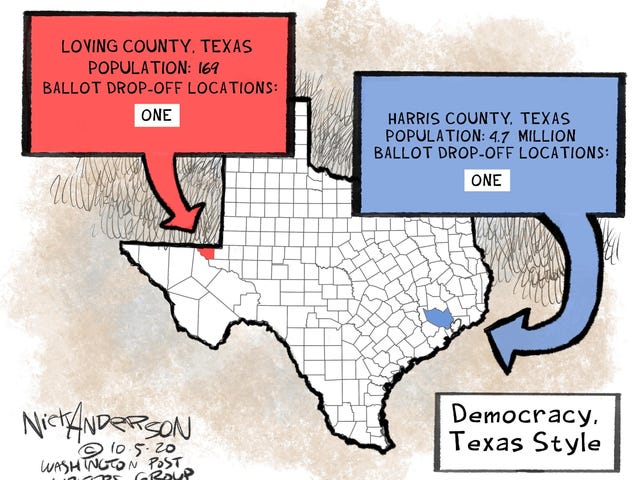
After all, it's easy to imagine a situation where certain groups might want to manufacture evidence of voter fraud.
The recourse should a person's vote be stolen that way is proof that the vote was stolen followed by punishment for the thief, and that punishment can be fairly severe because vote tampering cannot be taken lightly given the impact it can have on the process itself.
Spoiled ballots go into a separate lockbox. At the end of the night everything is tabulated (winners, losers, provisional ballots, spoiled ballots) and posted at the voting precinct. The spoiled ballots box is sealed and taken to the election office to be inspected. This is for 1 state. Every state manages elections differently.
BTW, if you can sign up to be a poll worker. It’s a thankless job that takes 1 day a year. Most poll workers are retirees and I was one of the youngest there.
I know this is probably techno-utopianism, but it'd be pretty cool if every resident were issued a certificate (for free) with their state or federal government as the certificate authority, which would be used for voting, paying taxes, etc. instead of ad-hoc verification systems like Name + SSN + Address.
I can imagine so many horrible problems with implementing such a system in any US state (let alone federally), but it would be pretty damn cool.
Create a system like https://news.ycombinator.com/item?id=31668814 for voting.
Voters remain anonymous yet can still verify their particular vote was counted correctly (and in fact that all votes are counted correctly)
You’d still want a paper trail.
Our new voting machines in our county are awesome, I hope they are used across the state (NJ).
You get a blank piece of paper that you insert into the machine. You vote electronically, and it prints your vote out in plain readable text on the paper, and presents it to you protected under a piece of glass (maybe pexiglass?) to validate your choices. If there is something wrong, you can reject it at this point. If you accept it, it records your vote electronically, and swallows the paper ballot as a record.
Nice clear printed text. No chads.
No doubt the machines were sold off to one of those. Should have scrapped them.
https://www.wired.com/2003/11/e-votes-must-leave-a-paper-tra...
I agree so, that if a system isn't set up that way, early results should not be important.
The way French elections are run is insanely elegant though, it’s basically perfect from a security/transparency l POV.
We just had presidential elections and are electing representatives for parlement next week, we had local elections in 2020, nation-wide elections are not that rare.
Having mandatory voting would mean that non votes don't screw up the results when one side manages to mobilize morw voters than others. And intentionally voting blank actually sends a pretty strong signal.
Sure, they don’t vote for judges and sheriffs and stuff, and it’s a system that’s more representative than participative as in, say, Switzerland. But it works.
One of the things that helps is that voting happens always on Sundays, when most people do not have to take a day off work to vote or to help counting.
It has a cost but most people involved are not paid. Referendums are uncommon but that has more to do with political culture than costs I think.
- substantial social services that don't directly require individuals to have disposable income and aren't tied directly to employment
- humane policies for vacation days in general, and
- national holidays for things like election day.
In the USA, we teach our children that civic engagement is important, but then corrupt politicians at all levels make civic engagement as hard as possible, abetted by moralizing reactionary conservatives.
No wonder Americans are generally cynical and don't participate in politics.
Pay rates vary by locality (as elections are run by local councils)- typically it seems to be around £200 for the day.
There are multiple stories of electronic voting machines changing the vote on the screen. The voter corrects it, and the correct ballot is printed. But, if the voter misses the change, then an incorrect ballot is printed. Sometimes, the voter has to correct it more than once.
Here in New Hampshire, we use paper ballots marked with a felt tip pen. They are scanned with an optical reader, but it's straightforward to do a manual recount of the official paper ballots.
Electronic balloting machines are an invitation to programmatic fraud.
I attended a Free Software Foundation annual meeting some years ago. The assembled group was asked whether they preferred electronic voting systems over paper ballots. Not a single hand went up.
This is the best argument I'm familiar with against the electronic machines we used to use, and our state switched to paper oval-fill ballots that are then electronically tabulated. But, I haven't seen the statistics yet on how many mis-counts we now have as a result relative to the old system and I'd be curious to see them... Ask yourself how confident you are that 100% of voters know how to successfully fully darken the oval. And since the system is anonymous, nobody looks over their shoulder to verify they understand how to do it before the vote is dropped in the box (though in the event of a close race, a manual recount will be automatically triggered and at that point, at least it'll be human eyes deciding whether the voter circling the oval indicates their intent to vote for that candidate).
There is even a race between a few constituencies to be the first to officially declare a result. These guys are really well organised, and for a few days it is a huge piece of civic pride.
Very clear printed text. No hanging chads.
Meanwhile the few politicians that DID attempt to do go along with this effort... died. Maybe they "died", who knows.
Counting ballots by hand sucks. Moving paper ledgers physically sucks.
Unfortunately it has yet to be demonstrated that it can be done well, let alone perfectly.
Here's a paper with details in PDF form [1], and here it is in HTML [2]. Here's a paper proving that it is coercion-resistant [3]. Here's a Wikipedia article [4] on it.
Voting systems with these kind of verification/auditing capabilities are called "end-to-end auditable" or "end-to-end voter verifiable" systems, and here is some information on them in general [5].
[1] https://www.usenix.org/legacy/event/evt08/tech/full_papers/c...
[2] https://www.usenix.org/legacy/event/evt08/tech/full_papers/c...
[3] https://eprint.iacr.org/2010/502.pdf
[4] https://en.wikipedia.org/wiki/Scantegrity
[5] https://en.wikipedia.org/wiki/End-to-end_auditable_voting_sy...
Maybe in the US, a lot of places do it just fine so.
Before election
Union boss: "we expect everyone to vote for candidate X"
After election
Union boss: "show me your vote receipt"
It's better than what we have. Vote-changing can be uncovered by an audit. ... But I still prefer the coercion-resistant systems that let you verify your own vote was counted correctly after the fact. Someone else posted a link to a bunch of papers.
What would be cool is if you combined that serial number with a hash generated by filling in the ballot after the fact.
Eg you go to a page, supply your serial number and the things you voted for, and it tells you if it was counted and matches what you're saying.
Of course, this could still be used that way... but in CA ballots usually have enough options that it would be difficult for a malicious actor to have that much intent haha.
Most people would probably forget which smaller issues they voted for though.... so I dunno if it'd be reliable.
Companies can strongly suggest who employees should vote for and solicit donations to specific candidates.
As far as checking a record of actual votes, that's old days Tammany Hall kind of stuff. Not to say it wouldn't happen again if people could easily get away with it.
https://www.findlaw.com/legalblogs/in-house/can-a-company-te...
It is good that these laws continue to protect the voter's right to autonomy against new threats to it.
Since you are asking me, If you read or scan the page you will see how unions historically operated in the US.
Always bugged me too, but the good news is dirty jerz just got new machines that are auditable this year. Just voted yesterday in primaries and the machines print a paper ballot with answers ready to review. Before it drops into a lockbox, it gives you a final chance to accept or reject what is printed.
Step one, check the signature, the voter roles, and remove the envelope. Throw the ballot into the bin to be counted.
Step two, count the ballot. This ballot now has no identifiable information on it at all. There's no way to verify that a person's ballot was correctly tallied.
So if you wanted to ballot stuff, you could do so prior to step two. Recounts wouldn't identify fraud, you're just counting anonymous ballots again.
The NY Times wrote about the possibility for mail-in voter fraud back in 2012: https://www.nytimes.com/2012/10/07/us/politics/as-more-vote-...
That's one way to illegally harvest votes. One that almost certainly occurred in nursing homes around the country in the last election.
So that leaves people that are coerced into asking for mail-in ballots and are then forced to vote a certain way. Without being caught doing it at a scale enough to tip an election. good luck doing that in a system that isn't gerrymandered to the point that one district in, e.g. Florida, can decide a presidential election with only a handful of votes. In a normal system not election is ever close enough that this small scale tempering has any impact on results. Which is exactly why it happens so rarely, and is almost always detected.
Nope, 8 states automatically mail ballots to all eligible voters: https://ballotpedia.org/All-mail_voting
Plus Illinois (and maybe others?) now has a permanent opt-in.
(Quick edit: More up-to-date source that removed the state labeled "temporary" from the previous source)
This is specifically about the US. Arguing some random position inconsistent with US voting systems is not helpful discourse
EDIT: Thinking of it, I'll add policing to the list. Made worse by the fact that even dictatorships solved it better then the US, totalitarian regimes tend to have better rules and control over law enforcement resulting in targeted brutality, and not the random variety, inflicted by badly trained and scared officers, the US seems to have.
Maybe it's luck?
Or maybe something to do with the prescience of several men who laid out a framework for federalism and distributed power with clear checks and balances, ensuring resilience and the longest running constitutional democracy in the world [1], understanding that reasonable people can disagree and that the most effective form of governance is a non-centralized distributed system that serves the needs of state citizens first.
Or it could be all the corn. [2]
[1] https://www.politifact.com/factchecks/2011/aug/08/jon-huntsm...
[2] https://www.investopedia.com/articles/markets-economy/090316...
You can’t start your topic broad “every American” and then use the much less broad amount of immigrants to “prove” your point.
Because “every American” means I can’t bring up the non-zero amount of Americans that do emigrate elsewhere.
Your entire argument is in bad faith.
Seemed like a tongue-in-cheek quip to demonstrate that there are a lot more folks in the world who are trying to come to the U.S. than the opposite, which as far as I know is pretty true.
In my experience of talking to said Americans, that many can't is largely a case of restrictive immigration policies in most places Americans would like to move to.
So usually America has lower than average citizens wanting to emigrate. Trump made Trump haters want to leave, bringing it up to global averages.
That’s a significant jump, but being globally average does not fit the narrative you’re trying to portray.
But there’s no way to really know either way, can’t really do blind testing of this can we!
That’s a bullshit statement though because countries don’t agree on how they should approach those topics.
The healthcare in Canada vs UK vs Germany is starkly different. Canadians even come to the US for elective procedures.
Gun access is also vastly different between Switzerland, Canada, and the UK. In the UK you can’t even bring a baseball bat to a park.
Hoverer, US is weirdly stuck in local maximums in a lot of places.
You may have noticed that between 2016 and 2020 there were a bunch of media articles about voting security and how poor it was despite this. That's because the US media has no problem concluding that the voting system can't be trusted when the wrong party wins something important, like the presidential election. I'm not even exaggerating here, whether (say) voting machine security is portrayed as a non-issue that's impossible to exploit or a gaping hole that throws into question the entire results aligns exactly with who's winning.
The solution is not a simple one as you imply, otherwise it would have been solved already. Give people some credit!
Australia, imprisoned? Because of our gun laws?
I have access to four different shooting ranges within twenty minutes travel, and my friends go hunting every other weekend. How exactly are we imprisoned?
I mean, who exactly would you shoot? And after shooting them how would the outcome improve?
If you go to the airport how do you find a plane big enough to take you somewhere? Or enough people to prepare it to fly? And when you get to where you are going, how do you avoid getting arrested?
Ditto a boat. And a boat to where exactly?
Having a gun would literally have made zero difference on anything. Oh, wait, you meant that enough gun owners would get together, and perform some coup-like action to replace the government? Sure. That seems likely to turn out really well.
No Australian government agent is going to shoot fellow Australians, or be shot by fellow Australians, to enforce such an absurd prohibition on free and peaceful movement.
Such unilateral authoritarian nonsense can only occur when the majority of the population is disarmed first.
You'll note that the same thing happened in New York City during the 2004 RNC, during Bush's term and Bush's invasion of Iraq. There were unlawful mass arrests by NYPD of thousands of peaceful protesters, who were kettled and housed with limited food and water for 24-48h in large high-density camps along the river. Most were released without charges several days later (when the RNC was over) which, years later, resulted in hundreds of millions of dollars of taxpayer money being paid out as settlement for the illegal actions of the police. This never would have happened if the protest were not approximately 0% armed; the police would not have attempted to kettle a crowd where even a few dozen were able to defend themselves from police violence.
This is why Hong Kong no longer has a free press, fair elections, or due process. They were forced to "fight" well-armed authoritarians with nothing more than umbrellas and laser pointers. Such a battle simply would not have happened in the first place were the population sufficiently armed. Police are not stupid; they will only engage with violence where they are nearly certain not to lose or be harmed (as we observed recently in Texas).
A well-armed population keeps the state from overstepping its bounds without a single shot being fired.
Not that this whole "armed people against the government" thing works in the US, after all the Jan 6th insurrection wasn't an armed mob storming the capitol. Despite being from groups that are peretty well armed.
No unorganised group of people will ever beat state actors just by being armed. Another counter point that often brought up is the rose of the Nazis and how the Nazis took away the guns first. Wrong, because there loads of illegal militias equipped with military grade weaponry around that time. It was exactly those grouos that enabled the Nazis rise to power and formed the core of the SA. The Nazis took the guns awau from the SA, a long with the leadership and the whole organisation, once they were firmly in power.
So then if Australians wanted to mass-disobey the stay-at-home order they could. As you say "No Australian government agent is going to shoot fellow Australians." So guns or no guns, if there was sufficient demand citizens who wanted to could simply have moved around. (Lacking planes and boats travel out of Australia would likely still be restricted.)
By your own point, it's not lack of guns that caused the population to follow the guidelines. It was rather a respect for authority, and the rule of law, that kept the masses at home. Sure a few would reject those guidelines, and be arrested, but that is literally the "few" - not the majority.
>> Such unilateral authoritarian nonsense can only occur when the majority of the population is disarmed first.
I'm not sure I agree. There is plenty of unilateral authority in places where people have guns.
>> You'll note that the same thing happened in New York City during the 2004 RNC, during Bush's term and Bush's invasion of Iraq. There were unlawful mass arrests by NYPD of thousands of peaceful protesters, who were kettled and housed with limited food and water for 24-48h in large high-density camps along the river. Most were released without charges several days later (when the RNC was over) which, years later, resulted in hundreds of millions of dollars of taxpayer money being paid out as settlement for the illegal actions of the police.
Indeed the police committed illegal actions, and have paid out well for it. Perhaps they will learn from that, perhaps not.
>> This never would have happened if the protest were not approximately 0% armed; the police would not have attempted to kettle a crowd where even a few dozen were able to defend themselves from police violence.
um. So you're saying they were reasonably sure that out of thousands of protesters there weren't "a few dozen" who were armed? I agree that sounds reasonable. but if there had been say 100 armed those 100 would have opened fire on the police, and everyone would just have gone home? Given the follow up from another incident (Jan 6) I suspect anyone who fired would have been speedily prosecuted. Anyone who even brandished a gun would have been prosecuted. A bunch of people (likely from both sides) would be dead - and that's somehow a _better_ outcome?
On the other hand it doesn't really matter if the protesters were armed or not - ultimately it was the _perception_ that they were not which allowed them to corral the protest?
>> This is why Hong Kong no longer has a free press, fair elections, or due process. They were forced to "fight" well-armed authoritarians with nothing more than umbrellas and laser pointers. Such a battle simply would not have happened in the first place were the population sufficiently armed. Police are not stupid; they will only engage with violence where they are nearly certain not to lose or be harmed (as we observed recently in Texas).
I think you perhaps are miss-conflating local police in a small Texas town, to the discipline and willingness of well trained armed forces of authoritarian regimes. I don't think hand-guns in Hong Kong would have made the slightest bit of difference to the Chinese authorities in Hong Kong.
>> A well-armed population keeps the state from overstepping its bounds without a single shot being fired.
That's certainly a point of view, and it's obviously a very popular view with a lot of US citizens. I respect that you have that point of view, and respect your right to have that point of view. Personally I don't see that your view is accurate to the reality in the US, much less anywhere else.
It's widely reported that at least 40% of Americans believe the election was rigged. Whether they are correct or not is irrelevant. If 40% of a population _believe_ that democracy has been usurped, and are armed to the teeth, and yet clearly there has not been an (armed) uprising then I'm wondering what has to happen for said armed population to actually take action? Even the Jan 6 incident is laughable for how small, unarmed, and ineffective it was. Apparently there were lots of conspirators, much planning behind the scenes, all sorts of machinations in play, and yet all we got was some folk wandering around a building, then going home. If the outcome of the 2nd amendment is Jan 6, well that seems like a wasted effort.
I don't think we're in the final inning yet. The only thing I know for sure is that I don't intend to be in North America for any day in January 2025, and that I will have full and complete backups of all my irreplaceable data on my person whilst traveling.
The type of populace that willingly disarms themselves is the same populace that willingly accepts totalitarian lockdowns.
In America, if the government had tried anything near that, there'd have been riots immediately. And yes, rioters with guns are a lot less likely to be stopped.
Everything in the US is the way it is because it's best for SOMEONE, but rarely everyone.
When contacting these people many claimed they did not request or receive the mail in ballot.
You have described one particular case that doesn't involve fraud or bad actors. That is called a strawman argument.
Has anyone ever read any studies into this phenomenon, or anything closely related?
All that is required is the belief that it is imperative your team wins. The ideology that you can be dishonest if you do it for the right reasons grants considerable latitude for these types of corrections.
In the case you present, one bad actor is somehow able to manipulate the system en mass. That is certainly likely to draw attention, as you've pointed out.
Nothing would make me more convinced of an election outcome than having my ballot rejected due to signature comparison and getting the opportunity to cast it again
Citation, please.
https://detroit.cbslocal.com/2022/02/24/macomb-county-nursin...
https://hotair.com/jazz-shaw/2020/11/12/texas-nursing-home-w...
https://www.apr.org/2007-07-13/two-charged-with-voter-fraud-...
https://ktla.com/news/nationworld/4th-resident-of-villages-f...
https://www.tmj4.com/news/local-news/wisconsin-sheriff-wants...
https://www.inquirer.com/philly/news/vote-fraud-election-sen...
In the 2000 Washington gubernatorial race the number of votes counted exceeded the number of registered voters and the margin of victory was less than the number of excess votes.
And even if it is just a local school board seat or dog catcher, it’s still a violation of people’s civil rights. What’s more is local elections usually have way more direct impact on people’s lives than federal elections.
The Wikipedia page, as well as the cited sources, are a fun read. The final decision by a judge in the case was that 1678 illegal votes were to be removed from the total number of votes cast. However, they were not apportioned to either candidate. The final margin of victory was 133 votes.
False. I've encountered easily thousands of people who make such claims on the internet.
You might then say "No officials make such claims" - here you're technically correct, but somewhat misinformative: the people in such situations have public relations professionals at their disposal, and also tend to have years of experience (or at least observation) of how to do PR.
When election fraud is discussed, they choose their words carefully, opting to discuss not election fraud, but massive election fraud.
If the topic was other than this one (if "the shoe was on the other foot" so to speak), I don't think these things would be hard to notice...but, human psychology is what it is, so here we are.
> But as seen by the links you provided, there are people watching for these kinds of fraud, and people get caught all the time, even when it's just a single extra vote, much less enough to actually make a difference.
This is speculation, stated in the form of a fact - this, combined with the topic, may cause readers to form a belief that it is necessarily factual.
It is not speculation that there are people who look for election fraud (and then prosecute it when found). And folks do get caught/prosecuted for just about every election cycle, so "all the time". And the links demonstrate that. I may have expounded on that a bit but the language is not speculative except maybe the portion about whether or not there is enough to make a difference. That is my opinion, but heavily based on the reading on this topic I have done, checking claims from a wide variety of sources, parties, etc. I make no claims to expertise but I do believe the information I have shared is accurate to the best of my ability and folks can do with that what they will (hopefully spend their own time actually making sure they are not misled).
And while contemplating this idea, remember that we are dealing with human beings.
Technically, this isn't true.
> But the chance of the being sufficient fraud to change say the presidential election is extremely unlikely....
Technically, the likelihood is not known. Humans are welcome to state estimates of the likelihood, and believe those estimates to be true (and rebroadcast them, seeding the "fact" into other minds), but base reality is where the truth lies. We can (and do!) pretend that our estimated reality is factual but this is a collective cultural delusion, and a harmful one at that (which sometimes people can see clearly (in the behavior of our outgroups), and other times not (in their own and ingroup behavior)). Pick any culture war topic thread on HN, and observe how people describe "reality" - the phenomenon is not really hiding as much as we aren't able to see it (similar to how we couldn't see certain things until we developed techniques, like using lenses to see into different realms of reality).
> ...especially given the evidence that we have.
Our discovery of evidence has no influence on that which preceded it, it only has influence on our beliefs of that which preceded it. Unfortunately, we often tend to not form a distinction between the two.
I personally think that fraud of a significant scale in a country with thousands of different voting systems is basically impossible to hide, and a lot of people are looking for it. We take many steps to reduce that risk. And when we catch someone trying, we should slap them down hard as an example to others.
Citation? This article shows 2 out of 2 as Democrats.
This article shows a guilty plea from a Democrat who for years rigged votes with a Judge of Elections and Democrat Ward Leader, Domenick J. DeMuro. Demuro pled guilty in 2020.
Citation, please.
https://www.theatlantic.com/ideas/archive/2018/12/bladen-cou...
[1] https://www.americanbar.org/groups/public_interest/election_...
Otherwise, keep the sarcastic BS to yourself. Please.
upsidesinclude wrote:
> You find a bunch of people that can't or wouldn't vote and collect their automatically mailed ballots, fill them out and have them dropped off in boxes.
>That's one way to illegally harvest votes. One that almost certainly occurred in nursing homes around the country in the last election.
thenewwazoo replied:
> Citation, please.
This isn't about substantial fraud. It is about a very specific source of fraud that upsidesinclude said was likely to have happened.
using the "left-over" ballots of people not voting, sure, all you have o do is to convince the other 3 to 4 people present at the polling station to go along. and since we have literally thousands of those stations you have to repeat that a lot. And as soon as the participation exceeds the other places, people will investigate. The provisional count done on-site is redone before it is official, so again deviations will be found. And if they are not, congrats, you managed to stuff maybe a dozen ballots, if you are lucky.
Otherwise, I agree with your point. The reason ballot harvesting is much less of an issue than made out is because there's a vast paper trail with each mail in ballot cast.
I don't believe 'signatures change' is reasonable or valid. By the time someone reaches adulthood and has an ID, their mark is likely to be quite distinct. Check your grandmother's signature sometime. My point being, that dismissal is not evidence or fact based, but likely aligns with your opinion.
>ultimately up to the counter
There's absolutely no reason to do that. Digital files already exist of all signatures and the envelope is coded to each voter. The comparison can be done trivially by image processing.
I have my own signature that I can check and I KNOW it has changed significantly over time. Why? Because I don't sign a lot of things! Hell, I hardly write anything down.
There are many, MANY, reasons a signature can change, for example, injury. But beyond that, there's just general drift in the way people write things. [1]
> The comparison can be done trivially by image processing.
No, it can't, because the signature is not exact, even in the best of cases. The software HAS to make allowances in differences and once that happens, we are in the territory of "what is this actually proving?"
Further, signature forgery is a thing. There's a reason banks and CCs no longer even check the signature. It's a relic that proves nothing.
But beyond all this conversation, the current process for states doing signature validation isn't to reach out to the person that cast the vote to verify their ballot, no, instead they mark the ballot as invalid and move on. [2]
Indeed, if the concern was voter fraud, why WOULDN'T you want to reach out to the absentee ballot caster to find out if they actually cast the ballot? Why would "throw it away" ever be the right move?
[1] https://www.thecut.com/2016/09/why-your-handwriting-keeps-ch...
[2] https://electionlab.mit.edu/sites/default/files/2021-07/swif...
I would be greatful to read that what you have stated is true, but I sincerely doubt it.
If you believe that to be true, it would be much easier to dismiss concerns
Many US problems could be solved if Americans could get over our irrational fears about comprehensive databases. The boogeyman is already real. Let's be tracked in one auditable location instead of 36+ incomplete and contradictory databases where the contradictions can be used as "evidence" of fraud. The downsides are already here, let's acknowledge reality and then build systems to give us a chance at enjoying the benefits of centralized intelligence.
Either (1) or (2) not being true makes elections way less secure.
I do like postal mail. I've yet to see a convincing argument that the coercion risk is substantial enough to offset the other benefits. Voting slowly at my living room table is awesome.
It’s not just coercion risk. It’s the whole chain of custody.
Give the FEC the power to issue photo ID for voting. Legislate that it is only valid for that purpose and any other use is illegal. Send out census-style teams to track down every citizen and issue them a card, free of charge.
Of course, there are all sorts of problems with this that are entirely self-inflicted. Someone will oppose a national ID, even if we already have that. Someone else will point out that the states legally get to make their own voting rules, and they're right. This isn't a problem anyone actually wants to solve. Democrats want to make it easier to vote, Republicans want to make it harder. It's like every other tribal issue, neither side will give an inch because they fear the other side will take a mile.
Wow, I didn’t know I live in a black neighborhood!
https://www.bloomberg.com/news/articles/2015-10-01/alabama-c...
When one considers action such as this in light of the GOP being caught red-handed attempting to shape the census questions to deprive states of Congressional representation (https://www.nytimes.com/2019/05/30/us/census-citizenship-que...), it becomes, at the very least, suspicious. For at least a short time (politically speaking, maybe half a generation), the GOP has lost the benefit of the doubt regarding its actions being race-neutral and some healthy skepticism is justified.
IANAL, but I believe that something like this would require a constitutional amendment, unless it could be squeezed in under the umbrella of the ICC like most other federal overreach laws.
If one agrees that this is true, that's not an answer to the question of why not do it; it does affect the mechanics—either a Constitutional Amendment (to do it federally) or a fifty-state compact (do it as a coordinated state-ID system for all state purposes, which is arguably closer to what was described) would be available mechanisms.
“The Constitution doesn't currently allow the federal government to do it” is not an answer to “why not do this in a centrally coordinated way”.
Personally I think there is some constitutional justification for a national ID system. The commerce clause gets abused a lot IMHO but identity is at the core of just about any contract. You could argue that state identification and plain old name, address, signature are sufficient, but it's not like SSNs are ubiquitous for no reason. Even as dumb as it is to use a single number for someone that never changes, the benefits of a single static identifier that is the same across a person's lifetime and established by the government outweighs the horrific insecurity of it all. Fundamentally a government is the root authority of legal identity for all the citizens of that country. The government should provide a modern secure way of establishing identity for both public and private matters.
Summary: They pretty much all responded "whoever thinks we don't have / can't get IDs is ignorant and probably a bit racist".
- 13% of Blacks, 10% of Hispanics, but only 5 percent of Whites lack photographic identification.
- 12% of adults living in a household with less than $25,000 annual income lack photo ID, compared to just 2 percent in households with over $150,000 annual income.
- 15 percent of 17-20 year olds lack photo ID, and 11 percent of those ages 21-24 lack photo ID.
So yeah, ID requirements are not a half bad way to skew election results in your favor.
And consider for a moment just how strong an advantage Republicans have in the house of representatives these days compared to how weak their actual number of represented voters is. All the little efforts absolutely add up to real results.
And how does the voter turnout look for those groups anyway? The only people who might be impacted negatively by ID requirement are those unable (for whatever reason? Why can't there be an easy way to get an ID in the first place?) and actually wanting to vote.
http://www.electproject.org/home/voter-turnout/voter-turnout...
I think almost every person interested in elections is someone with enough money to get an ID every 5 years. But hell give out a subsidy for the poor to get an ID card for free.
The German system would be much more onerous if implemented in America than one tied to driver’s licenses that virtually everyone in America has already.
> requires showing up in person within a month of moving
Not during covid by the way. I moved in 2020 and could simply send in the documents by email. Then some time later I had to briefly drop by to get a stamp for my ID, but that was like 5 minutes.
> registering to vote is super easy and can be done online in most states
That is nice, but not having to register at all is even easier.
Sure, lots of things were relaxed during the pandemic. But you have to register in person normally, correct?
Partially. You can fill out and send all documents online or by mail -- at least in the city I moved to. Then once everything is done you need to make an appointment to stop by and pick up your address sticker and certificate.
Having some in person part for ID things seems unavoidable, but nothing onerous.
In case you think I’m joking, Joe Biden has claimed that Georgia’s online voter registration (https://registertovote.sos.ga.gov/GAOLVR/welcometoga.do?#no-...) and free Voter ID card (https://dds.georgia.gov/voter) amounts to “the New Jim Crow.”
And why do think your German ID card won't work anymore if the address on it is wrong?
> Anyone who moves into a residence in Germany must register within two weeks of moving in. To register, you have to go to the registration authority of your municipality and present a valid ID card, passport or passport substitute document and a certificate issued by the person providing the residence.
> Persons moving abroad must deregister with the registration authority of their municipality, while those moving within Germany only have to register their new residence. It is not necessary to deregister the former residence.
> Both Germans and foreigners are required to register. Violations of the registration re-quirement are subject to fines.
I didn’t say the German ID card would stop working. But as I understand it, voting is based on your registered address, which must be current to vote, and that residency registration requires showing up in person.
The point is that voting in Germany requires showing up to a registration office with documents every time you move, which is more onerous than presenting an ID to vote in the US. Both voter registration and renewing a driver’s license or changing your address on your license can be done completely online in most states. I’ve only gone in person to deal with my driver’s license twice in my life (I’m almost 40), despite moving almost a dozen times. Once when I got my license as a teenager, and once when I changed my residency permanently from Virginia to Maryland.
Their fraud used the voter information of real people who they expect to simply not come to the polling station. It’s hard to catch. If you notice double voting from when the person actually votes then they simply throw out both votes (legitimate and illegitimate).
This seems like a tactic that would work well in a place like the USA which has low voter turn out.
And I am describing just one way of how paper ballots work save, anonymous and at scale. You need some truly mind blowing organizational fuck up (look up the last election in Berlin) for it to not work. An even then it affected one single (?) voting district (as in polling places, not candidate districts if i remember correctly), was instantly identified and investigated and almost impossible to use to temper with the results (it was found out immediately).
Do they pay them?
There were also a number of reports on the integrity of the election, many legitimate audits (including in Antrim county). Did you read them? Did you look for them? Or are you trying to undermine something by feigning concern and sowing doubt?
Edit: also it is useful to remember that the 2020 presidential election wasn’t close. Nothing like 2000. Neither in total votes, electoral votes, or the margin in any of the marginal electoral-vote supplying states.
I’m of the understanding that ballots stripped from their envelopes were transported to counting centers. Perhaps bribing one driver would be sufficient to swap 1000s of ballots and there would be no trail.
I find the following from https://www.politifact.com/factchecks/2021/feb/05/gateway-pu...
“”” Only after ballots were validated were they delivered to the TCF Center for election workers to process and tabulate them.
Shane Trejo, a writer for the right-wing website Big League Politics, told the Gateway Pundit that he was at the TCF Center where he said he witnessed thousands of ballots being unloaded early Wednesday morning. "There were at least 50 boxes that I saw unloaded at 3:30 a.m.“””
It’s my understanding that the validating process results in the naked ballots being placed into boxes for delivery to a counting center.
The linked article debunks that the ballots were late, but that is not my concern.
I was going to write more about Georgia but then I came across this article which eliminated most of my concerns there. I don’t know why it took a whole year before this was printed though.
https://www.marketwatch.com/amp/story/investigators-locate-n...
I did see some of the audits, which mostly removed my concerns of cheating. However there were claims in Georgia of mail in ballots that appeared marked by computer and I knew there was going to be a court case on this, but I never saw any reporting on this case. The above article says there were never any such perfect ballots found.
I think the perfect ballot is where my fears come from. Where in the chain could you swap out ballots and put in generated ballots.
Where does it say that ballots were stripped before delivery? Do you have evidence of that? The politifact piece says the signatures were validated then they were taken for processing. Signatures are on the outside of the envelope. That isn’t delivering naked ballots. Stripping the envelope happened at the processing center based on the videos of them describing the process [0], videos of them carrying out the process which were live-streamed and still available, and the State’s published documents describing the process.
Everyone is concerned that voting is done well. Your concern seems to move between ‘specific things which didn’t happen’ and ‘hypothetical perfectionism’ which is an unmeetable standard.
Edit, added video link: [0] https://www.usatoday.com/story/news/politics/elections/2020/...
https://aceproject.org/ace-en/topics/vc/vcf/vcf02/mobile_bro...
I appreciate your response, it has made me question my thought process.
Ballots need serial numbers that trace back to a person that we can pick up a phone and confirm their vote when elections are contested. Being unable to do a spot-check audit is just plain stupid. Every person should be able to look up their ballot and see how it was counted at the end of the election.
Let's say voter fraud is indeed very low in the US, why not make obvious moves to make it even more accurate and honest?
The secret ballot is essential, as compromise of that secrecy enables vote selling and voter intimidation. One of the reasons New York had tabulating machines and kept them was to limit the ability of political machines to interfere with elections at the local level. Tammany Hall operatives and others would retaliate against voters who didn’t do what the machine wanted. (Later those machines aged and became a liability)
There’s no such thing as a perfect process, and while your idea is a worthy way of providing validation, it creates more serious issues that ultimately undermine the democratic process.
If you have any kind of audit background they answer to ensuring integrity is always a same: a well defined process where different individuals are responsible for different parts of the process and are audited to achieve best practices.
The reality is that measures designed to target individual voter fraud are solving a problem that doesn’t exist and are done to suppress turnout.
The actual risk of voting related fraud is pretty obvious - political partisans with the access and ability to intimidate or bypass civil service employees from following the process. As a nation, we should be lauding the courage of the GOP election commissioners in Georgia who risked their careers and perhaps their lives to defy a demented president. Whatever the politics, those are people with integrity.
The tabulating machines or the political machines?
I meant the physical devices. Towards the end of their tenure, there were some statistical irregularities that suggested the gears were failing to roll over correctly, resulting in undercounting.
That would mean that elections are no longer secret. There are many good reasons why elections are secret in most (all?) democracies. It makes it impossible for people to be pressured into voting a certain way or payed to vote a certain way. It also means that you can't be prosecuted for voting a certain way. Giving up all of this would open up so many new avenues for voter fraud.
Edit: This is not necessarily an argument but secret ballots are part of the Universal Declaration of Human Rights.
The formula is simple: Central, automatic voter registration, easy access to ID cards (the general one, not a voter Id. You know, the thing most use to identify citizens instead of drivers liscences), easy access to polling stations, no Gerrymandering and paper ballots. That's all you need.
Generally the thinking is that there must never exist a mechanism by which you can prove to some other person how you voted, or voters can be coerced into voting a certain way.
> Let's say voter fraud is indeed very low in the US, why not make obvious moves to make it even more accurate and honest?
Because if you aren’t careful you can make it worse.
> Beren and her accomplices from the Board of Elections would then falsify the polling books and the List of Voters and Party Enrollment for the 39th Ward, 2nd Division, by recording the names, party affiliation, and order of appearances for voters who had not physically appeared at the polling station to cast his or her ballot in the election. Beren took pains to ensure that the number of ballots cast on the machines was a reflection of the number of voters signed into the polling books and the List of Voters. After the polls closed on Election Day, Beren and her associates would falsely certify the results.
Obviously, I believe this actually happened. But: how? What is Philadelphia not doing that we do in Chicago? You couldn't do this here; it's hard for me to even imagine how someone could walk into a precinct and cast multiple votes. And how would they cast their second and third vote? Do you give them a list of no-show registrations from the precinct? And then they just sign the pollbook multiple times?
They can't just re-vote at the same precinct. The EJs will absolutely notice a person coming in and voting more than once. If that gets noticed a single time, the EJ calls the sheriff (in Cook County, at least).
It takes, like, best case, 10-15 minutes to vote in a precinct. There are lines!
How many votes can you cast this way? 10? 20?
I'm not saying you couldn't manage to cast a fraudulent vote by doing this. I'm saying that your odds of influencing the election by doing it, while at the same time not guaranteeing you end up in prison for trying, are so low that my mind boggles that anyone would try.
To quote further up:
> and also cast fraudulent votes in support of Myers’ preferred candidates on behalf of voters she knew would not or did not physically appear at the polls.
And:
> They can't just re-vote at the same precinct. The EJs will absolutely notice a person coming in and voting more than once. If that gets noticed a single time, the EJ calls the sheriff (in Cook County, at least).
From the article:
> Beren, who was charged separately and pleaded guilty in October 2021, was the de facto Judge of Elections and effectively ran the polling places in her division by installing close associates to serve as members of the Board of Elections.
The election judge was the one doing this, didn't have to get past anyone.
> Demuro fraudulently stuffed the ballot box by literally standing in a voting booth and voting over and over, as fast as he could, while he thought the coast was clear
TFA explains the other case was nepotism enabled conspiracy:
> Beren, who was charged separately and pleaded guilty in October 2021, was the de facto Judge of Elections and effectively ran the polling places in her division by installing close associates to serve as members of the Board of Elections.
https://nypost.com/2020/11/03/houston-woman-turned-away-from...
https://abc11.com/nc-vote-provisional-ballot-voter-already-v...
> North Carolina State Board of Elections data shows more than 2,600 voters cast provisional ballots during early voting this year. Around 19% of ballots cast were due to voters--like Prince--who were told they already voted.
At least that’s what it sounds like in
> Beren and her accomplices from the Board of Elections would then falsify the polling books and the List of Voters and Party Enrollment for the 39th Ward, 2nd Division, by recording the names, party affiliation, and order of appearances for voters who had not physically appeared at the polling station to cast his or her ballot in the election. Beren took pains to ensure that the number of ballots cast on the machines was a reflection of the number of voters signed into the polling books and the List of Voters.
https://www.clickondetroit.com/news/2020/11/05/did-a-dead-11...
Older people are much more likely to vote and much more likely to die.
I'm aware that votes cast in the name of the long-deceased has been used for fraud in the past. But some of number of votes cast by dead people should be expected! Just way below the number needed to influence elections.
People say this like there are no close elections, or are only talking about Presidential elections (and ignoring Florida 2020), but pretty much every year there are razor thin votes in statewide and congressional races. Good example is Iowa 2nd district in 2020 which was decided by 6 votes:
https://abcnews.go.com/Politics/democrat-rita-hart-ends-elec...
GOP Rep. Mariannette Miller-Meeks was certified the winner in November by a mere six votes out of 400,000 cast, marking one of the closest House races in modern history.
Given 400,000 votes, there is guaranteed more than 6 fraudulent, mistaken, or sabotages ballots. Maybe that affected the result, or just missed flipping the seat, who knows. But small time voting fraud can still be a big problem.
Assuming that's true, you just need to know when it is going to be close, and that only requires polling, not prescience.
https://www.thegazette.com/article/polling-shows-iowa-2nd-di...
Slightly more than two months before Iowans begin voting, polling shows the open-seat race in the U.S. House 2nd District as a dead heat.
In a live poll of 406 likely voters by Harper Polling, Republican state Sen. Mariannette Miller-Meeks and Democrat Rita Hart each had the support of 41 percent of the respondents
So this is exactly the kind of race where a smart cheater would cheat, not trying to get Trump to win California or Biden to win West Virginia. But I assume people who are corrupt and cheat are going to be corrupt and cheat even when it is not in their own interest. And just by chance that will affect other elections happening at the same time.
No, this doesn't sound plausible.
Not in reality, you appended that to your local model.
It's true that there is only so much fraud you can get away with, and if the legitimate votes outnumber your ballot stuffing then your plan failed.
Presumably fraudsters do not know what the final counts are going to be (unlike how many people in this thread "know" things they have no way of knowing), so this would not necessarily alter their plans on sites that are plausibly (in their estimation) swingable.
> But in fact Meeks vs. Hart was newsworthy because results like that are incredibly rare. 99 times out of 100, if you try to juke the election, you're putting yourself at pretty grave legal risk and accomplishing absolutely nothing.
This rests on the premise of omniscience, and while this is a fairly standard convention on the internet these days, there is no scientific evidence I've seen that substantiates the phenomenon.
What is rcv? How would runoff’s help if there are only two candidates?
https://blockclubchicago.org/2018/10/24/chicago-and-rigged-e...
Pretty sure that quite a lot has changed since 1922, including damn near every single adult alive.
> You certainly can't just make up a final tally. The numbers from the individual voting machines and the paper ballots have to match up; we had to stay an extra 2 hours after the polls closed last time I did this (in 2020) because of an equipment screwup that kept us from doing the final certified count/reconciliation.
Honest question: what if the final count _didn't_ match, or people _were_ made up? If all of the judges were corrupt, and they gave a false count, whose job would it be to step in and fix it? The police? The current (potentially lame duck) government? Ideally the regulations would be enough of a disincentive that no one would risk it, but if the set of people who finalize the counts blatantly lie, who has the authority to overturn them? And what's stopping that authority itself from being bribed to overturn legitimate results?
Continuing the hypothetical you suggest, what would an individual actually be able to achieve if they did somehow get the evidence they were looking for that the vote count was fabricated? Is there some sort of civil procedure for contesting the vote tally? Would it require a lawsuit against the person or group of people who lied about the totals? Is there some sort of hearing where people can make a case that whoever is supposed to certify the count (e.g. the legislature) can argue against it? Or would it just be a matter of fighting in the court of public opinion to mount enough pressure to get the lying party to cave?
Really, all these systems rely on humans so they have inherent weaknesses.
but what if they are all from the same party?
Second, the story we're talking about here is about a primary election; the whole contest took place within a single party.
Third, I'm not sure why it would matter. OK, they're all Democrats. Now what? Even if all 4 EJs wanted to corrupt the results of an election, it's not super obvious how you'd undetectably do that. The paper ballots get hauled back to the central counting facility; the registrations have to match the ballots, etc.
I don't know about you, but I used to change my party affiliation before the primary to be able to vote in the election I care the most about... (I'm not from that state though).
> Inside the polling place and while the polls were open, Beren would advise actual in-person voters to support Myers’ candidates and also cast fraudulent votes in support of Myers’ preferred candidates on behalf of voters she knew would not or did not physically appear at the polls (emphasis mine)
I'd say so, but not in a sense that the effect is only or even primarily associated with [insert political party here].
Edit: We like to envision Judges as impeccably impartial, but they have a considerable amount of leeway, ambiguity, and procedural caveats they can employ should they choose to make partisan decisions. Given that judges are often selected by, or elected with support from, a political party machine, it stands to reason that they can be swayed to help the party that is responsible for their position. Especially if there is plausible deniability of bias or wrongdoing.
And a member of party X is more likely to be willing to cheat to benefit party X,
Then having all the members that need to sign off be from party X does indeed increase the ability to cheat for party X.
I think you have to have some pretty huge procedural gaps to make this viable, which is my point here.
But there is no political WILL to do it. Making voting hard, complex and open for abuse is literally how the parties want it.
The Heritage Foundation, which is very much in love with the idea of voter fraud, has been able to find a total of 19 cases since 1997 where somebody used a deceased person's registration to (attempt to) vote.
So maybe let's kick the facetious "supposedly" of the last sentence.
And if we wanted to do better with that - the same crowd that is oh-so-concerned with voter fraud is oddly opposed to a federal registry, federal ID, or free state ID. All things that'd help tremendously with increasing the accuracy of voter rolls.
On the larger topic of voter registration, it shouldn't be that hard for them to keep relatively clean rolls. Even if it's not causing an issue, having clean rolls promotes the integrity of and trust in the voting system. I mean, most of the dead people voting is just people signing in the wrong spot.
I'm not sure how a federal registry would really help much. I doubt there are really people voting in multiple states. There is a federal ID - the passport. Although that is relatively expensive, but it is also valid for a much longer duration, so the card can be cheaper than a state ID. I do believe that state IDs should be free if people are under the poverty level, but I also have a hard time believing that $40ish dollars every 4 year is the real barrier (things like the documents needed to get one are a bigger pain in my opinion, like birth certificates, marriage certificates for name changes, bill with your name and address, etc; even more so for Real ID). Plus the hassle of spending hours at the DMV.
"So maybe let's kick the facetious "supposedly" of the last sentence."
I'm not being facetious. Many states have implemented new programs to clean up the voter rolls. There's very little data to show if it's any improvement. In part, that's because the problem had little baseline data to go on (few occurrences of dead people voting). The other part is that many places haven't been very strict about cleaning (like Philly having approximately 1M registered voters when there's maybe 700k eligible to vote just based on age). So not much to speak of on the actual "problem" side since it wasn't large to begin with. But also not much progress on the trust side with cleaning up.
Also, I think that 19 number is low. I thought they found something like 35 in Philly in one election (year 2016? out of the 6k dead people who voted). The rest were simple mistakes. Still not a big problem, but certainly more they 19 nationally in 25 years. Again, it's mostly a trust and integrity issue than a true functional issue.
By the way, that's not "every instance". The database is a "sampling".
"This database is not an exhaustive or comprehensive list."
If that's the case then one could simply use deceased persons to vote. It's not like they'll come back from the dead as a voter fraud zombie
I wish people defined their acronyms. It doesn't appear in the linked document either.
So can each vote be attributed to a individual (tracked)?
You can't just make people up! Every vote is tied to a specific registration. We do same-day registration, but those votes are cast provisionally, with a paper log; there aren't many of them, and they can all be set aside and audited after-the-fact.
You certainly can't just make up a final tally. The numbers from the individual voting machines and the paper ballots have to match up; we had to stay an extra 2 hours after the polls closed last time I did this (in 2020) because of an equipment screwup that kept us from doing the final certified count/reconciliation.