The guilty parties were literally casting votes for people they knew would not show up.
It’s an identity issue, much harder, and with its own set of controversies.
Unregistering has had some serious problems of hitting active voters in the past, though I'm not an expert there.
But I can easily say that checking ID, without first making sure valid voters can easily get the needed ID, is unacceptable.
Agreed. The issue is the Democratic solution is to never ID, instead of coming up with a way to easily get people IDs. That makes me rather suspicious of their motives.
No, it isn't, anywhere in the US. A bare majority (26) states have stop-and-identify laws which allow stops to determine identity based on reasonable suspicion of crime, but many don't, and those that do don't (and cannot Constitutionally) require presenting identification.
Everywhere in the US, the law around Terry stops[1] applies. In fact every time the police “pull you over” on the road is a Terry stop.
In such a stop, mere “reasonable suspicion” is required for police to require you to identify yourself. You’re not required to present ID but you must tell them your name (you could lie, but that’s another crime). You can be arrested for refusing to identify yourself.
In order to determine if your are experiencing a Terry stop, ask the officer “Am I free to go?”, if the answer is no, ask “Why am I being detained?” and the officer should state his cause. If it’s not valid you won’t be able to fight it until after the encounter, possibly after you’ve already been arrested.
Egregious example: The infamous NYC “stop and frisk” policy[2] was essentially a massive Terry-stop program.
[1] https://en.wikipedia.org/wiki/Terry_stop
[2] https://en.wikipedia.org/wiki/Stop-and-frisk_in_New_York_Cit...
IANAL, either, but I passed Con Law in law school, and it is.
> Everywhere in the US, the law around Terry stops[1] applies.
Yes, that’s what we are talking about.
> In such a stop, mere “reasonable suspicion” is required for police to require you to identify yourself.
Wrong. In such a stop, it is not federally unconstitutional for such a demand to be made, but it still requires that there is actual state law authorizing it. In 26 states there is, and in the rest there is not.
> You’re not required to present ID
Yes, that’s what I said, that even in the 26 states with stop-and-identify laws, permitted by the Supreme Court, you are still not, as the upthread commenter, required to present ID.
You’ve literally repeated what I said (except for confusing the federal limits of state authority with what police can do without supporting state law), after saying “It’s not that simple”.
Maybe after I take that course I’ll agree with you. I don’t think that’s a great option for most.
Regarding this topic, there are historical and recent reasons for suggestions of cleaning, trimming, purging etc. the vote roster to be met with extreme scrutiny and skepticism. The United States simply has a bad history of using tools like that for shaping the electorate to meet a desired outcome.
https://www.gannett-cdn.com/-mm-/b9fb2868c7c1a0e1f4f7e8f7c0f...
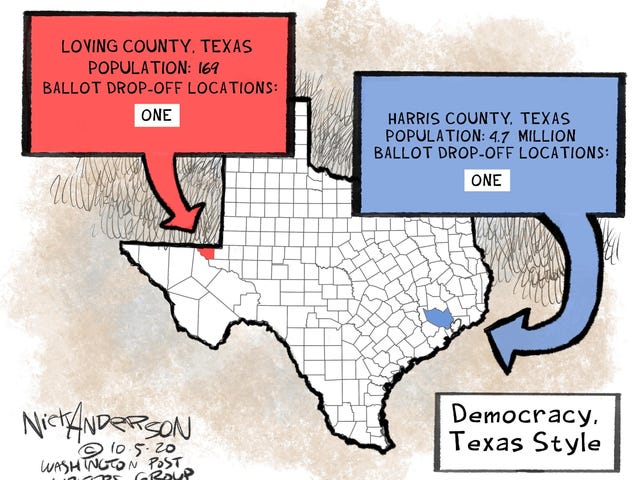
After all, it's easy to imagine a situation where certain groups might want to manufacture evidence of voter fraud.
The recourse should a person's vote be stolen that way is proof that the vote was stolen followed by punishment for the thief, and that punishment can be fairly severe because vote tampering cannot be taken lightly given the impact it can have on the process itself.
Spoiled ballots go into a separate lockbox. At the end of the night everything is tabulated (winners, losers, provisional ballots, spoiled ballots) and posted at the voting precinct. The spoiled ballots box is sealed and taken to the election office to be inspected. This is for 1 state. Every state manages elections differently.
BTW, if you can sign up to be a poll worker. It’s a thankless job that takes 1 day a year. Most poll workers are retirees and I was one of the youngest there.
I know this is probably techno-utopianism, but it'd be pretty cool if every resident were issued a certificate (for free) with their state or federal government as the certificate authority, which would be used for voting, paying taxes, etc. instead of ad-hoc verification systems like Name + SSN + Address.
I can imagine so many horrible problems with implementing such a system in any US state (let alone federally), but it would be pretty damn cool.
Create a system like https://news.ycombinator.com/item?id=31668814 for voting.
Voters remain anonymous yet can still verify their particular vote was counted correctly (and in fact that all votes are counted correctly)
You’d still want a paper trail.
Our new voting machines in our county are awesome, I hope they are used across the state (NJ).
You get a blank piece of paper that you insert into the machine. You vote electronically, and it prints your vote out in plain readable text on the paper, and presents it to you protected under a piece of glass (maybe pexiglass?) to validate your choices. If there is something wrong, you can reject it at this point. If you accept it, it records your vote electronically, and swallows the paper ballot as a record.
Nice clear printed text. No chads.
No doubt the machines were sold off to one of those. Should have scrapped them.
https://www.wired.com/2003/11/e-votes-must-leave-a-paper-tra...
I agree so, that if a system isn't set up that way, early results should not be important.
The way French elections are run is insanely elegant though, it’s basically perfect from a security/transparency l POV.
We just had presidential elections and are electing representatives for parlement next week, we had local elections in 2020, nation-wide elections are not that rare.
Having mandatory voting would mean that non votes don't screw up the results when one side manages to mobilize morw voters than others. And intentionally voting blank actually sends a pretty strong signal.
Sure, they don’t vote for judges and sheriffs and stuff, and it’s a system that’s more representative than participative as in, say, Switzerland. But it works.
One of the things that helps is that voting happens always on Sundays, when most people do not have to take a day off work to vote or to help counting.
It has a cost but most people involved are not paid. Referendums are uncommon but that has more to do with political culture than costs I think.
- substantial social services that don't directly require individuals to have disposable income and aren't tied directly to employment
- humane policies for vacation days in general, and
- national holidays for things like election day.
In the USA, we teach our children that civic engagement is important, but then corrupt politicians at all levels make civic engagement as hard as possible, abetted by moralizing reactionary conservatives.
No wonder Americans are generally cynical and don't participate in politics.
Pay rates vary by locality (as elections are run by local councils)- typically it seems to be around £200 for the day.
There are multiple stories of electronic voting machines changing the vote on the screen. The voter corrects it, and the correct ballot is printed. But, if the voter misses the change, then an incorrect ballot is printed. Sometimes, the voter has to correct it more than once.
Here in New Hampshire, we use paper ballots marked with a felt tip pen. They are scanned with an optical reader, but it's straightforward to do a manual recount of the official paper ballots.
Electronic balloting machines are an invitation to programmatic fraud.
I attended a Free Software Foundation annual meeting some years ago. The assembled group was asked whether they preferred electronic voting systems over paper ballots. Not a single hand went up.
This is the best argument I'm familiar with against the electronic machines we used to use, and our state switched to paper oval-fill ballots that are then electronically tabulated. But, I haven't seen the statistics yet on how many mis-counts we now have as a result relative to the old system and I'd be curious to see them... Ask yourself how confident you are that 100% of voters know how to successfully fully darken the oval. And since the system is anonymous, nobody looks over their shoulder to verify they understand how to do it before the vote is dropped in the box (though in the event of a close race, a manual recount will be automatically triggered and at that point, at least it'll be human eyes deciding whether the voter circling the oval indicates their intent to vote for that candidate).
There is even a race between a few constituencies to be the first to officially declare a result. These guys are really well organised, and for a few days it is a huge piece of civic pride.
Very clear printed text. No hanging chads.
Meanwhile the few politicians that DID attempt to do go along with this effort... died. Maybe they "died", who knows.
Counting ballots by hand sucks. Moving paper ledgers physically sucks.
Unfortunately it has yet to be demonstrated that it can be done well, let alone perfectly.
Here's a paper with details in PDF form [1], and here it is in HTML [2]. Here's a paper proving that it is coercion-resistant [3]. Here's a Wikipedia article [4] on it.
Voting systems with these kind of verification/auditing capabilities are called "end-to-end auditable" or "end-to-end voter verifiable" systems, and here is some information on them in general [5].
[1] https://www.usenix.org/legacy/event/evt08/tech/full_papers/c...
[2] https://www.usenix.org/legacy/event/evt08/tech/full_papers/c...
[3] https://eprint.iacr.org/2010/502.pdf
[4] https://en.wikipedia.org/wiki/Scantegrity
[5] https://en.wikipedia.org/wiki/End-to-end_auditable_voting_sy...
Maybe in the US, a lot of places do it just fine so.
Before election
Union boss: "we expect everyone to vote for candidate X"
After election
Union boss: "show me your vote receipt"
It's better than what we have. Vote-changing can be uncovered by an audit. ... But I still prefer the coercion-resistant systems that let you verify your own vote was counted correctly after the fact. Someone else posted a link to a bunch of papers.
What would be cool is if you combined that serial number with a hash generated by filling in the ballot after the fact.
Eg you go to a page, supply your serial number and the things you voted for, and it tells you if it was counted and matches what you're saying.
Of course, this could still be used that way... but in CA ballots usually have enough options that it would be difficult for a malicious actor to have that much intent haha.
Most people would probably forget which smaller issues they voted for though.... so I dunno if it'd be reliable.
Companies can strongly suggest who employees should vote for and solicit donations to specific candidates.
As far as checking a record of actual votes, that's old days Tammany Hall kind of stuff. Not to say it wouldn't happen again if people could easily get away with it.
https://www.findlaw.com/legalblogs/in-house/can-a-company-te...
It is good that these laws continue to protect the voter's right to autonomy against new threats to it.
Since you are asking me, If you read or scan the page you will see how unions historically operated in the US.
Always bugged me too, but the good news is dirty jerz just got new machines that are auditable this year. Just voted yesterday in primaries and the machines print a paper ballot with answers ready to review. Before it drops into a lockbox, it gives you a final chance to accept or reject what is printed.
> You can't just make people up!
> You certainly can't just make up a final tally
> the paper ballots have to match up
It seems you live in an area with auditable physical copies of the poll receipts. Good. That should be the standard.
But 5 states still don't do that: https://www.axios.com/2018/02/16/five-states-without-paper-t...
And I seem to recall things were pretty disheartening nationwide in the early-2000s too: https://en.wikipedia.org/wiki/File:2004_us_voting_machine_pr...