The telecoms which own this infra have been lobbying hard to erode those regulations, and, they've been rather sucessful because the CRTC - the telecom regulatory body - has been composed largely of ex-executives of said telecoms.
Oh and if you think the internet situation is bad up here in Canada, then wait 'till you hear about our mobile phone rates.
I fucking left and haven't had a cell phone plan in Canada for like a decade. My bill on TWO FOREIGN PHONES even roaming WITHIN CANADA is cheaper than maintaining a stupid Bell Rogers or Telus plan internationally.
The major sense I get from Canadians whenever I arrive back is an enormous sense of financial illiteracy. Like they just don't know or care about how badly they get ripped off all the time on so many things and will never care enough to do anything meaningful about it.
The fear being that if Canada deregulates fully and opens critical sectors like telecomms etc. to full competition we will completely lose these industries to US (or Chinese, etc.) interests.
And yet at the same time domestic regulation is continually captured by predatorial internal interests.
Canada has always been this way, and it's frustrating as hell. Almost every industry has a caste of "goold old boys" who seek to prevent competition by capturing regulatory agencies.
Many times many participants all went to private school together @ Upper Canada College, etc. Or sit/sat on boards together.
You could say "ok, disband the regulation and let them compete" but many times that just leads to the total collapse of certain domestic industries because they simply can't compete with US capital.
I have never understood the reluctance of successive governments to allow foreign competition in our telecom markets. Telus, Shaw, Bell, and Rogers are all widely held public companies. They answer to global shareholders.
Yet, I can accept the argument writ large that some degree of sovereign relatedness for significant industries is sensible in a world where many foreign companies receive illicit government support for strategic reasons.
The best solution to bring down prices while protecting corporate sovereignty is a state-owned provincial provider. Mobile prices in Saskatchewan are significantly lower because of SaskTel. At times, yes, even a boring state-owned telecom is a good thing. Rogers/Telus/etc resist this notion, yet prices are evidentially a great deal cheaper in that province.
IMHO, the feds should create a fund to help provinces and municipalities build their own public broadband and mobile infrastructure, with the stated aim of competing with big-telecom.
This doesn’t happen because people involved are less competent, it’s just that if they make some bad decisions or have some bad luck, they won’t be forced to answer to reality by the market by e.g. running out of money or being beaten by competition. Public corporations are too easy to keep going by continuing to fund through state coffers; to shut them down suggests that leaders made a mistake, so instead we throw good money after bad. It may not have been a mistake to attempt a public option, however even good ideas can fail for lots of reasons, and incentives just make it too hard to fail when it should.
To me the LCBO is the shining example of this: any reasonable analysis that compares with private competition for alcohol sales (e.g. Alberta, BC) would find Ontario has much worse store coverage, worse selection and lower net revenue per unit of alcohol .. yet, no politician would dare visit such an idea, since it suggests government (and its leaders) and ineffective.
The best thing would be to do a Yozma-style funding program. The government offers to match investment and provides clear buy-out terms for successful cases. If you lower the downside risk, you’ll get the competition you want in the space.
I grew up in Alberta. Privatization of liquor there happened just around when I turned 18. LCBO vs the typical Alberta "liquor barn" type operation is no contest: the LCBO wins. On selection, on service, on presentation.
There are just a handful of decent wine shops in Edmonton when I visit. Their selection is meh. Almost every decent sized LCBO has a "Vintages" selection with a decently currated selection of wines. They are actually the superior retail experience, and they treat their employees far better on the whole.
The LCBO is also the single biggest importer of liquor in North America last I looked. Many European producers actually produce special labels and product just for the LCBO, because it buys in quantity for all of Ontario.
Politicians don't dare visit privatizing it not because of the suggestion it might make them look ineffective but because the LCBO brings in an obscene amount of revenue.
(The wine industry in Ontario is actually something I know a lot about. The real problem here is the regulatory side of things, and also the regulatory capture that what I call the "Niagara VQA Mafia" has over the domestic wine market. Becoming a wine producer in this province is stupid, it's been locked down to the same handful of meh grapes in an essentially locked in set of growing regions with no room for innovation, and the gov't totally destroys you on excise taxes, etc. not to mention the cut the LCBO takes from you)
Alberta has many kinds of liquor stores that optimize for different things, such as price, convenience or selection, all based on market demand. Last time I checked, they had far more SKUs overall (distribution is still centralized by the government for taxation and regulation).
Your experience at the LCBO might be great, but this is coming from less efficient operation. Would the private market support a “Vintages” section in every store and unionized cashiers at $30/hr? Probably not. Why should Ontario taxpayers be effectively subsidizing the alcohol retail experience in Ontario? It’s a ridiculous proposition.
The LCBO brings in a lot of revenue, but with a monopoly on most alcohol sales this is inevitable. Every privatization study (including the Liberals’ own study which they ignored) says that privatization would have no impact on revenues, which improving almost everything for the consumer (more convenience, more selection albeit via specialized stores, etc.)
Especially since it's a huge opportunity for profits for Canadian companies.
In Europe telecoms became an open market where any European carrier could setup shop anywhere else in Europe. The result was that the more efficient operators managed to grow considerably. Just take a look at the French Orange Telecom [0]
Opening the Canadian market to the USA or Europe would mean that Canadian companies could setup shops and disrupt the market in foreign countries. There's no reasons they would get crushed by their foreign competitors in an open market.
I mean, I remember the times when everyone had a BlackBerry phone and when Nortel was still a thing. These two companies were very much Canadians and killing it abroad.
1. Pick a couple of industries and specialize in them 2. Deregulate everything
This way, we can compete as a small country without getting screwed as consumers across the board.
I think Sweden followed this model with cars and something else.
What’s wrong with this if it leads to lower costs for consumers and better service?
Just because the industry is foreign doesn’t mean it isn’t subject to local regulation and oversight.
Fun fact posted here before: The McDonald's locations that were recently shuttered in Russia were specifically founded by McDonald's Canada.
Welcome to the protectionism vicious cycle.
In reality there is nothing meaningful Canadians can do to fix this, that isn't how things work in Canada. MPs and MLAs don't listen and no party that could actually win will take the required steps to solve this problem. It's extremely difficult not to be apathetic when you know the fight isn't winnable.
People know they're getting ripped off, that's why anyone who can goes to America to buy essential goods.
It's 2022, we have technology that can make direct democracy cheap, easy and secure. Some countries are doing it the old fashion way, and it works.
In the meantime, proper representation is a good intermediate step:
PR is definitely an improvement on FPTP, which is hugely biased towards the Establishment.
But it's still very vulnerable to well-funded PR and influencing campaigns.
Real democracy is difficult and precarious. Solutions have to be systemic covering not just politics but also law, the civil service, education at all levels, the media, the military and police, and ownership of key public assets.
There will still be well funded PR in a direct vote system, but it will hopefully be easier to expose and see the value of each law.
Sure the executive side of things can and should be improved, but it'll be harder, and I'd argue a different initiative.
Are you from a parallel universe where operating systems, compilers, and software and hardware supply chains are secure against nation-state adversaries?
Obligatory https://cs.cmu.edu/~rdriley/487/papers/Thompson_1984_Reflect...
Trudeau did campaign on electoral reform, and then went back on his word: https://www.cbc.ca/news/politics/ask-electoral-reform-2021-f...
It's a nice passport.
If you're either not in a high demand industry, not highly skilled, or lack a degree you aren't going to be leaving Canada. Even if you are all of those things it can still be difficult.
I'd leave in an instant but despite being highly skilled I lack a university degree which in my experience has made it almost impossible, despite trying.
It's a tradeoff between freedom and community, but it's still a tradeoff most people aren't fully aware off.
I'm in the same boat, highly skilled and lack a university degree. I left for ~8 years and came back.
The TN visa program has many qualifying jobs that dont require uni degrees.
It was VERY easy.. apply for US job, take US Job offer to the boarder, pay like $35 and get a TN stamp in my passport. Use this to get a Social security number, bank account, etc.
I'm STRONGLY advising all my kids leave. The taxes and how you are treated in Canada is shitty.
Try finding a Doctor here, or sign up for any programs. 6 month wait lists, overbooked, overcrowding... This country LOVES to make promises to get your votes, takes your tax dollars to pay for it, but fails to deliver when you need the services you paid for?
Get a decent job, they will provide good coverage and you can see a doctor next-day.
And I think for software engineers with experience getting a degree in CS while not trivial is doable, especially if you're not hoping for high grades.
A plane ticket out of Canada has never costed me more than half of average monthly rent in BC
> I don't have a uni degree either, kinda sounds like a you problem for lack of a better term
I'm not going to partake in this dude. You don't have to be nasty because I suggested you might be privileged in some way.
Not everyone gets the same opportunities and not everyone has the same life circumstances.
it is always external factors isn't it? He's privileged, I went to the US for years because i am privileged.. Everyone else who has done this is privileged?
This is sort of the "everyone thinks they are above average which is impossible" problem.. Not everyone can be "privileged".. maybe that isnt the issue after all?
what have YOU done to make YOURSELF admissible? No one will do this for you... there isn't any form of "Affirmative action" program to enter a foreign country.
They admit based on your skills and abilities and their needs to fill those roles. Look at the requirements, find out what you are missing..
Most countries I see, the problem is one of the two. Non-English industry and one doesn't speak the native language. Missing a desirable education + experience combo (e.g. any masters or PhD, STEM bachelor, software dev with 3+ YoE).
I'd imagine most individuals looking here would hit one of the requirements on the last, and English tends to be the language spoken in software dev in most of the world (or at least, the ability to). Several may be willing to accommodate non-native language speakers on several other fields, too.
At the very least, I know much of Europe is bending over backwards for skilled workers (backlash from trying to cheapen everything and from the US taking EU's skilled workers, I guess) and the US is Canada's neighbor.
That said, Canadian politics and crony capitalism are a grind sometimes, but looking over the fence it’s not totally obvious that other systems aren’t trading one set of intractable problems for another.
Has it?
When hiring for US positions we get a lot of resumes from Canada.
Suggesting "just leave" is a pretty facile argument if I'm being abundantly generous.
Fleeing a country whenever you take issue with industry cronyism is an excellent way to move to a new country every 3 weeks. It's also a great way to make sure whatever policies you disagree with flourish in your absence.
Changing country comes at a huge financial and emotional cost not everyone can afford.
What country did you move to that magically doesn't have any problems?
US system is far from perfect, but at least I can always find a doctor when I need one.
The outcome is having to go to a walk-in clinic or (worst case) the ER room if you need care and don't have a doctor. That's inconvenient because of having to sit in the waiting room for a few hours.
In Alberta there is a genuine issue with doctors leaving the province (mostly for other provinces, not the country entirely), but that is the direct result of the conservative government there waging war on the public medical system in an effort to build support for a private system.
The only place I hear about the terrible medical care situation in Canada is in the American far-right press and some of their Canadian surrogates (e.g. Rebel News in Alberta).
Just look at the COVID numbers. For all its problems, Canada's healthcare system is handling COVID far better than the US.
I fly to Latin America and go to a doctor throw down less than 100$ and my health is immediately better. Total investment stays under 1000$.
It is impossible for someone who moves to Halifax, for example, to get a new primary care doctor (<https://globalnews.ca/news/2668767/halifax-area-doctor-says-...>, <https://www.cbc.ca/news/canada/nova-scotia/john-ross-healthc...>).
You can easily find this, and basically every other problem and horror story from countries with universal care, in the US. Long wait times, trouble finding doctors who are taking new patients, trouble getting appointments with specialists. All that stuff. It varies by location and by which healthcare "networks" you have access to.
And on top of that we get the how-the-fuck-is-this-still-a-thing nightmare of US healthcare billing.
Still it's hemorrhaging talent because of dumb pay schemes that could probably be fixed overnight if it wasn't for the aforementioned financial illiteracy
Completely false. Ask any Canadian how they feel about their internet or mobile phone bill and they will tell you they're being ripped off. We have been battling Rogers and Bell for decades, they have too much money and influence at this point.
You can still literally just go to the USA and get a sim chip that costs less to use in Canada than it does to do the opposite. Hmm.
There are huge promotions multiple times a year because the competition is fierce between the top providers. When long-term contracts that subsidized phones were still around up to a few years ago, the buyouts to switch providers were so aggressive that you could end up with an extra few hundred dollars in your pocket on top of a new phone every 2 years when switching providers, or staying with the same provider and getting the loyalty/retention department to match offers. Yes, there may be better deals to be found down south sometimes, but not by enough of a margin to deal with cross-border banking, currency conversion, and much worse consumer protection laws for most people.
Yes, additional competition might potentially help drive prices down, but the low ROI on the huge amount of infrastructure required for such a small population might also result in worse economies of scale for all players resulting in the need to cut corners on coverage or service quality to remain competitive.
Also, I'm not convinced coverage is better down south. Anecdotally, I seem to hit way more deadspots driving down I5 through Washington and Oregon than I do on Highway 1 across BC to Alberta despite having much larger swathes of populated areas. I'm also shocked everytime I go to New York and get zero cell signal in every subway station including near Wall Street, when every underground transit station in Vancouver has coverage (admittedly Toronto does not have this though).
Last time I had a bill in my name in Canada it was pretty pricey to get any reasonable amount of international (Not just USA) roaming plans with reasonable amounts of data, like around 200 for sure.
"The major sense I get from Canadians whenever I arrive back is an enormous sense of financial illiteracy. Like they just don't know or care about how badly they get ripped off all the time on so many things and will never care enough to do anything meaningful about it."
First, that isn't what financial illiteracy means.
Next, It is very easy to write things like this but what are your proposals? you seem to feel they are being "ripped off", speak down upon them for not doing anything, but fail to offer any solutions.. very helpful?
Are they really being ripped off?
I lived in the US for ~8 years and used T-Mobile. i dont find the T-Moble price to be too far off my freedom monthly rates.
we LOVE to complain about the prices differences, but never actually show what they really are.
it is hard to provide coverage in a massive country with low population. California has more people vs Canada.
I pay Sprint (now T-Mobile) $20 total for two unlimited lines. Yes, that includes all taxes and fees.
Admittedly, I got a fantastic deal (only available for two weeks) for one of the two lines, got the other line as a free promotion also only briefly available, and then got the taxes/fees incorporated into the total when the account moved over to T-Mobile. But if I didn't have those deals, I'd pay $25 (after a group discount that's trivial to get) to Visible for an unlimited line on the Verizon network, or Mint Mobile's[1] $30/month for unlimited plan, or $20/month for 10GB plan (which might as well be unlimited for me, and probably 95% of others). My understanding is that nothing in Canada comes close to these rates.
[1] Canadian Ryan Reynolds as spokesman and part owner
There is no reason to give the Canadian incumbents any more money.
I would get into detail about what plans I'm on but it feels too much like dropping my own dox.
Again this is two separate phone lines from two separate countries which work fine in Canada, costing less than one Canadian phone line would.
I have only one specific proposal - ban banks from giving horrible financial advise by changing one letter. If you want to understand where I'm coming from it's this [1]
[1] https://www.cbc.ca/news/business/marketplace-watchdog-advise...
Yes covering all of Canada would be very expensive because of the low population. But, coverage is spotty after driving only 30 minutes outside of a major city centre. And there aren't too many of those.
I suspect you're right that people don't care enough to make this a major political matter. But isn't financial illiteracy a common problem among workers and consumers throughout the world?
In some countries, a worker has only a small amount of vacation, no sick leave, no worker organisation, a wretched minimum wage, high rental cost, and no hope of owning a home to escape the threat of eviction.
There are places where health care is available only through an employer and the cost of health treatment can bankrupt workers and their families.
There are places where people pay taxes but infrastructure is not maintained and has become unsafe. The water may not be safe to drink and the electricity grid may be fragile but tax payers bear the exorbitant cost of for-profit utilities.
There are inexpensive talk-and-text plans in Canada. A generous cellular plan may still be a luxury for most people.
Bruh I live in a so-called third world country and no such restricted thing exists.
Can also drink the water juuuuuust fine.
Electricity grid is more an affect of extreme tropical weather. The Americans come here and point at messes of coils of wire on every pole - like yeah that's how we make it repaired fast when a tropical storm hits.
Health care is immediately available for less than a benjamin. If a Canadian doctor puts me on a waiting list on a visit back, I tell him sorry gonna do it somewhere else don't bother making another appointment.
We're all very glad you've found your utopia.
A little harsh? Do something about it enough that I might consider returning
We are a country with 1/10th the population of the US -- the largest economy in the world and an aggressive military power -- and we're sitting right next to it, for most of our history barely holding onto an independent existence. Most of our "successful" industries consist of "ripping and shipping" raw commodities to service that market.
It should not surprise you why things are the way they are. It's gross how these domestic industries end up this way, captured by a cabal of self-serving corporate dickheads, but TBH on the whole the alternative would be raw subservience to US corporations who would steamroll our entire economy.
There is no easy answer, or it would have been done already.
Good luck with that I guess.
[1] https://www.theglobeandmail.com/podcasts/the-decibel/article...
It was, however, amusing watching so many Canadians return during the Trump years and COVID. Our Google office in Waterloo almost doubled in size from returning Canadians.
But we frankly should have clawed the subsidized portion of your tuition from you before you left the country.
https://en.wikipedia.org/wiki/W._(film)
>>W. is a 2008 American biographical comedy-drama film based on the life of George W. Bush. Directed by Oliver Stone and written by Stanley Weiser, it stars Josh Brolin as Bush. The supporting cast includes Elizabeth Banks, James Cromwell, Ellen Burstyn, Thandiwe Newton, Jeffrey Wright, Scott Glenn, and Richard Dreyfuss. Filming began on May 12, 2008, in Louisiana, and the film was released on October 17, 2008.
That was not my understanding of the trend at all. From all sources I've seen discussed over the years, it seems the Trump admin coincided with a record number of engineers coming to America from Canada. In 2020, 84% of graduating engineer from the Waterloo college went on to move to America [0].
However, what I was told and observed is that a lot of engineers previously working on H1Bs or other non-immigrant visas had their work authorizations revoked after the Trump administration decided to increase the scrutiny on "specialty occupations" [1]. From a friend of mine, I heard Canada was a popular destinations to send programmers who couldn't keep working in the US, no matter their passport, due to a lower bar on immigration.
[0] https://twitter.com/danluu/status/1351785083598893062
[1] https://www.reuters.com/article/us-usa-immigration-employmen...
I love letting condescending Google employees steal my identity ever since deleting my Gmail account
This is the closest I've come to a flamewar on this site, thanks for the cheap entertainment
When a Liberal federal candidate came to my door last election cycle the electoral reform about face was the first thing I grilled them on. I didn’t get a satisfying answer.
First past the post is not going away any time soon.
Why Canadians pay much more and have access to less despite living in a country that is 95% culturally, economically, and politically identical to the US, I do not know. I didn't fully understand the disparity until I read the amazing stories in a /r/canada discussion. victorn72's account <http://np.reddit.com/r/canada/comments/1ueai3/why_are_our_pr...> caused my jaw to drop open.
That said, isn't the sheer popularity of crossborder shopping an indicator that Canadians aren't financially illterate? That they do know what's going on, and act accordingly?
I have a friend who didn't graduate high school cause he was too busy playing world of warcraft all the time who is the only millionaire I know from those days and he pulls stuff like this off all the time too.
A colleague of mine had an acquaintance in the Canadian CBP who apparently managed to get a cell phone plan in America that included free roaming in Canada via a postal box. So he ended up paying half of what Canadians paid (and also had international roaming at much cheaper rates). Kinda ironic considering that, as my colleague put it, his job consists mostly of taxing people trying to get a bargain by shopping across the border.
With all due respect, I don’t pick up on this at all. I get the distinct impression that everyone realizes how much we’re getting screwed but has a learned helplessness that we are no match for the corruption of our corporate political overlords.
Protest over $150/mo cellphone plans? We don’t even do that over 35% growth in housing prices year over year over year.
It's ration dis-engagement -- even if they don't know they are doing it. Deep down even the most dedicated sheep know they have no ability to impact anything.
Canada is a democracy but that doesn't mean what people think it means. There's zero public accountability for anything and it's only getting worse.
The 'solution' offered for this created problem is always more bureaucracy and government and taxes, but no accountability on results.
Canada is the country of the future..! If the future is the movie Brazil.
That’s why they cut out the copper when they light up the fiber.
Which irks me because these companies were able to build out these fibre networks because of the advantage that they received from being practically gifted publicly owned utilities.
I wasted a good half a day going around different mobile phone shops in Vancouver because I couldn't understand why none of them had a $20 pay as you go simcard which would have me a dozen GB of data and some calls.
In the end one of the shop assistants who had been to Europe understood our confusion and explained that those just don't exist in Canada. He also showed us the coverage map and that the minute we left Vancouver cell service would be next to nothing anyway.
And it would have worked incredibly well but during the rollout, the conservative party got in and caused the countries biggest infrastructure fuckup.
Australia is NOT the example to follow, its worse then Canada they sold the public network to a private entity who then sold it back to them 10yrs later. EXACTLY the same situation. BUT WORSE!
[0] - https://www.standard.co.uk/comment/comment/anthony-hilton-st...
It was really gamers trying to grab 100gb updates and workers transferring large files who were hit hardest.
However, to cater for rural areas, they rolled out Wireless NBN, which is just a dedicated 4G connection and 50% more cost over standard NBN... staying on 4G is cheaper and has a closer tower (so the signal is better).
Starlink is starting to look better... (if only I trusted Elon Musk).
(the original FTTP plan was replaced with a "multi technology mix" plan -- the new federal government argued that their plan would be cheaper because instead of laying new fibre, just buy the existing degraded legacy copper lines from telstra, and also buy and reuse the HFC from telstra and optus.
so instead of spending tens of billions of dollars of public money building brand new infrastructure, spend tens of billions of dollars of money and reuse existing degraded infrastructure! think of the savings!
from memory getting the HFC regions to actually work was a bit of a fiasco, that part of the rollout was heavily delayed.
anyhow, it is great to see the coalition lose another federal election, albeit entirely unrelated reasons)
And even semi-rural, just outside the main cities, you might find yourself with "Fixed Wireless NBN" that promises to hit 25Mbps at least once per 24 hour period.
Broadband in Aus (I'm a recent migrant) is so far behind Europe and so expensive!
It is, or at least was, insanely expensive to use the Australian next generation network. It cost ISPs providing service on the network thousands of dollars per month if a fiber customer actually used their gigabit connection, instead of a fixed line rental fee.
Batshit crazy stuff.
In other words, an ISP customer taking full advantage of their gigabit fiber connection could cost the ISP almost $8000 per month.
And that was just the cost for the local bandwidth in Australia. Add all the costs for cross connects and Internet capacity in addition to all the normal costs of running a business.
Obviously this was and is a millstone around the ISPs’ neck. You can find a plethora of complaints and write ups on the ISP business in Australia illuminating the extremely thin or negative margins in the business.
The only thing that kept the ISPs in business was statistical multiplexing at scale and aggressive traffic shaping.
Concepts involved:
Canada is an interesting one though; the geography is wildly different both in terms of scale (~40x?) and population (60%). Most important : Canada does not have a megacity (London, Paris, New York, LA, etc) London is a pain in the arse to wire up (due to being compact and medieval) but it is very very profitable if you do manage it. This pays for wiring up the tail of the distribution of settlements.
Now in the UK we have a tiny fraction of places that are ~10k from exchanges/local offices (places where the backhaul terminates and you have power and space to put kit in). My feeling is that this proportion in Canada will be much much greater.
This really screws the economics. Repair overhead is exponential on line length (because you have to mount expiditions to get out and fix the thing). Optics is pretty resilliant (it's not bothered by water) but I think those burdens are going to stretch a neutral pipe provider to the limit.
The answer is really that this is a matter for the government and not for private enterprise. Profit motives have limits, the Canadian people need to figure out how much they are willing to pay for rural Canada to have fast internet (> than LEO).
But it doesn't work any better than it would work if the network infrastructure were publicly-owned - and arguably coverage in remote areas would be better. And cost and time wouldn't have to be expended on regulation. And there would be no risk of the monopoly infrastructure-provider being bought-out.
There's no sense in having a natural monopoly such as a water or gas pipeline network be operated by a commercial monopoly, and then regulated to blazes. That's just make-work for civil servants. Same for internet cabling. Instead, let the government provide dark cable/fibre, and let retail operators negotiate peering, provide NOCs, and add services like Sport TV (which I don't have a use for).
It's good that there's a market in retail internet provision; I use a fantastic boutique ISP, with almost-instant telephone support from people who know what they're talking about, and don't have scripts. Because it's a market, I can choose to pay more for a superior service.
I'm assuming this is just a joke, or is there something I've actually missed?
Canada, especially Vancouver is one of the most corrupt places in the first world I have ever been.
It's generally the form of legal "captured industries." Regulatory agencies, government, associations, etc. work together to put a fence around some industry for their own benefit.
In Canada, right now, I'd say the worst offender is real estate and while I don't live in Vancouver, it seems from the outside like it in particular seems to suffer the most from this. Toronto as well, obviously.
Any time any gov't makes any tepid moves to try to deal with these types of situations they're put in their place. Already the mumbling is starting about the Bank of Canada and interest rates and the property market. And all the gov'ts measures around regulating real estate practices are completely de-fanged.
When the Trudeau gov't made moves some years ago to close loopholes in tax code re: the use of corporate taxation by "consultants" and "small businesses" (who really aren't, and are often just individuals) to shelter assets, the pitchforks came out and they had to back down. So middle class wage earners are taxed like crazy while a whole cabal of fake-businesses pay some of the lowest corporate taxes in the western world while really just being effectively employees. But I digress.
Everything in this country -- from telecoms to commodity/resource sectors to wine (dear god, VQA Ontario, don't get me started), to the tech sector, etc. -- falls prey to this. It goes back to colonial times and has a lot to do with being a resource rich colony with a small(ish) population cordoned off from our more powerful neighbour to the south.
Historically that neighbour tolerates our local bourgeoisie as long as the commodities keep exporting for cheap and we stay compliant. So a little caste of bullies runs things up here, profiting off us and off of their exclusive access to this world. Because the alternative would seamingly mean the disintegration of the country.
But there isn't an outright corruption like you would find in Ukraine or Zambia.
If you think Vancouver is corrupt, you really haven't travelled
Go to ubc where there is massive cheating and you can pay to have others write your exam for you.
Look at the monopolies everywhere. Look at how long the taxi industry kept out uber and lyft.
afaik, Utopia Fiber out in Utah operates like this. They only do infrastructure and coordinate the last mile connections. A dozen or so companies actually sell the service to customers (and interface with customers).
Sort of like a power coop, I suppose.
I desperately wish there was actual competition in broadband.
Neither option compares to DOCSIS 3.0 (no requirement to update splitters), DOCSIS 3.1 (requires updated splitters in the networks) (shared bandwidth up to 2GHz) and those won't be able to compete with Fiber's shared or dedicated 1THz+ bandwidth.
Most certainly. Tbaytel, Bruce Telecom, and CityWest are municipally owned. Sasktel, provincially. There are also a number of cooperatives, which has proven to be a nice model as well. My family farm in Canada is connected with fibre, offering gigabit service, by one of those co-ops. Canada's rural internet landscape is half decent as the big players never established themselves there.
> Do they pull the same trick of begging for government money to build rural infrastructure and then never build anything?
Yes, there are some known instances of that.
Where I live (rural area), a private ISP covers the county with fixed wireless and competes with a national ISP that does the same but with satellite for infill where there is no tower coverage. The various levels of government announced plans for massive funding to provide "high speed" internet everywhere, and Bell manages to be the only qualifier for our county, taking the entire subsidy to the tune of millions of dollars. They still do not provide fixed wireless service to this day but they do continue to provide backbone and peering to the other ISPs. Eventually, and unreliably.
Depends on the state. In mine (NC), they aren't not unless you had one before the telcos bribed the General Assembly to pass their build outlawing it.
They're legal in a fair few of the states out west. There's one in Utah called Utopia which is a grouping of 11 cities that even provides a 10gbps service.
In Toronto a client has used Terago for over a decade (they have their own radio network), which is expensive but has also been great (and managed to stay up when both Rogers and Bell were knocked offline by a major fiber backbone break some years back).
Personally I think reducing barriers and finding ways to make it cheap to install new infrastructure (eg. piggyback off hydro facilities?) would also help a lot to stimulate new startups.
I do not know the exact nature, but from my years of experience and living the growth of tech and the internet, all I have witnessed to this day is ever increasing sloppiness and waste of resources, bandwidth, and computation.
There should be a framework for, at the very least, to build websites and services that are bandwidth efficient. Here’s the challenge … How do we get to a place where the evaluation and value determination is incentivized to be efficient computation and bandwidth?
The rather obvious start may be the inherent connection to “climate change”; all this waste of resources, computation, and bandwidth is immensely energy intensive.
There have been posts on YN about low data or bandwidth sites, how do we get that initiative to the the primary measure of success, not, e.g., wasteful and sloppy design and “experiences”?
As an example, I was checking bandwidth usage of the apps on my phone, and standing out near the top with over 200 MB was my Tim Horton's app. My usage is simply scanning a QR code when I go there a few times a week. The app also receives special offers that are updated weekly. I'm not sure how they manage to inflate that to 200 MB in a month of usage.
There is nothing wrong with infrastructure owners also offering the other layer, as long as you mandate that they charge the same prices internally as they do externally, run separate books, and don’t cross-subsidize.
Running the lines is a natural monopoly. Since digging ditches isn’t too complicated, there are a number of countries that have seen success with leaving this business in the hand of governments. As an alternative, you should be able to compare costs across time or geography, both domestic and international, and get a fairly good idea what it should cost, then set wholesale prices accordingly.
It seems a lot easier to require them to be separate companies than to invasively regulate them like this.
If the infra side of it can’t be profitable then run it as a crown corp, or subsidize it, but asking companies to play games with their books is practically begging them to come up with the most creative way to bypass the intent. Accountants love puzzles.
And i think this is borne out in history as well. Whether the Paramount Consent Decree or the breaking up of Bell, breaking up vertical integration works well until either new technology created new opportunities for integration (streaming) or they promise to be nice if they could have just a little integration, as a treat, and then shoved that wedge open as hard as they could (telecom).
OSI Layers 1 and 2 should be either an independent non-profit corporation providing equal access to all Layer 3 plays, or a government-owned utility.
Take the profit motive out of fibre infrastructure.
Although I had some questions about the article, especially when they said "The bottom line is that Canadians have something that is relatively novel to Americans: Many people have options to pick a home internet provider that they don’t hate."
While simultaneously saying that all service is through the same companies - only the billing name is different.
The small independent isps were almost universally loved. Now they are being killed off.
That all said I will say the big ones we have left, while awfully overpriced, still provide waaay better (not great) service then what I heard from across the border with Comcast etc
So to say: ANY national critical infra like:
- transportation means (roads, rails networks for instance)
- energy production and distribution
- TLCs
- health, pharma included
- weapons productions
MUST be ONLY and ONLY public shows for the sake of the State and Democracy itself. We in the west have lost our global position for the sake of few legal thief profits. Do remember that VERY well.
Always for war/research, as in the USA with the NIH before the infamous Bayh-Dole Act, all "private" research in EU was done mostly by individuals paied by the public.
Electricity? The same: all EU countries, well at least all major countries (not sure for some non-major) have had ONE unique State/public electricity operator.
TLCs? The very same.
Water supply? The very same.
Rails? Equally.
When "privatizations" start they were prepared to DEMOLISH, slowly, the public parts to justify a passage and then they made hyper-expensive and hyper-bad services also reducing much their coverage.
Back than for instance in my home country (Italy) TeTi (national phone operator) was obliged by law to connect any home anywhere, after privatization, renamed SIP, law change they are "obliged only if possible". Rails? I do not have a map for Italy, but was roughly the same, here is for France: http://carfree.fr/img/2015/06/sncf.jpg of course the left side was when rails were public. About health: when my mother was young (she's a surgeon) at she's hospital there was a mess, in the sense that there was far less "style" and "property" in hoteliers terms, but ANYONE were admitted in the shortest possible time, witch means roughly short and no special "triage/color bureaucracy", now good luck if you need emergency services they are cut and bureaucratized so badly that just for a broken finger you might need HOURS of waiting time. Long story short ANYTHING has degraded except of some private profits.
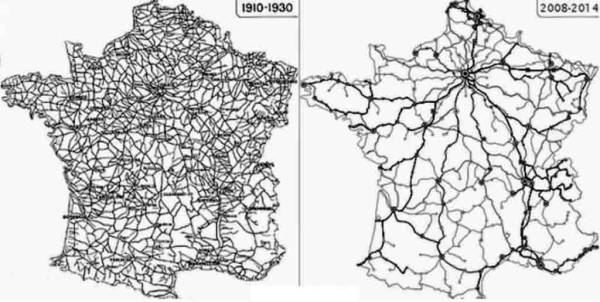
> Was weapon making done by governments rather than companies other than in the world wars?
Only in the far past, not in the last century UNFORTUNATELY.
> When did they do energy production?
Until around the '60s all "big national player" like ENEL (Italy), EDF (France), Endesa (Spain) etc was 100% public, oh and at that time 90% of nuclear reactor was built and put in service. They are still there. All new ones after privatizations IF there is ONLY one in service is a record. And a very expensive and late record.
But we did get a lot of money grants for municipal-owned fibers in rural areas, so basically the local government owns the fiber and rents it out to all interested telcos at the same price.
Bell (the phone provider) REALLY wants me to "go optical". For speed... But - Bell (the phone provider) is forced to share the copper. They do NOT share the optical! If I "go optical", they rip up the copper, and force me to use Bell or the cable company.
TekSavvy would be shut out (actually, they can use cable). I refuse to give business to the cable company (for other reasons).
So - vDSL all the way! Fortunately 25/5 mbps is sufficient for my uses.
Why TekSavvy? (1) they do NOT block ports (2) they can provide static IPv4 addresses -- so REAL INTERNET.
Something I do NOT get from either phone or cable companies.
Monopolies being monopolies are charging the consumers exorbitant prices, making Canada one of the countries with the most expensive Internet.
To create some semblance of competition, the 2 companies owning the infrastructure are required to rent it to smaller service providers (although at arbitrary prices effectively pricing them out). The arbitrary pricing was contested by the smaller providers and the regulator attempted to mandate fixed prices for infrastructure access. That was in turn contested by the monopolies, arguing that they were forced to subsidize the smaller providers.
That said, I think it would be a much better idea if our government had balls to actually separate infrastructure owners from the service providers, and block further mergers. So multiple end user facing companies would compete for access to the same infrastructure, and the infrastructure owners would compete for servicing the providers, not being able to directly own either of them. Both layers would be have the incentives to offer good service at reasonable prices, while the current incentive for the infrastructure owners is to hamper the small players as much as they can.