On the other side of things, on Reddit, nothing unfavorable about Ukraine is getting attention. You don't see any posts about Russia gaining territory, or Zelensky censoring media outlets favorable to opposition parties.
And nowhere on reddit or in the media do I see a discussion of the pros and cons of a Ukrainian surrender. It's really hard to see how Ukraine will successfully fend off a country 10x its size. (If someone has an answer as to why that might be realistic, I'm open to hear it).
It's really hard to see that Ukraine by itself could defeat Russia and it definitely seems far fetched, even if the Russian army has shown itself more inept than expected.
But that isn't what is happening either, and a Ukraine bankrolled and armed by the west. That is something else, and that combination might definitely be abel to defeat Russia. So the question is more, is the west or parts of it willing to spend enough and accept escalating tensions with nuclear armed Russia by doing that?
If you look at what Zelensky is doing at the drumbeat of asks for more weapons is obvious that Ukraine is fully aware of this.
It is actually more of a problem than an asset, because they must guard very long shores and borders against unfriendly neighbors. And if they decide to redeploy a unit from Khabarovsk to Ukraine, it takes at least a week to move it by rail. Probably longer than that. Not exactly a recipe for flexibility.
On the flip side they can afford to give up a lot of terrain while they get their act together. And now the other side has super long supply chains that they have to deal with.
See World War 2.
The Napoleonic wars were yet another great example of a strategic retreat and bleeding the enemy dry in the endless frozen steppe.
But for attacking someone else, the situation reverses and now it is Russia that faces serious logistical problems correlated to its sheer size.
It's actually almost 30× the land area (6.6M mi² vs 233k mi²)
The best effect of Russian admirers and propaganda alike is that people think it is bigger then it is and that everything Russian is better then it is. It is also country where huge amount of population does not have flushable toilet, have huge inequality and massive amount of internal issues.
Russian main advantage is that it does not value human life and is OK with massive looses. And that it has zero ethical limits with regards to civilians. That is amount of greatness.
Parent: russia is almost 30x the size of ukraine
This comment: what?! you're confused by russian propaganda! it's only 2733% larger than ukraine
And then, even if you adjust to claim that you were trying to reinforce parent's point, that's not plausible either since parent was actually pointing out that people's belief that russia was 10x bigger was actually a large underestimate of its size.
That and, a lot of the Russian military (the reserves) and their equipment (ships, subs, intercontinental bombers, nukes, etc) are not really going to help the Russians win the conflict, since they're either not useful, or politically impossible to use.
I think if Putin can sell to the Russian people that this is a war, not a special military operation, and as such, they should call up the reserves, break the law about how those reserves are allowed to be used, etc, then they could probably win. Without that, I don't think it's that realistic: they're fighting against a totally mobilized country that's being flooded with high-tech weapons. Imagine afghanistan, if the taleban were armed for free by the western military-industrial complex. The US wouldn't be able to do it. Russia almost certainly won't be able either.
He might "escalate to de-escalate", i.e. make a lot of noise about escalation to intimidate Biden (so far it worked), but it can only be bluff. Whichever metric you use, the ratio of power between Russia and Europe is much greater than Ukraine to Russia.
s/are doing/have done/
History is replete with completely incompetent offenses that were highly useful and motivating learning experiences.
I'm not sure that Russia is culturally in a position to be their own schoolmaster here, but they could be. And they have virtually infinite domestic capacity to churn out, man, and power last-gen war materiel, even with sanctions.
Only time will tell. Nobody knows anything yet.
Russian equipment loss in this war won't be replaced for decades if not longer.
Everyone refuses to trade with Russia until they're reduced to one of the most miserable countries on the planet. If their nuke program falls apart, several countries take some territory from them and no-one minds. Possibly they're reduced to selling parts of the country (maybe on a lease-like arrangement, which isn't unprecedented) in exchange for re-opening limited trade with countries that are willing, but see that they really have them over a barrel (China, again, is a likely beneficiary)
Several countries start or re-prioritize nuclear programs. Turkey, Iran, South Korea, and maybe even Japan, all likely candidates. Maybe more.
That's roughly what I'd expect the world to do about it, if the result isn't a spiral into outright nuclear war, or a swift and decisive coup in Russia. No, it's not good, but it's especially not good for Russia.
I see this differently.
My understanding of the Russian "heartland" narratives suggest Russia is dead if they cannot control Ukraine in the medium term. Their "multi polar" view suggests that they MUST be at the centre of an anti-US alliance extending across Asia, Europe and Africa.
From these perspectives they HAVE to fight this war now. Even if they lose now, they feel they have to keep trying.
There are many paths but they are all long term "replace the Taliban with the Taliban" type ones that people don't wanna talk about.
The current Taliban are way, way more liberal than the 90s Taliban. They've embraced modern communication, dropped most of their Pashtun ethnic supremacy stuff and are a little less violent across the board. That's really a big change all things considered.
Every Ukrainian defender kills 10 Russian occupiers?
Obviously some will be less fortunate, and a select few will go down in history as extremely effective removers of Russian conscripts.
I don't know many western countries that would tolerate to be invaded, having some territory taken off without fighting back bitterly. I mean this is the whole story of ww1.
In the end it is up to the Ukrainians to decide how much pain they are willing to endure for their independence and freedom. But if they chose to fight, it's not our role to second guess their decision and it is our duty to help them (at least us Europeans - for US citizens, different story).
Isn't this up the ukranians themselves? I mean really.
Maybe the Americans should have just given up on their revolution in order to save more lives. There is no way they could win against the might of the british empire.
Nope. The world needs Ukraine to be a buffer state. Sorry. Greatest good for the greatest number and whatnot.
Just like many of the sportspeople who aren't in the country, even those who have left since the invasion, the majority of people who disagree with it are too afraid of the consequences for saying too much or saying anything against the Kremlin narrative.
As an example, a Nobel-winning journalist was assaulted by pro-Putin Russians in public, when he has even abided by the new laws.
Also, I doubt Putin's regime is more frightening than the risk to die in a pointless war.
If Ukraine refuse to cooperate with Russia and fight a guerrilla war, there is absolutely no way they can hold the whole country.
Morale: While the war is popular in Russia, that's mostly among older generation who won't be fighting in the war. On the other hand Ukraine is highly motivated to not become a part of Russia.
Logistics: The Russian military logistics are terrible, their military was built to wage a defensive war next to Russian railroads. They don't have much practice projecting power.
Kleptocracy: The Russian commanders have been systematically stealing all of the money Putin was pumping into the military.
Training: Since 2014 the Ukrainian military has undergone a revolution building a modern NATO trained military, the Russian military just isn't as good.
Command: The Russian military does a lot of top down decision making, this means they can't react to news quickly. There observe -> decide -> act cycle is so long they can't really hit moving targets.
The only advantage Russia has is a larger population, and nuclear weapons. Every other advantage is to the Ukrainian's. Right now Russia has taken losses similar or worse than the absolutely worst his armies in the civil war. There are battalions where 80% of the soldiers are dead or wounded.
A large portion of the Russian military goes home in June, and they're going to have a tough time replacing them when Ukraine is viewed as a meat grinder.
The status quo is far too advantageous for the pro-war segment of our national security establishment for that idea to get any traction. Currently we have a "moral" war for the first time since the Balkans, it's strengthening NATO, and Russia is being weakened at the expense of mere pocket change and outdated weapons. And from a PR perspective, the American public cares far less about Ukrainian casualties than dead American soldiers. Then there's the benefit of blaming Putin for inflation with "Putinflation" and advancing other goals like shutting down Nordstream 2 and selling LNG to Europe.
I'm pro-Ukraine, but I can't help but notice how average Ukrainians are being screwed by this conflict, while US foreign policy hawks are breaking out the champagne.
I feel sorry for the Ukrainians, having met a lot of refugees in Prague. But I don't believe that they would rather surrender and have "Russian peace". Some of them perhaps, but not the majority. They do not want to be yoked again.
And that's not even considering how Ukraine has taken thousands of casualties, has it's economy wrecked, had millions of people flee the country, and much of their infrastructure is ruined.
They can possibly agree to territorial losses (though after all the bloodshed and murder I consider even that unlikely - not just that, but the West does not want Putin to gain anything from this war, so it will support Ukraine until victory, however long it takes), but not to any kind of hollowing out of their army. That would be a prolonged national suicide.
I have seen daily posts about Russia gaining territory in news. For weeks, it was daily report of Russian progression even with maps.
And Russia is not 10x bigger.
I have also seen more articles about nazi in Ukraine then nazi in Russia. In fact, Russian fascism and Putins rehabilitation of Stalin were oddly missing. For years, but also during this conflict.
It was only when invasion started to look like genocide journalists started to look more at who Russia actually is.
Firstly, the size of a country doesn't immediately matter, it's more about the size of the army. E.g. China 50 years ago was bigger than the US, but couldn't "win" in a war with the US.
Having said that, wars are a political tool. For the most part, wars aren't about fighting until you "kill everyone" or anything like that. They are fought to achieve certain goals, and end when one side decides its goals aren't worth the price of the fight.
This is true in all situations - even in a war of conquest. Ukraine will put up a huge fight, because the goal is to stop themselves from being conquered. But there could come a point where they decide to surrender, because the death toll will be too high (or because the leadership is captured and threatened, or because the army is too fatigued to continue fighting and surrenders without the leadership, etc).
Likewise, it's possible that Russia decides to stop the fighting. This could be because they decide it's weakening the army too much (too many soldiers dying and munitions being used up). Or it could be because internal public opinion is too heavily against the war. It could even be for reasons that are only internally visible, like that Putin starts feeling that his position is threatened because of the war.
All Ukraine has to do is to keep up their resistance long enough for the war to not be worth continuing from Russia's side. Or for the rest of the world to decide to help more than they are, which is why Zelensky's main goal is to keep the front-and-center in the West's consciousness. How long that is (if it's even possible) nobody knows.
Do what the Taliban did in Afghanistan to defeat US.
No different than what Britain did to pro-German media and parties during WW2.
I've had a hard time with this one as for weeks it was "Russia is not advancing, yada yada" meanwhile the graphic they showed while saying this clearly showed a map with more occupied territory than the same map the day before and another city under siege which has deteriorated my trust where I was a skeptic before, I did at least think war reporting would be rather accurate. I really got the feeling they were trying to calm us down and getting those talking points from some unified source (the govt?) and worries me that this conflict does in fact have potential to get massively out of hand
Ukrainian propaganda for an instance is obviously not eager to report on their military losses but have to do so to counter-attack Russian propaganda. It's just that it makes sense to be truthful when you are morally justified and in overall winning.
Same here. I consider myself a big consumer of news from a variety of sources, and it's hard to get nearly any perspective except "Ukraine is dominating the battlefield". It's strange times, but this is the information war.
I think there are too many Cartesians sitting in front of their screens going "perhaps an evil demon is trying to fool me about everything!"
Question is whether you think "Russia made a planned withdrawal from the north of the country after completing all the objectives of this military exercise which definitely isn't a war" is a more plausible description of the short-lived invasion of the north of the country than "Russia's advances have slowed down... Russia stopped advancing... Russia is retreating...". Both narratives agree that the facts on the ground are that Russian troops made large scale incursions into the north of Ukraine but aren't there any more.
Yes, most Western media has sought to emphasize Russian casualties over Ukrainian ones and Ukrainian minor success over Russian ones, but it's not like Western media hasn't been free to predict Russia will have full control of Mariupol in a couple of days for over a month now and talk up the Russian convoy advancing on Kyiv which never made it there, or like the official Russian narrative isn't palpably absurd.
Propaganda is one thing, but right now every report we have, incoming from Russian state media, points in the direction of "Russia is getting their ass kicked".
I think the West expected better but not lot better, it does seem that was about what Russia expected (possibly on bad political intelligence on how the population would respond to an invasion.)
You still have fawning over Russian this and that, culture, shock over their army being disorganized and corrupt or looting etc, despite them being like that always. While Ukraine was mostly non-existent.
That was pretty explicitly stated by a number of officials, I just get the feeling that they thought the timeline would be longer than what the Russians were thinking, but probably in the 2-3 week window for the government, in any meaningful form, holding out, with the situation, at best being guerilla resistance after that.
It's funny, I don't recall seeing any pro-Russian sources stating that the goal was to capture all of Ukraine. In fact, they've publicly stated their goals since the beginning, and annexing all of Ukraine was never listed. Where did this idea in the media come from, since it didn't come from Russia..?
"Ukraine has returned to Russia...It will be reorganized, re-established and returned to its natural state as part of the Russian world...[Russia, Belarus and Ukraine will now act] in geopolitical terms as a single whole,"
https://www.newsweek.com/state-run-russian-news-site-acciden...
Also if you take the time to notice what Putin is saying and doing you will realize that denazification = genocide. The goal was not to arrest Hitler's fans but to destroy Ukrainian nationality.
https://snyder.substack.com/p/russias-genocide-handbook
From Wikipedia.
"Genocide is the intentional destruction of a people — usually defined as an ethnic, national, racial, or religious group — in whole or in part."
Interesting take.
What they do is far more informative than what they say. What they say also includes Mr Putin's frankly unhinged speeches calling for more Russian Lebensraum.
Second, the point of such disinformation is not necessarily to make everyone believe this story, but to muddy that waters so much that people are no longer sure where the truth lies, they either fall back to the "well, there must be truth on both sides" or just give up on ever finding out the truth.
Thus, this kind of disinformation does not need to even be self-consistent or even that believable. But it does need to be relentlessly sent out.
Not accurate, read the above again, and follow the links.
Well, their publicly stated goal was "this is a training exercise how dare you accuse us of anything", and we all saw how much truth there was to that.
In another thread, he describes it as:
> So to put it bluntly, if the 'clever plan' was to lose 10,000 KIA to set conditions to walk away with the Donbas, that's a stupid plan. That's winning the negotiation on a $15k car by cleverly offering an opening bid of $55k and throwing in your old car as a sweetener.
Admittedly I'm not a historian like the Twitter guy with the bad analogies, but I suspect the furthest west that Russia seeks to control is Kherson (not Odessa), then following the water going back NE of there to Zaporizhzhia & then all the way up towards Kharkiv in some fashion. This gives Russia a ton of natural[1] and industrial resources, plus significantly weakens Ukraine, without having to try and occupy the more populated and less Russian areas west of there towards Kyiv and further. Putin will likely try to sell this as necessary to provide a buffer zone for the heavily Russian Donbas region from Ukrainian shelling.
That being said, I'm just some turd on the internet so I'm probably wrong and nobody knows for sure what Putin's long term plan is.
[1] https://w7.pngwing.com/pngs/864/537/png-transparent-ukraine-...

"the Azov Battalion" hasn't existed since 2015
https://en.wikipedia.org/wiki/Azov_Battalion#Current_status
https://www.cbsnews.com/news/ukraine-russia-war-azov-battali...
https://edition.cnn.com/2022/03/29/europe/ukraine-azov-movem...
Cite your sources please.
I note that they also say "Moscow has given the regiment an outsized role in the conflict" ... "Ukraine "is not a cesspit for Nazi sympathizers" ... "There are far-right actors prominent in Russia, too." ... "For its part, Russia also has a thriving ultra-nationalist scene that is tolerated by the authorities." ... " some experts say Russia's fixation on a minor player like the Azov movement serves a purpose -- allowing the Kremlin to frame the conflict as an ideological and even existential struggle. However remote from reality that may be."
> "Azov's military and political wings..."
And which one - military or political - is of interest to you?
The first, the military wing, is just another regiment (not a Battalion) under regular military command now.
There are _militant nationalists_ in a country's _national military_ ? No shit, that's literally the right place for them. Any country will be the same: people who want to fight for their country are a natural fit for ... fighting for thier country. Tell me that the USA doesn't have any gung-ho conservative patriots in the armed services ranks before you make a big deal out of this.
This is not remarkable about Ukraine outside of Russian propaganda, as the above CBS and CNN links make clear.
You say that the army is "very much involved in the current conflict"? No fooling, what else would the actual army be doing in wartime?
The second, political:
Myth: "Nazism is rampant in Ukrainian politics and society, supported by authorities in Kyiv."
Reality: "The candidate for the far-right nationalist party, Svoboda, won 1.6% of the vote in the 2019 presidential election."
https://www.theguardian.com/world/2022/mar/03/russia-ukraine...
This is a much lower percentage than in many EU countries. And I that see your "far-right National Corps party" was similar. https://en.wikipedia.org/wiki/National_Corps#Election_result...
Reality: President Zelenskyy is secular Jewish, and the Odessa religious Jewish community was thriving in 2018
https://www.haaretz.com/world-news/europe/.premium.MAGAZINE-...
That is not an indicator of widespread "neo-Nazi leanings".
So why do you continually bring this misleading scare story up? It's nothing but Russian propaganda talking points that don't have basis in current reality. The CBS link above made that clear, but you did not respond to it. Your own CNN report says the same.
Talk to us about the same in Russian military (e.g. Wagner Group) and society (Mr Putin's recent unhinged speeches calling for more Russian Lebensraum) before you say that this is a Ukrainian problem.
Interesting take.
no, I said that "the Azov Battalion" hasn't existed since 2015, when it ceased to be either independent of the military or a Battalion. This doesn't stop you using the misleading phrase.
> and then when you get called out
Cherry-picking quotes from a CNN article, without attribution, does not constitute a "call out".
> you write a text wall
I'm sorry if you didn't take the time to read it, but that is not a counter-argument in any way. First you say "you can't back up your claims with sources" then you change to "oh no, too many claims and sources, and thanks for locating my source for me, but let me fail to talk about any of them at all, but let's repeat a slur word and finish up with a 'zinger'!".
Not interesting.
Sometimes what a person says and a person does don’t agree. In situations like that—you don’t need to believe what they say! You can just accept they lied and move on.
It's the same as the maps of county-by-county US election results that show a sea of red that equate to a population smaller than LA county.
People are the important unit in political conflicts and Russia is very much struggling to take any meaningfully populated area (See: Chernobyl, a place where sane humans refuse to go, being one of the first trophies)
And here's an interesting take: https://medium.com/matter/the-trouble-with-the-purple-electi...
Maps should not be treated as simple visualizations. They can (and should) contain plenty of information, and interpreting them properly often takes a lot of skill and effort.
I do find it interesting, though, that the media is willing to show the civilian casualties of this war, when there was a practical media blackout on the same type of reporting of the wars in Iraq or Afghanistan.
I can't imagine why. There are massive disinformation campaigns and only a psychopath could be an impartial observer while watching two sides kill each other.
The "fog of war" is hard to penetrate for anyone, from reporters to combatants.
I recall with the early days of Iraq and the Baghdad invasion that I felt like I was getting the full picture. Perhaps because it was US forces with journalists in tow. The reason we were there was highly questionable and suspicious but I felt like I was getting a rather accurate picture of what happened on the ground.
I say all this but should also mention that my perception could also be significantly off. I am not a regular consumer of news and this just happens to be what I'd see when I decided to get a quick update on the situation.
I've noticed this too, and I need to make a point:
In the long run, this will be a serious security threat to Europe.
In this, Europe took almost completely the wrong lessons regarding America's role in NATO. Yes a stronger NATO is good. Yes, stronger ties to America are necessary to counter Russia.
But now is not the time to abandon strategic autonomy. Just the opposite. Macron is right, just as DeGaulle before him was right. Yes, Europe should ally with the United States, but it also must begin to stand on its own two feet.
Why? Because the next American generations don't give a shit about Europe. In a very deep way, Europeans have not absorbed the social earthquakes that have hit the United States. In younger American minds, Europe doesn't matter. Ukraine doesn't matter.
Europe should maintain its alliances, but it also needs to plan for a future in which it depends only on itself for its defense. It needs to do this seriously and as though its life depends on it.
I think you misinterpret what Europe is doing, because it's mostly doing exactly what you propose. Hell, even Germany seriously plans to overhaul it's dismal army.
They are just now waking up from two years of debating whether not wearing masks was a hate crime.
Maybe in their minds, the conditions on the opposite side of the world just seem too brutal to belong in the same reality. It looks and sounds too crazy to be real, so they can't decide if it's fake.
I don't recall putin or medvedev ever being mentioned in that class, but it's clear that's the time that mattered to them, defining their worldview.
Words of Wisdom. It is the same with China as well. On the surface your might think things are moving in the direction to whatever you viewed or desire, western democracy in this case. But as your professor stated. Nothing has changed.
https://www.economist.com/obituary/2022/04/16/vladimir-zhiri...
What we are seeing, is that the transition out of the idealistic world view, is happening at a much later age. That is already happening with Gen Y or Millennials, and especially those in Tech. People who are over 40s still have these simplistic world view.
I dont know what it is about Tech. But it is especially problematic in tech.
by example -- I knew about ancient greeks partly due to interest in classics as a young intellectual.. most people at that age did not know any details of ancient greeks. But I did not care very much about military history, so even if I knew it, I didnt factor it into relevant thinking. Next, wrt middle ages history of Ottoman slave society, fluxes in military rule in North Africa, or endless tribal and cultural clashes in eastern Europe.. I just did not know many of those things, to this day. Maybe I might care, but I had literally not heard of certain things (like Mongols in Poland, or Napolean imprisoning a sitting Pope, or Vikings in Turkey) and did not know they existed, even as as active learner.
So to sum up, people may know a little bit, but do not care, therefore do not apply it to reasoning. Even people who do have greater capacity for details, may not know, due to incomplete learning and local teaching of history. Last, wikipedia really is a remarkable thing in our time.
I would argue precisely the opposite.
Support in tech for Ukraine is quite high because most people have worked with Ukranian programmers, generally find them to be decent human beings like all human beings, and seeing posts/pictures from someone you know in the midst of being attacked upsets you.
Most Americans working non-tech jobs, even the supposedly worldly younger-than-Boomers, have never had contact with somebody outside American borders. Tech can expand your world. Tech can also simply provide a safe bubble that never disturbs your delicate sensibilities.
Maybe I'm old but I haven't seen any of these things. Where do you find all of these?
> It is not uncommon for Ukrainians to refer to African-Americans as “[N-Word]”. Volunteers of color may be called 'a monkey' or may see children’s games with Blackface. Being aware of the history of dehumanization for people of African descent may help inform where this comes from; it does not justify it. It will be at your discretion to determine the intent.
[2]
> "Problems arise when young foreigners are prioritised over women and children of Ukrainian citizenship who are trying to get on the same trains."
> "Maybe we will put all foreigners in some other place so they won’t be visible and there won’t be conflict with Ukrainians trying to flee in the same direction. This is something that has to be taken care of and we will be doing it."
[3]
> Ukrainian servicemen help evacuate civilians near Irpin, #Ukraine. Three civilians were killed as Russian mortar rounds landed, striking a route used by civilians fleeing southeast toward #Kyiv.
trooper in the front sporting a Black Sun patch
[4]
source for the other comment
----
[1] https://www.peacecorps.gov/ukraine/preparing-to-volunteer/di...
[2] https://12ft.io/proxy?q=https%3A%2F%2Fwww.independent.co.uk%...
[3] https://twitter.com/GettyImagesNews/status/15004917028801536...
Prior to the invasion, there was rampant criticism of NATO, and calls for its dissolution, on left-wing media, as an instrument of American imperialism, despite the fact that Russia has a history of aggression against post-Soviet states (e.g. Georgia) in the 21st century. With the outbreak of the war (outside of east Ukraine), some have walked back the more extreme aspects of those statements (as NATO's potential usefulness has been illustrated), but American imperialism via NATO is still discussed in the same breath as Russian imperialism via a military invasion and territorial annexation.
The truth is we have very little choice in our great powers or global hegemonies, and I will always take the NATO brand of "imperialism" (e.g. where countries literally ask for American military bases to ward against actual aggression) over the Russian brand. Should we be skeptical of NATO? Of course, as we should with all power structures, especially when they engage in actual violence; but to not have a nuanced discussion about what actual imperialism looks like in the 21st century, and to simply be blanket "anti-imperialist," is juvenile, and I'd argue probably detrimental to those that actually feel its real world effects.
Can you provide examples? I have not seen this, and as dissolution of NATO or otherwise weakening NATO was a goal of the previous administration, I am confused at this claim.
With that in mind, here is an article from 2018 in Jacobin, a left-wing magazine, saying that, regardless of Trump's comments, NATO's continued existence remains a valid question [2]; in fact, the Democratic Socialists of America (the primary progressive/socialist/labor party in the US) has calls for the US to immediately withdraw from NATO as part of its stated policy, even after the Russian invasion of western Ukraine [3]. These are among the most well stated positions regarding NATO skepticism on the American left, but similar opinions were expressed throughout left-wing independent media in the months leading up to the invasion (and earlier).
1. https://abcnews.go.com/US/trump-seeks-rewrite-role-bolsterin...
2. https://www.jacobinmag.com/2018/07/nato-donald-trump-putin-c...
3. https://www.dsausa.org/statements/on-russias-invasion-of-ukr...
When you state you are a "millennial on the left", In the context of US / Americans, does left here means Democrats, or does left here means left on the political spectrum. Or at least left in the US political spectrum. ( Since left in US and left in UK are largely if not completely different )
Because I have seen a lot of "NATO skepticism on the American left". I dont even think the word skepticism is correct. They literally wanted to cancel NATO.
Wouldn't your view, in this case be more aligned as what is called centre-left? Especially in the context of US. Because if an outsider were to judge the US Left purely from Internet / Social Media / TV / Mass Media, than being pro-NATO ( so to speak ) is very much a right wing or non left wing view.
I don't think I would describe myself necessarily as pro-NATO, I just don't think its dissolution is reasonable, and I think its actually quite arguable that NATO dissolution would be a net negative. With that in mind, it's not uncommon for people, who are otherwise very far off from one another on the ideological or political spectrum, to agree (or at least agree in policy outcome) on individual issues (especially foreign policy ones). That's the nature of using a relatively one-dimensional spectrum to describe a complex system of beliefs.
Yes. I mean internet discussions are already hard on any subject with just text and little context. And politics is possibly the worst of all subjects.
Thank You for the well reasoned reply.
The aggression against georgia was due to NATO. Just like the current aggression against ukraine. NATO's existence is a threat to world peace just like the soviet union was. Any sane person would be for the elimination of NATO.
> and I will always take the NATO brand of "imperialism"
Yeah because syria, libya, etc are doing so great. NATO's imperialism has murdered far more people than russia's. Even in europe - yugoslavia.
> (e.g. where countries literally ask for American military bases to ward against actual aggression) over the Russian brand.
There are ukrainians who asked russia to protect them too...
A complete inversion of reality. Post-soviet states want to be part of NATO because they are afraid of Russian agression, and Russia is afraid of those states joining NATO, because that means it cannot agress against them. Hence, Russia starting border conflicts in countries that wish to join NATO in order to secure Russia's ability for further aggression later.
If you don't mind me asking, do you think the invention of the nuclear bomb was a mistake, and the world would be better off if nukes wouldn't have existed (1945-)?
There is some truth in that. But you are conveniently leaving out the other part. These post-soviet states are threatened with economic isolation/attacks/destruction/etc from "NATO/EU/US". Lets not pretend we are saints. The empire that needs to go today isn't the soviet union or russa. It's NATO. The greatest source of destruction, death, instability around the world.
> because that means it cannot agress against them.
What exactly prevents aggression against post-soviet states? Nothing. All their membership means is that they get to serve as buffers/firing range. Instead of germany or france taking the brunt of the bombs, it will be poland, latvia, etc. If russia invaded a post-soviet state, which country in NATO will come to their defense if it meant getting nuked by russia? Do you think britain is willing to get london nuked over lithuania? Think france will sacrifice paris? Every international treaty has been broken for a reason. If russia marched into poland or lithuania tomorrow, we'd all say see you in another 60 years.
> If you don't mind me asking, do you think the invention of the nuclear bomb was a mistake, and the world would be better off if nukes wouldn't have existed (1945-)?
No. I think every country should get nukes. Who doesn't want ukraine to get nukes? Russia and NATO. Think about it. Who doesn't want poland, lithuania, estonia, etc from getting nukes? NATO. What would have kept ukraine safe? What would keep post-soviet states safe? Nukes.
Lonely north korea angrily firing missiles into the sea of japan is far more secure than any post soviet state in NATO. You would think these post-soviet states would have learned their lesson, but they apparently have not. The only thing these countries have going for them is russia's weak economic position and the lack of incentive to invade post soviet states. Simple as that. Is there any sane lithuanian who truly believes any country is willing to suffer nuclear destruction on their behalf?
The first point is something that you'll have to resolve yourself, so I'd actually like the time to disagree on your second point - that a small nuclear force provides deterrence against major powers, like North Korea. North Korea has a very small nuclear arsenal, and an even smaller number of carrier missiles; this is exactly the threat you counter with BMD, and indeed, if you look at a map of where the US's BMD is located, you will find that it's squarely pointed at North Korea. North Korea is safe for other reasons, not because it could lob a nuclear-tipped missile at the US; it could lob nukes at various US allies, this provides deterrence, and is more difficult to defend against (and, as you would expect from this line of reasoning, both Japan and South Korea have been investing and continue to do so a lot into BMD). And North Korea is of course in a range where it could glass Seoul using conventional weapons, which is virtually impossible to defend against. On top of that there is an unclear amount of China in the back of North Korea; it seems unlikely that you could intervene in NK without China doing something.
The situation is even worse for a country like Lithuania. Even assuming they bring up their own nuclear arms program without Russia or anyone else intervening, which seems like one heck of an assumption to me, deterrence requires that you're actually able to feasibly launch something. This essentially rules out land-based nukes, because Lithuania is too small and all possible locations are too close to Russian land forces or naval forces to be able to launch a missile without giving a large window to intercept it. Air-based nukes are out for similar reasons, the country is small enough that air defenses would cover most of it. So now you're looking at SLBMs and the submarines that go with them.
There is only country that managed to do something like this, and that's Israel. And it does not border on another nuclear country, not even close - in part because they actively prevent that from happening.
This would have played a decade ago, or even after Russia's quasi-covert military actions in Ukraine in 2014 that were easily relativized away. But these days, tens of thousands of humans in mass graves and billions worth of destroyed civilian infrastructure say otherwise.
The USian economic empire is a malevolent force, for sure. But Russia's industrial genocide and concomitant domestic nosedive into totalitarianism is on a completely different level, on a scale that we thought was a relic of the 20th century. Equating the two demonstrates a staggeringly foolish lack of perspective.
The civilian casualties in ukraine since 2014 is about 3,000. Not sure where you get tens of thousands.
> But Russia's industrial genocide and concomitant domestic nosedive into totalitarianism is on a completely different level, on a scale that we thought was a relic of the 20th century.
You do realize that far more people died in iraq, afghanistan, etc than will ever die in ukraine right?
That fact that you have to outright lie shows that your position is wrong.
He is clearly referring to the 2022 Russian invasion of Ukraine.
> You do realize that far more people died in iraq, afghanistan, etc than will ever die in ukraine right?
Iraq was notably not a NATO operation, and Afghanistan was a protracted twenty year long war that saw some ~50 000 civilian deaths. At this point, considering the intensity and very high casualty numbers in the 2022 invasion of Ukraine, it's hardly credible to claim to know how many will "ever die in Ukraine" if we don't even know where that war is going, let alone how and when it will end. Above you also brought up Syria, which is again not a NATO operation, and Libya, where some 10 000 NATO air-strikes ended up killing less than hundred civilians [1]. Would it be better if those 40-70-ish people not have died? Obviously. Is an amortized 0.7 % chance of a given air-strike killing one civilian showing that NATO targeted civilians? I think not. That brings up to the NATO bombing of Yugoslavia, which if I recall is the only time NATO actually did something without UNSC (~everything) or Article 5 (~once) authorization, solely based on all NATO members agreeing to do it. Personally, I think it was the right thing to do, but it was done the wrong way legally and operationally.
[1] A popular claim on social media is that NATO killed over 500 000 civilians in Libya, which would amount to about 10 % of the population at the time.
The magnitude of the Iraq body count is horrendous, agreed. USG unilaterally deciding to attack Iraq is undeniably evil, agreed. If the US empire diminished, it would be a good thing - assuming it were due to underlying causes weakening the fundamental viability of large influence structures, and not simply different empires becoming more powerful.
But since we're talking about war, and not say cryptography bolstering personal liberty, then I'll begrudgingly accept the least-worst empire. And that is the role the US is playing in this situation, supporting Ukraine's self-defense against an aggressive totalitarianism-resurgent Russia. It does bother me to say that, knowing weapons manufacturers and other architects of USG's aggressive wars are making bank, and knowing the perverse incentive is for USG to string Ukraine along with just enough supplies to damage Russia but not make for a decisive end to the war. But I remember I am against Russia's imperialist attack on Ukraine for the same exact reasons I was against USG's imperialist attack on Iraq. The roles of the players have changed, so I must incorporate nuance to my views rather than leaning on the same old USG-bad heuristic.
> Gen Z is also more diverse and broadly anti-American (or “anti-imperialist”)
as a factor contributing to not supporting US and ending up supporting Russia, one of the most imperialistic nations out there. The irony :(
They've been raised in a post-modernist neo-marxist environment that very clearly marks the Western order as evil. To them, there is no "good vs evil", because they are evil and the West has no redeeming factors.
Why would you fight to defend that? Why fight to spread that?
Add a keen awareness of the Elites (however you define them) as the sole beneficiaries or war. The conscript or recruit on the ground pays the price so some WEF-agenda shareholder gets to see a bigger dividend this quarter? Hard pass fam.
Add in a general anxiety about everything: from talking to a stranger to the impeding collapse of life on Earth due to climate change within X years (where X is always a handful of years away), and war doesn't make sense. There are Bigger Issues than some lines on the map drawn by Evil White Men.
Now obviously this is all a generalization, and all of it goes out the window the minute someone shoots at you, but it's going to be interesting to watch what tactics have to be used to get an unwilling generation in the metaphorical front lines.
> Why would I, ever shoot someone just like me because his/her/xyr government has forced them to point a rifle at me?
It's irrespective of the western order being evil or anything to do with climate change. Sure, there's a sense that the elites are the only beneficiaries of war, but even before that you'd have to explain why it's okay to shoot someone for someone else's _benefit_, even if it's our own. The very idea is absurd.
I think most millennial sorts are on board with the idea of a "war to stop atrocity", but that's about it. Why would you hurt someone to get what you want? How medieval.
You may have your family spread across the continent, on your island, or concentrated around a single town.
That's why I pointed out that the position as stated is relevant only to the nationalist ideology.
It's all connected... if you let oil-hungry autocrats rule the world, climate change is completely out of the window. Also human rights and ideals we should all stand for.
I do want peace as soon as possible. I believe a compromise might be necessary. I think Putin's worldview has been shown critically dated, so hopefully Russians can rise against this sort of government eventually. It's very difficult to rise up when your life is threatened by the regime though, but reason and truth tend to find their way through the cracks.
---
I am specially moved because of the parallels to Nazi invasions. Doing nothing proved a grave mistake, not standing up for human rights, giving fascists the benefit of the doubt cost so many lives. I've said "never again" too. It's easy to fact-check the fascist lies in this case.
I suggest any new generations read Anne Frank's diary if you can.
---
Also: don't believe narratives of doom. There's no doom incoming immediately, not from nuclear war (it's been shown it would doom civilization at least), not from climate change (we're in a pathway for significant damage, but it will be decades until it reaches its consequences, and it`s certainly no doom[1]). Doom narratives and hopelessness can create inaction, which is not what we want. Hope is the most powerful weapon for change.
[1] See Kurzgesagt on this: https://www.youtube.com/watch?v=LxgMdjyw8uw
Seconded, in fact I would suggest every read it and re-read it every decade or two or so.
Also, I don't want to come off as a cultural absolutist, I think other countries can have different cultures than standard western; but conquering and imposing culture with violence does not respect basic humanity. Also, we should be able to defend and evolve every culture with peaceful discussion, communication and schooling instead of bombs; and even incorporate other cultures as we see fit (this is a big theme here in Brazil related to our modern art week :) ).
I don't have a personal problem with Russia "winning". How could it possibly be "my" problem. It isn't impacting me and it not my responsibility.
I think that my country has a long history of intervention abroad, and it is nearly always shown to be negative and self interested in hindsight.
In past interventions, most of the information presented to the public is lies and propaganda, so I have essentially no faith any any of the reporting on the current war.
I think the US involvement in this war has resulted in escalated death and destruction, and prevented peaceful resolution.
If it were up to me (as a non-interventionist), the US would have agreed to keep NATO out of Ukraine, and thereby avoided the deaths that occurred. If it were up to me, I would have also offered this in negotiation for Russia pulling out of Ukraine after the war started.
Why do I care what the Russians and Ukrainians do? Now if the American world hegemony or whatever wishes to continue to exert control over Ukraine, fine. But, I have no stakeholdership in that, and it increasingly seems that I and people like me are quite disliked by said hegemony. If they want us to support their empire, maybe they ought to cut us in on a bit more of its spoils, and give us a bit more say in its aims.
What document do you believe said that?
I got that part...
What does that mean? It seems like a contradiction in terms. How could you have someone who rejects modernist ideology but promotes a modernist ideology?
There's a bit more nuance if you want to try to take the term at face value. DDG renders this, which seems reasonable https://areomagazine.com/2022/04/11/is-postmodernism-neo-mar...
Biden's admin is already ..trying.. the "how do you do, fellow kids" approach
https://www.washingtonpost.com/technology/2022/03/11/tik-tok...
That's a funny use of the word skeptical. I think you mean outright ignorant.
That's how we get "Dear Mister President Vladimir Putin…" https://twitter.com/IAMannalynnemcc/status/14968775417720627...
They simply don't care beyond an opportunity to self-aggrandize. We're over a month in, Ukraine is old news already.
Before you call me an old fogey, I am younger than the woman in this video clip with 32 million views.
These are dark times.
This one really annoys me. Yes, people care more about people who look like them, and certainly those who are closer and where war is less common. Same reason predominantly Muslim diasporas in the west care about Palestine a lot
This particular refrain is one that's worth examining from the lens you're dismissing. Under what frame is "war less common" in Europe (or even "East Europe")? An extremely narrow one at best, IMO. A large proportion of pro-Ukrainian propaganda also outright contradicts this notion by referencing historical acts of Russian aggression.
I do concede that this is the least relevant point though, the similarity one is much more significant.
I don't think that's true. It's true the Muslims I know care about Palestine. But, for example, nobody cares about Uyghurs, who are Muslim. I don't know any Bangladeshis that care about the Rohingya, even though they're at least closely related to Bangladeshis (and "look" the same and speak a closely related language). My impression, being part of this "diaspora," is that the common support for Palestine is more about shared animosity against Israel. This animosity is partly just anti-Jewish, but also partly anti-Anglo-meddling, insofar as Britain was instrumental in enabling Jewish repatriation of Israel, and the United States continues to support Israel.
It’s interesting that I’ve noticed many posts of “Ukrainian refugees were accepted, Syrian refugees weren’t; therefore, racism” since the outbreak. I wish Instagram, Facebook, Twitter would release more research on ad spend by company and not activity.
It’s pretty cheap to buy these kind of ads and market toward people who signal boost such causes. So I’m assuming that Russia is doing that.
I've learned there's a certain portion of the population that believes the Russians are behind almost everything.
Logically, there are so many differences between the two populations it wouldn’t make sense to actually make a racism claim (eg, Syrians were high percentage young male vs Ukrainian families; Syria over multiple years vs Ukrainians in weeks; 8M Syrians vs 1M Ukrainians; Syrians travel across multiple countries far away vs Ukrainians in neighboring countries; we’re only weeks in for Ukraine vs years for Syria; etc etc).
The two situations are very different so comparing the two and then saying that the reason is racism seems pretty silly. So I think “what’s more likely, silliness or Russian bots?”
An irony, considering that Russian imperialism is the one that actually performs land grabs and ethnic cleansing without even trying to cover it up.
You can not be "anti-imperialist" and tolerate this war, however. This is a war of Russian imperialism.
American imperialism is bad, I agree with that. But Russian imperialism is also bad. As was British imperialism.
If you're an anti-imperialism, you must be against the Russian invasion.
Anyway, I wasn't trying to disagree with you or anything. Just adding my own clarification around the context from some of the other discussions I've had on this topic. See, for example, macanchex's reply to my topic, which places all of the blame for this war on Western powers.
The dramatic developments we are witnessing today have causes that we knew about but refused to see:
    on the strategic level, the expansion of NATO (which we have not dealt with here);
    on the political level, the Western refusal to implement the Minsk Agreements;
and operationally, the continuous and repeated attacks on the civilian population of the Donbass over the past years and the dramatic increase in late February 2022.This is an Orwellian distortion of language.
Expansion can be interpreted in a literal sense or a metaphorical one. Organizations expand in a metaphorical sense. When we say that a company "expands" by by entering a new market or hiring new talent, we know that this is metaphorical.
NATO is a defensive pact with voluntary membership, but by calling it "expansionist," Russia plays a trick where it evokes the literal sense of expand to transform NATO into the aggressor. It seems fairly plain to me that the real expansionists would be the ones who have literally, physically expanded into a neighboring country by annexing Crimea. The expansionists would be the ones who are currently occupying territory in three foreign nations against the will of those nations' governments.
> and operationally, the continuous and repeated attacks on the civilian population of the Donbass over the past years and the dramatic increase in late February 2022.
By third party estimates, the civillian casualties in the Russian invasion are about two to three orders of magnitude higher than the civilian casualties in Donbass prior to the invasion. This is like slaughtering an entire village because it contains a single murderer. There is absolutely zero ambiguity about where the moral high ground is here.
This does not even include the fact that any civilian casualties in Donbass were either incidents when counterfiring to russian and separatist shelling, or russian provocations.
We can even see this right now in the war: Russia just randomly shells apartment blocks with Grads, while UA only targets real military targets on Russian soil, like Belgorod fuel depots or Taganrog airfield. Russian propaganda doesn't even try to claim that, at least yet.
A voluntary alliance isn't an imperialist agenda (assuming that the sovereign nations have the opportunity to make a truly voluntary decision, without outside coercion).
In fact, many nations have requested voluntarily to join NATO. Ukraine was one such nation, and wasn't allowed in.
Arguing that Russia should get a veto over which defensive alliances other nations join is a pro-imperialist position. You're taking the view that Russia gets to determine the behavior of other nations, because they are "in its security umbrella". I'm sorry, but that position is inherently untenable for an "anti-imperialist".
It's a coherent position for Russian Nationalists, or for believers in Super Power Imperialism.
He seems to be claiming there wasn't weapons transfer to Donbass, etc when they were initially acting as break away republics. How does he explain MH17? I spent too much time looking at this.
To think that Ukraine was shelling Donbass and "provoking" after what we seen in the last 50 days is truly a mental distortion.

On Bucha: https://www.moonofalabama.org/2022/04/if-the-pentagon-can-no...
> Anyone who is still pushing more weapons into Ukraine or tells Kiev to prolong the war is putting more Ukrainian lives at risk for zero potential gain.
Surely life under Russia will be blissful with no Ukrainians harmed.
But if you are american, those things pretty much should be the same. Anti-imperialism is not an abstract struggle, and for many around the world the US and its allies are a concrete enemy they've come by honestly.
If you live in the US, solidarity with those people means using whatever power you have internally to oppose the US's imperial actions.
The US is not the only imperialist force by any means. But particularly from inside one of these machines, it is hard to understand and act against other forms of imperialism without also assisting your own country's imperial projects.
Countries are adept at turning their own subversive and radical movements outward against their political enemies. An awareness of the mechanics of imperialism does I think lead to a "clean up your own house first" praxis and I don't think there's anything wrong with that.
They are not opposing takes. Someone trying to tell you they are is trying to sell you a fiction that just so happens to benefit Russia
But while I don't think that position is correct, I do think it's probably valuable to have some people take that stance. It's similar to the social value in having non-political conservatism that will resist all change no matter what. We'll change anyway, but having to fight for it a little will slow down the changes, hopefully dodge some of the worst consequences, maybe prevent some changes that shouldn't actually happen.
The US should be opposed. Not because we are inherently bad, but because our interests aren't everyone's interests. An always-support, always-oppose, or case-by-case stance will each have different failure modes. I think we want a mix, as unpalatable as that can be sometimes.
Apologists / accidents happen I can understand, but I wouldn't trust any individual pretending that they can do no wrong.
Nuance is important. It's just that younger lefty folks aren't used to having to use nuance on this particular topic.
The media and establishment want it both ways. in the '80s imperialism was BAD. Now, rebranded as globalism, this imperialism is good, but that one over there by them is BAD! and so on it goes.
Can't blame them after the Iraq war and everyone getting on a bandwagon of lies including the left, right and center with the exception of Libertarians.
This is a result of a common propaganda attack by a party that wants to cover up the truth: seed multiple competing story lines through varying outlets to create a sense of confusion. That way, when the truth is reported, people will react to it like it's just 1 more among the many competing stories.
Russia in particular has been running this play both domestically and abroad. It's a formidable approach, and defense against it is difficult.
You get enough of this and people tune out and don't give a lick any more.
This is only true if your conception of 'the left' is just American liberals. Plenty of people and groups on the left were against the invasions from the get-go.
Main point stands though. the media want to have it multiple ways, like John Kerry, one day it's for something, then, the next, it's against the same thing, and a third day it's back on.
https://en.wikipedia.org/wiki/Authorization_for_Use_of_Milit...
The Left (including most of the center-left Democratic faction in Congress) was against the Iraq War, the more dominant Democratic center-right faction was for it (or, at least, against not giving the President the authority to wage it conditionally, which some of them will distinguish by suggesting that the required determinations made by the President under that authority were in bad faith, but that was pretty predictable...)
you should learn about this thing called the 2003 invasion of Iraq, then the Vietnam war, etc.
As is this invasion portrayed as a 'special military operation', what distinction that actually is from an invasion is up to the rules lawyers, apparently.
I don't think it's accurate to say they're "broadly anti-American" because they're "more diverse." The increased diversity in the younger generation is due to Hispanic and Asian immigrants and their kids.[1] First and second generation immigrants are equally or more patriotic than native born Americans, and are significantly less likely to say they are “ashamed” of any aspect of America: https://www.cato.org/publications/immigration-research-polic....
All else being equal, immigration-driven population change is driving down "anti-American" sentiment. Indeed, the only political group where a majority say they’re “ashamed to be American,” progressives, is also amongst the whitest: https://hiddentribes.us/profiles.
I think what you see amongst immigrants is a less ideological view of foreign policy. They have often seen first hand that American has done a lot of harmful things abroad. At the same time, they compartmentalize that because they don't view foreign policy in terms of "good and evil." They may also feel less ownership of America's role and status as world "lawgiver."
I also think immigrants are more cynical than Americans. I'd describe my dad and myself as "pro America," but neither of us care about Ukraine. (And frankly I see no connection between being pro-American and supporting Ukraine.) As immigrants from Bangladesh we don't have idealistic notions about sovereignty and human rights. “The strong do what they can and the weak suffer what they must.” (It drives my Daughter of the American Revolution wife nuts when we say "some countries' fate is to be a buffer state.")
And of course "immigrants" are not homogenous but rather from a wide range of different countries that have various idiosyncratic positions on foreign policy. Some of the most rabidly patriotic people I know are kids of Vietnamese immigrants. Meanwhile in India and Bangladesh, there is a historical affinity with Russia from the Soviet times.
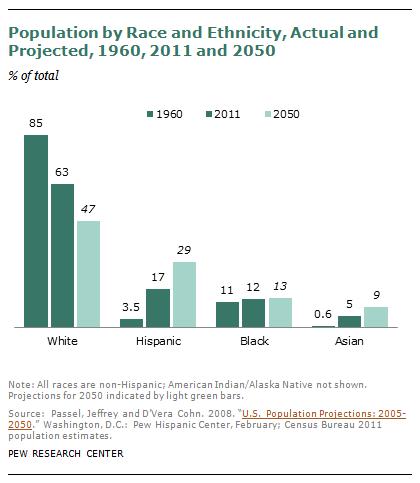
[1] The Black population share was 11% in 1960 and 12% in 2010, and is projected to rise to 13% in 2050. https://thesocietypages.org/socimages/files/2012/11/117.jpg. The white population share will decrease from 85% to 47%, with almost all of the delta due to Hispanics, and to a lesser extent Asians.
https://twitter.com/Acyn/status/1497035201196617733
Carlson (on Fox to millions): "I think we should probably take the side of Russia, if we have to choose between Russia and Ukraine."
(later) "And why shouldn't I root for Russia? Which I am."
Further, most of the elderly lived at a time when the USSR was the clear and obvious enemy of “freedom”, so it’s not hard to fathom Russia being back into its usual shenanigans.
Gen Z is also more diverse and broadly anti-American (or “anti-imperialist”) so they’re less willing to blindly support US foreign policy and feel less connected to European conflicts than previous generations.
Finally Russia has, in my opinion, waged a fairly successful social media campaign to muddy the waters. Those videos of Ukrainians discriminating against people or color were signal boosted everywhere on Twitter. Same with the Azov Batallion which some people believe are the entire Ukrainian army. You also have people bringing up Yemen, Syria, Palestine, etc to emphasize the “white-supremacist” support of Ukraine receiving overwhelming attention.
Gen Z has thus mostly understood this conflict through the propaganda wars that play out in social media and thus have conflicting and/or “both-sides” takes.