People of all races also overwhelmingly oppose consideration of race in hiring: https://www.pewresearch.org/social-trends/2019/05/08/america....
In California, Prop 16 failed in every single majority Hispanic county. It’s a minority of mostly white progressives pushing this stuff.
I think if you look a little closer you'll find that many members of that "white" minority are in fact not White (or Hispanic, Black, or Asian.)
There it is much more explicit and written in the law. For some subjects, the criteria it takes for one cohort to get admission in the top college is the same one in which the other cohort will not even get admission in any college in the top 20. You can see this in undergraduate level admissions the most. I read interesting stats on this long time back, will need to see if I can find them.
However, in case of South Asia/India, the argument is positive discrimination now to correct for negative discrimination in the past. The same argument can't be made in US though against Asians.
Ironically, Teltumbde advocates for replacing reservations with American-style affirmative action.
Should an Asian kid coming from a family with financial difficulties be subjected to the same bias as others.
Also, I read a weird thing that in India even religions that don't have a caste system, have castes. It is interesting that Christians, Muslims can have one. It seems like that's one way to reap the benefits of the system.
That isn't unpractical realism, nothing else is required. Of course some will have a huge head start and culture towards education is a very important factor. But you can shelve the false justice which is just racism with another motivation.
There's no argument to be had; injustices of the past do land on the shoulders of the present generation. Everyone is born into circumstances they did not create.
There is a reason "The sins of the father shall be visited upon the sons" is a saying.
Now, given that reality, the question becomes "What does a society do about it?" When people believe in equality of opportunity but can see that opportunity is heavily influenced by birth circumstance, how does one address that fact?
http://thinkaboutnow.com/2016/03/debunking-the-underfunded-p...
Compare the homepages of the two. I know which one I trust more.
https://www.commonwealthfoundation.org/
https://www.heritage.org/education/report/the-myth-racial-di...
School funding is still an issue.
Could this indicate that there're many bright people in India, who are mostly self taught, because they belonged to the "wrong" group and so couldn't study at University (or at least not the one they wanted) ?
Whilst, if someone has studied at a top university, it doesn't mean that much?
For someone belonging to "general" category, anyone designated to an upper caste, the cutoffs percentage for selection could be as high as 97-99%. For "reserved" category candidates, those from the lower castes, the cutoff can be as low as 10-20% for the same test. This means someone scoring 95% would not get get an admission offer while someone else scoring 15% would.
This reservation system is also a part of government jobs. I have seen "reserved" teaching positions being filled by candidates who score negative marks in the selection exams. But since no other type of candidate can fill the reserved position, the highest negative score gets the job.
Does this really alleviate the issues borne out of historical oppression of the lower cast, I don't know. Perhaps. Is this overall a good thing for a nation and its people? Again, I have no idea.
Sounds entirely made up. All these exams generally have a minimum clearing criteria at 60-65%
https://economictimes.indiatimes.com/industry/services/educa...
Also, the example I have provided are from 15 years ago, when I appeared for these exams. I'm not going to bother finding verifiable information from back then but the figures I mentioned are pretty much what I saw.
The cutoffs I'm talking about are dependent on overall performance of all candidates. In the link I have shared this cutoff is 18% (89/480) for reserved category students. There are more details in the article about the cutoff for reserved category students being 60% of that of general category ones. There is further elaboration on how many students have to drop off because of their poor performance. These vacant seats are rarely filled.
> the cutoff for reserved category students being 60% of that of general category ones
It is not that off and even if it were, it's not as bad as you initially claimed: 18%. AND media houses are known to sensationalize everything.
I'd like to point out that there is a high possibility that there is an upward trend in reservation category cutoffs. And if it is indeed the case then I'd be the happiest.
As for my other claim, please see [1] and [2].
1. https://www.theyouth.in/2018/06/16/candidate-who-scored-minu...
2. https://www.india.com/education/zero-cut-off-maths-phd-inter...
I've seen this sort of characterization a lot here. I can understand it, but it doesn't really reflect reality. I don't know a lot about other areas, but in NYC, most asians are not "wealthy". Far from it, Asians in NYC have a substantially lower median income ($53k household, $25k per capita) than whites ($69k household, $50k per capita ).
More importantly, the asian kids being discriminated against are not from wealthy families. Those that come from well off families tend to have all the extra-curriculars that white kids from wealthier families do. It's the ones from poor families. The ones who have to work after school and weekends to help out... and still study hard. Their parents cannot afford music/dance/arts lessons. The kid can't spend hours a day volunteering. Etc. It's these kids who get shafted when universities seek "well rounded".
Many of the lower income asian kids are from recent immigrant families. Their parents who barely speak english, working low paying jobs. They sacrifice everything to try to give their kids a chance to get ahead. And push their kids crazy hard to do well in school as they see it as their only way up. Imagine the feeling when -- after years of sacrifice and hard work -- after your kid did great in school, got great SAT scores, did everything he's supposed to do... he still gets denied by every good school..
Or even just middle class families. I send my kids to private school with family money WASPs where we have a second winter break in February for ski trips. My kids will know how to navigate a system that puts more emphasis on writing an essay about how her grandfather grew up in a Bangladeshi village than on her SAT scores. But when my parents and I were recent immigrants to the country I certainly didn’t have that kind of cultural capital.
And it’s not just an immigrant thing. My (American) wife was noting that her dad, who grew up objectively poor would never have suggested he suffered adversity growing up, because after all they lived in a “stick built house” (a framed house as opposed to a mobile home).
I don't think India makes this "penance for primordial sins" argument.
There's a current high correlation between somebody's caste and somebody's socio-economic status which is reservation is supposed to solve. It has loopholes surely and in some parts of the country, completely useless. But overall it is effective in increasing social mobility and social cohesion.
I know it is not a good example but should we have affirmative action in sporting teams as Asians seem to be underrepresented there.
Should we rather improve the funnels before which are leading to this concentration of Asian kids. This is not even considering the fact if even the desire to follow some subject is equal in every race. If it is not and it should be all things being equal at the start, then we should fix the funnels before.
I wish the effort was put into making them less scarce. It's one of the very specific illnesses of American economic culture that we are willing to bite and claw each other over access to things that need not be rare.
I'll also add, the paper you linked sort of muddies the waters on your point.
> Based on complete data for three applicant cohorts to three of the most academically selective research universities, we show that admission bonuses for athletes and legacies rival, and sometimes even exceed, the size of preferences for underrepresented minority applicants.
That is to say, there is a lot going on in the admissions process, but it isn't clear to me that much is gained by insisting on a racial perspective. With all that stated, it seems obvious that Asian Americans should fight against discrimination that statistically disadvantages them based on their identity. It's unfortunate that a quality education is a finite pie we have to divvy up into thin slices.
If you look at those particular stats, sure, it doesn't sound particularly objectionable. But if you look at others: https://www.cnn.com/2018/10/15/politics/harvard-affirmative-...
> Under questioning from SFFA lawyer John Hughes, Fitzsimmons detailed some of the recruitment efforts that begin the selection process. Harvard mails recruitment letters to black and Hispanic high schoolers with middle-range SAT scores, Fitzsimmons acknowledged, yet only sends such letters to Asian Americans if they have scored more than 200 points higher.
> According to charts Hughes displayed, Harvard sends such recruiting letters to black, Hispanic, and Native American students with top grades who hit at least 1100 on the combined math and verbal SAT score (the top score is 1600). To receive such letters under similar circumstances, Asian American men must have a combined score of 1380, and Asian American women, a combined score of 1350.
So, an individual Asian student needs to score much higher to have a chance at Harvard, compared to students of other ethnicities. That's very blatantly racial discrimination.
This amounts to, "sorry, we have enough people of your color, so we're gonna make it harder for you to get in." That's wrong. Period.
> This amounts to, "sorry, we have enough people of your color, so we're gonna make it harder for you to get in." That's wrong. Period.
"The law of unintended consequences" ... what are they going to do if the target demographic (in this case Asians) start their own merit-based and academic-based colleges and universities?
Sure, it's not cheap, but large communities have done much more expensive things in the educational space before, and of course being pure merit-based means that the graduates will (eventually) be more sought after than the standard colleges[1].
Will someone then cry racism then?
[1] Maybe not to the level that Harvard grads are.
Why even bother doing good parenting when the ideologues in charge want to “fallacy of meritocracy” away any advantages you have given to your kids?
I used to be pretty annoyed by conservatives boasting about "family values". I thought it was just performative virtue signaling. But looking at how the far left views the hard work of parenting as something that ought to be "equalized away" has me thinking maybe the I was wrong.
You can only improve education in a way that is offers support for people in difficult homes. Perhaps their difficult childhood will ultimately hinder them from becoming the best. But then perhaps their children will fare better.
If you make it so that only “merit” is considered - you’re only gonna get rich kids. (And I see this already through SV - it’s nothing but rich or well educated parents for the children here)
What is the argument against letting children who have had a rough lot in their life get a slight lessening of their handicap when applying for colleges or other life changing scenarios that could pull them out of their rut for future generations?
If you don’t and are unwilling to address the root cause (and we aren’t willing to address that in the US - we don’t even have universal healthcare yet guys) then you’re gonna keep having this shit continue.
The demographic profile of these two schools are substantially lower income than the very expensive cities they reside in.
Edit: Got the names of the schools wrong.
It's literally the opposite of what you said, unless you suddenly changed your mind and agree that the merit-based schools are the best option for poor kids.
> If you make it so that only “merit” is considered - you’re only gonna get rich kids.
He said:
> The merit-based school such as Styuvesant in NYC and Lowell in SF are both filled with rather poor Asian kids.
> The demographic profile of these two schools are substantially lower income than the very expensive cities they reside in.
It couldn't possibly be further from supporting what you said.
Please try to think about how the context of what I said could be interpreted. If you take literally everything at face value - you're truly not thinking critically about anything.
As analogy: we won't (and we shouldn't) stop billionaires from making money as fast as they (legally) can, but we can sure as hell tax them proportional to their success at it.
Would it be reasonable to say that hard work should be rewarded? Well…ones propensity for hard work, it turns out, is highly heritable. Either from your genes or from your upbringing. You didn’t choose your parents, nor did you choose your upbringing. So your propensity for hard work is really just unearned privilege.
Same line of reasoning can be applied with future orientation, or smarts. People don’t deserve the fruits of their intellect, because they didn’t do anything to earn it.
I’m not sure if there is a name for this kind of absurdity, but “Achievement Fatalism” is a nice fit.
Legally, it should be added... The freedom protected in the first amendment is the freedom of political assembly. The Civil Rights Act has been argued repeatedly in the Supreme Court, and the court has ruled repeatedly that the constitutionally protected freedom of assembly is not curtailed by requiring corporations, incorporated under the rules of the state, to be required to serve everyone in the protected classes.
The court was wrong and will be wrong again.
I would ask how progressives square two contradictory interpretations of the first amendment but then I realized they don’t really support the freedom of non-progressive speech anymore.
(IANAL disclaimer) The freedom of association has been implied by analogy to be protected by the explicitly-enumerated freedom to peaceably assemble in the First Amendment, in some specific cases. But it's a loose protection by analogy; the letter of the First Amendment doesn't even mention a freedom of association. The SCOTUS has not ruled that the freedom of association extends to a freedom to exclude in public accommodation; in layman's terms, the reasoning is "You have the freedom to serve as many people as you want, but that does not imply a freedom to not serve other people if you want to operate under the corporate charter that the government grants."
This overview describes things much better than I can. https://constitution.findlaw.com/amendment1/first-amendment-...
> The court was wrong and will be wrong again.
No doubt, but I don't think you'll find a receptive ear (in the public or in legal circles) to the notion that the Court has been wrong regarding upholding the Civil Rights Act.
Yes, anyone neutral or right of center knows all about that unreceptive ear.
Without knowing that, broadly speaking: freedom of speech has never implied freedom to have people agree with you. And freedom of the press implies a lack of obligation to publicize information the owner of the press doesn't want to promulgate. It also implies an editorial right to modify published information, ideally with explanation but that explanation is not required (the back-stop on that right being if the public thinks the press's output is trash, they don't have to care what it has to say).
Some positions, you can argue until you're out of breath. If the position is bad, the argument won't win support no matter how much breath is put into it.
The argument is simple: people should be free to include or exclude others in their private business/university/home/club as they see fit, and suffer free market consequences for doing so. This freedom was taken away by the civil rights act and the supreme court.
History suggests the market can't solve everything. History also suggests the majority is not always right, which is why the US government is structured as a system of checks and balances and not a simpler-to-implement mobocracy.
But (like any business owner) if a minority business owner wants to incorporate and exchange money with the public for goods and/or services, their rights are curtailed like everybody else's are regarding who they may not refuse service to. For example, a black business owner isn't allowed to kick white people out. They are allowed to kick Klansmen out (as per federal law; states may place additional restrictions).
It is the nature of societies that we give up some rights to protect others. The law is one long, ongoing conversation on what that trade-off looks like. And in the specific case, I'm of the opinion that we tried it the other way (refraining from curtailing the right for a business to refuse service universally) for at least a hundred years and found that it didn't make a good society.
I would expect setting up Asian-American universities in which non-Asians need not apply to be highly illegal due to the Civil Rights Act.
Who said anything about non-Asians? I said "merit-based" and "academic-based".
Is it inconceivable that a university that accepts only on academic performance and focuses only on academic performance will end up disproportionally Asian?
[EDIT: Actually, they can make it so that the "merit" test is not in English, but a selection of Asian languages. That'd very quickly make it into an Asian-only university without specifying Capital-R Race]
At the same time you will push out Asian kids from regular Ivy-League school admission processes, after all "they can go to that Asian school".
If you promote the parallel polis, you will get more segregation, not less. That's the very reason you create a parallel polis.
You're asking what people would do if those who couldn't get into university address the issue by building a new university, thereby increasing supply?
"Celebrate," I'd assume.
No, I am asking what you would do if the people discriminated against built their own power structures (out of necessity) that, due to merit, was disproportionately made up of members of their community AND produced superior results for their graduates.
Right now many people are basically ranting that Asians are performing too well, leading them to succeed well above other $GROUP.
What do you think those people will say if the discriminated group sets up structures that further reinforce their success in succeeding generations?
Segregation resulting from discriminating against a particular minority to the level that they go ahead and establish their own structures can backfire immensely.
I've seen this (and currently living it firsthand) happen, to the point that the minority group is around 1.5% of the population but holds around 10% of executive and corporate positions[1].
And of course, the 90% majority is baying for blood...
> "Celebrate," I'd assume.
Segregation is never a reason to celebrate.
[1] Last I checked, anyway, which was about a decade ago.
"Congratulations on achieving the American Dream."
The NAACP already exists. What you're describing as a nightmare scenario is basically the way this has been done historically in America. It's part of the "rugged individualism" mythology that a group that feels marginalized organizes to take care of itself.
If, today, Harvard is keeping Asians out, it means more smart, eager Asian students to be recruited by other universities, which just might rise in status for admitting those students.
The "personal" ratings might:
> Lee said Students for Fair Admissions had misconstrued data, and that race was used only to a student’s advantage in certain circumstances, and never to his or her disadvantage.
which sounds like a weird argument since obviously "advantage" for one in a zero-sum competition is disadvantage for all others, but counters the accusation that Asians in particular are being penalized.
A close friend of mine had perfect scores in basically everything and Harvard turned him down on the basis of "we already accepted your older brother and it wouldn't be fair of us to take two of you".
I will go out on a limb and say that this is a narrative he shares to avoid embarrassment, and it’s probably not true from the Harvard perspective.
SAT scores and grades are only one part of the admissions evaluation criteria. How did he do in the others? What about his brother?
Something like this might happen if his high school had a certain range of slots for each elite school, and the school counselor decided to against advocating for him to get into Harvard specifically for some reason. That said, it still may have been a polite way of saying that he was not as good as his brother. Furthermore, if he was actually a compelling applicant, I imagine he got into some other elite school.
I really wish more people would learn about and appreciate the different evaluation criteria that elite schools use. These criteria aren’t perfect, but they strike me as being fairly dynamic.
If he got into another major school (e.g., Yale or Princeton), the admissions folks or the school counselor may have decided that he was a better fit at one of those.
Good for him for getting into other elite schools.
A little late to this, but…
1. Your quotes refer to recruiting, not admissions.
2. Even if your conjecture that Asians admitted to elite schools have higher scores on average than other minorities holds water (it probably does), I think this focus on SAT scores and grades sort of misses the point of the admissions processes in many elite schools (including, and perhaps especially, Harvard). Specifically, they are typically looking for people who have been at the top of something or had an impact on something at a regional, national, or international level. Lots of folks (Asians and otherwise) have great grades and SAT scores, but they don’t really stand out in other ways.
> This amounts to, "sorry, we have enough people of your color, so we're gonna make it harder for you to get in."
It’s more like “sorry, you were only above average (not outstanding) in one of the five criteria we evaluate, so we will take a hard pass”.
Note that academics is only one of five factors used in Harvard admissions (iirc). Getting the top rating in academics might be something like winning a prestigious math or science competition, so having “great grades and high SAT scores” doesn’t even merit the top rating in one category. I think many people don’t realize this.
You don’t need top ratings in any single category to get in, but if you don’t have a top rating for any of the evaluation criteria, you need to be above average in several of them.
Please correct me if I'm wrong..but these are recruitment letters, not acceptance letters, right? A letter asking them to apply to Harvard? My son has been getting a ton of these since he took a PSAT.
This is how US green card applications work too though.
People shouldn’t be treated better or worse just because their country has more or fewer immigrants.
Really? I find it very easy. Racial discrimination is wrong. Period. You're pointing to a social discrepancy and saying "eh, maybe racial discrimination is okay because it might make the demographics more equal." I urge you to fully consider what this entails. If we want to live in a multicultural society, we must accept that different groups have different values, preferences, and practises. We choose to allow groups to be different, so we must accept that this means groups end up in different places.
Asian parents in the U.S. exhibit high propensity to encourage that their children study more than all other ethnic groups(https://www.sciencedaily.com/releases/2011/05/110505103345.h...) (data here: https://www.bls.gov/tus/). Unsurprisingly, Asian children grow up to earn more than all other ethnic groups, and display lower levels of crime. In other words, this cultural difference results in an income and wealth disparity.
I am not of Asian descent, and I believe that a child should not be studying their childhood away. Who is right? Should I be making my children study 13 hours every week? Or should the Asian parents have their children study less? After all, if the existence of a disparity alone is morally wrong, one group must bend.
Or can we accept that different groups are different. This is indeed the premise behind multiculturalism. This will result in disparities between groups as a necessary and healthy outcome. Not something to be feared, but something to be celebrated as an expression of free will and cultural autonomy.
Most likely, by raising the bar for college entry in desirable schools, you only make them study more.
I'm not sure where I heard it, but the admissions departments aren't looking for well rounded students, they are looking for a well rounded class.
I get that it doesn't make sense to require every admitted at Harvard plays the Violin/Cello. But it's easy to discriminate against a minority--like Asians--with facially neutral quotas that are designed to exclude them. "We've already got too many classical music instrument players" when the admissions dean knows Asians are more likely to play those instruments.
Schools in state's that banned affirmative action still practice it by applying these standards.
If racial discrimination is acceptable in this case, why not other cases?
Bringing Blacks and Hispanics into the conversation is a red herring used by elite universities to defend the indefensible. If you want to see what a truly meritocratic admissions policy would look like, at least in STEM, just see Caltech, where Asians make up 44% of the student body, not the paltry 15% quota the Ivies have consented to grant them.
https://www.registrar.caltech.edu/records/enrollment-statist...
The other thing to consider is that “diversity” somehow fails to consider class. Have you noticed how universities prattle on about racial statistics but getting stats on socio-economic background is like pulling teeth, if you can get data at all?
Is it? The estimate at https://cdn.substack.com/image/fetch/f_auto,q_auto:good,fl_p... disagrees, but if you have other data I would be interested.
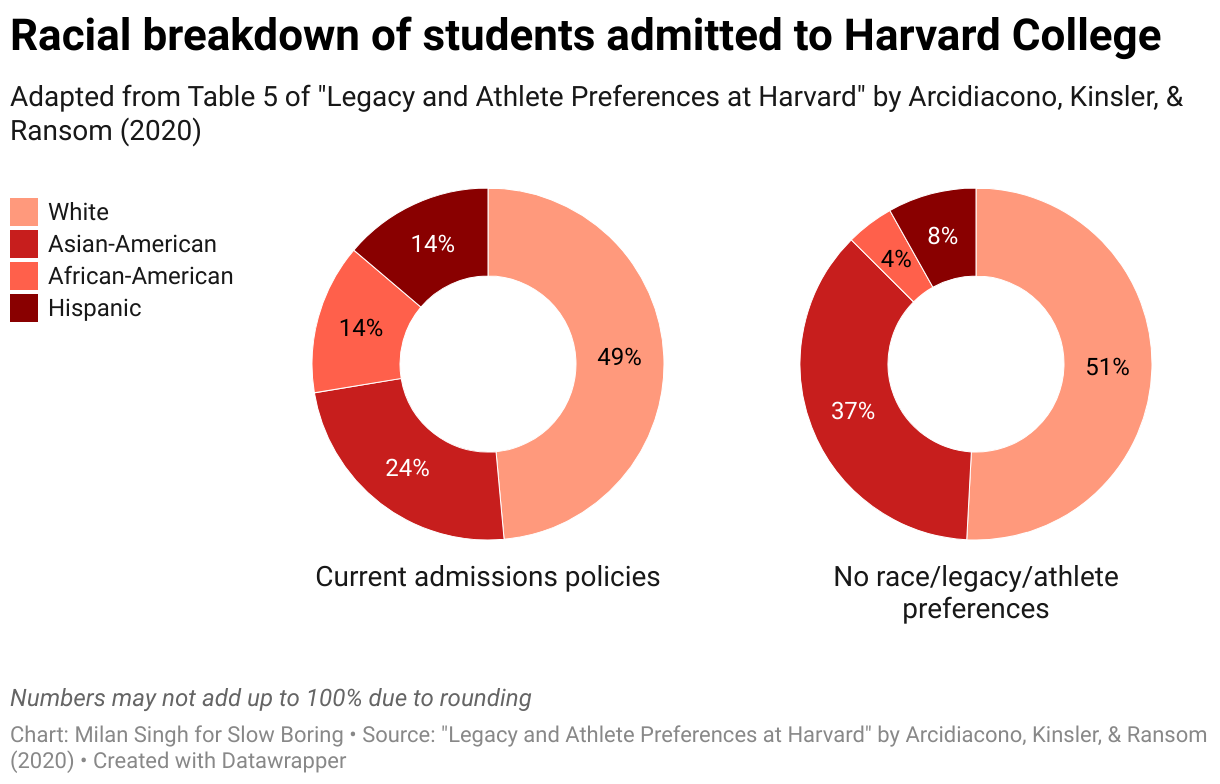
> at least in STEM
This is an important caveat, by the way. The racial breakdown differs quite a bit by major at many of these schools. I doubt Harvard would be 44% Asian even without the discrimination they engage in (and so do the authors of the study linked above, who put it at 37% Asian admittees if all the racial/atheletic/legacy preferences went away).
> not the paltry 15% quota the Ivies have consented to grant them.
15% when? The data I've seen has Harvard at 15% Asian about 10 years ago. Per the chart above the fraction of Asians in the set of people who get _admitted_ is 24%. Per the numbers at https://www.collegefactual.com/colleges/harvard-university/s... Harvard's _enrolled_ undergrads are 21% Asian. Not sure whether the discrepancy has tso do with systematic differences in how often people accept the offer of admission or whether something else is going on.
> The other thing to consider is that “diversity” somehow fails to consider class.
Yes, fully agreed.
Good that it's not then? With modern technology, one can get started on ultra cheap automated courses (not necessarily just static lectures, can be interactive/VR experience like good computer games), coupled with one on one help from paid and volunteer tutors around the world. Than those who show potential can in due time be given access to expensive research equipment and world renoun professors. All without a need to make a life making or breaking decision based on a single admission process. Let students decide for themselves if and when to conclude that a subject is not for them. Current system amounts to artificial gatekeeping of success.
You cannot compare a degree from a well known university with cheap/free online courses. The benefits of a degree from a well known university are immeasurable.
What elite institutions offer is mainly connections and access directly into the pipeline of companies in a respective field.
There is some benefit to have elite institutions because proximity of highly educated people can spawn a lot of innovation, but a successful education system needs to be broad.
And if you think that the resource is no longer finite, then are you going to supply and maintain the hardware and infrastructure to provide everybody with an online computer? Are you going to translate the coursework and exams to their languages? Provide the electricity? Provide the meal in the childrens' bellies so that their mind could be on the classwork?
[1] In my opinion there is no similar justification for preferences in favor of Hispanics. Studies show that Hispanics are similarly situated to previous generations of white immigrants: https://academic.oup.com/qje/article/135/2/711/5687353. Their income disparity is explained by recency and character of immigration, and disappears over time. You see the same phenomenon about Asian groups that comprise primarily refugees. Vietnamese people were as poor as Black people in the 1970s. Today their household income is slightly higher than white people. By contrast, Black and indigenous people face persistent disparities that are not disappearing over time.
The numbers are a little misleading because 25% of the students have their race listed as "non-resident alien", aka no race assigned.
Removing that group and adjusting the other percentages accordingly gives:
* 55% White (61.5% of US population)
* 20.4% Asian (5.4% of US population)
* 12.2% Hispanic (17.6% of US population)
* 7% Black (12.3 % of US population)
* 4.7% Biracial (3.1% of US population)
I was just curious about the numbers and how they stacked up to the national average, and thought others might be as well.
It's no coincidence that most founders come from ivy-league schools.
Think how all these startups are getting loads of "trickled-down" money from the Fed's money printer. Look at the list of chairs of the Federal Reserve and most of them are from prestigious Ivy League schools, you get what I mean.
Everybody can know how atoms work, and read Cicero, and figure out where on the shore a boat traveling diagonally will land if the wind is picking up at a given rate. Increasing the human knowledge pie in that way is what universities claim to do.
We used to do that, wasn't it called Jim Crow?
I think this belief is part of the problem. Information is infinitely replicable at zero cost, but we create barriers to its dissemination. If there are kids who are eager and able to learn material, they should have access to that it. And if they have mastered the material, they should be granted recognition of that objective fact. Any other policy means we are deliberately dumbing ourselves down.
On the other hand, perhaps we need to dissect what it is we mean by "education", because while access to information can be unlimited, the number of places at Harvard IS limited. Inasmuch as membership in an exclusive social club is limited, and inasmuch as the Harvard class is an exercise in social engineering, I can see wny one may want some representation for various groups.
In short, knowledge doesn't need to be a finite pie. It only appears to be so because some domains are gate-kept by limited admissions numbers in order to protect the supply of labour in those professions. The tech industry shows that when we don't have professional licensing, talent can find a way regardless of credentialism.
If this is the objective, then we need to start a lot earlier than the point of university admissions. Also, "circumstances of their birth" would need to be broadened to encompass quite a bit more than just race.
Everyone agrees with this, on all sides. That's why we have highschool and grade school for example.
Then you don't have the "did we do enough for XYZ group", the RNG will simplify both decision making and justification. If there's x% of XYZ passing the minimum score, that's how many will be in your class.
The activists that are regularly called racist against asians proposed exactly this policy. It was called a "merit lottery" and worked by setting a GPA lower bound and then admitting students randomly if they had a GPA of at least that level. This policy was ultimately seen as "too extreme" and non implemented but it saw its fair share of "lefties hate asian success" and proponents were even called "enemies of excellence" by Scott Aaronson.
You can pour money into giving test prep help to disadvantaged groups and keep the headline, which is that fate decides among many who are worthy.
Private high schools that had segregation policies ran the risk of having their tax status revoked messed with by the IRS.
Colleges get tons of money from the federal government, which is conditional on not discriminating - and keeping federal government happy.
So private secondary schools still have a fair amount of leeway. Not infinite, but in reality they don’t have to worry about lawsuits like this.
Colleges do.
I'm against affirmative action altogether but the best kind mostly avoids this problem: only consider ethnicity when it helps the application. Consider whites, Asians, Jews, and others as part of the same category.
Of course, if you look at grade schools, it looks like racial minorities are 'overrepresented' compared to the general population, so it's possible there's just fewer young white people.
The bar in the new system was the same for everybody. It was simply a different method of judging candidates. There was no "these groups get a lower bar because they are black or hispanic."
Notably a group whose admission went up with the policy change was poor asian people.
Many people get out of India to escape this nonsense. Sad to see USA follow the backward path.
Let me guess which caste you think you'll end up.
How does it even work practically? What stops an Asian American from saying they are African American?
Dividing humans into different races just an insane concept that has no place in the 21st century.
I am not arguing that such discrimination or racial categories are valid.
Other countries have official recognized minorities which you get from your parents, or use the birth nationality of your (grand)parents.
Good thing India's only been a multicultural society for decades.
Asians are part of society too, and yet Asian-American children have dramatically different and more stressful childhoods than their counterparts - a constant churn of studying, stress, and pressure, compared to the relatively carefree childhoods of their peers.
It disgusts me that you can say "this is good for America" - are Asian-American children not Americans? Asian-American children have to go through a nightmare to have a chance at opportunities comparable to their peers, simply because of the color of their skin. This is the literal definition of racism.
> You cannot justify holding Asian-Americans to a higher level because "they can handle it."
The person you're replying to didn't say anything like that.
> It disgusts me that you can say "this is good for America" when Asian-American children have to go through a nightmare to have a chance at opportunities comparable to their peers, simply because of the color of their skin.
I agree, but I think I understand what they meant. They're suggesting that the benefit to society of having more diversity in the higher educated (and then higher income, etc) brackets outweighs the harm to society from unfair admissions. It's certainly a way start rebalancing the race distribution of the "upper classes" of society.
I'm not sure why their comments are dead. I don't necessarily agree, but it's a valid point of view.
https://www.npr.org/sections/parallels/2016/09/29/495665329/...
https://foreignpolicy.com/2017/04/05/brazils-new-problem-wit...
>of sufficiently different populations is just demonstratably wrong.
The difficult lies in translating 'race' to 'populations.' A population of 'people born in India' is extremely well defined and lends itself to stochastic and scientific analysis. Many ideas of race are not so well defined, and can't be put into clearly laid out population of persons. The slight of hand here is your use of the word 'population' when we were speaking of 'race.'
Can you walk me through which DNA algorithm you're referring to that matches self-reported 'race' 99.9999% of the time?
College admissions departments already check to see if applicants are lying about race, e.g. by looking up their social media. Instead of scanning DNA, they could ask for some documentary evidence if they think an applicant is lying.
That's taking it way too far. Genotyping populations identifies variation, and in cases where populations that have been reproductively isolated for tens of thousands of years (e.g. western Europeans and west/central Africans) are now in proximity, there will be substantial variation that is idiosyncratic to each population.
In the US, reproductively isolated populations were suddenly placed in the same territory, and taboos on inter-racial mating persisted until very recently (50% toleration in the mid-1990s). One can accurately tell whether an American is phenotypically white versus black (or mixed) by DNA.
That isn't to say that our ability to predict accurately black-vs-white will remain. The more race-mixing, the less ability to accurately categorize. We'll instead move to a situation similar to the one in which 'white' people find themselves today, where they are mixes of x percent of a variety of populations and not categorically 'Dutch,' 'Irish,' 'Finnish,' etc.
Race is a sociological concept, yes, but it reflects reality in that people are visibly different. These differences are genetic in origin. It just so happens that in some cases, (e.g. two reproductively isolated and visibly distinct populations suddenly in contact with one another), these social categorizations will map to biological ones. In other cases where there is convergent evolution in terms of physical appearance, they won't.
I claimed you can predict 99.9999% of people's self-identified race from their DNA. Is that wrong? How high does that number have to be before you'd call it non-pseudo-science?
I know what meiosis is, that isn't in dispute here.
>College admissions departments already check to see if applicants are lying about race, e.g. by looking up their social media.
Isn't that just checking for consistency? Say I change my mind about what race I am due to it being typically poorly defined. Many children have changing views about race over time, so it seems quite absurd to expect a literal child applying for college applications to fully understand and stay consistent about a topic that is constantly evolving and often nebulous. What you know at age 13 when opening your first facebook may not match your understanding of yourself at 17 when applying for college. And it's not clear to me what objective definition we are using of 'races' to make sure every applicant is following the same standard for determining when the applicant is lying and when they are not.
> Say I change my mind about what race I am due to it being typically poorly defined.
But it isn't poorly defined. Your race is the combination of your parents'.
You're trying to use some college definition of race, and I don't know what sort of indoctrination made you that way, but that's not what people actually mean by race.
Like, middle easterners who are Republican might call themselves white, while politically involved Democrats might call themselves "people of color". I know two siblings who probably split down this divide. But even if they do, they're actually the same race, because they have the same parents.
>But it isn't poorly defined. Your race is the combination of your parents'.
This is circular reasoning. My race is a combination of my parents' <race>. So my race is my parents' combined race? The fact that you resort to this fallacy makes a great case that race ISN'T well defined.
Using your own (recursive) definition (which eventually recurses all the way up to the first reproducing organism from which we came), if humans all have a common ancestor (such as some single-cellular organism), then we're all the race of whatever that common parent is. Following our 'parents' all the way up, we should finally come to the first organism(s) to exist. We'd all be the same 'race'.
>You're trying to use some college definition of race, and I don't know what sort of indoctrination made you that way, but that's not what people actually mean by race.
I'm trying to understand how I can determine what race someone is. You mention 'middle easterner.' How can I determine with 99.9999% accuracy who is a 'middle easterner.'
Your comment about 'college' 'indoctrination' is purely ad hominem fallacy, specious anti-academic attack designed to negatively portray something perceived as an educated opinion. This is coming completely out of left field and seems to be a lashing out for some sort of internal axe you have to grind.
>Like, middle easterners who are Republican might call themselves white, while politically involved Democrats might call themselves "people of color". I know two siblings who probably split down this divide. But even if they do, they're actually the same race, because they have the same parents.
This comment seems to work against the notion that self-reported race is 99.9999% predictable by DNA.
> OK, so define to me then the algorithm
Lol, like I'm going to waste my time doing that. Trace back ancestry until the family trees circle in on themselves. Identify and pick out the clusters and subclusters as finely as you think appropriate.
> Your comment about 'college' 'indoctrination' is purely ad hominem fallacy,
Are you not regurgitating something you learned in college? Then where are you regurgitating it from?
It's fair to say you're regurgitating indoctrination because virtually everybody else, unlike you, knows their racial background in an objective sense.
What statement are you referring to me 'regurgitating'? I'm college educated but in the field of engineering, I don't recall having a discussion of this sort in college. Your statement is coming completely out of left field and frankly perplexing, again it seems you have some weird axe to grind about higher education.
>It's fair to say you're regurgitating indoctrination because virtually everybody else, unlike you, knows their racial background in an objective sense.
If I can 'know' my 'racial background' (which seems to mean race, otherwise this is just a red herring statement) in an 'objective sense', why would the bar be whatever I 'think' myself to be (your first sentence). Objective would mean my own opinions and personal feelings are irrelevant, thus someone else can make the call equally as well as myself with same available facts. Otherwise you would put the word 'subjective' here. What 'objective' facts are we using to determine my race?
That is:
>They would be correctly identified as their middle eastern ethnicities that they think themselves to be.
Contradicts
>virtually everybody else, unlike you, knows their racial background in an objective sense.
The second thing I learn from your first statement is that you seem to be saying race is what you(they) 'think themselves to be', and race is determined by self-selection. I honestly don't know what my race is from an 'objective' sense, that's why I'm asking you to provide a clear definition of what the races are and how to place each person in those buckets in an objective and fully defined way.
>Lol, like I'm going to waste my time doing that. Trace back ancestry until the family trees circle in on themselves. Identify and pick out the clusters and subclusters as finely as you think appropriate.
When pressed you clearly fail to either cite an algorithm that predicts self-selected race with 99.9999% parity, nor are you going to 'waste your time doing that.' So it's a completely unsubstantiated claim, along with virtually every other subjective opinion you offer. Presenting completely unsubstantiated claims as fact and then refusing to cite evidence nor 'waste your time' creating it, is precisely why I believe persons such as yourself are engaging in 'pseudo-science.'
Are you actually arguing some banal argument about taxonomic groupings in the edge cases or is it something else, where people can just make up their race?
Please explain why a professor had to resign for "lying" about being black: https://www.seattletimes.com/nation-world/professor-who-lied...
Please describe the algorithm that makes her non-black.
I'm unable to come up with a number with a complete lack of evidence that points me towards one. And apparently, neither are you.
>Are you actually arguing some banal argument about taxonomic groupings in the edge cases
Edge case of _what_? We haven't even figured out where the 'edges' are, or even the centers. You've talked about 'objective sense' of 'racial background', so we need to know objectively what you are saying these groups are and define them in a way we know where the edge even is from a factual objective viewpoint. How many races are there anyway, can we list them? Does everyone fit or self-select into a certain list of races, and if not how can we factor that into admissions? What happens during admissions if they're unable to truthfully say what race they think they are?
>They would be correctly identified as their middle eastern ethnicities that they think themselves to be.
You've implied here race is what they 'think themselves to be.' It's not clear to me whether that means they can make up their race, but either you're imposing some races on these people or they are indeed coming up with the race for themselves. Seems to be at odds with your flippant remarks about a circumstance 'where people can make up their race.'
>Please describe the algorithm that makes her non-black.
I never claimed that there was any way to determine 'race', which is such a nebulous concept that it borders on absurd to include it in determining college admission or employment decisions. It's not clear to me that 'black' (in the context of 'race') is objectively defined, but if it is please educated me.
>Please explain why a professor had to resign for "lying" about being black
To determine whether she is lying about being 'black', I would have to know how to define (in context of 'race') 'black.' Is black a race? What determines if someone is black? Is it that they merely consistently say they are black? Is it lying to change your mind about what your race is? Is it lying if you state you are black, while actually being black, but believe you're not telling the truth? If someone looks 'black' but says they are 'white', are they lying? Making hiring and admission decision based on these factors just seems absurd.
The best argument I can find for firing this person is if they were acting maliciously or unprofessionally inconsistent, not because of a racial component. People shouldn't be fired because of their race.
>Please describe the algorithm that makes her non-black.
You're the one who made the claim race had some stochastic parity with self-selection. I personally can't say what 'non-black' even means, neither to you nor from some objective definition. This is a question for yourself, since you've made the assertion 99.9999% parity of DNA with self-selected race (which in one of your early sentences, you did indicate race is self-selected at least for 'middle eastern ethnicities'.)
Strange, most black guys could.
Special admission can benefit marginalized low income communities if one of their students gets a step up. For example, a student of low socioeconomic status (or from under representative race). Let's say they qualify for a special admission. They train hard for years to become a doctor. It may be advantageous to have a doctor that can look back at where they grew up, hopefully putting resources in future to help others in their community.
Not only that, those marginalized communities can lose trust in the system, so seeing people who do 'make it' can be a motivator for others.
I do understand the predicament though. It's a shame we can't increase the number of spaces available. At some point there has to be a cut off. a hard decision to make.
India has had caste based reservations for a while. There is no going back. Now sometimes 60 to 80 percent of government jobs or higher education seats are reserved.
A sad joke.
There's your problem. Not the fact that there's affirmative action, but that it doesn't reflect society. Affirmative action should always result in outcomes that reflect society. So 60% is fine if 60% of the population are dalits (or whatever the protected class is). Basically you review it every few years so that it always reflects society.
I feel like you've taken this position as a fact without having any evidence supporting it.
Well, one difference between America and Malaysia is that majorities of every American racial group oppose racial preferences [1]. There is support for affirmative action in the sense of removing barriers and leveling playing fields, but racial preferences are quite unpopular. Even supermajorities of Democrats oppose them. They are only popular among Democratic elites.
[1] https://www.pewresearch.org/fact-tank/2019/02/25/most-americ...
I don't think ignoring the impact of the British being in charge and how that advantage flowed on to the Indian population, that they imported into Fiji to work for the British, is helpful at all.
The British turned up, imported a bunch of Indians, and fucked up the local social structure.
The 26% and 10% have a culture of striving, and they typically aspire towards business and/or the professions.
The 60% (the majority) are indigenous and had civilization that stretches back centuries. However, they did not (and do not) have a achievement-oriented culture and therefore are not given to striving (at least in comparison to the former groups).
For the longest time, the 26% and the elite among the 10% controlled the economy. This all came to a head when racial riots broke out, after which the government introduced affirmative action favoring the 60%, for exactly the reasons you outlined -- to create racial harmony and to quell the racial resentment.
In a sense, it worked. For decades racial strife was low, at the expense of marginalizing the capable 26% and 10%.
The problem is that once you introduce affirmative action, it becomes a political tool for staying in power, and no government can ever remove it without risking losing an election.
Affirmative action is a short term band-aid. If you keep it on for too long, people depend on it and the entire system degrades, especially when it applies to a large enough number of people. People lose the incentive to strive to do better, and the standards go down to accommodate the lowest common denominator. Affirmative action in my country has led to an overall decline in competency in many fields, and a brain drain of the people who are marginalized to neighboring countries and beyond. With every passing year, my country is surpassed by other countries in the region.
The feedback loop of stomping on meritocracy (where ascribed qualities like skin color or race are elevated over competence) is self-reinforcing. Our politics has gotten worse, we're getting less and less competitive by the day, and competitive forces are eating our lunch. We may have a more equal pie, but we got there by pulling everybody down so our pie is smaller. The society feels stagnant and continues to degrade. This is my lived experience.
The country next to us has also achieved low racial strife, but they adopted much more directed and -- I dare to say -- more social darwinist policies. They are economically much more successful than we are, and much more dynamic than we are, even though we both started out with similar initial conditions.
I do think we need to have a society where everyone has an equal shot at social mobility. However I also believe that affirmative action is too blunt an instrument for achieve that and it is one that creates vicious feedback loops that are politically difficult to get out of even when it's clear its usefulness is over.
So no, I'm not a big fan of affirmative action as it is conceived here in this article. To achieve a more equal society you cannot merely force equality by tweaking the gates, because (1) there's irreducible variance among humans that you quell at your own peril, (2) some of those gates are important -- remember Chesterton's fence. It's clear to me that a more thoughtful approach than affirmative action (or even a more thoughtful kind of affirmative action) is needed.
At the same time, you forget that this reverse-discrimination is usually justified under the guise of "perpetual" repression by the other group. It's a mess all-around and we're just adding additional layers of complexity and blame to go around. I.e. now you're punishing completely innocent people and breeding resentment, whilst telling the other group that they have essentially a repressive enemy. That is Not good for society.
I honestly don't know how we convinced ourselves that this entire thing is good. We will be judged by our future generations.
They're in a wonderful place. Your argument seems to be that the "rat race" is the optimal human condition. I disagree. Better themselves? That implies that there's something wrong with them in the first place.
> now you're punishing completely innocent people and breeding resentment, whilst telling the other group that they have essentially a repressive enemy. That is Not good for society.
Nobody is being punished. Student of X culture has to work hard to get a scholarship. He is competing with everyone else in X culture. Student of Y culture has to work hard to get a scholarship. He is competing with everyone else in Y culture. Everyone gets a chance, and if they fall short they have nobody to blame but themselves.
However based on the evidence presented, the admission policies at Harvard (and other schools like it) were absolutely appalling. The systematically lower "personality" scores for Asian applicants and the dean of admission's testimony about "geographic" diversity[1] paint the picture of a school that did not ask Asian American applicants to make a sacrifice in the name of the great good, but rather told them they did not deserve a spot on merit because they were boring, foreign grinds.
[1] https://www.nytimes.com/2022/01/27/opinion/affirmative-actio...
So what exactly does my anecdata mean? Exactly nothi g. But So does your "argument" (you didn't make one except touting a statement full of subliminal racism in the context of this discussion).
"Here we find our first indication of the strength of preferences for underrepresented minority students. African-American students have nearly an 80 percent better chance of being admitted than their white counterparts, while the Hispanic advantage is reflected in almost 50 percent higher odds compared to whites. By contrast, Asian applicants and those from other races face lower odds of admission on the order of 17 or 18 percent—in relation to comparable whites."
https://scholar.princeton.edu/sites/default/files/tje/files/...