If you look at those particular stats, sure, it doesn't sound particularly objectionable. But if you look at others: https://www.cnn.com/2018/10/15/politics/harvard-affirmative-...
> Under questioning from SFFA lawyer John Hughes, Fitzsimmons detailed some of the recruitment efforts that begin the selection process. Harvard mails recruitment letters to black and Hispanic high schoolers with middle-range SAT scores, Fitzsimmons acknowledged, yet only sends such letters to Asian Americans if they have scored more than 200 points higher.
> According to charts Hughes displayed, Harvard sends such recruiting letters to black, Hispanic, and Native American students with top grades who hit at least 1100 on the combined math and verbal SAT score (the top score is 1600). To receive such letters under similar circumstances, Asian American men must have a combined score of 1380, and Asian American women, a combined score of 1350.
So, an individual Asian student needs to score much higher to have a chance at Harvard, compared to students of other ethnicities. That's very blatantly racial discrimination.
This amounts to, "sorry, we have enough people of your color, so we're gonna make it harder for you to get in." That's wrong. Period.
> This amounts to, "sorry, we have enough people of your color, so we're gonna make it harder for you to get in." That's wrong. Period.
"The law of unintended consequences" ... what are they going to do if the target demographic (in this case Asians) start their own merit-based and academic-based colleges and universities?
Sure, it's not cheap, but large communities have done much more expensive things in the educational space before, and of course being pure merit-based means that the graduates will (eventually) be more sought after than the standard colleges[1].
Will someone then cry racism then?
[1] Maybe not to the level that Harvard grads are.
Why even bother doing good parenting when the ideologues in charge want to “fallacy of meritocracy” away any advantages you have given to your kids?
I used to be pretty annoyed by conservatives boasting about "family values". I thought it was just performative virtue signaling. But looking at how the far left views the hard work of parenting as something that ought to be "equalized away" has me thinking maybe the I was wrong.
You can only improve education in a way that is offers support for people in difficult homes. Perhaps their difficult childhood will ultimately hinder them from becoming the best. But then perhaps their children will fare better.
If you make it so that only “merit” is considered - you’re only gonna get rich kids. (And I see this already through SV - it’s nothing but rich or well educated parents for the children here)
What is the argument against letting children who have had a rough lot in their life get a slight lessening of their handicap when applying for colleges or other life changing scenarios that could pull them out of their rut for future generations?
If you don’t and are unwilling to address the root cause (and we aren’t willing to address that in the US - we don’t even have universal healthcare yet guys) then you’re gonna keep having this shit continue.
The demographic profile of these two schools are substantially lower income than the very expensive cities they reside in.
Edit: Got the names of the schools wrong.
It's literally the opposite of what you said, unless you suddenly changed your mind and agree that the merit-based schools are the best option for poor kids.
> If you make it so that only “merit” is considered - you’re only gonna get rich kids.
He said:
> The merit-based school such as Styuvesant in NYC and Lowell in SF are both filled with rather poor Asian kids.
> The demographic profile of these two schools are substantially lower income than the very expensive cities they reside in.
It couldn't possibly be further from supporting what you said.
Please try to think about how the context of what I said could be interpreted. If you take literally everything at face value - you're truly not thinking critically about anything.
As analogy: we won't (and we shouldn't) stop billionaires from making money as fast as they (legally) can, but we can sure as hell tax them proportional to their success at it.
Would it be reasonable to say that hard work should be rewarded? Well…ones propensity for hard work, it turns out, is highly heritable. Either from your genes or from your upbringing. You didn’t choose your parents, nor did you choose your upbringing. So your propensity for hard work is really just unearned privilege.
Same line of reasoning can be applied with future orientation, or smarts. People don’t deserve the fruits of their intellect, because they didn’t do anything to earn it.
I’m not sure if there is a name for this kind of absurdity, but “Achievement Fatalism” is a nice fit.
Legally, it should be added... The freedom protected in the first amendment is the freedom of political assembly. The Civil Rights Act has been argued repeatedly in the Supreme Court, and the court has ruled repeatedly that the constitutionally protected freedom of assembly is not curtailed by requiring corporations, incorporated under the rules of the state, to be required to serve everyone in the protected classes.
The court was wrong and will be wrong again.
I would ask how progressives square two contradictory interpretations of the first amendment but then I realized they don’t really support the freedom of non-progressive speech anymore.
(IANAL disclaimer) The freedom of association has been implied by analogy to be protected by the explicitly-enumerated freedom to peaceably assemble in the First Amendment, in some specific cases. But it's a loose protection by analogy; the letter of the First Amendment doesn't even mention a freedom of association. The SCOTUS has not ruled that the freedom of association extends to a freedom to exclude in public accommodation; in layman's terms, the reasoning is "You have the freedom to serve as many people as you want, but that does not imply a freedom to not serve other people if you want to operate under the corporate charter that the government grants."
This overview describes things much better than I can. https://constitution.findlaw.com/amendment1/first-amendment-...
> The court was wrong and will be wrong again.
No doubt, but I don't think you'll find a receptive ear (in the public or in legal circles) to the notion that the Court has been wrong regarding upholding the Civil Rights Act.
Yes, anyone neutral or right of center knows all about that unreceptive ear.
Without knowing that, broadly speaking: freedom of speech has never implied freedom to have people agree with you. And freedom of the press implies a lack of obligation to publicize information the owner of the press doesn't want to promulgate. It also implies an editorial right to modify published information, ideally with explanation but that explanation is not required (the back-stop on that right being if the public thinks the press's output is trash, they don't have to care what it has to say).
Some positions, you can argue until you're out of breath. If the position is bad, the argument won't win support no matter how much breath is put into it.
The argument is simple: people should be free to include or exclude others in their private business/university/home/club as they see fit, and suffer free market consequences for doing so. This freedom was taken away by the civil rights act and the supreme court.
History suggests the market can't solve everything. History also suggests the majority is not always right, which is why the US government is structured as a system of checks and balances and not a simpler-to-implement mobocracy.
But (like any business owner) if a minority business owner wants to incorporate and exchange money with the public for goods and/or services, their rights are curtailed like everybody else's are regarding who they may not refuse service to. For example, a black business owner isn't allowed to kick white people out. They are allowed to kick Klansmen out (as per federal law; states may place additional restrictions).
It is the nature of societies that we give up some rights to protect others. The law is one long, ongoing conversation on what that trade-off looks like. And in the specific case, I'm of the opinion that we tried it the other way (refraining from curtailing the right for a business to refuse service universally) for at least a hundred years and found that it didn't make a good society.
I would expect setting up Asian-American universities in which non-Asians need not apply to be highly illegal due to the Civil Rights Act.
Who said anything about non-Asians? I said "merit-based" and "academic-based".
Is it inconceivable that a university that accepts only on academic performance and focuses only on academic performance will end up disproportionally Asian?
[EDIT: Actually, they can make it so that the "merit" test is not in English, but a selection of Asian languages. That'd very quickly make it into an Asian-only university without specifying Capital-R Race]
At the same time you will push out Asian kids from regular Ivy-League school admission processes, after all "they can go to that Asian school".
If you promote the parallel polis, you will get more segregation, not less. That's the very reason you create a parallel polis.
You're asking what people would do if those who couldn't get into university address the issue by building a new university, thereby increasing supply?
"Celebrate," I'd assume.
No, I am asking what you would do if the people discriminated against built their own power structures (out of necessity) that, due to merit, was disproportionately made up of members of their community AND produced superior results for their graduates.
Right now many people are basically ranting that Asians are performing too well, leading them to succeed well above other $GROUP.
What do you think those people will say if the discriminated group sets up structures that further reinforce their success in succeeding generations?
Segregation resulting from discriminating against a particular minority to the level that they go ahead and establish their own structures can backfire immensely.
I've seen this (and currently living it firsthand) happen, to the point that the minority group is around 1.5% of the population but holds around 10% of executive and corporate positions[1].
And of course, the 90% majority is baying for blood...
> "Celebrate," I'd assume.
Segregation is never a reason to celebrate.
[1] Last I checked, anyway, which was about a decade ago.
"Congratulations on achieving the American Dream."
The NAACP already exists. What you're describing as a nightmare scenario is basically the way this has been done historically in America. It's part of the "rugged individualism" mythology that a group that feels marginalized organizes to take care of itself.
If, today, Harvard is keeping Asians out, it means more smart, eager Asian students to be recruited by other universities, which just might rise in status for admitting those students.
The "personal" ratings might:
> Lee said Students for Fair Admissions had misconstrued data, and that race was used only to a student’s advantage in certain circumstances, and never to his or her disadvantage.
which sounds like a weird argument since obviously "advantage" for one in a zero-sum competition is disadvantage for all others, but counters the accusation that Asians in particular are being penalized.
A close friend of mine had perfect scores in basically everything and Harvard turned him down on the basis of "we already accepted your older brother and it wouldn't be fair of us to take two of you".
I will go out on a limb and say that this is a narrative he shares to avoid embarrassment, and it’s probably not true from the Harvard perspective.
SAT scores and grades are only one part of the admissions evaluation criteria. How did he do in the others? What about his brother?
Something like this might happen if his high school had a certain range of slots for each elite school, and the school counselor decided to against advocating for him to get into Harvard specifically for some reason. That said, it still may have been a polite way of saying that he was not as good as his brother. Furthermore, if he was actually a compelling applicant, I imagine he got into some other elite school.
I really wish more people would learn about and appreciate the different evaluation criteria that elite schools use. These criteria aren’t perfect, but they strike me as being fairly dynamic.
If he got into another major school (e.g., Yale or Princeton), the admissions folks or the school counselor may have decided that he was a better fit at one of those.
Good for him for getting into other elite schools.
A little late to this, but…
1. Your quotes refer to recruiting, not admissions.
2. Even if your conjecture that Asians admitted to elite schools have higher scores on average than other minorities holds water (it probably does), I think this focus on SAT scores and grades sort of misses the point of the admissions processes in many elite schools (including, and perhaps especially, Harvard). Specifically, they are typically looking for people who have been at the top of something or had an impact on something at a regional, national, or international level. Lots of folks (Asians and otherwise) have great grades and SAT scores, but they don’t really stand out in other ways.
> This amounts to, "sorry, we have enough people of your color, so we're gonna make it harder for you to get in."
It’s more like “sorry, you were only above average (not outstanding) in one of the five criteria we evaluate, so we will take a hard pass”.
Note that academics is only one of five factors used in Harvard admissions (iirc). Getting the top rating in academics might be something like winning a prestigious math or science competition, so having “great grades and high SAT scores” doesn’t even merit the top rating in one category. I think many people don’t realize this.
You don’t need top ratings in any single category to get in, but if you don’t have a top rating for any of the evaluation criteria, you need to be above average in several of them.
Please correct me if I'm wrong..but these are recruitment letters, not acceptance letters, right? A letter asking them to apply to Harvard? My son has been getting a ton of these since he took a PSAT.
This is how US green card applications work too though.
People shouldn’t be treated better or worse just because their country has more or fewer immigrants.
Really? I find it very easy. Racial discrimination is wrong. Period. You're pointing to a social discrepancy and saying "eh, maybe racial discrimination is okay because it might make the demographics more equal." I urge you to fully consider what this entails. If we want to live in a multicultural society, we must accept that different groups have different values, preferences, and practises. We choose to allow groups to be different, so we must accept that this means groups end up in different places.
Asian parents in the U.S. exhibit high propensity to encourage that their children study more than all other ethnic groups(https://www.sciencedaily.com/releases/2011/05/110505103345.h...) (data here: https://www.bls.gov/tus/). Unsurprisingly, Asian children grow up to earn more than all other ethnic groups, and display lower levels of crime. In other words, this cultural difference results in an income and wealth disparity.
I am not of Asian descent, and I believe that a child should not be studying their childhood away. Who is right? Should I be making my children study 13 hours every week? Or should the Asian parents have their children study less? After all, if the existence of a disparity alone is morally wrong, one group must bend.
Or can we accept that different groups are different. This is indeed the premise behind multiculturalism. This will result in disparities between groups as a necessary and healthy outcome. Not something to be feared, but something to be celebrated as an expression of free will and cultural autonomy.
Most likely, by raising the bar for college entry in desirable schools, you only make them study more.
I'm not sure where I heard it, but the admissions departments aren't looking for well rounded students, they are looking for a well rounded class.
I get that it doesn't make sense to require every admitted at Harvard plays the Violin/Cello. But it's easy to discriminate against a minority--like Asians--with facially neutral quotas that are designed to exclude them. "We've already got too many classical music instrument players" when the admissions dean knows Asians are more likely to play those instruments.
Schools in state's that banned affirmative action still practice it by applying these standards.
If racial discrimination is acceptable in this case, why not other cases?
Bringing Blacks and Hispanics into the conversation is a red herring used by elite universities to defend the indefensible. If you want to see what a truly meritocratic admissions policy would look like, at least in STEM, just see Caltech, where Asians make up 44% of the student body, not the paltry 15% quota the Ivies have consented to grant them.
https://www.registrar.caltech.edu/records/enrollment-statist...
The other thing to consider is that “diversity” somehow fails to consider class. Have you noticed how universities prattle on about racial statistics but getting stats on socio-economic background is like pulling teeth, if you can get data at all?
Is it? The estimate at https://cdn.substack.com/image/fetch/f_auto,q_auto:good,fl_p... disagrees, but if you have other data I would be interested.
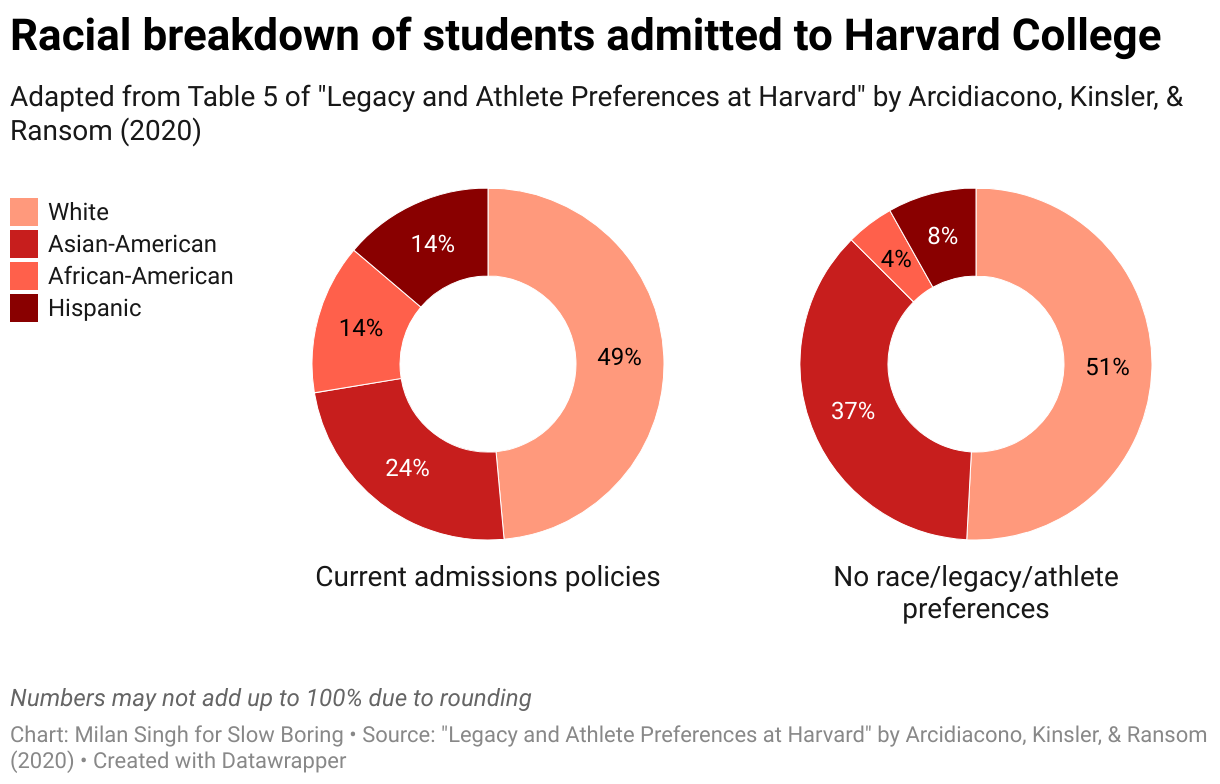
> at least in STEM
This is an important caveat, by the way. The racial breakdown differs quite a bit by major at many of these schools. I doubt Harvard would be 44% Asian even without the discrimination they engage in (and so do the authors of the study linked above, who put it at 37% Asian admittees if all the racial/atheletic/legacy preferences went away).
> not the paltry 15% quota the Ivies have consented to grant them.
15% when? The data I've seen has Harvard at 15% Asian about 10 years ago. Per the chart above the fraction of Asians in the set of people who get _admitted_ is 24%. Per the numbers at https://www.collegefactual.com/colleges/harvard-university/s... Harvard's _enrolled_ undergrads are 21% Asian. Not sure whether the discrepancy has tso do with systematic differences in how often people accept the offer of admission or whether something else is going on.
> The other thing to consider is that “diversity” somehow fails to consider class.
Yes, fully agreed.
Good that it's not then? With modern technology, one can get started on ultra cheap automated courses (not necessarily just static lectures, can be interactive/VR experience like good computer games), coupled with one on one help from paid and volunteer tutors around the world. Than those who show potential can in due time be given access to expensive research equipment and world renoun professors. All without a need to make a life making or breaking decision based on a single admission process. Let students decide for themselves if and when to conclude that a subject is not for them. Current system amounts to artificial gatekeeping of success.
You cannot compare a degree from a well known university with cheap/free online courses. The benefits of a degree from a well known university are immeasurable.
What elite institutions offer is mainly connections and access directly into the pipeline of companies in a respective field.
There is some benefit to have elite institutions because proximity of highly educated people can spawn a lot of innovation, but a successful education system needs to be broad.
And if you think that the resource is no longer finite, then are you going to supply and maintain the hardware and infrastructure to provide everybody with an online computer? Are you going to translate the coursework and exams to their languages? Provide the electricity? Provide the meal in the childrens' bellies so that their mind could be on the classwork?
[1] In my opinion there is no similar justification for preferences in favor of Hispanics. Studies show that Hispanics are similarly situated to previous generations of white immigrants: https://academic.oup.com/qje/article/135/2/711/5687353. Their income disparity is explained by recency and character of immigration, and disappears over time. You see the same phenomenon about Asian groups that comprise primarily refugees. Vietnamese people were as poor as Black people in the 1970s. Today their household income is slightly higher than white people. By contrast, Black and indigenous people face persistent disparities that are not disappearing over time.
The numbers are a little misleading because 25% of the students have their race listed as "non-resident alien", aka no race assigned.
Removing that group and adjusting the other percentages accordingly gives:
* 55% White (61.5% of US population)
* 20.4% Asian (5.4% of US population)
* 12.2% Hispanic (17.6% of US population)
* 7% Black (12.3 % of US population)
* 4.7% Biracial (3.1% of US population)
I was just curious about the numbers and how they stacked up to the national average, and thought others might be as well.
It's no coincidence that most founders come from ivy-league schools.
Think how all these startups are getting loads of "trickled-down" money from the Fed's money printer. Look at the list of chairs of the Federal Reserve and most of them are from prestigious Ivy League schools, you get what I mean.
Everybody can know how atoms work, and read Cicero, and figure out where on the shore a boat traveling diagonally will land if the wind is picking up at a given rate. Increasing the human knowledge pie in that way is what universities claim to do.
We used to do that, wasn't it called Jim Crow?
I think this belief is part of the problem. Information is infinitely replicable at zero cost, but we create barriers to its dissemination. If there are kids who are eager and able to learn material, they should have access to that it. And if they have mastered the material, they should be granted recognition of that objective fact. Any other policy means we are deliberately dumbing ourselves down.
On the other hand, perhaps we need to dissect what it is we mean by "education", because while access to information can be unlimited, the number of places at Harvard IS limited. Inasmuch as membership in an exclusive social club is limited, and inasmuch as the Harvard class is an exercise in social engineering, I can see wny one may want some representation for various groups.
In short, knowledge doesn't need to be a finite pie. It only appears to be so because some domains are gate-kept by limited admissions numbers in order to protect the supply of labour in those professions. The tech industry shows that when we don't have professional licensing, talent can find a way regardless of credentialism.
I'll also add, the paper you linked sort of muddies the waters on your point.
> Based on complete data for three applicant cohorts to three of the most academically selective research universities, we show that admission bonuses for athletes and legacies rival, and sometimes even exceed, the size of preferences for underrepresented minority applicants.
That is to say, there is a lot going on in the admissions process, but it isn't clear to me that much is gained by insisting on a racial perspective. With all that stated, it seems obvious that Asian Americans should fight against discrimination that statistically disadvantages them based on their identity. It's unfortunate that a quality education is a finite pie we have to divvy up into thin slices.