It seems every defense is built around hedges like this one:
> although they are cutting geometry a bit, which doesn't make as much sense today as it did 100 years ago when far more people grew up to be farmers or ranchers
Which suggests to me that they really are trying to walk back the complexity of the education, perhaps as part of a goal to force the variance of educational progress into a narrower range within classes.
The language is so vague that it's hard to understand exactly what they're trying to do, which I think is their point. If they wanted to emphasize advanced education topics it would have been front and center in the plan. Instead, it seems like a footnote that we're supposed to assume will get taken care of in some future iteration of this integrative math program.
My complaint about these reforms is that the root cause of the issue is not being addressed. This has long term negative effects. My own anecdotal experience is that what used to be a C is now an A or a B in my classes and I’m passing people who don’t know anything. I’m judged by the passing rate so I’m maximizing that metric. These reforms are just doing what I’m doing but in a less forthright way.
The root cause is well outside of the scope of schools to address. Perhaps they can help to a small extent through things like lunchtime meals. But curriculum reform itself will never narrow the gap more than a tiny amount.
Childhood nutrition, single parent households, health of mother during pregnancy, culture/respect towards education as a virtue in the community and household, education level of parents and the time they have to play and talk with their kids.
All these things are going to impact the capabilities of young school children and feed into outcome gaps between various groups (Black vs White, poor vs rich).
I believe most proponents of "math equity" actually know all this, and are just maliciously virtue signalling either because they're jealous that their own kids aren't doing well, or for social credit.
I'm not American, and I don't claim to know the environment and the issues people face there, or their root causes. I may not be fully understanding the extent of nutritional differences or family dynamics.
I am, however, absolutely certain that affluence feeds affluence and that misfortune feeds misfortune, on average. Even if you had all of the above equal except for the education levels and socio-economic status of the children's parents, you'd end up with statistically different outcomes.
I live in a fairly egalitarian country, and if I remember correctly, there's an average income gap of ~30 percent or so between people whose parents were in the highest quartile in income and those who were in the lowest quartile. While ethnicity may play some role in the statistical gap nowadays, I don't think it explains the statistical difference; ethnic minorities are disadvantaged here but they make up a small enough minority that I expect the bulk of the difference to be simply due to socio-economic differences within the same ethnic group.
Basically, if your parents and their social in-group got highly educated, I believe you perceive that as the norm. If they didn't, it's not as likely that you do.
Add in some practical stuff such as whether your parents can afford to finance or support your education, and the gap's already there. The rest just amplifies it.
Sure, physical health, nutrition etc. can have an effect, and they certainly do if the differences are great enough. I'm sure ethnicity or race has an effect, sometimes due to racism, and sometimes because people perceive their own opportunities or expectations differently depending on social roles, and for various other sociological dynamics. The latter is true even if you remove ethnicity or race from the equation. Racial stereotypes and images probably emphasize things but I don't think you can pin it all on that.
Considering how much worse off African Americans are socio-economically, on average, than white Americans, it's a no-brainer that their kids end up worse off on average as well. I'm not saying you should just shrug and accept that, and I'm sure actual racism exists as well, but the point is that some of it would happen even without racism, either overt or covert, or any "structural racism" that could include a whole spectrum of things.
That means any real solution is going to be hard and slow, unfortunately. Changing the subject matter in the name of equity really doesn't sound like one.
> I believe most proponents of "math equity" actually know all this, and are just maliciously virtue signalling either because they're jealous that their own kids aren't doing well, or for social credit.
It could also be that people take an easy non-solution in preference to working towards improvements and solutions that could take time, great patience, tolerance of morally and socially undesirable situations (one might have to accept that you can't achieve perfect equity, or at least not quickly, and be able to withstand social judgement for that), and are all around a lot harder to accomplish.
I don’t understand why we are so arrogant about everything that we don’t even try to teach 5th graders how to use spreadsheets and generate graphs. So much of math education is useless punishment.
Given that we know how the sausage is made, pretty much the last thing on earth we as software professionals should want is to inculculate the public with an overreliance and blind trust of software.
It's worse than that. There's something about the American system which forces black families to be not just stagnant economically, but often to move backwards (at least in the transition from Boomer/Gen X to later generations). Both of my grandfathers provided a strikingly middle class life for their families, leaving the military after WWII for decent careers: one as a stable, unionized factory employee, the other as a nuclear physicist. All of their children went to college. Both of my parents hold advanced degrees. Even still, they face financial difficulties that their white peers don't seem to, and my generation of siblings and cousins, while along a spectrum of affluence, seems to have inherited a magnified version of their parents' diminished prospects relative to their achievement. On average, the families that were middle class mid-century are now working class, even with degrees.
And we're outliers, in terms of educational attainment in the black community heretofore. That's changing, but to what ends, when black professionals must have a more advanced degree to be considered for the same job as a white applicant with a less advanced degree? When our houses are worth $50k less, our access to credit is restricted, our tax burden relative to income tends to be higher, and we are actively sought out for discrimination by many bedrock institutions of American life? It's not a level playing field.
Well, that's not quite what they're saying - essentially what they're saying is that they're a different kind of smart. Not that I agree with the logic, but essentially what they're saying is that the tests - along with the whole curriculum - were designed and written by white people, so they're unintentionally biased in a way that non-white people (except, I guess, asians) can't understand them. The implication being, of course, that if black people had designed the entire curriculum and the tests, they would be similarly impenetrable to white people. Of course, I don't think that makes much sense either, but that is the essence of what they're trying to assert.
But teaching math absolutely is not. It is a very human process, helping students find handholds in what they know to make the next conceptual step. Absolutely breaking their minds with a new topic, then returning to it a month later and they find it obvious now. There are no platonic math lesson plans out there to tap into, and finding more effective ones has been one of humanity's jobs for at least as long as there has been written language.
(FWIW, real analysis is generally considered one of the easier courses in a typical math degree)
On the other hand, in my real analysis course we worked with metric spaces, topological spaces, Hilbert spaces, the Baire Category Theorem, etc. I doubt most students in “a typical math degree” would be studying these topics outside of a pure mathematics specific degree program.
Quite a few colleges seem to use it as a filter class to determine who has the requisite aptitude and interest in pure math. At my college, the material wasn't particularly bad, but the evaluations were designed to be pretty challenging and grades weren't curved at all.
I'm pretty sure that is exactly what they are saying. The 2021 version of it anyway
What is a "white person"? A "black person"? Are these metaphysical categories? Biological categories? Cultural categories? Why would a person of one category be unable to understand curricula produced by people of another?
If we're going to go there: I went from being a straight-A math student in Pre-Calculus to a C (verging on D) student in my AP Calculus course in high school. In college, I retook Calculus and aced it, receiving one of the highest final scores in the class. The first course was taught by a black woman. The second was taught by a white man. The last was taught by a black man. I am a black man.
People in this conversation are frequently quick to dismiss the value of anti-racist (and, for that matter, anti-sexist) policy and execution in STEM pedagogy. They lean on and extrapolate erroneously from the notion of many great mathematical thinkers' probable hereditary advantages to a general, in-born hierarchy of fitness for STEM thinking. Coincidentally, this shields them from tough conversations regarding their own fitness to teach, and especially to teach children whose backgrounds they cannot or will not find sympathy and empathy for. I will admit that the solution is not so simple as my anecdote might suggest, but the implied path shares character with the correct one, in recognizing the farcical nature of assuming that the status quo - especially in this country - is a product of actual potential playing out as it must necessarily so, and not of history overshadowing even the best of intentions (though they are usually less than that).
I don’t dismiss the value of anti-racist policy and attempts to rid myself of negative biases that affect my students. My compliant is when I’m told, and I have been told this by an educator, that the act of requiring knowledge of algebra is itself racist. That’s when I feel we’ve gone too far. I don’t necessarily think algebra should be required but the reasoning for getting rid of that requirement shouldn’t be because black students are not passing it at a high enough rate.
My belief is that far too many people are going to college. The degree therefore is being watered down. If we lived in a country where everyone had guaranteed access to food, shelter, and medical care then the emphasis on college wouldn’t be so pronounced and colleges could then concentrate on what’s needed.
I don’t believe your comment should have been downvoted. Thank you for sharing your experience and thoughts.
So while I appreciate the sympathetic elements of your reply, I have to point out that the root of your argument is a baseless suspicion of the cognitive capabilities of students of color. Yes, requiring knowledge that has been systematically denied, effectively on the basis of race, in order to obtain a credential that is necessary to earn a dignified living, is a form of racism. And we will need to "change things" to fix that.
Do you have any evidence that the vast majority of people can learn calculus in a timely manner? I have a lot of anecdotal evidence that this is simply not true. Please note that I’m making no reference to or claims about students of color. I’m speaking about all people. In my experience a lot of people simply can’t learn calculus to any reasonable definition of what that notion entails.
The requirement of a specific set of knowledge for a degree is not what is wrong. What is wrong is living in a society in which having a degree is increasingly necessary to live at a decent standard.
https://matheducators.stackexchange.com/questions/11396/what...
I'm at a loss as to how you might construe these statements, which you presented as wrongheaded (i.e., that you believe the inverse of each), to not imply that you believe that the "cognitive capabilities of students of color" are lesser, considering the nature of the racial achievement gap (an aspect of the conversation which you broached). Either you simply do not remember what you stated earlier, or you're lying. This is clearly a reference to students of color, at the very least. I just want to establish the high probability that you are being disingenuous.
>Do you have any evidence that the vast majority of people can learn calculus in a timely manner?
Assuming that most people can learn at a 5th grade level, and that, as suggested several times in the comments, this lecture could be broken up into multiple days worth of dynamic, interactive instruction, rather than being presented as a blitzkrieg 20-minute lecture:
This is not conclusive, of course. But you asked for any evidence, and I think a reasonable person arguing in good faith would conclude that it suffices. You've shown evidence to be otherwise, so I don't expect you to agree, but I would be happy to be wrong for once in this conversation, on this matter.
The idea in education is that everyone is intellectually equal. Therefore the racial achievement gap in mathematics is due to racism. The solution is to change things.
This is a line of reasoning used by people to advocate for things like getting rid of remedial math. The problem with this line of reasoning to me is the premise that everyone is intellectually equal. Not all premises have to be wrong for an argument to be wrong. This comports with my later statement that too many people are going to college.
There is nothing of a racial nature in any of the statements I made in this regard. To reiterate, I believe that there is meaningful variation in the intellectual ability of humans. I believe too many people are going to college.
My problem with the California initiative is that it is based on the idea that everyone has the same intellectual ability and, furthermore, it does not meaningfully address the true cause of the problem of the racial achievement gap. It’s worthy to address biases amongst institutions and I agree with their efforts in this regard.
The racial achievement gap is a systemic wide problem caused by the structure of our society and nothing meaningful will improve until these things are addressed at a higher level. The effect of the California reforms, I fear, will cause more harm than good.
(I would argue that the majority of what we call "software engineering" is actually of this nature.)
Must you have the same skin color to teach rather than babysit/police? No. In the American context, though, it takes effort rather than inertia to accurately see and develop the potential of your black students -- because inertia gives white teachers in particular a relentlessly negative media stream about "thugs" instead of "future Nobel winner". Our segregated society gives white teachers an incorrect set of Bayesian priors on the meaning of acting out or difficulties in class. They don't have black friends whose kids are going through a rough patch but are still the same sweet kid they were at age six. I mean, I just talked with a high school teacher in a rural Midwestern district who said 'at least she didn't have to worry about kids doing cocaine in the closet at school like at an inner city school', and as a graduate of such an inner city school, my response was "honey we couldn't afford cocaine, that's a rich kid drug". This is a lovely lady, dedicated teacher, and that's her prior on "inner city kids" as of Dec 3, 2021.
So, no. Please read carefully and avoid kneejerk responses.
Fuck it. It sucks so much that your comment is downvoted. Fuck that. This place is fucked up sometimes, where people downvote comments that might at a very long stretch be misconstrued as displaying some remote racial insensitivity if you squint really, reaaaaly hard, and then downvote a black guy who says what he's seen first-hand. It's like watching the BBC giving equal screen time to climate scientists and climate denials in service to some objectivity, long ago lost.
It becomes a question of how do we ensure every child has access to a dedicated adult willing to tutor them and push them in education matters. Once a child begins to fail in a class, unless someone is there who can help them back onto the route of succeeding, they risk developing learned helplessness around education. Maybe a single subject, maybe education in general. It takes a lot of time for someone to work with a kid, find out what the root cause of the problem is, help them overcome that, and then build up on the topics they have fallen behind on. It helps greatly when that person isn't just there for teaching/tutoring but also invested in the child in other ways so the child values their input.
When parents either don't have time, ability, or desire to do this, there is rarely a backup. Teachers try to fill the gap but they are spread too thin over too many students and rarely are with a student long enough to make a significant impact. Some teachers may even avoid it because it can quickly become an issue of favoring certain students over others. As for parents, while some parents will be able to fix the problem by having more time available, some parents lack enough education to keep helping their child past a certain point. Both finding how to give parents more time and how to educate parents enough to help their children are hard problems. As for the parents who don't have a desire to help, there might not be any solution at all.
I'm curious how it's handled in California, considering that Asian's votes taken a bit more seriously.
Some have suggested racism is cause for inequality, yet Asians do well in America where they’re a small minority.
Some have suggested culture: certain parents promote education more.
Some have suggested examining IQ more closely (though thinking along these lines is a doubleplusungood thought crime)
Ridiculous.
There are long established Chinese communities in the US who came over to be railroad laborers. Why would they somehow be in the top 1% smart?
Those long established Chinese families represent a tiny minority of Asian American university students. The vast majority are international students or first generation immigrants.
[1] https://en.wikipedia.org/wiki/Demographics_of_Asian_American...
I’m sure it doesn’t help that admissions discriminate against them because they look similar to the international students and first generation immigrants.
Descendants of those people are a tiny part of the Asian population (though probably formed an important part of the initial cultural support network for later immigrants, at least those settling in the area where those earlier groups were concentrated.)
or that the kid inherit good DNA so probably also have high IQ like their parent ?
We really need to divorce the teaching and accreditation functions bundled in the modern university. There is a clear conflict of interest.
Your C student with an A doesn’t need your math class, they need an A.
The employer filters all non college graduates and then filters by GPA. With most employers, knowing what you are doing is not ranked 1st or 2nd. Price and qualification is up front.
I quickly found that we are now getting 40% on those math test which result in an (A+) because they grade in the curve but 20 years ago the real average for this teacher exams where around (75%) and those exam had question of similar difficulty.
TLDR: an A+ today is not the same as an A+ 20 years ago
California math education (again, at the time I took it) was already extremely oddly paced. The Algebra 2/Trig class I took was extremely aggressive, and then the year of pre-calc that followed it [1] had about 2 weeks of novel content spread over a year's worth of teaching. I was initially a year behind most of my classmates (starting in junior high), then skipped ahead to do Calculus BC alongside everyone who'd been a year ahead of me---and aced it. On the other hand, the people who were really advanced had already gone on to college courses at that point and basically hadn't bothered with anything in the system for many years.
In short, it's a mess and has been for decades. If they can clean it up a bit and make the pacing more even and integrated, I think that would be a net win.
[1]: "Introduction to Analysis", I think they called it.
Finally, my first reply was disputing the claimed uselessness of geometry. It's very clear that it's far from useless these days, although some material is certainly less useful than it maybe used to be.
[1] https://www.cde.ca.gov/ci/ma/cf/documents/mathfwgeometryjl.p...
I'm not sure why how you get "walk back the complexity of education" when it's obvious that the current system is broken.
Students are tracked (into courses/pathways and within the classroom).
This is a sign of white supremacy in their view.
See this PDF:
https://equitablemath.org/wp-content/uploads/sites/2/2020/11...
> Administrators should examine programs and policies and how white supremacy impacts student outcomes (e.g., tracking, course selection, intervention rosters).
> White supremacy culture shows up in math classrooms when... Students are tracked
I interpreted this to mean that tracking is (like course selection) a student outcome that can be impacted by "white supremacy culture", not that tracking is, inherently and unavoidably, a sign of white supremacy. If there's burglars around, unlocked doors are usually correlated with burglary; that doesn't mean you can't leave your doors unlocked, but you're going to want to be careful about it. Similarly, if you live in a society with pervasive racism (read: most societies), it's possible to track students in a way that doesn't reinforce those racist trends, but probably only if you're careful about it.
I think I probably agree with you that "white supremacy culture" is, as a term, perhaps more aggressive than it needs to be. Not being deeply embedded in this debate, I'd assume it's going to turn off more people who hear it, think "I'm not a klansman, so this isn't something I need to address" than it will engage people who think racism is bad but haven't considered how their own (probably unexamined) practices are leading to outcomes they don't want.
If you told me that math education professionals were a fundamental cornerstone of an oppressive culture, I would sign on immediately. But you have to be aware that it is exactly that cadre of professionals that are offering up the recommended changes.
Under the Common Core, children in middle school who are ready for Algebra may opt for Algebra, and children who benefit from a delay may opt for a delay — but this is viewed by Equitable Math as sustaining White Supremacy in math education.
But that's not what's happening, so, again, what does that have to do with the actual changes being made?
If no to both, it does seem an awful lot like invoking the motivations of some of the people involved as a boogeyman rather than making an argument about the final recommendations themselves.
For schools under the Equitable Math proposals, the goal will be that for any given grade level, all children will be at the same level up until their last year. The explicitly stated reasoning by the program authors is that alternative tracks in math are a form of disparity which promotes White Supremacy. Will this in fact be the final final proposal? That is what is under debate right now.
The parent comment literally admitted that they were removing specific complex topics.
That is what I was responding to.
you quoted and responded to
> although they are cutting geometry a bit, which doesn't make as much sense today as it did 100 years ago when far more people grew up to be farmers or ranchers
so which specific and complex topics are you referring to in the OP?
The point of high school Geometry was never to compute areas of fields. Trigonometry is far more useful for that anyway.
The point of high school Geometry is that it is the first introduction to rigorous mathematical proof -- and has been, ever since Euclid's Elements.
Geometry proofs are a terrible way of introducing rigorous mathematical proofs to students. Seriously. I cannot overstate how misleading they are. I remember my first abstract algebra class in college, after the first HW I got called in by the TA because I tried to structure my proofs like I learned in geometry class - a sequence of symbols and references to hard-coded lists of axioms and prior deductions. I thought that's what proofs are, but they are not, at least not as humans do higher math. High school geometry tries to distill this process down to a symbol manipulation game that students can memorize and regurgitate, and in the process loses the essence of the thing it was meant to capture in the first place.
The fundamental concepts
1. We have axioms which are things we accept without proof because we all agree that they're obvious;
2. Everything else should follow logically from things which come earlier;
3. Don't skip steps!
are extremely important and apply regardless of the field you're in.
Like you end up having to reteach proof in university discrete math or stats classes anyway!
Using motivations that we know to be true (or can see empirically are true) but don't feel trivial because "duh those lines are the same length" is a lot more compelling. You actually feel like you've learned something, not just a dumb formalism for something you could already intuit (and I mean if that's all proof does, let you formalize things you already know, what's the point?)
You're of course not the audience of these changes, because I expect that my last statement made you gag a little bit. But that's the way a lot of people are, and we shouldn't restrict ourselves to teaching the way they did 2500 years ago[0] unless there's still good reason to do it that way.
[0]: I'll admit that I think "look they were able to prove these things in this way 2500 years ago prior to the conceptualization of zero" is a compelling way to teach this stuff, but we don't do it that way either.
For those not so lucky, they need to spend probably about a semester un-learning what math is before they can really start.
[0]- In the arbitrary parts of the US that I know anything about
I did ok in college Cal I and II (I’d been warned by older friends that our high school calculus class was a joke) but hit the wall in Cal III and ended up dropping Diff Eq before I could actually fail it. I barely passed Discrete Math by memorizing a bunch of proofs.
Turns out, I’m really great at memorizing arithmetic tricks and wasn’t actually that good at math.
“The remainder had parents who taught this kind of thinking from a much younger age.”
Fortunately for our child, my husband was a success in Germany’s math education system, and will therefore have the lead on how our kid is taught to think about numbers - I’ll just give the English words for things.
And I think that's where my objection comes in: if you spend the entire first year just developing that intuition but forcing a rote procedure, you'll have lost the majority of people already. Proof isn't arithmetic and we shouldn't teach it in the same way. Sure develop the process on the easy method first, but then show people why it's important to not skip steps.
Though admittedly I only got an SB in Math, I think geometric proofs were an okay introduction to the idea of the proof and of logic. Of course they are not representative of professional math. There are many things we learn as an introduction which don't turn out to bear that much resemblance to the more advanced form. I don't write 5-paragraph essays with clear thesis sentences anymore either. But it helped me to learn to write that way as a way of clarifying that I was stating my arguments effectively.
Sometimes, for my homework, I tried to state very explicitly in my proofs which axiomata I was using, both as an intellectual exercise and to see, e.g., where I might have gotten my logic backwards or where I used the axiom of choice (which constantly surprised me). I wouldn't turn these overexplicit proofs, but it helped to clarify that I was doing things correctly. If anything, when I was in college, the trend was away from 'informal' language. When I took, e.g., Discrete Math, for more complicated proofs, we were encouraged to write out a DAG for the dependencies of the proofs/lemmata so that it was exceedingly clear what depended on what and that we had in fact proven what we set out to prove.
    Geometry -> Proofy Linear Algebra
    Trig     -> Computational Linear Algebra
Sorry, but this is crazy. If you're in physics, electrical engineering, mechanical engineering, or civil engineering[1], then trigonometry appears in so many problems - including ones that have little to do with triangles and geometry.
Calc II is heavy on trigonometry for a good reason. So many integrals that show up in the "real world" are solvable if you know your trig identities. These show up in semiconductor theory, mechanics, electromagnetics, quantum mechanics, etc.
Trig is the one thing I'm glad I was taught well in high school. Used it all the time for over a decade.
[1] And probably many other disciplines.
Math, and specifically Geometry aren't about useful skills, they are about understanding the world.
I can't remember a physics class where LA didn't pay heavy dividends -- in particular, differential equations are the language of physics, and you'd be hard pressed to find either an analytical or computational diff eq technique that didn't have a core of linear algebra.
Meanwhile, the last time Power of a Point gave me dividends was on math contests.
But imagine that you never heard of concepts behind it.
It'd just become a more-or-less useful artefact. And in no time it would devolve into a useless ... thing so to say, a decoration, as you lose knowledge how to apply it.
Believe me, it pains me to suggest bumping it back. Introductory proofy linear algebra just hits a quadruple home run: it's astonishingly useful, it's getting moreso, it's simple enough to remain age appropriate, and it can serve as an intro to proofs. As much as I enjoy geometry puzzles, I just don't see how they compete with that.
For the true fans, of course, the answer today & in this hypothetical future is still to learn both.
You might be right, but they are the only high school math class that teaches proofs. If you take away geometry you are left with nothing.
Having said that - any math concept can be memorized and regurgitated. My kids are in CA elementary math right now and it seems to be better than when I was a kid. The emphasis is on derivation rather than memorization. It might just be that geometry is better now than when you were a kid.
I still suck at geometry.
Geometry is a really poor representation of whether one can do proof based maths.
The issue with Euclidean geometry as an entrance to proofs and logic is two-fold. First, the definitions and axioms of Euclidean geometry are incomplete in many ways. Many definitions, such as that of a line, cannot be understood from what is written in Euclid but require a significant amount of intution pumping to be able to know how to properly work with them. Thus, the fundamental definitions in Euclidean geometry are bad examples of what a definition in math should be, and we are already starting on very rocky footing. Moreover, the axioms, as they are presented in Euclid or common modern educational sources, are not sufficient to do what is claimed. For example, the proof of postulate 1 already has a logical gap because there is no axiom which guarantees the existence of a point lying at the intersection of the two circles one has drawn. Again, the argument relies crucially on a figure, which is the intuition pump used in all of Euclid, but the picture is not based on any of the axioms, so it is reinforcing a bad way of thinking about proofs that is intuitive and not at all focused on carefully using definitions and axioms. (Of course, one can fix Euclidean geometry to be rigorous by adding many extra axioms, but the resulting axiomatic system is much more complex and is not at all suitable for highschool students, except possibly the brightest.)
The second, somewhat more minor, issue I have with Euclidean geometry, related to the first, is that the way arguments are phrased, and the use of figures to illustrate, often hides many logical steps that are only implicit. In particular, I am thinking of the implicit use of qunatifiers in statements that are proven in Euclidean geometry. This is an issue because as soon as one moves on to proofs in any other context encountered by students, e.g. in first year undergrad, it becomes much more difficult to do things correctly while only thinking about quantifiers implicitly.
It would be much more beneficial, in my opinion, to have the first introduction to proofs be a topic that is much, much simpler (such as integers) where the focus can be purely on how statements are formed with quantifiers, how strategies of proof are determined based on the form of the statement and which quantifiers are involved, and how the (much shorter and simpler, and not requiring an intuition pump to use correctly) definitions and basic properties of that topic can be applied in a proof.
The root of all of this is the importance in proofs of properly using the definitions and axioms. Students in highschool, except the most talented, just are not careful thinkers and will revert to their preferred lazy way of thinking (such as pictures and vague ideas) as soon as you give them the opening. In my experience, the only way to force students to understand how to properly prove things is to pull out the rug of their intuition, even briefly, for just long enough so that they learn how to do things without it. Then later, once they have properly adopted the mindset of using the definitions, you can let the intuition back in.
For context, I don't know if any of what I just said reflects how Euclidean geometry is taught in, say, Caifornia. I only know this from the perspective of having tried to incorporate Euclidean geometry in an undergraduate proofs course (in Canada where Euclidean geometry hasn't been part of the grade school curriculum for some time).
As a data point of one (heh there's that stats again...) my two high school geometry classes 15 years ago never touched any proofs. I have no clue if they still teach that way.
Edit: just noticed that I'm replying to someone who is far more knowledgeable about math than me. I stand by my point though, people like Colin can seek that out in more advanced classes.
https://www.maa.org/external_archive/devlin/LockhartsLament.... makes the best case for this.
Briefly, he argues that we greatly exaggerate how much math you actually need in ordinary life and in most jobs that people usually think of as needing math (and what you do actually need can be learned on the job), but nevertheless learning math is worthwhile and important because of what it teaches you about how to think.
It's hard to imagine now, but back in the early days of the US similar debates played out over teaching arithmetic in schools. Most people didn't need more than counting and simple addition and subtraction, so why make everyone learn any more than that? Those few who meeded more could learn it outside of school.
If you remove all of that, you can embed actual geometric content into other classes as you go, much like probability and statistics is currently integrated across multiple years.
I don't know whether it's intentional but the FAQ reads like it's intending to deceive me. They answer questions with "no we're not doing that", then follow up with how they do exactly that with different words. For example:
Q: "Does the draft Mathematics Framework eliminate middle school mathematics acceleration programs?"
A: "No. The draft Mathematics Framework does not eliminate middle school mathematics acceleration programs (including programs that offer Integrated Math 1 or Algebra 1 courses to grade eight students). The draft Mathematics Framework emphasizes the importance of following the sequenced progression of topics laid out in the Common Core State Standards for Mathematics (CCSSM) and considers the latest research on the impact of skipping grades or undermining the sequences progression."
They're not "eliminating", they're "emphasising" and "considering". Maybe what they're doing really isn't eliminating but it sure reads like it is. The tone reads like corporate damage control. 'We didn't "spill" the oil, we misplaced it.'
It is almost as if words have actual meanings ...
Have you ever seen Terence Tao signing up for a manufactured outrage? Alan Kay? If you're the type to read technical papers you'll recognize a bunch more names on the list of signers. Furthermore the language in the post was calm and measured.
> I find it interesting with many of these criticisms that subject matter experts on maths, sciences, etc think that they are also subject matter experts on the pedagogy of maths, science, etc especially at a high school level.
The people you mentioned are my idols, same as the authors and hosts of this blog post. But there is a world of difference between being a great scientist and being a great K12 teacher.
Very good point. K12 teachers know a lot, but they may not know much about the path to becoming a world-renowned scientist. The signers of this letter know that path from their own experience and the experience of their colleagues. They may not be educators but they have intimate understanding of the education process of bright children.
A central pillar of Equitable Math is that all children of any given grade ought to be in the same math class, and that there ought not be any standard specification for, say, taking Algebra "early" in middle school. The explicitly stated reasoning by the program authors is that this disparity sustains White Supremacy in math.
A child who is ready for Algebra would be best served by opting into a classroom where a teacher has been polishing a year-long discourse on Algebra, as opposed to creating an ad-hoc gifted program. A return to gifted programs would be a return to administrative opacity.
> The signatories include ... educators with decades of experience teaching students at all levels ... people vested in mathematical high-school education, such as ...
Obviously this is just my personal anecdote, but I do claim I have been very invested in exactly this type of education and have seen how well-meaning crazy-smart professors are failing to teach K12 students (in their once-a-year charity event) while patting themselves on the back for a job well done.
What do you think of the claim that the policy will increase inequality of preparation because better-off parents will bypass public education more? It sounds like you might have more light to shed on that.
But to actually answer your question. Better-off parents already bypass public education, even if not completely. If this new program works (not a given), the problem will not be exacerbated, rather more students will be prepared to reach for these "gifted programs" (which in many cases, even if expensive, usually have good fee-waivers as this gives them more credibility).
[1] Obviously just a personal opinion. But in the interactions I have had in this context I feel I have seen a lot of inflated but unsubstantiated sense of competence.
(I wouldn't bet on it, personally, and I don't think the infusion of wokeness is mainly about helping more people to understand math better. Hopefully I'm too cynical. The Common Core math stuff seems like progress, for instance.)
It is cited in the open letter's supporting document. It would take some very serious effort to read through these resources and try to disentangle the biases of the authors, but I guess this meltdown would not have happened if reading social/ed science papers was easy.
Or Scott Aaronson. Scott Aaronson is about as social-justice-y as you get. When even he thinks the equity types have gone too far, it's really time to step back and see if you're making sense, even to yourself.
He and some of his collaborators were among the earliest in applying Piaget and Bruner's learning models to programming education, mainly for learners under age 15.
There's a bigger argument here, but I'm just addressing this one unmerited accusation in this thread.
A pillar of Equitable Math is that all students should be at the same level up until the last year of high school.¹ The re-arrangement of subjects is not the hotspot of contention, and neither is the disagreement over "deepness".
The contention is over whether or not there ought to exist a faster track which, for example, permits students to take Algebra in middle school. This has been specifically derided as a sustainer of white supremacy under the Equitable Math discussion.
A return to gifted programs as the way to deal with students with differences in math preparation and ambition would be a return to administrative opacity. A failure to specify tracks which allow students to take Algebra in middle school would be a solid win for private schools and after-school programs like RSM.
Under Equitable Math, the last year in high school is the only year of differentiation.
I mean, if they're going to eliminate gifted programs for an advanced academic students, then they should eliminate sports teams for advanced athletic students by parity of reasoning. Isn't the star quarterback just as unfairly advantaged by family and genetics as the smart math geek?
These don't apply to any special program, there is no lottery, and they aren't hand-picked by teachers or administrators.
This is not manufactured outrage. I have read the framework (and many of the sources cited as support for the recommendations), and I am outraged.
If you follow the footnotes, you'll find instances where:
- the framework incorrectly states the conclusion/claim in the paper/study/web-page
- the framework relies on a claim in a paper/study/web-page, when the paper/study/web-page lacks sufficient evidence to support the claim due to poor experimental design, poor interpretation, or lack of evidence altogether
"The FAQ is at [2] and directly responds to these characterizations."
The FAQ does not accurately portray the implications of the recommendations. (I read both the framework and FAQ a few months ago.)
However the entire goal of the integrated program was to maximize the amount of Calculus students could get through. I got not one year but two years of Calculus effectively by the end of HS and had no problem passing the AP calc exam. Probably only 10% of my HS class did that though, and that was already at a selective private school.
Integrated is great as long it gets students to the same place.. it's still really important to get as many talented students into Calculus before HS graduation.
It's also funny you mentioned that California will emphasize more on "applied math". I mean really? We're talking about high school maths. They are so simple and so fundamental that there shouldn't be a distinction between the applied and the theoretical. Teaching "applied maths" is simply a coded word for watering down the standard.
How do I square this with their claim that the CMF is "placing obstacles (such as doubling-up, compressed courses, or outside-of-school private courses) in the way of those who want to take advanced math in higher grades."?
When I read "they're not forbidden", I take that to also mean that there's few new obstacles.
Geometry is one of those things that you can teach in the utmost horrible way though (make students memorize theorems verbatim), I understand why students can perceive it as incredibly boring and useless.
Which, if they did, would I think be a mistake.
What I can see is:
(1) Chapter 7 of the first field review draft says that they intend to de-recommend "Algebra I" for people in grade, in favor of something called "CA CCSSM" which incorporates concepts of algebra. They seem to say that CA CCSSM is much more thorough and comprehensive than Algebra I and is a better choice for students who are showing particularly strong math skills.
"In grade eight, the CA CCSSM are significantly more rigorous than those from previous grade-eight content standards. They address the foundations of algebra by including content that was previously part of the Algebra I course—such as more in-depth study of linear relationships and equations, a more formal treatment of functions, and the exploration of irrational numbers. … The rigor of the CA CCSSM for grade eight means the course sequencing needs to be calibrated to ensure students are able to productively engage with the additional content. Specifically, students who previously may have been able to succeed in an Algebra I course in eighth grade may find the new CA CCSSM for grade-eight content significantly more difficult. The CA CCSSM provides for strengthened conceptual understanding by encouraging students—even strong mathematics students—to take the grade eight CA CCSSM course instead of skipping ahead to Algebra I or Mathematics I in grade eight."
(2) The FAQ and accompanying diagram say that they intend to recommend "Algebra I" as one of three options for a 9th grade curriculum -- with the other standard options being "Integrated I" and "MIC I". I think the idea this diagram presents is that 9th/10th grade carries Algebra I/Geometry or Integrated 1/Integrated 2 or MIC 1/MIC 2, and then you can spend 11th/12th grade studying other concepts in detail like statistics (great choice IMHO) or calculus.
That's the diagram here: https://www.cde.ca.gov/ci/ma/cf/images/mathfwfaqs.png
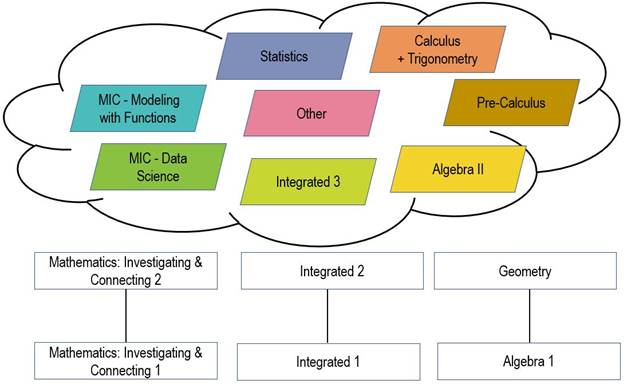
(3) Critics of this proposal (writing at https://bit.ly/cmfanalysis cited in the guest blog post linked here) argue that postponing Algebra I from 8th grade to 9th grade reduces the opportunity for students to study calculus in detail in high school.
I happen to agree that calculus concepts might not be the most important -- maybe it's more important to get a good grounding in statistical thinking as opposed to integral calculus? Maybe it's better to learn really strong proof skills and approach calculus directly via real analysis? I dunno.
I guess what would bug me would be if kids didn't get abstract thinking early. The core concept of algebraic thinking to me as a nonexpert is treating things as variables rather than concrete numbers, and being able to reason about changing a function or a family of functions rather than a specific line or curve.
But what confuses me overall here is -- why does the CA Math Framework still include Algebra I as a 9th grade program? If the new 8th grade CA CCSSM is indeed so rigorous that stronger math students should take it, and if it includes the essentials of Algebra I, then why waste another year on the concepts again? I don't understand.
We have the shittiest math education in the developed world, and it comes down to teacher training, teacher support, professional development, and ensuring that children are fed and in safe situations where they can do laundry and wear non-smelly clothes to school [1]. In Finland that is understood, and lo and behold, good scores overall. In the US we think that curriculum is a magic bullet. Like changing the textbook will change what kids learn. As a former math professor, this is bullshit. I can take whatever curriculum you want in math and transform it to meet students where they're at -- because I f*(&ing know math. Too many of our teachers don't, and it's our fault as a society. I left education because of the crap wages and that creeping feeling that my individual efforts to better things just couldn't match the magnitude of the problems.
America keeps being a magic-bullet country. The vaccine will fix COVID, so we don't need societal support for public health measures. Right or left, I don't care; the right thinks "individual responsibility" is the magic bullet in the face of infrastructure problems, funding problems, everything, while the left thinks technocratic solutions or "being correct" will be the fix.
I strongly support the shift to more applications of math, more stats and probability, more analysis of real-world systems. There is plenty of room to challenge gifted students in this context and I have done so myself -- you do need the time and support to build scaffolded projects so when "that kid" is done you can say, "Well, what about this?" and when that other kid is still struggling you can break it down. The factory grind of education in American and the fact that many math teachers don't even have a degree in math means that is quite difficult to put in place.
[1] https://www.nytimes.com/2019/03/13/us/schools-laundry-rooms....
this blurb alone invalidates everything else you have to say. you have absolutely no idea what are you talking about.
What they are fundamentally doing is breaking up the classic U.S. staged path where you learn algebra for a year, then geometry for a year, then back to algebra / pre-calc for a year, then maybe take statistics or calculus as an elective, etc. Instead, all branches of math will be taught in an integrated approach focused around applied problems.
This is how a lot of European math courses are taught. In fact, I think HN would appreciate the shift from focusing on pure numbers and classic formulas to more applied uses of math, including algorithms, probability, data collected and analyzed in charts, etc. Students also forget a lot of algebra when they do a year of geometry by itself, then have to go back to algebra / pre-calc.
It also does mean that in the transition, it will be harder for students to "test out" of the classic algebra I/II, geometry, pre-calc sequence, because it will just be "year X integrated math." But the framework does not forbid gifted and talented programs or anything like that. There will just be a few awkward years while the curriculum shifts.
Now, there are some on the left who advocated for the elimination of gifted and talented programs altogether, for equity reasons. They did not get what they wanted in the new California framework. That hasn't stopped a lot of people from looking at what California is doing and imagining it is actually some kind of Harrison Bergeron dystopia, when that is absolutely not the case.
[1] https://www.cde.ca.gov/ci/ma/cf/
[2] https://www.cde.ca.gov/ci/ma/cf/mathfwfaqs.asp