1) The scale and depth of the disruption makes it impractical to figure in any kind of accurate way and
2) The disruption will have introduced hypotheticals that nay spiral out themselves (butterfly effect style) e.g. some retailer may have lost a customer who went elsewhere, some supplier may have lost a retailer who went elsewhere, etc
In general, temporary disruption has some long-term positive economic effects (which is directly why 'disruption' is valued in Silicon Valley).
For example, during London Tube Strikes, commuters find different and more efficient routes and 5% ended up permanently changing their route on public transport: https://www.independent.co.uk/news/business/news/tube-strike...
I used to take the access road parallel to the bridge and avoid a lot of traffic that was south bound. When the bridge collapsed and I-85 was blocked off, everyone learned about the parallel access road, and it now became a cluster of a traffic hot zone too.
Prior to that, a lot of people were not aware of the alternate route.
[1] https://en.wikipedia.org/wiki/Interstate_85_bridge_collapse
Unless the bridge collapse resulted in increased traffic levels afterwards, the same traffic that used to go over I85 is now distributed over 2 routes.
While there's a net negative to you, it's likely that a lot of people ended up saving time on their routes.
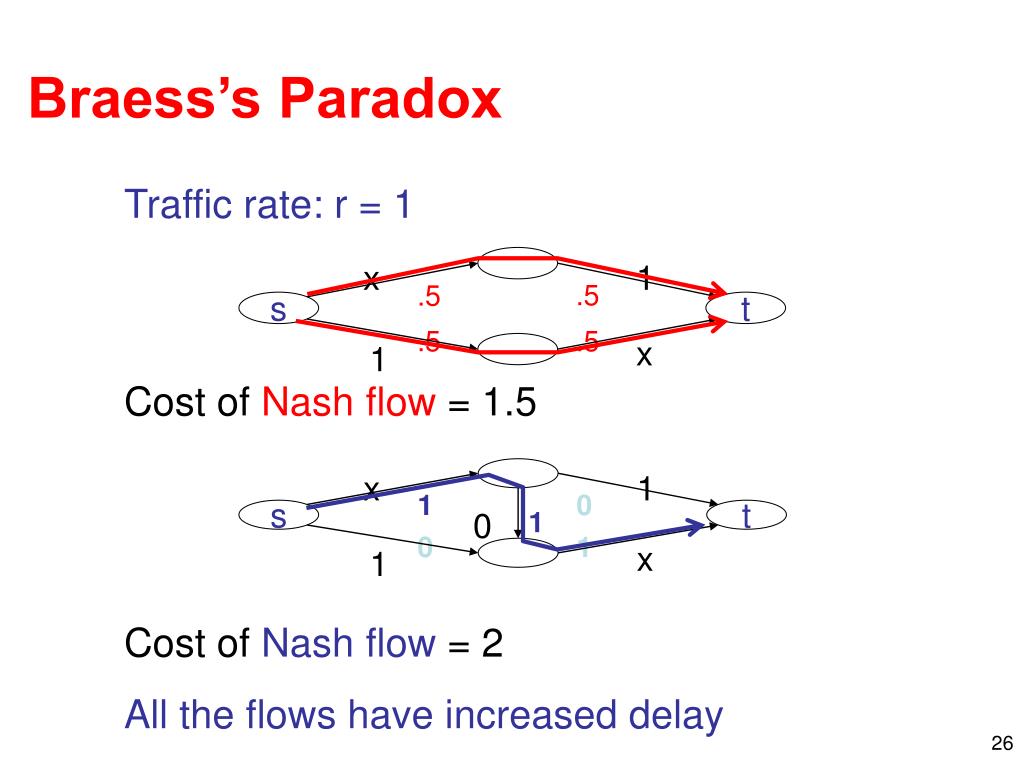
It's theoretically possible this describes a Braess paradox, whereby everybody loses: https://image.slideserve.com/280060/braess-s-paradox-l.jpg
Also in the big picture with covid not being as deadly as it could have been, could serve as a nice dress rehearsal for a captain trips.
1. How did they decide that the benefits would continue over the course of 4 years?
2. How did they determine what "time lost" was? I imagine it's greater than just extra time waiting at the station. People probably also got lost trying to find a new way around, and were late to things important to them. Unexpectedly being late to a job interview is a very different kind of time lost than saving 3 minutes on your regular daily commute.
However... that is no excuse to shrug this off. We were very, very lucky that it was only a week. The ship could easily have broken in two, which would have been a catastrophe of the first order and likely shut the canal down for a year. The world dodged a major bullet here.
[1] https://en.wikipedia.org/wiki/1974_Suez_Canal_Clearance_Oper...
This has a rather odd diagram, and I'm not sure if it supports your comment or not.
It shows Suezmax as having "unlimited length", while Chinamax is given as 360 meters, which I think is smaller than Ever Given.
Obviously unlimited length can't be literal, if the Suez isn't perfectly straight, right?
On the other hand the Chinamax diagram says "unlimited air draft" which again, can't be literal since at some point it would be impossible to keep upright?
The Chinamax designation seems to imply a greater draft, which does make sense, but it's only 20% greater than the greatest stated for Suezmax.
The Suez Canal doesn't have locks, so in principle the length isn't limited. In reality it of course is limited by the harbours you intend to use. Apparently ships longer than 400m also require permission from the Suez Canal Authority.
More important for the claim that Chinamax is bigger is the tonnage. Chinamax can carry 400,000 tonnes, while Suezmax is typically under 200,000 tonnes.
It looks to me from the map like the tightest turns in the canal are the southern exit near Suez, and the turns between Timsah Lake and El Qantara el Sharqiya (depending on which channel you're in, and whether you're allowed to use both channels in your turning maneuvers).
It would be a fun problem to find a good way to figure this out exactly, but it looks to me like a ship 3000 to 4000 meters long would not be able to complete those turns even in principle without running aground. (Presumably the actual practical limit is a lot lower.)
The longest ship ever built (which exceeded the draft limits for Suezmax, so it was out for a different reason) was 458 meters long
https://en.wikipedia.org/wiki/Seawise_Giant
... so there might still be an order of magnitude to play with if you were making a ship that was ideally small and maneuverable in other regards.
Smit is now part of Boskalis, which is a big marine engineering firm. They have dredgers, heavy lift ships, tugs, and barges, which are useful both for marine construction and for salvage. So the fleet can do other things between crises.
Obviously an extreme example, but the situation with this ship is likely similar. The damages probably far exceed the $15m/day in revenue (though I suspect they are far lower than $7b per day).
If you're going to run an extortion racket, you need the power to secure yourself against the inevitable challenges to your station. Egypt is in no position to handle and armed threat from the US, China, or even most European nations. Their government would be toppled and a sympathetic one would be installed who would lower shipping prices to something on the cheap side of fair.
A little history https://en.wikipedia.org/wiki/Suez_Crisis
The Israel, British, and French insurrection completely dominated the Egyptians. The US wanted to carry favors with Egypt to prevent them to falling into the communist sphere, so it applied a pressure campaign against the British and French that completely wrecked the European economies (and from which they never really recovered). It didn't work, Egypt did not become an American ally in any meaningful way, and instead the West lost control over one of the most important shipping lanes in the world, turning it into a corrupt mess where you have to pay for passage in cigarette boxes and bribes.
It was one of the biggest foreign policy fuck-ups of the USA, in my opinion.
Oh, wait, water's already a monopoly: https://en.wikipedia.org/wiki/Natural_monopoly
2. This isn't like a monopoly on water supply, because the ships don't have to go this way. To make the analogy work you'd have to add something like "everybody already has a well, but supplying tap water is cheaper than using a well". In such a situation, a water company that's maximizing profits would charge just a little bit less than using a well, and while it would annoy people it wouldn't harm them.
3. The government stops water companies from gouging for the good of the citizens, which isn't a factor here.
If we want to go with "everyone has suitable access to rainwater for important household use", then it changes the impact of the water company overcharging. It goes from despicable to mundane.
https://rurallivingtoday.com/homesteading-today/is-it-illega...
This is where someone steps in and says something to the tune of "Whatever price you're willing to pay is by definition reasonable" and completely ignore the ethical/moral issues with essentially holding someone's life for ransom by charging the maximum price they can get for something they need to survive.
It's a huge mistake to regard any international trade in the middle east as regulated by simple supply and demand curves. This is a site of world geostrategic focus, usually at the expense of the people that live there.
(Interestingly, both have been practiced towards Israel at different times, as the countries have gone from bitter enemies to cautiously aligned against both Iran and Sunni Islamism of the Brotherhood/Hamas flavor.)
You'd be wrong there! They actually have a rebate system[0] based on a number of factors including origin and destination. Basically, they try to make it so that its always cheaper to go through the canal, rather than sail around.
[0] https://www.wilhelmsen.com/ships-agency/suez-canal/suez-cana...
The cost here was for the interruption to the schedules, not the daily cost of operations normally.
End of the day, the big shippers can price in the two week delay to round Africa, and higher tolls could make a competing railway feasible. As it is China will probably have built a rail corridor in a few decades.
And some retailers and suppliers may have gained customers
But then that also created profits for another supplier!
[1] - https://en.wikipedia.org/wiki/Parable_of_the_broken_window
(Increasing economic outputs by breaking all canals is the perfect example of why I'm always worried about gradient descent)
We lost $100 millions, so it does not matter if it was $10k or $20k more or less because that is less than 1% of the total. There is no meaningful decision you can make based on that 1% difference.
Political instability is definitely a contributing factor to the fragility of the southern corridor.
That plan was frozen after the Egypt-Israel peace agreement.
As an alternative (and ignoring the obviously substantial geopolitical concerns), is there a geographic reason not to dig a canal on the other side of the Sinai from, say, Aqaba to Rafah? If you had to dig that far, it would seem to be the next best option.
1. https://www.npr.org/2007/06/04/10619929/six-day-war-shaping-...
I can't see Egypt approving an alternate canal that Israel would have any control over, but I could absolutely see Israel going in on a chance to a) take business from Egypt and b) add a defensive feature along that border.
An underappreciated fact of Israeli and Palestinian geography is its mountains and hills; any major transportation project [1] requires extensive tunnel and bridge work.
[1] Examples: the TLV/Jerusalem high speed rail, the Haifa highway bypass, or a proposed transportation corridor connecting the main West Bank population centers along the ridge of the Judean and Samarian mountain ranges.
A Bloomberg article (https://www.bloomberg.com/news/articles/2021-03-27/how-a-des...) says the speed limit was 7.6 to 8.6 knots but the Ever Given was traveling at 13.5 knots. So maybe they need to start enforcing that limit.
Reportedly this was during high winds, so they could also reduce the speed limit even further in those conditions.
Or they could have Suez specialists be the ones piloting large ships through the canal rather than the ship's normal crew. (As I understand it, that's pretty standard for harbors. Not sure if the Suez already does that.)
Or maybe there's a technology solution, something like stability control for cars, except it's for ships in narrow canals.
Because the boat is longer than the canal is wide, for any nonzero perpendicular wind speed there is a minimum boat speed below which it would not be able to avoid running aground. The solution is to either not permit such large ships to transit the canal during high wind events or to send them with enough tugboats to counteract the force of the wind.
Pilot was on board, but there seems to have been some kind of conflict between Master and Pilot that resulted in high tension environment on the bridge.
Ever Given Master’s statement is published here, and has been circulating among the crews for a few days: http://www.maritimebulletin.net/2021/03/28/ever-given-latest...
So, some weird drama. If this is true, however, this would be a gross misconduct of behalf of the Pilot.
Last line before the report
>Read this Statement and ask yourself – can such incident lead to accident like grounding or collision?
If the professionals are not doing their job and even causing issues on the bridge;
i.e. >As soon as the master picked up the VHF and called Ismalia Port Control on Ch8, the pilot raised his volume high, started shouting, snatched the VHF from the master’s hand (which also resulted in advertently pushing the Master) and threatened that if same was reported “It will not be good for the vessel”.
>At that very moment, in his raised volume he called for fwd and aft stations and for both anchors to be lowered to water level, as he insisted on stopping the vessel and arresting vessel for faulty steering. He said vessel will be held at Bitter lake until sea trials were carried out. Fwd station was immediately manned however anchors were not lowered as ship was doing 9 knots speed.
Then it could lead to accidents.
The linked article is a hodgepodge of random factoids and hearsay. It even confused the poster into thinking the report was from the Ever Given. Doesn't look like a good source to me.
Friends scientific boat had a same thing in Kiel canal, but only 22 meter boat and under and hour.
Like doing nothing, and sailing around Africa in the extremely rare case there's a problem.
Makes me think of: https://xkcd.com/1205/
A many weeks long shutdown (in case they had to unload the Ever Given) would be many orders of magnitude more expensive.
Factories will know enough in advance of this problem. They can fly over some supplies to keep the factory running. It's entirely normal to do this. They usually do _not_ idle or shutdown the factory. Who pays is for lawyers and so on.
A shipping company will know about these clients and prioritize that cargo.
How do you even try to calculate and reveal the cost associated with say a manufacturer in the middle of a supply chain deciding to source their parts from a different vendor for this run because their usual source was delayed due to the Suez blockage and they didn't want to leave their factory idle?