Is it safe for cats to eat X?
Cats are mischievous and we love them.
X is not typical cat food. Let's go over some background on X before we answer the question.
Cats are obligate carnivores.
Thanks for reading, make sure to subscribe or buy these products!
The answer to the "can cats eat X", of course, can't be at the beginning or at the end. The reason is that the user must stay a long time and read the text, otherwise Google punishes the website for having a more than acceptable "bounce rate".
Putting the answer in the title (what has been dubbed "Anti-clickbait") also makes the site "less clickable" and will make it drop from the results. Trust me, I tried.
This is why we can't have nice things.
Easy for me to believe. They have to use some formula, and as soon as they change it, well, there's a massive industry dedicated to getting around it. If their algorithm is just "filter out what's useless", that's AGI.
Personally, I swapped to DuckDuckGo in 2019 and have been consistently happier but Bing or whatnot is probably equally valid at this point.
I actually switched to DDG cold-turkey and didn't use !g at all. Until I couldn't solve some problem and someone in my team said "it's the first result on google", I felt pretty stupid then. Since then I've given up and just automatically stick !g whenever I'm searching anything programming related.
Full text search isn't, but ranking the results is - and more importantly there is no objectively best ranking.
[0] When I search "postgres array_agg" on DDG - something I actually had to search for today - the Postgres documentation is the 6th hit (not even visible without scrolling down!), preceded by crap like https://archive.is/7JeSe. On Google it's the 2nd hit, also preceded by what seems like SEO spam.
In this case, DDG happens to have a bang shortcut for postgres which takes you directly to the search results on the PostgreSQL site if you query !postgres array_agg.
There's a surprisingly large number of these which end up making it more useful than the generic web search results page overall.
I doubt a million is going to make a dent in it. Content marketers are automatically generating this stuff, and Google has billions of users, many of which will occasionally invent a novel query.
Old-school useful content is rarely monetized, just someone sharing their passion for something. Occasional affiliate link, with the obligatory apologetic "hey web servers cost money, so I included some affiliate links here!"
The uselessness is just a side effect of Google directing you toward paying customers.
The reason Google keeps those results near the top is because it drives up the cost of AdSense, since multiple competitors are fighting for the first page of organic results with those tactics, and AdSense is a way to "cut the line".
The result for users is that the first page of most result pages is littered with advertisement, either via real AdSense or with those inane marketing blog posts.
try it here : ssh [email protected]
I'm honestly such a huge fan of the Bing widgets, every time I see a someone google search for something basic and need to dredge through all of the AdWords laden blogspam, while I know bing has a good widget in your face widget with the answer, I can't help but feel confused at all the "Bing bad Google good" rhetoric.
Some of my favorites:
Annual Weather charts: See chart with monthly breakdown of temperature & rainfall for any location along with record temps, days of rain, and configurable units; Google has something similar but it presents the first few rows of a table first, with a separate tab for charts, and then the charts don't have nearly as much data (avg hi/lo, inches of rain, hours of daylight (bing doesnt have hours of daylight, so +1 to google for that))
Random animal fact cards: Try Binging something like "marsupial", you get a beautiful hand-crafted info card. There isn't one for every animal, but it's clear thought goes into creating them and they always make me happy to see for whatever reason.
can cats eat asparagus
I tried Google search, and produces a semi-useful snippet at the top, and reasonable results afterwards. Can you share what search you ran that had very bad results?
Can cats eat asparagus? ... It is neither toxic nor dangerous for our cats to consume in very small portions, but neither is it truly beneficial to them. Cats are obligate carnivores. Unlike dogs, who can and do eat everything they can wrap their jaws around, cats tend to be much more finicky eaters.
Can Cats Eat Asparagus? - Is It Safe For Cats? - ExcitedCatsexcitedcats.com › Blog Feb 12, 2021 — Vegetables, including peas, carrots, and asparagus, are safe for most cats to eat in small quantities. However, remember that your cat isn't going ... Interesting Facts About... · Which Vegetables Can I... · Is Asparagus Safe for Cats?
Can Cats Eat Asparagus - Cats Dogs Blogcatsdogsblog.com › can-cats-eat-asparagus Oct 18, 2020 — Although there are benefits for giving your cats asparagus, the potential risks are far much dangerous and outweigh the benefits. It is therefore not ...
Why Do Cats Like Asparagus? (And Is It Safe?)betterwithcats.net › why-do-cats-like-asparagus The short answer is that yes cats can eat asparagus in small amounts without any problems. But while asparagus is quite healthy for humans, your cat really doesn't need to eat it.
Can cats eat chocolate? Yields ovrs.com (Oakland vet), purina, webmd, thesprucepets.com (cat blog run by vets), pdsa (pet veterinary charity)...
Can cats eat grapes? Yields top-N dangerous foods for cats listicles from various sites such as pet insurance and cat food brands. A response from a veterinary trust is in the top ten.
Can cats eat paint? Yields all reputable medical sources for the first several hits.
I’m not sure I can square this with your description of ubiquitous spam swamping out useful information.
Huh, I just tried this with a bunch of stuff and the snippets for each of the top several results for each all had fairly direct yes/no answers with reasons. Don't know if I got lucky hitting the right food items, or if it's a personalization issue.
Contrary to that I tried "can cats eat salad" and got basically a yes in the first line:
"If your cat loves lettuce and greens, these can be a great source of water, bulk, and nutrients..."
It fits with the 2/3 of searches end without a click though. That was on Google's results page - I didn't have to click.
https://www.aspca.org/pet-care/animal-poison-control/toxic-a...
In addition to plants, common human drugs like alcohol, THC and caffeine are also poisonous to cats.
Also common human spices such as salt, garlic and onion can be toxic too. Cats tolerate very small quantities of these (e.g. small slice of salami), but feeding your cat a chicken with garlic sauce is probably a bad idea.
No broken links and much better experience.
Not trivial by any means but there's a lot of prior art floating around you could pull from.
Sure they could pull API access and be more hostile to scrapers but that's the current escape hatch for people who would have left because of the redesign.
Also love being redirected in order to continue reading certain threads
Google today limits how much of "the web" (their index) they will let you see.
You are only seeing what they choose to allow you to see.
Google, not the user, determines "relevance" and Google automatically excludes results. in theory this sounds useful. In practice, Google is now limiting max number of results to 200-300 or 500 if you add &filter=0. Retrieving 501 search results for a single search is not allowed. Sorry.
Try a search for some common phrase like "the web". Surely this phrase occurs on more than 500 web pages. Yet Google will limit you to only 231 results. Does that represent the entire www. Then you try "repeat the search with the omitted results included". Google then limits you to 466 results. WTF. What if you searched page titles for some string. Is every string you search going to be found in less than 500 pages.
Google search results today are not representative of the entire www. Not even close.
What I've discovered, though, is that what google images now does, is it is only returning a few results. If you click a result, then there's a "new-to-me" "related images" section that shows images similar to THAT image, only in that window. It is in these images that I actually see the results I was expecting to show on the main page.
Its still far worse than google images 10 years ago, but not as bad as the UI makes you believe by looking at the initial results page.
Beware though, yandex allows NSFW by default. You have to enable safe/family search. This is the opposite of Google and Bing, so it could get you in trouble at work. Those crazy Russians.
If I ever X vs Y in google, I append site:reddit.com
I'm not a huge fan of Reddit, but it's about the largest forum. I really miss Forum search in Google.
You may find this useful: https://boardreader.com/
I try to "collect" search engines, so I'm always interested in finding more/sharing the ones I've found.
As others have mentioned, Google no longer respecting literal search terms has made it much worse for many types of searches. DDG had been great at this, but sadly has been following in Google's footsteps the past few years.
After reading through this discussion, I am inclined to explore search.
This crap sneaks up on a person one little adaptation at a time.
Searching on Yandex was a wake up call.
I update whenever I remember, which is sometimes.
It is currently up to date, except for the above linked engine. It doesn't have as many special purpose engines as I'd like though.
You can see the list here[0], and if you see more feel free to send them my way!
Added to my playbook. Thanks again.
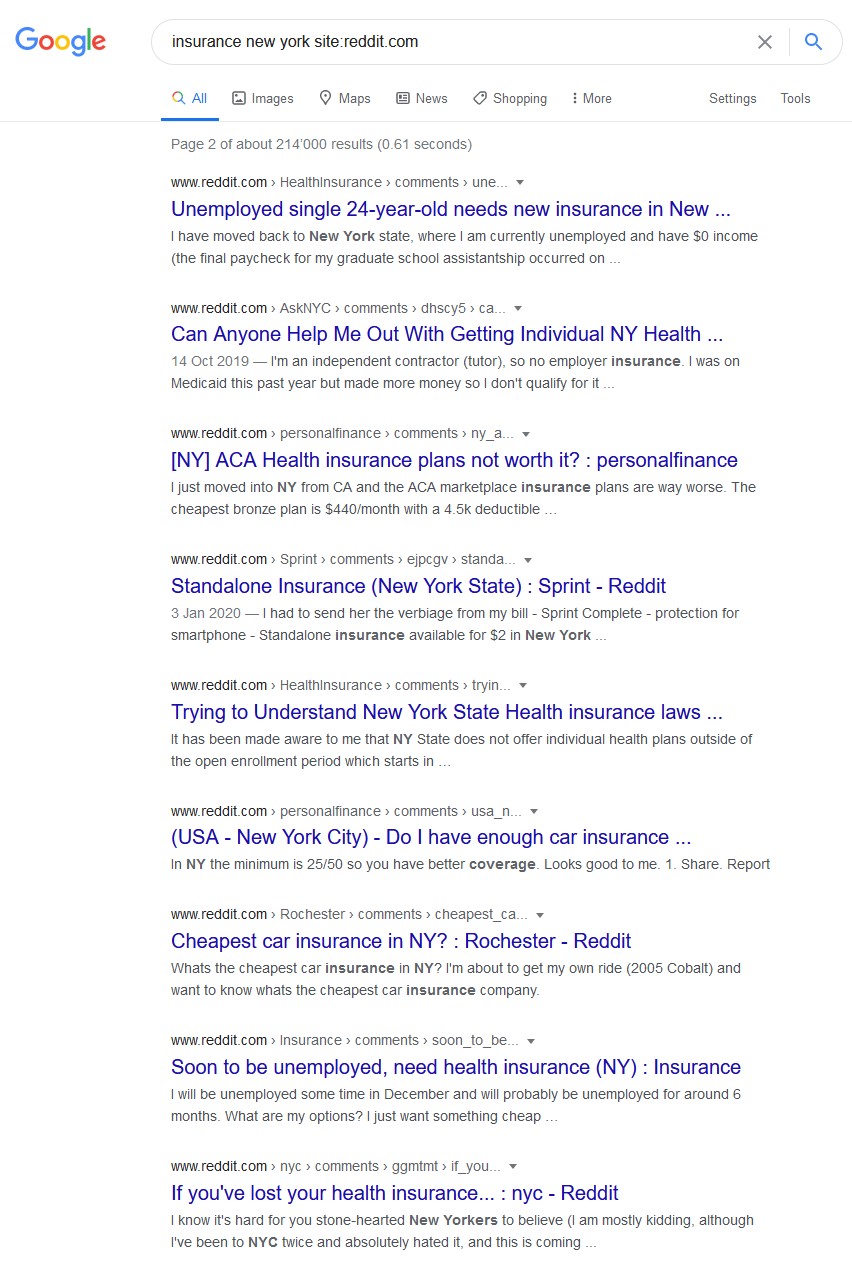
Sinister twist though: the SEO crowd has gotten wise to this. I've noticed recently that they've started throwing "reddit" into their spam as a random keyword.
I absolutely hated when they did remove it. I was able to sort of mitigate it by adding "forums" and "discussions" to search terms but it is not the same of course.
Usually: voted on/curated by members who are specialized in some way (reddit, so, hn, wikipedia to a degree).
The fallbacks are editorial sites.
If you make a search engine that focused on indexing user-curated sites + results outside of that that are themselves curated/voted-on by your search engine users (ie, you and others could upvote axios and Amazon as a good source), I think you'd have an interesting model. Basically, take the HN/reddit model to search itself.
Which is easier: enforcing one account per person and then identifying bad-voters, or not doing that and having N pages, and N*M page links?
Further, you'd now have direct access to customizing results per-user. Use my votes.
I prefer "site:reddit.com" but honestly it's only because I'm used to it. I search in-app on mobile frequently (which I assume is the same as the on-site search) and it's generally pretty good. It usually finds something for me but sometimes using an external search engine works better.
Agree, the web is unusable without an ad blocker.
I think the future of search is in finding trusted results, such as those upvoted by reddit or HN or SO, assuming the upvoting system is robust enough to withstand spambots etc. The question is whether a big enough fraction of the population actually care to get good search results.
You are absolutely correct. So many of the top results are basically machine-generated pages, perfectly optimized for search robots, not so much for humans.
1) Bring in tabbed search result like Cuil search used to have. Easily lets you go to similar/variant topics from UX POV and must be a good way for a search engine to learn what people want more.
2) Add a 'dont show this site' option. So they can easily see when people get annoyed with a result and use that as a ranking signal against search terms. E.g. if people press that for a particular KW but not usually Google knows they got that result wrong and if people press it for almost everything you know its a site people dont want to see. And at a personal level its great to custom remove stuff, like when Pinterest was dominating so much a year or so ago.
Would be a great way to community curate results.
Probably some financial positive feedback loop is responsible for this.
I tried this with a bunch of products ripe for spamming: instapot review, nvidia 3070 review, and Apple Watch review, and the first page results were almost entirely reputable.
I also tried “huggies vs pampers pull ups” and the result is quite a good variety of forum threads, blogs, and reputable articles. “Quasar formation” leads to Wikipedia, but also academic articles and astronomy.com. “How beer is made” is even better quality.
Is most of the web junk? Have I gotten astronomically lucky in not finding it? Are these somehow the exceptions that prove the rule?
(Ironically I think my search terms caused this comment to be flagged as spam..!)
It's less common stuff that tends to give you mostly crap.
I’ve found this to no longer be the case after Reddit has starting doing nefarious tricks with the date of a post.
For example, I’ll click on a link in Google showing it’s from last week when in reality the post is 2 years old.
Once I took the time to read one of the sites and it’s obvious it’s generated content, and awful at that. I still reading pros and cons of one of the product and the same thing was mentioned under both, just with different wording.
GPT-3 or similar is going to make this way worse.
The only time I still use google (via !g on ddg, what an awesome feature) is to search for local info or in native language. But even here ddg is getting better, especially if I append the name of my city or country.
I didn't realize that I'd migrated over to this. All my searches now are 'xxx reddit' or 'xxx stackoverflow'
It's only a matter of time.
That's true. But out amongst that is the result you actually wanted that google doesn't have any incentive to lead you to.
As they wound down the top writer program, which is really where the "hits good" seeds are, they decided to pay people to ask questions.
Signal to noise ratio began to trend toward unfavorable. But traffic shot right up!
There have been other decisions contributing to the Quora we see today, but the paid questions really had the most impact in my view.
That said, yeah. There is still a lot of high value contributions to Quora. They are just a little harder to find now.
One thing I feel they missed the boat on was the credits system. Early on one could accumulate those and use them as a sort of currency. I "spent" some of my pile asking specific people for insight and it worked out well. I had others do the same with me.
Basically, one could get to a domain or subject expert and the site was still "family", so it would lead to a high value exchange.
For a little while, their text question UI hinted at what a Quora could be. Well connected Quorans could toss a question in via SMS and get solid responses back, sometimes quickly.
(Came down to follower counts, writer status, and a few other things)
These options were not abused much that I could tell and they hinted at a means to query people without draining said people, and or everyone participating having some give and take.
Was a fleeting moment, but one I ponder from time to time.
I would subscribe to a "group" that has the UX and overall dynamics of something like what I just described right.
“Product vs. Product” -> list of spam websites that just show them side by side with ads.
“Product Review” -> same as above, spam.
“Product referral code” -> sites with spam and no codes.
Interesting web content is in Reddit (and youtube), Google exists as a tool to search Reddit since the “new” Reddit site is awful.
Programming questions are mostly stack overflow, but occasionally you get a useful blog.
General knowledge is Wikipedia, news is axios.
Amazon for most purchases (except for products that have their own brand and sites that are at risk of being faked). Etsy for boutique stuff.
Most of the rest of the web is junk.
I think we could probably go back to curated 90s era web portals and have a better experience.