Lottery is too improbable but some other things ”no rational person would do” can be ok. Main thing is to get over with it soon and protect the downside.
Of course if you get lucky you need to be contempt with the nice head start and switch strategy to doing the boring rational things. Not sure if these qualities are often found in one person.
This is indeed, after all, a website about founding startups.
No shame in gambling your way to wealth if you don't care about the social signaling.
Perhaps most humans cannot truly be atheists, but will always be caught by something to believe in.
In any case, I have mixed feelings about in which direction society is heading.
On the one hand, I think this game of social ascension is the same as before, only the dream changed: we have no illusions of having a well paid job that affords us house, cars and a big family, at least not without acquiring a huge debt.
On the other hand, on average, we have much more access to information. The average joe is much more educated and have higher buying power than 100 years ago.
I think we can't really look at the present comparing with what once was, because we live in a time of its own. We have to reassess the current configuration, fight to keep what we acquired in terms of freedom and equality, but try to fix the perceived feeling of separation, loneliness and helplessness together.
This almost certainly results in a worse average outcome, because of diminishing returns on income. Winning a 10M jackpot won't bring you 10,000 times the happiness compared to finding $1000 on the ground.
Suppose that there are 1,000 basement-dwelling redditors (okay, it's a caricature). Each has their basic needs taken care of, but not much money, and not much scope to improve their lot in life. What little money they have doesn't get invested, but spent frivolously.
Suppose 1,000 such people could all put in $500 and give it to a randomly selected one of them. That person wins a life-changing amount of money. They suddenly have their prospects upgraded - they can travel, buy a house, live in some comfort, pursue a dream career. Couldn't it arguably be rational for all 1,000 to participate in that game? Doesn't it make sense that the utility curve is convex, not concave - that $500,000 is more than 1,000 times better than $500, when compared to $0?
After all, suppose that $500 was a year's spare income. Even saving for most of a lifetime would only yield $20-30,000, nothing like enough for many of the opportunities that half a million would make possible. And a lump sum at age 65 could be much less useful than one at age 25. Losing the $500 might barely make a difference to one's quality of life.
Now suppose that to participate in this lottery, they have to pay 10% of the money to Wall Street, or high frequency market makers, or whoever. Couldn't it still be a rational choice for each of the 1,000 to participate?
To the person with 10 million dollars, doubling their wealth is nice for them but likely won't result in a major change in lifestyle and what they could or couldn't do before. Maybe they go from a large house to a larger house. For the person that makes 30 thousand a year, doubling it makes a huge difference in how they live. The disposable income amount doesn't double, it's likely many many times higher, because it was such a relatively small portion before.
The same thing applies to one-time payments. It would make sense in your example even if the payout was much less (like $10k) but still affected the group similarly (i.e. if they had less disposable income). That amount of money is a huge to people that have little disposable income.
The implication you're making here is that these people wouldn't mind losing $500/year, because it's otherwise being spent "frivolously". I don't think this is true because if you're spending it on something, you're getting joy out of it, otherwise you wouldn't be spending money on it in the first place. For reference, $500 can buy you a game console or several games, which can provide you with tens or hundreds of hours of entertainment.
If it's really the case that the $500/year is being spent frivolously (ie. being spent on things that don't bring joy), then the correct course of action would be some sort of intervention that forces them to save, so they receive a large enough lump sum that can be used productively. We sort of see this happen with tax refunds, where people are basically forced to save throughout most of the year, the IRS gives it back at the end of the year, and they spurge the refund on a big purchase.
>Doesn't it make sense that the utility curve is convex, not concave - that $500,000 is more than 1,000 times better than $500, when compared to $0?
What makes you think that? I think it's generally accepted that money has a diminishing returns on happiness. I guess if you go to the extremes there's some ranges where it doesn't apply (eg. it's hard to do anything fun with a $5 bill), but there's also nothing preventing you from saving up the money.
>After all, suppose that $500 was a year's spare income. Even saving for most of a lifetime would only yield $20-30,000, nothing like enough for many of the opportunities that half a million would make possible.
You're off by a factor of 2. Factoring in a 6% inflation adjusted return, you end up with a return of $77,380 if you do this for 40 years.
Things that bring me joy are being able to donate enormously to solve social problems in my quality. I can say for certainty that it will bring me 10,000 times happiness.
The problem with this argument is that there's always an "expert" that can justify your speculative positions.
We can find plenty of experts rationalizing some stocks or history, all with convincing narratives. But can you find a expert explaining the numbers which came up in lottery last night with such a believable narrative (wrong or right)?
Isn't that what fortune tellers are? The only difference is that most people know that trying to predict the lottery is bullshit, but most don't think that's the case for stocks despite evidence to the contrary (eg. that actively managed funds underperform passive funds on average).
I'm not familiar with the Powerball, but I'm guessing that's for a prize of somewhere around $5 for a ticket price of $2. Hardly relevant, is it?
We saw this happen in 2008 with Volkswagen. 1% of the total shares were floating because Porché had purchased the remaining, the rest of the shares were owned by institutions and they were not selling them.
This has nothing to do with the ratio of short shares to float. What happens if there are 300 shares floating, 20 short shares, and nobody sells?
But how is having short interest of 140% of the float different from having short interest of 80% of the float?
(Honestly asking and don't know, everyone please only answer if you have knowledge of how these kinds of things work and are able to identify and explain away the relevant confusions.)
However, it looks very clear that GameStop is allowed to hold on to a bunch of shares it can sell directly in the stock market, since it did exactly that:
> Happily, GameStop does have an ATM offering going. It put it in place on Dec. 8, 2020, when the stock was at about $16.35. The way these things work is that GameStop disclosed that its bank could sell stock—up to $100 million worth—“from time to time” at GameStop’s request “consistent with its normal trading and sales practices”; it did not disclose any particular schedule, and has not yet reported if any shares have been sold, or how many, or when. So I don’t know if GameStop had sold the whole $100 million before Friday’s wild run, or if it had any stock left over to sell; if it had any left over, I don’t know if it sold it all on Friday. I hope it did!
that's not necessarily true.
Quoting Matt Levine[0]
> There are 100 shares. A owns 90 of them, B owns 10. A lends her 90 shares to C, who shorts them all to D. Now A owns 90 shares, B owns 10 and D owns 90—there are 100 shares outstanding, but 190 shares show up on ownership lists. (The accounts balance because C owes 90 shares to A, giving C, in a sense, negative 90 shares.) Short interest is 90 shares out of 100 outstanding. Now D lends her 90 shares to E, who shorts them all to F. Now A owns 90, B 10, D 90 and F 90, for a total of 280 shares. Short interest is 180 shares out of 100 outstanding. No problem! No big deal! You can just keep re-borrowing the shares. F can lend them to G! It's fine.
[0] https://www.bloomberg.com/opinion/articles/2021-01-25/the-ga...
Same thing happened to Volkswagen, only 1% of the shares was available for purchase and they had to close their positions.
And this is for a global pandemic. You think they're gonna do anything if people choose to make risky-ass bets that don't pan out?
That easy money is driving malinvestment and it will just fuel any future bubble that inevitably ends up popping.
That's what you get when your system is designed to give money easily to young people who don't understand the consequences of major financial debt.
Blaming this on the individuals is leaving aside that there are huge incentives to behave like that in the US: lack of financial education during formative years, a society based on consumerism and status, a society which provides easy access to a huge amount of capital through student loans.
From the outside it looks extremely predatory, even more when this easy money flows into universities increasing tuition prices, the same pressures on housing prices get in play here, with the difference that a mortgage is potentially dismissable if you go into bankruptcy.
Who exactly designed the system that way? Banks (aka capitalists) were not very keen on doing this exact thing for the risk reasons, and now the government ended up backing most of the educational debt for some reason (aka socialism).
And I'm sorry, the moment you use "socialism" to describe the government backing private loans from institutions that are privately held you lost me. This is not even close to a semblance of socialism, this is your government trying to live by the ideology of "free market everything" and patching the holes created by this ideology with a more expensive (and dumber) solution.
If higher education was free for every citizen, subsidised by taxes, you could call it a socialist-ish policy. Having to pay "market price" for your education through government-backed loans to private banks is far, very far from socialism.
I'm not an ardent capitalist, but I think education is an area that would have been better off without government tampering, or perhaps with less-clever tampering. The good bit about our student loan program is that it normalized higher education (perhaps too much to the extent that many would have been happier and more successful in the trades). The bad bit is that government put all risk on the students, allowing for students to elect into programs that wouldn't have a good return on investment--something that virtually no bankers would have signed off on. As a result, two things happened: 1. millions of students annually opt into careers with poor job prospects on the other side and 2. the price of higher education inflated (something like tenfold) to meet the availability of student loan money (and without any corresponding increase in value) because the system isn't steering students (and their loan money) toward programs that deliver. I think if we allowed students to default on their loans, we would see loan prices fall 80% or more ($8K instead of $40K).
No, I am sorry. When government forces financial institutions to give loans to everyone applying without risk analysis it IS socialism, aka “democratic control over the enterprise”. No capitalist in their right mind would give hundreds of thousands of dollars to pay for underwater basket weaving degrees and expect to see the money back.
No one has a degree in underwater basket weaving.
Did you go to a 4 year private school (possibly a non-Ivy)? I feel like you are describing a class of Americans who are oblivious to their privilege, but are mistakenly labeled as the working class who’s problems would simply be solved if they stopped buying avocado toast and switched their Starbucks for water.
I assure you your classmates who went to private 4 year school on dad’s dime do not reflect the majority of working class millennials. For many millennials they are more worried about being wiped out by a trip to the hospital that would cost the price of 3 lifetimes of lattes
> I assure you your classmates who went to private 4 year school on dad’s dime do not reflect the majority of working class millennials.
I wasn't talking about working class millennials, but millennials in general.
> For many millennials they are more worried about being wiped out by a trip to the hospital that would cost the price of 3 lifetimes of lattes
Yeah, we have private health insurance and that really sucks for those who don't have access to decent insurance. But that doesn't justify living it up in school. Note also that I'm not even blaming millennials per se; our society failed to teach us personal responsibility, and it went even farther by creating a loan program and dumping us into a predatory university system with the vague guidance that we should follow our dreams, have a good time, and everything will just work itself out. Of course the majority of us took the bait and lived it up. Worse still, we graduated into an economy that was worse than what our parents dealt with. Excuses abound, but nevertheless, our generation YOLOed pretty hard even though the YOLOing wasn't evenly distributed.
I still saw this behaviour a ton, and it wasn't people living large off of daddy's money, it was people living large off of way too much student loan money.
People would take the maximum loan they could get even if they were living at home with no expenses, just so they could afford a party lifestyle
Nor me. I worked throughout all of undergrad. My work paid for my grad degree. I have an MSEE and am looking at $50k of student debt. My income is such that I expect the only way my debt will go away in the next ten years is through PSLF. Owning a house before I’m 40? I’m not so sure. Where exactly is the YOLO? The generation didn’t piss anything away. We’re getting shafted.
Are you still working in a job requiring that degree, because if so, that does seem like you're getting shafted (especially compared to the equivalent on the CS side of EE/CS).
You don't see a problem with a motivated, hardworking, educated individual meeting the market at a price that keeps them below what previous generations consider middle class? That is not indicative of an issue to you?
> You don't see a problem with a motivated, hardworking, educated individual meeting the market at a price that keeps them below what previous generations consider middle class? That is not indicative of an issue to you?
I think people are trying to understand if you are working at or below your regional market value. That said, it sounds like a problem local to your region. I think if you look at Glassdoor you'll find that you're well below the national average, and I don't think it's just Silicon Valley inflating the national average. (I have an EE degree as well and on graduation it seemed like $75K was a pretty reasonable starting salary most places with lots of room for growth).
The people who aren't doing well aren't the ones who didn't drink, lived at home and did math degrees as far as I can tell
Some of those things are not like the other. I studied computer science, plenty of people partied and as far as I can tell, people who studied humanities like literature had to work more. It was not easier major in terms of how much you have to work. I liked computer science, so I am always surprised about how many people seem to hold resentment toward those who studied less fun majors.
In any case, miniscule amount of population majored in women’s studies and they tend to cluster in top universities and from richer families. Meaning, it is not major drag on their future.
Majority of students go for practically sounding degrees - like various business related degrees. They tend to learn to like them somewhat, but generally are not intrinsically motivated to be accountants or what not at first. They are not making childhood passion based decisions, but the "what gets me job" decisions.
Unfortunately, many young people and their parents didn't understand this dynamic of watering down and still believe that the degree opens a path to a better life, while the truth is, most people are just not talented enough to be employed into demanding and well-paying office positions that most of us here work in. The Universities are silently running a scam, taking advantage of the obliviousness of young people and their parents by selling them a way to waste 4 years of their lives in exchange for a lifetime of debt... It sounds really horrible. At least here in Europe education is free so you "only" spend 4 years doing things that won't help you in life later.
Luckily, the stories of people who graduated only to sell shoes or coffee are now prevalent enough to make the next generation more aware of the real value (or lack of thereof) of a degree in something non-commercial from an average university. In my family, I now see younger people more often deciding that higher ed is not for them and going straight into trades.
Need or want?
We've spent 30yr trying very hard to remove individual judgement and responsibility from the corporate world. Most employers larger than say ~75 people likely have enough process built up that they can skate by on people who mindlessly follow process with a few talented people sprinkled about to spice things up.
>while the truth is, most people are just not talented enough to be employed into demanding and well-paying office positions that most of us here work in.
The hardest part about working as a programmer is getting your first job as a programmer which usually means suffering through Calc 3 you'll never think very hard about again. Getting a pay stub is on FAANG letterhead doesn't automatically equate with intelligence though many here may keep telling themselves that. The bulk of the SWEs and SREs in those companies are just going through the motions and reacting to situations as any other person operating under the same constraints would. Besides basic problem solving ability that all humans have and a background with experiences that qualify you for the job there's nothing special about it.
I think it's need. There's plenty of chairwarmers hired as senior managers in my place of employment. The company would be doing radically better if these people were genuinely talented and dedicated, but apparently it was too hard to hire such folks, so we got those impostors instead. The whole department is a mess as a result. And it's mostly the same across the whole org. The world just doesn't have that many talented and dedicated people, and also a lot of them decide to just launch their own businesses instead of being a part of some corporate charade.
> Besides basic problem solving ability that all humans have and a background with experiences that qualify you for the job there's nothing special about it.
Are you aware of basic problem solving abilities of average human? They're... not that great. Intelligence plays a key role in constructing good ad-hoc working theories as to the hidden/internal state of the mess you're currently working with. Smart people are just better/faster at it and the more complex the problem is (and we're working with problems of huge complexity - often with codebases that are to large to understand within a lifetime), the more important that becomes. Not to mention that there's plenty of people who just don't tolerate (emotionally) uncertainty too well, and they feel terrible at jobs like ours, preferring to be a supermarket clerk or doing something else with minimum uncertainty, exploration and decision-making. For example, my mother once worked with a woman who has severely stressed over having to learn to operate a new kind of cash register (and she was a clerk at a store). Imagine how well would she do in the world of front-end development...
I don't believe that's true at all. Historically, in the US anyway, a university education was a wealth signal more than an intelligence or work ethic signal.
The only hard part about the literature classes was how much reading was assigned (often 300+ pages before the next class, per class, which might be 2 days later). But for the most part you could skim them just enough to take the pop quiz for the day and then get the parts the professor wanted you to know from the lectures, although I did my best to actually keep up with the reading. Tests and essays for lit classes were super easy for me, mostly just required parroting back what was covered in the lectures.
For Computer Science classes (in particular the programming assignments), if I couldn't figure out how to get something working, I ended up sitting in the computer labs for an extra 10-20+ hours until I could, because otherwise the best I could hope for on the assignment was a C. Professor's office hours were usually a joke for me, I even got told once "If you didn't get it in class I can't help you now," which I thought was the whole point of office hours. Didn't have Stack Overflow or Youtube or even very many tutorials online back then either to help out.
Also I had several friends who pursued various humanities majors, and it never seemed like they were ever as busy as I was. I even thought maybe I picked the wrong major at one point because I was spending so much of it stressed out about classes (that's actually the main reason I minored in English, I spent a semester only taking English classes, considering changing my major, but didn't end up doing it).
Now that I've ended up working in software engineering, I wish I'd had the foresight to have done joint degree in computer science and literature. Applying NLP techniques to literature would have been a blast.
My Religion degree, esp. when we got to things like post-modern criticism and Hegel, were leap-years more difficult than anything we had to study in computer science. So, yeah, I take umbrage to people saying that the humanities are easy.
(The Religion degree was incredibly interesting, too, though ultimately not terribly practical for anything but law, and I wasn't really interested in doing that.)
To your point, though, studying just for interest is probably not prudent, and it's also probably not prudent to study humanities if you're not prepared to attain a subsequent degree/go on the academic track.
> Majority of students go for practically sounding degrees - like various business related degrees. They tend to learn to like them somewhat, but generally are not intrinsically motivated to be accountants or what not at first. They are not making childhood passion based decisions, but the "what gets me job" decisions.
I welcome some evidence here. I’m very skeptical.
Source: https://educationdata.org/number-of-college-graduates
For bachelors degrees: 432,077 STEM 386,201 business 244,909 healthcare 44,262 liberal arts 82,621 education
So business is approx 9 times more popular than all of liberal arts combined with the vast majority of the rest being made up of degrees that would seem to be things that make money.
Looking at the pie graph breakdown by field business is the largest section not including "Other fields": https://educationdata.org/wp-content/uploads/76/bachelors-pr...
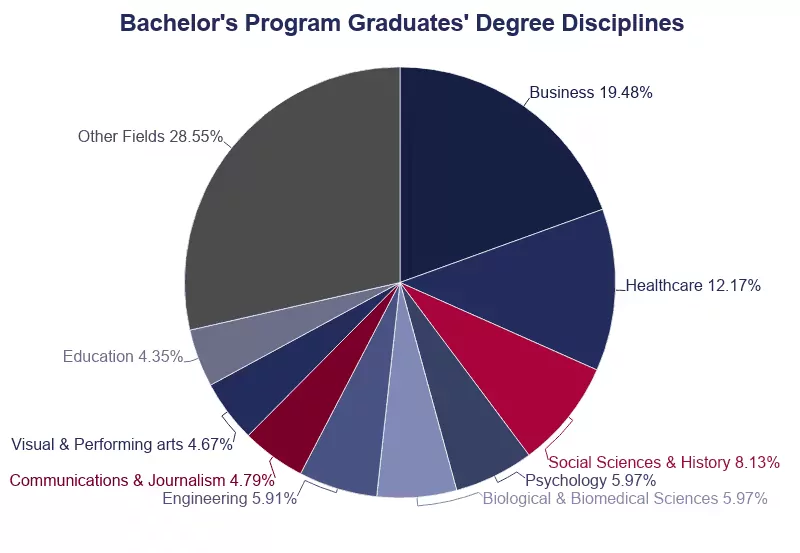
So appears the person you're responding to is exactly right.
- am I doing it right?
Damn. I've never considered the psychological effects of the lottery system, but in a way I think you hit the nail on the head.
Anyways, in the GME scenario it appears that most retail investors are actually in a better place financially because of it.
This is sad because most of what you've said can be applied to lotteries as well, which historically has been criticized as being a "tax" on the poor. The end result is the same: people putting themselves in a worse place financially (on average), just so they can cope with their bleak existence.